坡度对紫色土坡耕地产流产沙特征的影响
奚宏
1
,
唐继斗
1,
史东梅
2
,
冉文建
3,
杨军
3
1. 重庆市水土保持监测总站, 401147, 重庆;
2. 西南大学, 400700, 重庆;
3. 重庆市万州区水利局, 404020, 重庆
收稿日期:2021-12-14; 修回日期:2022-04-14
项目名称:国家自然科学基金"紫色土坡耕地耕层质量对侵蚀/管理响应机制试验研究"(41771310)
通信作者简介:史东梅(1970—), 女, 博士, 教授, 博士生导师。主要研究方向: 水土生态工程, 流域管理, 生产建设项目土壤侵蚀与水土保持。E-mail:
shidm_1970@126.com
摘要:为了研究坡度对紫色土坡耕地产流产沙特征的影响, 基于2014—2017年5个不同坡度径流小区的典型次降雨条件下产流产沙数据, 结合降雨、种植制度、田间管理和作物覆盖度变化, 分析紫色土坡耕地的产流产沙变化特征。研究表明: 1)坡耕地径流深与坡度总体呈正相关关系, 径流深增加幅度随坡度增大逐渐减缓, 当坡度从5°增大到10°时, 径流深增幅在66.56%~1 327.27%之间, 从10°增加到20°则径流深增幅在2.55%~300.00%之间, 最大产流坡度主要为20°, 最小产流坡度主要为5°; 2)产沙量随坡度增大总体呈增加趋势, 当超过20°后, 产沙量开始减小; 最大产沙量坡度为20°, 最小产沙量坡度为5°, 这主要因为坡度超过20°后, 坡度增大同时导致雨滴击溅侵蚀力减弱, 产沙量随坡度的增大而减少; 3)采用合理的种植制度可提高坡耕地作物覆盖度、增强农作物根系固土能力, 通过加强对降雨截留、减缓径流和提高入渗等多种途径有效降低坡耕地径流量和产沙量。
关键词:紫色土 坡耕地 产流 产沙 坡度
Effects of slope on the runoff and sediment yield in purple soil sloping farmland of Chongqing
XI Hong
1,
TANG Jidou
1,
SHI Dongmei
2,
RAN Wenjian
3,
YANG Jun
3
1. Chongqing Soil and Water Conservation Monitoring Station, 401147, Chongqing, China;
2. Southwest University, 400700, Chongqing, China;
3. Water Conservancy Bureau of Wanzhou District, Chongqing City, 404020, Chongqing, China
Abstract: [Background] Purple soil is one of the main types of sloping farmland in the Three Gorges Reservoir area, which causes a lot of soil erosion under the action of rainfall and runoff all the year round, posing ecological threats to the safety of the reservoir area. In order to study the effect of slope on the characteristics of sand yielding in purple soil sloping farmland, and to further clarify the characteristics of sand yielding in purple soil sloping farmland under different slopes, the process of sediment yielding in purple soil sloping farmland under rainfall conditions was studied. [Methods] Based on the typical sub-rainfall and sediment production data of 5 runoff plots with different slopes (5°, 10°, 15°, 20° and 25°) in Tangfang Slope Runoff Observation Field, Wanzhou district, Chongqing from 2014 to 2017, combined with changes in rainfall, cropping system, field management and crop coverage, the characteristics of runoff and sediment yield in purple soil sloping farmland under different slopes were analyzed. [Results] 1) The runoff depth of sloping farmland has a positive correlation with the slope as a whole. The increase of the runoff depth gradually slows down with the increase of the slope. When the slope increases from 5° to 10°, the runoff depth increases between 66.56% and 1 327.27%, and increases from 10°. When it reaches 20°, the runoff depth increases between 2.55% and 300.00%, the maximum runoff gradient is mainly 20°, and the minimum runoff gradient is mainly 5°.2) The sediment yield generally increases with the increase of the slope. When the slope exceeds 20°, the sediment yield begins to decrease; the maximum sediment yield slope is 20°, and the minimum sediment yield slope is 5°, the increase of the slope also leads to the weakening of the erosive force of raindrop splashing, and the sand production decreases with the increase of the slope. 3) The adoption of a reasonable planting system improved the crop coverage of sloping farmland, enhanced the soil fixation capacity of crop roots, and effectively reduced the runoff and sediment yield of sloping farmland by strengthening rainfall interception, slowing runoff and increasing infiltration. [Conclusions] Overall, the maximum 30-minute rainfall intensity and sub-rainfall in the slope and rainfall characteristics were the main factors affecting the sand yield of the purple soil sloping farmland. The research results can provide a reference for the evaluation of soil and water conservation effect of purple soil slope farmland and the layout of farming management measures, and provide a scientific basis for soil and water conservation in small watersheds.
Keywords:
purple soil sloping farmland runoff sediment yield slope
水土流失是当今世界最严重的生态环境问题之一。紫色土丘陵区作为长江上游最为重要的农业耕作区域之一。该区水土流失类型以水力侵蚀为主,坡耕地是其主要发生地[1]。据第1次全国水利普查数据, 该区水土流失面积16.2万km2, 占幅员面积的31.76%, 中度及以上水土流失面积占水土流失总面积的64.10%[2]。降雨是坡耕地产流产沙的先决条件, 径流量和产沙量的大小不仅取决于降雨强度和降雨量, 还主要受坡度[3-11]的影响。韩旭等[12]研究发现土壤侵蚀程度随坡度增加而增大,坡度超过20°后土壤侵蚀严重加剧。产沙量随降雨强度的增加而增大,而植被盖度的增加明显降低产流产沙量[13]。Dai等[14]研究发现在细沟填筑的前提下,产沙量随坡度的增大而显著增加,且细沟填筑与坡度之间存在耦合关系。对降雨强度和坡度对沟垄作土壤和产流的影响研究表明,随着降雨强度和坡度的增加,土壤表面将会发生严重的细沟侵蚀,产流产沙量迅速增加[15]。在一个比较长的系列中,径流小区产流产沙量的年际变化趋势大致相同,年际起伏的变化趋势也具有一致性[16]。侯宁等[17]通过耕作侵蚀对不同坡度下紫色土侵蚀产沙的影响研究表明,耕作侵蚀导致坡面在降雨条件下侵蚀产沙量显著增大(P<0.05),并且随坡度增大呈先增加后减小的趋势,在15°达到峰值。目前有关降雨条件下紫色土坡耕地产流产沙的研究多以人工降雨为主,自然降雨条件下的研究较少。因此,笔者选择重庆万州塘坊紫色土坡耕地径流小区为研究对象,分析不同坡度径流小区的年际产流产沙、典型次降雨条件下产流产沙变化特征,以及坡度对坡面产流产沙的影响,揭示坡度和降雨特征对紫色土坡耕地水土流失的响应特征,以期为紫色土坡耕地水土保持监管重点、耕作管理措施布设提供科学依据。
1 研究区概况
本试验小区位于重庆市万州区塘坊坡面径流观测场,当地主要种植方式为玉米(Zea mays)和油菜(Brassica napus)。小区水平投影坡长20 m、宽度5 m、面积100 m2,分别设置5°、10°、15°、20°和25°共5个坡度级的小区(表 1)。小区土壤均为紫色土,土壤深度为40 cm。每个小区下建设分流池(横截面面积1.766 3 m2)+集流池(横截面面积1.130 4 m2),集流池、分流池均为圆柱形,一级分流,采用七孔分流(图 1)。小区耕作制度为间作、套种以及轮作。根据2011—2018年小区降雨观测结果,暴雨频率一般年均2~3次, 并且降雨集中于夏季,降雨量可占全年的70%~90%,5个小区产流产沙同样集中在6—8月。鉴于此,选取2014—2017年中每年的6、7和8月小区产流产沙数据,分析不同坡度条件下产流产沙差异,揭示不同坡度对紫色土坡耕地水土流失的响应特征。
表 1(Tab. 1)
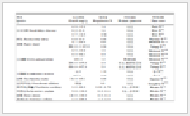
表 1 径流小区基本特征
Tab. 1 Basic information of runoff plots
小区编号
No. |
径流小区规格
Runoff plot specification |
|
种植制度
Cropping system |
|
作物覆盖度
Vegetation coverage/% |
水平投影坡长
Horizontal projected slope length/m |
水平投影宽度
Horizontal projection width/m |
小区面积
Runoff plot area/m2 |
坡度
Slope/(°) |
土壤类型
Soil type |
土层厚度
Soil thickness/cm |
2014 |
2015 |
2016 |
2017 |
2014 |
2015 |
2016 |
2017 |
| 1 |
20 |
5 |
100 |
5 |
紫色土
Purple soil |
40 |
|
玉米
Zea mays |
花生+玉米
Arachis hypogaea + Zea mays |
土豆+红薯
Solanum tuberosum + Ipomoea batatas |
油菜+黄豆
Brassica napus + Glycine max |
|
20.5 |
19.4 |
24.9 |
52 |
| 2 |
20 |
5 |
100 |
10 |
40 |
24.6 |
20.3 |
26.9 |
55 |
| 3 |
20 |
5 |
100 |
15 |
40 |
21.0 |
20.3 |
41.9 |
55 |
| 4 |
20 |
5 |
100 |
20 |
40 |
24.2 |
22.9 |
42.2 |
55 |
| 5 |
20 |
5 |
100 |
25 |
40 |
23.7 |
22.6 |
42.9 |
59 |
|
表 1 径流小区基本特征
Tab. 1 Basic information of runoff plots
|
2 材料与方法
2.1 降雨量
在径流场内设置精度0.5 mm的遥测雨量计(EL- RS)、集雨桶,全天候实时监测日降雨量、次降雨量及降雨过程,数据采集时间间隔设定为5 min。主要监测指标:降雨起止时间、降雨历时、降雨量、降雨强度等。
2.2 产流量
在降雨产流后,在没有分流的情况下,通过测量一级分流的水位高度,用水位高度乘以一级分流池内径面积计算得到径流量;产生分流时,用一级分流池的径流量+集流桶径流量×分流孔数7计算得出总的径流量。年径流量为一年中次径流量的和。主要监测指标为径流量。
|
$
R= \frac{Qt}{1 000F} 。$
|
(1) |
式中:R为径流深,mm;Q为时段t内的平均流量,m3/s;F为流域面积,km2。
|
$
α= \frac{R} {P′} 。$
|
(2) |
式中:α为径流系数;P′为降雨量,mm。
2.3 产沙量
在径流量测定结束后,采集每个小区分流池和集流池泥沙样品,产生径流后需要取样2~5瓶,每瓶1 000 mL, 待样品沉降水泥分开后,倒入滤纸过滤至干,放入烘箱烤至110 ℃,取出放入干燥器冷却,用电子天平称量得到样品含沙量,然后用平均含沙量乘以径流量就得到此次径流产生的产沙量。年产沙量为1年中产沙量的和。主要监测指标有含沙量和产沙量。
3 结果与分析
3.1 次降雨产流特征
在坡耕地关于产流的研究中,不同坡度小区在历次自然降雨产流过程中降雨量、田间管理方式、植被盖度等条件基本一致,因此,坡度是导致不同小区径流量差异的主要因素。由图 2可知,2014—2017年12次降雨产流中,径流深最大值8次出现在20°小区,3次出现在25°小区,1次出现在15°小区;径流深最小值有1次出现在10°小区,11次出现在5°小区。由此可知,径流深与坡度总体呈正相关关系。坡度从5°增大到10°,径流深增幅为66.56%~1 327.27%,增加速率较高;坡度从10°增大到20°,径流深增幅为2.55%~300.00%,增加速率逐渐减缓。由2014—2017年的12次降雨产流分析可知,最大产流坡度为20°,最小产流坡度为5°。
对比分析表 2和表 3可知,次降雨量、最大30 min降雨强度(I30)和作物覆盖度是导致同一小区径流深差异的重要因素。以整体径流深最大的20°径流小区为例,由表 3可知20°径流小区年际径流深从大到小依次为2017年(228.9 mm)>2014年(127.6 mm)>2016年(100.9 mm)>2015年(25.4 mm);20°小区径流深与降雨量和I30呈显著相关(P<0.05)(相关系数分别为0.939和0.972),即小区径流深随着降雨量和降雨强度的增大总体呈增大趋势,分析原因认为在次降雨量一定的情况下,I30越大代表单位时间内单位面积土壤降雨量越多,土壤表层结构破坏,使径流量上升,径流深增加。以作物覆盖度变化幅度最大的2016年10°小区、15°小区和20°小区为例,15°小区作物覆盖度较10°小区增加55.76%,径流深增加0.44%,20°小区作物覆盖度较15°小区增加0.72%,径流深增加174.56%,即小区径流深随着作物覆盖度的增加总体呈减小趋势。结果表明径流深受次降雨量、I30和作物覆盖度共同影响。
表 2(Tab. 2)
表 2 2014—2017年降雨特征
Tab. 2 Rainfall characteristics from 2014 to 2017
日期
Date |
最大30 min降雨强度
Maximum 30 min rainfall intensity/(mm·h-1) |
降雨量
Rainfall amount/mm |
| 2014-06-02 |
9.0 |
50.0 |
| 2014-07-12 |
9.7 |
41.5 |
| 2014-08-01 |
7.6 |
41.0 |
| 2015-06-15 |
30.6 |
64.5 |
| 2015-07-14 |
20.5 |
67.5 |
| 2015-08-05 |
49.2 |
56.3 |
| 2016-06-29 |
18.0 |
74.1 |
| 2016-07-29 |
41.3 |
28.1 |
| 2016-08-07 |
36.2 |
22.0 |
| 2017-06-27 |
50.0 |
33.5 |
| 2017-07-10 |
17.0 |
70.0 |
| 2017-08-09 |
47.9 |
69.1 |
|
表 2 2014—2017年降雨特征
Tab. 2 Rainfall characteristics from 2014 to 2017
|
表 3(Tab. 3)
表 3 不同坡度坡耕地年际产流产沙特征
Tab. 3 Interannual runoff and sediment yield of sloping farmland with different slopes
年份
Year |
小区编号
No. |
降雨量
Rainfall amount/mm |
径流深
Runoff depth/mm |
径流系数
Runoff coefficient |
产沙量
Sediment yield/(t·hm-2) |
| 2014 |
1 |
1 090.00 |
23.0 |
0.03 |
8.65 |
| 2 |
91.6 |
0.13 |
26.64 |
| 3 |
98.8 |
0.14 |
32.09 |
| 4 |
127.6 |
0.17 |
33.10 |
| 5 |
91.4 |
0.13 |
27.02 |
| 2015 |
1 |
1 207.40 |
29.7 |
0.02 |
1.74 |
| 2 |
30.5 |
0.03 |
5.97 |
| 3 |
26.0 |
0.02 |
3.14 |
| 4 |
25.4 |
0.02 |
3.73 |
| 5 |
69.1 |
0.06 |
8.58 |
| 2016 |
1 |
1 044.00 |
4.9 |
0.00 |
0.13 |
| 2 |
36.6 |
0.04 |
12.17 |
| 3 |
36.3 |
0.03 |
11.52 |
| 4 |
100.9 |
0.10 |
96.05 |
| 5 |
98.2 |
0.09 |
78.60 |
| 2017 |
1 |
1 680.20 |
38.2 |
0.02 |
1.07 |
| 2 |
187.1 |
0.11 |
23.18 |
| 3 |
157.8 |
0.09 |
22.87 |
| 4 |
228.9 |
0.14 |
25.44 |
| 5 |
185.8 |
0.11 |
22.41 |
|
表 3 不同坡度坡耕地年际产流产沙特征
Tab. 3 Interannual runoff and sediment yield of sloping farmland with different slopes
|
3.2 次降雨产沙特征
不同坡度紫色土坡耕地土壤产沙量随坡度增大呈增加趋势,但是当坡度为15°~20°时, 产沙量开始减小。由图 3可知历次产流降雨后的产沙量测验结果,在2014—2017年12次降雨产沙中,产沙量最大值4次出现在20°小区,5次出现在25°小区,1次出现在15°小区,2次出现在10°小区,产沙量最小值均出现在5°小区。产沙量随坡度增大总体呈现先增大后减小的趋势,坡度为15°~20°时,产沙量减小。分析原因认为,产沙量随坡度、径流量增大呈增加趋势,但坡度增大同时导致雨滴击溅侵蚀力的减弱,产沙量随坡度的增大而减少。在2016年6月29日次降雨过程中,产沙量随坡度增大呈直线增加趋势,主要是6月24日小区土壤受田间作物管理活动的影响,土壤结构遭到破坏,产沙量随坡度增大呈直线增加。
土壤流失量表现出与径流深相似变化规律,与次降雨量及I30呈显著正相关,与作物覆盖度呈负相关。以整体土壤流失量最大的20°径流小区为例,20°径流小区土壤流失量与降雨量和I30呈显著相关(P<0.05)(相关系数分别为0.486和0.792),即小区土壤流失量随降雨量和降雨强度的增加呈增大趋势,而土壤流失量与降雨历时相关性不大。分析原因认为降雨量和I30的增加不仅意味着坡面地表径流的增大,同时加强了径流运移泥沙的能力,进而导致土壤流失量的增加。以2016年10°小区、15°小区和20°小区为例,15°小区土壤流失量较10°小区增加30.99%,20°小区土壤流失量较15°小区增加131.62%,即小区土壤流失量随着作物覆盖度的增加总体呈减小趋势。分析原因认为,种植制度通过加强对降雨截留、减缓径流和提高入渗等多种途径有效降低坡耕地径流量和土壤流失量。
3.3 产流产沙年际变化特征
年际径流深随坡度增大总体呈现增加趋势,并且增幅减缓。除2015年外,同一年内小区径流深在20°时达到最大值。从表 3可看出,2014—2017年降雨量为1 044.00~1 680.20 mm,除2015年径流深较小外,其余年份各小区径流深随年降雨量的增加总体呈现增加趋势。坡度对坡面产流量的影响很大程度上受降雨量的制约,即相同坡度条件下,年内降雨量越大,径流深越大;相同次降雨条件下,随着坡度的增大,径流深总体呈上升趋势。2015年降雨量均大于2014和2016年,而其整体径流深都低于2014和2016年,分析原因认为2015年各小区径流深差异相对较小,与该年度耕作活动较其他年度少,从而地表扰动减少,削弱了坡度对小区径流深的影响有关。
产沙量受坡度和降雨量共同影响,随坡度增大总体呈增大趋势,并且增幅随坡度增大而减缓,表现出与径流深相似的变化规律。2014—2017年产沙量分布在0.13~96.05 t/hm2之间,除2015年产沙量较小外,其余年份各径流小区产沙量随年降雨量和坡度的增大总体呈增大趋势(表 3)。2015年降雨量均大于2014年和2016年,而其产沙量低于2014年、2016年,分析原因认为2015年小区耕种较少,地表扰动较少,从而减少了产沙量。
4 结论与讨论
1) 紫色土坡耕地次降雨径流深与坡度总体呈正相关关系。坡度从5°增加到10°,径流深增加速率较高;从10°增加到20°,径流深增加速率逐渐减缓;由2014—2017年的12次降雨产流结果表明最大产流坡度主要为20°,最小产流坡度主要为5°,与魏小燕等[5]研究结果一致。
2) 紫色土坡耕地产沙量随坡度增大总体呈先增大后减小趋势,最小产沙坡度主要为5°,最大产沙坡度主要为20°,当坡度达到20°时,产沙量开始减小,与温永福等[7]研究结果不一致。分析原因认为,产沙量随坡度、径流量增大呈增加趋势,但坡度超过20°时,坡度增大同时导致雨滴击溅侵蚀力的减弱,产沙量随坡度的增大而减少。
3) 紫色土坡耕地年际径流深随坡度增加总体呈现增大趋势,径流深增加速率随坡度的增加而减缓。除2015年各小区径流深差异相对较小,与该年度耕作活动较年少,地表扰动减少,从而径流深和土壤流失量均较小外,其余年份各小区径流深和土壤流失量随年降雨量的增大总体呈现增大趋势,与郑江坤等[10]研究结果一致。
4) 作物覆盖度是影响紫色土坡耕地产流产沙量的主要因素。合理的种植制度可提高坡耕地作物覆盖度、增强农作物根系固土能力,通过加强对降雨截留、减缓径流和提高入渗等多种途径有效降低坡耕地径流量和产沙量。
本研究在实验设计中未设置重复对照组和未设置相同坡度下不同种植制度的径流小区以研究种植制度对紫色土坡耕地产流产沙过程的影响,拟在后续研究中解决。研究结果可为紫色土坡耕地水土保持效应评价、耕作管理措施布设,小流域水土保持提供科学参考。
5 参考文献
| [1] | |
| [2] |
鲍玉海, 丛佩娟, 冯伟, 等. 西南紫色土区水土流失综合治理技术体系[J]. 水土保持通报, 2018, 38(3): 143. BAO Yuhai, CONG Peijuan, FENG Wei, et al. Comprehensive management system of soil and water loss in purple soil area of southwestern China[J]. Bulletin of Soil and Water Conservation, 2018, 38(3): 143. |
| [3] |
KOMATSU Yoshitaka, KATO Hiroaki, ZHU Bo, et al. Effects of slope gradient on runoff from bare-fallow purple soil in China under natural rainfall conditions[J]. Journal of Mountain Science, 2018, 15(4): 738. DOI:10.1007/s11629-017-4714-3 |
| [4] |
QIAN Feng, DONG Linyao, LIU Jigen, et al. Equations for predicting interrill erosion on steep slopes in the Three Gorges Reservoir, China[J]. Journal of Hydrology and Hydromechanics, 2020, 68(1): 59. |
| [5] | |
| [6] |
杨建霞, 雷孝章, 邱景, 等. 5°~25°坡耕地径流小区产流产沙规律[J]. 中国水土保持科学, 2008, 6(S1): 30. YANG Jianxia, LEI Xiaozhang, QIU Jing, et al. Law of water loss and soil erosion in the 5°-25° sloping field[J]. Science of Soil and Water Conservation, 2008, 6(S1): 30. |
| [7] |
温永福, 高鹏, 穆兴民, 等. 野外模拟降雨条件下径流小区产流产沙试验研究[J]. 水土保持研究, 2018, 25(1): 23. WEN Yongfu, GAO Peng, MU Xingmin, et al. Experimental study on runoff and sediment yield in runoff plot under field simulated rainfall condition[J]. Research of Soiland Water Conservation, 2018, 25(1): 23. |
| [8] |
MANDAL D, CHANDRAKALA M, ALAM N M, et al. Assessment of soil quality and productivity in different phases of soil erosion with the focus on land degradation neutrality in tropical humid region of India[J]. Catena, 2021, 204(8): 105440. |
| [9] |
赵龙山, 侯瑞, 吴发启, 等. 坡度对农业耕作措施水土保持作用的影响[J]. 水土保持学报, 2017, 31(3): 69. ZHAO Longshan, HOU Rui, WU Faqi, et al. Effects of slope gradient on soil and water conservation benefit of tillage practices in agricultural lands[J]. Journal of Soil and Water Conservation, 2017, 31(3): 69. |
| [10] |
郑江坤, 杨帆, 王文武, 等. 不同降雨等级下耕作措施对坡地产流产沙的影响[J]. 中国水土保持科学, 2018, 16(1): 38. ZHENG Jiangkun, YANG Fan, WANG Wenwu, et al. Effects of tillage measures on runoff and sediment yield of farmland under different rainfall levels[J]. Science of Soil and Water Conservation, 2018, 16(1): 38. |
| [11] |
曾凤铃, 刘淑婧, 运剑苇, 等. 模拟降雨条件下三峡库区紫色土坡地产流入渗特征[J]. 中国水土保持科学, 2022, 20(1): 107. ZENG Fengling, LIU Shujing, YUN Jianwei, et al. Runoff and infiltration characteristics of purple soil slope in the Three Gorges Reservoir region under simulated rainfall[J]. Science of Soil and Water Conservation, 2022, 20(1): 107. |
| [12] |
韩旭, 田培, 黄建武, 等. 基于2009—2018年径流小区观测数据的武汉市土壤侵蚀因子定量评价[J]. 生态学报, 2021, 41(10): 3878. HAN Xu, TIAN Pei, HUANG Jianwu, et al. Quantitative evaluation of soil erosion factors in Wuhan based on observationdata of runoff plots during 2009—2018[J]. Acta Ecologica Sinica, 2021, 41(10): 3878. |
| [13] |
陈炳, 王苗, 姚会恩, 等. 汤峪河流域径流小区水土保持监测点2017—2019年监测结果分析[J]. 中国水土保持, 2021(5): 55. CHEN Bing, WANG Miao, YAO Hui'en, et al. Monitoring results of soil and water conservation monitoring sites in runoff plots of Tangyu River watershed from 2017 to 2019[J]. Soil and Water Conservation in China, 2021(5): 55. |
| [14] |
DAI Jiadong, ZHANG Jianhui, ZHANG Zehong, et al. Effects of water discharge rate and slope gradient on runoff and sediment yield related to tillage erosion[J]. Archives of Agronomy and Soil Science, 2020, 67(6): 849. |
| [15] |
LIU Yuxin, XIN Yan, XIE Yun, et al. Effects of slope and rainfall intensity on runoff and soil erosion from furrow diking under simulated rainfall[J]. Catena, 2019, 177: 92. |
| [16] | |
| [17] |
侯宁, 王勇, 赵虎, 等. 耕作侵蚀对不同坡度下紫色土侵蚀产沙的影响[J]. 山地学报, 2021, 39(4): 49. HOU Ning, WANG Yong, ZHAO Hu, et al. Effects of tillage erosion on sediment yield of purple soil under different slopes[J]. Mountain Research, 2021, 39(4): 49. |
 2022, Vol. 20

