文章快速检索     高级检索
  中国水土保持科学   2022, Vol. 20 Issue (3): 126-134.  DOI: 10.16843/j.sswc.2022.03.016
0

引用本文 

黑杰, 李先德, 刘吉龙, 王亚非, 胥佳忆, 阳祥, 尹晓雷, 王维奇, 张永勋. 轮作模式对农田土壤团聚体及碳氮含量的影响[J]. 中国水土保持科学, 2022, 20(3): 126-134. DOI: 10.16843/j.sswc.2022.03.016.
HEI Jie, LI Xiande, LIU Jilong, WANG Yafei, XU Jiayi, YANG Xiang, YIN Xiaolei, WANG Weiqi, ZHANG Yongxun. Effects of crop rotation patterns on the soil aggregates and carbon and nitrogen content in farmland[J]. Science of Soil and Water Conservation, 2022, 20(3): 126-134. DOI: 10.16843/j.sswc.2022.03.016.

项目名称

全球重要农业文化遗产项目“安徽铜陵姜-稻轮作系统”(DH-1612)

第一作者简介

黑杰(1996—),男,硕士研究生。主要研究方向:生态与环境。E-mail: hj15377185569@163.com

通信作者简介

王维奇(1982—),男,博士,研究员。主要研究方向:生态与环境。E-mail: wangweiqi15@163.com

文章历史

收稿日期:2021-04-01
修回日期:2022-01-22
轮作模式对农田土壤团聚体及碳氮含量的影响
黑杰 1, 李先德 2, 刘吉龙 2, 王亚非 1, 胥佳忆 1, 阳祥 1, 尹晓雷 1, 王维奇 1,3, 张永勋 2     
1. 福建师范大学地理科学学院, 350007, 福州;
2. 中国农业科学院农业经济与发展研究所, 100081, 北京;
3. 福建师范大学 湿润亚热带生态-地理过程教育部重点实验室, 350007, 福州
摘要:土壤碳(C)和氮(N)含量在农田作物养分利用和循环中起着关键作用。土壤团聚体的C、N含量和稳定性是表征土壤结构、退化和稳定性的重要指标。姜-稻轮作和姜-菜轮作为水旱轮作和旱地轮作,具有不同的C、N保护机制。为探究不同轮作模式下农田土壤团聚体分布规律、稳定性和C、N含量的变化特征,寻求最优的轮作模式,以安徽省铜陵市姜-菜轮作和姜-稻轮作模式下的农田为研究对象,采集0~20 cm深度的土壤样品,测定不同粒级土壤团聚体的质量分数,并使用单因素方差分析土壤团聚体及C、N含量的差异性。通过土壤团聚体稳定性指标平均质量直径(MWD)、几何平均直径(GMD)、大团聚体含量(DR0.25)和分形维数(D)来衡量土壤团聚体的稳定,并使用皮尔逊相关系数分析土壤团聚体和团聚体C、N与土壤稳定性指标的关系。结果表明:1)姜-菜轮作下姜季>0.053~0.25 mm微团聚体质量分数比菜季显著增加53%(P < 0.05),姜-稻轮作下姜季≤0.053 mm微团聚体质量分数比稻季显著降低39%(P < 0.05),>0.25~1.00 mm大团聚体质量分数比稻季显著增加约2倍(P < 0.05);2)与姜-稻轮作相比,姜-菜轮作分别显著降低姜季≤0.053 mm微团聚体C、N质量分数32%与33%(P < 0.05),>1.00 mm大团聚体C、N含量分别显著降低39%与33%(P < 0.05);3)姜-稻轮作下姜季>1.00 mm大团聚体C的贡献率显著高于姜-菜轮作24%(P < 0.05),>0.25~1.00 mm大团聚体C、N贡献率分别显著低于姜-菜轮作32%与25%(P < 0.05);4)GMD和DR0.25均与>0.25~1.00 mm大团聚体质量分数显著正相关(P < 0.01),MWD与>1.00 mm大团聚体含量显著正相关(P < 0.01),MWD、GMD、DR0.25均与>0.25 mm大团聚体C、N显著正相关(P < 0.05)。相对于姜-菜轮作下的旱地轮作,水旱轮作下的姜-稻轮作模式可以持续改善土壤团聚体稳定性和维持高效的土壤C、N的养分利用,是实现铜陵市水土保持与养分协调利用的最优轮作模式,有利于维系白姜的可持续生产。
关键词土壤团聚体    团聚体稳定性    轮作模式    农田    
Effects of crop rotation patterns on the soil aggregates and carbon and nitrogen content in farmland
HEI Jie 1, LI Xiande 2, LIU Jilong 2, WANG Yafei 1, XU Jiayi 1, YANG Xiang 1, YIN Xiaolei 1, WANG Weiqi 1,3, ZHANG Yongxun 2     
1. School of Geographical Science, Fujian Normal University, 350007, Fuzhou, China;
2. Institute of Agricultural Economics and Development, Chinese Academy of Agricultural Sciences, 100081, Beijing, China;
3. Key Laboratory of Humid Sub-tropical Eco-geographical Process of Ministry of Education, Fujian Normal University, 350007, Fuzhou, China
Abstract: [Background] Soil carbon (C) and nitrogen (N) content plays a key role in nutrient utilization and cycling of farmland crops. The carbon and nitrogen content and stability of soil aggregates are important indicators to characterize soil structure, degradation and stability. Ginger-rice rotation and ginger-vegetable rotation are different patterns of paddy and dry land rotation, which have different carbon and nitrogen protection mechanisms. This work aims to explore the distribution patterns, stability and variation characteristics of C and N content of farmland soil aggregates under different rotation patterns, and to select the optimal rotation pattern. [Methods] In this study, the farmland under the ginger-vegetable and ginger-rice rotation patterns was used as the research object of Tongling city, Anhui province, and soil samples with a depth of 0-20 cm were collected. The contents of soil aggregates with different particle sizes were measured, and the differences of soil aggregates and C and N contents were analyzed by ANOVA. The qualitative characteristics of soil aggregate stability were measured by the soil aggregate stability index mean weight diameter (MWD), geometric mean diameter (GMD), > 0.25 mm diameter aggregate (DR0.25) and fractal dimension (D), and the relationship between soil aggregate, aggregate carbon and nitrogen and soil stability index was analyzed by Person correlation. [Results] 1) The content of >0.053-0.25 mm microaggregates in the ginger season under the ginger-vegetable rotation increased by 53% compared with that in the vegetable season (P < 0.05). Under ginger-rice rotation, the content of microaggregates≤0.053 mm in the ginger season was 39% lower than that in the rice season (P < 0.05), while the content of large aggregates >0.25-1.00 mm was about twice higher than that in the rice season (P < 0.05). 2) Compared with the ginger-rice rotation, the ginger-vegetable rotation significantly reduced the C and N content of ≤0.053 mm microaggregates in the ginger season by 32% and 33% (P < 0.05), and the C and N content of the large aggregates >1.00 mm significantly reduced, respectively, in 39% and 33% (P < 0.05). 3) Under the ginger-rice rotation, the contribution rate of ginger >1.00 mm large aggregate C was significantly higher than that of ginger-vegetable rotation by 24% (P < 0.05), and the contribution rate of >0.25-1.00 mm large aggregate C and N was significantly lower than that of ginger-vegetable rotation 32% and 25% (P < 0.05). 4) GMD and DR0.25 was significantly positively correlated with the content of >0.25-1.00 mm large aggregate (P < 0.01). MWD was positively correlated with the content of >1.00 mm aggregates, respectively (P < 0.01). MWD, GMD, and DR0.25 were all significantly positively correlated with the C and N of larger aggregates >0.25 mm (P < 0.05). [Conclusions] Compared with the dry land rotation under the ginger-vegetable rotation, the ginger-rice rotation pattern under the paddy dry rotation can continuously improve the stability of soil aggregates and maintain the efficient utilization of soil C and N nutrients. It is the optimal rotation pattern to realize the coordinated utilization of soil and water conservation and nutrients in Tongling city, which is conducive to the sustainable production of white ginger.
Keywords: soil aggregates    aggregate stability    crop rotation pattern    farmland    

土壤团聚体是植物与微生物共同衍生的矿物颗粒物,是土壤最基本的组成单元[1]。土壤团聚体具有保持水、肥、气、热,调节土壤酶种类和保持土壤疏松的作用[2],对于提高农业产量和保护土壤碳(C)、氮(N)具有重要意义。不同粒级团聚体在土壤C、N固持中扮演着不同的角色,>0.25 mm大团聚体富含更多的C、N[3],而 < 0.25 mm微团聚体更利于维持土壤结构的稳定性[4];因此,探讨不同粒级土壤团聚体与C、N循环的关系有助于科学管理和调控土壤团聚体结构的稳定性。

轮作通过不同的水肥管理、底物添加等措施调节土壤团聚体稳定性、养分含量及利用效率,被认为是改良土壤结构和保持肥力的重要举措[5]。目前,国内外关于轮作模式与土壤团聚体与C、N分布的研究主要包括常规性耕种与保护性耕作[6]、小麦-豆类连续轮作[7]、烟-稻轮作等[8]。稻田与旱地土壤C、N的周转、稳定机制和环境条件都深受农业管理系统的影响,表现出矿化速率、营养利用率、氧化还原过程与微生物活性方面的差异性[9]。目前水旱轮作与旱地轮作下C、N养分与团聚体异同的比较研究相对较少。通过对水旱与旱地轮作C、N周转与稳定性特征的研究,可从不同轮作模式角度下揭示土壤养分与稳定性的变化特征,为科学评估铜陵市农田养分固持,土壤结构稳定及其对水土保持功能的影响提供理论支撑。

安徽省铜陵市的白姜种植历史悠久,是中国重要农业文化遗产。目前,安徽铜陵的姜-稻轮作和姜-菜轮作模式正积极申报全球重要农业文化遗产,筛选出更为合理的轮作模式,可为白姜(Zingiber officinale)可持续生产提供理论和实践的支撑。探究姜-稻和姜-菜轮作模式下农田土壤团聚体及C、N特征,对以白姜为核心要素的农业文化遗产保护与发展具有重要意义。

1 研究区概况

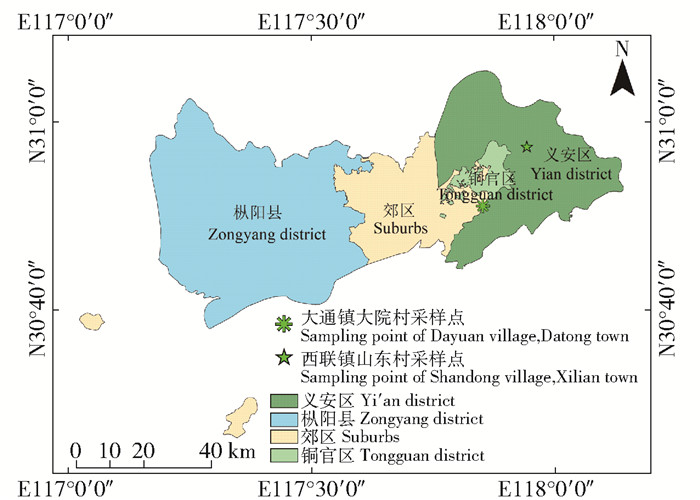
安徽省铜陵市位于长江中下游(E 117°42′~118°10′、N 30°45′~31°07′),属北亚热带湿润季风气候,年均气温16.4 ℃,年均日照时间为2 025 h,年日照率为43%,年均降水量1 360.3 mm[10]。采样点土壤类型以水稻土和红壤为主,轮作模式为姜-菜轮作和姜-稻轮作,试验地已经历经5次轮作。姜-菜轮作研究样点位于安徽省铜陵市郊区大通镇大院村(图 1),为秋葵-白姜轮作模式,每2~3年轮作换茬1次。菜季施肥措施为复合肥100 kg/亩(N∶P∶K为18∶18∶18,1 hm2=15亩)、有机肥250 kg/亩(100 kg饼肥、150 kg商品有机肥);姜季施肥措施为复合肥150 kg/亩(N∶P∶K为18∶18∶18)、有机肥375 kg/亩(150 kg饼肥、225 kg商品有机肥)。姜-稻轮作研究样点位于安徽省铜陵市义安区西联镇山东村(图 1),为水稻-白姜,每2~3年轮作换茬1次。稻季施肥措施为复合肥50 kg/亩(N∶P∶K为16∶16∶16);姜季施肥措施为复合肥30 kg/亩(N∶P∶K为16∶16∶16)、有机肥325 kg/亩(饼肥)。2个采样点都以平原为主,地貌类型相似,为探究姜-稻和姜-菜轮作下土壤团聚体及C、N特征提供理想的试验地。

图 1 研究区地理位置 Fig. 1 Geographical location of the study area
2 材料与方法 2.1 样品采集

2020年8月,用采土器分别采集姜-菜轮作和姜-稻轮作样地0~20 cm深度的土壤样品,每种处理采集5个重复,部分样品4 ℃冷藏保存,另一部分样品挑出根系和植物残体等杂质后,等自然风干后,过100目筛后待用。

2.2 测定方法

土壤团聚体含量通过湿筛法测定[11],土壤有机质(soil orangic matter,SOM)含量通过土壤有机碳含量转换[12],土壤大团聚体含量(lavge aggregate content,DR0.25)与土壤团聚体稳定性指标平均质量直径(mean weight diametter,MWD)和几何平均直径(gerometric mean diametter,GMD)参照罗晓虹等[13]的方法计算得出,分形维数(fractal dimension,D)与团聚体贡献率分别参照杨培岭等[14]和邱莉萍等[15]的方法计算得出,土壤C、N采用土壤碳氮元素分析仪(Elemental Analyzer Vario EL Ⅲ,Germany)测定,土壤密度和含水量分别采用环刀法和烘干法测定[16],土壤pH采用pH计(STARTER 300,USA)测定,水土质量比为2.5∶1,土壤电导率采用电导仪(2265FS,USA)测定。

3 结果和分析 3.1 土壤理化性质的特征

姜-稻轮作下姜季土壤密度比稻季下降17%(P < 0.05),土壤含水量比稻季下降36%(P < 0.05)。姜-菜轮作下姜季土壤含水量比菜季增加37%(P < 0.05),土壤电导率比稻季增加94%(P < 0.05);姜-稻轮作下姜季SOM比菜季降低18%(P < 0.05)。从2种轮作模式对比来看,姜-稻轮作下姜季土壤电导率和SOM比姜-菜轮作增加75%、12%(P < 0.05)[17]

3.2 土壤团聚体分布特征

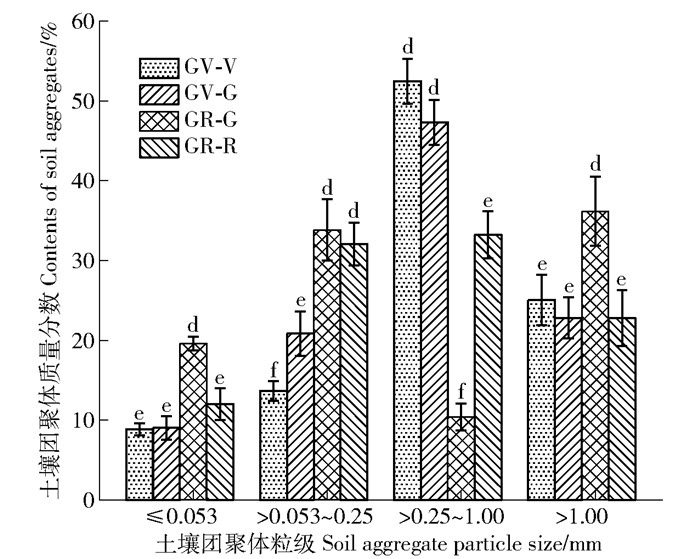
姜-菜轮作下姜季>0.053~0.25 mm微团聚体质量分数比菜季增加53%(P < 0.05)。姜-稻轮作下姜季≤0.053 mm微团聚体质量分数比稻季降低39%(P < 0.05),而>0.25~1.00 mm大团聚体质量分数比稻季增加约2倍(P < 0.05),>1.00 mm大团聚体质量分数比稻季降低37%(P < 0.05)(图 2)。

同一粒级下不同字母表示差异性显著(P < 0.05)。GV-V为姜-菜轮作下的菜季;GV-G为姜菜-轮作下的姜季;GR-R为姜-稻轮作下的稻季;GR-G为姜-稻轮作下的姜季。下同。 Different letters in the same grain size indicate significant differences (P < 0.05). GV-V is the vegetable season under the ginger-vegetable rotation; GV-G is the ginger season under the ginger-vegetable rotation; GR-R is the rice season under the ginger-rice rotation; and GR-G is the ginger season under the ginger-rice rotation. The same as below. 图 2 不同轮作模式土壤团聚体质量分数 Fig. 2 Percentage of soil aggregate content in different rotation patterns
3.3 土壤团聚体稳定性特征

表 1所示,姜-菜轮作下姜季土壤MWD、GMD、DR0.25D比菜季差异均不显著(P>0.05)。姜-稻轮作下姜季MWD、GMD和DR0.25比稻季差异均不显著(P>0.05),但D比稻季降低19%(P < 0.05)。

表 1 土壤团聚体稳定性指标 Tab. 1 Stability indexes of soil aggregate
3.4 土壤团聚体粒级与稳定性的关系

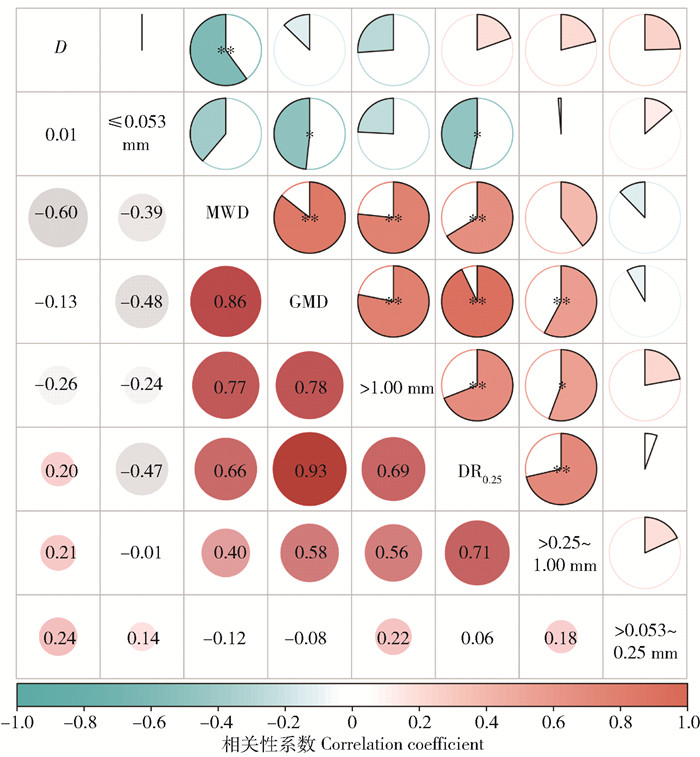
图 3所示,土壤稳定性参数MWD、GMD、DR0.25之间均显著正相关(P < 0.01),D与MWD显著负相关(P < 0.01)。GMD和DR0.25均与>0.25~1.00 mm大团聚体显著正相关(P < 0.01)。MWD与>1.00 mm大团聚体显著正相关(P < 0.01)。

*和**分别表示在0.05和0.01水平上显著差异。下同。 * and ** indicate significant differences at the levels of 0.05 and 0.01, respectively. The same below. 图 3 土壤稳定性指标与各粒级团聚体质量分数相关性分析 Fig. 3 Correlation analysis of soil stability index and aggregate content of each particle size
3.5 不同粒级土壤团聚体C、N含量特征

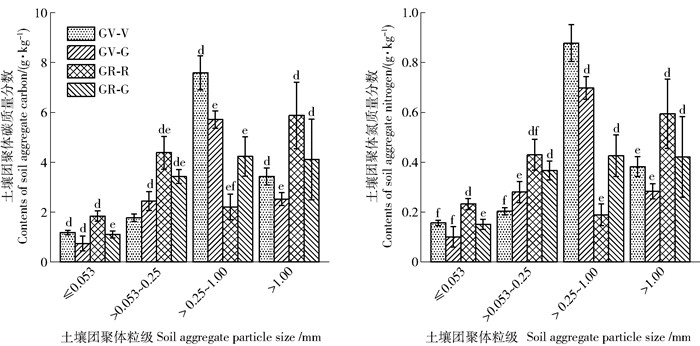
图 4所示,2种轮作均表现为>0.25 mm大团聚体C、N质量分数较高,≤0.25 mm微团聚体质量分数较低。姜-菜轮作下>0.25~1.00 mm大团聚体C质量分数比菜季降低25%(P < 0.05)。姜-稻轮作下姜季>0.25~1.00 mm大团聚体C、N质量分数比稻季分别增加91%与107%(P < 0.05)。从2种轮作模式比较来看,姜-菜轮作下姜季≤0.053 mm微团聚体C、N质量分数分别低于姜-稻轮作32%与33%(P < 0.05),>1.00 mm团聚体C、N质量分数分别低于姜-稻轮作39%与33%(P < 0.05)。

图 4 不同轮作模式土壤团聚体C、N质量分数的变化 Fig. 4 Changes of C and N contents in soil aggregates in different rotation patterns
3.6 不同粒级土壤团聚体C、N累积的变化特征

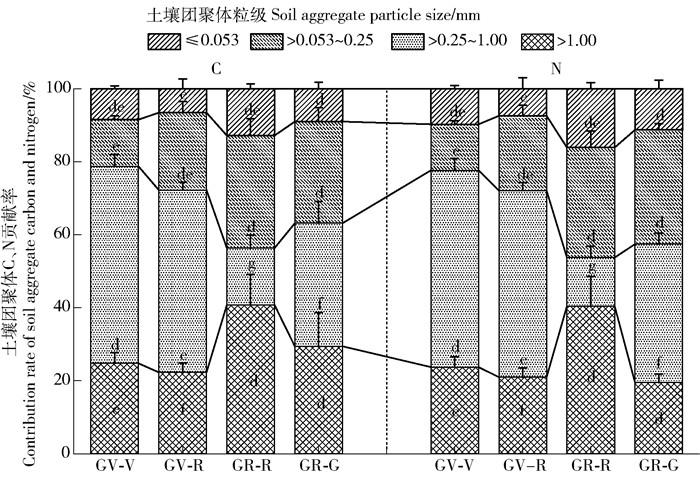
图 5所示,2种轮作模式都以>0.25 mm粒级大团聚体对于土壤C、N贡献率高,≤0.25 mm微团聚体贡献率较低。姜-菜轮下姜季大团聚体中>1.00 mm团聚体C、N贡献率分别比菜季降低10%与11%(P < 0.05);>0.25~1.00 mm大团聚体C、N贡献率分别比菜季降低7%与5%(P < 0.05)。姜-稻轮作下姜季>0.25~1.00 mm大团聚体C、N贡献率分别比稻季增加54%与65%(P < 0.05)。2种轮作对比下,姜-稻轮作下姜季>1.00 mm土壤团聚体C贡献率高于姜-菜轮作24%(P < 0.05),>0.25~1.00 mm团聚体C、N贡献率分别低于姜-菜轮作32%与25%(P < 0.05)。

图 5 不同粒级土壤团聚体C、N累计贡献率 Fig. 5 Cumulative contribution rate of carbon and nitrogen in the soil aggregates of different particle sizes
3.7 土壤碳、氮含量与团聚体组成和稳定性的关系

图 6所示,MWD与>1.00 mm大团聚体C、N质量分数显著正相关(P < 0.05, P < 0.01)。GMD与>0.25~1.00 mm大团聚体C、N质量分数显著正相关(P < 0.05, P < 0.01)。DR0.25与>0.25~1.00 mm大团聚体的C、N质量分数显著正相关(P < 0.01)。D与>0.25~1.00 mm大团聚体C、N质量分数显著正相关(P < 0.01)。

C和N代表碳和氮。C1、C2、C3、C4分别为>1.00 mm、>0.25~1.00 mm、>0.053~0.25 mm、≤0.053 mm粒级土壤团聚体C质量分数;N1、N2、N3、N4分别为>1.00 mm、>0.25~1.00 mm、>0.053~0.25 mm、≤0.053 mm粒级土壤团聚体N质量分数。 C and N represent carbon and nitrogen. C1, C2, C3, and C4 refers to the carbon content of soil aggregates of >1.00 mm, >0.25-1.00 mm, >0.053-0.25 mm, and ≤0.053 mm, respectively. N1, N2, N3, and N4 indicates the nitrogen content of particle size soil aggregate at >1.00 mm, >0.25-1.00 mm, >0.053-0.25 mm, ≤0.053 mm, respectively. 图 6 土壤团聚体C、N质量分数与稳定性性指数相关性分析 Fig. 6 Correlation analysis of soil aggregate C, N content and stability index
4 讨论 4.1 对土壤团聚体分布的影响

土壤团聚体是表征土壤结构和肥力的主要指标,深刻影响土壤的物理和化学性质。其粒级变化受农田管理模式、土壤质地、土壤养分、土壤微生物的影响[18]。DR0.25可以用来反映土壤大团聚体变化状况,姜-菜轮作下姜季土壤DR0.25呈现下降趋势,主要因同处于旱作管理模式,轮作会造成大团聚体的破碎,并向微团聚体转化[19]。姜-稻轮作下姜季土壤DR0.25呈现增加趋势,说明姜-稻轮作强化姜季土壤团聚体的形成与积聚,笔者发现,姜-稻轮作下姜季土壤团聚体的增加以>0.25~1.00 mm粒级为主,说明姜-稻轮作模式改善土壤团聚体结构是渐变的过程,且DR0.25仅与>0.25~1.00 mm粒级大团聚体的正相关关系。

4.2 对土壤团聚体稳定性的影响

MWD、GMD和D表示土壤团聚体结构稳定性的重要指标,其与土壤团聚体积聚能力和稳定性程度呈正相关,而D值越小表示团聚体团聚效果和稳定性越强[18]。姜-菜轮作下姜季的DR0.25、MWD和GMD均降低,D显著增加,表明土壤团聚体稳定性和团聚效果在下降,主要因生姜播种前需要翻耕细耙,会对表层土壤团聚体进行干扰和破坏[20]。姜-稻轮作下姜季的GMD和DR0.25增加,这表明姜-稻轮作土壤团聚体的稳定性增强,主要原因是:在干湿交替模式下土壤水分的变化会影响土壤理化性质和土壤结构,提高微生物的活性与数量,加速有机质的分解[21]。特别是在轮作下的旱季,干燥环境会促使原来在水中的悬浮物质与可溶性物质之间的螯合,促进土壤团聚体的形成[22]。此外,姜-稻轮作属于水旱交替作用下的耕作地,稻季长期处于厌氧的淹水环境下,微生物分解过程缓慢,进而使得腐殖质与有机质得以保留[9],这为姜季提供更多的有机物质,并在微生物的作用下促进姜季大团聚体的形成。

4.3 对土壤C、N含量的影响

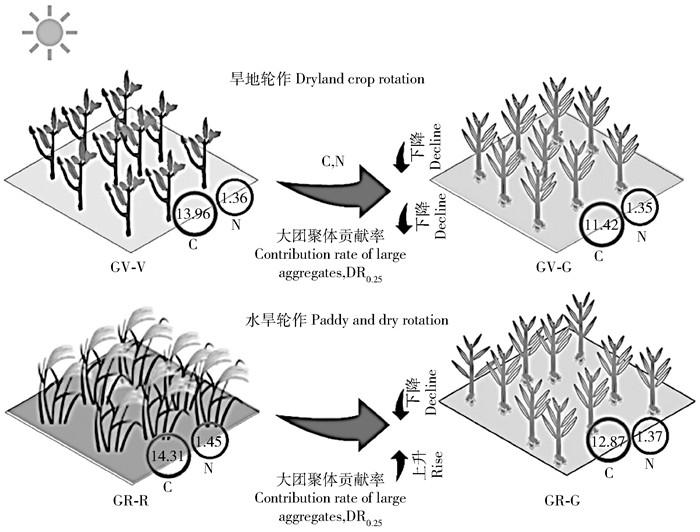
笔者发现,姜-菜轮作和姜-稻轮作下姜季土壤C、N的含量均低于菜季和稻季,可能与轮作年限和作物类型有关(图 7)。相关研究表明轮作对土壤有机物和C、N含量的增加可能由于轮作年限和作物类型在初期表现的不明显,但经过一定的年限这种情况会有所改善[23];另外,轮作模式下姜季对土壤肥力需求量大,加上翻耕土壤造成表层C、N含量的损失,导致姜季土壤C、N含量偏低[20]。但轮作模式是基于生态学原理,根据作物对养分需求的差异,以及根系分布层次的不同,进行因地制宜的施肥和补肥,有利于土壤结构的稳定。作物类型和根系的不同,会影响微生物种类和数量,有利于维持土壤养分含量和微生物群落的多样性[24]。此外,姜-稻轮作下姜季C、N含量较姜-菜轮作高,表明姜-稻轮作固存C、N含量的能力较姜-菜轮作更好,这与水稻和白姜生长阶段的管理模式相关。相对于水稻田的秸秆还田,菜地植物残体还地程度相对较低,进而使姜-菜轮作土壤肥力低于姜-稻轮作。此外,与旱地土壤相比,稻田土壤微生物周转速率慢、厌氧环境和铁锰氧化物的氧化还原都会减缓微生物的分解,稳定土壤C、N含量的累积[9]。金雯晖等[5]也得出相似的结论,认为水旱轮作相对于旱地轮作固C、N含量的效果更好。综上,基于C、N等养分利用和固持的视角,姜-稻轮作是更为合理的模式。

图 7 不同轮作模式土壤养分与团聚体变化概念模型图 Fig. 7 Conceptual model diagram of changes in soil nutrients and aggregates in different crop rotation patterns
5 结论

通过水旱与旱地轮作模式异同的比较,姜-菜轮作下姜季微团聚体含量增加显著(P < 0.05);姜-稻轮作下姜季>0.25~1.00 mm粒级大团聚体含量显著增加约2倍(P < 0.05)。姜-稻轮作下姜季比姜-菜轮作土C、N含量高。2种轮作均表明>0.25 mm粒级大团聚体具有更多的C、N。并且>0.25 mm粒级大团聚体C、N含量均与GMD、MWD和DR0.25显著正相关(P < 0.05),说明大团聚体对于保持土壤养分含量和维系白姜可持续生产更具有实践指导意义。特别是水旱轮作模式下的姜-稻轮作,其土壤肥力与结构稳定性的保护效果更优于姜-菜轮作,是铜陵市白姜可持续发展中可选择的轮作模式。

6 参考文献
[1]
TISDALL J M, OADES J M. Organic matter and water-stable aggregates in soils[J]. European Journal of Soil Science, 1982, 33(2): 141. DOI:10.1111/j.1365-2389.1982.tb01755.x
[2]
王清奎, 汪思龙. 土壤团聚体形成与稳定机制及影响因素[J]. 土壤通报, 2005, 36(3): 415.
WANG Qingkui, WANG Silong. The formation and stabilization mechanism and influencing factors of soil aggregates[J]. Soil Bulletin, 2005, 36(3): 415.
[3]
SIX J, BOSSUYT H, DEGRYZE S, et al. A history of research on the link between (micro) aggregates, soil biota, and soil organic matter dynamics[J]. Soil and Tillage Research, 2004, 79(1): 7. DOI:10.1016/j.still.2004.03.008
[4]
ANGERS D A, RECOUS S, AITA C. Fate of carbon and nitrogen in water-stable aggregates during decomposition of 13C15N-labelled wheat straw in situ[J]. European Journal of Soil Science, 1997, 48(2): 295. DOI:10.1111/j.1365-2389.1997.tb00549.x
[5]
金雯晖, 杨劲松, 侯晓静, 等. 轮作模式对滩涂土壤碳及团聚体的影响[J]. 土壤, 2016, 48(6): 1195.
JIN Wenhui, YANG Jinsong, HOU Xiaojing, et al. Effects of crop rotation patterns on soil organic carbon and aggregates in tidal flats[J]. Soils, 2016, 48(6): 1195.
[6]
GAO Lili, BECKER E, LIANG Guopeng, et al. Effect of different tillage systems on aggregate structure and inner distribution of organic carbon[J]. Geoderma, 2017, 288: 97. DOI:10.1016/j.geoderma.2016.11.005
[7]
RABBI S M F, TIGHE M, COWIE A, et al. The relationships between land uses, soil management practices, and soil carbon fractions in South Eastern Australia[J]. Agriculture, Ecosystems & Environment, 2014, 197: 41.
[8]
刘勇军, 彭曙光, 肖艳松, 等. 湖南烟稻轮作区土壤团聚体稳定性及其与碳氮比的关系[J]. 中国烟草学报, 2020, 26(1): 75.
LIU Yongjun, PENG Shuguang, XIAO Yansong, et al. Soil aggregate stability and its relationship with carbon-nitrogen ratio in tobacco-rice rotation area in Hunan[J]. Acta Tobacco Sinica, 2020, 26(1): 75.
[9]
WEI Liang, GE Tida, ZHU Zhenke, et al. Comparing carbon and nitrogen stocks in paddy and upland soils: Accumulation, stabilization mechanisms, and environmental drivers[J]. Geoderma, 2021, 398: 115121. DOI:10.1016/j.geoderma.2021.115121
[10]
李鹏飞, 周晓飞, 张庆国, 等. 铜陵市近49年气温变化特征及其趋势分析[J]. 安徽农业大学学报, 2010, 37(2): 346.
LI Pengfei, ZHOU Xiaofei, ZHANG Qingguo, et al. Characteristics and trend analysis of temperature change in Tongling city in recent 49 years[J]. Journal of Anhui Agricultural University, 2010, 37(2): 346.
[11]
KONG A Y Y, SIX J, BRYANT D C, et al. The relationship between carbon input, aggregation, and soil organic carbon stabilization in sustainable cropping systems[J]. Soil Science Society of America Journal, 2005, 69(4): 1078. DOI:10.2136/sssaj2004.0215
[12]
JIN Q, PEÑUELAS J, SARDANS J, et al. Changes in soil carbon, nitrogen, and phosphorus contents, storages, and stoichiometry during land degradation in jasmine croplands in subtropical China[J]. Experimental Agriculture, 2021, 57(2): 113. DOI:10.1017/S0014479721000089
[13]
罗晓虹, 王子芳, 陆畅, 等. 土地利用方式对土壤团聚体稳定性和有机碳含量的影响[J]. 环境科学, 2019, 40(8): 3816.
LUO Xiaohong, WANG Zifang, LU Chang, et al. Effects of land use patterns on soil aggregate stability and organic carbon content[J]. Environmental Science, 2019, 40(8): 3816.
[14]
杨培岭, 罗远培. 用粒径的重量分布表征的土壤分形特征[J]. 科学通报, 1993, 38(20): 1896.
YANG Peiling, LOU Yuanpei. Soil fractal characteristics characterized by weight distribution of particle size[J]. Chinese Science Bulletin, 1993, 38(20): 1896.
[15]
邱莉萍, 张兴昌, 张晋爱. 黄土高原长期培肥土壤团聚体中养分和酶的分布[J]. 生态学报, 2006, 26(2): 364.
QIU Liping, ZHANG Xingchang, ZHANG Jinai. The distribution of nutrients and enzymes in soil aggregates for long-term fertilization on the Loess Plateau[J]. Acta Ecologica Sinica, 2006, 26(2): 364.
[16]
鲁如坤. 土壤农业化学分析方法[M]. 北京: 中国农业科技出版社, 2000: 269.
LU Rukun. Soil agricultural chemical analysis method[M]. Beijing: China Agricultural Science and Technology Press, 2000: 269.
[17]
阳祥, 李先德, 刘吉龙, 等. 不同轮作模式的土壤真菌群落结构及功能特征分析[J]. 环境科学学报, 2022, 42(4): 432.
YANG Xiang, LI Xiande, LIU Jilong, et al. Analysis of soil fungal community structure and functional characteristics under different rotation patterns[J]. Journal of Environmental Science, 2022, 42(4): 432.
[18]
姜敏, 刘毅, 刘闯, 等. 丹江口库区不同土地利用方式土壤团聚体稳定性及分形特征[J]. 水土保持学报, 2016, 30(6): 265.
JIANG Min, LIU Yi, LIU Chuang, et al. Stability and fractal characteristics of soil aggregates in different land use patterns in Danjiangkou Reservoir Area[J]. Journal of Soil and Water Conservation, 2016, 30(6): 265.
[19]
连玉珍, 刘合满, 曹丽花, 等. 西藏林芝不同土地利用方式的土壤团聚体及其有机碳分布[J]. 浙江农业学报, 2019, 31(8): 1353.
LIAN Yuzhen, LIU Heman, CAO Lihua, et al. Soil aggregates and their organic carbon distribution in different land uses in Linzhi, Tibet[J]. Journal of Zhejiang Agricultural Sciences, 2019, 31(8): 1353.
[20]
苏思慧, 王美佳, 张文可, 等. 耕作方式与玉米秸秆条带还田对土壤水稳性团聚体和有机碳分布的影响[J]. 土壤通报, 2018, 49(4): 841.
SU Sihui, WANG Meijia, ZHANG Wenke, et al. Effects of tillage methods and maize straw strip returning on soil water stable aggregates and organic carbon distribution[J]. Soil Bulletin, 2018, 49(4): 841.
[21]
张素, 熊东红, 校亮, 等. 干湿交替对土壤性质影响的研究[J]. 土壤通报, 2017, 48(3): 762.
ZHANG Su, XIONG Donghong, XIAO Liang, et al. Effect of alternation of drying and wetting on soil properties[J]. Soil Bulletin, 2017, 48(3): 762.
[22]
刘艳, 马茂华, 吴胜军, 等. 干湿交替下土壤团聚体稳定性研究进展与展望[J]. 土壤, 2018, 50(5): 853.
LIU Yan, MA Maohua, WU Shengjun, et al. Research progress and prospect of soil aggregate stability under dry wet alternation[J]. Soils, 2018, 50(5): 853.
[23]
MAIGA A, ALHAMEID A, SINGH S, et al. Responses of soil organic carbon, aggregate stability, carbon and nitrogen fractions to 15 and 24 years of no-till diversified crop rotations[J]. Soil Research, 2019, 57(2): 149. DOI:10.1071/SR18068
[24]
张立成, 邵继海, 林毅青, 等. 稻-稻-油菜轮作对土壤微生物活性和多样性的影响[J]. 生态环境学报, 2017, 26(2): 204.
ZHANG Licheng, SHAO Jihai, LIN Yiqing, et al. Effects of rice rice rape rotation on soil microbial activity and diversity[J]. Acta Ecologica Sinica, 2017, 26(2): 204.