1956—2017年黄河上游水沙变化及其驱动因素
范俊健
1,2,3
,
赵广举
1,2,4
,
穆兴民
1,2,4,
田鹏
5,
王瑞东
6
1. 中国科学院 教育部 水土保持与生态环境研究中心,712100,陕西杨凌;
2. 中国科学院 水利部 水土保持研究所,712100,陕西杨凌;
3. 中国科学院大学,100049,北京;
4. 西北农林科技大学 水土保持研究所,712100,陕西杨凌;
5. 西北农林科技大学 资源环境学院,712100,陕西杨凌;
6. 鄂尔多斯水文勘测局,017010,内蒙古鄂尔多斯
收稿日期:2021-06-30; 修回日期:2022-04-27
项目名称:中国科学院战略性先导科技专项“泛第三极环境变化与绿色丝绸之路建设”(XDA20040202);国家重点研发计划“黄河流域水沙多时空演变及其分异规律”(2016YFC0402401)
摘要:为明确黄河上游径流输沙时空变化及其驱动因素,采用Man-Kendall趋势检验、BFAST检验、水沙关系曲线以及双累积曲线等方法,分析黄河上游兰州断面以上4个水文站1956—2017年径流输沙变化及其驱动因素。研究表明:黄河上游唐乃亥站的年径流输沙呈非显著减少趋势,贵德、循化和兰州站的年径流输沙均呈显著下降趋势,且径流输沙的减少量沿程增加,趋势更为显著。黄河上游水沙变化的突变年份发生在1968和1986年,佐证了上游大型水利工程的显著调控影响。河流径流量变化较为平缓,最大减幅为20%;输沙量变化较为强烈,1987—2017年贵德、循化和兰州站减幅均>70%。不同时段的水沙关系曲线表明,黄河上游各站点水沙关系于1986年后发生显著改变,河道输沙特性发生明显变化,河道输沙量明显减少。不同时段内人类活动对输沙量减少的贡献率均>98%,对径流量减少的贡献均>63%。结果表明:人类活动是黄河上游水沙变化的主要驱动因素,大规模的水土保持措施与水利工程能够有效拦蓄泥沙,调控径流、输沙关系。
关键词:黄河上游 径流量 输沙量 水沙变化 水沙关系
Variation of runoff and sediment load and their driving factors on the upper stream of the Yellow River from 1956 to 2017
1. The Research Center of Soil and Water Conservation and Ecological Environment, Chinese Academy of Sciences and Ministry of Education, 712100, Yangling, Shaanxi, China;
2. Institute of Soil and Water Conservation, Chinese Academy of Sciences and Ministry of Water Resources, 712100, Yangling, Shaanxi, China;
3. University of Chinese Academy of Sciences, 100049, Beijing, China;
4. Institute of Soil and Water Conservation, Northwest A & F University, 712100, Yangling, Shaanxi, China;
5. College of Resource and Environment, Northwest A & F University, 712100, Yangling, Shaanxi, China;
6. Erdos Hydrological Survey Bureau of Inner Mongolia Autonomous Region, 017010, Erdos, Inner Mongolia, China
近年来,受气候变暖和人类活动的影响,流域水循环过程发生显著变化。随着社会经济发展和水利工程、水土保持措施及生态工程的规模化实施,黄河干支流径流和输沙均发生显著变化[1-3],进而导致流域水资源时空分布不均等问题愈发突出[4-5]。黄河上游水资源开发进程加快,导致水沙情势发生显著变化;因此,开展黄河水沙时空分异特征与水沙关系变化研究是黄河流域综合治理的基础,可为黄河流域水土保持措施实施、水利工程布局等提供技术支撑。
已有研究表明自20世纪80年代以来,黄河流域的径流量和输沙量呈现显著下降趋势[6-7]。Liu等[8]分析1960年代以来人类活动对黄河径流输沙的影响,表明急剧增加的人类活动与黄河的泥沙含量剧烈减少显著相关。穆兴民等[9]指出黄河流域水沙变化的主要因素在不同时期有所差异,1980年代坝库工程拦蓄水沙是黄河水沙变化的主要因素,而21世纪以来国家实施大规模的退耕还林(草)政策,植被恢复成为黄河水沙减少的主导因素。然而,黄河流域水沙异源,空间分布不均,大量研究集中在黄河中游地区,尤其是黄河中游多沙粗沙区的水沙变化及其驱动因素的相关研究[9-11]。受气候变化、大规模的水土保持措施和水库建设等影响,黄河上游径流量、输沙量及水沙关系亦发生显著变化。笔者基于黄河上游唐乃亥至兰州区间4个水文站的径流输沙观测资料,分析水沙变化情况,探讨水沙关系变化特征及其驱动因素,结论可为流域水资源合理利用和水沙关系调控提供依据。
1 研究区概况
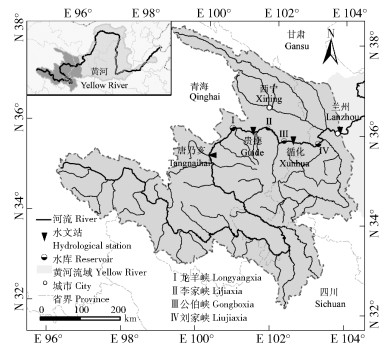
黄河上游区上段即河源至兰州段,地处E 97°~ 104°,N 32°~38°,流域面积约为22.3万km2,占黄河流域总面积的29.7%;干流河长为2 119 km,占黄河干流长的38.8%。笔者以黄河上游唐乃亥至兰州区间为研究区(图 1)。研究区内峡谷纵横,为上游支流集中区段,其间大通河、洮河、湟水等重要支流在此区段汇入黄河,为黄河上游径流补给的重要区域。唐乃亥站1956—2017年年均流量为198.64亿m3,为兰州站的65%;该站年均沙量为0.117亿t,仅为兰州站的21%;同时区间内水力资源丰富,是我国重要的梯级水库建设地区,现已建成龙羊峡、李家峡、公伯峡、刘家峡等诸多水电站。
2 材料与方法
2.1 数据收集
根据研究区内水文站的分布,兼顾水文数据的准确性、监测的完整性和连续性,笔者获取黄河上游的唐乃亥、贵德、循化以及兰州等4个水文站的径流和输沙资料,分析黄河上游地区1956—2017年的水沙时空变化特征及其驱动因素;同时选取研究时段内黄河上游近20个国家气象站的降雨资料,并结合泰森多边形法计算得到研究区域内的平均雨量。笔者所采用的水文站点资料见表 1,径流和输沙资料来源于《黄河流域水文年鉴》,降雨数据来源于国家气象信息中心(https://data.cma.cn/)。
表 1(Tab. 1)
表 1 黄河上游水文站的基本信息
Tab. 1 General information of hydrological stations in the upper stream of the Yellow River
水文站
Hydrological station |
控制面积
Controlled area/
(104 km2) |
年均值 Mean |
数据年限
Data period |
输沙量
Sediment load/(108 t) |
径流量
Runoff/
(108 m3) |
| 唐乃亥 Tangnaihai |
12.20 |
0.117 |
198.64 |
1956—2017 |
| 贵德 Guide |
13.37 |
0.139 |
199.24 |
1956—2017 |
| 循化 Xunhua |
14.43 |
0.262 |
208.50 |
1956—2017 |
| 兰州 Lanzhou |
22.25 |
0.557 |
303.89 |
1956—2017 |
|
表 1 黄河上游水文站的基本信息
Tab. 1 General information of hydrological stations in the upper stream of the Yellow River
|
2.2 研究方法
笔者主要采用线性趋势法、非参数Mann-Kendall(MK法)趋势检验法、Sen斜率估计法、BFAST检验及水沙关系曲线等方法。MK法适用范围广,定量化程度高,且理论意义明确,是当下水文气象研究中常用的时间序列检验方法[12-13]。Sen斜率估计法能降低或避免数据缺失及异常对统计结果的影响[14]。双累积曲线是在直角坐标系中2个不同变量同期内连续累加值所构建的关系曲线,常用于水文气象要素长期演变趋势及一致性的检验分析[15]。
BFAST作为时间序列分解方法,能够有效地解析长时间序列的周期变化、趋势特征等,最早被用于分解季节性的遥感影像特征,并广泛用于气象、水文等领域[16]。笔者采用BFAST方法识别不同水文站月径流、输沙的突变特征,并在R软件中实现。BFAST将时间序列迭代分解为季节项、趋势项以及残差项:
|
$
{Y_t} = {T_t} + {S_t} + {\phi _t}, t = 1, \cdots , n。$
|
(1) |
式中:Yt为t时刻观测数据;Tt、St和ϕt分别为长期趋势项、季节项和残差项;t为观测时刻。
同时采用水沙关系曲线,研究径流量和输沙量之间的关系[17]。该变化曲线为幂函数:
|
$
{Q_{\rm{s}}} = a{Q^b}。$
|
(2) |
或者两边同时取对数,则表示为
|
$
\lg \;{Q_{\rm{s}}}{\rm{ = }}\lg \;a + b\lg \;Q。$
|
(3) |
式中:Qs为输沙率(单位时间内的泥沙通量),kg/s;Q为流量,m3/s;a和b为拟合系数。高lg a反映流域内可搬运泥沙增多,导致泥沙供给量增大。对于某一个特定流域而言,lg a随时间变化,与人为活动过程有密切联系。b为双对数水沙关系曲线的斜率,其值越高反映水流挟沙能力越强。
3 结果与分析
3.1 水沙变化趋势
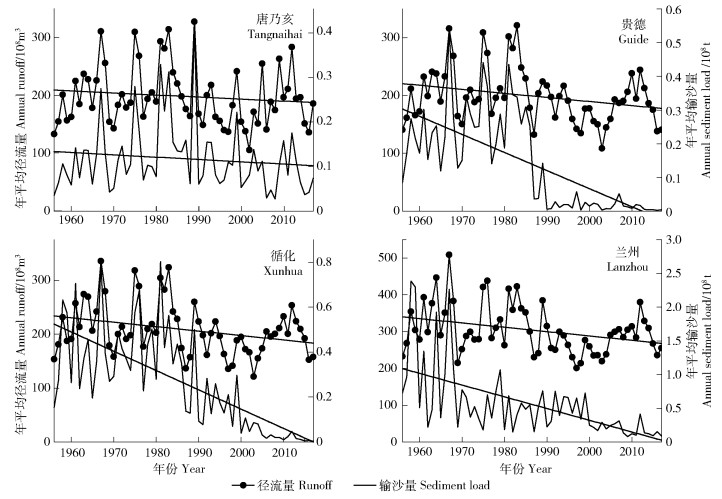
对黄河上游4个水文站的年径流输沙序列进行线性趋势分析(图 2),可知各站径流量和输沙量变化均呈减少趋势,尤其是从1969年开始较为明显。所有水文站点的径流量和输沙量实测值显示1956—1968年的径流量与输沙量变化相对稳定,而在1969年之后开始减少,且输沙量变化更为剧烈。与1956—1968年比较,近10a (2008—2017年)河流径流量减少幅度较小,输沙量变化幅度较大。1956—1968年期间,贵德、循化、兰州3个站点的年平均输沙量分别为0.232亿、0.416亿和1.198亿t;而近10年来3个站点的年平均输沙量分别为0.009亿、0.017亿和0.144亿t,分别锐减至1956—1968年的4.00%、3.97%和12.03%。输沙量的锐减主要是黄河上游梯级水库建设运行的结果。然而近10 a来唐乃亥站的年平均输沙量为0.109亿t,仅减少至1956—1968年的79.46%,这与河源至唐乃亥区间无大型水利工程等人类活动影响密切相关[6]。
对各站点水沙序列进行Mann-Kendall趋势检验和Sen斜率估计分析(表 2),可知在研究时段内黄河上游除唐乃亥站外各站点的水沙减少趋势均达显著水平(P < 0.05),其中循化站年输沙量减少趋势最显著。Sen斜率反映各站点年径流量和年输沙量的年均变化幅度[14],黄河上游各站点径流量与输沙量的年均变化幅度自上游至下游沿程依次增大,但径流量的年均变化不明显,其减幅均<1.0亿m3;而河流输沙量的年均变化幅度较大,其最大值出现在兰州站(0.013亿t),约为唐乃亥站(0.000 4亿t)的32倍,这在一定程度上反映唐乃亥至兰州区间产沙量大幅度减少。
表 2(Tab. 2)
表 2 黄河上游水沙年际变化趋势分析
Tab. 2 Trends analysis of annual runoff and sediment load in the upper stream of the Yellow River
水文站
Hydrological station |
指标
Index |
Z |
显著水平
Confidence level |
Sen斜率
Sen’s slope |
| 唐乃亥 Tangnaihai |
径流量 Runoff |
-0.97 |
>0.05 |
-0.306 |
| 输沙量 Sediment load |
-1.01 |
>0.05 |
-0.000 4 |
| 贵德 Guide |
径流量 Runoff |
-2.02 |
< 0.05* |
-0.595 |
| 输沙量 Sediment load |
-6.04 |
< 0.01** |
-0.004 |
| 循化 Xunhua |
径流量 Runoff |
-1.98 |
< 0.05* |
-0.623 |
| 输沙量 Sediment load |
-6.83 |
< 0.01** |
-0.008 |
| 兰州 Lanzhou |
径流量 Runoff |
-1.98 |
< 0.05 * |
-0.993 |
| 输沙量 Sediment load |
-5.64 |
< 0.01** |
-0.013 |
|
注:**表示达到0.01的显著性水平;*表示达到0.05的显著性水平。Notes: ** and * indicate that the correlation coefficient is significant at the confidence level of 0.01 and 0.05.
|
|
表 2 黄河上游水沙年际变化趋势分析
Tab. 2 Trends analysis of annual runoff and sediment load in the upper stream of the Yellow River
|
3.2 水沙突变特征
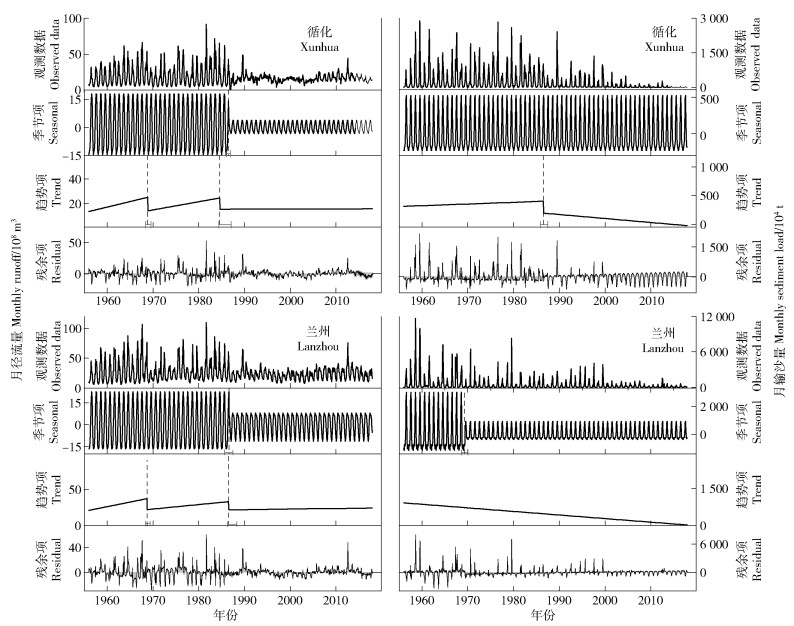
图 3为黄河上游循化和兰州2个水文站点的BFAST检验结果。由图 3中季节项和趋势项可知各水文站点的突变时间与黄河上游刘家峡、龙羊峡建库运行时间一致。各站点的径流量突变年份较为一致,分别在1968和1986年左右发生减少突变;而输沙量突变年份差异较大,其中兰州站年输沙量在1969年发生减少突变,而循化站于1986年发生减少突变。
以突变点前研究时段为基准期,突变点后研究时段为变化期,结合各站点径流输沙突变点将水沙时间序列划分为1956—1968、1969—1986和1987—2017年3个时段。与基准期1956—1968年比较,各站径流量变化不大,最高减幅20%;输沙量变化较为强烈,其中1969—1986年唐乃亥、贵德以及循化增幅4%~33%,而兰州减幅>58%,1987—2017年除唐乃亥之外,贵德、循化以及兰州减幅均达>70%。
3.3 上游干流水沙关系变化
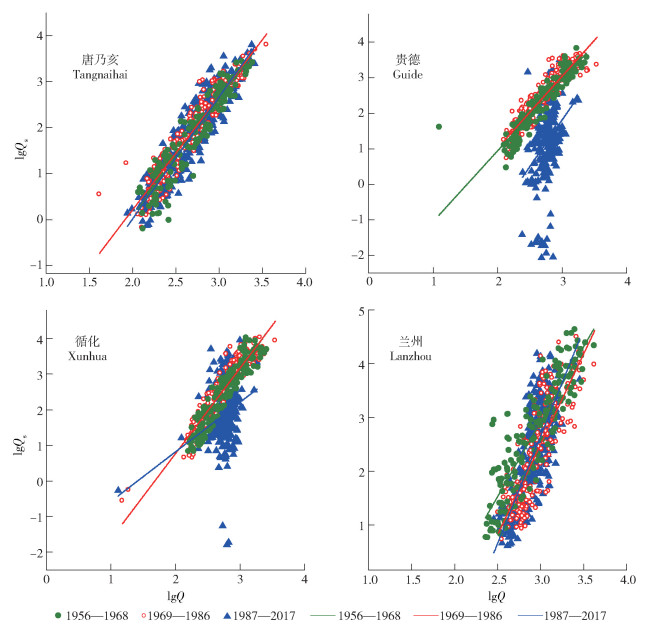
根据BFAST检验结果,在突变年前后,除唐乃亥站之外,其余3站的水沙关系均发生明显变化(图 2)。因此利用水沙关系曲线进一步分析黄河上游各站点不同时段月尺度的水沙关系变化(图 4),可见唐乃亥站的水沙关系在3个时段内变化不大;贵德站和循化站1987—2017年水沙关系点据基本上处于1956—1968年和1969—1986年的下方,表明在同等径流条件下,输沙率明显减少;兰州站的输沙率1987—2017年较1956—1968年略有增加。
如表 3所示,1956—2017年,唐乃亥站lg a与b值以及R2变化不明显,表明黄河源区受气候变化和人类活动的影响较小。贵德站和兰州站的lg a持续下降,b值持续增加,表明泥沙供给量减少,河流侵蚀能力增强,这是黄河上游大量泥沙被拦蓄的结果。循化站的变化正好相反,lg a持续增加,b值持续下降,表明泥沙供给量增加,河道淤积导致输沙能力下降。1956—1986年上游水沙关系R2相对较高,而1987—2017年水沙关系R2较低,这可能是梯级水库建设运行的结果。
表 3(Tab. 3)
表 3 4个水文站点不同时期的输沙率参数
Tab. 3 Sediment rating parameters for different periods at 4 hydrological stations
时段
Period |
唐乃亥 Tangnaihai |
|
贵德 Guide |
|
循化 Xunhua |
|
兰州 Lanzhou |
| lga |
b |
R2 |
lga |
b |
R2 |
lga |
b |
R2 |
lga |
b |
R2 |
| 1956—1968 |
-5.03 |
1.55 |
0.89 |
|
-3.05 |
1.00 |
0.84 |
|
-4.64 |
1.58 |
0.89 |
|
-5.46 |
1.79 |
0.78 |
| 1969—1986 |
-4.71 |
1.46 |
0.89 |
-3.03 |
1.02 |
0.86 |
-4.03 |
1.40 |
0.88 |
-7.57 |
2.36 |
0.66 |
| 1987—2017 |
-5.29 |
1.66 |
0.87 |
-6.21 |
1.68 |
0.11 |
-1.81 |
0.34 |
0.07 |
-9.21 |
2.95 |
0.59 |
|
表 3 4个水文站点不同时期的输沙率参数
Tab. 3 Sediment rating parameters for different periods at 4 hydrological stations
|
3.4 水沙变化驱动因素分析
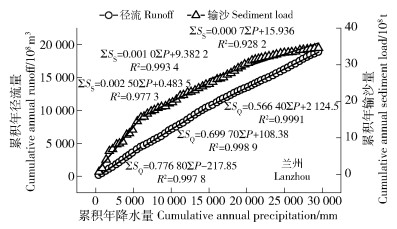
流域水沙变化是气候变化和人类活动共同作用的结果[7]。为量化分析黄河上游兰州断面以上区域水沙变化成因,结合各站点水沙突变分析结果,采用年降水量-年径流量和年降水量-年输沙量双累积曲线方法(图 5)分析气候变化和人类活动对黄河水沙变化的影响。
研究结果(表 4)显示,突变后不同时段内,人类活动对兰州断面以上输沙量减少贡献率分别为98.80%和98.28%,远远高于降水对输沙量减少的贡献;人类活动对径流减少的贡献率分别为63.10%、77.61%,说明人类活动为黄河上游水沙变化的主要驱动因素。由此可见,不同时段内人类活动对黄河上游兰州断面以上区域径流输沙减少始终占据主导地位,梯级水库、梯田、淤地坝等水利水土保持措施的减水减沙作用显著[18-20]。
表 4(Tab. 4)
表 4 黄河上游降水与人类活动对水沙减少的贡献率
Tab. 4 Contribution rate of rainfall and human activities on the runoff and sediment load reduction in the upper stream of the Yellow River
指标
Index |
时段
Period |
实测值
Observed value |
计算值
Calculated value |
水沙变化情况
Change situation of runoff and sediment load |
|
气候变化贡献
Contribution rate of climate change |
|
人类活动贡献
Contribution rate of human activities |
变化量
Change value |
比例
Percentage/
% |
变化量
Change value |
贡献率
Contribution rate/% |
变化量
Change value |
贡献率
Contribution rate/% |
径流量
Runoff/108 m3 |
1956—1968 |
345.28 |
|
|
|
|
|
|
|
|
|
| 1969—1986 |
326.37 |
371.91 |
18.91 |
5.48 |
-26.63 |
36.90 |
45.54 |
63.10 |
| 1987—2017 |
274.28 |
374.06 |
70.99 |
20.56 |
-28.79 |
22.39 |
99.78 |
77.61 |
输沙量
Sediment load/108 t |
1956—1968 |
1.198 |
|
|
|
|
|
|
|
|
|
| 1969—1986 |
0.500 |
1.21 |
0.699 |
58.32 |
-0.009 |
1.20 |
0.708 |
98.80 |
| 1987—2017 |
0.322 |
1.21 |
0.876 |
73.11 |
-0.016 |
1.72 |
0.892 |
98.28 |
|
表 4 黄河上游降水与人类活动对水沙减少的贡献率
Tab. 4 Contribution rate of rainfall and human activities on the runoff and sediment load reduction in the upper stream of the Yellow River
|
4 讨论
据有关研究[21]表明,近年来黄河上游地区降水总体上呈不显著增加趋势,气温和蒸发量呈显著增加趋势,这与黄河上游地区水沙减少密切相关。大规模的水土保持措施、生产生活耗水以及水利工程建设等人类活动也与黄河水沙变化密切相关。
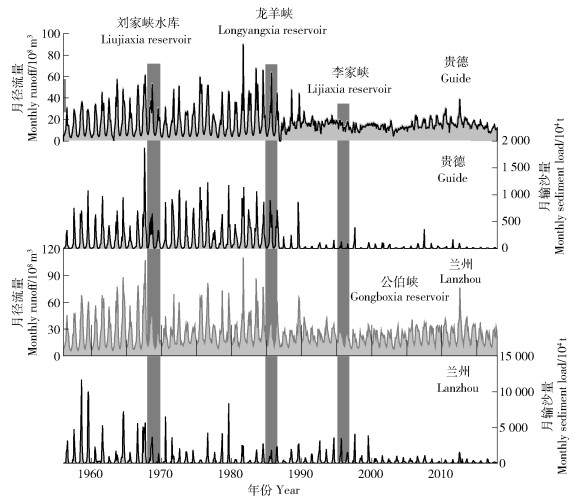
图 6显示水库联合调度下贵德站和兰州站水沙变化情况:黄河上游梯级水库的蓄水拦沙作用可能是月径流量和输沙量发生剧烈变化的主要原因[18],水库在雨季蓄水,在旱季以满足农业生产的需求,从而在很大程度上降低洪峰流量;此外,上游梯级水库的建设运行与各水文站点径流输沙突变时间一致,刘家峡水库自1968年运行以来泥沙逐年淤积,至1986年已淤积泥沙约10亿t,1986年以后持续淤积,截至2003年淤积泥沙约16亿t;龙羊峡水库1986年建库运行以来约淤积泥沙3.5亿t,表明水库运行过程中大量泥沙被拦截,水沙关系发生显著改变[22]。
20世纪60年代以前黄河流域径流量和输沙量基本处于自然变化状态,受人类活动影响较小[11]。然而,据有关研究[19-20]表明,70年代后黄河上游湟水与洮河2大支流梯田比例分别为6.1%和5.3%,其减沙量达到0.21亿t;淤地坝骨干坝178座,中小型坝531座,年均拦沙量达到651万t。大规模的水土保持保持措施(梯田、淤地坝等)等在一定程度上改变地表产汇水、泥沙输移过程,有效地改善流域内的生态环境以及下垫面特征,显著降低流域水土流失,从而导致河流水沙减少[20, 23]。
5 结论
黄河上游4个水文站点的水沙变化均呈减少趋势,除唐乃亥站外,其余站点均达到95%的显著水平。循化站年输沙量的减少最为剧烈。径流量、输沙量及其年均变化幅度沿程依次增大,径流量年均减幅均小于1.0亿m3;输沙量年均减幅较大,其最大值出现在兰州站(0.013亿t),约为唐乃亥站(0.000 4亿t)的32倍。
流域内水沙变化的突变年份多发生在1968年、1986年,与黄河上游大型水利工程(刘家峡、龙羊峡等水库)的运行时间相吻合。以突变点之前为基准期,研究表明,河流径流量变化不大,最高减幅20%;而输沙量变化较为强烈,1987—2017年贵德、循化及兰州等水文站点减幅均>70%,表明水库运行对黄河水沙情势与水沙关系调控作用显著。
唐乃亥站在3个时期内水沙关系变化不大。1986年之后,研究区内河流输沙量显著减少,水流挟沙能力增强,同时水沙关系发生显著变化。不同时段内,人类活动对兰州断面以上区域径流量和输沙量减少贡献率均远高于降水对径流输沙减少的贡献,说明人类活动为黄河上游水沙变化的主要驱动因素。大规模的水土保持措施,有效改善地表下垫面情况,从而改变地表汇水输沙过程,而水库等水利工程拦蓄大量泥沙,使下游站点输沙量大幅减少。
 2022, Vol. 20