文章快速检索     高级检索
  中国水土保持科学   2022, Vol. 20 Issue (2): 58-64.  DOI: 10.16843/j.sswc.2022.02.008
0

引用本文 

姜尧, 及金楠, 刘迅, 蔡尚妍, 李奕良, 范雪松. 基于仿生材料的根系固土力学机制[J]. 中国水土保持科学, 2022, 20(2): 58-64. DOI: 10.16843/j.sswc.2022.02.008.
JIANG Yao, JI Jinnan, LIU Xun, CAI Shangyan, LI Yiliang, FAN Xuesong. Root reinforcement mechanism based on bionic materials[J]. Science of Soil and Water Conservation, 2022, 20(2): 58-64. DOI: 10.16843/j.sswc.2022.02.008.

项目名称

北京市级大学生创新创业训练计划项目“基于仿生材料的根系固土力学机制研究”(S201910022030);国家自然科学基金青年科学基金“基于应变控制的根系固土纤维束模型研究”(31400616)

第一作者简介

姜尧(1999—),女,本科生。主要研究方向:根系固土。E-mail:18811700273@163.com

通信作者简介

及金楠(1982—),女,博士,副教授。主要研究方向:防灾减灾,生态护坡。E-mail:jjn0402@126.com

文章历史

收稿日期:2021-02-25
修回日期:2022-02-10
基于仿生材料的根系固土力学机制
姜尧 , 及金楠 , 刘迅 , 蔡尚妍 , 李奕良 , 范雪松     
北京林业大学水土保持学院 山西吉县森林生态系统国家野外科学观测研究站,100083, 北京
摘要:根系对土体具有显著的加固作用。由于天然植物根系种类繁多、根构型复杂多变,关于根系影响土体内摩擦角的机制研究相对较少且结论尚不明确。以聚乳酸为原材料,使用3D打印技术制作仿真根纤维、标准砂模拟土体、黄原胶凝胶模拟根系分泌物,使用干燥标准砂模拟土壤排除黏聚力影响,通过室内直剪试验研究黄原胶凝胶质量分数、根截面积比一定时根数量和直径协同变化、根数量和根直径对土体内摩擦角的影响,以分析土体加固机制。结果表明:1)当控制根直径及数量不变,仅改变黄原胶凝胶质量分数时,内摩擦角随黄原胶凝胶质量分数的增加先增加后波动平稳,黄原胶凝胶质量分数的提高可以促进内摩擦角的增加,但这种作用在达到一定程度后便不再明显;2)当根截面积比不变,根系含量和黄原胶凝胶质量分数一定,仅改变根直径和根数量时,随着根数量的增加,即根直径的减小,内摩擦角先增加后减小,整体波动稳定;3)当控制黄原胶凝胶质量分数和根直径不变,仅改变根数量时,随着根数量的增加,内摩擦角整体呈增加趋势,内摩擦角随根数量的增大而增大;4)当控制黄原胶凝胶浓度和根数量不变,仅改变根直径时,随着根直径的增加,内摩擦角整体波动稳定呈增加趋势。综上,内摩擦角随根直径的增大而增大。研究结果可为进一步揭示根系加固土壤的机理提供了理论依据。
关键词根系固土    仿生材料    内摩擦角    直剪试验    
Root reinforcement mechanism based on bionic materials
JIANG Yao , JI Jinnan , LIU Xun , CAI Shangyan , LI Yiliang , FAN Xuesong     
Jixian National Forest Ecosystem Observation and Research Station, CNERN, School of Soil and Water Conservation, Beijing Forestry University, 100083, Beijing, China
Abstract: [Background] A large number of studies have shown that root system has a significant reinforcement effect on soil. However, due to the complicated plant species and roots architecture, the reinforcement of roots on soil is not easy to be quantified. Also, because the internal friction angle is not significantly affected by independent variables, there are few studies on the mechanism of roots affecting soil friction angle, and the conclusion is not clear yet. Therefore, in order to eliminate the synergistic interference of complex factors, the bionic root soil composite model was used to study the effects of xanthan gum gel concentration, the synergistic change of root amount and root diameter with the constant root amount ratio, root amount, and root diameter on soil reinforcement in this research. [Methods] PLA (polylactic acid) was used as raw material and 3D printing technology was used to produce simulated root fiber. Standard sand and xanthan gum gel was used to simulate soil and root exudates, respectively. Here, dry standard sand was chosen to eliminate the influence of cohesion. Through the test of indoor direct shear instrument and the test results analyzed by SPSS software, influence of the above variables on internal friction angle of soil was studied, and the reinforcement mechanism of soil was analyzed by ANOVA (analysis of variance). [Results] 1) When the diameter and amount of the roots were constant, internal friction angle increased with xanthan gum concentration increasing and the fluctuation was stable when only the gel concentration of xanthan gum changed. The increase of xanthan gum gel concentration promoted the internal friction angle increasing, but this effect was not obvious after reaching a certain degree. 2) When RAR (root area ratio) was constant, the root content and xanthan gum gel concentration were given, only the root amount and root diameter changed. With the increase of root number, in other words, root diameter decreasing, the internal friction angle firstly increased and then decreased, and the overall fluctuation was stable. 3)When keeping the xanthan gum gel concentration and root diameter constant while only changing root amount, internal friction angle increased with root amount increasing. The internal friction angle increased with the increase of the amount of roots. 4)When keeping the xanthan gum gel concentration and root amount constant while only changing root diameter, internal friction angle increased with root amount increasing, but generally stable. [Conclusions] The ideal scenario is set by bionic root soil matrix, the test parameters are reasonably controlled, the influence of root related variables on the internal friction angle of soil is studied, and then the reinforcement mechanism of root system to soil is explored. The results provide a theoretical basis for further revealing the mechanism of root reinforcement of soil.
Keywords: soil reinforcement by roots    bionic material    internal friction angle    direct shear test    

植物根系具有稳定斜坡、控制重力侵蚀、防治浅表层滑坡和崩塌等作用[1-4]。大量研究[5-7]表明,根土复合体可以显著提高土体的抗剪强度。但目前,有关根系固土的研究[8-10]大多通过试验方法探究天然植物根系加固土体的效果,还有部分学者[11-12]利用有限元等方法通过数值模拟探究根系固土的力学性能。但存在以下问题:1)天然根系纷繁复杂、种类繁多、对环境的可塑性高、生长周期长、隐蔽性突出,使根土间相互作用的研究、多因素共同作用下的定量分析等工作难以开展;2)大批量采集根系进行试验研究,对环境具有一定破坏性。

根据土的摩尔库仑破坏理论,内摩擦角是评价根系加固作用一个重要的指标;然而,目前针对内摩擦角方面的研究相对较少,且结论尚不明确。陈洁等[13]研究发现随着含根量的增加,内摩擦角增大。吕建根等[14]认为含根量对内摩擦角影响不大。王月等[15]研究发现随着根长密度、根表面积密度的增大, 土壤内摩擦角ϕ随之均呈对数增长。分析比较后发现结论存在分歧的主要原因为天然植物根系内摩擦角的变化不明显,且易受外界因素干扰,导致结论出现不同甚至相反的现象。

因而,笔者为控制复杂因素的协同干扰、简化试验流程,采用仿生材料聚乳酸(polylactic acid,PLA)、标准砂与黄原胶凝胶模拟根土复合体,使用3D打印技术制作仿真根纤维,通过室内直剪试验分析根系固土力学机制,研究黄原胶凝胶质量分数、根截面积比一定时根数量和直径协同变化、根数量和根直径对土壤力学性质的影响,进一步阐明根系固土的力学机制,总结影响规律, 为治理水土流失和山体滑坡灾害提供有效的理论依据。

1 材料与方法 1.1 试验材料

本研究选用仿生材料聚乳酸PLA模拟植物根系——具有成本低、易加工、可降解和生物毒性低等优点[16],是一种性能良好的3D打印材料,应用十分广泛。向师庆等[17]依照林木各类根的生长发育情况及其相对粗壮发达的优势根,将根型分为水平根型、垂直根型等5类。本试验选用垂直根型:以垂直根、整个根系中占优势,其水平根或斜生根较弱或者没有。此外,根系固土研究中常使用抗拉强度来评价材料的力学特性。利用uniplus 3D打印机,根据试验要求,打印长度为20mm,直径为1.29、2.50、2.89、3.50和5.00mm的根样各20根。试验开始前,将制备好的根纤维利用WDW-100E万能试验机采用单根拉伸方法测定抗拉强度。经测定,本研究所采用根纤维均落在20~60MPa范围内。根据Baets等[18]的研究结论,植物根系的抗拉强度一般在5~100MPa之间;因而,根纤维满足选用模型需求。综合以上3点:本试验选用PLA为根纤维材料,利用3D打印技术生产仿真垂直根纤维,模拟天然根。

研究采用国家标准规定的干燥标准砂,级配良好,含水率为0。经测定,试验所用标准砂内摩擦角为45.26°,黏聚力为0。故本试验排除黏聚力影响,仅探究黄原胶凝胶质量分数、根截面积比一定时根数量和直径协同变化、根数量和根直径与内摩擦角的关系。

黄原胶是一种以多糖为基础的外聚物,被用于模拟生物膜[19-20]和植物黏液[21]。研究发现它具有显著的土壤黏附性能[22], 对土壤力学性能的影响与常见的黏液模型聚半乳糖醛酸相似[19]。因而,依照Zickenrott等[23]的研究结果,设定黄原胶凝胶质量分数范围为9.53~33.33mg/g干土。按照这个范围,使用精度为0.001g天平称量黄原胶粉,与纯净水混合后利用磁力搅拌器搅拌至均匀,配置质量分数为2%、3%、4%、5%、6%和7%的黄原胶凝胶。

1.2 试验方法

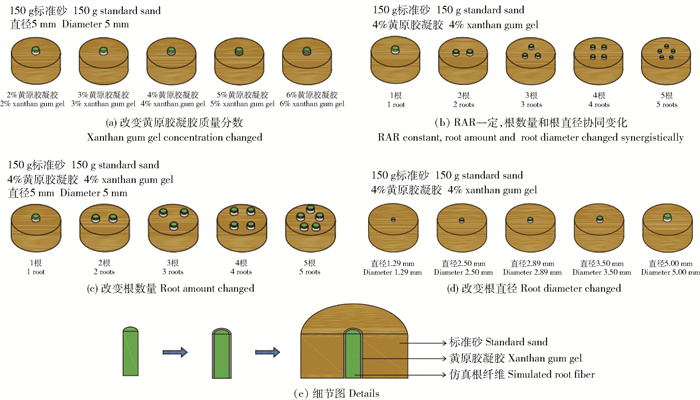
制样时,使用天平分别称量根纤维及对应凝胶质量,将凝胶均匀涂抹在根纤维表面后再次称量根纤维及凝胶质量,以保证凝胶添加的一致性。具体变量见表 1。试验利用DJY-4L四联等应变直剪仪速率控制器。试验要求对准上下剪切盒,插入固定销,在剪切盒内放置透水石,将准备好的根纤维在剪切盒内按设计方案(图 1a1b1c1d所示)摆放好,用钢丝网保持其位置和状态,根纤维以垂直状态排列(图 1)。使用天平称量150g标准砂,将称量好的标准砂缓慢、均匀地倒入剪切盒中。最后,在试样顶部放置透水石,盖上盖,调整杠杆,拔固定销。分别在100、200、300和400kPa的法向压力作用下,将每组试样以0.8mm/min的速率剪切并记录剪切位移,绘制剪应力-位移曲线,每组试验重复3次。根据数据和曲线拟合得出各组根-土复合体的内摩擦角ϕ,并比较分析各组的差异。

表 1 各组试验相关变量 Tab. 1 Related variables for each set of experiment
图 1 试样模型示意 Fig. 1 Schematic representation of sample model
1.3 试验数据处理

基于土的摩尔库伦破坏理论(式1),分析根纤维对土体的加固作用。

$ {\tau _{\rm{f}}}{\rm{ = }}\sigma {\rm{tan}}ϕ + c{\rm{ }}。$ (1)

式中:τf为土(包括根土复合体)的抗剪强度,kPa;σ为作用在剪切面上的法向应力,kPa;ϕ为土的内摩擦角,°;c为土的黏聚力,kPa。

利用室内直接剪切试验,软件采集得到不同变量条件下,正应力σ分别为100、200、300和400kPa下剪应力τf,再通过数据拟合处理求得土的黏聚力c和内摩擦角ϕ。经试验测定黏聚力近似为0,故仅探究相关变量对于土体内摩擦黏角的影响。将得到的数据利用SPASS进行平均值和方差分析后得出结论。

2 结果与分析 2.1 黄原胶凝胶质量分数的影响

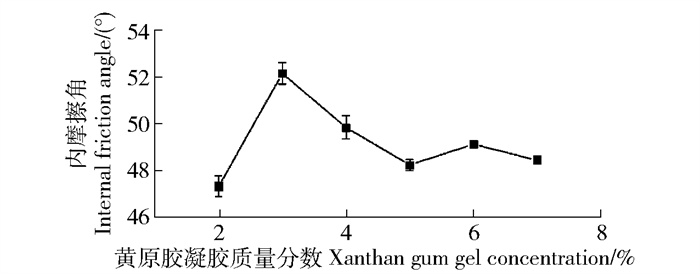
为研究黄原胶凝胶质量分数对内摩擦角的影响,控制根纤维直径(5mm),根数量(1根)不变,仅改变黄原胶凝胶质量分数,试验结果如图 2所示。结果表明内摩擦角随黄原胶凝胶质量分数的增加先增加后波动平稳(F = 22.207,P < 0.001,ANOVA),在质量分数为3%时,内摩擦角最大,为52.16°。之后,随着质量分数的提高,内摩擦角波动平缓并趋于稳定。由此可见,黄原胶凝胶质量分数的提高可以促进内摩擦角的增加,但这种作用在达到一定程度后便不再明显。

图 2 黄原胶凝胶质量分数对内摩擦角的影响 Fig. 2 Effects of xanthan gum gel concentration on friction angle
2.2 根截面积比一定,根数量和直径协同变化

分析RAR不变时,根直径和数量对内摩擦角的影响。试验控制黄原胶凝胶质量分数(4%)、根面积和(19.635mm2)、含根量为0.654%不变,仅改变根数量和直径,结果如图 3所示。研究发现,随着根数量的增加,即根直径的减小,内摩擦角先增加后减小,整体波动稳定(F = 6.341,P = 0.002,ANOVA),峰值内摩擦角为52.19°。

图 3 RAR恒定,根直径和根数量协同变化对内摩擦角的影响 Fig. 3 Effects of root diameter and root amount on the friction angle with constant RAR
2.3 根数量的影响

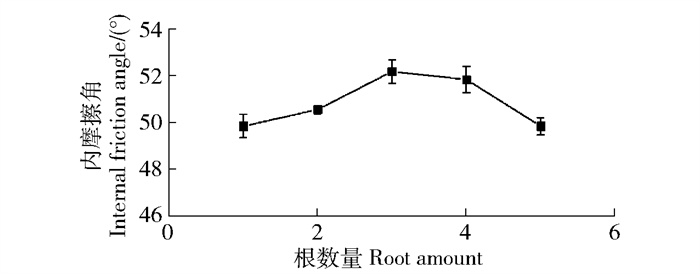
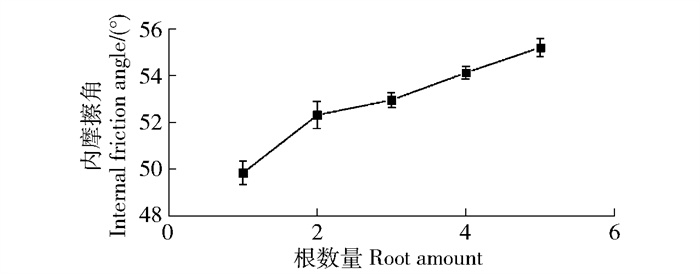
控制黄原胶凝胶质量分数(4%)和根直径(5mm)不变,只改变根数量,分析根数量对内摩擦角的影响。结果表明,随着根数量的增加,内摩擦角整体呈增加趋势(图 4)(F = 23.097,P<0.001,ANOVA),在根数量为5时达到峰值,为55.22°。

图 4 根数量对内摩擦角的影响 Fig. 4 Effects of root number on friction angle
2.4 根直径的影响

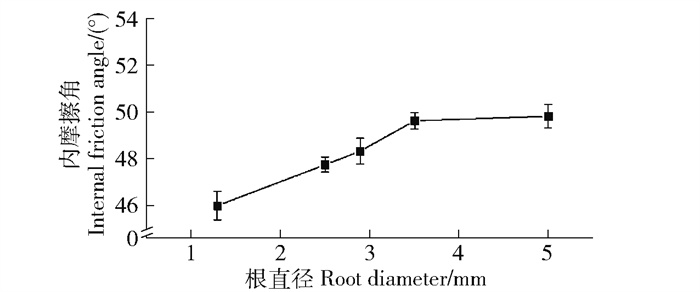
控制黄原胶凝胶质量分数(4%)和根数量(1根)不变,改变根直径,分析根直径对内摩擦角的影响。研究发现随着根直径的增加,内摩擦角整体波动稳定呈增加趋势(图 5)(F = 10.444,P<0.001,ANOVA)。在根直径为5mm时达到峰值,为49.845°。

图 5 根直径对内摩擦角的影响 Fig. 5 Effects of root diameter on friction angle
3 结论与讨论

1) 黄原胶凝胶质量分数和内摩擦角呈正相关关系,这种关系在达到一定程度后不再明显。在本试验中,凝胶质量分数为3%时,内摩擦角达到峰值,为52.16°。

2) 根直径、数量增加引起含根量增加,从而使内摩擦角增大。在本试验中,根直径为5mm,根数量为5时内摩擦角达到峰值,为55.22°。

3) RAR一定时,含根量一定时,内摩擦角受根直径影响先增大后减小。在本试验中,根直径为2.89mm,根数量为3时土壤内摩擦角达到峰值,为52.19°。

大量研究表明,植物根系对土体有显著的加固作用。根据土的摩尔库仑破坏理论,内摩擦角是评价加固作用的一个重要指标。为探究根系各参数对内摩擦角的影响,本研究利用仿生根系排除复杂根构型等因素的干扰,进行试验。试验结果表明:与素土相比,根系的存在会引起内摩擦角的增大,这和前人[6]的研究结论是相符的。

研究发现根直径和根数量的增加会引起土体内摩擦角的增加。这可以解释为根直径和根数量的增加引起了含根量的增加,根土间接触面积增大,使内摩擦角增大。许多学者已经证明含根量的增加会引起内摩擦角的增加。刘秀萍等[6]研究发现根直径增大,根土间接触面积增大,内摩擦角增大。罗露瑶等[24]研究发现根土复合体的内摩擦角随着含根量的增加整体呈增加趋势。王耕等[25]发现在试验含根量范围内,含根量增加内摩擦角增大,并存在最优含根量区间。肖宏彬等[26]以小叶女贞(Ligustrum quihoui)为研究对象,发现了根土复合体内摩擦角随含根比的变化呈幂函数关系增加。

另外,研究还发现控制RAR不变,内摩擦角随根数量整体波动稳定与内摩擦角的大小、根土间的接触面积有关。随着接触面积的增大,根土界面间的摩擦力和咬合力增大,从而引起内摩擦角增大。而当接触面积达到一定程度时,单位体积的土壤减少,根土间接触面积一定,内摩擦角便趋于稳定。这与王月等[15]和李建兴等[27]的研究结论相似:随着根表面积密度的增大,土壤内摩擦角呈对数增长,但是当根表面积密度达到一定程度后,根土间的摩擦作用转化为根系与根系之间的作用,土壤内摩擦角将不再增大。

由黄原胶凝胶质量分数和内摩擦角的曲线(图 2)可见,随着黄原胶凝胶质量分数增大,内摩擦角先增大后趋于稳定。由于根系分泌物起到黏结土壤、增大根土间接触面的作用,随着黄原胶质量分数的升高,接触面积增大,根土间可以更好地黏结,内摩擦角增大。而当黄原胶质量分数超出一定范围时,接触面积达到一定程度,作用效果不再显著,表现为内摩擦角波动稳定。但目前有关于根系分泌物提高土壤抗剪强度的研究相对较少,故这一结论仅从理论层面推导,还需要后续试验进一步验证。

在本研究中,根数量为5,直径为5mm,黄原胶凝胶质量分数为4%时,内摩擦角增加最大,为55.22°,相比素土提高了9.96°。这与以前部分研究结果认为根系变量对内摩擦角以及对土壤抗剪强度影响不大的结论存在一定的差别,这可能与立地条件、土壤类型、根纤维特性等有一定关系,后续研究将进一步验证。

4 参考文献
[1]
朱海丽, 李志威, 胡夏嵩, 等. 黄河源草甸型弯曲河流的悬臂式崩岸机制[J]. 水利学报, 2015, 46(7): 836.
ZHU Haili, LI Zhiwei, HU Xiasong, et al. Cantilever bank failure mechanism of meadow meandering river in the Yellow River source region[J]. Journal of Hydraulic Engineering, 2015, 46(7): 836.
[2]
张兴玲, 胡夏嵩, 毛小青, 等. 植物根系固土护坡力学机理研究现状与进展[J]. 人民黄河, 2009, 31(6): 88.
ZHANG Xingling, HU Xiasong, MAO Xiaoqing, et al. Current status and progress of study on mechanical mechanism of plant root solid soil and slope protection[J]. Yellow River, 2009, 31(6): 88. DOI:10.3969/j.issn.1000-1379.2009.06.037
[3]
DOCKER B B, HUBBLE T C T. Modeling the distribution of enhanced soil shear strength beneath riparian trees of south-eastern Australia[J]. Ecological Engineering, 2008, 35(5): 921.
[4]
鄢朝勇, 叶建军, 韦书勇. 植被对边坡浅层稳定的影响[J]. 水土保持研究, 2007, 14(1): 24.
YAN Chaoyong, YE Jianjun, WEI Shuyong. Influence of vegetation on slope shallow stability[J]. Research of Soil and Water Conservation, 2007, 14(1): 24. DOI:10.3969/j.issn.1005-3409.2007.01.008
[5]
代全厚, 张力, 刘艳军, 等. 嫩江大堤植物根系固土护堤功能研究[J]. 水土保持通报, 1998, 18(6): 8.
DAI Quanhou, ZHANG Li, LIU Yanjun, et al. Soil-fixation and dyke revetment function of plant root system in Nenjiang Dyke[J]. Bulletin of Soil and Water Conservation, 1998, 18(6): 8. DOI:10.3969/j.issn.1000-288X.1998.06.003
[6]
刘秀萍, 陈丽华, 宋维峰. 林木根系与黄土复合体的抗剪强度试验研究[J]. 北京林业大学学报, 2006, 28(5): 67.
LIU Xiuping, CHEN Lihua, SONG Weifeng. Study on the shear strength of forest root-loess composite[J]. Journal of Beijing Forestry University, 2006, 28(5): 67. DOI:10.3321/j.issn:1000-1522.2006.05.011
[7]
程洪, 张新全. 草本植物根系网固土原理的力学试验探究[J]. 水土保持通报, 2002, 22(5): 20.
CHENG Hong, ZHANG Xinquan. An experimental study on herb plant root system for strength principle of soil-fixation[J]. Bulletin of Soil and Water Conservation, 2002, 22(5): 20. DOI:10.3969/j.issn.1000-288X.2002.05.006
[8]
杨亚川, 莫永京, 王芝芳, 等. 土壤-草本植被根系复合体抗水蚀强度与抗剪强度的试验研究[J]. 中国农业大学学报, 1996, 1(2): 31.
YANG Yachuan, MO Yongjing, WANG Zhifang, et al. Experimental study on anti-water erosion and shear strength of soil-root composite[J]. Journal of China Agricultural University, 1996, 1(2): 31.
[9]
杨维西, 黄治江. 黄土高原九个水土保持树种根的抗拉力[J]. 中国水土保持, 1988(9): 47.
YANG Weixi, HUANG Zhijiang. Tensile strength of roots of nine soil and water conservation tree species in the Loess Plateau[J]. Soil and Water Conservation in China, 1988(9): 47.
[10]
高齐治, 张俊斌, 张新萍. 台湾西南部优势竹类箣竹根力之研究[J]. 世界竹藤通讯, 2008(1): 10.
GAO Qizhi, ZHANG Junbin, ZHANG Xinping. Study on the root strength of dominant bamboo in south-western Taiwan[J]. World Bamboo and Rattan, 2008(1): 10. DOI:10.3969/j.issn.1672-0431.2008.01.003
[11]
刘秀萍.林木根系固土有限元数值模拟[D].北京: 北京林业大学, 2008: 34.
LIU Xiuping. Finite element method numerical simulation of forest roots reinforcement[D]. Beijing: Beijing Forestry University, 2008: 34.
[12]
鞠青娟.基于ANSYS建立的油松根土复合体有限元模型的验证[D].北京: 北京林业大学, 2015: 56.
JU Qingjuan. To verify the finite element model of the Pinus tabulaeformis root-soil composite based on the ANSYS[D]. Beijing: Beijing Forestry University, 2015: 56.
[13]
陈洁, 雷学文, 黄俊达, 等. 花岗岩残积土边坡草本植物根固效应试验[J]. 水土保持学报, 2018, 32(1): 104.
CHEN Jie, LEI Xuewen, HUANG Junda, et al. Experimental research on reinforcement mechanism of herbs root system on granite residual soil slope[J]. Journal of Soil and Water Conservation, 2018, 32(1): 104.
[14]
吕建根, 陈学研, 谢志雄, 等. 边坡草本植物根系固土抗剪强度试验研究[J]. 现代园艺, 2018(19): 23.
LU Jiangen, CHEN Xueyan, XIE Zhixiong, et al. Experimental study on the shear strength of soil-roots in slope[J]. Xiandai Horticulture, 2018(19): 23. DOI:10.3969/j.issn.1006-4958.2018.19.011
[15]
王月, 杜峰, 周敏, 等. 陕北林草混交根土复合体抗剪强度研究[J]. 水土保持研究, 2018, 25(2): 213.
WANG Yue, DU Feng, ZHOU Min, et al. Research on shear strength of root-soil composite in a forest and grass standing site in northern Shaanxi[J]. Research of Soil and Water Conservation, 2018, 25(2): 213.
[16]
陈彩珠, 潘汉军. 3D打印高分子材料研究进展[J]. 工程塑料应用, 2016, 44(9): 137.
CHEN Caizhu, PAN Hanjun. Research progress of 3D printing polymer materials[J]. Engineering Plastics Application, 2016, 44(9): 137. DOI:10.3969/j.issn.1001-3539.2016.09.030
[17]
向师庆, 赵相华. 北京主要造林树种的根系研究[J]. 北京林学院学报, 1981(3): 9.
XIANG Shiqing, ZHAO Xianghua. A study on the root system of the main afforestation tree species in Beijing[J]. Journal of Beijing Forestry University, 1981(3): 9.
[18]
BAETS S, POESEN J, REUBENS B, et al. Root tensile strength and root distribution of typical Mediterranean plant species and their contribution to soil shear strength[J]. Plant and Soil, 2008, 305(1/2): 207.
[19]
TRAORÉ O, GROLEAU-RENAUD V, PLANTUREUX S, et al. Effect of root mucilage and modelled root exudates on soil structure[J]. European Journal of Soil Science, 2000, 51(4): 575.
[20]
MALARKEY J, BAAS J H, HOPE J A, et al. The pervasive role of biological cohesion in bedform development[J]. Nature Communications, 2015, 6: 6257. DOI:10.1038/ncomms7257
[21]
DI MARSICO A, LAURA S, LABELLA R, et al. Mucilage from fruits/seeds of chia (Salvia hispanica L.) improves soil aggregate stability[J]. Plant and Soil, 2018, 425(1/2): 57.
[22]
AKHTAR J, GALLOWAY A F, NIKOLOPOULOS G, et al. A quantitative method for the high throughput screening for the soil adhesion properties of plant and microbial polysaccharides and exudates[J]. Plant and Soil, 2018, 428(1/2): 57.
[23]
ZICKENROTT I M, WOCHE S K, BACHMANN J, et al. An efficient method for the collection of root mucilage from different plant species: A case study on the effect of mucilage on soil water repellency[J]. Journal of Plant Nutrition and Soil Science, 2016, 179(2): 294. DOI:10.1002/jpln.201500511
[24]
罗露瑶, 宋路, 朱海丽, 等. 根系参数对根土复合体抗剪力学特性的影响[J]. 人民黄河, 2020, 42(10): 42.
LUO Luyao, SONG Lu, ZHU Haili, et al. Influence of root parameters to the shear resistance of soil-root composite[J]. Yellow River, 2020, 42(10): 42. DOI:10.3969/j.issn.1000-1379.2020.10.009
[25]
王耕, 周腾禹, 韦杰. 紫色土和黄壤草本根土复合体抗剪性能试验研究[J]. 中国水土保持, 2019(4): 34.
WANG Geng, ZHOU Tengyu, WEI Jie. Experimental study on shear resistance of herb root-soil complex in purple soil and yellow soil[J]. Soil and Water Conservation in China, 2019(4): 34. DOI:10.3969/j.issn.1000-0941.2019.04.013
[26]
肖宏彬, 田青青, 李珍玉, 等. 林草混交根-土复合体的抗剪强度特性[J]. 中南林业科技大学学报, 2014, 34(2): 1.
XIAO Hongbin, TIAN Qingqing, LI Zhenyu, et al. Shear strength characteristics of root and soil composite formed from mixed forest and grass[J]. Journal of Central South University of Forestry & Technology, 2014, 34(2): 1.
[27]
李建兴, 何丙辉, 谌芸, 等. 不同护坡草本植物的根系分布特征及其对土壤抗剪强度的影响[J]. 农业工程学报, 2013, 29(10): 144.
LI Jianxing, HE Binghui, CHEN Yun, et al. Root distribution features of typical herb plants for slope protection and their effects on soil shear strength[J]. Transactions of the CSAE, 2013, 29(10): 144.