北方土石山区土壤侵蚀对典型地形因子的响应——以北京市房山区为例
中国地质大学(北京)信息工程学院, 100083, 北京
收稿日期:2021-02-28; 修回日期:2021-06-17
项目名称:教育部基科研费科研启动基金项目"基于GIS支持的城市边缘区基本农田空间演化机理及其保护策略研究"(2011YYL148);北京市规划和自然资源委员会"北京市第三次全国土地调查(土地调查数据应用研究)"(3-4-2020-320);教育部《3S综合实习》国家级一流课程项目(国家级); 北京市高等学校高水平人才交叉培养计划——实培计划项目"森林公园多维大数据GIS防火预警指挥系统"(2020114150430), "上方山智慧旅游大数据系统"(2019114150397);北京市本科教学改革创新项目"上方山GIS专业3S野外综合实习创新实训基地及课程建设"
摘要:为了定量评估土壤侵蚀分布格局与动态特征,分析北京市房山区土壤侵蚀对地形因子的响应,并为土壤侵蚀防治的重点布局决策提供参考,基于通用土壤流失方程USLE,将遥感反演与GIS空间叠加分析技术结合,对2013-2018年北京市房山区土壤水力侵蚀进行模拟和计算,分析研究区域不同高程带、不同坡度的土壤侵蚀量以及土壤侵蚀状况特征和变化趋势。结果表明:1)研究区土壤侵蚀量随年际变化整体呈现减小的趋势;2)研究区土壤侵蚀主要为微度侵蚀和轻度侵蚀;3)[400,800) m高程带的土壤侵蚀模数为各高程带中最高,且土壤侵蚀量最大;4)[15°,25°)的坡度对应的土壤侵蚀模数为各坡度等级最高,但土壤侵蚀量主要产生在[0°,5°)的微坡等级。因此,房山区总体土壤侵蚀程度较轻,今后土壤侵蚀防治的重点为[400,800) m高程带及[15°,25°)坡度带的区域。
关键词:土壤侵蚀监测 USLE模型 GIS 水力侵蚀 北京
Response of soil erosion to typical topographic factors in the rocky mountain area of North China: Taking Fangshan district as an example
GUO Kexin

,
AI Gang

,
MA Xingxiang
,
HE Xin
School of Information Engineering, China University of Geosciences(Beijing), 100083, Beijing, China
Abstract: [Background] The current soil erosion researches in Fangshan district did not cover the response of soil erosion to typical topographic factors, thus supplementary research is in demand. The 3 main objectives of this study are for quantitative assessment of the distribution pattern and dynamic characteristics of soil erosion, analysis of the response of soil erosion to topographical factors in Fangshan district, and to provide reference for soil erosion prevention and control. [Methods] We used USLE model combined remote sensing inversion and GIS spatial overlay analysis technology to calculate the soil erosion modulus and erosion amount in Fangshan district from 2013 to 2018. Then we calculated the six factors (R, K, L, S, P, and C) of the USLE based on the meteorological data, vegetation index data, land use data and soil attribute data. Thus we obtained the erosion amount and modulus, and divided erosion levels to analyze the soil erosion status of Fangshan district, and the erosion status under different typical topographic conditions. [Results] 1) The soil erosion amount in Fangshan district has gradually decreased in each year, from a maximum of 70.694×10⁴ t in 2013 to 29.082×10⁴ t in 2018. 2) Soil erosion was divided into 6 grades by intensity, showing that the average annual rate of slight erosion was 64.13%, followed by light erosion accounted for 29.99%, the other higher grade areas accounted for < 6%. 3) The ratio of slight erosion area gradually increased in each year. The soil erosion modulus at the elevation of[400, 800 m) was the highest, followed by the elevation range lower than 400 m. More than 40% of the erosion amount occurred in the area where elevation was higher than 400 m. In the[0°, 25°) slope grade, the soil erosion modulus increased with the increase of the slope; but at slope grade higher than 25°, the soil erosion modulus decreased with the increase of the slope. The soil erosion of this grade for areas with slope of[0°, 5°)accounted for more than 70% of the total erosion. [Conclusions] The overall annual soil erosion in Fangshan district has gradually decreased over time. From 2013 to 2018, the total amount of soil erosion has decreased by 58.86%. The ratio of slight erosion intensity area rose from 55.74% in 2013 to 71.70% in 2018. The overall soil erosion degree in Fangshan district is light or slight. The analysis of the response of soil erosion to topographical factors shows that there is the highest soil erosion modulus at[400, 800) m elevation interval and the slope grade of[15°, 25°), indicating it is the focus area of soil erosion prevention and control in the future.
Keywords:
soil erosion monitoring USLE model GIS soil water erosion Beijing
USLE土壤流失方程是经验统计模型中出现最早且影响最广的模型,Wischmeier归纳出通用土壤流失方程USLE[1],被广泛应用于土壤侵蚀预测、土壤侵蚀时空变化、评估区域土壤侵蚀风险等领域[2-3]。北京市房山区现有的土壤侵蚀研究主要集中在水土保持效益评价[4]以及不同雨型对坡面土壤侵蚀的影响分析[5],欠缺针对房山区土壤侵蚀对典型地形因子响应的研究;因此,笔者采用通用土壤流失方程USLE,结合GIS与RS技术对北京市房山区2013—2018年土壤水力侵蚀进行模拟计算,定量评估北京市房山区土壤侵蚀分布格局与动态特征,探索土壤侵蚀与地形因子的关系,并为研究区土壤侵蚀防治的重点布局决策提供参考。
1 研究区概况
北京市房山区地处华北平原和太行山交界地带,介于E 115°25′~116°15′,N 39°30′~39°55′之间,总面积2 019 km2。房山区气候属暖温带半湿润大陆性季风气候,四季特征分明,春季干旱多风,夏季炎热多雨,多大到暴雨且雨量集中;多年平均气温10.8~11.6 ℃,多年平均降雨量为602.5~645.2 mm。房山区地貌西北高,东南低,由西北向东南依次为中山、低山、丘陵、岗台地、冲(洪)积平原,其中66%的区域为山地丘陵;海拔区间为-8~2 014 m,平均381.92 m。根据南京土壤所提供的1∶100万土壤数据分析得知,房山区土壤类型以褐土为主,占全区面积的51.91%,集中分布于研究区南部及西部,土壤质地以壤质为主,其中轻壤质占78.80%,中壤质和砂壤质分别占全区总面积的6.14%和9.42%。房山区植物茂盛,种类众多,植物种类共137科、545属、1 064种。区域内土地利用类型以农用地为主,其中林地占农用地总面积的63.24%,分布于全区的西部和北部山区,耕地占农用地面积的25.50%,分布于东部平原地区。根据水利部办公厅关于印发《全国水土保持规划国家级水土流失重点预防区和重点治理区复核划分成果》的通知(办水保[2013]188号文),房山区为太行山国家级水土流失重点治理区;房山区属于全国水土保持规划(2015—2030)中北方土石山区(北方山地丘陵区)太行山东部山地丘陵水源涵养保土区,水土流失以微度和轻度水力侵蚀为主。
2 数据与方法
2.1 数据来源与处理
笔者利用GIS,结合多源遥感数据建立土壤侵蚀方程,计算研究区土壤侵蚀模数及侵蚀量,并划分土壤侵蚀等级,分析房山区土壤侵蚀状况。主要数据及数据来源见表 1所示。
表 1(Tab. 1)
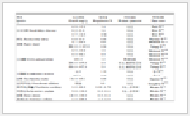
表 1 数据及来源
Tab. 1 Data and their sources
数据类别
Data category |
来源
Sources |
精度
Precision |
气象数据
Meteorological data |
中国气象数据共享网以及国家气象中信息中心
China Meteorological Data Sharing Network and National Meteorological Information Center |
2013—2018年降水日值数据
Daily rainfall data from 2013 to 2018 |
植被指数数据
Vegetation index data |
中科院资源环境数据中心
Chinese Academy of Sciences Resources and Environment Data Center |
500 m旬合成数据
500 m resolution 10-day synthetic data |
土地利用数据
Land use data |
资源环境科学数据中心
Resource and Environment Science Data Center |
空间分辨率1 000 m
Spatial resolution 1 000 m |
土壤属性数据
Soil attribute data |
南京土壤所提供的1∶100万土壤数据
1∶1 million soil data provided by Nanjing Institute of Soil Science, |
空间分辨率1 000 m
Spatial resolution 1 000 m |
数字高程模型
Digital elevation model (DEM) |
资源环境数据云平台
Resource environment data cloud platform |
空间分辨率30 m
Spatial resolution 30 m |
|
表 1 数据及来源
Tab. 1 Data and their sources
|
2.2 土壤侵蚀因子计算
通用土壤流失方程由6个影响因子组成[1],其中降雨侵蚀力因子R由气象数据计算并插值后得出;土壤可蚀性因子K先根据土壤属性划分出研究区各土壤类型,然后根据土壤类型计算得出;坡长、坡度因子LS由数字高程模型计算;作物覆盖和管理因子C由植被指数数据计算得出;水土保持措施因子P由土地利用数据查表得出;最后将6项因子相乘得到土壤侵蚀模数A,其中各因子含义、计算公式与单位见表 2。
表 2(Tab. 2)
表 2 各因子含义、计算公式与单位
Tab. 2 Corresponding meanings, calculation formulas and units of factors
因子
Factor |
含义
Meaning |
公式
Formula |
单位
Unit |
| A |
土壤侵蚀模数
Soil erosion modulus |
A=R×K×L×S×C×P |
t/(hm2·a)(or t/(km2·a)) |
| R |
降雨侵蚀力因子[6]
Rainfall erosivity factor |
$R=0.698 \sum\limits_{j=1}^{k}\left(p_{j}\right)^{1.671} $
|
(MJ·mm)/(hm2·h·a) |
| K |
土壤可蚀性因子[7]
Soil erodibility factor |
$ \begin{gathered}
K_{a}=\left\{0.2+0.3 \exp \left[0.0256 \mathrm{SAN} \times\left(1-\frac{\mathrm{SIL}}{100}\right)\right]\right\} \\
\left(\frac{\mathrm{SIL}}{\mathrm{CAL}+\mathrm{SIL}}\right)^{0.3}\left(1.0-\frac{0.25 C}{C+\exp (3.72-2.95 C)}\right) \times \\
\left(1.0-0.7 \mathrm{SN}_{1}\right) /\left[\mathrm{SN}_{1}+\exp \left(-5.51+22.9 \mathrm{SN}_{1}\right)\right] \\
\mathrm{SN}_{1}=1-\mathrm{SAN} / 100 \\
K=K_{\mathrm{a}} \times 0.1317
\end{gathered}$
|
(t·hm2·h)/(hm2·MJ·mm) |
| L、S |
坡长因子、坡度因子[8],用于表述研究区地形
Slope length factor, slope factor. Used for describing the topography of the study area |
$\begin{gathered}
S=\left\{\begin{array}{l}
10.8 \sin \theta+0.03 \quad \theta \leqslant 5^{\circ} \\
16.8 \sin \theta-0.05 & 5^{\circ}<\theta \leqslant 10^{\circ} \\
21.9 \sin \theta-0.96 & \theta \geqslant 10^{\circ}
\end{array}\right. \\
n= \begin{cases}0.2 & \text { if }~~ \theta \leqslant 1^{\circ} \\
0.3 & \text { if }~~ 1^{\circ}<\theta \leqslant 3^{\circ} \\
0.4 & \text { if }~~ 3^{\circ}<\theta \leqslant 5^{\circ} \\
0.5 & \text { if }~~ \theta>5^{\circ}\end{cases} \\
L=\left(\frac{\lambda}{22.13}\right)^{n}
\end{gathered} $
|
1 |
| C |
作物覆盖和管理因子[9]
Crop coverage and management factors |
$ \begin{array}{l}
G = \frac{{N - {N_{{\rm{soil }}}}}}{{{N_{{\rm{veg }}}} - {N_{{\rm{soil }}}}}}\\
\left\{ {\begin{array}{*{20}{l}}
{C = 1}&{G = 0}\\
{C = 0.6508 - 0.3436{{\log }_{10}}G}&{0 < G < 78.3\% }\\
{C = 0}&{G \ge 78.3\% }
\end{array}} \right.
\end{array}$
|
1 |
| P |
水土保持措施因子[10]
Soil and water conservation measures factor |
|
1 |
| 注:pj为日降水量,mm;SAN、SIL、CAL分别为土壤砂粒、粉粒、黏粒含量,%;Ka为土壤侵蚀力因子(美制单位);θ为坡度,(°);n为坡长指数,量纲1;λ为坡长,m;G为植被覆盖度,%;Nsoil为裸地NDVI值,Nveg为高纯度植被像元NDVI值。Notes:pj is the daily rainfall amount, mm; SAN, SIL, and CAL are the soil sand, silt, and clay content, respectively, %; Ka is the soil erosivity factor (US unit); θ is the slope, °; n is the slope length index; λ is slope length, m; G is vegetation coverage, %; Nsoil is the NDVI value of bare land, and Nveg is the NDVI value of high-purity vegetation pixels. |
|
表 2 各因子含义、计算公式与单位
Tab. 2 Corresponding meanings, calculation formulas and units of factors
|
3 结果与分析
3.1 土壤侵蚀总量与等级变化
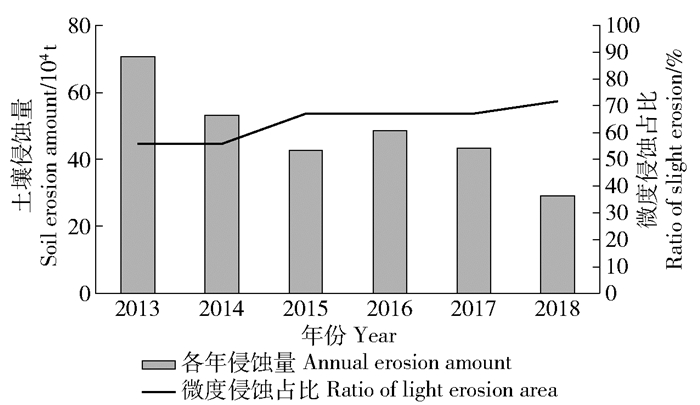
根据土壤流失方程计算得出2013—2018年房山区土壤侵蚀量,各年土壤侵蚀总量逐渐减少,从2013年的最高70.694万t降低至2018年的29.082万t,其余各年土壤侵蚀量为:2014年53.138万t、2015年42.699万t、2016年48.504万t、2017年43.509万t(图 1)。根据SL190—2007《土壤侵蚀分类分级标准》将土壤水力侵蚀划分为微度、轻度、中度、强烈、极强烈、剧烈6个不同的等级,微度侵蚀等级各年平均占比64.13%,其次为轻度侵蚀占比29.99%,其余各更高侵蚀强度等级面积占比 < 6%,且各年微度侵蚀面积占比逐步上升,由2013年的55.74%至2018年的71.70%。综上2013年至2018年间土壤侵蚀强度的变化,表明房山区土壤侵蚀状况逐步好转。
3.2 土壤侵蚀对典型地形因子的响应
3.2.1 高程
高程对于土壤侵蚀量具有显著影响,不同高程带上地貌、降雨、植被类型特征均直接影响土壤侵蚀量[11]。根据研究区的高程范围(21~2 019 m),参考类似研究[12]的做法,以区分高程梯度为目的,将房山区所涉及高程均分 < 400 m、[400,800) m、[800,1 200) m、[1 200,1 600) m、≥1 600 m 5个范围。并与各年房山区土壤侵蚀模数分布图进行叠加分析,得到不同高程带的土壤侵蚀特征。
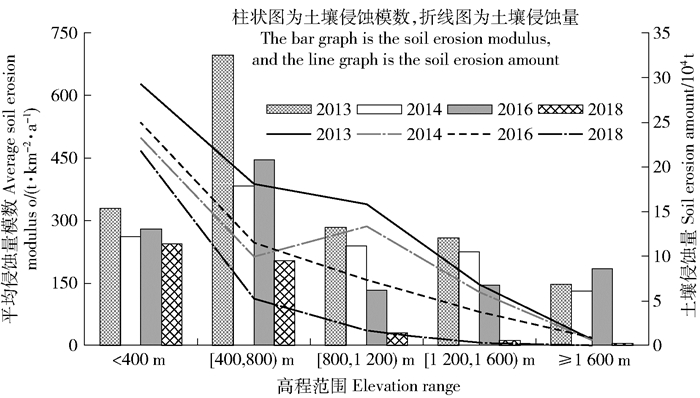
从平均土壤侵蚀模数来看(图 2),各年[400, 800) m高程的土壤侵蚀模数均最高,其次为 < 400 m高程范围,[400,1600) m高程范围平均土壤侵蚀模数随高程升高而下降。
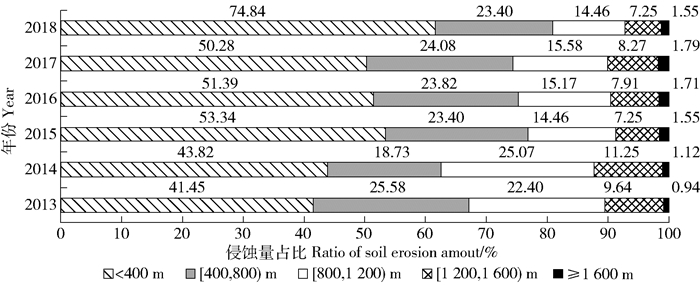
土壤侵蚀量方面(图 3),各高程带土壤侵蚀量随着高程升高而减小,40%以上侵蚀量都发生在 < 400 m高程一带,且除 < 400 m高程带外,各高程带的土壤侵蚀量占比总体上逐渐减少,说明≥400 m高程带的土壤侵蚀状况恢复较明显。
3.2.2 坡度
按照GB/T 15772—2008《水土保持综合治理规划通则》,将地表坡度划分为微坡[0°,5°)、较缓坡[5°,8°)、缓坡[8°,15°)、较陡坡[15°,25°)、陡坡[25°,35°)、极陡≥35°6个等级并与房山区土壤侵蚀模数分布图进行叠加分析,得到不同坡度带的土壤侵蚀特征。
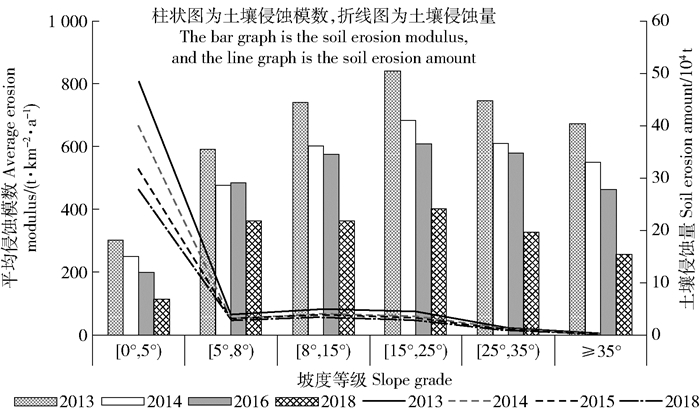
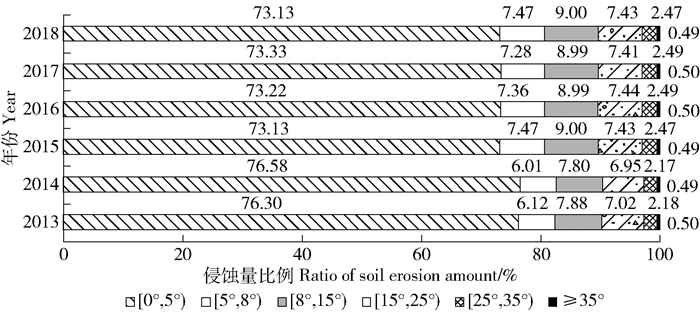
从土壤侵蚀模数上来看(图 4和图 5),在[0°,25°)坡度等级,平均土壤侵蚀模数随着坡度增加而增大,坡度越陡的地区在难以形成植被覆盖的条件下,潜在的土壤侵蚀量也较大。但在≥25°的坡度等级下,土壤侵蚀模数出现了一定程度的下降,其原因是坡度过陡时,降水在这一坡度等级地点停留时间缩短,快速形成径流转移至其他地点。在2013年较陡坡平均土壤侵蚀模数达到各年各坡度等级最高的841.40 t/(km2·a),但随着时间推移,各坡度带上的土壤侵蚀模数都出现逐步下降的情况。
从土壤侵蚀量上来看,主要的侵蚀量分布于[0°,5°)的微坡等级区域,该等级的土壤侵蚀量占到总侵蚀量>73%,微坡、较缓坡、缓坡等级在各年的侵蚀量分布都相对均匀。从各坡度带侵蚀量占比年际变化上来看,各年各坡度等级侵蚀量分布较为均衡,但2018年微坡等级侵蚀量占比较2013年有一定降低。总体上由于微坡等级面积较大,则微度等级土壤侵蚀量也较大;其他坡度等级因面积较小,尽管土壤侵蚀模数较微坡等级大,但其土壤侵蚀量小于总量的30%。
4 结论
1) 北京市房山区的年度土壤侵蚀总量,随着时间推移逐渐减少,自2013年至2018年土壤侵蚀总量减少58.86%,研究区的土壤侵蚀总量明显降低。
2) 在不同侵蚀强度面积中,房山区以微度侵蚀面积占比最大,各年度微度侵蚀面积占比均在55%以上;随时间推移微度侵蚀面积逐渐增加,自2013年55.74%增至2018年71.70%,则研究区的土壤侵蚀面积明显减少。
3) 在不同高程范围内,以[400,800) m高程区间的土壤侵蚀模数较高,以[0,800) m高程区间的土壤侵蚀量占比较大,各年占比均>60%。
4) 在不同坡度范围内,以[15°,25°)较陡坡等级的土壤侵蚀模数较高,以[0°,5°)微坡等级的土壤侵蚀量占比较大,各年微坡等级的土壤侵蚀量占比>73%。
本研究结论还局限于基于1 000 m卫星影像获取土地利用等数据的计算结果,研究区在更高分辨率(如2 m等)影像下表现的土壤侵蚀分布特征及其与本结果的差别还需要进一步研究。
5 参考文献
| [1] | |
| [2] | |
| [3] | |
| [4] |
朱春竹, 赵天忠, 孙若修, 等. 小流域水土保持效益评价系统的研建与应用——以北京市房山区蒲洼小流域为例[J]. 林业资源管理, 2018(1): 132. ZHU Chunzhu, ZHAO Tianzhong, SUN Ruoxiu, et al. Development andapplication of benefit evaluation system for soil and water conservation in small watersheds: A case study of Puwa Small Watershed in Fangshan district, Beijing[J]. Forest Resources Management, 2018(1): 132. |
| [5] |
黎俊佑, 马岚, 刘京晶, 等. 雨型对华北土石山区坡面土壤侵蚀的影响[J]. 水土保持学报, 2020, 34(4): 1. LI Junyou, MA Lan, LIU Jingjing, et al. Effects of rainfall patterns on slope soil erosion in the rocky mountain area of North China[J]. Journal of Soil and Water Conservation, 2020, 34(4): 1. |
| [6] |
章文波, 谢云, 刘宝元. 利用日雨量计算降雨侵蚀力的方法研究[J]. 地理科学, 2002, 22(6): 705. ZHANG Wenbo, XIE Yun, LIU Baoyuan. Rainfall erosivity estimation using daily rainfall amounts[J]. Scientia Geographica Sinica, 2002, 22(6): 705. DOI:10.3969/j.issn.1000-0690.2002.06.012 |
| [7] |
单奇华, 李卫正, 俞元春, 等. 南京城市林业土壤可蚀性及影晌因素[J]. 南京林业大学学报(自然科学版), 2008, 32(2): 47. SHAN Qihua, LI Weizheng, YU Yuanchun, et al. Erodibility of urban forest soil in Nanjing[J]. Journal of Nanjing Forestry University(Natural Science Edition), 2008, 32(2): 47. DOI:10.3969/j.issn.1000-2006.2008.02.010 |
| [8] |
符素华, 刘宝元, 周贵云, 等. 坡长坡度因子计算工具[J]. 中国水土保持科学, 2015, 13(5): 105. FU Suhua, LIU Baoyuan, ZHOU Guiyun, et al. Calculation tool of topographic factors[J]. Science of Soil and Water Conservation, 2015, 13(5): 105. DOI:10.3969/j.issn.1672-3007.2015.05.016 |
| [9] |
蔡梦雅. 植被盖度对土壤侵蚀模数计算的影响研究[D]. 长春: 东北师范大学, 2016: 14.
CAI Mengya. Effects of vegetation cover on soil erosion modulus calculation[D]. Changchun: Northeast Normal University, 2016: 14.
|
| [10] |
朱虹, 唐婷婷, 蔡艳蓉. 土壤侵蚀预报模型中的水土保持措施因子研究进展[J]. 科技展望, 2015(21): 222. ZHU Hong, TANG Tingting, CAI Yanrong. Progress on soil and water conservation factors in soil erosion prediction model[J]. Technology Outlook, 2015(21): 222. DOI:10.3969/j.issn.1672-8289.2015.21.196 |
| [11] | |
| [12] |
魏兰香. 基于USLE模型的祁连山南坡土壤保持量评估[D]. 西宁: 青海师范大学, 2017: 21.
WEI Lanxiang. Evaluation of soil conservation quantity of the southern slope of Qilian Mountains based on universal soil loss quation model[D]. Xining: Qinghai Normal University, 2017: 21.
|
 2021, Vol. 19