文章快速检索     高级检索
  中国水土保持科学   2021, Vol. 19 Issue (3): 72-80.  DOI: 10.16843/j.sswc.2021.03.009
0

引用本文 

邱德勋, 赵佰礼, 尹殿胜, 穆兴民, 高鹏. 黄土丘陵沟壑区土壤水分垂直变异及影响因素[J]. 中国水土保持科学, 2021, 19(3): 72-80. DOI: 10.16843/j.sswc.2021.03.009.
QIU Dexun, ZHAO Baili, YIN Diansheng, MU Xingmin, GAO Peng. Vertical variation of soil moisture in the loess hilly and gully region and its influence factors[J]. Science of Soil and Water Conservation, 2021, 19(3): 72-80. DOI: 10.16843/j.sswc.2021.03.009.

项目名称

国家重点研究计划专题计划“黄土高原水土流失综合治理技术及示范”(2016YFC0501707)

第一作者简介

邱德勋(1997-), 男, 硕士研究生。主要研究方向: 水土保持与生态水文学。E-mail: qiudexun97@163.com

通信作者简介

高鹏(1976-), 男, 博士, 研究员。主要研究方向: 水土保持与生态水文学。E-mail: gaopeng@ms.iswc.ac.cn

文章历史

收稿日期:2020-02-01
修回日期:2021-03-02
黄土丘陵沟壑区土壤水分垂直变异及影响因素
邱德勋 1,2, 赵佰礼 3, 尹殿胜 4, 穆兴民 1,2,3, 高鹏 1,2,3     
1. 中国科学院 水利部 水土保持研究所, 黄土高原土壤侵蚀与旱地农业国家重点实验室, 712100, 陕西杨凌;
2. 中国科学院大学, 100049, 北京;
3. 西北农林科技大学黄土高原土壤侵蚀与旱地农业国家重点实验室, 712100, 陕西杨凌;
4. 中水淮河规划设计研究有限公司, 230601, 合肥
摘要:以陕西安塞纸坊沟小流域为例,通过测定0~1 000 cm深度土壤含水量,分析不同坡度、坡向和土地利用方式下的土壤水分垂直变异特征。结果表明:1)不同土地利用方式下土壤水分垂直分布特征不同。乔木林地与灌木林地土壤含水量均在0~50 cm减小,而在50 cm以下乔木林地小幅波动,灌木林地缓慢增大。撂荒草地与农地土壤含水量逐渐升高,最后趋于稳定。2)乔木林地和灌木林地随退耕年限的增加,土壤水分减少,而撂荒草地差异不明显。3)浅层(0~200 cm)土壤含水量:撂荒草地(10.20%)>农地(10.04%)>灌木林地(9.39%)>乔木林地(8.91%);深层(200~1 000 cm)土壤含水量:农地(13.50%)>撂荒草地(13.34%)>灌木林地(11.66%)>乔木林地(7.87%)。表明撂荒草地能够较好地保持土壤水分,乔木林地则相对较差。4)坡度对撂荒草地浅层和乔木林地深层土壤水分有显著影响,土壤含水量随坡度增大而减小。坡向对乔木林地和撂荒草地浅层土壤水分有极显著影响,且阴坡土壤水分大于阳坡。总体上,土地利用方式、坡度及其交互作用对浅层土壤水分有显著影响,坡度的贡献率最大(34.85%),土地利用方式对深层土壤水分有显著影响,贡献率为23.03%。地形是浅层土壤水分变异的重要影响因素,而深层土壤水分则主要受土地利用方式的影响。
关键词土壤水分    垂直变异    地形因子    土地利用    黄土丘陵沟壑区    
Vertical variation of soil moisture in the loess hilly and gully region and its influence factors
QIU Dexun 1,2, ZHAO Baili 3, YIN Diansheng 4, MU Xingmin 1,2,3, GAO Peng 1,2,3     
1. State Key Laboratory of Soil Erosion and Dryland Farming on the Loess Plateau, Institute of Soil and Water Conservation, Chinese Academy of Sciences, 712100, Yangling, Shaanxi, China;
2. University of Chinese Academy of Sciences, 100049, Beijing, China;
3. State Key Laboratory of Soil Erosion and Dryland Farming on the Loess Plateau, Institute of Soil and Water Conservation, Northwest A&F University, 712100, Yangling, Shaanxi, China;
4. China Water Huaihe Planning Design and Research Co., Ltd., 230601, Hefei, China
Abstract: [Background] Soil moisture (SM) is one of the key factors for plant growth and eco-environment reconstruction on the Loess Plateau of China. Vertical variation of SM as affected by landform and land use was studied in the Zhifanggou watershed of Ansai county in Shaanxi province. [Methods] We selected 78 representative plots with four land use types in the whole watershed. Three sampling points were selected on the diagonal of each plot. The sampling depth ranged from 0 to 1 000 cm. A total of 40 samples were collected at each point by using a soil auger (10 cm intervals from 0 to 100 cm, 20 cm intervals from 100 cm to 500 cm, and 50 cm intervals from 500 cm to 1 000 cm). The average soil moisture, standard deviation and coefficient of variation of each layer were calculated. The effects of different factors on soil moisture were analyzed quantitatively by variance contribution rates. LSD multiple comparison and t-test were used to compare the differences of soil moisture under different conditions. [Results] 1) The vertical distribution characteristics of SM in 0-1 000 cm were different under different land use. With the increase of soil depth, the SM of the forest land decreased rapidly (0-50 cm) to 6%-9%. The SM of the bush land decreased first (0-50 cm) and then increased slowly. The SM of the abandoned grassland and the farmland increased gradually with the increase of soil depth, and finally stabilized. 2) In general, the longer vegetation age, the lower mean soil moisture. However, in the abandoned grassland, the trend was not obvious. 3) The SM in the shallow layer (0-200 cm): abandoned grassland (10.20%) > farmland (10.04%) > bush land (9.39%) > forest land (8.91%); in the deep layer (200-1 000 cm): farmland (13.50%) > abandoned grassland (13.34%) > bush land (11.66%) > forest land (7.87%). This indicated that the abandoned grassland maintained SM well, while the forest land was relatively poor. 4) The slope had a significant effect on the SM in the shallow layer of the abandoned grassland and the deep layer of the forest land. The steeper a slope was, the lower SM was observed. The aspect had a significant effect on the SM in the shallow layer of the forest land and the abandoned grassland, and the SM on the sunny slope was higher than the shade. On the whole, the SM and the coefficient of variation both decreased first and then increased, which showed a significant positive correlation. Land use, slope and their interaction had significant influence on the SM in shallow layer, the contribution rate of slope was the largest (34.85%), and land use had significant influence on the SM in deep layer, the contribution rate was 23.03%. [Conclusions] The SM in loess hilly and gully area had obvious vertical variation, and was affected jointly by land use, slope and aspect. Abandoned grassland may keep SM better, but forest land was relatively poor. Topography was an important factor affecting the variation of SM in shallow layer, while SM in deep layer was mainly affected by land use.
Keywords: soil moisture    vertical variation    topographic factors    land use    loess hilly and gully region    

黄土高原丘陵沟壑区处于我国干旱和半干旱地区,降水稀少,地表水资源匮乏,地下水埋深而难以利用[1]。土壤水分几乎是植被唯一可利用的有效水资源,成为决定生态系统结构和功能的关键因子[2-3]。土壤水分受多种因素影响,包括气候、植被、地形、土壤特性等,在坡面、流域等较小尺度上,土壤水分主要受植被、地形影响[4]。1999年,我国政府实行以退耕还林(草)为主的植被恢复措施,区域生态环境得到改善的同时改变原有的土地利用方式,影响土壤水分的空间分布格局[5]。不合理的退耕还林(草)方式会加快土壤水分的消耗,使土壤含水量降低,造成土壤干层现象[6],阻碍生态系统的恢复与改善。地形主要是通过影响坡面的光照、气温、降水、土壤性质和植被格局,使土壤水分含量存在很大差异[7]。通过了解土壤水分分布状况,掌握不同土地利用方式下土壤水分动态变化,以及地形因子对土壤水分变异的影响,对于改善黄土丘陵沟壑区的农业生产、植被恢复和土地的合理利用具有重要的指导意义。

目前,对于黄土高原土壤水分变异性及影响因素的研究取得众多成果。王云强等[8]发现黄土高原地区土壤水分在垂直方向上(0~500 cm)表现出先减小后增加的分布特征。杨磊等[9]认为坡面尺度浅层土壤水分的空间分异主要受地形驱动,深层水分空间分异特征与浅层水分截然相反。在较小尺度上(流域、坡面等),地形和土地利用是影响土壤水分异质性的重要因素[10]。张瑞等[11]发现小流域尺度土地利用和地形对土壤水分具有显著的交互作用。当前关于土壤水分空间异质性的研究多集中在农田[12]、林地[13],将地形因子与不同土地利用方式相结合来探讨土壤水分垂直变异的相关研究较为缺乏。且多数研究只关注浅层地表(< 500 cm)的水分空间变化,而深层土壤水分是维持该地区人工植被生长和生态系统健康的重要水分来源[9],其与地表植被及地形的关系仍有待深入研究[14]。因此,笔者以典型黄土丘陵沟壑区纸坊沟流域为例,选取不同坡度和坡向的乔木林地、灌木林地、撂荒草地和农地为研究对象,测定0~1 000 cm深度土壤水分,探讨不同地形和土地利用方式下土壤水分的垂直分布与变化,旨在揭示黄土丘陵沟壑区土壤水分垂直变异特征及影响因素,为该区生态系统恢复与水资源短缺有效治理提供科学的理论依据。

1 研究区概况

纸坊沟流域位于陕西省安塞区(E 109°13′46″~109°16′3″,N 36°42′42″~36°46′28″),属于典型的黄土丘陵沟壑区,是延河支流杏子河下游的一级支沟。流域呈南北向狭长形,海拔1 041.50~1 425.71 m,总面积约8.27 km2。该地区属暖温带半干旱季风气候,年均气温8.8℃,年均降水量549.1 mm,降水年内分配不均,枯水年降水量只有300 mm左右,丰水年可达700 mm以上,雨季(7-9月)降水量占全年降水量的61.1%。土壤类型主要为黄绵土[15],质地为砂壤土。研究区主要的土地利用方式为林地、灌木地、草地、农地、果园、苗圃、撂荒地等。

2 材料与方法 2.1 研究方法

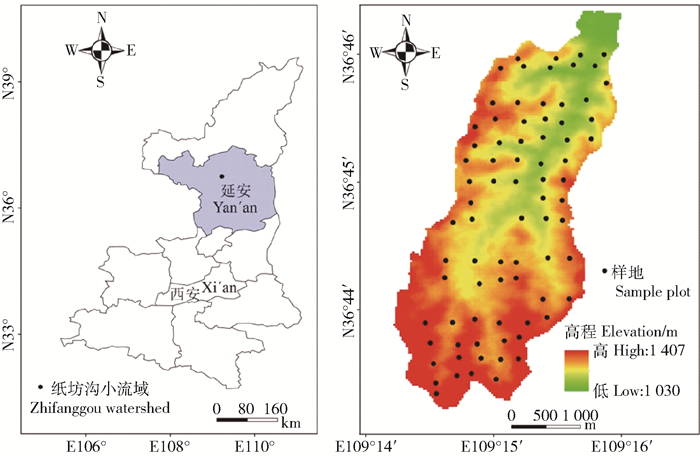
根据纸坊沟流域土地利用方式和退耕年限,同时结合地形特征,应用不规则网格布点法(200 m×200 m),相对均匀地选择78个样地(图 1)。各类土地利用面积、样地数及其比例见表 1。野外采样于2019年4-6月进行,采用传统的人工土钻取样法在每个样地对角线上选择3个样点进行采样,采样深度为1 000 cm,每个采样点共收集40个土壤样品(0~100 cm,间隔10 cm取样;100~500 cm,间隔20 cm取样;500~1 000 cm,间隔50 cm取样)。由于部分沟道和梁上深层存在岩石,有5个点采样深度 < 900 cm。土壤样品置于铝盒中并密封,带回实验室采用烘干法(105~110 ℃,12 h)测定土壤质量含水量。基于1 m分辨率的数字高程模型(digital elevation model,DEM)及实地考察,将南偏东/西15°以内作为阳坡,北偏东/西15°以内作为阴坡,样地坡度均在0~40°之间。乔木林地(15、20、30、40 a)、灌木林地(20、40 a)和撂荒草地(15、20 a)的退耕年限通过询问当地居民获取。其中,乔木林地的主要植被类型为刺槐(Robinia Pseudoacacia)和山杏(Armeniaca sibirica),灌木林地主要为沙棘(Hippophae rhamnoides)和柠条(Caragana intermedia),撂荒草地的优势物种主要为沙打旺(Astragalus adsurgens)、铁杆蒿(Artemisia gmelinii)和长芒草(Stipa bungeana)等。分析土地利用对土壤水分的影响时,选择坡度、坡向相似的18个样地(15°~20°,阳坡),即乔木林地8个、灌木林地3个、撂荒草地5个、农地2个。选取刺槐林地(10°和26°)、灌木林地(8°和25°)和撂荒草地(12°和28°)研究不同坡度下的土壤水分状况。选取不同坡向的乔木林地和撂荒草地各3个,对比阴、阳坡土壤水分状况。根据降水的补给影响[16-17]和植物根系的分布[18],将200 cm定为分界深度,把1 000 cm的土层人为划分为2层,分别为0~200 cm和200~1 000 cm,分析浅层与深层土壤水分的数量差异。

图 1 纸坊沟小流域地理位置及样地分布 Fig. 1 Distribution of the sample plot in the Zhifanggou watershed
表 1 流域内各类土地利用面积、样地数及其比例 Tab. 1 Quantity of sample plots and area of different land use as well as their proportions
2.2 数据处理

采用SPSS 16.0软件进行数据统计与分析,计算各层土壤含水量、标准差以及变异系数。对土壤含水量与变异系数进行相关分析;通过一般线性模型(GLM)中的单因素方差分析,分析各影响因子的显著性,并计算方差贡献率;采用LSD多重比较,比较不同土地利用方式下土壤含水量均值差异;采用t检验分别对比阴、阳坡和2组不同坡向的土壤含水量均值差异。每个样地每层的土壤含水量用所在样地的3个重复采样点相应土层的算术平均值表示。

3 结果与讨论 3.1 土地利用方式对土壤水分的影响

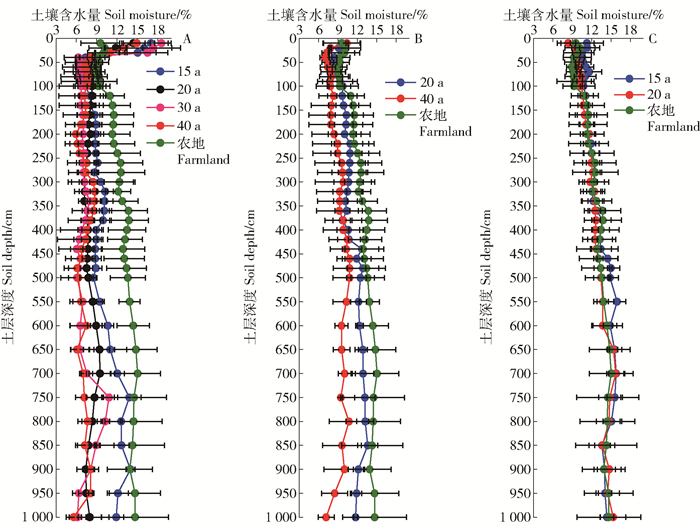
以农地为对照,分析不同退耕年限下乔木林地(15、20、30、40 a)、灌木林地(20、40 a)和撂荒草地(15、20 a)的土壤水分垂直分布规律(图 2)。随着土层深度增加,退耕20、30、40 a的乔木林地土壤含水量在0~50 cm土层范围内迅速降低,之后相对稳定,整体上处于较低水平(6%~9%),根据王力等[6]对黄土高原土壤干层程度的划分标准(土壤含水量 < 6%为严重干层),退耕20 a以上的乔木林地土壤干层现象较为严重。而退耕15 a的乔木林地土壤含水量呈现先降低后升高的趋势。农地土壤含水量先缓慢升高之后基本稳定。灌木林地土壤含水量整体上呈先降低(0~50 cm)后升高的趋势,但退耕40 a的土壤含水量出现小幅下降的现象。撂荒草地(15、20 a)土壤含水量随土层深度增加而逐渐升高,最后趋于稳定,与农地含水量接近,并且变化趋势相似。当退耕年限同为20 a时,土壤含水量为:撂荒草地>灌木林地>乔木林地。对于乔木林地和灌木林地,土壤水分随退耕年限的增加而减小,但撂荒草地差异不明显。这表明撂荒草地能够较好地保持土壤水分,乔木林地则相对较差。这与安文明等[19]的研究结论一致,即撂荒草地是比人工刺槐林地更为合理的植被恢复方式。

图 2 乔木林地(A)、灌木林地(B)和撂荒草地(C)土壤水分垂直分布特征 Fig. 2 Vertical distribution of soil moisture in forest land (A), bush land (B) and abandoned grassland (C)

分别对4种土地利用方式0~200和200~1 000 cm的土壤含水量进行统计分析(表 2)。在浅层(0~200 cm),乔木林地的含水量变化幅度较大,其变化范围在7.78%~14.40%之间,但平均含水量最低,仅为8.91%;撂荒草地含水量最高,平均含水量达10.20%,在8.38%~11.65%之间波动。土壤含水量为:撂荒草地(10.20%)>农地(10.04%)>灌木林地(9.39%)>乔木林地(8.91%)。LSD多重比较显示,乔木林地与撂荒草地、农地的土壤含水量差异显著(P < 0.05)。深层(200~1 000 cm)土壤含水量则有所不同,乔木林地含水量最低,并且低于浅层(0~200 cm),平均值仅为7.87%,在7.17%~9.48%之间波动;土壤含水量最高的是农地,在11.52%~15.03%之间波动,平均值为13.50%。土壤含水量为:农地(13.50%)>撂荒草地(13.34%)>灌木林地(11.66%)>乔木林地(7.87%)。其中,除草地与农地土壤含水量无显著差异,其余土地利用方式之间的土壤含水量均通过0.05显著性水平检验。

表 2 不同土地利用方式下土壤含水量特征值 Tab. 2 Characteristic values of soil moisture in different land use

以刺槐为主的乔木林地根系长且密度大,对土壤水分吸收作用强,同时受林冠截留影响[20],土壤可补给水量减少,植被的蒸腾作用也会加强土壤水分散失,使乔木林地土壤水分长期处于欠饱和状态,土壤含水量整体较低且变异系数较大。而撂荒草地由于水分利用深度相对较小,地表存在较多的地面枯草层,可减少蒸散量、增加土壤水库积蓄与贮存[21],土壤含水量整体较高且变异系数较小。农地多为1年生作物,其蒸腾耗水量相对较小,人工耕作也会破坏毛管水的连续性,进而减小土壤水分的蒸发损失[8],因此深层土壤水分含量高且变异性小。

3.2 坡度对土壤水分的影响

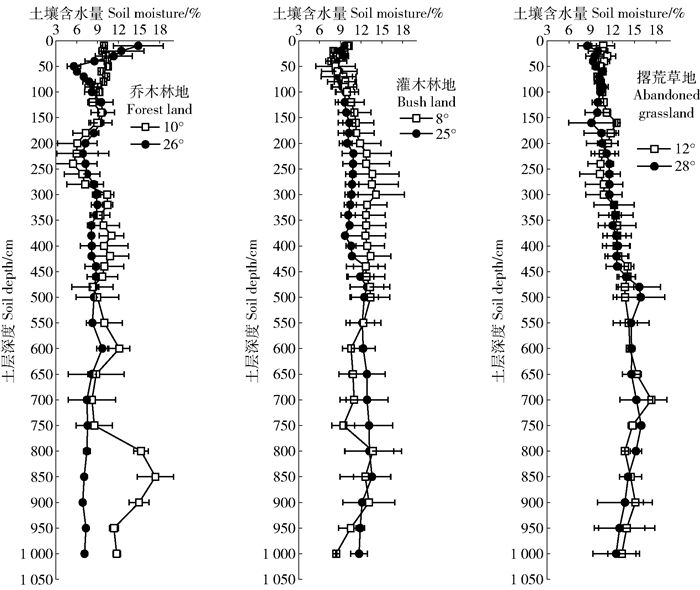
选取10°和26°乔木林地、8°和25°灌木林地以及12°和28°撂荒草地,对比相同土地利用方式下坡度对土壤水分的影响。各样点坡向一致(阳坡),对照组内退耕年限一致(20 a)。由图 3可知,相同土地利用方式下不同坡度的水分垂直分布特征不同。上层土壤水分具有一定差异,中层土壤水分较为接近,下层土壤水分差异较大。而不同土地利用方式的3个层次所处的土壤深度有所不同。其中,乔木林地的上、中、下层分别处于0~100、100~300和300~1 000 cm;灌木林地的上、中、下层分别处于0~50、50~200和200~1 000 cm;撂荒草地的上、中、下层分别处于0~200、200~450和450~1 000 cm。主要原因是不同植被类型的根系分布和耗水程度存在差异,这与杨磊等[9]人的研究结果基本一致。

图 3 不同坡度土壤水分的垂直分布特征 Fig. 3 Vertical distribution of soil moisture in different slope

比较2个不同坡度下的土壤含水量均值并进行t检验可知(表 3),在浅层(0~200 cm),坡度为12°撂荒草地土壤含水量比28°撂荒草地高0.953%,二者之间有显著差异(P < 0.01),坡度越大,土壤含水量越低。而坡度为10°与26°乔木林地土壤含水量差异不显著,坡度为8°与25°灌木林地土壤含水量差异也不显著;在深层(200~1 000 cm),坡度为10°和26°撂荒草地深层土壤含水量具有显著差异(P < 0.01),坡度越大,土壤含水量越低。而坡度为8°与25°灌木林地土壤含水量差异不显著,坡度为12°与25°撂荒草地土壤含水量差异也不显著。乔木林地与灌木林地根系发达,消耗的水分较多,在一定程度上减弱了坡度对土壤水分的影响。而乔木林地在陡坡上的种植密度小于缓坡,这可能是坡度对深层水分影响显著的主要原因。草地生物量相对较小,受降水与蒸发的影响更加显著,坡度大不利于降水入渗,土壤含水量变小。草地的根系分布较浅,且降水的影响主要集中在浅层土壤,因此坡度对撂荒草地深层土壤的影响不大。

表 3 不同坡度0~200和200~1 000 cm深度土壤含水量均值比较 Tab. 3 Comparison of mean soil moisture in different slope of 0~200 cm and 200~1 000 cm 
3.3 坡向对土壤水分的影响

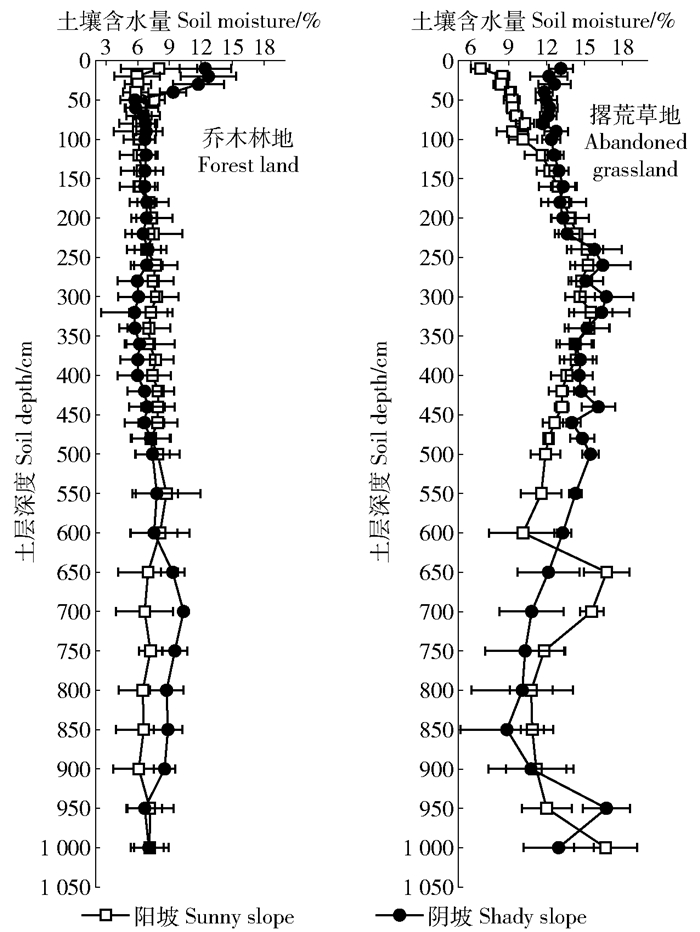
选取不同坡向的乔木林地和撂荒草地,分析同种土地利用方式下土壤水分的坡向差异。各样点坡度一致(20°),对照组内退耕年限一致(20 a)。由图 4可知,阴坡乔木林地上层(< 50 cm)土壤含水量明显高于阳坡,中层(50~600 cm)较为接近,下层(>600 cm)阴坡高于阳坡,但整体上垂直分布规律相似。阴坡撂荒草地上层(< 150 cm)土壤含水量高于阳坡,中层(150~400 cm)较为接近,下层(>400 cm)阴、阳坡的土壤含水量垂直分布无明显规律性。

图 4 不同坡向土壤水分的垂直分布特征 Fig. 4 Vertical distribution of soil moisture in different aspect

对阴坡与阳坡的土壤含水量均值进行t检验可知(表 4),乔木林地和撂荒草地阴、阳坡浅层(0~200 cm)土壤含水量差异显著(P < 0.05),土壤水分阴坡比阳坡分别高1.394%和2.221%,但深层(200~1 000 cm)土壤含水量无显著差异。坡向仅对乔木林地和撂荒草地浅层土壤水分有极显著影响(P < 0.01),进一步说明坡向并非深层土壤水分空间变异的主要影响因子。这与前人的研究结论[19]相一致,即坡向通过影响地表太阳辐射而影响地温,进而间接影响土壤水分蒸发和植被蒸腾[22],导致阴坡的土壤含水量相对较高。

表 4 不同坡向0~200 cm和200~1 000 cm深度土壤含水量均值比较 Tab. 4 Comparison of mean soil moisture in different aspect of 0~200 cm and 200~1 000 cm 
3.4 土壤水分分布及影响因子分析

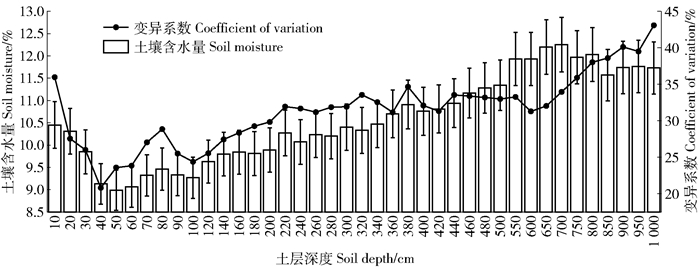
对各采样点不同深度的土壤含水量及变异系数进行统计分析(图 5)。随着土层深度增加,土壤含水量总体上呈先减小后增大的趋势,最小值出现在40~50 cm土层,最大值出现在650~700 cm土层,分别为8.99%和12.25%,变化幅度为3.26%。变异系数的变化与土壤含水量在垂直方向上的分布特征具有一致性,即土壤水分的水平变异性也是先减小后增大。变异系数介于20.81%~43.08%之间,属中等程度变异。变异系数较大的土层位于0~10 cm和700~1 000 cm(>35%),较小的土层位于20~60 cm和80~120 cm(< 26%)。土壤含水量与变异系数的Pearson相关系数为0.816,呈极显著的正相关(P < 0.01)。这是因为表层土壤水分受降雨、蒸发等影响较大,变异程度高[23],而不同的土地利用方式、结构及其空间格局增加了深层土壤水分的变异性[9]。此外,黄土高原古土壤层的存在也会影响土壤水分的数量及其变异程度[8]

图 5 各土层平均土壤含水量及变异系数 Fig. 5 Soil moisture and coefficient of variation in each soil layer

通过一般线性模型(GLM)中的单因素方差分析,得到不同层次下土地利用方式、坡度、坡向及其交互作用的显著性,并计算方差贡献率(表 5)。在0~200 cm土层,土地利用方式、坡度及其交互作用对平均土壤含水量均有显著影响(P < 0.01),而坡向没有显著影响。坡度的贡献率最大,达到34.85%。在200~1 000 cm土层,只有土地利用方式对土壤含水量有显著影响(P < 0.01),贡献率为23.03%。坡度、坡向的影响均不显著。这主要是因为浅层(0~200 cm)土壤水分消耗主要受植被蒸腾和强烈的土壤物理蒸发两个生态水文过程的影响,而深层(200~1 000 cm)土壤水分作为“土壤水库”的重要组成部分,其消耗则主要是地表林草植被强烈蒸腾的作用,地形因子产生的影响较小。另外,本研究采样时间为生长季节的中期(4-6月),此阶段土壤水分变异主要受土地利用方式影响。除土地利用与地形之外,不同深度的土壤物理性质,如土壤质地(沙壤土、中壤土、重壤土)等也可能会对土壤水分产生影响[8]

表 5 土地利用方式、坡度、坡向对不同深度土壤含水量的影响 Tab. 5 Effects of land use, slope and aspect on soil moisture in different soil layers
4 结论

1) 随着土层深度增加,乔木林地土壤含水量迅速降低(0~50 cm)至6%~9%后小幅波动变化。灌木林地土壤含水量整体上呈先降低(0~50 cm)后升高的趋势。撂荒草地与农地土壤含水量均随土层深度增加而逐渐升高,最后趋于稳定。

2) 乔木林地和灌木林地随退耕年限的增加,土壤水分减少,而撂荒草地差异不明显。

3) 浅层(0~200 cm)土壤含水量:撂荒草地(10.20%)>农地(10.04%)>灌木林地(9.39%)>乔木林地(8.91%);深层(200~1 000 cm)土壤含水量:农地(13.50%)>撂荒草地(13.34%)>灌木林地(11.66%)>乔木林地(7.87%)。这表明撂荒草地能够较好地保持土壤水分,乔木林地则相对较差。

4) 坡度对撂荒草地浅层和乔木林地深层土壤水分有显著影响,坡度越大,土壤含水量越低。坡向对乔木林地和撂荒草地浅层土壤水分有极显著影响,且阴坡土壤水分大于阳坡。

总体上,随着土层深度的增加,土壤含水量与变异系数均呈先减小后增大的趋势,二者呈极显著的正相关。浅层(0~200 cm)土壤水分受土地利用方式、坡度及其交互作用的显著影响,坡度的贡献率最大(34.85%),而深层(200~1 000 cm)土壤含水量只受土地利用方式的显著影响,贡献率为23.03%。因此,地形是浅层土壤水分变异的重要影响因素,而深层土壤水分则主要受土地利用方式的影响。

5 参考文献
[1]
姚雪玲, 傅伯杰, 吕一河. 黄土丘陵沟壑区坡面尺度土壤水分空间变异及影响因子[J]. 生态学报, 2012, 32(16): 4961.
YAO Xueling, FU Bojie, LÜ Yihe. Spatial patterns of soil moisture at transect scale in the Loess Plateau of China[J]. Acta Ecologica Sinica, 2012, 32(16): 4961.
[2]
胡伟, 邵明安, 王全九. 黄土高原退耕坡地土壤水分空间变异性研究[J]. 水科学进展, 2006, 17(1): 74.
HU Wei, SHAO Ming'an, WANG Quanjiu. Study on spatial variability of soil moisture on the recultivated slope-land on the Loess Plateau[J]. Advances in Water Science, 2006, 17(1): 74. DOI:10.3321/j.issn:1001-6791.2006.01.012
[3]
裴艳武, 黄来明, 贾小旭, 等. 黄土高原2种典型灌木地土壤水分有效性及其影响因素[J]. 土壤学报, 2019, 56(3): 627.
PEI Yanwu, HUANG Laiming, JIA Xiaoxu, et al. Soil water availability and its influencing factors in soils under two types of shrubberies typical of the Loess Plateau[J]. Acta Pedologica Sinica, 2019, 56(3): 627.
[4]
CHEN Liding, HUANG Zhilin, GONG Jie, et al. The effect of land cover/vegetation on soil water dynamic in the hilly area of the Loess Plateau, China[J]. Catena, 2007, 70(2): 200. DOI:10.1016/j.catena.2006.08.007
[5]
薛志婧, 马露莎, 安韶山, 等. 黄土丘陵区小流域尺度土壤有机碳密度及储量[J]. 生态学报, 2015, 35(9): 2917.
XUE Zhijing, MA Lusha, AN Shaoshan, et al. Soil organic carbon density and stock at the catchment scale of a hilly region of the Loess Plateau[J]. Acta Ecologica Sinica, 2015, 35(9): 2917.
[6]
王力, 邵明安, 侯庆春. 延安试区土壤干层现状分析[J]. 水土保持通报, 2000, 20(3): 35.
WANG Li, SHAO Ming'an, HOU Qingchun. Status of dried Soil layer in the Yan'an experimental area[J]. Bulletin of Soil and Water Conservation, 2000, 20(3): 35. DOI:10.3969/j.issn.1000-288X.2000.03.010
[7]
刘鑫, 毕华兴, 李笑吟, 等. 晋西黄土区基于地形因子的土壤水分分异规律研究[J]. 土壤学报, 2007, 44(3): 411.
LIU Xin, BI Huaxing, LI Xiaoyin, et al. Variation of soil moisture in relation to topographic factors in loess region of West Shanxi[J]. Acta Pedologica Sinica, 2007, 44(3): 411. DOI:10.3321/j.issn:0564-3929.2007.03.005
[8]
王云强, 邵明安, 刘志鹏. 黄土高原区域尺度土壤水分空间变异性[J]. 水科学进展, 2012, 23(3): 310.
WANG Yunqiang, SHAO Ming'an, LIU Zhipeng. Spatial variability of soil moisture at a regional scale in the Loess Plateau[J]. Advances in Water Science, 2012, 23(3): 310.
[9]
杨磊, 卫伟, 陈利顶, 等. 黄土丘陵沟壑区深层土壤水分空间变异及其影响因子[J]. 生态与农村环境学报, 2012, 28(4): 355.
YANG Lei, WEI Wei, CHEN Liding, et al. Spatial variation of deep soil water in the loess hilly and gully regions and its influencing factors[J]. Journal of Ecology and Rural Environment, 2012, 28(4): 355. DOI:10.3969/j.issn.1673-4831.2012.04.004
[10]
YAO Xueling, FU Bojie, LÜ Yihe, et al. The multi-scale spatial variance of soil moisture in the semi-arid Loess Plateau of China[J]. Journal of Soils and Sediments, 2012, 12(5): 694. DOI:10.1007/s11368-012-0481-5
[11]
张瑞, 曹华, 王云强, 等. 黄土丘陵沟壑区小流域土壤水分空间变异性及其影响因素[J]. 水土保持研究, 2012, 19(5): 52.
ZHANG Rui, CAO Hua, WANG Yunqiang, et al. Spatial variability of soil moisture and its influence factors in watershed of gully region on the Loess Plateau[J]. Research of Soil and Water Conservation, 2012, 19(5): 52.
[12]
YANG Lei, WEI Wei, CHEN Liding, et al. Response of temporal variation of soil moisture to vegetation restoration in semi-arid Loess Plateau, China[J]. Catena, 2014(115): 123.
[13]
ZANG Hao, LEI Xiangdong, MA Wu, et al. Spatial heterogeneity of climate change effects on dominant height of larch plantations in northern and northeastern China[J]. Forests, 2016, 7(7): 151.
[14]
刘志鹏, 邵明安. 黄土高原小流域土壤水分及全氮的垂直变异[J]. 农业工程学报, 2010, 26(5): 71.
LIU Zhipeng, SHAO Ming'an. Vertical variations of soil moisture and total nitrogen in small catchment on Loess Plateau[J]. Transactions of the CSAE, 2010, 26(5): 71.
[15]
HU Guangyin, DONG Zhibao, LU Junfeng, et al. The developmental trend and influencing factors of aeolian desertification in the Zoige Basin, eastern Qinghai-Tibet Plateau[J]. Aeolian Research, 2015, 19(Part B): 275.
[16]
杨维西. 试论我国北方地区人工植被的土壤干化问题[J]. 林业科学, 1996, 32(1): 78.
YANG Weixi. The preliminary discussion on soil desiccation of artificial vegetation in the northern regions of China[J]. Scientia Silvae Sinicae, 1996, 32(1): 78.
[17]
杨文治, 马玉玺, 韩仕峰. 黄土高原地区造林土壤水分生态分区研究[J]. 水土保持学报, 1994, 8(1): 1.
YANG Wenzhi, MA Yuxi, HAN Shifeng. Soil water ecological regionalization of afforestation in Loess Plateau[J]. Journal of Soil and Water Conservation, 1994, 8(1): 1. DOI:10.3321/j.issn:1009-2242.1994.01.005
[18]
赵忠, 李鹏, 王乃江. 渭北黄土高原主要造林树种根系分布特征的研究[J]. 应用生态学报, 2000, 11(1): 37.
ZHAO Zhong, LI Peng, WANG Naijiang. Distribution patterns of root systems of main planting tree species in Weibei Loess Plateau[J]. Chinese Journal of Applied Ecology, 2000, 11(1): 37. DOI:10.3321/j.issn:1001-9332.2000.01.010
[19]
安文明, 梁海斌, 王聪, 等. 黄土高原阴/阳坡向林草土壤水分随退耕年限的变化特征[J]. 生态学报, 2017, 37(18): 6120.
AN Wenming, LIANG Haibin, WANG Cong, et al. Dynamic characteristic of soil water with an increase in restoration years on the shady and sunny slope aspects of the Loess Plateau[J]. Acta Ecologica Sinica, 2017, 37(18): 6120.
[20]
王爱娟, 章文波. 林冠截留降雨研究综述[J]. 水土保持研究, 2009, 16(4): 55.
WANG Aijuan, ZHANG Wenbo. Reviews of vegetation interception of rainfall[J]. Research of Soil and Water Conservation, 2009, 16(4): 55.
[21]
程积民, 万惠娥, 王静, 等. 黄土丘陵半干旱区天然草地土壤水分调控研究[J]. 草地学报, 2003, 11(4): 296.
CHENG Jimin, WAN Huie, WANG Jing, et al. Soil water regulation of the natural grassland of semi-arid loess hilly region[J]. Acta Agrestia Sinica, 2003, 11(4): 296.
[22]
徐学选, 刘文兆, 高鹏, 等. 黄土丘陵区土壤水分空间分布差异性探讨[J]. 生态环境, 2003, 12(1): 52.
XU Xuexuan, LIU Wenzhao, GAO Peng, et al. The discussion on soil moisture distributional diversity in hilly Loess Plateau region[J]. Ecology and Environment Sciences, 2003, 12(1): 52. DOI:10.3969/j.issn.1674-5906.2003.01.014
[23]
王瑜, 朱清科, 赵维军, 等. 陕北黄土区人工林地土壤水分的垂直变化规律[J]. 中国水土保持科学, 2015, 13(6): 54.
WANG Yu, ZHU Qingke, ZHAO Weijun, et al. Vertical distribution of soil moisture in artificial forests in loess region of northern Shaanxi[J]. Science of Soil and Water Conservation, 2015, 13(6): 54. DOI:10.3969/j.issn.1672-3007.2015.06.008