基于南方结构化植被指数的植被覆盖管理因子遥感反演
代侨

,
林杰

,
朱燕芳
,
潘颖
,
董波
,
许彦崟
南方现代林业协同创新中心, 江苏省水土保持与生态修复重点实验室, 210037, 南京
收稿日期:2019-11-26; 修回日期:2021-03-07
项目名称:国家自然科学基金面上项目“基于侵蚀与沉积过程的林下水蚀区碳源汇效益研究”(31870600);国家重点研发项目“特色生态衍生产业关键技术研究与示范”(2017YFC0505505);江苏高校优势学科建设工程资助项目(PAPD)
摘要:为探索不同尺度植被覆盖与管理措施因子C的最佳估算模型,以南京市为研究区域,利用南方结构化植被指数(The southern structured vegetation cover index,Vs)对C因子进行估算。在坡面尺度,将不同植被类型Vs与C因子进行拟合;在区域尺度,借助Vs筛选最佳遥感指数,进而遥感反演C因子。结果表明:1)基于Vs估算C因子有效提高模型精度。2)C因子对黄度指数更加敏感,因此衰老植被和枯枝落叶覆盖对于地表土壤的保护作用是不容忽视的。3)基于最佳遥感指数反演C因子,模型R2=0.598,ME>0.5,因此该模型被推荐用于大尺度下的C因子估算。Vs有效地筛选遥感指数,且黄度指数和绿度指数相结合估计C因子更加精准。
关键词:遥感指数 结构化植被指数 模型 C因子
Remote sensing inversion of vegetation cover management factor based on the southern structured vegetation cover index
Co-Innovation Center for Sustainable Forestry in Southern China, Key Laboratory of Soil and Water Conservation and Ecological Restoration of Jiangsu Province, 210037, Nanjing, China
植被覆盖与管理措施因子(C)是评价径流冲刷和雨滴击溅能力的重要指标,如ULSE,RULSE等模型均以C因子作为预测水土流失模型的关键参数之一,因此,不同尺度C值的估算方法成为研究热点之一。C值的估算通常有4种方法:1)赋值法,该方法会引入分类误差。Panagos等[1]对赋值法进行改进,增加覆盖管理因子Carable(Carable=Ccrop×Cmanagement);但仅适用于坡面尺度C值的估算,而且需要国家级的数据库支撑。2)通过传统植被盖度(vegetation coverage,Vc)估算C因子,此类模型受空间异质性影响,且忽略植被的垂直结构对水土流失的控制作用。3)基于波段组合或植被指数的遥感信息反演C因子;投影覆盖通常用于此模型,但是投影覆盖无法反映植被垂直结构对水土保持的贡献。4)叶面积指数法,该方法可以反映植被的水平覆盖和垂直结构[2]。然而传统的叶面积指数方法成本高,破坏大无法应用于区域尺度的研究;激光雷达方式获取叶面积指数的成本高,飞行区域有限,同时为充分体现垂直结构需要多角度数据,而多角度的重叠会带来一定的误差[3-4]。
Wen等[5]提出分层植被覆盖指数,展现垂直结构中各植被层的水土保持作用。分层植被覆盖指数基于黄土高原地区的植被状况开展的,由于空间异质性的影响导致模型应用于南方地区出现较大的误差;此分层植被覆盖指数尚未与C因子建立联系。Feng等[6]在安塞地区对温仲明的分层覆盖指数进行验证,并重新构建C因子与遥感指数的关系模型,发现该指数适用于落叶树种为主的地区。由于常绿树种为主的地区黄度指数的无法提取,本文针对南方地区C因子的研究现状,以常绿树种为主的南京为研究区域,实现2点目标:1)基于朱燕芳[7]南方丘陵山区结构化植被指数建立南方结构化植被指数与C因子之间的关系方程,首次建立南方结构化植被指数与C因子之间的关系,为坡面尺度的C因子估算提供新方法;2)将南方结构化植被指数(The southern structured vegetation cover index)Vs引入最佳遥感指数筛选过程,将植被的垂直结构和水平覆盖与遥感数据结合,提供遥感反演C因子的新思路,提高区域尺度C因子的估算精度。
1 研究区概况
南京地处长江下游中部地区,江苏省西南部,介于E 118°22′~119°14′,N 31°14′~32°37′之间。地形以低山、丘陵为主,以环状山、条带山和箕状盆地为主。属北亚热带季风气候区,四季分明,雨量充沛,年平均气温为16 ℃,年平均降水时间为117 d,年平均降水量为1 106 mm,无霜期为237 d。南京北、中部广大地区土壤为黄棕壤(地带性土壤),南部与安徽省接壤处有小面积红壤。植被类型属于常绿落叶阔叶混交林。南京地区人口密集,属于农业活动强烈区;现有植被多属次生林,人工林面积大于自然恢复的次生林。
2 材料与方法
2.1 数据采集
2.1.1 遥感影像数据与预处理
影像选取:与采样时间一致,为当年7—9月,雨热同期,植被生理活动旺盛,是体现研究区内植被状况和土壤侵蚀的最佳时段[8]。为保证影像提取精度,尽量选取无云覆盖的高质量影像,因此选取时间为2017年7月21日的Landsat 8 OLI卫星影像数据,轨道号为120/38。
2.1.2 野外调查
野外采样时间为2017年7—9月,结合研究区的地形条件与实地考察结果,按不同植被类型(针叶林、阔叶林、针阔混交林、竹林、灌草地和草地)和不同垂直结构(乔灌草、乔草、乔、灌草、草),选取研究区域8个辖区16座山脉87个典型样方(30 m×30 m),考虑到遥感像元采样间距>30 m,样点按空间分布均匀原则布设(图 1)。详细调查并记录样点的经纬度、高程、坡度、坡位、土地利用现状、枯枝落叶层厚度、乔、灌、草植物种类及树高等详细信息,如表 1所示。
表 1(Tab. 1)
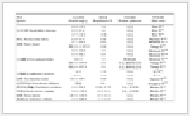
表 1 不同植被群落取样地数量
Tab. 1 Sample sites of different vegetation community
按植被类型分类
Classified by vegetation types |
草地
Grassland |
灌草地
Shrub-land |
阔叶林
broad-leaved forest |
针叶林
Coniferous forest |
针阔混交林
Theropencedrymion |
竹林
Bamboo forest |
| 取样地数目Number of sampling sites |
10 |
7 |
33 |
8 |
26 |
3 |
按植被垂直结构分类
Classified by vegetation vertical structure |
草Grass |
灌草
Shrub+Grass |
乔
Trees |
乔草
Trees+Grass |
乔灌草
Trees+Shrub+Grass |
|
| 取样地数目Number of sampling sites |
10 |
7 |
1 |
30 |
39 |
|
|
表 1 不同植被群落取样地数量
Tab. 1 Sample sites of different vegetation community
|
植被盖度采样方法如下: 乔木层:样方取10 m×10 m,采取五点采样法,将配有鱼眼镜头的相机平行于地面垂直向上拍摄,避免太阳直射,将5张鱼眼照片按样方编号。利用软件CanopOn2,提取乔木层植被盖度,取平均值作为该样方乔木层植被盖度的实测值(canopy vegetation coverage, CVC)。草被层:在乔木样方内选取五个1 m×1 m小样方,将相机平行于地面垂直向下拍摄,按样方编号共拍摄5张。其盖度按植被绿色部分占整个照片的比例提取[9]。灌木层:在乔木样方内选取树高不超过1 m的乔木作为灌木样方,大小为5 m×5 m,用皮尺测得灌木植株南北方向和东西方向的冠幅,求出冠幅面积,按灌木冠幅面积占样方面积的比例提取灌木层植被盖度。
2.1.3 遥感指数的选取
遥感指数包括绿度指数与黄度指数,绿度指数对绿色植被敏感;而黄度指数反映植被整体凋萎程度,植被缺水状况、作物成熟等状况。因此C因子的遥感反演黄度指数和绿度指数皆不可或缺的[10]; 因此,选取常用的2个黄度指数和7个绿度指数[11-12]:归一化耕作指数(normalized difference tillage index, NDTI)、归一化差异衰败指数(normalized difference senescent vegetation index, NDSVI)、归一化植被指数(normalized difference vegetation index, NDVI)、比值植被指数(ratio vegetation index,RVI)、土壤调节植被指数(soil-adjusted vegetation index, SAVI)、修正土壤调节植被指数(modify soil-adjusted vegetation index, MSAVI)、垂直植被指数(perpendicular vegetation index, PVI)、差值植被指数(difference vegetation index, DVI)、增强型植被指数(enhanced vegetation index, EVI)。
2.2 南方结构化植被指数的计算
笔者基于朱燕芳的研究[7]进行C因子的反演,其Vs的模型如表 2。
表 2(Tab. 2)
表 2 不同植被类型的Vs模型
Tab. 2 Vs model of different vegetation types
| 植被类型Vegetation types |
模型Model |
| 针阔混交林(乔草) Theropencedrymion (Trees + Grass) |
Vs=0.292f1+0.378f3 |
| 针阔混交林(乔灌草) Theropencedrymion (Trees + Shrub + Grass) |
Vs=0.292f1+0.440f2+0.268f3 |
| 阔叶林(乔草) Broad-leaved forest (Trees + Grass) |
Vs=0.284f1+0.378f3 |
| 阔叶林(乔灌草) Broad-leaved forest (Trees + Shrub + Grass) |
Vs=0.284f1+0.445f2+0.271f3 |
| 针叶林(乔草) Coniferous forest (Trees + Grass) |
Vs=0.256f1+0.378f3 |
| 针叶林(乔灌草) Coniferous forest (Trees + Shrub +Grass) |
Vs=0.256f1+0.462f2+0.281f3 |
| 毛竹林Bamboo forest |
Vs=0.532f1+0.378f3 |
| 灌草地Shrub-land |
Vs=0.622f2+0.378f3 |
| 草地Grassland |
Vs=0.37 f3 |
| 注:f1、f2、f3分别为乔、灌、草覆盖度; Vs为南方结构化植被指数。Notes:f1,f2,and f3 is tree, shrub and grass coverage respectively;Vs is the southern structured vegetation cover index. |
|
表 2 不同植被类型的Vs模型
Tab. 2 Vs model of different vegetation types
|
2.3 数据分析
坡面尺度,利用origin软件中的Plot工具和Nonlinear工具,将C与不同植被类型和结构进行拟合;区域尺度,利用SPSS软件分析Vs和9个遥感指数进行相关性分析,确定其相关性;同时结合R语言的BRT分析包筛选出最佳遥感指数,用于区域尺度的遥感反演。基于相关系数(R)、均方根误差(RMSE)和模型效率系数(ME)验证C因子估计模型的性能。
3 结果与分析
3.1 基于分层覆盖指数的C因子估算方程
在坡面尺度,按结构进行分类,将4种植被类型乔灌草、乔草、灌草和草的Vs值与实测的C值进行回归分析(图 2)。结果表明4种类型植被拟合出的模型方程的R2均>0.7,表明该模型可以很好地解释C因子,特别是灌草结构的回归模型可以解释90%以上的C因子(R2=0.973)。
ME和RMSE均用于评价模型的精度,其中ME越接近1,模型越可靠。由图 2可知,灌草的ME达到0.972,余下3种类型均>0.7;此外RMSE也均<0.05,模型拟合精度高。按结构分类的Vs建模有效解决C因子估计精度低的问题, 因此基于分层植被覆盖指数与C因子的回归模型十分可靠,建议推广应用[9, 13]。
3.2 最佳遥感指数筛选
在区域尺度,综合考虑植被垂直结构和水平覆盖对C因子的影响,笔者选择7种绿度指数和2种黄度指数。为减少实测样点植被类型、采样地理位置以及模型训练样本数过少对模型精度的影响,最终随机选取62个训练样本与25个验证样本。利用SPSS软件分别对不同指数与Vs做相关性分析。由表 3中可见,PVI在0.05的水平上显著相关,其他因子均在0.01的水平上显著相关;其中NDVI、NDTI、NDSVI与Vs相关性显著。
表 3(Tab. 3)
表 3 Vs与各指数相关性分析
Tab. 3 Correlation analysis between Vs and each index
| 指数Indices |
NDVI |
NDTI |
NDSVI |
RVI |
MSAVI |
EVI |
SAVI |
DVI |
PVI |
| R |
0.539** |
0.527** |
0.457** |
0.429** |
0.379** |
0.374** |
0.359** |
0.309** |
0.227* |
| Sig. |
0.000 |
0.000 |
0.000 |
0.000 |
0.000 |
0.000 |
0.000 |
0.004 |
0.038 |
| 注:*和**分别表示在0.05和0.01水平(双侧)上显著相关,样本数n=87。Notes: * and ** indicate significant correlation at the 0.05 and 0.01 levels, sample size n=87. NDVI: normalized difference vegetation index. NDTI:normalized difference tillage index.NDSVI: normalized difference senescent vegetation index. RVI:ratio vegetation index.MSAVI: modify soil-adjusted vegetation index. EVI: enhanced vegetation index. SAVI: soil-adjusted vegetation index. DVI: difference vegetation index. PVI: perpendicular vegetation index. The same below. |
|
表 3 Vs与各指数相关性分析
Tab. 3 Correlation analysis between Vs and each index
|
为进一步筛选主要贡献因子,对各指数与Vs进行BRT分析。如图 3所示,NDTI对Vs的贡献最大,占47.3%。是NDVI与NDSVI次之,分别是17%和14.5%。该结果与相关性分析的结果一致,因此在遥感反演过程中,将NDTI、NDVI与NDSVI作为最佳遥感指数。
3.3 C因子的反演
为实现区域尺度的C因子遥感反演,笔者基于Vs筛选遥感指数,既解决黄度、绿度指数的提取问题,又综合利用各植被层和植被类型的遥感指数的情况。因此,基于最佳遥感指数进行非线性回归分析,得出C因子的遥感反演模型,如表 4。
表 4(Tab. 4)
表 4 C因子的非线性拟合模型
Tab. 4 C-factor fitted by non-linear models
模型类型
Model type |
模型训练集(N=62)
Model construction(N=62) |
|
模型验证集(N=25)
Model validation (N=25) |
| 模型Model |
R2 |
P |
R2 |
RMSE |
ME |
| 非线性Non-linear |
C=exp(NDVI5.908+NDTI-1.028+NDSVI3.281-6.616) |
0.688 |
0.828** |
|
0.598 |
0.000 2 |
0.585 |
|
表 4 C因子的非线性拟合模型
Tab. 4 C-factor fitted by non-linear models
|
4 模型对比与讨论
4.1 基于植被覆盖的C因子估算
坡面尺度,为展现分层植被指数分类建模的优势,笔者将实测的C因子对传统经典模型进行对比(表 5),其中江忠善等[14]、卜兆宏等[15]和蔡崇法等[16]对于不同类型和结构的植被建立单一的方程估算C因子,对植被盖度一致而土壤侵蚀差异显著的现状无法提供科学科学的解释。ME在南京地区均为<0,意味着这些模型对于C因子的估计效率低下,因此植被垂直结构的水土保持作用其水平覆盖是无法替代的;而采用Vs估计南京市的C因子时ME均≥0.7。值得一提的是,灌草结构的C因子估算的ME=0.972,R2=0.973,模型效果十分可靠。由表 5可知,由于空间异质性的影响,前人关于C因子估算模型应用于南京地区出现效率低下的问题;对于不同类型和结构植被分别建立模型是解决这一问题的有效途径[17]。
表 5(Tab. 5)
表 5 植被覆盖度V与C因子之间的关系方程
Tab. 5 Relationship equations between the vegetation coverage V and C-factor
| 前人研究的关系方程Relationship equations of prior researchers |
|
精度评价Precision evaluation |
| 参考Reference |
植被类型
Vegetation type |
研究区域Study area |
关系方程Relationship equations |
R |
RMSE |
ME |
金争平等[17]
JIN Zhengping, et al[17] |
草地Grassland |
皇甫川流域
Huangfuchuan basin |
C=0.992exp(-0.034V) |
0.700 |
0.190 |
-22.120 |
| 江忠善等[14] |
草地Grassland |
纸坊沟流域Zhifanggou basin |
V>5 C=exp[-0.041 8(V-5)]
V≤5 C=1 |
0.278 |
0.666 |
-1 647.088 |
JIANG Zhongshan,
et al[14] |
林地Woodland |
|
V>5 C=exp[-0.085(V-5)1.5]
V≤5 C=1 |
0.204 |
0.030 |
-0.798 |
卜兆宏等[15]
BU Zhaohong, et al[15] |
草地、灌草地Grassland and shrub-land |
张家口水保站Zhangjiakou Soil and Water Conservation Station |
C=0.414 9-0.052V |
0.756 |
0.108 |
-8.624 |
蔡崇法等[16]
CAI Chongfa, et al[16] |
林地Woodland |
三峡库区王家桥小流域Wangjiaqiao basin in the Three Gorges Reservoir Area |
V=0 C=1
0 < V < 78.3
C=0.650 8-0.343 6lgV
V>78.3 C=0 |
0.487 |
0.033 |
-0.481 |
|
表 5 植被覆盖度V与C因子之间的关系方程
Tab. 5 Relationship equations between the vegetation coverage V and C-factor
|
4.2 基于分层植被覆盖指数的C因子反演
在区域尺度,前人对C因子与遥感之间的关系的研究如表 6所示。NDVI被广泛应用于C因子的遥感反演,但NDVI难以体现植被活力状况和无法排除土壤反射率。PVI可以最大限度地克服土壤反射率带来的误差,并且在低的植被覆盖下优于NDVI。EVI包含经验推导的校正因子,包含林冠状况和大气影响,对高生物量条件更敏感。NDVI、PVI和EVI具有各自的特性,须根据植被条件选取合适的指数来估计C因子[18]。
表 6(Tab. 6)
表 6 基于遥感指数与C因子模型
Tab. 6 Relationship models between C-factor and remote sensing indices
| 前人研究的关系方程Relationship equations of prior researchers |
|
精度评价Precision evaluation |
| 参考References |
关系方程Relationship equations |
R |
RMSE |
ME |
| Yoshino, et al[20] |
C=1.005exp[-0.426(PVI+0.012)] |
|
0 |
0.035 |
-1.086 |
| Suriyaprasita, et al[21] |
C=0.227exp(-7.337NDVI) |
0.004 |
0.024 |
-1.001 |
| Kefi, et al[22] |
C=exp(-7.291EVI) |
0.282 |
0.024 |
-0.642 |
| Can, et al[19] |
C=0.345-0.546NDVI-0.265NDVI2+0.468NDVI3 |
- |
- |
- |
| Feng, et al[6] |
C=0.681-0.523PVI-1.255NDSVI |
- |
- |
- |
| C=exp(4.672-5.468NDVI-14.666NDTI-9.723NDSVI) |
0 |
0.024 |
-1.072 |
| 注:-表示超过阈值。Notes: -indicates that the threshold is exceeded. |
|
表 6 基于遥感指数与C因子模型
Tab. 6 Relationship models between C-factor and remote sensing indices
|
众多研究建立的C因子与遥感指数之间的关系模型,但在南方红壤丘陵区缺乏相关研究,笔者选取在现阶段使用较为广泛的模型与本文的模型进行类比。Can Vatanlar[19]和Feng等[6]的线性模型应用于本研究区域,C因子的预测值是超过正常阈值(0~1),可能是单一遥感指数仅仅代表了绿色或黄色部分的覆盖,不能充分反映C因子;表明以遥感指数为基础的关系模型往往不适用建立模型所在区域以外的地区,与Feng等[6]在安塞流域对于遥感指数研究的结果相一致。笔者借助Vs对遥感指数进行筛选,将植被的垂直结构的信息均反射至遥感信息上,解决了以常绿树种为主地区的遥感指数的选取的问题,将Vs与遥感指数有效的结合后进行C因子的遥感反演,大大提高反演精度,为区域尺度的C因子估计提供新思路。
5 结论
1) 基于Vs在坡面尺度进行分类建模,提高坡面尺度C因子估算精度,为南方地区植被种植模式提供理论基础,填补了南方地区植被垂直结构的水土保持作用的研究空白。
2) 通过Vs筛选出有效的遥感指数,将植被的垂直结构反射至影像上,解决植被垂直结构的水土保持作用的忽视和提取问题;实现南方地区流域尺度的高精度的C因子估算。
 2021, Vol. 19

