文章快速检索     高级检索
  中国水土保持科学   2021, Vol. 19 Issue (3): 103-109.  DOI: 10.16843/j.sswc.2021.03.013
0

引用本文 

张帅, 赵书兰, 雷孝章, 符文熹, 陈卓. 基于区域生长算法巴谢河流域典型滑坡自动识别[J]. 中国水土保持科学, 2021, 19(3): 103-109. DOI: 10.16843/j.sswc.2021.03.013.
ZHANG Shuai, ZHAO Shulan, LEI Xiaozhang, FU Wenxi, CHEN Zhuo. Automatic identification of typical landslides in Baxie River Basin based on region growing[J]. Science of Soil and Water Conservation, 2021, 19(3): 103-109. DOI: 10.16843/j.sswc.2021.03.013.

项目名称

国家自然科学基金“含贯通管缝岩土体多孔介质Navier-Stokes流耦合non-Darcy流的拖曳力效应研究”(41772321);中国地质调查局基础地质调查项目“安宁河活动断裂带地质灾害效应调查与评价”(DD20160272)

第一作者简介

张帅(1996-), 男, 硕士研究生。主要研究方向: 地质灾害与岩土工程。E-mail: s_zhang1996@163.com

通信作者简介

雷孝章(1965-), 男, 博士, 研究员。主要研究方向: 水土保持和河流泥沙。E-mail: 314129368@qq.com

文章历史

收稿日期:2019-11-27
修回日期:2020-04-10
基于区域生长算法巴谢河流域典型滑坡自动识别
张帅 1,2, 赵书兰 3, 雷孝章 1,2, 符文熹 1,2, 陈卓 1,2     
1. 四川大学水利水电学院, 610065, 成都;
2. 四川大学水力学与山区河流保护国家重点实验室, 610065, 成都;
3. 成都树德中学, 610035, 成都
摘要:黄土高原在夏季集中降雨条件下易发生大量滑坡,对当地居民生命财产造成巨大损失,快速提取滑坡信息对灾害应急有至关重要的作用。传统的人工解译可以有效识别滑坡,但是其效率极低。以黄土高原巴谢河流域为研究区,利用Google Earth软件提取研究区图片,通过研究区已解译滑坡体后缘灰度值范围作为种子点自动选取条件,利用区域生长算法和形态学操作实现对研究区未解译典型滑坡的识别和滑坡后缘边界提取。发现本方法能够自动识别研究区典型滑坡,当灰度生长阈值为10时,识别滑坡后缘范围精度达到78.94%。结果表明:本文方法能够应用于黄土高原巴谢河流域典型滑坡识别,为滑坡灾害评估、救援和重建提供方向。
关键词滑坡    灰度    区域生长    形态学    黄土高原    巴谢河流域    
Automatic identification of typical landslides in Baxie River Basin based on region growing
ZHANG Shuai 1,2, ZHAO Shulan 3, LEI Xiaozhang 1,2, FU Wenxi 1,2, CHEN Zhuo 1,2     
1. College of Water Resource & Hydropower, Sichuan University, 610065, Chengdu, China;
2. State Key Lab of Hydraulics and Mountain River Engineering, Sichuan University, 610065, Chengdu, China;
3. Chengdu Shude High School, 610035, Chengdu, China
Abstract: [Background] The Loess Plateau is prone to a large number of landslides under the condition of concentrated rainfall in summer, which causes huge damage to local people's lives and property, rapid extraction of landslide information plays an important role in disaster response. At present, there are a large number of landslides in the Baxie River Basin of the Loess Plateau, and most of them are typical landslide. Traditional manual interpretation can effectively identify landslides, but its efficiency is extremely low. In addition, due to the restrictions of terrain and weather, the manual interpretation of typical landslides is more difficult. [Methods] On study area Baxie River Basin in the Loess Plateau, using Google Earth software to extract the images of study area, and Gaussian filter was adopted to reduce the influence of image noise on recognition results. The gray value range of the trailing edge of the interpreted landslide in the study area was used as the condition for automatic selection of seed points, then using region growing algorithm and morphological operations to realize recognition and trailing edge boundary extraction of landslides in typical landslides that has not been interpreted in the study area. Optimal region growth conditions were obtained by adjusting the growth threshold. [Results] This method automatically identified the typical landslide in the study area.The combination of morphologic open operation and close operation removed the obvious sawtooth and small burrs in the results and link the external broken lines to smooth the edges. Sobel operator combined with watershed algorithm extracted effectively the landslide's trailing edge boundary. Correct identification, wrong identification and missing identification existed in the extraction process of landslide trailing edge boundary. With the increase of the growth threshold, the divergence factor increased and the error factor decreased, indicating that the over-recognition increased and the missing recognition decreased. Three images of the Baxie River Basin in the Loess Plateau were extracted by Google Earth. The three images were identified and the landslide trailing edge was extracted by this method. Meanwhile, the three images were interpreted manually and the landslide trailing edge was drawn to verify the identification results. When the gray growth threshold is 10, the accuracy of identifying the trailing edge of landslide reached 78.94%. For new landslides, the grayscale characteristics at the back edge of the landslide body were obvious, and the identification results were good. For landslides with a long occurrence time, the surface weathering and new vegetation growth will reduce the identification accuracy of this method. [Conculsions] These suggest that the proposed method is effective to identify the typical landslides in Baxie River Basin of Loess Plateau, which provides a direction for landslide disaster assessment, rescue and reconstruction.
Keywords: landslide    gray    region growing    morphology    Loess Plateau    Baxie River Basin    

黄土高原缺乏植被保护,土质较为疏松,在地震或夏季暴雨条件下极易形成滑坡,1983年甘肃省东乡族自治县洒勒山黄土滑坡造成242人伤亡[1],据不完全统计,因黄土高原滑坡伤亡的人数约1万人[2]。黄土高原滑坡由于其分布广,致灾面积大的特点,相应的滑坡识别难度较大,对灾后评估、救援和重建提出了严峻考验。

早期滑坡识别主要通过人工野外勘察、统计和简绘相应的图纸,但其效率较低[3],人工目视解译虽然精度高,但工作量大,处理速度非常慢,适用性不高[4],为了解决人工目视解译效率低和解译工作者主观性影响的问题,一些研究者开始尝试计算机半自动或自动识别如变化检测方法、面向对象提取方法等被广泛应用在滑坡信息的提取识别中[5-8]。鲁学军等[9]通过1维、2维和3维3种滑坡解译方法对贵州“6·28”滑坡进行分析发现以人机交互式方式使滑坡解译由定性观测向定量计算延伸。马瑛等[10]应用SPOT-5融合影像图,结合Quick Bird等高分辨率图像对黄土高原西气东输沿线滑坡进行人机交互式解译,但图像分辨率严重影响解译效果。许冲[11]利用最大似然法结合SPOT-5影像提取滑坡信息,最高正确率仅35.52%。袁咏仪等[12]依托汶川地震区域数据源,建立面向高分辨率影像的快速分割方法,实现对一些具有特征参数的灾害快速识别。杜一民等[13]利用高程信息和彩色遥感相结合对目标对象进行解译,其精度达到79.1%。陈文龙等[14]将尼泊尔地震滑坡前后Landsat-8影像进行主成分变换,提取第1主成分影像作变化检测,利用第3主成分去除非滑坡地物,结果滑坡识别质量为75.5%。李松等[15]提出了以不同时段遥感影像为数据源, 结合纹理分析的变化检测来自动识别北川地区滑坡,结果表明纹理分析的变化检测相对于影像光谱特征检测更加具有适用性。叶润青等[16]以三峡库区归州老城滑坡为例,用ENVI对遥感影像分类,基于图像分类提出一种可以去除无用信息的滑坡解译方法。一些学者也尝试用区域生长算法来计算滑坡面积,但是都是通过人机交互式选取种子点,没有实现全自动化识别[17-19]

目前滑坡识别主要通过识别图斑特征、纹理和几何形状等特征,缺乏将不同地域的典型滑坡进行分类识别,且识别自动化程度较低,精度较低。笔者在深入分析巴谢河流域典型滑坡特征的基础上,以提取黄土高原巴谢河流域已解译的边界特征较为明显、灰度特征相似且形成时间都较新的典型滑坡体灰度值范围为基础,实现对未解译图像进行区域生长自动识别滑坡,结合形态学开、闭运算和分水岭算法提取滑坡后缘边界,最终实现黄土高原巴谢河流域典型滑坡识别和滑坡后缘边界提取。

1 研究区概况

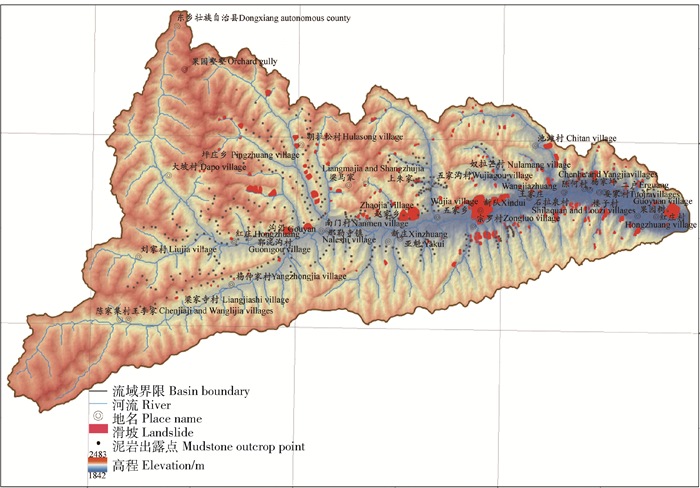
笔者选取甘肃省陇西地区巴谢河流域作为研究区域(图 1)。该地区滑坡分布众多[20-22],是陇西地区滑坡密集发育的典型区,根据实地考察在432 km2范围内有249处典型滑坡[23-25],对当地的人民群众生命财产安全构成严重的威胁。

图 1 研究区巴谢河流域滑坡分布图 Fig. 1 Landslides distribution map of Baxie River Basin in the study area
2 数据处理 2.1 数据及其预处理

研究区影像图来源于Google Earth软件所提取图片,影像信息如表 1所示。

表 1 影像数据信息 Tab. 1 Image data information

预处理主要针对巴谢河流域影像图数据,为了减少云对滑坡识别的影响,选取云量较少时段的影像,其目的是最大程度地展现原始地形图的灰度值。为了减少噪声对巴谢河流域影像图的影响,笔者选取高斯滤波器对图像进行滤波,最终达到改善巴谢河流域影像数据质量。

2.2 识别方法

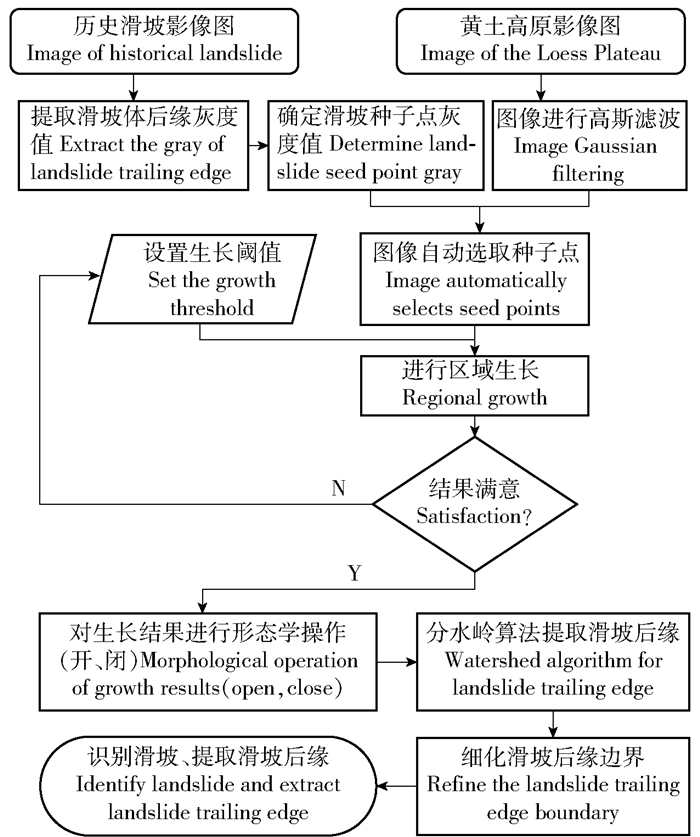
本研究自动识别黄土高原巴谢河流域典型滑坡和估算其致灾面积的计算流程如图 2所示。

图 2 滑坡自动识别技术流程图 Fig. 2 Flowchart of automatic landslide identification
2.2.1 滑坡种子点确定

种子点为区域生长的起始点,在区域生长滑坡识别过程中,滑坡种子点的确定是至关重要的,因为滑坡种子点影响着整个滑坡区域的生长,传统的种子点确定方法是人机交互式手动选择,其执行效率低,且存在主观人为因素对生长结果的影响,不适用于大规模多种子点选取。

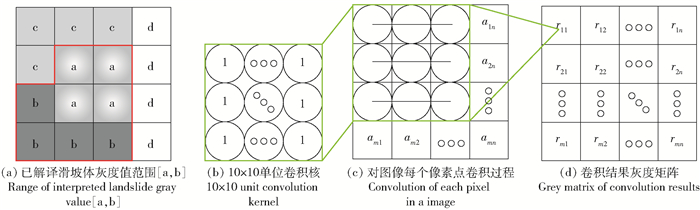
笔者通过提取黄土高原巴谢河流域已被解译的滑坡体历史影像图灰度值范围,将滑坡体后缘灰度值范围[a, b]作为黄土高原巴谢河流域影像图滑坡种子点自动选取的条件,为了减少种子点自动选取的错误率,对黄土高原巴谢河流域影像图灰度矩阵进行卷积核为10×10单位矩阵的卷积运算,将卷积结果除以100得到新的灰度矩阵, 其中每一像素点灰度值为其相邻10×10方正的平均灰度值,若新灰度矩阵中像素点灰度值在已解译滑坡体灰度值范围[a, b]内,则自动提取该点的坐标作为区域生长种子点(图 3)。

图 3 种子点自动选取示意图 Fig. 3 Schematic diagram for automatic selection of seed points
2.2.2 区域生长的构建

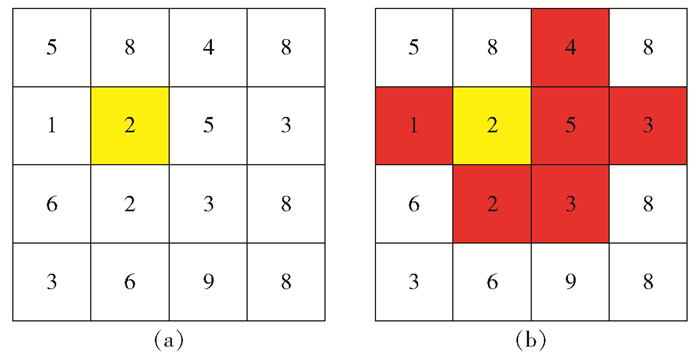
滑坡区域生长是从图像灰度矩阵中某个或多个像素点开始,按照一定的规则,将满足规则的周围点合并到开始的像素点生长为更大的区域,它的中心理念是:将符合一定特征的点作为生长的“种子”初始点,根据相应的生长准则,在“种子”初始点的附近邻域中寻找出与“种子”初始点有类似属性强度、灰度级、纹理颜色等的相邻像素点,并把这些相似像素点合并到“种子”初始点所在的区域里,将这些新合并的像素点作为新的“种子”点并重复上面的工作,直到达到终止的条件后停止[19]。本文生长规则为相似属性灰度级,即通过设置灰度生长阈值,种子点与其周围点之间的灰度差的绝对值小于生长阈值时,将其周围点合并到种子点区域中,将这些周围点作为新的种子点继续进行区域生长,直到整个图像的像素点都经过访问后停止,黄色像素点为种子点,以生长阈值D=3为生长准则进行4邻域的区域生长,生长结果如图 4所示。

图 4 区域生长示意图 Fig. 4 Schematic diagram of region growing
2.2.3 形态学操作

区域生长结束后,滑坡后缘域内部可能存在孤立的噪声点,外部也可能存在断线,采用形态学开运算和闭运算相结合,能够去掉结果中明显的锯齿和细小的毛刺,并将外部断线链接起来起到平滑边缘的效果。开、闭运算定义式见式(1)和(2):

$ A^{\circ} B=(A \circleddash B) \oplus B; $ (1)
$ A \cdot B=(A \oplus B) \circleddash B 。$ (2)

式中:A为原图;B为结构元素;“°”为开运算;“·”为闭运算;“⊖”为腐蚀运算;“$ \oplus $”为膨胀运算。

2.2.4 边界提取和细化

在形态学操作结束后,为了提取经过区域生长得到的滑坡后缘边界,即滑坡区域灰度矩阵的最外层位置,采用Sobel算子结合分水岭算法提取出其滑坡后缘边界。为了得到更精确的边界,需要对提取出的边界进行骨架提取,不断细化,直到边界不能细化为止。

3 结果与讨论 3.1 滑坡识别结果

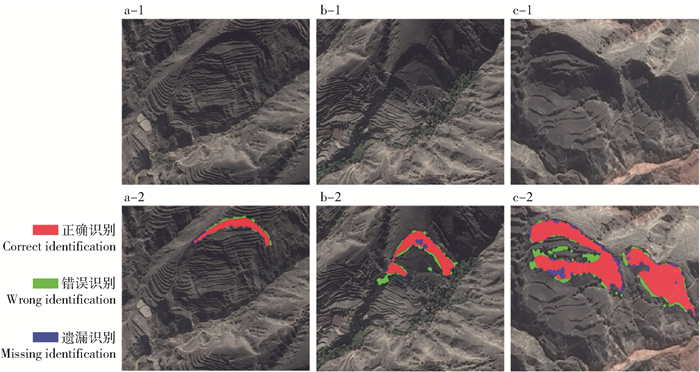
从黄土高原巴谢河流域实验区选取3张未解译的图像,初次设置生长阈值D=10,通过上述方法识别滑坡,并提取出其滑坡后缘边界,同时对该3张图进行人工解译并绘制出相应的滑坡后缘,如图 5所示,图a、b和c分别对应表 1中a、b和c,每张滑坡图像范围大概在0.04 km2

a, b, c corresponds to a, b, c in the Tab. 1 图 5 滑坡识别结果 Fig. 5 Results of landslides identification
3.2 精度评价

为了检验该方法对滑坡后缘识别的精度,提取出上述3张区域生长识别结果的滑坡后缘像素点,同时提取人工解译滑坡后缘所包围的像素点,以人工解译结果为参照对象,采用Lee等[26]基于误差分析的方法对滑坡识别结果进行分析,计算公式为

$ B_{\mathrm{f}}=\frac{F_{\mathrm{P}}}{T_{\mathrm{P}}} ; $ (3)
$ M_{\mathrm{f}}=\frac{F_{\mathrm{N}}}{T_{\mathrm{P}}} ; $ (4)
$ D_{\mathrm{p}}=\frac{T_{\mathrm{P}}}{T_{\mathrm{P}}+F_{\mathrm{N}}} \times 100 ; $ (5)
$ Q_{\mathrm{p}}=\frac{T_{\mathrm{P}}}{T_{\mathrm{P}}+F_{\mathrm{N}}+F_{\mathrm{P}}} \times 100 。$ (6)

式中:Bf为分歧因子,量纲为1;Fp为错误识别滑坡像素点,量纲为1;Tp为正确识别滑坡像素点,量纲为1;Mf为错误因子,量纲为1;FN为漏识别滑坡像素点,量纲为1;Dp为正确识别的比例,%;Qp为正确识别滑坡后缘的质量比例,%。

滑坡后缘验证结果如图 5所示,正确识别滑坡后缘像素点(Tp)8万7 261个,错误识别滑坡后缘像素点(Fp)1万5 962个,漏识别滑坡像素点(FN)7 311个,精度评价如表 2所示。由表可知,错误因子为0.08,漏识别较少,分歧因子为0.18,说明存在部分过渡识别,识别质量比例为78.94%,识别结果精度较高。

表 2 滑坡后缘识别结果精度评价 Tab. 2 Accuracy evaluation of landslide trailing edge identification results
3.3 讨论

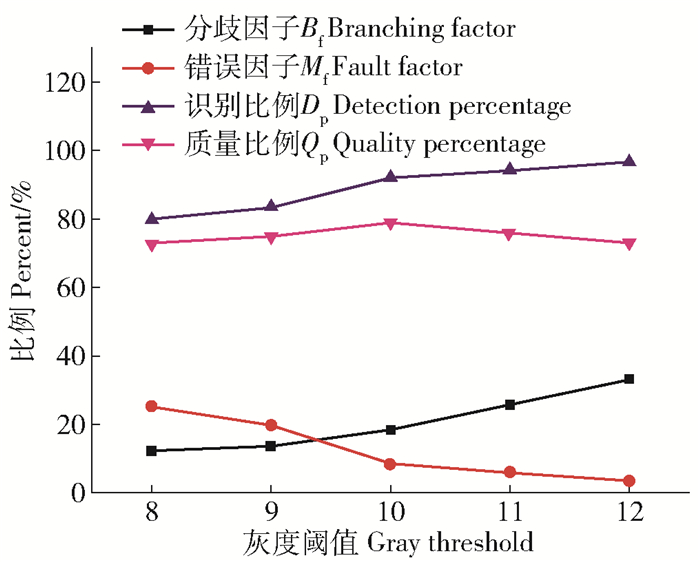
本方法识别滑坡过程中受滑坡规模、图像分辨率和滑坡边界图像灰度梯度的影响较大,对于新滑坡,其滑坡体后缘灰度特征较为明显,识别结果较好,对于发生时间较长久的滑坡,其表面由于风化和植被新生长会降低其识别精度,本方法滑坡后缘区域识别结果取决于灰度生长阈值的设定,通过设置不同灰度生长阈值,探究本方法识别精度,从图 6分析发现:随着灰度生长阈值的增加,分歧因子不断增加,错误因子不断减小,说明过度识别不断增加而漏识别不断减少。识别结果表明当生长灰度阈值为10时,滑坡后缘识别结果最理想,正确率达到78.94%。

图 6 生长灰度域值对滑坡识别精度的影响 Fig. 6 Influence of growth gray threshold on landslide identification accuracy
4 结论

1) 基于区域生长的黄土高原巴谢河流域典型滑坡识别,实现对黄土高原巴谢河流域典型滑坡识别和滑坡后缘边界提取。

2) 通过Google Earth提取3张未解译黄土高原巴谢河流域影像图,利用本方法对3张图片进行滑坡识别和滑坡后缘提取,同时对3张图片进行人工解译并绘制出滑坡后缘以验证识别结果,发现滑坡后缘识别精度在78.94%,当灰度生长阈值在10时,黄土高原巴谢河流域典型滑坡后缘识别效果最理想。表明所建立滑坡识别和滑坡后缘提取方法有推广性,可以应用到滑体灰度特征相似的其他地区进行滑坡识别。

3) 本研究所提出的方法适用于自动识别边界特征较明显的高精度新滑坡影像,尚未实现对大规模低精度的影像图进行滑坡自动识别,将该方法嵌入到高分卫星实现对滑坡后缘快速自动识别等技术还有待进一步研究,从而更好、更快的实现对滑坡灾害的识别、评估和救援。

笔者最初的概念为“黄土高原典型滑坡”,专家审稿后建议用“黄土高原巴谢河流域典型滑坡”更贴切,在此表示感谢!
5 参考文献
[1]
徐张建, 林在贯, 张茂省. 中国黄土与黄土滑坡[J]. 岩石力学与工程学报, 2007, 26(7): 1297.
XU Zhangjian, LIN Zaiguan, ZHANG Maoshen. LoessinChinaandloesslandslides[J]. Chinese Journal of Rock Mechanics and Engineering, 2007, 26(7): 1297. DOI:10.3321/j.issn:1000-6915.2007.07.001
[2]
彭建兵, 段钊. 听黄土粒儿说滑坡[J]. 自然论坛, 2018, 40(4): 285.
PENG Jianbing, DUAN Zhao. Landslides in the words of little loess-grain[J]. Chinese Journal of Nature, 2018, 40(4): 285.
[3]
彭令, 徐素宁, 梅军军, 等. 地震滑坡高分辨率遥感影像识别[J]. 遥感学报, 2017, 21(4): 509.
PENG Ling, XU Suning, MEI Junjun, et al. Earthquake-induced landslide recognition using high-resolution remote sensing images[J]. Journal of Remote Sensing, 2017, 21(4): 509.
[4]
温阿敏, 郑江华, 陈梦, 等. 荒漠生态林区大沙鼠鼠洞密度的无人机遥感监测技术初探[J]. 林业科学, 2018, 54(4): 186.
WEN Amin, ZHENG Jianghua, CHEN Meng, et al. Monitoring mouse-hole density by Rhombomys opimus in desert forests with UAV remote sensing technology[J]. Scientia Silvae Sinicae, 2018, 54(4): 186.
[5]
LI Zhongbin, SHI Wenzhong, LU Ping, et al. Landslide mapping from aerial photographs using change detection-based Markov random field[J]. Remote Sensing of Environment, 2016(187): 76.
[6]
NICHOL J, WONG M S. Satellite remote sensing for detailed landslide inventories using change detection and image fusion[J]. International Journal of Remote Sensing, 2005, 26(9): 1913. DOI:10.1080/01431160512331314047
[7]
LÜ Z, WEN Z, XIAO C, et al. Semi-automatic system for land cover change detection using bi-temporal remote sensing images[J]. Remote Sensing, 2017, 9(11): 1112. DOI:10.3390/rs9111112
[8]
BEHLING R, SIGRID R, DARYA G, et al. Derivation of long-term spatiotemporal landslide activity: A multi-sensor time series approach[J]. Remote Sensing of Environment, 2016(186): 88.
[9]
鲁学军, 史振春, 尚伟涛, 等. 滑坡高分辨率遥感多维解译方法及其应用[J]. 中国图象图形学报, 2014, 19(1): 141.
LU Xuejun, SHI Zhenchun, SHANG Weitao, et al. The method and application of multi-dimension interpretation for landslides using high resolution remote sensing image[J]. Journal of Image and Graphics, 2014, 19(1): 141.
[10]
马瑛, 田望学. 高分辨率遥感图像在黄土高原滑坡解译中的应用[J]. 资源环境与工程, 2007, 21(2): 167.
MA Ying, TIAN Wangxue. The high resolution remote-sensing images in landslide interpretation of Loess Plateau[J]. Resources Environment & Engineering, 2007, 21(2): 167. DOI:10.3969/j.issn.1671-1211.2007.02.018
[11]
许冲. 基于最大似然法的地震滑坡信息自动提取及其可靠性检验[J]. 中国地质灾害与防治学报, 2013, 24(3): 19.
XU Chong. Automatic extraction of earthquake-triggered landslides based on maximum likelihood method and its validation[J]. The Chinese Journal of Geological Hazard and Control, 2013, 24(3): 19.
[12]
袁咏仪, 毛宏燕, 彭令, 等. 高分辨率影像灾害识别研究及实现[J]. 电脑知识与技术, 2018, 14(14): 199.
YUAN Yongyi, MAO Hongyan, PENG Ling, et al. Research and implementation of high resolution image disaster recognition[J]. Computer Knowledge and Technology, 2018, 14(14): 199.
[13]
杜一民, 戴激光. 利用高程信息结合彩色遥感航空影像提取建筑物目标[J]. 测绘与空间地理信息, 2019, 42(7): 125.
DU Yimin, DAI Jiguang. Using elevation information to combine color remote sensing aerial images extraction of building targets[J]. Geomatics & Spatial Information Technology, 2019, 42(7): 125. DOI:10.3969/j.issn.1672-5867.2019.07.036
[14]
陈文龙, 候勇, 李楠, 等. 基于主成分变换的2015年尼泊尔地震滑坡识别方法研究[J]. 长江科学院院报, 2020, 37(1): 166.
CHEN Wenlong, HOU Yong, LI Nan, et al. Post-earthquake landslides detection in nepal based on principal component analysis(PCA)[J]. Journal of Yangtze River Scientific Research Institute, 2020, 37(1): 166.
[15]
李松, 李亦秋, 安裕伦. 基于变化检测的滑坡灾害自动识别[J]. 遥感信息, 2010, 24(1): 27.
LI Song, LI Yiqiu, AN Yulun. Automatic recognition of landslides based on change detection[J]. Remote Sensing Information, 2010, 24(1): 27. DOI:10.3969/j.issn.1000-3177.2010.01.006
[16]
叶润青, 邓清禄, 王海庆. 基于图像分类方法滑坡识别与特征提取: 以归州老城滑坡为例[J]. 工程地球物理学报, 2007, 4(6): 574.
YE Runqing, DENG Qinglu, WANG Haiqing. Landsides identification based on image classification: A case study on Guizhoulaocheng landslide the Three Gorges Reservoir Area[J]. Chinese Journal of Engineering Geophysics, 2007, 4(6): 574. DOI:10.3969/j.issn.1672-7940.2007.06.012
[17]
李麒崙, 张万昌, 易亚宁. 地震滑坡信息提取方法研究: 以2017年九寨沟地震为例[J]. 中国科学院大学学报, 2020, 37(1): 93.
LI Qilun, ZHANG Wanchang, YI Yaning. Seismic landslide information extraction method: A case study of the 2017 Jiuzhaigou earthquake[J]. Journal of the University of Chinese Academy of Sciences, 2020, 37(1): 93.
[18]
王琦理. 基于图像处理的公路滑坡规模自动提取方法研究[D]. 西安: 长安大学, 2018: 1.
WANG Qili. Research on automatic extraction method of highway landslide scale based on image processing [D]. Xi′an: Chang′an University, 2018: 1.
[19]
魏冬梅. 基于遥感影像滑坡边界自动提取方法的研究[D]. 成都: 西南交通大学, 2013: 30.
WEI Dongmei. Theresearchon themethods of landslide edge automaticextraction based on remote sensing image [D]. Chengdu: Southwest Jiaotong University, 2013: 30.
[20]
桂先刚, 梁收运, 赵红亮, 等. 基于分形的巴谢河流域滑坡空间分布格局及其影响因素分析[J]. 地震工程学报, 2020, 42(1): 250.
GUI Xiangang, LIANG Shouyun, ZHAO Hongliang, et al. Analysis of spatial distribution pattern and influencing factors of landslide in Baxie River basin based on fractal[J]. Chinese Journal of SeismicEengineering, 2020, 42(1): 250. DOI:10.3969/j.issn.1000-0844.2020.01.250
[21]
李昂, 侯圣山, 王立朝, 等. AMS14C测年揭示的临夏盆地巴谢河流域典型滑坡的四次滑动[J]. 中国地质, 2008, 45(3): 636.
LI Ang, HOU Shengshan, WANG Lichao, et al. Four slides of typical landslide in Baxie River basin of Linxia basin revealed by AMS14C dating[J]. Geology of China, 2008, 45(3): 636.
[22]
杨志昆, 梁收运, 陈卓, 等. 基于因子相关性-聚类分析的巴谢河流域滑坡危险性评价[J]. 水土保持研究, 2008, 25(3): 305.
YANG Zhikun, LIANG Shouyun, CHEN Zhuo, et al. Evaluation of landslide risk in Baxie River basin based on factor correlation-cluster analysis[J]. Research of Soil and Water Conservation, 2008, 25(3): 305.
[23]
陈卓. 巴谢河流域滑坡易发性评价[D]. 兰州: 兰州大学, 2017: 20.
CHEN Zhuo. Landslide susceptibility mapping in Baxie River Basin [D]. Lanzhou: LanzhouUniversity, 2017: 20.
[24]
CHEN Zhuo, LIANG Shouyun, KE Yutian, et al. Landslide susceptibility assessment using evidential belief function, certainty factor and frequency ratio model at Baxie River basin, NW China[J]. Geocarto International, 2019, 34(4): 348.
[25]
CHEN Zhuo, LIANG Shouyun, KE Yutian, et al. Landslide susceptibility assessment using different slope units based on the evidential belief function model[J]. Geocarto International, 2019, 1.
[26]
LEE D S, SHAN J, BETHEL J S. Class-guided building extraction from Ikonos imagery[J]. Photogrammetric Engineering & Remote Sensing, 2003, 69(2): 143.