文章快速检索     高级检索
  中国水土保持科学   2021, Vol. 19 Issue (2): 86-91.  DOI: 10.16843/j.sswc.2021.02.011
0

引用本文 

许洪娇, 胡海波, 初磊, 燕超, 王超骐. 香樟林地枯落物的截流减沙效应分析[J]. 中国水土保持科学, 2021, 19(2): 86-91. DOI: 10.16843/j.sswc.2021.02.011.
XU Hongjiao, HU Haibo, CHU Lei, YAN Chao, WANG Chaoqi. An analysis on runoff interception and sediment reduction effect by litter in Cinnamomum camphora forest[J]. Science of Soil and Water Conservation, 2021, 19(2): 86-91. DOI: 10.16843/j.sswc.2021.02.011.

项目名称

国家林业和草原局长江三角洲森林生态系统定位研究项目(2018-LYPT-DW-159);江苏省人民政府高等学校林学优势学科建设项目(164010641)

第一作者简介

许洪娇(1995-), 女, 硕士研究生。主要研究方向: 城市生态。E-mail: 283305530@qq.com

通信作者简介

胡海波(1964-), 男, 博士, 教授。主要研究方向: 水土保持, 林业生态工程和城市生态。E-mail: huhb2000@aliyun.com

文章历史

收稿日期:2019-09-04
修回日期:2020-05-14
香樟林地枯落物的截流减沙效应分析
许洪娇 , 胡海波 , 初磊 , 燕超 , 王超骐     
南京林业大学南方现代林业协同创新中心, 江苏省水土保持与生态修复重点实验室, 210037, 南京
摘要:通过研究香樟林枯落物对产流产沙效应的影响,揭示枯落物覆盖的坡面侵蚀机制,可加深人们对水土保持和土壤侵蚀的理解。通过模拟降雨试验,对不同降雨强度(30、60、90 mm/h)和不同枯落物覆盖(0、50、100、250 g/m2)条件下的坡面侵蚀过程进行观测,分析不同枯落物量下产生的的截流减沙效应。结果表明:1)在一定的坡度和降雨强度下,产流率和产沙率在短时间内迅速升高,随后保持稳定。2)坡面径流量随枯落物量的增大而减小,坡面产沙量随枯落物量的增大而减小,产沙量和产流量的变化表明枯落物的减沙效应高于枯落物的减少径流作用。3)产沙量与产流量呈二次函数关系;在枯落物量较大的情况下,降雨强度较强时依然可以起到良好的减沙作用。
关键词模拟降雨    枯落物    产流量    产沙量    截流减沙    
An analysis on runoff interception and sediment reduction effect by litter in Cinnamomum camphora forest
XU Hongjiao , HU Haibo , CHU Lei , YAN Chao , WANG Chaoqi     
Co-Innovation Center for Sustainable Forestry in Southern China, Jiangsu Province Key Laboratory of Soil and Water Conservation and Ecological Restoration, Nanjing Forestry University, 210037, Nanjing, China
Abstract: [Backgrounds] The deterioration still exists partially though the situation of soil erosion in red soil regions of South China has been generally improved in recent years, and the reduction of soil erosion is not proportional to the magnaged area. The undergrowth litter layer is generally considered to be useful in reducing the damage of soil from rainfall. Therefore, the aim of this study is to reveal the mechanism of slope erosion by analyzing the effects of undergrowth litter of Cinnamomum camphora forest on runoff interception and sediment reduction. [Methods] There are two independent variables in this study, rainfall intensity and litter coverage. Simulated rainfall experiment was undertaken in order to simulate different rainfall intensities (30, 60, and 90 mm/h), and litter coverage was also set to be 0, 50, 100 and 250 g/m2. The dependent variables are runoff yield and sediment yield. Significance analyses and regression analyses were undertaken on these variables by using SPSS 18.0 software in order to demonstrate the effects of undergrowth litter on runoff interception and sediment reduction. Fitting analyses were also conducted by Matlab software to illustrate the relationship between sediment yield and runoff yield. [Results] Under the same rainfall intensity and litter coverage, the runoff yield increased rapidly at the beginning for a short period then remained stable, while the sediment yield also increased rapidly at the beginning but decreased afterwards, then stayed stable. More specifically, the runoff reduction rate ranged from 4.06% to 34.21% under different rainfall intensities and litter coverage. At the same condition and the same period, the sediment reduction rate ranged from 25.78%-96.73%. Additionally, the runoff yield and sediment yield both decreased with the increase of the biomass of litter under the same rainfall intensity in this experiment. Moreover, the comparison between the effects of litter coverage on the runoff yield and on the sediment yield showed that, litter cover was more effective in reducing the sediment. [Conclusions] The effect of runoff interception and sediment reduction by litter cover decreases when rainfall intensity increases; however, the litter cover can still intercept runoff and reduce sediment considerably compared to bare slope under the same rainfall intensity. That is to say, the ground litter layer can effectively mitigate soil erosion caused by rainfall because it can reduce the rainfall energy by covering bare slope therefore prevent it from direct rainfall splash. There is a clear quadratic relationship between the runoff yield and the sediment yield in this study.
Keywords: simulated rainfall    forest litter    runoff yield    sediment yield    runoff interception and sediment reduction    

近年来,南方红壤区水土流失状况虽整体好转,但局部恶化,减少的幅度与治理面积不相称,每年人为新增水土流失面积达到2 256 km2,水土流失治理任务仍然十分艰巨[1]。降雨是产生土壤侵蚀的主要自然因素[2-4],主要包括降雨强度、降雨量、降雨历时等因子。枯落物层是森林生态系统的重要组成部分,在拦蓄降雨、保护地表土壤等方面都具有重要意义[5-6]。国内外学者对不同森林类型枯落物的水文特征和生态效应进行了大量研究,取得了许多重要成果,但有关林下枯落物覆盖程度对于土壤侵蚀的影响研究较少。张桢尧等[7]对栓皮栎林枯落物减流减沙效应研究发现,枯落物层能延长坡面径流产生的时间,降低坡面流流速,同时还能有效地减少坡面的产流量(6.60%~8.17%)和产沙量(11.08%~65.08%)。张芝萍等[8]对北亚热带毛竹林枯落物水土保持功能进行研究,发现室内人工模拟降雨条件下,降雨强度为10~50 mm/h时,有枯落物覆盖的土壤侵蚀量比裸露坡面减少35.58~256.16 g/m2

目前,国内外学者对于枯落物层能够调节水文功能的研究,大多是采用浸泡法或通过室内人工模拟降雨试验测定枯落物的最大持水量、持水率和持水过程[9-10],而涉及枯落物减蚀能力以及不同枯落物覆盖对土壤水蚀过程影响的研究较少[11-12]。笔者主要研究在不同降雨强度时香樟(Cinnamomum camphora)枯落物量的减流减沙功能, 能够揭示枯落物覆盖的坡面侵蚀机制,加深人们对水土保持和土壤侵蚀的理解。

1 材料与方法 1.1 试验装置与材料

实验于2018年6月在南京林业大学溧水白马基地进行,白马基地位于南方红壤区,多年平均降雨量(1967—2017年)为1 072.90 mm(南京站),汛期为5—9月。试验地开阔空旷,便于安装器材及开展试验。香樟为南方地区常见树种,因此选取它作为研究对象。试验所用模拟降水装置为南京南林电子科技有限公司研制的NLJY-10型人工模拟降雨控制系统,本次实验每次设置3个重复,以减少实验误差。准备4个1 m×2 m×0.5 m的长方形钢槽作为降水试验小区。本试验用土均来自于南京林业大学溧水白马基地,以南京林业大学校园内的香樟林枯落物(枝叶比例2:8)作为研究材料。为减少叶片表面携带泥沙、水分,导致试验误差,将枯落物用清水洗净, 在65 ℃下烘干至恒质量,分成50、150和250 g分别编号、装袋,备用。

1.2 实验设计与测定

本试验在4个径流小区分层填土,每10 cm一层,共分3层,每层填装完毕充分压实,保持土壤密度为1.34 g/cm左右。填土前,在土槽的底部平铺17 cm细沙,保证良好的透水性。填土时,注意坡面保持平整,每层填装完压实后刮毛,制造一定的地表糙度,防止土层间滑动。通过不同量枯落物覆盖设置各处理组,共设计4种枯落物覆盖量,分别为0、50、100和250 g/m2;设计3个降雨强度,分别为30、60、90 mm/h,坡度均为5°,降雨均匀度超过90%。每次降雨结束后,土槽需要被静置至土壤含水率与上一次实验相一致时再重新开始实验。为保证试验精度,每个处理均进行重复试验取平均值分析(表 1)。

表 1 枯落物覆盖量及降雨强度设计 Tab. 1 Litter coverage and rainfall intensity design

降雨前,将枯落物均匀铺在试验土体上,保证厚度均匀。实验时间为产流开始后的1 h,由于试验初期产流率变化较大,因此前10 min每2 min取1次径流泥沙样,产流10 min以后每5 min取1次径流泥沙样,用聚乙烯塑料桶取径流水样,用量筒来测量径流的体积,然后将径流静置12 h,倒掉上层清液,先用烘干法测定泥沙质量,然后称量测得产沙量。试验小区设置4个雨量筒,以便测定实际降雨量。测定指标包括降水量、降水强度、降水历时、径流量和产沙量等。

1.3 数据处理与分析

水动力学参数采用Microsoft Excel软件进行数据统计及绘图,采用SPSS进行显著性分析。径流减少率为枯落物覆盖条件下的产流量相比裸坡的减少量与裸坡产流量的比值,计算公式[12]为:

$ {L_{\rm{p}}} = \left( {\left( {{S_{\rm{f}}} - {S_{\rm{p}}}} \right)/{S_{\rm{f}}}} \right) \times 100\% 。$ (1)

式中:Lp为径流减少率,%;Sf为裸地产流量,L/(min·m2);Sp为覆盖坡面产流量,L/(min·m2)。

产沙减少率为枯落物覆盖条件下坡面产沙率相比裸坡的减少值与裸坡产沙率的比值, 计算公式[13]为:

$ {N_{\rm{p}}} = \left( {\left( {{R_{\rm{f}}} - {R_{\rm{p}}}} \right)/{R_{\rm{f}}}} \right) \times 100\% 。$ (2)

式中:Np为产沙减少率,%;Rf为裸地产沙量,g/(min·m2);Rp为覆盖坡面产沙量,g/(min·m2)。

2 结果与分析 2.1 枯落物覆盖下坡面产流过程特征 2.1.1 枯落物覆盖的产流过程

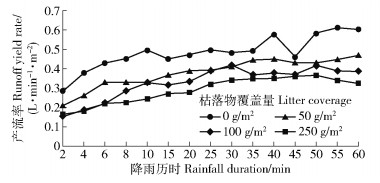
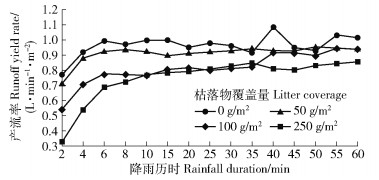
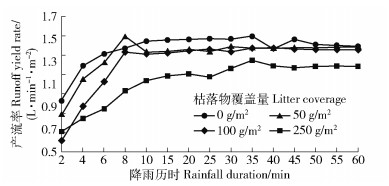
图 1~3可以看出,产流率均是随着降雨强度的增大而增大,随着枯落物的生物量增大而减小,产流率在前5 min迅速提高,在第20~25 min达到稳定。当降雨强度为30 mm/h时,达到稳定时的裸坡径流量为0.605 L/(min·m2)。枯落物覆盖的生物量为50、100和250 g/m2时,达到稳定时的产流率分别为0.469、0.387和0.326 L/(min·m2)。相比于裸坡,枯落物覆盖量为50、100和250 g/m2时,达到稳定时的产流率分别减少22.48%、36.03%和46.12%。当降雨强度增大到60 mm/L时,径流达到稳定时,枯落物覆盖量增多,减少的产流率依次7.70%、7.65%和15.83%。当降雨强度达到90 mm/h时,产流率则分别减少0.70%、2.30%和12.45%。可以看出随着降雨强度增大,枯落物对产流率的影响程度逐渐降低,降雨强度在30和60 mm/h时枯落物对于径流量的影响大于90 mm/h。

图 1 降雨强度为30 mm/h时不同枯落物覆盖量产流率随降雨历时的变化 Fig. 1 Changes in runoff yield rate with different litter coverage under rainfall intensity of 30 mm/h
图 2 降雨强度为60 mm/h时不同枯落物覆盖程度下产流率随降雨历时的变化 Fig. 2 Changes in runoff yield rate with different litter coverage under rainfall intensity of 60 mm/h
图 3 降雨强度为90 mm/h时不同枯落物覆盖程度下产流率随降雨历时的变化 Fig. 3 Changes in runoff yield rate with different litter coverage under rainfall intensity of 90 mm/h
2.1.2 枯落物覆盖的产流特征

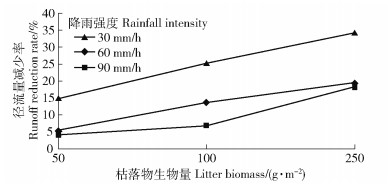
图 4所示,随着降雨强度增大,径流量减少率逐渐降低。在同等的降雨强度下,随着枯落物量的增大,对坡面的减流作用逐渐增强。当降雨强度为30 mm/h时,枯落物量在250 g/m2时,平均产流率仅为0.29 L/(min·m2);而降雨强度达到90 mm/h时,产流率可以达到1.13 L/(min·m2)。径流量随着降雨强度的增大不断增大,枯落物的减流作用逐渐下降。而在相同枯落物量的覆盖下,当降雨强度为30 mm/h时,枯落物对于径流量的减少最为明显,径流量的减少率可以达到34.21%,当降雨强度增加到90 mm/h、枯落物量为250 g/m2时,径流量的减少率仅为18.23%。

图 4 不同降雨强度时枯落物量对径流量的影响 Fig. 4 Effects of litter coverage on runoff reduction rate under different rainfall intensity

以降雨强度I和枯落物量G为自变量,覆盖枯落物的坡面径流量Q为因变量,运用SPSS 18.0软件进行回归分析,得到如下多元回归方程式:

$ Q = 0.980{\rm{ }}I - 0.186{\rm{ }}G - 0.977(I > 30, 0 < G < 250)。$ (3)

式中:I为降雨强度,mm/h;G为枯落物量,g/m2Q为坡面径流量,L/(min·m2)。从式(3)可以看出,坡面径流量与降雨强度和枯落物量呈线性相关关系,通过对比系数可以得知,降雨强度对坡面径流量的影响高于枯落物对径流量的影响。

2.2 枯落物覆盖下坡面产沙过程特征 2.2.1 枯落物覆盖的产沙过程

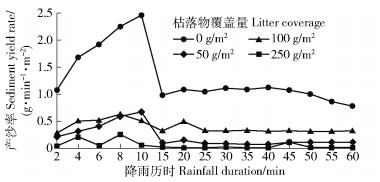
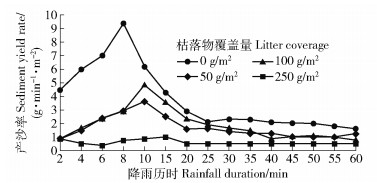
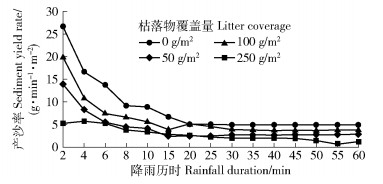
图 5~7可以看出,产沙率-降雨历时的变化曲线在不同量的枯落物覆盖下相似,从坡面产沙开始,短时间内产沙率迅速提高,在保持平稳后下降,最终趋于稳定。产沙率同时受降雨强度和枯落物量的制约,当降雨强度在30 mm/h时,枯落物覆盖量达到50 g/m2就可以起到良好的防蚀效果,最终产沙率稳定在0.078 4 g/(min·m2)。当枯落物覆盖量达到250 g/m2时,产沙率稳定时仅为0.019 g/(min·m2)。随着降雨强度增大,枯落物对产沙率的影响逐渐减小。当降雨强度为30 mm/h,枯落物量分别在50、100和250 g/m2时,产沙率分别降低59.57%、86.35%和97.58%。当降雨强度上升到60 mm/h,枯落物量分别在50、100和250 g/m2时,产沙率分别降低51.32%、56.56%和68.10%。当降雨强度达到90 mm/h,达到稳定后的产沙率分别降低21.59%、42.38%和66.45%。

图 5 降雨强度为30 mm/h时枯落物量对产沙率的影响 Fig. 5 Effects of litter coverage on sediment yield rate under rainfall intensity of 30 mm/h
图 6 降雨强度为60 mm/h时枯落物量对产沙率的影响 Fig. 6 Effects of litter coverage on sediment yield rate under rainfall intensity of 60 mm/h
图 7 降雨强度为90 mm/h时枯落物量对产沙率的影响 Fig. 7 Effects of litter coverage on sediment yield rate under rainfall intensity of 90 mm/h
2.2.2 枯落物覆盖的产沙特征

从实验结果可以看出,产沙量随着降雨强度的增大而增大,枯落物对于降低产沙量有明显作用。当降雨强度为30 mm/h时,裸坡的总产沙量为69.55 g,而当枯落物的生物量增加到250 g/m2时,总产沙量仅为2.273 g。在同等降雨强度下,产沙率随着枯落物生物量的增加而降低;在枯落物的生物量相同时,产沙率随着降雨强度的增加而不断增加。枯落物对于产沙量的减小作用随着降雨强度的不断增加而减弱,当降雨强度为30 mm/h,枯落物的生物量达到250 g/m2时,相比较于裸坡,产沙量可降低96.73%;当降雨强度为90 mm/h时,枯落物的生物量为250 g/m2,产沙量仅降低49.51%。

以降雨强度I和枯落物量G为自变量,覆盖枯落物坡面的总产沙量S为因变量,运用SPSS18.0软件进行回归分析,得到如下多元回归方程式:

$ S = 3.969I - 0.572G - 50.137\quad (I > 30, 0 < G < 250)。$ (4)

从式(4)可以看出,随着枯落物量的增大,产沙量逐渐减小;随着降雨强度的增大,产沙量增大。通过斜率比较发现,降雨强度对产沙量的影响明显高于枯落量对产沙量的影响。

2.3 坡面产沙和产流的关系

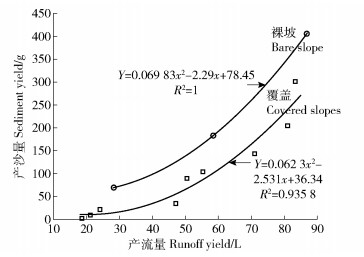
根据统计分析可以得到,无论裸坡还是有枯落物覆盖的坡面,产沙量和产流量呈显著相关关系。使用Matlab软件进行拟合分析,从图 8可以看出,在裸坡和有枯落物覆盖的坡面上,产沙量和产流量均呈现二次函数关系。以产流量x为自变量, 以产沙量Y为因变量,在裸坡的条件下R2=1,在有枯落物覆盖的情况下R2=0.935 8。

图 8 产沙量与产流量的关系 Fig. 8 Relationship between sediment yield and runoff yield

在裸坡的情况下,拟合出的曲线方程为:

$ Y = 78.45 - 2.29x + 0.069\;83{x^2}。$ (5)

在有枯落物覆盖的情况下,拟合出的曲线方程为:

$ Y = 36.34 - 2.531x + 0.062\;3{x^2}。$ (6)

从上列方程可以看出,随着产流量的增大,产沙量逐渐增多。且随着产流量的增大,产沙量增加的速度也随之增加。

3 结论与讨论

1) 在一定的坡度和降雨强度下,产流率在短时间内迅速升高,随后保持稳定;产沙则在短时间内迅速升高,随后降低到一定的速率后保持稳定。在一定的坡度和降雨强度条件下,坡面径流量随枯落物量的增大而减小,30~90 mm/h降雨强度下径流量减少率为4.06%~34.21%,降雨强度越小,径流量减少率越高。在一定的坡度和降雨强度条件下,坡面产沙量随枯落物量的增大而减小,30~90 mm/h降雨强度下产沙减少率为25.78%~96.73%,降雨强度越小,产沙减少率越高。因此,枯落物对降低产沙率可以起到良好的效果,这是因为枯落物层削弱了降雨动能,防止雨滴直接打击土壤,且大大减轻了径流冲刷作用。随着降雨强度的增大,枯落物对产沙率的影响逐渐减小,这主要是因为降雨强度是影响侵蚀过程最主要的因素,当降雨强度增大时,径流增多、侵蚀能力增强,相对而言枯落物的影响减小。

2) 枯落物的减沙效应高于枯落物的减少径流作用。产沙量与产流量呈二次函数关系;在枯落物量较大的情况下,降雨强度较强时依然可以起到良好的减沙作用。在裸坡条件与有覆盖的条件下,产流量均与产沙量呈二次函数关系,这对于水土流失量具有很好的预测作用。在何玉广等[13]对于模拟降雨条件下侧柏林地枯落物对坡面产流产沙的影响中得出,在裸坡条件下,产沙量和产流量呈指函数关系;在有枯落物覆盖的条件下,产沙率和产流量呈线性相关关系,与本研究结果不同。这可能是因为在何玉广等实验中,采用的是野外侧柏人工林,与本试验人造径流小区不同所致。

4 参考文献
[1]
SCHARLEMANN J P, TANNER E V, HIEDERDER R, et al. Global soil carbon: understanding and managing the largest terrestrial carbon pool[J]. Carbon Management, 2014, 5(1): 81. DOI:10.4155/cmt.13.77
[2]
张会茹, 郑粉莉. 不同降雨强度下地面坡度对红壤坡面土壤侵蚀过程的影响[J]. 水土保持学报, 2011, 25(3): 40.
ZHANG Huiru, ZHENG Fenli. Effect of slope gradients on erosion from a red soil hillslope under different rainfall intensity[J]. Journal of Soil and Water Conservation, 2011, 25(3): 40.
[3]
肖继兵, 孙占祥, 刘志, 等. 降雨侵蚀因子和植被类型及覆盖度对坡耕地土壤侵蚀的影响[J]. 农业工程学报, 2017, 33(22): 159.
XIAO Jibing, SUN Zhanxiang, LIU Zhi, et al. Effects of rainfall erosion factor, vegetation type and coverage on soil erosion of sloping farmland[J]. Transactions of the CSAE, 2017, 33(22): 159. DOI:10.11975/j.issn.1002-6819.2017.22.020
[4]
樊登星, 余新晓, 岳永杰, 等. 北京西山不同林分枯落物层持水特性研究[J]. 北京林业大学学报, 2008, 30(S2): 177.
FAN Dengxing, YU Xinxiao, YUE Yuejie, et al. Study on water holding characteristics of litter layers in different stands in Xishan, Beijing[J]. Journal of Beijing Forestry University, 2008, 30(S2): 177.
[5]
陈奇伯, 解明曙, 张洪江. 森林枯落物影响地表径流和土壤侵蚀研究动态[J]. 北京林业大学学报, 1994, 16(S3): 106.
CHEN Qibo, XIE Mingshu, ZHANG Hongjiang. Study on effects of forest litter on surface runoff and soil erosion[J]. Journal of Beijing Forestry University, 1994, 16(S3): 106.
[6]
QIN Yongsheng, YU Xinxiao, WANG Shiyong. Water interception and retarding characteristics of forest litter in the upper streams of the Miyun Reservoir, Beijing[J]. Forestry Studies in China, 2000, 2(1): 58.
[7]
张祯尧, 孙佳美, 余新晓, 等. 栓皮栎林下枯落物减流减沙效应研究[J]. 水土保持学报, 2016, 30(3): 55.
ZHANG Zhenyao, SUN Jiamei, YU Xinxiao, et al. Experiment study on effects of undergrowth litter of Quercus variabilis on runoff and sediment reduction[J]. Journal of Soil and Water Conservation, 2016, 30(3): 55.
[8]
张芝萍, 杨均科, 胡海波. 人工降雨条件下毛竹林地表枯落物固土防蚀效应[J]. 林业工程学报, 2012, 26(2): 68.
ZHANG Zhiping, YANG Junke, HU Haibo. Soil erosion resistant and water resorting of bamboo forest litters under simulation rainfall conditions[J]. Journal of Forestry Engineering, 2012, 26(2): 68.
[9]
徐铭泽, 杨洁, 刘窑军, 等. 不同母质红壤坡面产流产沙特征比较[J]. 水土保持学报, 2018, 32(2): 34.
XU Mingze, YANG Jie, LIU Yaojun, et al. The characteristics of runoff and sediment yield of red soil slope with different parent materials[J]. Journal of Soil and Water Conservation, 2018, 32(2): 34.
[10]
寇馨月, 姜学兵, 黄俊, 等. 红壤区小流域次降雨产流产沙因素分析及模型构建[J]. 水土保持通报, 2017, 37(6): 34.
KOU Xinyue, JIANG Xuebing, HUANG Jun, et al. Analysis of factors affecting runoff and sediment yield and its modelling construction in individual rainfall in small watershed of red soil region[J]. Bulletin of Soil and Water Conservation, 2017, 37(6): 34.
[11]
孙佳美, 余新晓, 李瀚之, 等. 模拟降雨下枯落物调控坡面产流产沙过程及特征研究[J]. 水利学报, 2017, 48(3): 341.
SUN Jiamei, YU Xinxiao, LI Hanzhi, et al. Runoff and sediment yield process and characteristics research on litter slopes in simulated rainfall[J]. Journal of Hydraulic Engineering, 2017, 48(3): 341.
[12]
郑文杰, 郑毅, FULLEN M A, 等. 模拟降雨条件下秸秆编织地表覆盖物对土壤侵蚀和小麦产量的影响[J]. 土壤通报, 2006, 37(5): 969.
ZHENG Wenjie, ZHENG Yi, FULLEN M A, et al. Effects of straw braiding mulch on soil erosion and wheat yield under simulated rainfall conditions[J]. Chinese Journal of Soil Science, 2006, 37(5): 969. DOI:10.3321/j.issn:0564-3945.2006.05.031
[13]
何玉广, 信忠保, 余新晓, 等. 模拟降雨条件下侧柏林地枯落物对坡面产流产沙的影响[J]. 水土保持学报, 2017, 31(3): 27.
HE Yuguang, XIN Zhongbao, YU Xinxiao, et al. Influence of litter layer of Platycladus orientalis forests on runoff and sediment yield of the slope under simulated rainfall[J]. Journal of Soil and Water Conservation, 2017, 31(3): 27.