文章快速检索     高级检索
  中国水土保持科学   2020, Vol. 18 Issue (1): 18-24.  DOI: 10.16843/j.sswc.2020.01.003
0

引用本文 

李强, 刘国彬, 张正, 亢福仁, 马春艳, 赵学庆, 蒋晋豫. 电阻抗法在根系抗侵蚀研究中的应用[J]. 中国水土保持科学, 2020, 18(1): 18-24. DOI: 10.16843/j.sswc.2020.01.003.
LI Qiang, LIU Guobin, ZHANG Zheng, KANG Furen, MA Chunyan, ZHAO Xueqing, JIANG Jinyu. Application of electrical impedance method in the study of root resistance to erosion[J]. Science of Soil and Water Conservation, 2020, 18(1): 18-24. DOI: 10.16843/j.sswc.2020.01.003.

项目名称

国家自然科学基金"水蚀风蚀交错区沙柳根系固土抗侵蚀机理研究"(41661101);国家自然科学基金"优势植物根系构架对矿区排土场新构土体土壤抗侵蚀的影响机理"(41807521);黄土高原土壤侵蚀与旱地农业国家重点实验室开放基金"毛乌素沙地沙柳群落枯落物格局形成及抗风蚀机理研究"(A314021402-1801);陕西省青年科技新星人才支持计划项目(202057)

第一作者简介

李强(1986-), 男, 副教授。主要研究方向:土壤侵蚀及根系固土效应。E-mail:qiangli@yulinu.edu.cn

通信作者简介

刘国彬(1958-), 男, 博士, 研究员。主要研究方向:流域生态系统管理。E-mail:gbliu@ms.iswc.ac.cn

文章历史

收稿日期:2019-05-06
修回日期:2019-10-09
电阻抗法在根系抗侵蚀研究中的应用
李强 1,2, 刘国彬 2, 张正 1,2, 亢福仁 1, 马春艳 1,2, 赵学庆 3, 蒋晋豫 3     
1. 榆林学院 陕西省陕北矿区生态修复重点实验室, 719000, 陕西榆林;
2. 中国科学院水利部水土保持研究所 土壤侵蚀与旱作农业国家重点实验室, 712100, 陕西杨凌;
3. 陕西省治沙研究所, 719000, 陕西榆林
摘要:为了探索原位植物根系固土效应的非直接估测,以泥沙收集法为参照,引入电阻抗法,分析黄绵土中不同根系密度处理下根系固土总效应、物理固结效应及生物化学效应等参数。结果表明:线性方程可以较好地拟合累积泥沙流失量与土壤电阻抗之间的关系,且产流的前3 min电阻抗均值能够较好地反映根系固土效应;根系物理固结效应是强化抗冲性土体构型的关键,平均为66.5%;随着根系密度的增加,物理固结效应呈显著增加趋势,但与泥沙收集法相比,其数值平均低13.5%。因此,电阻抗法在一定程度上能够非直接性估测根系固土抗侵蚀效应。本研究期望为原位植物根系固土效应估测提供新的技术手段。
关键词根系    土壤流失量    土壤抗冲性    电阻抗    
Application of electrical impedance method in the study of root resistance to erosion
LI Qiang 1,2, LIU Guobin 2, ZHANG Zheng 1,2, KANG Furen 1, MA Chunyan 1,2, ZHAO Xueqing 3, JIANG Jinyu 3     
1. Yulin University, Shaanxi Key Laboratory of Ecological Restoration in Shaanbei Mining Area, 719000, Yulin, Shaanxi, China;
2. State Key Laboratory of Soil Erosion and Dry-land Farming on the Loess Plateau, Institute of Soil and Water Conservation, CAS, 712100, Yangling, Shaanxi, China;
3. Desert Control Research Institute of Shaanxi Province, Yulin, Shaanxi, 719000, Yulin, Shaanxi, China
Abstract: [Background] In semi-arid areas, soil erosion is a serious threat to land productivity and sustainability for both natural and human-managed ecosystems. Traditional vegetation techniques are recognized as effectively in reducing soil erosion, whereas the most evident vegetation source that protects soil against erosion is root wedging, which is an important mechanism where roots can bind soil together and tie weak surface soil layers into strong and stable subsurface layers. Plant roots significantly affect soil erosion process of overland flow by physical consolidation (root link and root-soil adhesive) and biochemical functions. [Methods] This study introduced electrical impedence method, with the purpose to evaluate the relative contributions of root link, root-soil adhesive as well as root biochemical functions to soil erosion resistance non-directly. For this purpose, a simulated scouring experiment was conducted on a sandy soil with sand content 36.8%, silt content 51.2% and clay content 12.0%. Three treatments considered were:1) fallow (CK), 2) root-penetrated soil and 3) simulated-root-penetrated soil. Each treatment had 4 replicates. Rectangular, undisturbed soil samples (20 cm×10 cm×10 cm) were taken in the fallow and root pans and were conducted with a hydrological flume (2 m×0.10 m). The flume contained an opening at its lower base, equaling the size of metal sampling box, so that the surface of soil sample was at the same level of the flume surface. Space between the sample box and the flume edges was sealed with painter' mastic to prevent edge effects. The slope of the flume bottom could be varied and clear tap water flow was applied at 4.0 L/min rate discharge on a washing flume slope of 15° for 15 min. During the 15 minutes of each experiment, samples of runoff and detached soil were collected in every 1 min in the first 3 min and 2 min in the following time using 10 L buckets for determining sedimentation. Then, this paper analyzed the relative role in creating the soil configuration of soil resistance to erosion quantitatively, using no root-penetrated soil, root-penetrated soil erosion simulation test. [Results] The linear equation can well fit the relationship between the soil resistance and the accumulated sediment loss, and the mean of the per 3 min electrical impedance of the flow can better reflect the soil physical consolidation effect of the root system. Physical consolidation effect is the key role in soil erosion resistance, with the contribution rate of 66.5%. The values obtained by electrical impedance method is 13.5% smaller than that of the collected sediment method, though a significant relationship is found between them. [Conclusions] To some extent, the electrical impedance method is able to estimate soil erosion resistance of root non-directly. It is expected to provide new technical means for estimating soil consolidation effects of plant roots in the flow-induced erosion regions.
Keywords: root    soil loss extent    erosion resistance    electrical impedance    

土壤侵蚀是我国重要的生态环境问题之一。通常来讲,土壤抗侵蚀能力的大小受到土壤内在特性(如土壤孔隙状况、有机质含量等)和外界环境(如根系密度)的影响[1-2]。黄土丘陵区由于高强度的侵蚀性降水和质地疏松的黄绵土下垫面特征,致使该区细沟侵蚀普遍发育,土壤抗侵蚀能力主要表现为土壤抗冲性能[3-4]。对于特定立地条件的土壤,植物根系及其在土壤中的分布特征是强化抗冲性土体构型的关键,因此,根系固土成为植被保持水土机理研究中的重要科学问题之一,其研究方法的探索逐步成为本领域的热点之一[5-6]

土壤阻抗是土壤本身所具有导电特性的反映,用来指示土壤传导电流能力的指标。当某一立地条件下的土壤环境(如表层土壤迁移、孔隙水分增减等)发生变化,土壤阻抗能够对这一过程做出灵敏的响应[7];因此,通过动态监测含根土壤中植物根系的电阻抗特性,可以较好地表征根系性状参数,如根生物量、根长密度、根比表面积等,间接反映了含根土壤抗侵蚀性能大小[8-9]

本文的科学假设是含根土壤为一均质导体,电阻抗仪连接被测导体2极,与土壤介质形成闭合的电流回路,当土壤的含根量以及侵蚀状态发生变化时,土壤电阻抗可对这一过程做出灵敏的反映[10]。鉴于此,笔者引入电阻抗方法,通过人工模拟冲刷试验,分析根系物理固结效应和生物化学效应对创造抗侵蚀土体构型的相对重要性,研究期望为植物根系固土抗侵蚀效应估测提供新的技术方法。

1 研究区概况

本实验供试土壤来自中科院水利部水土保持研究所安塞水土保持综合试验站的坡耕地(E 109°19.38′,N 36°51.5′)。土壤类型为黄绵土,黏粒(<0.02 mm)15.8%,粉粒(<0.02~0.05 mm)65.2%,砂粒(<0.05~2.00 mm)19.0%。耕层土壤密度1.15~1.35 g/cm3,pH值8.4~8.6,有机质3.5~4.8 g/kg。笔者选取黄土母质作为对照1(CK1),即该层土壤无根系生物化学作用的影响。同时,选择农地0~20 cm的耕作层土壤为对照2(CK2),认为该土壤中存在根系生物化学效应,但无根系物理固结效应。

2 材料与方法 2.1 实验材料与设计

将野外采集的土壤样品自然风干,通过人工去除根系、碎石等杂质后,过5 mm土筛,并按1.35 g/cm3的设计密度分层填装土槽(长2 m×宽0.28 m×高0.3 m)。4个土槽自装槽后保持裸地状态,作为本研究的对照2(图 1a图 1b)。当装土结束后,用1层细沙布平铺在土槽内,其上用洒水壶充分洒水后静置。本研究选取直根系的苜蓿(Medicago sativa)为对象,设置5个种植密度水平(RD1=50株/槽、RD2=100株/槽、RD3=150株/槽、RD4=200株/槽),4次重复。同时,黄土母质CK1和耕层土壤CK2各设置4个重复,共计试验土槽24个。2013年4月5日,将苜蓿草籽与等量细沙混合,按沟深0.8 cm,行距10 cm,通过沿沟撒播覆土进行种植。模拟根系选择与根系质地相近直径为0.4 mm的绵线,试验过程中,将绵线按水平面15°夹角,用自制钢针轻轻穿入取样器土中,绵线密度与试验根系密度一致。人工模拟冲刷试验于2013年9月下旬开始。

(a:实验处理Experimental treatment. b:模拟根系Simulated roots. c:电阻抗仪装置Electrical imedance device. d:冲刷过程Scouring process. 1: CK1. 2: CK2). 图 1 土壤抗侵蚀装置示意图 Fig. 1 Sketch map of experimental set-up
2.2 模拟冲刷试验及电容测定

本文模拟冲刷试验设置见文献[11]。在采集冲刷样品时,采用特制取样器,规格为20 cm×10 cm× 10 cm(长×宽×高)。为了减少采样过程对土壤的扰动,在取样器上方垫以结实木块,用皮锤将取样器顺坡垂直砸下。然后,铲掉取样器周边土壤,将取样器完整取出,用剖面刀沿取样器底部将土样削平后垫上带小孔铝制底片,再用保鲜膜密封,尽力避免土样流失。除此,在搬运取样器过程中,将带有铝制底片的一端朝下,保持取样器内土样完整。将带回的取样器连同铝制底片置于水盘中,水面高度为5 cm,水从铝制底片小孔自下而上浸润土壤12 h直至达到饱和。然后,将饱和的原状土轻轻置于铁架台上8 h去除土壤重力水后进行抗冲试验(见图 1a图 1b)。电阻抗测定采用电阻抗仪(MT4080A,中国台湾)及自制电极探头(见图 1c图 1d),电路连接方式采用2端电极结构[12]。在土样冲刷前,将5 cm长的电极垂直插入土样中,电阻抗仪设置1 kHz的读数频率,数值类型为电阻抗(Ω),并记录土壤的初始电阻抗值Z。冲刷自产流后的前3 min,每1 min记录1个土壤阻抗值Zi(i=1,2,3),同时在相应时刻用径流桶收集1次水流泥沙样。随后每2 min收集1次径流,同时记录瞬时土壤电阻抗值。实验共采集9次径流样品,对应记录9个土壤电阻抗值。

2.3 参数确定及方法

根系总效应(ARTE)是指含根土层相对于不含根黄土母质的土壤流失量,可分为根系物理固结效应BRPE,即含根土样相对于同一土层中无根土样的土壤流失量的比例,和生物化学效应CRBE,即根系总效应中除去物理固结效应的部分。其中,根系物理固结效应包括网络串连作用BNF和根土黏结作用BBF[13]

根系总效应(ARTE)、根系物理固结效应(BRPE)和网络串连效应(BNF)分别按照式(1)、(2)和(3)进行计算。

$ {A_{{\rm{RTE}}}} = \frac{{{\rm{ }}{y_{{\rm{C}}{{\rm{K}}_1}}} - {y_i}}}{{{y_{{\rm{C}}{{\rm{K}}_{\rm{1}}}}}}} \times 100\% ; $ (1)
$ {B_{{\rm{RPE}}}} = \frac{{{y_{{\rm{C}}{{\rm{K}}_{\rm{2}}}}} - {y_i}}}{{{y_{{\rm{C}}{{\rm{K}}_{\rm{2}}}}}}} \times 100\% ; $ (2)
$ {B_{{\rm{NF}}}} = \frac{{{y_{{\rm{C}}{{\rm{K}}_1}}} - y_i^\prime }}{{{y_{{\rm{CK1}}}}}} \times 100{\% _ \circ } $ (3)

式中:yCK1为黄土母质流失量, g;yCK2为含根土层的土壤流失量, g;yi为不同根密度下土壤流失量, g;yi为不同模拟根系密度下土壤流失量, g(i=1,2,3,4)。

为了实现数据的可比性,本文假定根系总效应为100%,对式(1)~(3)的数据进行归一化处理,即其他效应值的计算采用已有数据除以总效应值,进而获得根土黏结效应(式4)和生物化学效应(式5)。

$ {B_{{\rm{BF}}}} = {B_{{\rm{RPE}}}} - {B_{{\rm{NF}}}}; $ (4)
$ {C_{{\rm{RBE}}}} = {A_{{\rm{RTE}}}} - {B_{{\rm{RPE}}\; \circ }} $ (5)
3 结果与分析 3.1 泥沙流失与含根土壤电阻抗特征

土壤电阻抗是反映土壤自身导电特性的重要指标。对于含根土壤来讲,土壤电阻抗数值越大间接反映含根土壤的根系密度越大,坡面土体越难被冲刷流失[9, 11]。笔者对土壤流失过程中的含根土壤电阻抗数据分别按照最大值、最小值、平均值、产流的前3 min均值和4~15 min均值等5种数据处理方式对试验数据进行对比分析。图 2是含根土壤在冲刷过程中产流的前3 min电阻抗均值与累积泥沙流失量之间的关系。由图 2可以看出:土壤电阻抗能够灵敏地反映冲刷过程中累积泥沙流失量的变化。冲刷过程中的土壤阻抗与累积泥沙流失量在处理CK1、CK2和RD1均具有显著的线性正相关关系(P < 0.05)。随着根系密度的增加,处理RD2中土壤电阻抗与累积泥沙流失量无统计学的相关关系。然而,处理RD3和RD4中,土壤电阻抗随着累积泥沙流失量的增加呈减小趋势。

(RD1~RD4分别代表根系密度50, 100, 150和200株/槽,**表示统计学极显著水平P < 0.01。RD1-RD4 denote root density of 50, 100, 150 and 200 plants/box as described in materials and method; * indicates significant at P < 0.01) 图 2 冲刷过程中土壤电阻抗与累积泥沙流失量之间的关系 Fig. 2 Correlation between soil electrical impedance and cumulative sediment
3.2 根系强化土壤抗冲性的相对重要性

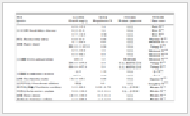
表 1可以看出:根系物理固结效应是强化抗冲性土体构型的关键,占根系总效应的66.5%。随着根系生物量的增加,物理固结效应在根系总效应中的贡献呈增加趋势,增幅约18.9%,而生物化学作用在根系总效应中的相对重要性减弱。在根系物理固结效应中,与根土黏结相比,随着根系密度的增加,根系的网络串连作用显著增加(P < 0.05),与处理RD1相比,处理RD4的根系网络串连效应值增加58.8%,根土黏结效应的相对贡献呈下降趋势。

表 1 根系强化土壤抗侵蚀的相对贡献 Tab. 1 Relative contribution of roots to soil erosion resistance in loess soil   %
3.3 电阻抗法与泥沙收集法结果相关性

图 3示出不同处理下电阻抗法和泥沙收集法的根系固结效应数值的变化。可知,随着根系密度的增加,根系物理固结效应数值在泥沙收集法和电阻抗法条件下均呈线性增加趋势,且达到了统计学显著相关水平(P < 0.05)。然而,电阻抗法获得的根系物理固结效应数值较泥沙收集法偏低,平均小13.5%。

(RD1~RD4分别代表根系密度50, 100, 150和200株/槽,*表示统计学显著水平P < 0.05。RD1-RD4 denote root density of 50, 100, 150 and 200 plants/box as described in materials and method; * indicates significant at P < 0.05) 图 3 不同处理电阻抗法和泥沙收集法的根系物理固结效应变化 Fig. 3 Changes of root consolidation effect with electrical impedance and collected sediment method
4 结论与讨论

模拟冲刷过程中电阻抗值与土壤累积泥沙流失量在处理CK1、CK2和RD1均具有显著的线性正相关关系。随着苜蓿根系生物量的增加,土壤电阻抗值与累积泥沙流失量趋向于线性负相关关系,临界密度为RD2处理。出现这一结果可能原因在于:第一,土壤固体的介电系数一般介于5至20,含根土体由于植物根系的存在,其产生的电阻抗呈增加趋势[14-15]。第二,在低根系生物量(RD1和RD2)时,能产生导电的根系较少,不足以引起土壤电阻抗发生变化;当植物根系密度较大时,随着表层土壤的流失,根系露出地表面积变大,能产生电阻抗的根系部位逐渐变小,导致含根土壤电阻抗开始下降。这一结果可能是处理RD2中土壤阻抗与冲刷过程中累积泥沙流失量无明显相关关系的原因之一[16-17]

笔者以泥沙收集法为参照,引入电阻抗法,分析了黄绵土中不同根系密度处理下根系网络串连、根土黏结及生物化学效应等参数。通过上述研究,可以发现根系物理固结效应可占根系抗侵蚀总效应的70%(泥沙收集法为80%以上),是根系强化土壤抗冲性能的主要表现形式。这一研究结果与刘国彬[13]研究认为根系物理固结效应和生物化学效应贡献比例为8.6 :1.4类似。出现这一结果的可能原因是,根系物理固结效应的计算方法是有根土样相对于同一土层无根土样的土壤流失量。本文中的无根土样为自然状态农地表层土壤,经过筛处理后静置了4个月。此时的土壤生物化学活性及效应势必会有所降低,冲刷泥沙含量会有所增加,致使根系物理固结效应偏大,生物化学效应在根系强化抗侵蚀总效应中的相对重要性减小[18-19]。因此,泥沙收集法可能高估了物理固结效应在根系抗侵蚀总效应中的贡献。反之,电阻抗法是将电阻抗仪与冲刷土体形成闭合电路,把冲刷土体作为一个独立导体进行研究,在一定程度上客观反映了含根土体中根系生物化学效应在总效应中的相对重要性[20-21]

5 参考文献
[1]
TUO Dengfeng, XU Mingxiang, GAO Liqian. Changed surface roughness by wind erosion accelerates water erosion[J]. Jouranl of Soils and Sediments, 2016(16): 105.
[2]
GYSSELS G, POESEN J. The importance of plant root characteristics in controlling concentrated flow erosion rates[J]. Earth Surface Processes and Landforms, 2003, 28(4): 371. DOI:10.1002/esp.447
[3]
朱显谟. 黄土高原地区植被因素对于水土流失的影响[J]. 土壤学报, 1960, 8(2): 110.
ZHU Xianmo. The influence of vegetation on soil erosion in the Loess Plateau[J]. Acta Pedologica Sinica, 1960, 8(2): 110.
[4]
刘国彬. 黄土高原草地土壤抗冲性及其机理研究[J]. 水土保持学报, 1998, 12(1): 93.
LIU Guobin. Study on soil anti scourability and mechanism of grassland on the Loess Plateau[J]. Journal of Soil and Water Conservation, 1998, 12(1): 93.
[5]
温维亮, 郭新宇, 赵春江, 等. 作物根系构型三维探测与重建方法研究进展[J]. 中国农业科学, 2015, 48(3): 436.
WEN Weiliang, GUO Xinyu, ZHAO Chunjiang, et al. Research progress on three-dimensional detection and reconstruction of crop root Architecture[J]. Scientia Agricultura Sinica, 2015, 48(3): 436.
[6]
曹丹妮, 钟琦, 秦嘉惠, 等. 基于知识图谱的根系对土壤侵蚀阻控作用的研究进展[J]. 中国水土保持科学, 2018, 16(6): 127.
CAO Danni, ZHONG Qi, QIN Jiahui, et al. Research progress of root resistance and control of soil erosion based on knowledge map[J]. Science of Soil and Water Conservation in China, 2018, 16(6): 127.
[7]
CAO Yang, REPO T, SILVENNOINEN R, et al. Analysis of the willow root system by electrical impedance spectroscopy[J]. Journal of Experimental Botany, 2011, 62(1): 351. DOI:10.1093/jxb/erq276
[8]
DIETRICH RC, BENGOUGH AG, JONES HG, et al. A new physical interpretation of plant root capacitance[J]. Journal of Experimental Botany, 2012, 63(17): 6149. DOI:10.1093/jxb/ers264
[9]
张正, 刘国彬, 李强, 等. 电容法估测植物根系生物量研究[J]. 草地学报, 2014, 32(2): 383.
ZHANG Zheng, LIU Guobin, LI Qiang, et al. Estimation of root biomass by capacitance method[J]. Acta Agrestia Sinica, 2014, 32(2): 383.
[10]
李强, 曹扬, 张正, 等. 应用电阻抗法植物根系生物学研究进展[J]. 植物科学学报, 2016, 34(3): 488.
LI Qiang, CAO Yang, ZHANG Zheng, et al. Research progress of plant root biology by electrical impedance method[J]. Plant Science Journal, 2016, 34(3): 488.
[11]
LI Qiang, LIU Guobin, ZHANG Zheng, et al. Relative contribution of root physical enlacing and biochemistrical exudates to soil erosion resistance in the loess soil[J]. Catena, 2017, 153: 61. DOI:10.1016/j.catena.2017.01.037
[12]
张正, 刘国彬, 李强. 四端子电极提高根系生物量电容法估测的有效性[J]. 农业工程学报, 2017, 33(5): 185.
ZHANG Zheng, LIU Guobin, LI Qiang. Four terminal electrode improves the effectiveness of root biomass capacitance estimation[J]. Transactions of the CSAE, 2017, 33(5): 185.
[13]
刘国彬.黄土高原草地土壤抗冲性及其机理研究[D].陕西杨凌: 中国科学院水利部水土保持研究所, 1996: 32.
LIU Guobin. Study on the erosion resistance and mechanism of grassland soil on the Loess Plateau[D]. Yang Ling, Shaanxi: Institute of soil and water conservation, Ministry of Water resources, Chinese Academy of Sciences, 1996: 32. http://www.cnki.com.cn/Article/CJFDTotal-TRQS801.015.htm
[14]
DIETRICH R C, BENGOUGH A G, JONES H G, et al. Can root electrical capacitance be used to predict root mass in soil[J]. Annals of Botany, 2013, 112(2): 457.
[15]
吴林坤, 林向民, 林文雄. 根系分泌物介导下植物-土壤-微生物互作关系研究进展与展望[J]. 植物生态学报, 2014, 38(3): 298.
WU Linkun, LIN Xiangmin, LIN Wenxiong. Research progress and Prospect of plant soil microbial interaction mediated by root exudates[J]. Chinese Journal of Plant Ecology, 2014, 38(3): 298.
[16]
程谅, 占海歌, 郭忠录. 3种草本植物根系对土壤抗蚀特性的响应[J]. 草业科学, 2019, 36(2): 284.
CHENG Lang, ZHAN Haige, GUO Zhonglu. Response of root system of three herbaceous plants to soil erosion resistance[J]. Pratacultural Science, 2019, 36(2): 284.
[17]
DALTON F N. In-situ root extent measurements by electrical capacitance methods[J]. Plant Soil, 1995, 173(1): 157. DOI:10.1007/BF00155527
[18]
李强.黄土丘陵区植物根系强化土壤抗冲性机理及固土效应[D].中国科学院研究生院(教育部水土保持与生态环境研究中心), 2014: 95.
LI Qiang. Mechanism of plant roots strengthening soil anti scourability and soil consolidation effect in Loess Hilly Area[D]. Graduate School of Chinese Academy of Sciences (Ministry of Education, Soil and Water conservation Research Center for Sustainable and Ecological Environment), 2014: 95. http://cdmd.cnki.com.cn/article/cdmd-80129-1014052035.htm
[19]
李强, 刘国彬, 张正, 等. 黄土风沙区根系强化抗冲性土体构型的定量化研究[J]. 中国水土保持科学, 2017, 15(3): 99.
LI Qiang, LIU Guobin, ZHANG Zheng, et al. Quantitative study on the soil configuration of root system strengthening anti scourability in the aeolian sand area of loess[J]. Science of Soil and Water Conservation, 2017, 15(3): 99.
[20]
刘红岩, 周正朝, 王宁, 等. 黄土区草被生长初期土壤抗冲性及其影响因素[J]. 中国水土保持科学, 2018, 16(2): 58.
LIU Hongyan, ZHOU Zhengchao, WANG Ning, et al. Soil erosion resistance and its influencing factors in the early stage of vegetation growth in Loess Area[J]. Science of Soil and Water Conservation, 2018, 16(2): 58.
[21]
李强, 杨俊诚, 张正, 等. 植物根系抗侵蚀指标及模型研究进展[J]. 农业资源与环境学报, 2020, 31(1): 17.
LI Qiang, YANG Juncheng, ZHANG Zheng, et al. Research progress on anti erosion indexes and models of plant roots[J]. Journal of Agricultural Resources and Environment, 2020, 31(1): 17.