不同农田防护林下盐碱地土壤水分特征曲线差异对比
1. 滨州学院, 山东省黄河三角洲生态环境重点实验室, 256603, 山东滨州;
2. 山东农业大学资源与环境学院, 271018, 山东泰安
收稿日期:2018-06-07; 修回日期:2019-03-05
项目名称:山东省重大科技创新工程项目"盐碱地林业生态功能提升关键技术"(2017CXGC0316);山东省重点研发计划"黄河三角洲盐碱地农田林网生态工程治理及配套生物修复技术研究与示范"(2015GNC111022)
通信作者简介:夏江宝(1978—), 男, 博士, 教授。主要研究方向:植被恢复与生态重建。E-mail:
xiajb@163.com
摘要:揭示黄河三角洲农田防护林土壤持水特征,探讨适宜的土壤水分特征曲线,为黄河三角洲农田防护林蓄水保土提供理论依据。以毛白杨林、白蜡林和混交林(毛白杨+白蜡)等黄河三角洲农田林网建设的3种典型农田防护林为研究对象,利用烘干法、环刀法和离心法测定土壤含水量、物理性质及持水性,分析其土壤水分状况及不同土层水分特征曲线的变化动态,运用决定系数和均方根误差分析比较Gardner和van Genuchten模型对实测数据的拟合效果。研究结果表明:黄河三角洲防护林土壤含水量因吸力不同呈下降快速-缓慢-平稳的变化规律,随着水吸力的增大,比水容量均单调递减且无限趋近于零;在低吸力段失水快,水分易流失,随着吸力的增强,土壤持水性增强。分析Gardner和van Genuchten模型的参数,结果表明混交林的持水能力最强,其次是毛白杨林,白蜡林最弱。由分析2种模型的决定系数(R2)和均方根误差(RMSE)可知,van Genuchten模型对黄河三角洲农田防护林的实测土壤水分特征曲线的拟合效果优于Gardner模型。
关键词:土壤持水性 土壤水分特征曲线 农田防护林 盐碱地 黄河三角洲
Comparison of soil water characteristic curves of saline-alkali land under different farmland shelterbelts
1. Binzhou University, Shandong Provincial Key Laboratory of Eco-environmental Science for Yellow River Delta, 256603, Binzhou, Shandong, China;
2. Shandong Agricultural University, College of Resources and Environment, 271018, Tai'an, Shandong, China
土壤水分特征曲线能够反映土壤水能量与数量间的关系,是土壤水力学性质的重要指标[ 1-4]。目前,拟合土壤水分特征曲线的模型主要有van Genuchten方程及其修正方程、Gardner方程、Brooks-Corey方程和Dual-porosity方程等[5],其中应用较多的是van Genuchten方程和Gardner方程。防护林在保持水土、防风固沙、涵养水源等方面发挥着重要的作用[6]。黄河三角洲地下水埋深浅、矿化度高及蒸降比大,水分成为限制该地区植被成活和生长的主要因子,植物-土壤之间的水分协调适应性是盐碱化地区农业发展的瓶颈,许多研究集中在防护林树种的选择、造林技术、土壤的盐碱化改良等方面,针对防护林土壤蓄水保水的研究较少,土壤水分特征曲线对研究土壤水分迁移和植物生长具有重要的作用,可反映土壤的持水特征[7-8];因此,笔者选择黄河三角洲农田林网建设中3种典型防护林,利用国内外学者使用较多、拟合效果较好的土壤水分特征曲线经验模型Gardner方程以及van Genuchten方程对测定的防护林土壤水分含量进行拟合,根据所得参数分析土壤的持水性,揭示3种农田防护林土壤的水分特征,探讨适宜该区域农田防护林土壤水分特征曲线的方程,为黄河三角洲盐碱地农田防护林蓄水保土提供理论指导,对进一步研发该地农田林网工程治理模式及配套生物修复技术具有重要的意义。
1 研究区概况
研究区位于山东省东营市东营区的六户镇,位于E 37°21′~37°28′,N 118°25′~118°33′,属于温带大陆性季风气候,夏季高温多雨,冬季寒冷干燥,年平均气温13 ℃,年平均无霜期为206 d,年平均降水量555.9 mm,降水多集中在夏季,占全年降水量的65%,夏季极易形成旱、涝灾害。土壤主要为盐土和潮土。该区适于多种植物生长,主要的乔木有白蜡(Fraxinus chinensis)、毛白杨(Populus tomentosa)、刺槐(Robinia pseudoacacia)、槐(Sophora japonica)等,灌木有木槿(Hibiscus syriacus)、紫穗槐(Amorpha fruticosa)、柽柳(Tamarix chinensis)等,草本植物有地肤(Kochia scoparia)、盐地碱蓬(Suaeda salsa)、藜(Chenopodium album)等。农作物以普通小麦(Triticum aestivum)、玉米(Zea mays)、大豆(Glycine max)、棉花(Gossypium spp.)为主。
2 研究方法
2.1 样品采集和处理
2016年7月,选择3种典型的农田防护林:毛白杨树林、白蜡林和毛白杨+白蜡混交林(简称混交林),三者之间的相互距离约2 km。3种防护林的株行距分别为2 m×2 m、3.5 m×3 m和3 m×3 m,树均高为8 m、7.5 m和8 m,平均胸径为4.5 cm、4.2 cm和5.0 cm,林地内侧种植的农作物为棉花、玉米、大豆、小麦等。林分树龄均为7 a。林下以地肤、盐地碱蓬等草本植物为主。在每个防护林内,设置3个面积为20 m×15 m的样地,按S型取样法选取5个取样点。土壤样品的采集是在林地内距表层0~10 cm、>10~20 cm的深度使用环刀(容积100 cm3)采样。在靠近采样的区域,取3份土样装入铝盒中,测土壤含水量;以四分法取混匀5个取样点的土样约300 g装入自封袋中,经过晾晒风干、碾碎和过筛等处理后测试土壤的pH值和含盐量。土壤密度、土壤总孔隙度采用环刀法测定;烘干法测土壤含水量;pH计测土壤pH值;残渣烘干法测土壤含盐量;土壤粒径由激光粒度仪Mastersizer 2000测量;土壤水分特征曲线利用高速冷冻离心机(日本产CR21N)测定[9]。防护林土壤基本物理性质见表 1。
表 1(Tab. 1)
表 1 农田防护林试验地不同土层的土壤物理性质
Tab. 1 Soil physical properties for different depths of soil in test plots under farmland shelterbelt
防护林
Shelterbelt |
土层深度
Soil depth/cm |
密度
Bulk density/(g·cm-3) |
总孔隙度
Total porosity/% |
饱和含水量
Saturated water content/% |
pH值
pH value |
含盐量
Salt content/% |
粒径Particle size/% |
砂粒Sand
(0.02~2 mm) |
粉粒Silt
(0.002~0.02 mm) |
黏粒Clay
(< 0.002 mm) |
| YS |
0~10 |
1.40ab |
46.59b |
33.24c |
8.79a |
0.26c |
29.44b |
63.21a |
7.35b |
| >10~20 |
1.34b |
49.03b |
36.51b |
9.13a |
0.32b |
26.38c |
65.82a |
7.80b |
| BL |
0~10 |
1.47a |
42.71c |
29.88d |
8.87a |
0.58a |
35.36a |
58.71ab |
5.93c |
| >10~20 |
1.47a |
43.92c |
29.12d |
8.95a |
0.36b |
33.25a |
60.65a |
6.10c |
| HJ |
0 ~ 10 |
1.38b |
47.54b |
34.52c |
8.85a |
0.24cd |
32.82a |
59.53ab |
7.65b |
| 10 ~ 20 |
1.13c |
54.9a |
48.44a |
9.08a |
0.24cd |
30.28b |
61.22a |
8.50a |
| 注:1. YS:毛白杨树林BL:白蜡林HJ:混交林2.不同小写字母表示不同植被间差异显著(P<0.05),下同。Notes:YS:Populus tomentosa forest; BL:Fraxinus chinensis forest; HJ:mixed forest(Populus tomentosa + Fraxinus chinensis). 2. Different letters represent significant differences at 0.05 levels among different vegetations. The same below.
|
|
表 1 农田防护林试验地不同土层的土壤物理性质
Tab. 1 Soil physical properties for different depths of soil in test plots under farmland shelterbelt
|
2.2 模型拟合与结果验证
1) 土壤水分特征曲线拟合模型。
van Genuchten模型
|
$
\frac{{\theta - {\theta _{\rm{r}}}}}{{{\theta _{\rm{s}}} - {\theta _{\rm{r}}}}} = {\left[ {\frac{1}{{1 + {{\left( {\alpha h} \right)}^n}}}} \right]^m}。$
|
(1) |
式中:θ为体积含水率,cm3/cm3;θr为残留含水率,cm3/cm3;θs为饱和含水率,cm3/cm3;h为土壤水吸力,cm;α近似为土壤进气值的倒数,1/cm;参数n、m与土壤水分特征曲线的形状有关,其中,m=1-1/n(n>1)。
Gardner模型
|
$
\theta = A{h^{ - B}}。$
|
(2) |
式中A和B为拟合参数:A表示土壤持水能力的大小,其值越大,土壤持水能力越强;参数B指示曲线的走向,当A值不变时,B值越大(0≤B≤1),则土壤水分特征曲线越靠近水势轴,反映了土壤含水量随吸力变化的快慢[10-11]。
2) 比水容量(specific water capacity,Cθ):土壤水分特征曲线斜率即单位基质势的变化引起含水量变化[5]。对Gardner模型拟合的土壤特征水分曲线的斜率求导可得
|
$
{C_\theta } = A \cdot B \cdot {h^{ - (B + 1)}}。$
|
(3) |
2.3 数据处理
使用Excel 2010进行数据处理及作图,SPSS 18.0进行ANOVA分析。利用均方根误差(root mean square error,RMSE)和决定系数(coefficient of determination R2)比较土壤含水率实测值与模型预测值的拟合效果。
|
$
{\rm{RMSE}} = \sqrt {\frac{{\sum\limits_{i = 1}^N {{{({P_i} - {\theta _i})}^2}} }}{N}};$
|
(4) |
|
$
{R^2} = 1 - \frac{{\sum\limits_{i = 1}^N {{{({P_i} - {\theta _i})}^2}} }}{{\sum\limits_{i = 1}^N {{{({\theta _i} - {\theta _a})}^2}} }}。$
|
(5) |
式中:N为设定压力值的总个数;Pi为与第i个压力值所对应土壤含水率的模拟值,cm3/cm3;θi为与第i个压力值所对应土壤含水率的实测值,cm3/cm3。θa为含水率的平均值,cm3/cm3。
3 结果与分析
3.1 不同农田防护林地的土壤水分特征曲线
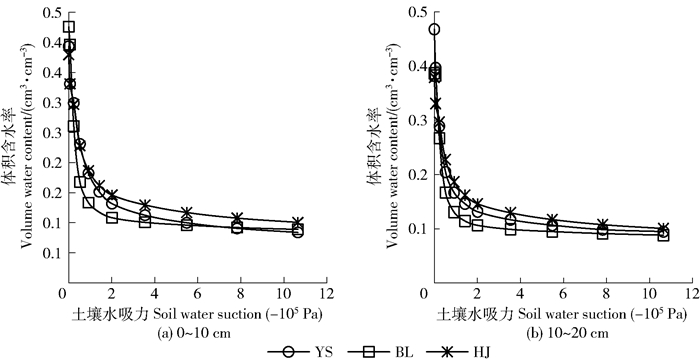
不同农田防护林土壤水分特征曲线如图 1所示。在-1.0×10⁵~0 Pa吸力段,随吸力增大,土壤水分含量急剧下降,曲线陡直。-3.5×10⁵~
-1.0×10⁵ Pa吸力段曲线较缓,同一吸力下,土壤含水率大小为混交林>毛白杨林>白蜡林。在-11.0×10⁵~-3.5×10⁵ Pa吸力段,吸力增大,土壤水分减少的速率减慢且趋于稳定,3种农田防护林的土壤含水量趋于重合。因此,黄河三角洲农田防护林的土壤水分特征曲线呈下降快速(-1.0×10⁵~0 Pa)、缓慢(-3.5×10⁵~-1.0×10⁵ Pa)和稳定(-11.0×10⁵~-3.5×10⁵ Pa)的变化趋势。
3.2 不同农田防护林地的土壤水分特征曲线参数
3.2.1 Gardner模型拟合结果分析
由表 2可见,3种防护林土壤0~10 cm和>10~20 cm Gardner模型中参数A值的平均值表现为混交林>毛白杨林>白蜡林,说明混交林土壤的持水能力最强,白蜡林的最小。混交林和毛白杨林土壤>10~20 cm>0~10 cm,即下层土壤持水能力强,而白蜡林土壤0~10 cm>10~20 cm,其下层土壤持水较弱,保水能力差,影响植物根系的用水。混交林土壤参数B值最小,表明其土壤含水量随吸力变化的慢;毛白杨林和白蜡林的B值接近,较混交林的高,土壤含水量随吸力变化较快。
表 2(Tab. 2)
表 2 2种模型拟合的土壤水分特征曲线参数
Tab. 2 Results for fitted parameters of soil water characteristic curves by two models
防护林
Shelterbelt |
土层
Soil layer depth/cm |
Gardner模型Gardner model |
|
VG模型van Genuchten model |
| 参数A Parameter A |
参数B Parameter B |
参数θs Parameter θs |
参数θr Parameter θr |
| YS |
0~10 |
0.169 |
0.296 |
|
0.336 |
0.072 |
| >10~20 |
0.170 |
0.290 |
0.423 |
0.083 |
| BL |
0~10 |
0.154 |
0.289 |
|
0.417 |
0.090 |
| >10~20 |
0.149 |
0.290 |
0.395 |
0.090 |
| HJ |
0~10 |
0.182 |
0.252 |
|
0.339 |
0.084 |
| >10~20 |
0.266 |
0.168 |
0.400 |
0.167 |
| 注:1. A、B为拟合参数; 2. θs为饱和含水率,θr残留含水率。Notes:1. A and B are the fitting parameters. 2.θs is saturated water content, θr is residual water content.
|
|
表 2 2种模型拟合的土壤水分特征曲线参数
Tab. 2 Results for fitted parameters of soil water characteristic curves by two models
|
3种农田防护林土壤的比水容量随吸力增加而减小逐渐趋近于零。在-0.06×10⁵ Pa吸力下,比水容量的值较高,-0.5×10⁵ Pa吸力下,比水容量为10-1,当吸力值达到-1.0×10⁵ Pa时,比水容量降为10-2,在-3.5×10⁵ Pa吸力时,其值为10-3。不同防护林土壤的比水容量的变化趋势为:在-2.0×10⁵~0 Pa吸力段,毛白杨林土壤的最高(P < 0.05),白蜡林和混交林间差异不显著(P>0.05)(表 3)。
表 3(Tab. 3)
表 3 不同水吸力下土壤的比水容量(Cθ)
Tab. 3 Specific water capacity of soil in various water suctions
防护林
Shelterbelt |
土层Soil layer/cm |
土壤吸力Soil water suction/105 Pa |
| 0.06 |
0.5 |
1 |
2 |
3.5 |
5.5 |
8 |
12 |
| YS |
0~10 |
1.927a |
0.116a |
0.056a |
0.022a |
0.009a |
0.006a |
0.003a |
0.002a |
| >10~20 |
1.864a |
0.114a |
0.055a |
0.02a |
0.009a |
0.005a |
0.003a |
0.002a |
| BL |
0~10 |
1.672b |
0.103b |
0.049b |
0.018ab |
0.009a |
0.005a |
0.003a |
0.002a |
| >10~20 |
1.636b |
0.1bc |
0.048b |
0.018ab |
0.008ab |
0.005a |
0.003a |
0.002a |
| HJ |
0~10 |
1.554bc |
0.104b |
0.05b |
0.019ab |
0.009a |
0.005a |
0.003a |
0.002a |
| >10~20 |
1.197d |
0.096c |
0.049b |
0.019ab |
0.01a |
0.006a |
0.004a |
0.002a |
|
表 3 不同水吸力下土壤的比水容量(Cθ)
Tab. 3 Specific water capacity of soil in various water suctions
|
3.2.2 van Genuchten模型拟合结果分析
由表 2可知,3种农田防护林van Genuchten模型中土壤饱和含水率(θs)的取值范围为0.336~0.423 cm3/cm3,均值为0.385 cm3/cm3;残留含水率(θr)的取值范围为0.083~0.167 cm3/cm3,均值为0.098 cm3/cm3。比较3种农田防护林土壤θs和θr的均值,发现混交林>毛白杨林>白蜡林,不同土层的θs和θr除白蜡林外,0~10 cm均低于10~20 cm。
3.3 不同农田防护林土壤水分特征曲线模型的比较
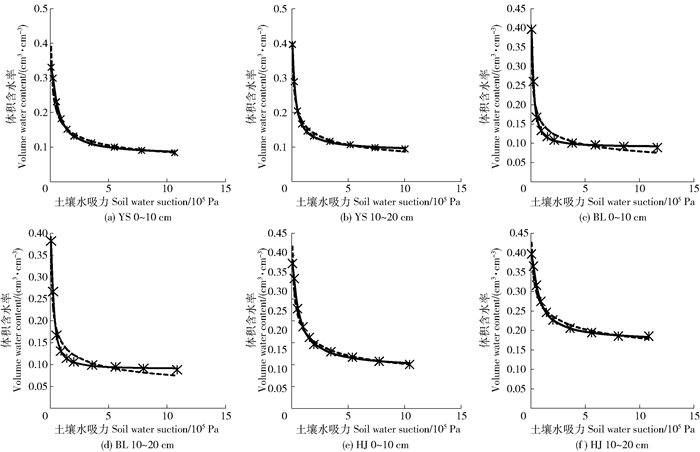
根据所得参数建立相对应的van Genuchten模型和Gardner模型,3种农田防护林土壤含水率绝大部分实测点在van Genuchten模型拟合的曲线上,部分实测点在Gardner模型拟合的曲线上,尤其在-11.0×10⁵~-8.0×10⁵ Pa吸力段,毛白杨林和白蜡林土壤含水率模拟值和实测值相差较大(图 2)。
利用3种农田防护林土壤含水率模拟值与实测值之间的决定系数(R2)和均方根误差(RMSE)对2种模型进行比较。Gardner模型的R2范围为:0.964~0.994,而van Genuchten模型R2为0.999和1.000,显著高于Gardner模型(P<0.05)。通过RMSE对比分析拟合效果,因Gardner模型的表达式是幂函数,无法拟合h=0时的土壤饱和含水率,所以不计吸力h=0时的RMSE。Gardner模型的RMSE均值为0.028;van Genuchten模型为0.002,显著小于Gardner模型所得RMSE值(P<0.05)(表 4)。
表 4(Tab. 4)
表 4 2种模型的适宜性评价
Tab. 4 Suitability evaluation of two models
| 防护林Shelterbelt |
土层
Soil depth/cm |
Gardner模型Gardner model |
|
van Genuchten模型van Genuchten model |
均方根误差
Root mean square error |
R2 Coefficient of determination |
均方根误差
Root mean square error |
R2 Coefficient of determination |
| YS |
0~10 |
0.024a |
0.963 8b |
|
0.002b |
0.999 7a |
| >10~20 |
0.011a |
0.994 1a |
0.002b |
0.999 7a |
| BL |
0~10 |
0.023a |
0.980 8b |
|
0.001b |
0.999 7a |
| >10~20 |
0.022a |
0.979 8b |
0.002b |
0.999 8a |
| HJ |
0~10 |
0.074a |
0.983 9b |
|
0.003b |
0.999 0a |
| >10~20 |
0.015a |
0.978 8b |
0.001b |
0.999 8a |
|
表 4 2种模型的适宜性评价
Tab. 4 Suitability evaluation of two models
|
4 讨论
土壤有效水是田间持水量(FC)和凋萎湿度(PWP)之间的差值,以“生长阻滞湿度”或“毛管联系断裂湿度”(BCM)为界,将土壤有效水划分为2段:FC-BCM为易效水,BCM-PWP为难效水或迟效水[12]。黄河三角洲农田防护林土壤在吸力值为-1.0×10⁵ Pa时,比水容量值数量级为10-2,10-2标志着土壤水已处于或大致相当于难效水范围,此时的吸力值大致与BCM相对应[12]。因此,黄河三角洲农田防护林土壤易效水与难效水的临界点对应的吸力值为-1.0×10⁵ Pa,小于塔里木沙漠公路防护林土壤所对应的吸力值(-1.5×10⁵ Pa)[13],当土壤比水容量达到10-2数量级时吸力值越大,土壤耐旱性越好[10],表明黄河三角洲农田防护林抗旱能力较弱,可能是因为该研究区土壤质地为盐土或潮土,取样地位于黄河入海口,在成土过程中从黄河带来的泥沙占有的比例较高,林地土壤砂粒和粉粒平均占土壤颗粒的90%左右,黏粒所占比例低[2],与本研究所得土壤砂粒和粉粒占土壤颗粒总数的91.5%~94.1%结果一致。黏粒是土粒中最小的部分,比表面积较大,对水分具有极强的吸附能力,在较高的吸力下也不易被释放,增强了土壤对水分的保持能力[14]。黄河三角洲农田防护林土壤中黏粒含量低,土壤水易被释放,其比水容量达到10-2数量级时吸力值小,抗旱能力差。因此,在黄河三角洲农田林网建设过程中,一方面需增加土壤的保水性,另一方面在选择防护林树种时应考虑耐旱物种。
研究表明,无论是Gardner模型还是van Genuchten模型,分析参数A、B、θs和θr均得到3种防护林中混交林的持水能力最强的结论,因此这2种模型都可以拟合该区域的土壤水分特征曲线。采用R2和RMSE对2种土壤水分特征曲线方程进行比较,van Genuchten模型的拟合效果优于Gardner模型。该结论与张露等[15]和栗现文等[16]的研究结果一致。邓羽松等[3]的研究结果则表明van Genuchten模型拟合崩岗表土层和红土层土壤水分特征曲线较好,Gardner模型拟合斑纹层和碎屑层的效果好。而汪时机等[17]通过比较几个常用水分特征曲线模型发现,Gardner模型和van Genuchten模型适用于任何土壤,因此,依靠某一种模型无法全面描述不同类型土壤的水分特征,可根据具体情况以及研究目的选择或整合适宜的模型。
5 结论
1) 黄河三角洲盐碱地农田防护林土壤释水量随吸力呈规律性变化,在低吸力段土壤释水能力强,持水性差;而中高吸力段土壤释水弱,持水性强。
2) van Genuchten模型对黄河三角洲农田防护林土壤水分特征曲线拟合精度较高。
3) 3种农田防护林土壤的持水强弱表现为混交林>毛白杨林>白蜡林。该地区农田防护林应以毛白杨和白蜡混交为宜;考虑到盐碱生境下,黄河三角洲农田防护林更易受到干旱胁迫,因此在管理过程中,需保证水的供给,满足防护林和农作物对土壤水分的需求。
 2019, Vol. 17