植物根系对三峡库区消落带紫色土崩解性能的影响
肖海
1,2
,
夏振尧
1,2
,
彭逗逗
3,
张伦
2,
李铭怡
2,
许文年
1,2,
刘普灵
4
1. 三峡库区生态环境教育部工程研究中心, 443002, 湖北宜昌;
2. 三峡库区地质灾害教育部重点实验室, 443002, 湖北宜昌;
3. 三峡大学生物与制药学院, 443002, 湖北宜昌;
4. 西北农林科技大学水土保持研究所 黄土高原土壤侵蚀与旱地农业国家重点实验室, 712100, 陕西杨凌
收稿日期:2018-09-25; 修回日期:2018-11-02
项目名称:国家重点研发计划"西南高山亚高山区工程创面生态修复关键材料制备与优化应用技术"(2017YFC0504902);国家自然基金青年科学基金"基于稀土元素示踪的植物篱对三峡库区坡耕地侵蚀-沉积分布的影响机制"(41807068);长江科学院开放研究基金"三峡库区消落带时空变化对侵蚀过程的影响及其动力机制"(CKWV2018488/KY);三峡库区地质灾害教育部重点实验室开放基金"植被混凝土生态防护坡面径流分离能力影响因素研究"(2017KDZ10)
摘要:为研究植物根系对三峡库区消落带紫色土崩解性能的影响,通过设置裸土对照(CK)和根系土样(RS)2种处理模式试验条件,利用自制崩解装置研究不同坡度下试样崩解过程,对比分析植物根系对紫色土崩解过程和崩解量的影响。结果表明:随着崩解时间的增加,CK和RS这2种处理模式下累计崩解量均呈现先快速增加之后缓慢增加并趋于平稳的趋势,而崩解速率随崩解却呈现不同的变化趋势。植物根系能够显著减小各时段的累计崩解量和前期崩解速率。坡度增加能够增加2种模式下的累计崩解量和最大崩解速率。中低坡度(10°和20°)时植物根系对崩解的影响较大,而在高坡度(30°)时影响减小。与CK相比,植物根系能够降低50%以上的崩解量,表明植物根系能够有效减缓崩解的发生。
关键词:土壤崩解 根系 紫色土 团聚体 三峡库区
Influence of plant root on the soil disintegration of purple soil from the water-level fluctuation zone in the Three Gorges Reservoir
1. Engineering Research Center of Eco-environment in Three Gorges Reservoir Region, Ministry of Education, China Three Gorges University, 443002, Yichang, Hubei, China;
2. Key Laboratory of Geological Hazards on Three Gorges Reservoir Area(China Three Gorges University), Ministry of Education, 443002, Yichang, Hubei, China;
3. College of Biological and Pharmaceutical Sciences, China Three Gorges University, 443002, Yichang, Hubei, China;
4. State Key Laboratory of Erosion and Dryland Agriculture on the Loess Plateaus, Institute of Soil and Water Conservation, Northwest A & F University, 712100, Yangling, Shaanxi, China
崩解是指土壤在静水中发生分散、碎裂、塌落或强度减弱的现象,也可用来反映土壤可蚀性[1]。相关研究表明,土壤黏粒含量、土壤被扰动情况、有机质含量、矿物成分、土壤胀缩性、pH值、土壤湿化速度和前期含水率、土壤密度等因素均对土壤崩解有较大的影响[2-4]。此外,植物通过根系与土壤形成根土复合体[5-6],并分泌形成大量的胶结物质,可将原本松散的土壤颗粒胶结形成土壤团聚体,进而改变土壤结构[7],也可显著影响土壤抗崩解特性[8-9]。
三峡水库冬季蓄水发电水位为175 m,夏季防洪水位降至145 m,其间30 m水位落差暴露出的土地就是消落带。三峡库区消落带是三峡水库生态系统健康、库岸稳定和水库安全运行的重要屏障带。在夏季出露时集中分布的降雨径流冲刷作用和常年的波浪作用下,消落带土壤侵蚀非常剧烈[10]。Bao等[11]研究发现长江干流消落带区域土壤侵蚀模数达到3万2 383~6万9 593 t/(km2·a),平均侵蚀模数为5万4 050 t/(km2·a),其中波浪侵蚀占总侵蚀的70%以上[12]。波浪破碎时射流的击溅、坡面回流冲刷等动力因子,造成消落带坡面的泥沙颗粒的分散、输移和沉积[13]。波浪对消落带不断侵蚀最终会在坡面形成一个含有临空面+斜坡的特殊地段。而在水位上涨时,这一特殊地段势必会受到库水浸泡产生崩解。夏振尧等[4]研究了干密度、初始含水率和坡度对此特殊地段崩解的影响,而根系对此特殊地段崩解性能的影响并不清楚。
因此,笔者以三峡库区消落带常见的紫色土为研究对象,利用自制可调坡度的崩解装置,研究植物根系对三峡库区消落带紫色土崩解性能的影响,以期深入理解消落带土壤崩解过程,为三峡库区消落带植被恢复、水土治理及生态环境治理提供理论依据及决策支持。
1 材料与方法
1.1 试验设计
紫色土是三峡库区的主要耕作土壤,也是消落带的主要土类,狗牙根(Cynodon dactylon)是禾本科多年生草本,是三峡库区消落带经过多年的水位涨落的变化后自然恢复最为优势的草种[14];因此,本研究选择紫色土和狗牙根作为研究对象。所用土壤采自宜昌市秭归县茅坪镇,风干后过5 mm筛,剔除土壤中小石子及根系等杂质。经测定,所用土壤有机质为6.46 g/kg,pH值为6.5,含有黏粒(< 0.002 mm)12.32%,粉粒(≥0.002~0.050 mm)43.32%和砂粒(>0.050~2.000 mm)44.36%。
为研究植物对崩解性能的影响,本研究将过筛后的紫色土按照野外密度装填于种植槽(长×宽×高为0.6 m×0.5 m×0.1 m)中,并在每个种植槽中均匀撒播4.5 g狗牙根种子,经过1年的生长后在表层取5 cm长×5 cm宽×5 cm高的试样作为根系土样(root sample, RS)用于崩解试验。此外,另留有1个种植槽不播撒狗牙根种子,其他处理方式与其他种植槽一致,作为裸土对照(CK)。三峡消落带按坡度可分为台(阶)岸(<15°)、滩坡岸(≥15°~25°)、陡坡岸(>25°~75°)和崖岸(>75°)[15],本研究设置了10°、20°和30°共3种坡度分别模拟台(阶)岸、滩坡岸和陡坡岸,研究坡度对崩解的影响。每种试验条件下重复3次,累计共18次试验。
本研究分别采用湿筛法、沉降法和重铬酸钾氧化外加热法分别测定土壤团聚体稳定性、土壤颗粒机械组成和有机质含量[16]。
1.2 试验装置
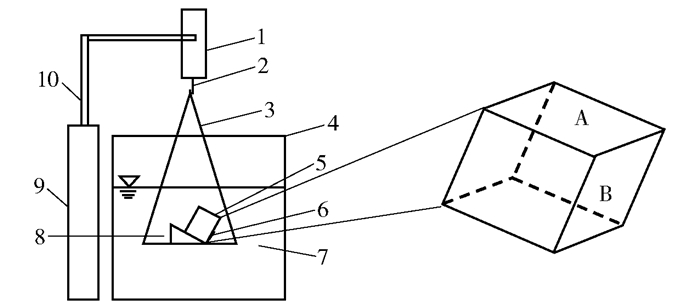
本研究使用自制崩解装置以进行静水崩解试验。自制崩解装置主要由支撑构件、拉力计、坡度架以及水箱等组件构成(图 1)。通过调节坡度架形成不同坡度,并在坡度架最底部两侧安置抗滑桩以固定试样。考虑到水位上涨后只有临空面和坡面斜面会与水直接接触,本研究将崩解试样放入特制的铁皮盒中,只有试块顶面及右前面与水体接触,其中顶面模拟消落带坡面斜面(A面),右前面为消落带受波浪侵蚀后出现的临空面(B面)。
1.3 试验过程与数据收集
使用剪刀将试样植被地上部分剪掉,对试样进行饱和处理以消除前期含水率对试验结果的影响。其次,将艾德堡HP-50数显拉力计(测量精度0.01 N)数显推拉力置零,将饱和试样缓缓放置于预设坡度架上,试样完全浸没在水中开始计时。试验时长为30 min,如果在30 min内完全崩解,按具体崩解的时间计算。试验过程中每min均读取拉力计以记录试样质量变化,分别使用文献[3]中公式计算累计崩解量及崩解速度。
笔者采用崩解减少量和崩解减少率评估根系对土壤崩解的影响,计算式分别为:
|
$
\mathrm{RA}_{S}=\left(\mathrm{BA}_{\mathrm{CK}S}-\mathrm{BA}_{\mathrm{RS}S}\right);
$
|
(1) |
|
$
\mathrm{RR}_{S}=\left(\mathrm{BA}_{\mathrm{CK}S}-\mathrm{BA}_{\mathrm{RS}S}\right) / \mathrm{BA}_{\mathrm{CK}S} \times 100 \%。$
|
(2) |
式中:RAS为S坡度时植物根系造成的崩解减少量,g;BACKS为S坡度时裸坡对照样的次试验累积崩解量,g;BARSS为S坡度时含根系土样的次试验累积崩解量,g;RRS为植物根系造成的崩解减少率,%。RAS和RRS越大,表示植物根系对崩解的影响程度越大。
团聚体稳定性采用平均质量直径(mean weight diameter,MWD)表示,MWD越大,表示土壤团聚体越稳定,能够抵抗湿筛过程中的破坏作用更强。计算式为
|
$
\mathrm{MWD}=\sum\limits_{i=1}^{n} \overline{x}_{i} w_{i}。$
|
(3) |
式中:xi为i径级下团聚体的平均直径,mm;wi为i径级下团聚体占土壤质量的比例,%。
1.4 数据处理
采用Excel和SPSS21软件进行数据处理及相关性分析,运用LSD进行多重比较,显著水平为P < 0.05。
2 结果与分析
2.1 不同坡度下根系对崩解过程的影响
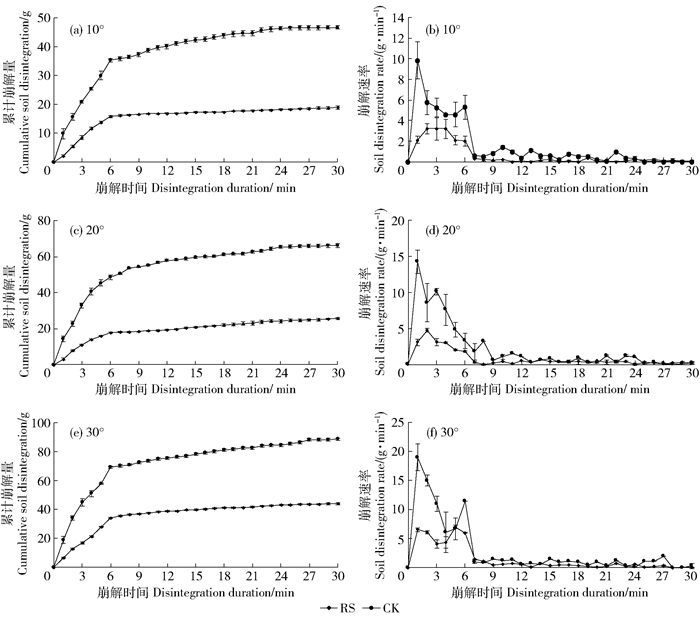
随着崩解时间的增加,2种处理模式CK和RS下累计崩解量均呈现在前6 min先快速增加之后缓慢增加并趋于平稳的趋势(图 2(a)、(c)和(e)),这与王健等[3]研究黄土崩解呈现土壤吸水缓慢崩解阶段、指数崩解阶段、崩解完成阶段3个崩解阶段有所不同。王健等[3]研究中土壤含水率较低,水分在崩解前期会进入试样增加质量基本抵消崩落的土壤质量,而本研究试样为饱和样,试验过程中基本不会有此吸水过程,因此没有出现前期土壤吸水缓慢崩解阶段。试验现象表面崩解先从试样底部产生一些颗粒状、块状崩解,掏空试样底部,在水分浸泡作用下土壤内部的胶结键在水分浸润作用下削弱或断裂,试样顶部出现明显裂缝,并在重力作用下土壤迅速崩解造成土壤累计崩解快速增加,最后试样会形成一个相对稳定的倾斜面累计崩解量缓慢增加并趋于平稳。
2种处理模式下崩解速率随崩解时间的增加呈现不同的变化趋势(图 2(b)、(d)和(f))。CK处理模式下崩解速率随崩解时间的增加总体呈现先快速减小后趋于波动稳定的趋势而RS处理模式下崩解速率则显现前期以较大的崩解速率而后期以较小的崩解速率波动稳定的规律。崩解过程中出现大块土壤塌落造成CK和RS 2种处理模式下崩解过程均会出现一定的波动。整体来说,RS处理模式下比CK处理模式的累计崩解量和崩解速率在整个崩解过程中均要大,这表明植物根系能够有效减缓整个崩解过程。
坡度增加加大重力作用对崩解过程的影响,因而造成CK和RS 2种处理模式在各时间段的累计崩解量均有所增加。坡度主要影响前期崩解速率,后期各坡度下崩解速率均较小,受到坡度的影响也不明显。在10°、20°和30°坡度下,CK和RS处理模式下最大崩解速率分别为9.87、14.27和18.97 g/s及3.20、4.76和6.53 g/s,这表明坡度增加会大幅度增加最大崩解速率。
2.2 不同坡度下根系对崩解的影响
RS处理均能够显著降低总崩解量和崩解速率,随着坡度增加,CK和RS模式下的总崩解量和平均崩解速度均呈现增加的趋势(表 1)。这与坡度增加,试样的临空面和坡面斜面的坡度均增加,因此试样土壤受到重力作用更强,增加脱离试样的可能性,造成更多崩解有关。在相同处理模式下,随着坡度增加,30°坡度下CK模式的总崩解量和崩解速度是10°坡度的1.90倍而RS模式下30°坡度的总崩解量和崩解速度是10°坡度的2.32倍,这表明坡度对根系土样的影响更大。
表 1(Tab. 1)
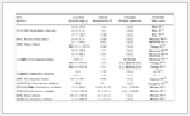
表 1 不同坡度下2种处理模式的总崩解量和平均崩解速率
Tab. 1 Total soil disintegration and average disintegration rate for 2 simulations under different slope gradient
处理模式
Simulation |
总崩解量Total soil disintegration/g |
|
平均崩解速度Average disintegration rate/(g·min-1) |
| 10° |
20° |
30° |
10° |
20° |
30° |
| CK |
46.77±0.65b |
66.23±1.06b |
88.83±0.75b |
|
1.56±0.02b |
2.21±0.04b |
2.96±0.03b |
| RS |
18.93±0.55a |
25.63±0.49a |
43.93±0.57a |
0.63±0.02a |
0.85±0.02a |
1.46±0.02a |
| 注:不同字母表示不同处理模式下0.05水平差异显著。Notes:Different letters in the same column refer to significant difference between two simulations at 0.05 level. |
|
表 1 不同坡度下2种处理模式的总崩解量和平均崩解速率
Tab. 1 Total soil disintegration and average disintegration rate for 2 simulations under different slope gradient
|
在10°、20°和30°坡度下,CK模式的总崩解量和平均崩解速度分别是RS模式下的2.47、2.58和2.02倍,这表明在坡度为中低坡度(10°和20°)时植物根系对崩解的影响较大,而在高坡度(30°)时植物根系对崩解的影响减小,这与崩解同时受到坡度和植物根系两方面的作用有关:坡度增加导致崩解可能性增加,而植物根系则通过自身作用,减少崩解的可能性;在坡度较小时,植物根系能够更有效的减少土壤崩解,而坡度较高时,重力作用增加消弱了植物根系作用。
2.3 根系对土壤抵抗崩解作用的分析
与CK处理模式相比,本研究中植物根系能够降低50%以上的崩解量,其中在中低坡度(10°和20°)时,植物根系能够降低约60%(表 2),这表明植物根系能够有效减缓崩解的发生。植物根系能够通过根系的缠绕、穿插、加筋等作用在土壤表层形成根系网络,为土粒提供了较好的整体网罗作用,增加了土壤颗粒间结合力[10]。此外,植物在生长过程中能够提高土壤有机质含量,根系分泌胶结物质并增加土壤微生物,这都可以将松散的土壤颗粒胶结形成土壤团聚体,进而改变土壤结构[7]。湿筛结果(表 3)表明:植物的存在能够显著提高>3 mm的水稳团聚体含量,相应 < 2 mm的团聚体含量则显著减小。此外,与CK处理模式相比,RS处理模式中下显著增加了团聚体平均质量直径,植物根系能够显著提高团聚体稳定性。
表 2(Tab. 2)
表 2 根系对不同坡度下崩解减少量和降低率
Tab. 2 Reduction amount and rate of disintegration by the root under different slope gradient
坡度
Slope gradient/ (°) |
崩解减少量
Reduction amount of disintegration/g |
崩解降低率
Reduction rate of disintegration/% |
| 10 |
27.84 |
59.53 |
| 20 |
40.60 |
61.30 |
| 30 |
44.90 |
50.55 |
|
表 2 根系对不同坡度下崩解减少量和降低率
Tab. 2 Reduction amount and rate of disintegration by the root under different slope gradient
|
表 3(Tab. 3)
表 3 2种处理模式下湿筛团聚体分布及其平均质量直径
Tab. 3 Size distribution of water-stable aggregates and the related mean weight diameter under 2 simulations
处理模式
Simulation |
团聚体大小Size distribution of aggregates/mm |
MWD/ mm |
| >5 |
≤5~3 |
≤3~2 |
≤2~1 |
≤1~0.5 |
≤0.5~0.25 |
≤0.25 |
| CK |
5.39±0.57a |
4.50±0.17a |
2.07±0.07a |
6.37±0.11a |
7.16±0.13a |
15.64±0.33a |
58.89±0.95b |
0.92±0.04a |
| RS |
10.52±0.25b |
5.61±0.57b |
2.20±0.28a |
8.17±0.11b |
9.12±0.38b |
18.83±0.41b |
45.56±0.89a |
1.39±0.01b |
| 注:不同字母表示不同处理模式下0.05水平差异显著。Notes:Different letters in the same column mean significant difference between two simulations at 0.05 level. MWD: Mean weight diameter. |
|
表 3 2种处理模式下湿筛团聚体分布及其平均质量直径
Tab. 3 Size distribution of water-stable aggregates and the related mean weight diameter under 2 simulations
|
3 结论
1) 植物根系对累计崩解量变化规律影响不大,但对崩解速率变化规律存在一定影响。植物根系能够显著减小各时段的累计崩解量和前期崩解速率。
2) 植物能够显著增加了团聚体平均质量直径,植物根系能够显著提高团聚体稳定性。
3) 植物根系能够有效减缓崩解的发生,与裸土对照相比,植物根系能够降低50%以上的崩解量。
 2019, Vol. 17