文章快速检索     高级检索
  中国水土保持科学   2019, Vol. 17 Issue (2): 70-76.  DOI: 10.16843/j.sswc.2019.02.009
0

引用本文 

王秀丽, 柳昱旻, 高润梅. 外生菌根真菌对干旱条件下油松幼苗生长的影响[J]. 中国水土保持科学, 2019, 17(2): 70-76. DOI: 10.16843/j.sswc.2019.02.009.
WANG Xiuli, LIU Yumin, GAO Runmei. Effects of ectomycorrhizal fungi on the growth of Pinus tabulaeformis seedlings under drought stress[J]. Science of Soil and Water Conservation, 2019, 17(2): 70-76. DOI: 10.16843/j.sswc.2019.02.009.

项目名称

国家自然科学基金"华北落叶松种子萌发与幼苗生长对暖干化气候的响应机制研究"(31400536);山西省回国留学人员科研资助项目"干旱胁迫下外生菌根菌对华北落叶松幼苗生长的影响机制"(2015-062)

第一作者简介

王秀丽(1986-), 女, 硕士研究生。主要研究方向:林木早期生长生理。E-mail:wanglili2005@yeah.net

通信作者简介

高润梅(1974-), 女, 教授, 博士生导师。主要研究方向:植物多样性。E-mail:sxndgrm@163.com

文章历史

收稿日期:2018-07-26
修回日期:2019-03-01
外生菌根真菌对干旱条件下油松幼苗生长的影响
王秀丽 , 柳昱旻 , 高润梅     
山西农业大学林学院, 030801, 山西晋中
摘要:通过对干旱条件下外生菌根真菌对油松苗木影响的研究,以期提高苗木成活率,促进树种更新和防治水土流失。采用盆栽控水模拟干旱胁迫,设对照(CK)、轻度干旱(LD)、中度干旱(MD)与重度干旱(SD)4个水分处理,并接种木霉,测定油松幼苗的生长与生理指标。结果显示:1)接种木霉后,油松幼苗的生物量与根冠比均显著提高(P<0.05);干旱胁迫下,油松幼苗株高和针叶长度都呈递减趋势;但接种木霉后,幼苗株高和针叶长度的降低趋势减弱,幼苗抗旱性显著增强(P<0.01)。2)随着干旱胁迫加剧,油松幼苗针叶的可溶性蛋白质和淀粉含量持续降低,接种木霉后,相应指标虽亦随胁迫加剧递减,但较之未接种幼苗,其变化趋势减弱(P<0.01)。3)干旱胁迫下,未接种和接种木霉的幼苗可溶性糖含量分别在轻度胁迫和中度胁迫达到最高值,即接种木霉后,幼苗的耐旱阈值增大。干旱胁迫下,外生菌根真菌可促进油松幼苗生长,中度干旱胁迫下木霉对油松幼苗生长的促进作用效果最显著。相同水分处理条件下,菌根苗比非菌根苗的抗旱能力更强。
关键词干旱胁迫    外生菌根真菌    油松    木霉    菌根依赖性    
Effects of ectomycorrhizal fungi on the growth of Pinus tabulaeformis seedlings under drought stress
WANG Xiuli , LIU Yumin , GAO Runmei     
College of Forestry, Shanxi Agricultural University, 030801, Jinzhong, Shanxi, China
Abstract: [Background] It researched the effect of ectomycorrhizal fungi on Pinus tabulaeformis seedlings to increase the survival rate of seedlings, promote the regeneration of tree species, and prevent soil erosion. [Methods] Potted water was used to simulate drought stress, and four water treatments were designed:control(CK), light drought(LD), moderate drought(MD), severe drought(SD). Inoculating the seedlings of Pinus tabulaeformis with Trichoderma spp. was to study the effect of growth which ectomycorrhizal fungi had on P. tabulaeformis seedling under drought stress. To each treatment, It selected seedlings whose growth was basically the same, and measured the morphological and physiological indexes. The specific operation refered to Principles and Techniques of Plant Physiological and Biochemical Experiments written by Li Hesheng. [Results] The plant height and needle length of P. tabulaeformis seedlings were significantly affected by inoculation with Trichoderma spp. and drought stress treatment (P < 0.01), but the interaction was not significant (P>0.05).The effects of inoculation with Trichoderma spp. and drought stress on the soluble protein, soluble sugar and starch content of P. tabulaeformis seedlings were significant (P < 0.01). However, the interaction to the soluble protein and starch content of Pi. tabulaeformis seedlings was not significant (P>0.05), and the interaction to the soluble sugar content was significantly affected (P < 0.01). The detailed analysis results to the morphological and physiological indexes of P. tabulaeformis seedlings were as follows:(1) After inoculation with Trichoderma spp., the biomass and root-shoot ratio of P. tabulaeformis seedlings were significantly increased (P < 0.05).The mycorrhizal dependence on Trichoderma spp. was moderately dependent. Under drought stress, the plant height and needle length of P. tabulaeformis seedlings showed a decreasing trend. However, after inoculation with Trichoderma spp., the decrease of plant height and needle length was weakened, and the drought resistance of seedling was significantly enhanced (P < 0.01). (2) With the increase of drought stress, the soluble protein and starch content of needles in P. tabulaeformis seedlings continued to decrease. After inoculation with Trichoderma spp., the corresponding index showed a decreasing trend with increasing stress, but the trend of inoculated Trichoderma spp. seedlings was weaker than that of uninoculated seedlings. (P < 0.01). (3) Under drought stress, the soluble sugar content of needles in P. tabulaeformis seedlings showed a trend of "first rise and then fall". The soluble sugar content of seedlings uninoculated and inoculated Trichoderma spp. reached the highest value in LD and MD, respectively. In other words, the drought tolerance threshold of the seedlings increased. [Conclusions] The results showed that under drought stress, ectomycorrhizal fungi promoted the growth of P. tabulaeformis seedlings. Under moderate drought stress, Trichoderma spp. had the most significant effect on the growth of P. tabulaeformis seedlings. Under the same water treatment, the mycorrhizal seedlings had stronger drought resistance than non-mycorrhizal seedlings.
Keywords: drought resistance    ectomycorrhizal fungi    Pinus tabuliformis    Trichoderma spp.    mycorrhizal fungi dependence    

干旱胁迫是限制干旱与半干旱地区植物生长最重要的因子,森林作为中国北方自然生态系统的主体与生态屏障,尤其夏季干旱环境下,多数树种难以实现更新[1],森林生态系统生产力下降,水土流失严重,生态恢复困难。我国植树造林过程中存在苗木成活率低、适应性差和不能保持水土流失等问题。研究发现外生菌根真菌(ectomycorrhizal fungi)能增强树木对干旱、病虫害、盐碱等伤害的适应性与抵抗力[2-3]。树木在遭受干旱胁迫时,外生菌根真菌通过根外菌丝运送土壤中的矿质元素与水分到根内供其吸收[4],同时获得其生长繁殖所需的碳水化合物,与宿主形成一种互惠共生的关系[5],利于提高树木抗性,促进其生长发育[3]。外生菌根可有效改善树木的水分生理状态,使其在持续干旱下也可成活,或复水后很快恢复生长[6]

油松(Pinus tabuliformis)属松科(Pinaceae)松属(Pinus),为阳性树种[3],对干冷气候的适应能力强;其根系发达、生长迅速、耐干旱、耐贫瘠,抗风沙能力强[7],防治水土流失能力强,可促进土壤肥力的恢复与土壤结构的改善。作为华北地区低山的主要造林树种,油松可保持水土、防风固沙,有效改善生态环境,对修复退化的生态系统有重要作用[8]

虽然油松菌根资源丰富,但大部分仍未应用于生产实际,具优良促生效果的菌剂较少[3]。有研究表明,木霉(Trichoderma spp.)对油松幼苗具一定促生效果[9]。笔者通过室内盆栽试验,研究木霉对油松幼苗抗旱能力的影响,以期为华北地区干旱半干旱低山地区的油松造林提供技术支撑,促进树种更新,进而防治水土流失。

1 材料与方法 1.1 幼苗培养

2016年10月,在山西省关帝山采取油松种子,室温下自然晾干,冷藏在0~4 ℃冰箱中。2017年12月,挑选大小均匀颗粒饱满的种子,于山西农业大学林学院树木学实验室室内育苗。试验前,温水浸种2 d,0.1%的KMnO4溶液振荡消毒30 min后播种。培养基质由进口草炭与蛭石(体积比2:1)组成,经高温高压蒸汽灭菌(121 ℃,0.1 MPa,2 h)后备用,基质装入灭菌的黑色营养钵(长宽高为10 cm×10 cm×9 cm),每钵10粒,覆1 cm厚的基质,浇透水后,室温培养,待种子萌发后,每钵定苗至4株,供试材料共64钵256株幼苗。

1.2 试验设计

采用双因素裂区试验设计,重复8次,主处理T为菌根真菌,设接种木霉(T+)和不接种(T-)2个处理。木霉由山西农业大学树木病理实验室提供,PDA培养基上活化培养15 d后使用。播种同时进行接种处理。32钵每钵注射10 mL菌丝悬浮液;另32钵每钵注射10 mL灭活后冷却的菌丝悬浮液(140 kPa高温灭菌30 min)。副区处理D为干旱胁迫处理,设4个水分梯度:正常供水(control, CK),浇水间隔期3 d,土壤相对含水量(relative soil water content, RSWC)70%~80%;轻度胁迫(light drought, LD),浇水间隔期5 d,RSWC为50%~60%;中度胁迫(moderate drought, MD),浇水间隔期10 d,RSWC为35%~50%;重度胁迫(severe drought, SD),浇水间隔期15 d,RSWC为20%~35%[2]。以15 d为处理周期,连续进行3个周期水分处理,45 d后结束试验,进行指标测定。

1.3 幼苗指标测定 1.3.1 生长指标

每个处理挑选长势基本一致的10株幼苗,测量每株幼苗的株高、针叶长度(选最长针叶测定),精确到0.01 cm;生物量测定:每处理取30株幼苗,洗净擦干,分地上与地下部分,105 ℃下,杀青10 min[10],80 ℃下烘干至恒质量,分别称量地上和地下部分的干质量[11];根冠比:根冠比(R/T)=地下部分干质量/地上部分干质量。

菌根真菌依赖性(Mycorrhizal fungi dependence,MFD)反映植物对菌根真菌依赖性大小, 数值越大,依赖性越强, 接种菌根后对植物的促生效果越好(MFD≥300%,属强依赖性;MFD≥200%,属中等依赖性;MFD<200%, 属弱依赖性)[12]。MFD计算方法为:MFD=(接种株干质量/对照株干质量)×100%

1.3.2 生理指标

剪取幼苗针叶,进行生理指标测定:可溶性蛋白质含量用考马斯亮蓝法测定;蒽酮比色法测定可溶性糖含量;蒽酮硫酸法测定淀粉含量。具体操作参照文献[13]。

1.4 数据处理

数据统计分析采用SPSS 21.0,以多因素方差分析(Univariate)和最小显著差数法(least significant difference,LSD)比较油松幼苗不接种木霉各个水分处理组、接种木霉各个水分处理组、相同水分处理组接种与不接种木霉油松幼苗各指标的差异显著性,差异水平为0.05。

2 结果与分析 2.1 接种木霉对干旱胁迫下油松幼苗形态的影响

正常水分下,接种木霉显著促进油松幼苗的地上生物量、地下生物量、根冠比(P<0.05,表 1);菌根苗的地上生物量、地下生物量、根冠比分别是非菌根苗的2.05、2.38、1.16倍;对木霉的菌根依赖性属中等依赖性。

表 1 油松幼苗对木霉的菌根依赖性 Tab. 1 Effect on the growth of Pinus tabulaeformis seedlings inoculated Trichoderma spp. under drought stress

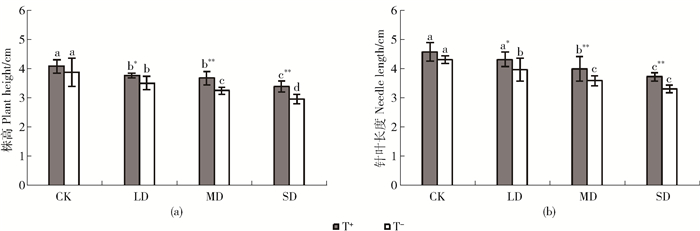
研究发现接种木霉与干旱胁迫对油松幼苗的株高和针叶长度均具极显著影响(P<0.01),但交互作用影响不显著(P>0.05)。不接种时,油松幼苗在CK、LD、MD、SD下的株高分别为3.88、3.51、3.25和2.96 cm,即随胁迫加剧,幼苗株高递减,与CK相比,LD、MD、SD分别减少9.47%、16.24%、23.65%;接种木霉后,随干旱胁迫加剧,株高仍呈下降趋势,LD、MD、SD分别下降7.70%、10.15%、17.11%(图 1(A))。表明随着干旱胁迫加剧,接种木霉的油松幼苗株高降低程度减缓。

CK、LD、MD、SD分别表示对照、轻度胁迫、中度胁迫与重度胁迫;柱形图上方不同的小写字母表示不同水分处理间差异显著(P<0.05);**表示接种木霉与不接种在相同水分处理下差异极显著(P<0.01),*表示接种木霉与不接种在相同水分处理下差异显著(P<0.05)。下同。CK, LD, MD, and SD respectively refers to control, light drought, moderate, sever drought; different lowercase letters above the histogram showed significant differences between different water treatments (P<0.05). ** indicated that the difference between Pinus tabulaeformis seedlings inoculated Trichoderma spp. or not at the same water treatment was very significant(P<0.01). * indicated that the difference between Pinus tabulaeformis seedlings inoculated Trichoderma spp. or not at the same water treatment was significant(P<0.05). The same as below. 图 1 接种木霉对干旱胁迫下油松幼苗的株高与针叶长度的影响 Fig. 1 Effect on plant height and needle length of Pinus tabulaeformis seedlings inoculated Trichoderma spp. under drought stress

不接种时,CK、LD、MD、SD组油松幼苗的针叶长度分别为4.30、3.95、3.58和3.30 cm,整体呈下降趋势,LD、MD、SD分别下降8.14%、16.86%、23.26%;接种木霉后,油松幼苗针叶长度均有所增长,但随着干旱胁迫的加剧,整体仍呈递减趋势,LD、MD、SD分别减少5.43%、12.55%、18.64%(图 1(b))。与不接种相比,随着干旱胁迫的加剧,接种木霉的油松幼苗针叶长度降低程度减缓,具有明显的增长作用。

2.2 接种木霉对干旱胁迫下油松幼苗生理指标的影响

渗透调节是植物在干旱环境下的重要生理机制[2],参与渗透调节的溶质称为渗透调节物质,可溶性蛋白质、可溶性糖与淀粉作为主要的渗透调节物质, 干旱胁迫下, 其含量变化可以反映出植物对逆境的抗性[14]。接种木霉与干旱胁迫对油松幼苗针叶的可溶性蛋白质、可溶性糖与淀粉含量影响极显著(P<0.01), 但交互作用对针叶的可溶性蛋白与淀粉含量影响不显著(P>0.05), 对可溶性糖含量影响极显著(P<0.01)。

2.2.1 可溶性蛋白质质量分数

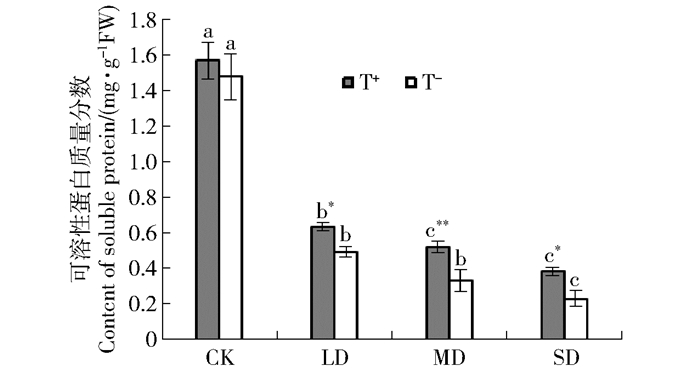
油松幼苗针叶CK组的可溶性蛋白质质量分数最高,随着干旱胁迫的加剧,质量分数逐渐降低。不接种时,LD、MD与SD分别比CK降低66.73%、77.91%、84.81%;相同水分梯度下,接种木霉后,油松幼苗针叶的可溶性蛋白质质量分数显著高于不接种木霉的幼苗,且与CK相比,LD、MD与SD分别减少59.79%、66.92%与75.64%(图 2),即接种木霉的油松幼苗,其针叶的可溶性蛋白质质量分数降低趋势减缓。

图 2 接种木霉对干旱胁迫下油松幼苗可溶性蛋白质质量分数的影响 Fig. 2 Effect on content of soluble protein in Pinus tabulaeformis seedlings inoculated Trichoderma spp. under drought stress
2.2.2 可溶性糖质量分数

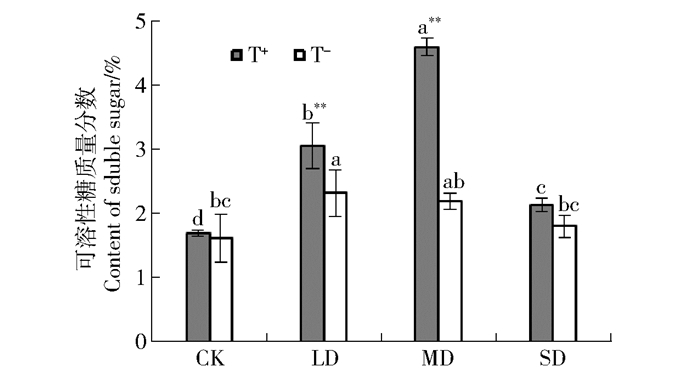
干旱胁迫下,油松幼苗针叶的可溶性糖质量分数均高于CK组,随着干旱胁迫的加剧,整体呈“先升后降”的趋势;未接种和接种木霉的幼苗可溶性糖质量分数分别在LD和MD达到最高值,MD和SD幼苗针叶的可溶性糖质量分数开始下降,与不接种相比,接种木霉后,油松幼苗耐旱阈值增大,抗性更强(图 3)。

图 3 接种木霉对干旱胁迫下油松幼苗可溶性糖质量分数的影响 Fig. 3 Effect on content of soluble sugar in Pinus tabulaeformis seedlings inoculated Trichoderma spp. under drought stress
2.2.3 淀粉质量分数

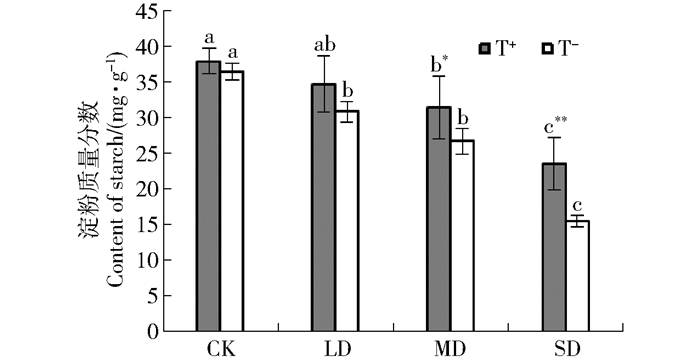
与干旱胁迫下的幼苗相比,CK组油松幼苗针叶淀粉质量分数最高,淀粉质量分数随着干旱胁迫的加剧,整体呈下降趋势;不接种木霉时,LD、MD与SD分别降低15.56%、26.88%、57.79%;接种木霉后,LD、MD与SD分别减少8.68%、17.35%、38.08%(图 4);与不接种相比,随着干旱胁迫的加剧,接种木霉的油松幼苗针叶淀粉质量分数降低程度减缓,表明接种木霉对于油松幼苗抗旱能力的提高具有明显的促进作用。

图 4 接种木霉对干旱胁迫下油松幼苗淀粉质量分数的影响 Fig. 4 Effect on content of starch in Pinus tabulaeformis seedlings inoculated Trichoderma spp. under drought stress
3 讨论

植物苗期较易受逆境影响[15],笔者发现干旱胁迫下,接种木霉可促进油松幼苗生长,这与王艺等[4]对马尾松的研究结果一致。接种木霉后,显著促进油松幼苗的株高、针叶长度与生物量等形态指标,主要原因在于菌根菌可扩大幼苗根系的吸收面积和范围,增加植株对矿质元素的吸收,改善植株矿质营养,减少水分散失,使植株更好地利用和保持土壤水分[16]。其次,真菌通过自身或利用周围微生物及植物等分泌多种酶类和次生代谢产物来分解有机质,活化土壤中的营养物质[17],改善土壤结构与环境等。

可溶性蛋白质是针叶中氮的重要存在形式,其质量分数下降是针叶衰老的主要标志[18]。接种木霉后,油松幼苗针叶的可溶性蛋白质质量分数均显著高于对照;但随着胁迫加剧,可溶性蛋白质质量分数呈递减趋势;可能在于干旱胁迫抑制蛋白质合成并诱导其降解,引起蛋白质质量分数下降[19]。可溶性糖是植物体内碳水化合物代谢和暂时贮藏的主要形式[20], 其质量分数变化可反映植株碳水化合物的合成与运输情况[18]。接种木霉后,油松幼苗针叶可溶性糖质量分数增加,利于植株保持较高的渗透压,以抵御干旱造成的不利影响[19]。其中:MD条件下可溶性糖质量分数达到最高值,此时油松幼苗抗性较强;SD条件下可溶性糖质量分数下降,可能由于重度胁迫下气孔关闭,导致碳摄取受阻,如果胁迫持续可能影响幼苗存活[21]。淀粉和可溶性糖作为主要的非结构性碳水化合物,其质量分数变化可表征植物对干旱胁迫的缓冲能力。接种木霉后,油松幼苗淀粉质量分数升高;随着干旱胁迫的加剧,其质量分数呈递减趋势;当植物遭受干旱胁迫时,土壤含水量减少,油松幼苗针叶积累的淀粉转化为可溶性糖,使油松在低水势下保持较高膨压,降低干旱对植物组织的伤害[22]。总之,干旱胁迫显著抑制油松幼苗的生长,但接种木霉后胁迫作用显著减缓,在形态与生理层面均有表征。

4 结论

1) 外生菌根真菌促进了干旱胁迫下油松幼苗的吸收功能,增加生物量的积累,进而促进了植株的生长。

2) 中度干旱胁迫下,接木霉对油松幼苗生长的促进作用效果最显著,推广使用过程中,应根据实际情况把握好干旱胁迫的阈值,在阈值内进行复水处理。

3) 相同水分处理下,菌根苗比非菌根苗的抗旱能力增强,菌根化苗木复水后也能更快恢复生长。

5 参考文献
[1]
KAZANTSEVA O, BINGHAM M, SIMARD S W, et al. Effects of growth medium, nutrients, water, and aeration on mycorrhization and biomass allocation of greenhouse-grown interior Douglas-fir seedlings[J]. Mycorrhiza, 2009, 20(1): 51. DOI:10.1007/s00572-009-0263-0
[2]
高润梅, 石晓东, 王林, 等. 当年生华北落叶松幼苗的耐旱性[J]. 林业科学, 2015, 51(7): 149.
GAO Runmei, SHI Xiaodong, WANG Lin, et al. Drought resistance of one-year-old seedlings of Larix principis-rupprechtii[J]. Scientia Silvae Sinicae, 2015, 51(7): 149.
[3]
王巧, 刘秀梅, 王华田, 等. 干旱和水涝胁迫对幼龄油松生长及光合作用的影响[J]. 中国水土保持科学, 2015, 13(6): 40.
WANG Qiao, LIU Xiumei, WANG Huatian, et al. Effects of drought and waterlogging on growth and photosynthesis of potted young Pinus tabulaeformis[J]. Science of Soil and Water Conservation, 2015, 13(6): 40. DOI:10.3969/j.issn.1672-3007.2015.06.006
[4]
王艺, 丁贵杰. 干旱胁迫下外生菌根真菌对马尾松幼苗生长和微量元素吸收的影响[J]. 浙江农林大学学报, 2012, 29(6): 826.
WANG Yi, DING Guijie. Growth and microelement absorption for Pinus massoniana seedlings with ecto-mycorrhizae and water stress[J]. Journal of Zhejiang A & F University, 2012, 29(6): 826.
[5]
邹红海. 接种外生菌根菌繁育苗木技术的应用[J]. 中国林副特产, 2015(1): 56.
ZOU Honghai. Application of inoculation of ectomycorrhizal fungi breeding seedlings[J]. Forest By-Product and Speciality in China, 2015(1): 56.
[6]
刘润进, 陈应龙. 菌根学[M]. 北京: 科学出版社, 2007: 161.
LIU Runjin, CHEN Yinglong. Mycorrhizology[M]. Beijing: Science Press, 2007: 161.
[7]
张凤翔. 油松的育苗及造林技术[J]. 吉林农业, 2014(24): 73.
ZHANG Fengxiang. Seeding and afforestation techniques of Pinus tabulaeformis[J]. Jilin Agriculture, 2014(24): 73.
[8]
ZHANG Haoqiang, TANG Ming, CHEN Hui, et al. Communities of arbuscular mycorrhizal fungi and bacteria in the rhizosphere of Caragana korshinkii and Hippophae rhamnoides in Zhifanggou watershed[J]. Plant & Soil, 2010, 326(1/2): 415.
[9]
WINDHAM MT, ELAD Y, BAKER R. A mechanism for increased plant growth induced by Trichoderma spp[J]. Phytopathology, 1986, 76(5): 520.
[10]
林武星, 黄雍容, 朱炜, 等. 干旱胁迫对台湾栾树幼苗生长和生理生化指标的影响[J]. 中国水土保持科学, 2014, 12(5): 54.
LIN Wuxing, HUANG Yongrong, ZHU Wei, et al. Effects of drought stress on the growth and physiological and biochemical characteristics of Koelreuteria elegans seedlings[J]. Science of Soil & Water Conservation, 2014, 12(5): 54.
[11]
陈志成, 王志伟, 王荣荣, 等. 3种阔叶树种对持续干旱的生理响应及抗旱性评价[J]. 中国水土保持科学, 2013, 11(2): 67.
CHEN Zhicheng, WANG Zhiwei, WANG Rongrong, et al. Physiological response of three broadleaved tree species to drought stress and evaluation of drought resistance[J]. Science of Soil & Water Conservation, 2013, 11(2): 67.
[12]
弓明钦, 王凤珍, 陈羽, 等. 西南桦对菌根的依赖性及其接种效应研究[J]. 林业科学研究, 2000, 13(1): 8.
GONG Mingqian, WANG Fengzhen, CHEN Yu, et al. Study on the dependence of Betula alnoides on mycorrhiza and its inoculation effect[J]. Forest Research, 2000, 13(1): 8. DOI:10.3321/j.issn:1001-1498.2000.01.002
[13]
李合生. 植物生理生化实验原理和技术[M]. 北京: 高等教育出版社, 2000: 183.
LI Hesheng. Principles and techniques of plant physiological and biochemical experiments[M]. Beijing: Higher Education Press, 2000: 183.
[14]
刘锦春, 钟章成, 何跃军. 干旱胁迫及复水对喀斯特地区柏木幼苗活性氧清除系统的影响[J]. 应用生态学报, 2011, 22(11): 2838.
LIU Jinchun, ZHONG Zhangcheng, HE Yuejun. Effects of drought stress and re-watering on the active oxygen scavenging system of Cupressus funebris seedlings in Karst area[J]. Chinese Journal of Applied Ecology, 2011, 22(11): 2838.
[15]
董丽佳, 桑卫国. 模拟增温和降水变化对北京东灵山辽东栎种子出苗和幼苗生长的影响[J]. 植物生态学报, 2012, 36(8): 819.
DONG Lijia, SANG Weiguo. Effects of simulated warming and precipitation changes on seed emergence and seedling growth of Quercus mongolica in Dongling Mountain, Beijing, China[J]. Chinese Journal of Plant Ecology, 2012, 36(8): 819.
[16]
简在友, 许桂芳, 孟丽. 微量元素对红豆杉菌根菌生长的影响[J]. 生态环境, 2007, 16(1): 201.
JIAN Zaiyou, XU Guifang, MENG Li. Effect of trace elements on growth of Taxus chinensis var. mairei mycorrhizal fungi[J]. Ecology and Environment, 2007, 16(1): 201. DOI:10.3969/j.issn.1674-5906.2007.01.037
[17]
童琳, 唐旭利, 张静, 等. 菌根形成对不同成熟度的森林优势树种磷吸收的影响[J]. 生态科学, 2015, 34(4): 96.
TONG Lin, TANG Xuli, ZHANG Jing, et al. Influence of mycorrhizal formulation on phosphorus acquisition of dominant tree species in young forest and old-growth forest[J]. Ecological Science, 2015, 34(4): 96.
[18]
韩旭, 宋述尧. 矮生菜豆叶片衰老过程中碳氮代谢指标的变化[J]. 长江蔬菜, 2009(10): 42.
HAN Xu, SONG Shurao. Changes of carbon and nitrogen metabolism indexes in the process of leaf senescence of dwarf bean[J]. Journal of Changjiang Vegetables, 2009(10): 42. DOI:10.3865/j.issn.1001-3547.2009.10.016
[19]
刘灵娣, 李存东, 孙红春, 等.干旱胁迫对不同铃重基因型棉花叶片碳水化合物代谢的影响[C].沈阳: 全国作物生理学研讨会, 2006(9): 252.
LIU Lingdi, LI Cundong, SUN Hongchun, et al. Effect of water stress on carbohydrate metabolism of different boll weight genotypes in cotton[C]. Shenyang: National Crop Physiology Symposium, 2006(9): 252. http://www.wanfangdata.com.cn/details/detail.do?_type=conference&id=6350500
[20]
MAI Li, GUNTER Hoch, CHRISTIAN Korner. Source/sink removal affects mobile carbohydrates in Pinus cembra at the Swiss treeline[J]. Trees, 2002, 16(4/5): 335.
[21]
郭华军. 水分胁迫过程中的渗透调节物质及其研究进展[J]. 安徽农业科学, 2010, 38(15): 7751.
GUO Huajun. Research progress on osmotic adjustment material under water stress[J]. Journal of Anhui Agricultural Sciences, 2010, 38(15): 7751.
[22]
潘昕, 邱权, 李吉跃, 等. 干旱胁迫对青藏高原6种植物生理指标的影响[J]. 生态学报, 2014, 34(13): 3558.
PAN Xin, QIU Quan, LI Jiyue, et al. Physiological indexes of six plant species from the Tibetan Plateau under drought stress[J]. Acta Ecologica Sinica, 2014, 34(13): 3558.