文章快速检索     高级检索
  中国水土保持科学   2019, Vol. 17 Issue (2): 146-153.  DOI: 10.16843/j.sswc.2019.02.018
0

引用本文 

叶露萍, 谭文峰, 方临川, 赵巍. 基于地统计学的土壤团聚体空间变异研究进展[J]. 中国水土保持科学, 2019, 17(2): 146-153. DOI: 10.16843/j.sswc.2019.02.018.
YE Luping, TAN Wenfeng, FANG Linchuan, ZHAO Wei. Research advances in spatial variability of soil aggregate by using geostatistics[J]. Science of Soil and Water Conservation, 2019, 17(2): 146-153. DOI: 10.16843/j.sswc.2019.02.018.

项目名称

国家自然科学基金项目"胶结物质驱动的土壤团聚体形成过程与稳定机制"(41330852)

第一作者简介

叶露萍(1991-), 女, 博士研究生。主要研究方向:土壤遥感与地理信息系统。E-mail:yeluping1991@yahoo.com

通信作者简介

谭文峰(1971-), 男, 博士, 教授。主要研究方向:土壤化学与环境。E-mail:tanwf@mail.hzau.edu.cn

文章历史

收稿日期:2018-06-21
修回日期:2019-03-01
基于地统计学的土壤团聚体空间变异研究进展
叶露萍 1,2, 谭文峰 1,3, 方临川 1, 赵巍 1     
1. 中国科学院 水利部 水土保持研究所, 黄土高原土壤侵蚀与旱地农业国家重点实验室, 712100, 陕西杨凌;
2. 中国科学院大学, 100049, 北京;
3. 华中农业大学资源与环境学院, 农业部长江中下游耕地保育重点实验室, 430070, 武汉
摘要:团聚体是土壤基本结构单元,犹如生物体的细胞,深刻影响着土壤肥力和植物生长,并在土壤抗蚀性、土壤修复、全球碳汇效应等方面起着重要作用。过去研究多关注于土壤团聚体的微观形成过程与稳定机制。由于土壤特性、自然要素、人为活动等多因素共同驱动,团聚体的微观尺度分析并不能完全理解团聚体在生态系统中的作用与功能;同时,团聚体结构和稳定性具有高度空间异质性,传统的经典统计学方法难以反映真实状态下团聚体的空间格局,使得其研究方法逐渐过渡到地统计学。本文综述国内外基于GIS和地统计学的土壤团聚体空间变异性的研究现状,分析空间定量方法和尺度效应,总结团聚体空间变异的定量方法、影响因素、空间变异预测模型及其可视化方法,提出了当前研究存在的主要问题,展望了GIS和地统计学在土壤团聚体空间变异性中的研究前景。
关键词土壤    团聚体    地统计学    GIS    空间变异    
Research advances in spatial variability of soil aggregate by using geostatistics
YE Luping 1,2, TAN Wenfeng 1,3, FANG Linchuan 1, ZHAO Wei 1     
1. State Key Laboratory of Soil Erosion and Dryland Farming on the Loess Plateau, Institute of Soil and Water Conservation, Chinese Academy of Sciences and Ministry of Water Resources, 712100, Yangling, Shaanxi, China;
2. University of Chinese Academy of Sciences, 100049, Beijing, China;
3. Key Laboratory of Arable Land Conservation(Middle and Lower Reaches of Yangtze River), Ministry of Agriculture, Huazhong Agricultural University, 430070, Wuhan, China
Abstract: [Background] Soil aggregate is to soil what cell is to organism. They have profoundly impacts on soil fertility and plant growth, and play important roles in soil resistance to erosion, soil remediation, and global carbon cycling, etc. The aim of this review is to find out the main issues in current researches, and provide an outlook of the potential for GIS and geostatistics application in spatial variability of soil aggregate. [Methods] We collected all relevant literature for this review. Based on these references, we reviewed the current development of spatial variability of soil aggregates by using GIS and geostatistics, analyzed spatial quantification methods and scale effects, summarized the factors influencing the spatial variation of soil aggregate, and the modeling of spatial variability prediction of aggregate stability. [Results] Current researches about geostatistics have made some progress in the spatial variability of soil aggregate. However, due to the spatio-temporal variability of soil properties, climate, topography, vegetation and human activities, the relevant researches need to be further studied. 1) At different spatial scales, the contribution of soil properties, natural factors, and human activities to the spatial variability of aggregate stability are unclear. 2) Some studies have used remote sensing data, DEM and other readily available data for spatial prediction of aggregate stability. The low spatial resolution cannot reflect the spatial variation in detail. Therefore, it is necessary to further improve the resolution of remote sensing data and predict the spatial variability of aggregate stability with a higher precision. [Conclusions] Previous studies placed emphasis on the formation process and stabilization mechanisms of soil aggregates at micro-scale. However, these micro-scale analyses cannot fully reveal the roles and functions of soil aggregates in ecosystems due to the fact that the eco-role of soil aggregate is affected by a combination of factors, such as soil properties, natural environment, and human activities, etc. In addition, the spatial heterogeneity in the aggregate structure and stability raises the difficulty in deriving the spatial pattern of soil aggregates with traditional classical statistics under real conditions, which makes geostatistics gradually be introduced in soil aggregates analysis. A large number of new methods and the continuous improvement of geostatistics are being applied to soil science. We should try to introduce the new analytical methods and models to analyze the spatial variability of soil aggregate. It is of great significance to study the formation process of aggregate, the influence factors of aggregate stability and the contribution of influence factors to aggregate stability, to understand the formation mechanism of aggregate, and to accurately explore the factors affecting the formation and stability of soil aggregate.
Keywords: soil    soil aggregate    geostatistics    GIS    spatial variability    

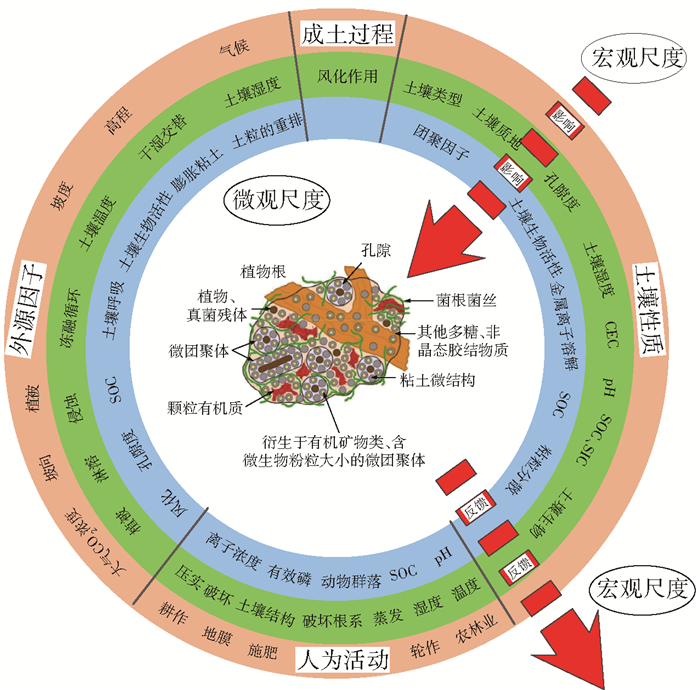
土壤团聚体是土壤基本结构单元,犹如生物体细胞,决定着土壤水分运动、通气性、溶质迁移、保水保肥能力、土壤抗蚀和固碳能力等[1]。气候、生物、母质、地形、时间、人为活动等成土因素的综合作用致土壤具高度时空异质性,严重阻碍了土壤学的定量、动态研究及其实际应用。Burrough研究表明,土壤空间格局分析是对土壤由经验认识上升到理性认识、由概念模型发展到机理模型的必要条件[2]。由图 1可见,在宏观尺度上,团聚体形成是环境要素、人为因素和土壤本身特性共同驱动的;但微观尺度上仅体现在土壤本身特性[3],其微观尺度的研究还不能完全理解团聚体在生态系统中的作用与功能;因此,其空间变异和驱动机制研究,有助于揭示团聚体空间分布规律和内在驱动机制,区分出土壤属性与外源因子的贡献,为全面理解团聚体形成和稳定机制打下良好基础;进而明确揭示出土壤稳定性差异的根本原因,这将有助于培育良好团聚体、提升土壤肥力、改善土壤质量、构建土壤安全等,同时还可为建立更精确的土壤侵蚀模型和水土流失综合治理提供科学依据。

图 1 不同尺度下的团聚体影响因素 Fig. 1 Factors affecting soil aggregation at micro and macro scale

以往针对团聚体空间变异的研究多采用Fisher创立的经典统计学,概括性描述其全貌,未考虑各样本的空间位置,不能反映局部空间特征,更不能反映自然状态下团聚体的空间格局;同时,其测定对象与空间位置无关的假设与实际情况不符。地统计学是由D. G. Krige于20世纪50年代提出,G. Matheron于60年代创立。1978年,Campbell首次将其引入土壤性质空间变异研究中,分析了土壤砂粒含量和pH的空间分布[4],推动了土壤空间格局研究的进度[5]。将地统计方法应用到土壤空间变异研究中可从不同空间尺度上全面、准确地揭示出其空间信息,已被证明是分析土壤空间变异性特征及其自然规律最为有效的方法之一,并已得到广泛应用[6];但在团聚体相关研究中还不多见,因此,笔者综述团聚体空间变异的定量方法、影响因素、空间分布预测模型构建及其可视化表达,总结当前研究的不足,并展望其研究前景。

1 土壤团聚体空间变异的定量分析方法

土壤性质空间分析中的地统计方法主要包括半变异函数和克里格插值[6]。半变异函数反映土壤性质在一定空间尺度上的变异特征和相关程度,克里格插值是利用原始数据结合半变异函数的结构性,对未采样区变量展开无偏估计。半变异函数和克里格插值作为地统计学中最基础的方法,已被应用于团聚体空间变异特征研究中:团聚体质量分维数、最大土粒粒径的空间分布特征[7];不同土地利用类型中水稳性团聚体含量[8]、平均重量直径等的空间分布差异性[9];土壤黏粒含量、土壤有机碳(SOC)含量、土地利用类型对水稳性团聚体含量空间分布的影响等[10]。不同研究区或不同空间尺度下,团聚体空间相关性差异显著,但主要呈现出中等强度的空间相关性[11-12];另外,Kriging空间插值能够获取团聚体空间变异,其精度相对于趋势面法提高了32%[13],且高于线性内插法和线性回归法[14],这归因于Kriging充分考虑空间变异[15-16];另外,插值精度比较发现:CoKriging内插明显优于普通Kriging[17],当土壤性质间高度相关性时,CoKriging效果更佳[17]。研究区样点数、样点空间距离、块金值和选用的半方差模型均会影响到Kriging的估计方差:采样点越多,采样点空间距离越小、块金值越小、半方差模型越合适,Kriging估计方差就越小[8]

2 土壤团聚体空间变异的影响因素

土壤团聚体是在一系列物理、化学、生物的综合作用下形成的,既受到土壤本身性质的作用,也受到外界自然因素、人为因素和成土过程的影响(图 1)[18]。由图 1可见,宏观因子对团聚体的影响归根结底是通过宏观过程影响其微观尺度上的团粒形成过程,宏观与微观有机结合,相互作用、相互反馈:如大气CO2浓度增加使得植被光合作用增强、根系发达、微生物群落增加、SOC增加、丛枝菌根增加等,对团聚体稳定性具有正效应;但也可能因为温室效应导致温度上升及微生物活动增强,使得SOC分解加快,从而产生负效应。土壤团聚体结构、稳定性及其影响因素研究受到广泛关注,传统上通过经典统计中的描述性统计研究团聚体空间变异,即计算团聚体稳定性系数的样本均值、标准差、方差、变异系数来反映其空间变异强弱,并利用经典统计学方法确定团聚体在不同土壤环境、外界环境因素、土地利用方式和耕作干扰等因素下的差异性[19-20]及其与土壤其它性质间的关联[21],通过统计特征值建立团聚体稳定性的半定量认知。为定量描述团聚体空间分异特征,更好地反映自然状态下团聚体的空间结构,引入地统计学[8]

2.1 土壤本质特征与团聚体空间变异

团聚体结构与土壤性质紧密关联,传统上研究团聚体与土壤性质间的关系主要采用经典统计学方法[22],该方法忽略土壤性质的空间格局特征和土壤性质间的空间相关性;因此,产生了对土壤性质空间格局和过程定量研究的地统计方法,以提高土壤空间变异的定量研究程度,反映出自然状态下土壤性质的空间格局和空间相关性。现应用地统计方法主要研究了团聚体空间格局与土壤质地、类型[9]、有机质含量、黏土矿物结晶度[23]、微生物特性[24]等土壤性质的空间关系。研究表明,土壤机械组成是控制团聚体稳定性的关键因素[25]:团聚体稳定性与砂粒(-0.132*)和黏粒含量(-0.351*)呈显著负相关,与粉粒含量(0.153*和0.436*)则呈正相关[17, 25],其相关程度在不同区域表现不同;但Öztaȿ等发现团聚体含量与土壤黏粒含量呈显著正相关(0.76*和0.91**)[26];这种相反的结果主要是土壤盐度和交换性Na+含量不同所致[27]。同时,黏粒和粉粒对团聚体空间变异的作用方式也不同:粉粒直接作用于大团聚体的空间变异;而黏粒则通过对微团聚体的影响间接影响大团聚体,其直接作用较小[13]。在SOC含量与团聚体空间关系的研究中,主要采用空间插值获取团聚体与SOC空间分布图以确定它们的空间相关性[27-30]:土壤肥力越高,团聚体空间异质性越大,大团聚体稳定性越强[27],这是由于肥力高的土壤中具有高含量的SOC[31-32],导致SOC对大团聚体空间变异的直接作用大于其间接作用[13]

2.2 自然因素与团聚体空间变异

显著影响团聚体结构和稳定性的自然要素主要包括地形地貌、气候因素、植被因素和土地覆被;这些要素通过影响土壤的5大成土因素来控制土壤形成过程,进而影响SOC含量、土壤呼吸、土粒的重排等方面,从而调控团聚体的结构(图 1)。地形地貌能够影响土壤水热条件和成土物质再分配,不同地形部位的团聚体有着不同的空间特征,其中线性地形(曲率几乎为0)较凹面地形(碗状地形、且碗口朝上[33])更益于大团聚体的形成[11];凹面地形较凸面地形(碗状地形、且碗口朝下)更益于稳定性团聚体的形成[34];Zadorova等[35]也发现相同结果,进一步研究发现坡度与团聚体稳定性的相关性较低,说明该研究区,坡度对土壤物质的再分配作用较弱。此外,团聚体稳定性的空间相关性分析表明凸面地形的团聚体空间相关性强于凹面的,说明凸面地形的团聚体主要受到土壤本质因素的作用,相比之下凹面团聚体受外在因素的影响更强[36]。这可能因为相比于凹面,凸面地形土壤含有较低的SOC、铁和锰,不益于团聚体的稳定,且土壤较为贫瘠,非农用地首选,因此受到人为干扰作用的概率会更小[34]。植被生长演替会影响SOC的数量与质量,从而影响团聚体的空间变异。不同植被类型下,土壤团聚体稳定性空间相关和自相关的差异性源自于土壤内外因素的共同作用[30, 37]。有研究表明,团聚体稳定性主要由地形、植被类型和植被恢复年限等内在因素共同决定,但耕作、放牧的作用也不容忽视,尤其是对土壤可蚀性[8];而团聚体稳定性的极值分布主要由土地利用、高程和土壤本身特性决定,由于步长对团聚体空间分布影响较弱,暗示着土壤母质、气候等外界因素影响显著[38]。气候因素对团聚体稳定性的影响主要通过气温、降水、干湿交替和冻融交替影响土壤颗粒的重新排列,从而影响团聚体稳定性(图 1);温度和湿度影响着土壤生物和微生物活性,从而影响腐殖质的分解速率,导致团聚体稳定性发生变化[39]

2.3 人为因素与团聚体空间变异

人为因素主要包括农业管理措施、土地利用方式、耕作干扰、施肥、放牧[40]等,对团聚体形成和结构影响显著。耕作主要通过改变土壤中SOC数量、质量和微生物活动生境对土壤结构产生影响[41]。耕作区种植作物不同,团聚体等土壤性质的空间结构差异性显著,如甘蔗地团聚体稳定性空间异质度较木薯地和农林业区更高[42];同时,耕作强度的增加促进SOC周转,减少土壤团聚,导致土壤质地粗糙,团聚体稳定性降低,土壤密度(BD)增加[43];不同耕作模式下团聚体稳定性的空间变异具有显著差异,这主要归因于机械操作在作物生长季节影响土壤结构:机械压实会导致土壤抗解聚力增强,大团聚体含量增加[10]。为验证机械压实对土壤性质空间变异的影响,Barik等比较分析重型机械操作前后土壤理化性质的空间分布差异,结果表明重型机械操作对各土层土壤性质影响不同,越接近于表层影响越大;压实前后团聚体空间分布差异增大,说明机械压实显著影响团聚体空间变异[12]。可见,耕作对土壤结构具有较大负作用,且该作用符合“就近原则”规律[44]。土地利用方式显著影响作物生产力和土壤理化性质[45],尤其是对团聚体[46]、SOC[47]、阳离子交换量[48]、土壤孔隙度[49]、土壤密度、抗剪强度、BD、土壤渗水性等[50]。不同土层团聚体稳定性差异不显著,但不同土地利用表层团聚体具显著差异,这进一步印证了土地利用对团聚体的影响:不当的耕作方式,尤其是丘陵地带的上下坡耕作、林地到牧场转变、滥伐均是小流域团聚体稳定性下降的主要原因[48]。农用地和草地不同土层土壤团聚体的空间相关性不同,说明人为管理对团聚体空间变异的显著影响,尤其是对表层土;考虑到采样区地形条件、土壤质地、母质和气候条件均相似,土地利用方式的不同则是导致土壤质量空间差异的关键原因[29]

3 土壤团聚体空间变异预测模型构建及可视化分析

环境系统是由多因素耦合而成的复杂非线性系统,并具有随机行为。土壤系统的空间变异也具有复杂性,建模是定量刻画土壤性质空间变异的有效手段[34, 51]。GIS所具有的强大空间分析和可视化表达能力,为表征土壤性质空间变异对相关环境因素的响应提供了强有力的工具。在其应用过程中,通常将土壤性质的影响因素进行量化作为输入集,结合不同算法构建模型。当前,以团聚体为对象的模型构建研究并不多见,现有研究利用遥感数据和数字高程模型(DEM)提取环境数据,构建团聚体稳定性反演模型[51-52];其反演模型精度较高(0.34≤R2≤0.69)[34]。进一步,将回归克里格引入反演较高精度的团聚体稳定性空间分布[53]。这些研究表明,地统计学和GIS的结合可快速获取土壤团聚体稳定性空间格局,更好的反映自然状态下团聚体的空间结构,从宏观尺度上探究团聚体在生态系统中的作用与功能。

4 研究展望

当前地统计在土壤团聚体空间变异上取得一定进展,但由于在区域尺度上,土壤特性、气候、地形、植被因素和人类活动的时空变异快速、复杂,使得相关领域还有待深入研究:1)不同空间尺度上,土壤性质、自然要素、人为活动与团聚体稳定性空间变异的贡献大小尚不清楚;2)目前已有少量研究将遥感、DEM等易于获取的数据用于团聚体空间变异的反演,但数据分辨率较低,不能很好地反映其空间变异,因此,需进一步提高数据分辨率。

随着大量新技术、新方法不断应用到土壤科学,以及地统计学自身的不断完善,这为团聚体研究带来广阔空间:1)引入因子克里格将系统总变异划分到不同空间尺度上,研究土壤性质与不同因素间的尺度依赖性关系;由于土壤是一个开放、动态的多组分体系,许多土壤性质都会发生时空变异,引入时空克里格模拟土壤性质的时空行为,有助于理解土壤时空变异规律。2)基于遥感、DEM、气候数据等易于获取的宏观数据,衍生出影响团聚体稳定性的环境数据,如植被覆盖、地形因子、景观结构、水热条件等,进而利用偏最小二乘法和结构方程模型量化各因素对团聚体稳定性空间变异的贡献大小。3)基于宏观数据构建团聚体空间分布预测模型,实现快速分析不同空间尺度上,团聚体稳定性空间变异与影响因素的空间关联。当前模型构建常用的有广义线性回归和多元线性回归模型,这些模型多为静态。随着计算机技术的发展和有关数学理论的日趋成熟,将不同建模方法(模糊推理系统、人工神经网络、支持向量机等)与模型精度进行权衡,使得模型更为精确,更能反映土壤团聚体空间变异特征。从宏观尺度研究团聚体形成过程、影响因素及其各因素贡献率,对推进团聚体形成机理的理解,准确的探讨团聚体形成和稳定性影响因素具有重要意义。

5 参考文献
[1]
RILLIG M C, WRIGHT S F, ALLEN M F, et al. Rise in carbon dioxide changes in soil structure[J]. Nature, 1999, 400(6745): 628. DOI:10.1038/23168
[2]
BURROUGH P. Soil variability: a late 20th century view[J]. Soils and fertilizers, 1993, 56(5): 529.
[3]
JASTROW J, MILLER R. Soil aggregate stabilization and carbon sequestration: Feedbacks through organomineral associations[J]. Soil Processes and the Carbon Cycle, 1997, 207.
[4]
CAMPBELL J B. Spatial variation of sand content and pH within single contiguous delineations of two soil mapping units[J]. Soil Science Society of America Journal, 1978, 42(3): 460. DOI:10.2136/sssaj1978.03615995004200030017x
[5]
MCGRATH D, ZHANG C S, CARTON O T. Geostatistical analyses and hazard assessment on soil lead in Silvermines area, Ireland[J]. Environmental Pollution, 2004, 127(2): 239.
[6]
LI Y Q, WANG X Y, NIU Y Y, et al. Spatial distribution of soil organic carbon in the ecologically fragile Horqin Grassland of northeastern China[J]. Geoderma, 2018, 325.
[7]
CASTRIGNANO A, STELLUTI M. Fractal geometry and geostatistics for describing the field variability of soil aggregation[J]. Journal of Agricultural Engineering Research, 1999, 73(1): 13. DOI:10.1006/jaer.1998.0385
[8]
YE L P, TAN W F, FANG L C, et al. Spatial analysis of soil aggregate stability in a small catchment of the Loess Plateau, China: Ⅰ. Spatial variability[J]. Soil and Tillage Research, 2018, 179: 71. DOI:10.1016/j.still.2018.01.012
[9]
VEIHE A. The spatial variability of erodibility and its relation to soil types: A study from northern Ghana[J]. Geoderma, 2002, 106(1/2): 101.
[10]
KAVDIR Y, OZCAN H, EKINCI H, et al. The influence of clay content, organic carbon and land use types on soil aggregate stability and tensile strength[J]. Turkish Journal of Agriculture and Forestry, 2004, 28: 155.
[11]
SIQUEIRA D S, MARQUES J, PEREIRA G T. The use of landforms to predict the variability of soil and orange attributes[J]. Geoderma, 2010, 155(1/2): 55.
[12]
BARIK K, AKSAKAL E L, ISLAM K R, et al. Spatial variability in soil compaction properties associated with field traffic operations[J]. Catena, 2014, 120: 122. DOI:10.1016/j.catena.2014.04.013
[13]
吕军, 俞劲炎. 水稻土物理性质空间变异性研究[J]. 土壤学报, 1990, 27(1): 8.
LÜ Jun, YU Jinyan. Spatial variability of physical properties of paddy soil in field[J]. Acta Pedologica Sinica, 1990, 27(1): 8. DOI:10.3321/j.issn:0564-3929.1990.01.002
[14]
梁春祥, 姚贤良. 华中丘陵红壤物理性质空间变异性的研究[J]. 土壤学报, 1993, 30(1): 69.
LIANG Chunxiang, YAO Xianliang. Spatial variability of physical properties of red soil in hilly land of central China[J]. Acta Pedologica Sinica, 1993, 30(1): 69.
[15]
司炳成, 褚达华. 田间土壤某些特性的空间变异分析与kriging和cokriging分析:Ⅰ.空间变异分析[J]. 河北农业大学学报, 1990, 13(1): 22.
SI Bingcheng, CHU Dahua. Structural analysis and kriging, cokriging analysis of some soil properties I. Structural analysis[J]. Journal of Hebei Agricultural University, 1990, 13(1): 22.
[16]
司炳成, 褚达华. 田间土壤某些特性的空间变异分析与kriging和cokrignig分析Ⅱ.Kriging分析[J]. 河北农业大学学报, 1991, 14(2): 15.
SI Bingcheng, CHU Dahua. Spatial structural analysis and Kriging or Cokriging analysis of some soil properties Ⅱ. Kriging analysis[J]. Journal of Hebei Agricultural University, 1991, 14(2): 15.
[17]
SHOUSE P J, GERIK T J, RUSSELL W B, et al. Spatial distribution of soil particle size and aggregate stability index in a clay soil[J]. Soil Science, 1990, 149(6): 351. DOI:10.1097/00010694-199006000-00006
[18]
卢金伟, 李占斌. 土壤团聚体研究进展[J]. 水土保持研究, 2002, 9(1): 81.
LU Jinwei, LI Zhanbin. Advance in soil aggregate study[J]. Research of Soil and Water Conservation, 2002, 9(1): 81. DOI:10.3969/j.issn.1005-3409.2002.01.020
[19]
OZTAS T, FAYETORBAY F. Effect of freezing and thawing processes on soil aggregate stability[J]. Catena, 2003, 52(1): 1. DOI:10.1016/S0341-8162(02)00177-7
[20]
OZGUL M, AKSAKAL E L, GUNES A, et al. Influence of global warming on aggregate stability and hydraulic conductivity under highland soil order in turkey[J]. Soil Science, 2011, 176(10): 559. DOI:10.1097/SS.0b013e3182288470
[21]
GRAF F, FREI M. Soil aggregate stability related to soil density, root length, and mycorrhiza using site-specific Alnus incana and Melanogaster variegatus s.l[J]. Ecological Engineering, 2013, 57: 314. DOI:10.1016/j.ecoleng.2013.04.037
[22]
陈晓芬, 李忠佩, 刘明, 等. 不同施肥处理对红壤水稻土团聚体有机碳、氮分布和微生物生物量的影响[J]. 中国农业科学, 2013, 46(5): 950.
CHEN Xiaofen, LI Zhongpei, LIU Ming, et al. Effects of different fertilizations on organic carbon and nitrogen contents in water-stable aggregates and microbial biomass content in paddy soil of subtropical China[J]. Scientia Agricultura Sinica, 2013, 46(5): 950. DOI:10.3864/j.issn.0578-1752.2013.05.010
[23]
CAMARGO L A, MARQUES J, NIOR J, PEREIRA G T, et al. Spatial variability of mineralogical attributes of an oxisol under different relief forms: Ⅱ-correlation between mineralogy and aggregation[J]. Revista Brasileira de Ciência do Solo, 2008, 32(6): 2279. DOI:10.1590/S0100-06832008000600007
[24]
MUMMEY D L, CLARKE J T, COLE C A, et al. Spatial analysis reveals differences in soil microbial community interactions between adjacent coniferous forest and clearcut ecosystems[J]. Soil Biology & Biochemistry, 2010, 42(7): 1138.
[25]
YEKZABAN A, SHABANPOUR M, DAVATGAR N. Spatial distribution of soil aggregate stability (MWD) as compared to particle size distribution (PSD) using geostatistics[J]. Scientific Journal Of Environmental Sciences, 2014, 3(4): 28.
[26]
ÖZTAÇ T, CANBOLAT M Y, SÖNMEZ K. Strength of individual soil aggregates against crushing forces ii. influence of selected soil properties[J]. Turkish Journal of Agriculture and Forestry, 1999, 23(6): 573.
[27]
GOKALP Z, BASARAN M, UZUN O, et al. Spatial analysis of some physical soil properties in a saline and alkaline grassland soil of Kayseri, Turkey[J]. African Journal of Agricultural Research, 2010, 5(10): 1127.
[28]
MOHAMMADI J, MOTAGHIAN M H. Spatial Prediction of Soil Aggregate Stability and Aggregate-Associated Organic Carbon Content at the Catchment Scale Using Geostatistical Techniques[J]. Pedosphere, 2011, 21(3): 389. DOI:10.1016/S1002-0160(11)60140-9
[29]
OZGOZ E, GUNAL H, ACIR N, et al. Soil quality and spatial variability assessment of land use effects in a Typic Haplustoll[J]. Land Degradation & Development, 2013, 24(3): 277.
[30]
BASARAN M, ERPUL G, OZCAN A U. Variation of macro-aggregate stability and organic matter fractions in the basin of Saraykoy Ⅱ Irrigation Dam, Cankiri, Turkey[J]. Fresenius Environmental Bulletin, 2008, 17(2): 224.
[31]
DE SOUZA Z M, MARQUES J, PEREIRA G T, et al. Spatial variability of aggregate stability in latosols under sugarcane[J]. Revista Brasileira De Ciencia Do Solo, 2009, 33(2): 245. DOI:10.1590/S0100-06832009000200002
[32]
薛涛.小流域土壤团聚体稳定性及空间变异特征研究[D].长沙: 湖南农业大学, 2010: 1.
XUE Tao. Characteristics of soil aggregation stability and its spatial variability in the small watershed of south Hunan Province[D]. Changsha: Hunan Agricultural University, 2010: 1.
[33]
TROEH F R. Landform equations fitted to contour maps[J]. American Journal of Science, 1965, 263(7): 616. DOI:10.2475/ajs.263.7.616
[34]
JAKSIK O, KODESOVA R, KUBIS A, et al. Soil aggregate stability within morphologically diverse areas[J]. Catena, 2015, 127: 287. DOI:10.1016/j.catena.2015.01.010
[35]
ZADOROVA T, JAKŠ K O, KODEŠOV R, et al. Influence of terrain attributes and soil properties on soil aggregate stability[J]. Soil and Water Research, 2011, 6(3): 111. DOI:10.17221/SWR
[36]
CAMARGO L A, MARQUES J, PEREIRA G T. Spatial variability of physical attributes of an alfisol under different hillslope curvatures[J]. Revista Brasileira De Ciencia Do Solo, 2010, 34(3): 617. DOI:10.1590/S0100-06832010000300003
[37]
OGUNWOLE J O, OBIDIKE E O, TIMM L C, et al. Assessment of spatial distribution of selected soil properties using geospatial statistical tools[J]. Communications in Soil Science and Plant Analysis, 2014, 45(16): 2182. DOI:10.1080/00103624.2014.912288
[38]
王峰.基于GIS的流域土壤特性及抗侵蚀性能空间变异研究[D].重庆: 西南大学, 2006: 1.
WANG Feng. Spatial variability of soil properties and anti-erosion ability in a small watershed based on GIS[D]. Chongqing: Southwest University, 2006: 1. http://cdmd.cnki.com.cn/Article/CDMD-10635-2006118463.htm
[39]
BRONICK C J, LAL R. Soil structure and management: a review[J]. Geoderma, 2005, 124(1/2): 3.
[40]
谭文峰, 朱志锋, 刘凡, 等. 江汉平原不同土地利用方式下土壤团聚体中有机碳的分布与积累特点[J]. 自然资源学报, 2006, 21(6): 973.
TAN Wenfeng, ZHU Zhifeng, LIU Fan, et al. Organic carbon distribution and storage in soil aggregates under land use change in Jianghan Plain, Hubei Province[J]. Journal of Natural Resources, 2006, 21(6): 973. DOI:10.3321/j.issn:1000-3037.2006.06.015
[41]
PARFITT J M B, TIMM L C, REICHARDT K, et al. Impacts of land leveling on lowland soil physical properties[J]. Revista Brasileira De Ciencia Do Solo, 2014, 38(1): 315. DOI:10.1590/S0100-06832014000100032
[42]
DE OLIVEIRA I A, CAMPOS M C C, SOARES M D R, et al. Spatial variability of physical properties in a cambisol under different land uses in the southern amazon region[J]. Revista Brasileira De Ciencia Do Solo, 2013, 37(4): 1103. DOI:10.1590/S0100-06832013000400027
[43]
AINA P, NURUDEEN O. Geostatistical approach to optimize impact of long term cultivation and fertility management on soil surface physical properties[J]. The 20th World Congress of Soil Science, 2014.
[44]
王金贵.人为生产活动与农田土壤主要性质空间变异性关系[D].陕西杨凌: 西北农林科技大学, 2009: 1.
WANG Jingui. The relationship of artificial production activity and spatial variability of soil main properties on farmland[D]. Yangling, Shaanxi: Northwest A&F University, 2009: 1. http://cdmd.cnki.com.cn/Article/CDMD-10712-2010049923.htm
[45]
姚喜军, 徐进才, 刘静, 等. 伊金霍洛旗不同土地利用方式下的土壤养分特征[J]. 中国水土保持科学, 2017, 15(5): 111.
YAO Xijun, XU Jincai, LIU Jing, et al. Characteristics of soil nutrient under different land use types in Yijinhuoluo county[J]. Science of Soil and Water Conservation, 2017, 15(5): 111.
[46]
周萍, 刘国彬, 候喜禄. 黄土丘陵区不同土地利用方式土壤团粒结构分形特征[J]. 中国水土保持科学, 2008, 6(2): 75.
ZHOU Ping, LIU Guobin, HOU Xilu. Fractal features of soil aggregate structure under different land use in the hilly-gully region of Loess Plateau[J]. Science of Soil and Water Conservation, 2008, 6(2): 75. DOI:10.3969/j.issn.1672-3007.2008.02.014
[47]
李鉴霖, 江长胜, 郝庆菊. 缙云山不同土地利用方式土壤有机碳组分特征[J]. 生态学报, 2015, 35(11): 3733.
LI Jianlin, JIANG Changsheng, HAO Qingju. Distribution characteristics of soil organic carbon and its physical fractions under the different land uses in Jinyun Mountain[J]. Acta Ecologica Sinica, 2015, 35(11): 3733.
[48]
HESHMATI M, ABDU A, JUSOP S, et al. Effects of land use practices on the organic carbon content, cation exchange capacity and aggregate stability of soils in the catchment zones[J]. American Journal of Applied Sciences, 2011, 8(12): 1363. DOI:10.3844/ajassp.2011.1363.1373
[49]
刘艳丽, 李成亮, 高明秀, 等. 不同土地利用方式对黄河三角洲土壤物理特性的影响[J]. 生态学报, 2015, 35(15): 5183.
LIU Yanli, LI Chengliang, GAO Mingxiu, et al. Effect of different land-use patterns on physical characteristics of the soil in the Yellow River delta region[J]. Acta Ecologica Sinica, 2015, 35(15): 5183.
[50]
王清奎, 汪思龙. 土壤团聚体形成与稳定机制及影响因素[J]. 土壤通报, 2005, 36(3): 415.
WANG Qingkui, WANG Silong. Forming and stable mechanism of soil aggregate and influencing factors[J]. Chinese Journal of Soil Science, 2005, 36(3): 415. DOI:10.3321/j.issn:0564-3945.2005.03.031
[51]
BESALATPOUR A A, AYOUBI S, HAJABBASI M A, et al. Estimating wet soil aggregate stability from easily available properties in a highly mountainous watershed[J]. Catena, 2013, 111: 72. DOI:10.1016/j.catena.2013.07.001
[52]
BESALATPOUR A A, AYOUBI S, HAJABBASI M A, et al. Feature selection using parallel genetic algorithm for the prediction of geometric mean diameter of soil aggregates by machine learning methods[J]. Arid Land Research and Management, 2014, 28(4): 383. DOI:10.1080/15324982.2013.871599
[53]
ANNABI M, RACLOT D, BAHRI H, et al. Spatial variability of soil aggregate stability at the scale of an agricultural region in Tunisia[J]. Catena, 2017, 153: 157. DOI:10.1016/j.catena.2017.02.010