县域尺度水土流失重点治理区域划定方法
1. 海河流域水土保持监测中心站, 300170, 天津;
2. 水利部水土保持监测中心, 100053, 北京
收稿日期:2018-03-19; 修回日期:2018-07-20
项目名称:水利部财政预算项目"全国水土流失动态监测项目"(126216229000150001)
摘要:对国家级水土流失重点防治区的重点治理区域进行划定是一项重要基础性工作,是落实精准治理、协调不同层级重点治理区域范围划定的关键。以河北省平山县为例,在县域尺度,分别以乡级行政区和小流域为单元,划定国家级水土流失重点防治区中的重点治理区域范围。结果表明:以乡级行政区为单元划分的重点治理区域面积是1 358.81 km2,以小流域为单元划分的重点治理区域面积是1 273.61 km2,结果均大于基准参照值。将乡级行政区和小流域的划分结果叠加分析,综合考虑定量指标与定性因素,在满足相对集中连片、空间不相互重叠、便于动态监管等原则下,进行局部区域取舍,划定的平山县重点治理区域面积为1 126.44 km2,接近基准参照值1 106.80 km2,且分布合理。因此,划定县域尺度重点治理区域,首先,设置科学的定量和定性划分指标体系;其次,设置合理的划分单元尺度;第三,优先划定国家级水土流失重点治理区中重点治理区域范围,再指导省级及以下各级水土流失重点治理区域划定;第四,划定结果应根据水土流失动态监测定期调整,实施动态管理。
关键词:水土流失 重点防治区 重点治理区域 县域尺度 划定方法
An approach of dividing key control area for soil and water loss at the county scale
LI Zixuan1
,
ZOU Haitian1,
ZHAO Hui2
,
QI Jianhuai1
1. Soil and Water Conservation Monitoring Center of Haihe Basin, 300170, Tianjin, China;
2. Monitoring Center of Soil and Water Conservation, Ministry of Water Resources, 100053, Beijing, China
Abstract:
[Background]
Forty national key prevention and control regions for soil and water loss were divided in China according to National Plan on Soil and Water Conservation (2015-2030), involving 1091 counties, with a total county area of 49.805×10⁸ km2, which was approved by the State Council of the People's Republic of China in 2015. The key control area is 4.944×10⁸ km2, but its specific scope has not been defined up to now. Due to this, key regionalization of prevention and control of soil erosion and water loss are affected on provincial and county levels. Thus studying a dividing method of key control area at the county scale for national key prevention and control region is necessary.
[Methods]
We used ArcGIS to study the dividing method of the key control area in Pingshan county, Hebei province. Before the research, we collected the results of national key regionalization of prevention and control of soil erosion and water loss, township-level divisions of Pingshan county, land use, vegetation coverage and soil erosion. Next, we selected the quantitative and qualitative indexes for analysis. At last, We divided the key control area in Pingshan county by the unit of township district and small watershed partly, and discussed contrastively between the results of study and the reference value of Pingshan county which had been rechecked and provided in National Plan on Soil and Water Conservation (2015-2030).
[Results]
According to quantitative index, the divided key control area based on the unit of township district was 1 358.81 km2, and the divided key control area based on the unit of small watershed was 1 273.61 km2. The results were all greater than the reference value. And area ratio of sloping land had no reference significance. Instead, the result (1 126.44 km2) was close to the reference value (1 106.80 km2) and reasonably distributed, the quantitative and qualitative indexes were considered comprehensively and were superimposed over the unit of township district and small watershed.
[Conclusions]
The division of the national key control area of soil and water loss is an important basic work. Firstly, the comprehensive, scientific and operable index system should be constructed. Secondly, the relatively suitable division unit should be selected, which follows the principle demand such as relative centralization. Thirdly, priority should be given to dividing key control area of soil and water loss at the national level, and the division of key control area at the provincial level and below should be carried out under its guidance. Fourthly, the national key control area should be adjusted and managed regularly through dynamic monitoring of soil and water loss.
Key words: water and soil loss key prevention and control region key control area county scale dividing method
水土流失重点预防区和重点治理区(以下简称“水土流失重点防治区”)的划分是因地制宜落实水土保持工作方针,实施分类指导和分区防治战略[1]的基础, 其涉及国家、省、市和县4级人民政府,且为便于管理,应满足不同级别间空间不相互重叠的原则要求[1-2]。2015年,国务院批复的《全国水土保持规划(2015—2030年)》划分了40个国家级水土流失重点防治区,其中:国家级重点预防区23个,涉及28个省(自治区、直辖市),460个县(区、市、旗),县域总面积334.4万km2(其中重点预防区域面积43.92万km2);国家级重点治理区17个,涉及24个省(自治区、直辖市)631个县(市区、旗),县域总面积163.65万km2(其中重点治理区域面积49.44万km2)。各地也相继开展了省级、县级水土流失重点防治区划分工作。省级重点防治区划分一般多以县级行政区为单元[3],其中重点防治区集中连片面积一般在1000km2以上;或以乡镇为基本划分单元[4-6],其中重点防治区集中连片面积一般在10~100km2及以上。北京市以小流域为最小单元进行重点防治区复核划分[7]。省级划定的重点防治区面积一般约占省级行政区面积30%~70%,少数涵括整个省域面积。县级一般以乡镇[8]或行政村[9]为单元,划分水土流失重点防治区域。
我国水土流失重点防治区划定工作尚未完成[10],国家级水土流失重点防治区重点防治面积尚未“落地”。按照各级水土流失重点防治区空间不相互重叠原则,这在一定程度上影响了省级及以下水土流失重点防治区划定;因此,划定县域尺度重点治理区域的具体边界,是协调各级重点防治区空间范围,开展水土流失监测,实施动态监管,落实水土流失防治责任的基础。笔者以平山县为例,研究县域尺度重点治理区域范围的划定方法,为国家级水土流失重点防治区重点治理面积“落地”提供实证。
1 研究区概况
河北省平山县,属太行山国家级水土流失重点治理区,位于E 113°31′~114°15′,N 38°09′~38°45′,土地总面积2648.00km2。境内北、西、南三面环山,成簸箕状地貌轮廓,地势自东南向西北逐渐升高,地貌类型依次为丘陵、低山、中山、亚高山。境内片麻岩、变质岩分布广泛,土壤以棕壤、褐土和草甸土为主。属暖温带落叶阔叶林,2017年全县植被覆盖率67.56%。属暖温带大陆性半湿润半干旱季风气候,冬春寒干,夏季炎热多雨,秋高气爽,四季分明,年平均气温12.7~14℃,极端最高气温42.5℃,极端最低气温为-17.9℃,年平均风速2.2m/s,多年平均降水量530~690mm。境内河流均系海河流域子牙河水系滹沱河支流,多年平均径流深189.8mm,多年平均径流系数28%。据全国第1次水利普查水土保持情况普查,至2011年底,全县共有水土流失面积1348.38km2,约占土地总面积的50%,以水蚀为主。
2 材料与方法
收集国家级水土流失重点防治区划分成果、平山县级和乡级行政区划、1:5万地形图等基础地理数据,以及县域土地利用、植被覆盖、土壤侵蚀、水土流失治理工程等基础资料。根据《全国水土保持规划国家级水土流失重点防治区复核划分结果》(2013年),平山县国家级水土流失重点治理区域面积为1106.80km2(仅有数量,无空间分布)。笔者以此作为基准参照值,进行平山县国家级重点治理区域划定和结果分析评价。
1) 利用ArcGIS软件,基于1:5万地形图和乡级行政区划图,提取等高线、高程点等数据,以及乡镇边界和小流域边界,完成小流域划分,建立拓扑关系。据统计,平山县现有25个乡镇(30~240km2),共划分为118个小流域(10~90km2)。
2) 参照《全国水土保持规划国家级水土流失重点防治区复核划分技术导则(试行)》[11],通过遥感解译和资料收集等方法,获取土地利用、土壤侵蚀等定量指标(表 1),以及国家主体功能区、重点治理工程和反映水土流失危害程度大小、治理迫切程度等定性因素,构建县域尺度重点治理区域划分指标体系。
表 1(Tab. 1)
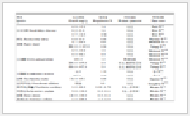
表 1 水土流失重点治理区域划分指标
Tab. 1 Division index of key control area of soil and water loss
定量指标
Quantitative index |
土壤侵蚀强度、水土流失面积比、中度以上水土流失面积比、坡耕地面积比
Soil erosion intensity, area ratio of soil and water loss, area ratio of soil erosion above moderate degree, and area ratio of sloping land |
划分标准
Dividing standard |
指标1:水土流失面积占比≥40%
Index 1: Area ratio of soil and water loss ≥40% |
指标2:中度以上水土流失面积占比≥20%
Index 2: Area ratio of soil erosion above moderate degree ≥20% |
指标3:坡耕地面积占比≥20%
Index 3: Area ratio of sloping land ≥20% |
定性指标
Qualitative index |
治理需求迫切程度、预期治理成效、水土流失治理程度
Urgency of control demand, expected effectiveness of control, and erosion control ratio |
辅助指标
Supporting index |
集中连片面积10km2及以上
Concentrated area of soil and water loss ≥10km2 |
|
表 1 水土流失重点治理区域划分指标
Tab. 1 Division index of key control area of soil and water loss
|
3) 分别以乡级行政区和小流域为划分单元计算定量指标。利用ArcGIS软件,将乡镇界和小流域界矢量数据,分别与县域土壤侵蚀、土地利用专题数据进行空间叠加分析,筛选符合定量指标划分标准的乡镇或小流域,汇总统计其面积,并与基准参照值进行对比。
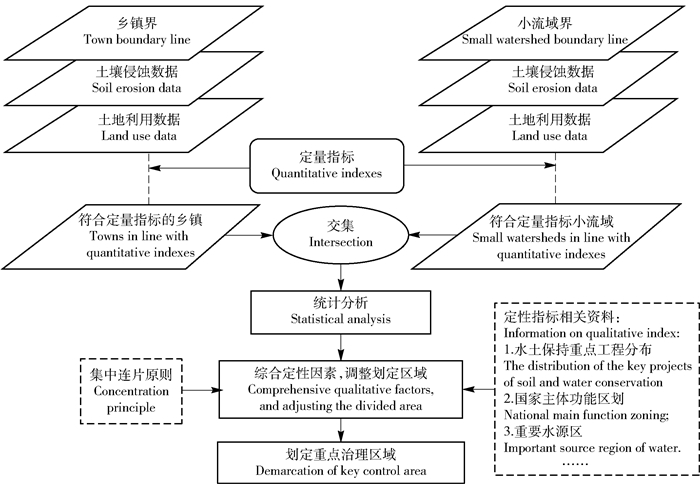
4) 根据定量计算结果,将以乡级行政区为单元的划分结果和以小流域为单元的划分结果进行叠加综合分析,在保证划定区域相对集中连片的基础上,综合考虑国家主体功能区、重要水源区和水土流失重点治理工程分布情况等定性因素,调整部分区域,划定重点治理区域的空间范围。技术流程详见图 1。
3 结果与分析
3.1 以乡级行政区为单元的划分结果
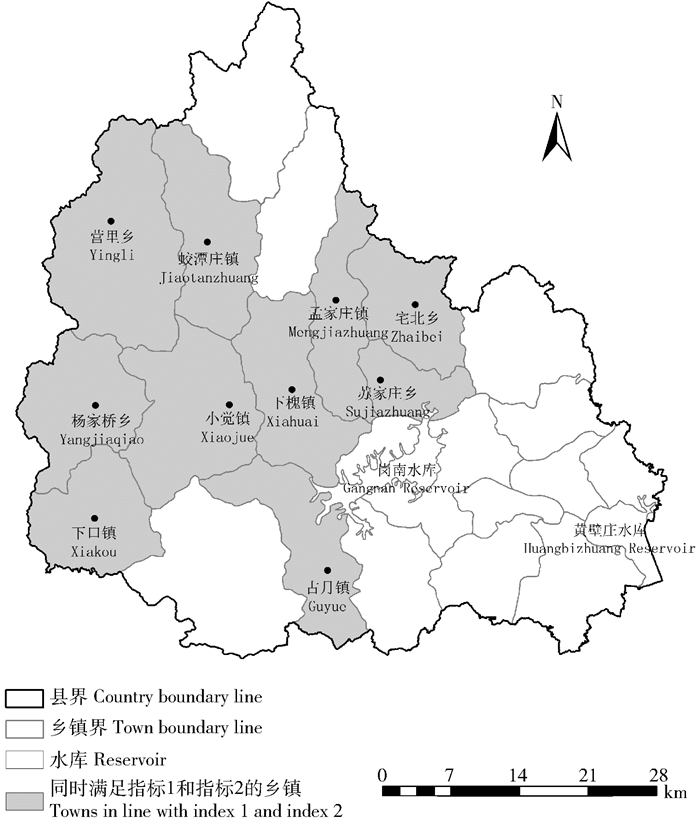
以乡级行政区为划分单元,利用ArcGIS软件,空间分析、统计土壤侵蚀和坡耕地面积。平山县25个乡级行政区中水土流失面积比≥40%的有12个,其中中度以上水土流失面积比≥20%的有10个,分别为孟家庄镇、蛟潭庄镇、宅北乡、营里乡、下口镇、下槐镇、古月镇、苏家庄乡、小觉镇和杨家桥乡,土地面积为1358.81km2,且所有乡镇的坡耕地面积比均≤20%(见表 2和图 2)。经分析可知,以乡级行政区为单元划分的重点治理区域,能在较大程度上实现集中连片;但因划分单元面积较大,易将部分植被覆盖条件好、土壤侵蚀相对较轻的区域划入重点治理区域,而将岗南水库上游周边等一些面积较小但水土流失较集中、需要重点关注和治理的区域剔除在外。坡耕地面积比指标没有参考意义。
表 2(Tab. 2)
表 2 以乡级行政区为划分单元的重点治理区域统计
Tab. 2 Statistics of key control area based on the unit of township district
乡镇名称
Town name |
土地面积
Land area/km2 |
坡耕地面积比
Area ratio of sloping land/% |
土壤侵蚀面积
Soil erosion area/km2 |
水土流失面积占比
Area ratio of soil and water loss/% |
中度以上水土流失面积占比
Area ratio of soil and water loss above moderate degree/% |
微度
Micro erosion |
轻度
Mild erosion |
中度
Moderate erosion |
强烈
Intense erosion |
孟家庄镇
Mengjiazhuang |
106.97 |
3.70 |
62.42 |
23.12 |
21.43 |
0 |
41.64 |
20.03 |
蛟潭庄镇
Jiaotanzhuang |
149.05 |
2.22 |
74.98 |
30.06 |
44.01 |
0 |
49.70 |
29.53 |
宅北乡
Zhaibei |
107.32 |
8.77 |
50.45 |
33.22 |
23.65 |
0 |
52.99 |
22.04 |
营里乡
Yingli |
231.72 |
1.66 |
103.01 |
74.54 |
54.17 |
0 |
55.54 |
23.38 |
下口镇
Xiakou |
120.07 |
1.64 |
48.83 |
51.15 |
20.08 |
0 |
59.33 |
20.89 |
下槐镇
Xiahuai |
141.78 |
3.57 |
49.10 |
44.01 |
48.58 |
0.08 |
65.37 |
34.33 |
古月镇
Guyue |
129.44 |
4.55 |
40.79 |
68.21 |
20.45 |
0 |
68.49 |
21.98 |
苏家庄乡
Sujiazhuang |
58.52 |
7.20 |
18.30 |
18.05 |
22.18 |
0 |
68.73 |
37.09 |
小觉镇
Xiaojue |
179.42 |
1.03 |
45.19 |
71.86 |
62.37 |
0 |
74.81 |
34.76 |
杨家桥乡
Yangjiaqiao |
134.51 |
1.08 |
33.00 |
59.64 |
41.86 |
0 |
75.46 |
31.12 |
|
表 2 以乡级行政区为划分单元的重点治理区域统计
Tab. 2 Statistics of key control area based on the unit of township district
|
3.2 以小流域为统计单元的划分结果
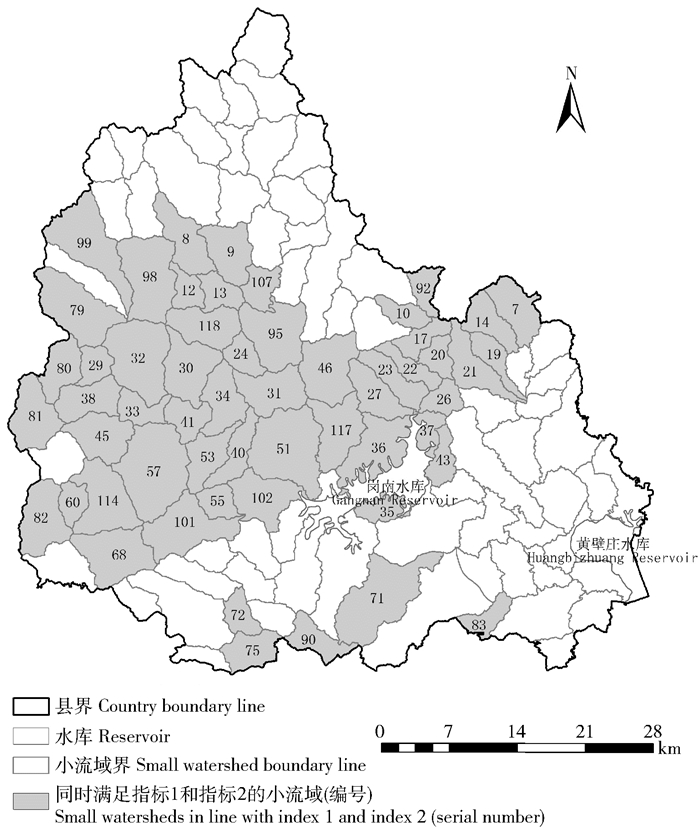
以小流域为划分单元,利用ArcGIS软件,空间分析、统计土壤侵蚀和坡耕地面积。平山县118条小流域中水土流失面积比≥40%的有64条,其中中度以上水土流失面积比≥20%的有56条,土地面积共计1273.61km2,且所有小流域的坡耕地面积比均≤20%(图 3)。经分析可知,以小流域为单元划分的重点治理区面积较接近基准对照值;但划定区域相对分散,不利于后续水土流失精准治理和综合管理。坡耕地面积比指标没有参考意义。
3.3 综合定量和定性指标的划分结果
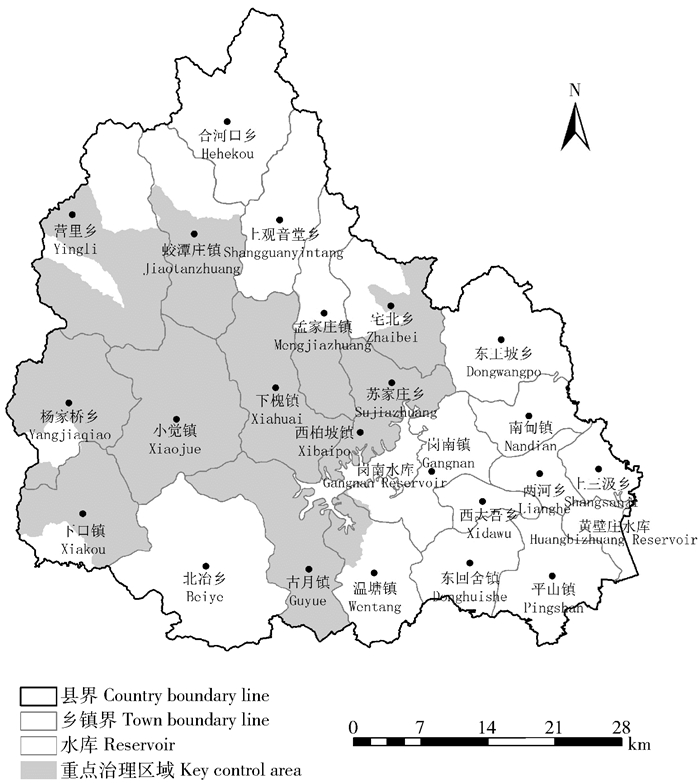
平山县土壤侵蚀现状表明,其水土流失严重区域多集中分布在岗南水库上游。由分析图 2和图 3可知,无论以乡级行政区为单元,还是以小流域为单元,划定的重点治理区域面积,均与基准参照值(即1106.80km2)有差距。为此,笔者利用ArcGIS软件,将以乡级行政区为单元的划分结果和以小流域为单元的划分结果进行叠加计算,在同时满足指标1和指标2要求的乡镇中,筛选出同时满足指标1和指标2的小流域。然后,按相对集中连片的原则,综合考虑平山县驼梁国家级自然保护区、西柏坡—天桂山风景名胜区等国家主体功能区,以及岗南水库等重要水源区、西柏坡水土流失综合治理和岗黄水库坡改梯水土保持重点治理工程分布等定性指标相关因素,将叠加结果外的6条小流域划入重点治理区域。最终,确定平山县重点治理区域面积为1126.44km2,涉及11个乡镇56个小流域(表 3和图 4),接近基准对照值,且分布合理。
表 3(Tab. 3)
表 3 综合定量和定性指标划分的重点治理区域结果
Tab. 3 Division results of key control area divided by the quantitative and qualitative indexes
划分单元
Division unit |
指标
Index |
基准参照值
Reference value/km2 |
面积
Area/km2 |
乡镇
Town |
指标1≥40%和指标2≥20%
Index 1≥40% and Index 2≥20% |
1106.80 |
1358.81 |
小流域
Small watershed |
指标1≥40%和指标2≥20%
Index 1≥40% and Index 2≥20% |
|
1273.61 |
乡镇+小流域
Town+small watershed |
指标1≥40%和指标2≥20%
Index1≥ 40% and Index 2≥20% |
|
1000.35 |
乡镇+小流域(增选)
Town+small watershed(co-opted) |
指标1≥40%和指标2≥20%
Index 1≥40% and Index 2≥20% |
|
1126.44 |
|
表 3 综合定量和定性指标划分的重点治理区域结果
Tab. 3 Division results of key control area divided by the quantitative and qualitative indexes
|
4 结论与讨论
通过平山县重点治理区域划定工作的开展,研究结论和有关问题归纳如下。
1) 平山县属太行山国家级水土流失重点治理区,地形破碎,土壤侵蚀较为严重,划定县域水土流失重点治理区域范围,对实施精准治理,协调省级、县级水土流失重点治理区的划定十分重要。首先应构建符合区域实际的指标体系,对不尽合理的定量指标进行甄选,对主观随意性强的定性指标综合考虑区域实际情况再行设定。只有设置科学准确的定量指标和操作性强的定性指标,才能保证划定结果相对合理。
2) 单一以乡级行政区或以小流域为单元,开展县域尺度重点治理区域划定工作,均存在一定局限性。结果与基准参照值相比均存在差距,且易受划分单元面积大小的影响;因此,在满足相对集中连片、空间不相互重叠、便于动态监管等原则下,综合考虑不同尺度划分结果的特点,适当取舍,才能保证划定结果较为合理。
3) 在县域尺度划定重点治理区域范围,易受县域自然条件和水土流失特性影响,采用的划分指标、划分标准及划分结果,在不同县域千差万别,难以复制;因此,应先从国家层面或全国水土保持区划一级区,自上而下,按不同层级的水土保持管理需求,进行合理划分,下一层级按空间不相重叠的原则,基于上一层级的划分结果,划定本级水土流失重点治理区域范围。
4) 国家级水土流失重点治理区重点治理区域划定是一项重要的基础性工作,应实施动态管理。各级水行政主管部门应根据水土流失发展、综合防治以及社会经济发展等情况,通过水土流失动态监测,定期进行合理划分或调整,并进行公告。
| [1] |
王海燕, 赵永军. 关于水土流失重点防治区划分标准的几个技术问题探讨[J].
中国水土保持, 2015(12): 61.
WANG Haiyan, ZHAO Yongjun. Discuss on several problems of the division standard of key prevention and control region for soil and water loss[J].
Soil and Water Conservation in China, 2015(12): 61.
DOI: 10.3969/j.issn.1000-0941.2015.12.020. |
| [2] |
赵永军. 水土流失重点防治区划分刍议[J].
中国水土保持, 2012(5): 4.
ZHAO Yongjun. Discuss on division of key prevention and control region for soil and water loss[J].
Soil and Water Conservation in China, 2012(5): 4.
DOI: 10.3969/j.issn.1000-0941.2012.05.002. |
| [3] |
|
| [4] |
顾再柯, 杨光檄, 李勇, 等. 贵州省水土流失重点预防区和重点治理区划分标准与方法[J].
中国水土保持, 2016(1): 37.
GU Zaike, YANG Guangxi, LI Yong, et al. The division standard and method of key prevention and control region for soil and water loss in Guizhou province[J].
Soil and Water Conservation in China, 2016(1): 37.
DOI: 10.3969/j.issn.1000-0941.2016.01.014. |
| [5] |
张洋, 彭瑶, 刘竞妍, 等. 江苏省水土流失重点防治区划分[J].
水土保持通报, 2014, 34(2): 300.
ZHANG Yang, PENG Yao, LIU Jingyan, et al. Regionalization of key prevention and control region of soil and water loss in Jiansu Province[J].
Bulletin of Soil and Water Conservation, 2014, 34(2): 300.
|
| [6] |
袁瀛, 郝惠莉, 马宁, 等. 陕西省水土流失重点防治区的划分方法及指标体系[J].
水土保持通报, 2017, 37(5): 333.
YUAN Ying, HAO Huili, MA Ning, et al. Division method and index system of key prevention and control region of soil and water loss in Shaanxi Province[J].
Bulletin of Soil and Water Conservation, 2017, 37(5): 333.
|
| [7] |
李世荣, 钟莉, 沈涛, 等. 北京市水土流失重点防治区复核划分研究[J].
中国水土保持, 2016(5): 52.
LI Shirong, ZHONG Li, SHEN Tao, et al. The study on recheck and division of key prevention and control region for soil and water loss in Beijing Province[J].
Soil and Water Conservation in China, 2016(5): 52.
DOI: 10.3969/j.issn.1000-0941.2016.05.018. |
| [8] |
王巧红, 熊波, 张君. 基于GIS监测技术的宜宾县水土流失重点防治区划分应用与研究[J].
通讯世界, 2017(7): 282.
WANG Qiaohong, XIONG Bo, ZHANG Jun. The division application and study on key prevention and control region for soil and water loss in Yibin county Based on GIS[J].
Telecom World, 2017(7): 282.
DOI: 10.3969/j.issn.1006-4222.2017.07.200. |
| [9] |
杨世凡, 孙泉忠, 宁茂岐, 等. 县级水土流失重点防治区划分研究[J].
中国水土保持, 2016(6): 31.
YANG Shifan, SUN Quanzhong, NING Maoqi, et al. The study on division of key prevention and control region for soil and water loss in county-level area[J].
Soil and Water Conservation in China, 2016(6): 31.
DOI: 10.3969/j.issn.1000-0941.2016.06.011. |
| [10] |
蒲朝勇. 贯彻落实十九大精神做好新时代水土保持工作[J].
中国水土保持, 2017(12): 1.
PU Chaoyong. Carrying out the nineteen spirits and doing the work of soil and water conservation in the new era[J].
Soil and Water Conservation in China, 2017(12): 1.
DOI: 10.3969/j.issn.1000-0941.2017.12.001. |
| [11] |
国家级水土流失重点防治区复核划分技术导则(试行)[S].北京: 水利部水利水电规划设计总院, 2012.
Technicalguidance of recheck and division of national key prevention and control region for soil and water loss[S]. Beijing: General Institute of Water Resources and Hydropower Planning and Design of the Ministry of Water Resources, 2012.
|
 2018, Vol. 16