Effects of water-retaining agent in different dosage on the growth and root morphology of 4 woody plants
在河北干旱区, 水分是植物生长与生态恢复的主要限制因子, 水分的低效利用, 导致该地区植被建设中土壤水分浪费、土壤干层、生态经济效益低下和植物生长不良等现象[1-2], 如何减少土壤水分的流失, 提高植物对土壤水分的利用效率, 是当今水土保持工作必须关心的问题。而保水剂(super absorbent polymers, SAP)的出现, 恰恰填补了这一空缺。农用抗旱保水剂是一种高吸水性树脂, 是一种吸水能力特别强的功能高分子材料, 可以吸收其自身质量成百上千倍的水供植物利用, 无毒无害, 在土壤中可以自行降解, 不会污染地下水资源, 农业上人们将其比喻为“微型水库”[3-4]。黄占斌等[5-6]将保水剂在农业水肥保持与高效利用方面, 做了深入研究。说明SAP可通过改善植物根际土壤结构, 提高土壤供水效率, 促进植物吸水, 其可用范围非常广。笔者通过研究不同用量保水剂对4种植物生长和根系形态的影响, 以期为中国北方干旱区植被造林提供较为科学的依据及参考。
1 材料与方法
1.1 材料
选用的保水剂(SAP)为台丽保AG101, 台湾塑胶工业股份有限公司生产, 为交联丙烯酸钠盐, 粒径150~850 μm之间, 密度650 g/L。吸水倍率大于300倍, 在1 L水中加入1 g该保水剂, 其pH值6~7, 残留丙烯酸350×10-6, 无毒无污染。
采用的苗木有丁香(Syzygium aromaticum)、红瑞木(Swida alba Opiz)、油松(Pinus tabulaeformis Carr.)和白蜡(Fraxinus chinensis Roxb.), 均为1年生种间同规格苗木, 苗高分别为30、30、5和30 cm。用土取自河北省张家口市, 用于栽植苗木的花盆规格为高30 cm, 盆口直径25 cm, 盆底直径18 cm。测量仪器有钢卷尺和50分度游标卡尺。
1.2 试验方法
1.2.1 试验设计
试验地为北京林业大学苗圃基地。根据台丽保AG101保水剂的使用方法和用量, 每盆栽植1株植物, 每种植物设置5个保水剂用量梯度, 另设一组对照(CK)。每个用量梯度设置3组重复试验, 试验共72个盆栽样本。保水剂用量梯度见表 1。
表 1(Table 1)
表 1 保水剂用量水平
Table 1 Amount level of water-retaining agent
保水剂用量
Amount of water-retaining agent/(g·plant-1) |
试验编号
Test number |
组别
Group |
| 0 |
CK |
对照组 CK |
| 5 |
T1 |
|
| 10 |
T2 |
|
| 20 |
T3 |
试验组 Test group |
| 30 |
T4 |
|
| 50 |
T5 |
|
|
表 1 保水剂用量水平
Table 1 Amount level of water-retaining agent
|
1.2.2 试验步骤
2016年4月开始种植, 首先在花盆底层铺垫3 cm厚土壤, 再将相当于花盆容积3/5的土壤和保水剂充分混合后装入花盆, 栽植苗木, 并在其上覆土约5 cm, 对照组不添加保水剂, 只装入土壤。为保证苗木存活, 每周浇水1 000 mL, 第2个月开始每周浇水500 mL, 并在8月1日充足浇水后暂停浇水, 进行水分控制, 测量土壤湿度, 之后恢复正常浇水。拔除盆栽实验地周围的灌草, 四周搭建铁架, 并用通用隔水透光塑料膜遮盖试验地, 以排除自然降水对试验产生的影响。12月将全部植物取出, 并送回实验室测定。
1.2.3 测定指标
1) 苗木株高、地径测量。按实验计划时间, 用钢卷尺和游标卡尺分别测量每株植物的株高、地径。
2) 植物生物量测量。试验结束后, 将植株取出花盆, 用去离子水洗净根部, 置于实验室晾干后, 分离地上与地下部分, 分别装入牛皮纸信封中, 全部放入烘箱, 60 ℃烘干至恒质量, 此时分别测量地上部分与地下部分植物体干质量。
3) 苗木其余生长指标测量。将洗净的根部用WinRHIZO根系扫描仪及数据分析软件, 对根长、根表面积、根系平均直径、根尖数以及分叉数进行分析。
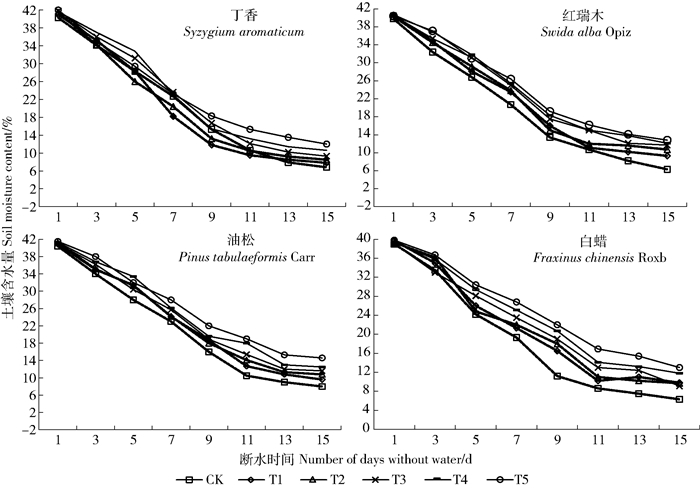
4) 土壤含水量测量。选取8月份连续15 d, 在第一次充分等量浇水后, 每隔2 d用土壤水分测量仪(HH2)测量一次土壤含水量, 共测量8次。
采用Microsoft Excel 2016进行数据统计与初步分析, IBM SPSS statistics 20.0进行方差、显著性检验和分析。
2 结果与分析
2.1 不同用量保水剂对土壤含水量与植物生物量的影响
由图 1可知, 在第1次充分浇水后, 4种树种的初始含水量差距不大, 随着时间的推移, 其土壤含水量迅速下降, 并在第11天后, 土壤含水量趋于平稳, 第15天的土壤含水量均为T5>T4>T3>T2>T1>CK, T5土壤含水量为CK的2倍, 可见该保水剂对土壤水分有很好的保持作用。
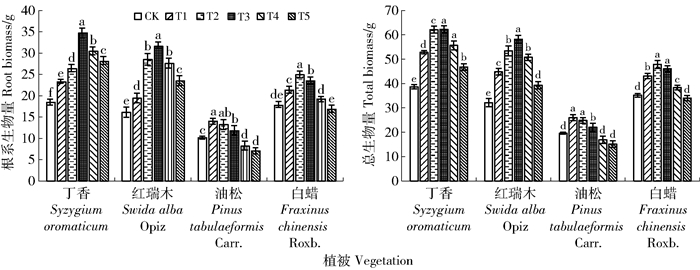
从图 2看出:4种植物总生物量与地下生物量变化规律基本相同, 均高于CK。与CK相比, 丁香的总生物量各处理较CK分别增加36.58%、60.75%、61.06%、44.01%和20.98%, 相邻组别差异显著, T3处理的总生物量达到最大, 为62.25 g; 红瑞木总生物量较CK分别增加39.33%、66.07%、80.78%、57.8%和22.11%, 相邻组别差异显著, 且在T3处理下, 植物总生物量达到最大, 为58.14 g; 油松的总生物量较CK分别增加33.2%、27.12%、12.74%、-13.56%和-22.57%。在保水剂浓度较高时, 同样受到抑制, 可见对油松来说, 当保水剂浓度>20 g/株时, 其对植物生物量生长的抑制作用愈加明显。白蜡各处理中, T2处理下总生物量最高, 但随着保水剂浓度的增加, 对根系生长的抑制作用也愈加明显, 各处理分别高于对照组22.53%、36.04%、33.80%、8.9%和-3.4%, 各组间差异较为显著。
2.2 不同用量保水剂对植物株高、地径的影响
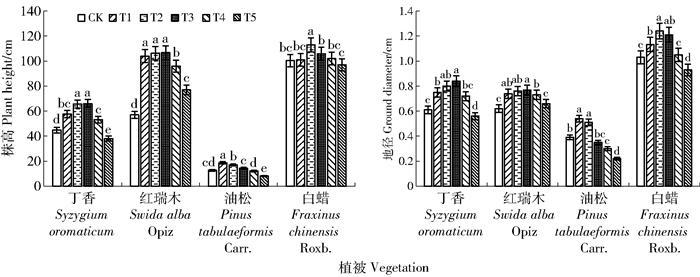
经过半年生长, 期间为保证植株存活进行适量浇水, 分别测定4种植物株高和地径。由图 3得出, T3处理对丁香株高影响最大, 10月份最大值为66 cm, T5处理<CK, 即当保水剂浓度为T5时, 丁香株高生长受到抑制; 红瑞木株高最大值也出现在当保水剂浓度为T3时, 10月份株高最大值达到106.85 cm, 各组并未出现抑制现象; 油松株高最大值出现在T1时, 达到18.6 cm, 随着保水剂浓度的增加, 油松株高不断减小, 组间差异愈加显著, T4、T5处理均<CK, 可见较高用量保水剂对油松株高生长有明显的抑制作用; 白蜡株高最大值出现在保水剂浓度为T2时, 达到113 cm, 组间差异不明显, T5处理株高<CK, 出现了抑制株高生长的现象。地径最大值与株高最大值都出现在相同的保水剂浓度时, 4种植物地径的生长规律与株高的生长规律基本相同。
2.3 不同用量保水剂对植物根系形态的影响
由表 2可知, 丁香根系各指标随着保水剂用量的增加变化规律基本相同。根长、根表面积、平均直径、根尖数和分叉数均在T3时达到最大值, 分别比对照组高出56.92%、21.51%、38.1%、56.38%和48.41%。显著性分析表明, 这5项指标在保水剂用量为T1和T5时, 已经没有显著性差异, 可见各指标变化趋势都为先增加后减少。红瑞木的5项指标中, 各指标变化趋势均为先增加后减少, 在T3时全部达到最大值, 根长、根表面积、平均直径、根尖数和分叉数分别高出对照组105.56%、21.32%、34.1%、24.53%和49.17%。
表 2(Table 2)
表 2 不同用量保水剂对2种灌木植物根系形态的影响
Table 2 Effects of water-retaining agent in different dosage on the root morphology of two shrub species
植被
Vegetation |
组别
Group |
根长
Root length/cm |
表面积
Surface area/cm2 |
平均直径
Average diameter/mm |
根尖数
Apical number |
分叉数
Bifurcation number |
丁香
Syzygium aromaticum |
CK |
2 105.99±61.89d |
1 475.62±119.65bc |
1.26±0.13d |
5 481±524d |
18 382±1 274c |
| T1 |
2 328.17±297.2d |
1 349.89±45.20cd |
1.28±0.06d |
6 826±764c |
22 266±955b |
| T2 |
2 747.14±198.78c |
1 621.36±138.34b |
1.50±0.14bc |
7 486±179bc |
22 662±2 035b |
| T3 |
3 304.63±48.21a |
1 792.97±23.56a |
1.68±0.11a |
8 572±486a |
27 281±2 852a |
| T4 |
2 955.92±79.66bc |
1 579.40±45.75b |
1.42±0.12c |
7 857±237ab |
23 759±2 470b |
| T5 |
2 167.26±152.26d |
1 267.61±59.06d |
1.31±0.05d |
6 887±763c |
23 468±455b |
红瑞木
Swida alba Opiz |
CK |
2 387.43±224.64c |
1 114.91±41.46b |
0.88±0.01e |
5 406±670d |
18 164±1 431d |
| T1 |
3 108.22±863.78c |
1 172.51±137.39b |
0.90±0.01e |
5 301±170d |
23 694±1 693bc |
| T2 |
4 455.55±7.45ab |
1 260.45±123.89b |
1.07±0.05bc |
5 651±150c |
26 350±1 303ab |
| T3 |
4 914.78±769.05a |
1 352.60±93.18a |
1.18±0.06a |
6 732±504a |
27 096±1 766a |
| T4 |
3 904.84±805.79ab |
1 174.08±73.19b |
1.06±0.02c |
6 023±210b |
24 203±4 307b |
| T5 |
3 411.32±293.86bc |
1 113.32±39.74b |
1.01±0.04de |
5 418±221cd |
20 673±2 274cd |
|
表 2 不同用量保水剂对2种灌木植物根系形态的影响
Table 2 Effects of water-retaining agent in different dosage on the root morphology of two shrub species
|
由表 3可知, 油松的根长、根表面积、根平均直径、根尖数和分叉数都随着保水剂用量的增加而逐渐减小, 最大值均出现在T1时, 相较于对照组分别提高29.6%、53.98%、17.89%、19.38%和35.89%, 各指标T4、T5值均<CK, 根系生长受到抑制; 白蜡树种各指标变化浮动较大, 5项指标的最大值均出现在T2时, 较对照组分别提高33.3%、10.2%、40.9%、54.69%和30.84%, 最小值均出现在T5时, 且<CK, 根系生长受到抑制。
表 3(Table 3)
表 3 不同用量保水剂对2种乔木树种根系形态的影响
Table 3 Effects of water-retaining agent in different dosage on the root morphology of 2 tree species
植被
Vegetation |
组别
Group |
根长
Root length/cm |
表面积
Surface area/cm2 |
平均直径
Average diameter/mm |
根尖数
Apical number |
分叉数
Bifurcation number |
油松
Pinus tabulaeformis Carr |
CK |
474.21±40.61c |
151.82±10.13b |
0.95±0.95ab |
2 724±58b |
3 355±85c |
| T1 |
604.56±96.36a |
233.77±38.06a |
1.12±1.12a |
3 252±72a |
4 559±576a |
| T2 |
522.98±84.14b |
170.79±11.95b |
1.12±1.12a |
2 865±164b |
3 968±365b |
| T3 |
507.13±42.54c |
146.54±15.19b |
1.06±1.05ab |
2 704±107b |
3 120±107d |
| T4 |
462.86±39.14cd |
144.97±18.05b |
0.88±0.88bc |
2 234±63c |
2 263±150d |
| T5 |
352.77±15.87d |
103.16±2.19c |
0.84±0.87c |
1 821±96d |
1 878±104e |
| 白蜡 Fraxinus chinensis Roxb |
CK |
3 404.12±212.50bc |
1 490.10±226.14ab |
1.27±0.38c |
12 236±1 186cd |
22 531±3 860d |
| T1 |
3 822.60±230.39b |
1 493.30±219.26ab |
1.51±0.04bc |
16 539±1 128ab |
24 351±4 194bc |
| T2 |
4 538.71±307.65a |
1 642.36±131.17a |
1.79±0.21a |
18 928±493a |
29 479±4 391a |
| T3 |
3 686.15±152.13b |
1 607.40±182.89ab |
1.78±0.22a |
14 664±1 802bc |
28 463±4 359a |
| T4 |
3 104.10±88.25c |
1 311.21±135.73bc |
1.57±0.12ab |
12 207±2 393cd |
22 468±3 930c |
| T5 |
1 859.27±331.23d |
1 275.09±118.30c |
1.21±0.15c |
10 035±1 889d |
18 653±3 641d |
|
表 3 不同用量保水剂对2种乔木树种根系形态的影响
Table 3 Effects of water-retaining agent in different dosage on the root morphology of 2 tree species
|
3 讨论
4种植物的生物量与根系形态变化趋势基本相同, 灌木树种丁香和红瑞木的最大生物量都出现在20 g/株时, 呈现先增大后减小的变化趋势, 油松和白蜡生物量最大值分别出现在5和10 g/株时, 其生物量逐渐减小, 较高浓度保水剂出现了抑制作用, 出现这种现象是因为保水剂用量超过了植物的最适用量。有研究表明, 保水剂对土壤含水量的影响是保水剂吸水后, 其本身可以膨胀, 使得土壤疏松, 总孔隙度增加, 并且改善土壤通气能力, 其膨胀体可使得水溶液处于非离析状态[7]。当土壤施用保水剂后, 土壤水分蒸发受到抑制, 原本理化性质相对稳定的土壤便发生了改变, 保水剂吸水后, 体积不断膨胀, 土壤空隙中的水分呈现增加趋势, 从而提高土壤水保持能力[8-9], 并且其保水能力随着保水剂的增加会逐渐增强, 可保证植物在干旱胁迫环境中, 同样可以吸收维持其自身生长的水分[10-12]。若加入过量保水剂, 一方面其吸水膨胀后, 必然会堵塞土壤原有孔隙, 使得土壤大孔隙不断地减少, 土壤水分配能力下降, 实际上就是抑制了土壤中水分的运动, 从而保水性能有所下降[13-15], 另一方面会吸持土壤水分量相对偏移, 植物吸收水分量相对减小, 不仅不能促进植物的生长, 反而会抑制植物的根系发育, 从而影响植物各生长指标的增加, 使得植物出现生长受阻[16-17]。
不同树种之间出现的生长差异, 还取决于不同树种对水分的适应性。不同植物幼苗生长以及不同的生长发育阶段需水量有所差异, 2种乔木幼苗较灌木对土壤水分更为敏感[18-19], 油松和白蜡幼苗生长所需的最适水量较丁香、红瑞木更低, 故其幼苗在土壤低含水量时生长较好。这与国内外研究一致, 也就解释了土壤含水量会随着SAP浓度的增加而提高, 但植物生物量反而会减小的原因。
植物根是植物生长最重要的部分, 是植被与土壤进行物质和能量交换的重要器官, 其形态的生长分布状况直接反映植被对土壤养分的吸收能力, 对植被的地上部分生长起到决定性的作用。有研究表明, 保水剂可以显著增加根密度和根生物量[20-22], 这样就解释了图 2中根系生物量和植被总生物量生长变化规律完全一致的原因。由表 2和表 3可知, 4种植物的5项根系生长指标最大值, 均与其生物量最大值所对应的保水剂浓度相同, 再次可以证明根系的生长可以直接影响植被地上部分的生长, 并且由此可以判断出, 4种植物在河北干旱地区种植时最适宜的保水剂用量[23-24]。
4 结论
1) 保水剂施用于土壤显著影响植物生物量。2种灌木(丁香、红瑞木)生物量随土壤保水剂用量增加, 呈现先增大后减小趋势, T1~T5的总生物量均为2倍CK生物量, 生物量增加最大分别为61.02%和80.78%;2种乔木中, 油松生物量随保水剂用量的增加而持续减少, 只有T1~T3的总生物量>CK; 白蜡生物量随着保水剂浓度的增大, 先增加后减少, 仅在T1~T4的总生物量>CK。比较发现, 灌木幼苗较乔木幼苗的保水剂可受用范围更广。
2) 保水剂的施用显著影响植物株高和地径的生长。丁香和红瑞木的株高、地径最大值均出现在T3时, 变化趋势为先增大后减小; 油松的株高、地径最大值出现在T1时, 且随着保水剂浓度的增加而逐渐减小, 并产生了抑制现象; 白蜡株高、地径的最大值出现在T2时, 随着保水剂浓度的继续增加, 其中长持续减小, 在T4、T5处理也出现了生长抑制现象。
3) 保水剂的施用显著影响了植物的根系形态, 而4种植物根系形态的变化规律与其生物量基本相同, 丁香和红瑞木5项指标最大值均出现在T3时, 油松和白蜡分别为T1和T2。相比CK而言, 在T1至T5范围内, 任何浓度的保水剂对丁香与红瑞木根系生长均起到促进作用, 而对油松和白蜡并非如此, 说明较高浓度保水剂处理, 已不利于油松和白蜡幼苗根系的生长。
综上认为, 在河北干旱区植被造林中, 丁香保水剂最适用量为20 g/株, 红瑞木保水剂最适用量为20 g/株, 油松为5 g/株, 白蜡为10 g/株。
 2018, Vol. 16