Root number characteristic of three typical soil and water conservation plants in an open-pit coal mine dump of Inner Mongolia
我国是世界上最大的煤炭生产国, 煤炭资源的开发对我国经济建设和社会发展起到了重要的支撑作用, 但也引发了一系列的生态环境问题。露天采煤矿区是直接剥离表土和矿层的上覆岩层, 使矿层暴露后开采, 并在采区内外分层堆置剥离岩土与矸石、尾矿等废弃物, 从而形成阶梯宝塔状的排土场。大型排土场的最大垂直高度在400 m左右, 最大容量达10亿m3[1]。新建大型排土场平台由于重型卡车碾压表层严重压实、高坡度大坡长的松散坡面、岩土混排、复杂的物料组成, 长时间的不均匀沉陷、特殊的孔隙、裂缝和洞穴分布, 形成了与原地貌显著不同的侵蚀特征。因压实造成植物扎根困难和大量地表径流; 因有沉陷裂缝存在, 径流汇集钻入裂缝, 集中下渗, 下渗水从下伏边坡间出露, 诱发崩塌、滑坡和坡面泥石流, 或钻向基底, 降低基底承载力, 整体失陷。而植物措施对于改善养分十分贫瘠的排土场, 是一项长期可行的水土流失治理措施[2]。
根系是植物吸收水分和养分的重要器官。强大的根系系统不但可以从土壤中吸收自身生长所必须的水分和养分, 而且对于改良土壤结构, 增强土壤抗侵蚀能力等也有着重要作用。根系在土体内的生长促使土-土界面和根-土界面的摩擦力不断增加, 同时根系自身的抗拉、抗剪性能也使土壤的抗剪切能力不断在增强[3]。这些作用是植物地上部分所不具备的, 因此, 研究植物根系对土壤侵蚀的影响一直以来是生态学、土壤侵蚀学等学科研究的重要内容[4-11]。近年来, 随着根系研究方法的发展, 人们对根系分布特征[12-25]和固土力学性能的研究也越来越多[26-33]。根系数量越多、根越长, 则分布的越深、越广, 植物根系固土能力就越强, 即根系数量特征和结构特征对于植物根系固土有着重要影响。鉴于此, 笔者以内蒙古中西部大型采煤矿区准格尔煤田黑岱沟露天矿再塑地貌—排土场植被恢复与重建中3种2~4龄典型水土保持乡土植物杨柴(Hedysarum laeve)、沙打旺(Astragalus adsurgens)和草木樨(Melilotus suaveolens)的根系为对象, 通过研究根系直径、根长、根表面积等参数及其数量分布特征, 从而确定每种植物根系的代表根, 进而为下一步3种植物根系生物力学特性的研究奠定基础, 同时也为正确认识3种植物根系形态结构特征提供参考依据。
1 材料与方法
1.1 研究区自然概况
准格尔煤田黑岱沟露天煤矿位于内蒙古自治区鄂尔多斯市准格尔旗东部(E111°13′~111°20′, N39°43′~39°49′), 海拔在1 025~1 302 m之间, 地处黄河西岸, 属于晋、陕、蒙接壤黄土地区一部分, 是我国乃至世界水土流失最严重的地区之一, 风蚀沙化、水土流失极为严重, 土壤侵蚀模数最高可达1.8万t/km2年[34]。研究区自然概况已另文[13]发表, 这里不再赘述。
1.2 样地及标准株选择
2013年9月中旬, 在研究区的内排土场平台, 平台海拔为1 255 m, 中心经纬度为N 39°47′15″、E 111°16′07″, 选择生长良好的2~4年生杨柴、沙打旺以及草木樨样地。随机抽取每种植株50株作为一个样本, 再测其地径(最大直径)、株高及冠幅, 并计算平均值。在50株样本中找出与平均值最接近的5株植株作为标准株进行研究。每种植物的造林方式、植株生长状况已另文[14-15]发表。
1.3 根系分级测定
用整株挖掘法挖出选择好的标准株根系, 测定各级根系的数量, 然后分别剪下, 用精度为0.01 mm的电子游标卡尺按0.5 mm为间隔对根系进行分级, 若某一条根跨越多个径级, 则在临界点处将其剪断, 分别归入相应的径级中[2]。根长用钢卷尺测量, 并按下式计算根系表面积:
Si=3.14DiLi。
式中:Si为第i条根段的表面积; Di为第i条根段的平均直径; Li为第i条根段的长度。
1.4 代表根确定方法
代表根的确定方法是将根系以0.5 mm为间隔进行分级, 计算每个径级的累计根数量、累计根长、累计根表面积, 取这3个值比例(%)相对较大的径级组作为各自的代表根。
2 结果与分析
2.1 3种植物侧根分级及不同径级根系的数量分布特征
2.1.1 侧根分级的数量分布特征
从主根上发生的根称为一级侧根, 又称支根或次生根, 由一级侧根上发生的根为二级侧根, 依次可分生多级侧根。表 1示出3种植物侧根分级(序级)的数量分布特征。
表 1(Table 1)
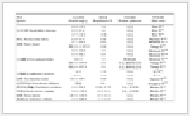
表 1 3种植物侧根分级的数量分布特征
Table 1 Number distribution of lateral roots for three plants
| 植物种 Plant species |
侧根分级及根数/(根·株-1)
Lateral root classification and their number/(Roots·plant-1) |
总数(根·株-1)
Total number/(Roots·plant-1) |
各级侧根所占比例
Proportion of each level of lateral root/% |
标准株
Standard plants |
Ⅰ级侧根
Lateral rootⅠ |
Ⅱ级侧根
Lateral root Ⅱ |
Ⅲ级侧根
Lateral root Ⅲ |
Ⅰ级侧根根
Lateral root Ⅰ |
Ⅱ级侧根
Lateral root Ⅱ |
Ⅲ级侧根
Lateral root Ⅲ |
| 杨柴 Hedysarum laeve |
1 |
7 |
19 |
23 |
49 |
14 |
39 |
47 |
| 2 |
5 |
15 |
32 |
52 |
10 |
29 |
62 |
| 3 |
8 |
18 |
28 |
54 |
15 |
33 |
52 |
| 4 |
6 |
15 |
36 |
57 |
11 |
26 |
63 |
| 5 |
8 |
13 |
29 |
50 |
16 |
26 |
58 |
| 均值 Mean |
|
7±1.30 |
16±2.45 |
30±4.83 |
52±3.21 |
13±3 |
31±5 |
56±7 |
| 沙打旺 Astragal-us adsurgens |
1 |
17 |
15 |
34 |
66 |
26 |
23 |
52 |
| 2 |
11 |
14 |
37 |
62 |
18 |
23 |
60 |
| 3 |
11 |
16 |
38 |
65 |
17 |
25 |
58 |
| 4 |
14 |
18 |
36 |
68 |
21 |
26 |
53 |
| 5 |
15 |
19 |
38 |
72 |
21 |
26 |
53 |
| 均值 Mean |
|
14±2.61 |
16±2.07 |
37±1.67 |
67±3.71 |
20±3 |
25±2 |
55±4 |
| 草木樨 Melilotus suaveolens |
1 |
21 |
11 |
33 |
65 |
32 |
17 |
51 |
| 2 |
23 |
20 |
45 |
88 |
26 |
23 |
51 |
| 3 |
19 |
18 |
38 |
75 |
25 |
24 |
51 |
| 4 |
22 |
15 |
36 |
73 |
30 |
21 |
49 |
| 5 |
26 |
21 |
48 |
95 |
27 |
22 |
51 |
| 均值 Mean |
|
22±2.59 |
17±4.06 |
40±6.28 |
79±12.09 |
28±3 |
21±3 |
50±1 |
|
表 1 3种植物侧根分级的数量分布特征
Table 1 Number distribution of lateral roots for three plants
|
从表 1中可以看出, 根的总数方面, 草木樨(79根)>沙打旺(67根)>杨柴(52根), 即3种植物根系的分枝能力大小顺序为草木樨>沙打旺>杨柴, 这与植物自身生物学特性有关。按照不同侧根数量统计, 3种植物均有Ⅲ级侧根, 其中, 杨柴和沙打旺Ⅲ级侧根根数>Ⅱ级侧根根数>Ⅰ级侧根根数, 且Ⅱ级和Ⅲ级侧根根数所占比例和分别为杨柴87%和沙打旺80%, 明显大于Ⅰ级侧根根数所占比例(13%和20%)。草木樨Ⅲ级侧根根数>Ⅰ级侧根根数>Ⅱ级侧根根数, 且Ⅱ级和Ⅲ级侧根根数所占比例和为71%, 明显大于Ⅰ级侧根根数所占比例28%, 表明3种植物根系在土壤中均以细根分布为主。
将同种植物在不同侧根分级后根数进行差异性检验, 结果显示杨柴侧根分级后的根数间有明显差异(a=0.05), 沙打旺、草木樨的Ⅰ、Ⅱ级侧根数间无明显差异、与Ⅲ级侧根数间均有明显差异(a=0.05)(表 2)。
表 2(Table 2)
表 2 3种植物侧根分级后根数的差异性检验表
Table 2 Difference validation of number of classified lateral roots for three plants
植物种
Plant species |
F |
Pr>F |
Ⅰ级侧根
Lateral root Ⅰ |
Ⅱ级侧根
Lateral root Ⅱ |
Ⅲ级侧根
Lateral root Ⅲ |
| 杨柴 Hedysarum laeve |
63.66 |
< 0.0001 |
6.80 C |
16.00 B |
29.60 A |
| 沙打旺 Astragalus adsurgens |
169.94 |
< 0.0001 |
13.60 B |
16.40 B |
36.60 A |
| 草木樨 Melilotus suaveolens |
34.80 |
< 0.0001 |
22.20 B |
17.00 B |
40.00 A |
| 注:Pr代表方差齐的可接受程度, Pr>F是对P值的检验, P<0.05表明差异性显著; A、B、C不同字母表示差异性显著, 相同字母表示差异性不显著。后同。Note:Pr represents the acceptable level of variance, Pr>F is the test of P value, P<0.05 indicates significant difference; different letters of A, B and C indicate significant differences, the same letter indicates no significant difference.The same as below. |
|
表 2 3种植物侧根分级后根数的差异性检验表
Table 2 Difference validation of number of classified lateral roots for three plants
|
从表 3中可以看出, 3种植物的Ⅰ级侧根数间有明显差异, Ⅱ级侧根数间无明显差异, 沙打旺与草木樨Ⅲ级侧根数间无明显差异, 但上述2种植物均与杨柴间有明显差异(a=0.05)。
表 3(Table 3)
表 3 3种植物相同序级间侧根数的差异性检验表
Table 3 Difference validation of the number of lateral roots between the same classes for three plants
侧根分级
Lateral root classification |
F |
Pr>F |
杨柴 Hedysarum laeve |
沙打旺 Astragalus adsurgens |
草木樨 Melilotus suaveolens |
| Ⅰ级侧根 Lateral root Ⅰ |
58.78 |
< 0.0001 |
6.80 C |
13.60 B |
22.20 A |
| Ⅱ级侧根 Lateral root Ⅱ |
0.14 |
0.869 2 |
16.00 A |
16.40 A |
17.00 A |
| Ⅲ级侧根 Lateral root Ⅲ |
6.43 |
0.012 7 |
29.60 B |
36.60 A |
40.00 A |
|
表 3 3种植物相同序级间侧根数的差异性检验表
Table 3 Difference validation of the number of lateral roots between the same classes for three plants
|
2.1.2 不同径级根系的数量分布特征
3种植物根系不同径级数量分布特征见表 4。以0.5 mm为间隔进行分径级后根的总数量是草木樨(90根)>沙打旺(74根)>杨柴(53根), 3种植物均在0~1.5mm径级范围内根数量最多, 即3种植物根系分径级后根数主要分布在小径级范围内。3种植物在分级(序级)和分径级后根数变化大小为草木樨(40根)>沙打旺(19根)>杨柴(-3根), 表明3种植物根系在分级后数量草木樨和沙打旺均有所增加, 而杨柴则稍有减少, 但差值很小。
表 4(Table 4)
表 4 3种植物不同径级根系的数量分布特征
Table 4 Distribution characteristics of numbers in different diameter class for three plants
植物种
Plant species |
根径
Diameter class/mm |
总计
Total |
| 0~0.5 |
0.5~1 |
1~1.5 |
1.5~2 |
2~2.5 |
2.5~3 |
3~3.5 |
3.5~4 |
4~4.5 |
4.5~5 |
>5 |
杨柴
Hedysarm Laeve |
1 |
19 |
16 |
13 |
3 |
2 |
1 |
1 |
0 |
1 |
0 |
1 |
57 |
| 2 |
15 |
17 |
9 |
4 |
4 |
1 |
1 |
1 |
0 |
0 |
1 |
53 |
| 3 |
13 |
17 |
8 |
1 |
1 |
1 |
1 |
0 |
1 |
0 |
1 |
44 |
| 4 |
13 |
15 |
14 |
4 |
1 |
1 |
1 |
2 |
1 |
1 |
1 |
54 |
| 5 |
14 |
17 |
18 |
4 |
0 |
1 |
1 |
1 |
0 |
0 |
1 |
57 |
均值
Mean |
14.8±2.49 |
16.4±0.89 |
12.4±4.04 |
3.2±1.30 |
1.6±1.52 |
1±0 |
1±0 |
0.8±0.84 |
0.6±0.55 |
0.2±0.45 |
1±0 |
53 |
沙打旺
Astragalus Adsugens |
1 |
31 |
15 |
6 |
7 |
4 |
1 |
0 |
0 |
0 |
1 |
1 |
66 |
| 2 |
34 |
16 |
8 |
7 |
1 |
2 |
1 |
0 |
0 |
0 |
1 |
70 |
| 3 |
39 |
12 |
12 |
3 |
3 |
2 |
0 |
0 |
1 |
1 |
1 |
74 |
| 4 |
29 |
18 |
13 |
6 |
5 |
2 |
1 |
1 |
1 |
1 |
1 |
78 |
| 5 |
31 |
21 |
15 |
5 |
4 |
3 |
1 |
1 |
0 |
0 |
1 |
82 |
均值
Mean |
32.8±3.90 |
16.4±3.36 |
10.8±3.70 |
5.6±1.67 |
3.4±1.52 |
2±0.71 |
0.6±0.55 |
0.4±0.55 |
0.4±0.55 |
0.6±0.55 |
1±0 |
74 |
草木樨
Melilotus suaveolens |
1 |
33 |
10 |
14 |
9 |
6 |
8 |
3 |
1 |
1 |
2 |
3 |
90 |
| 2 |
31 |
15 |
18 |
10 |
2 |
4 |
4 |
1 |
0 |
1 |
1 |
87 |
| 3 |
29 |
16 |
21 |
7 |
3 |
0 |
1 |
0 |
1 |
2 |
1 |
81 |
| 4 |
35 |
18 |
26 |
8 |
6 |
4 |
1 |
0 |
0 |
2 |
1 |
101 |
| 5 |
33 |
11 |
23 |
6 |
8 |
5 |
2 |
0 |
1 |
0 |
1 |
90 |
均值
Mean |
32.2±2.28 |
14±3.39 |
20.4±4.62 |
8±1.58 |
5±2.45 |
4.2±2.86 |
2.2±1.30 |
0.4±0.55 |
0.6±0.55 |
1.4±0.89 |
1.4±0.89 |
90 |
|
表 4 3种植物不同径级根系的数量分布特征
Table 4 Distribution characteristics of numbers in different diameter class for three plants
|
将同种植物不同径级根数进行差异性检验, 结果显示, 杨柴总体呈现相邻径级间无显著性差异, 沙打旺和草木樨则总体呈现≤1.5~2 mm径级时差异性显著, >1.5~2 mm则相邻径级间无显著性差异的特点。这与3种植物在分级(序级)和分径级后根数变化大小的结果, 即3种植物根系在分级后数量草木樨和沙打旺均有所增加, 而杨柴则稍有减少, 但差值很小的结论相吻合。表明杨柴根系直径变化较均匀, 而沙打旺和草木樨在小径级时根系直径变化较大。
对3种植物间相同径级下根系的数量分布特征进行差异性检验, 结果表明在1.5~2 mm径级时3种植物的根数有明显差异(a=0.05), 而在其他根径下则至少总有2个种间表现为无显著性差异的特点(a=0.05), 分析原因一方面与植物种生物学特性有关, 另一方面也受立地条件的影响的缘故, 关于这点需要进行进一步研究。
2.2 3种植物根系代表根
对杨柴、沙打旺和草木樨每种植物的5个标准株各自的累计根数量比例、累计根长比例、累计根表面积比例进行方差分析得出:每种植物的标准株间累计根数量比例、累计根长比例、累计根表面积比例均无显著差异(a=0.05)。
从表 5中可以看出, 杨柴、沙打旺和草木樨根系的累计根数比例在0~1.5 mm直径范围内分别占总根数的82.26%、81.07%和74.17%, 说明3种植物根系均以小径级分布为主。从累计根长比例来看, 杨柴根系在0~1.5 mm径级内累计根长比例和为56.14%、沙打旺为63.64%、草木樨为58.00%, 即3种植物0~1.5 mm径级细根累计长度占据根系总长度的主体。杨柴累计根表面积比例在0~1.5 mm直径范围内占据总根系的36.57%、沙打旺是41.21%, 草木樨为49.67%, 而在0~2.5 mm直径范围内杨柴累计根表面积比例占总根系的60.17%、沙打旺是74.30%, 草木樨为75.07%。综合上述结果, 从3种植物根系的累计根数量、累计根长度和累计根表面积比例3方面判断, 确定3种植物代表根径级分别为杨柴0~2.5 mm范围, 而沙打旺和草木樨代表根径级相同为0~1.5 mm范围。
表 5(Table 5)
表 5 3种植物累计根数量、累计根长、累计根表面积比例
Table 5 Percent of cumulative roots' number, cumulative root length, and cumulative surface area for three plants
| % |
| 参量 Parameters |
根径 Diameter class/mm |
合计 Total |
| 0~0.5 |
0.5~1 |
1~1.5 |
1.5~2 |
2~2.5 |
2.5~3 |
3~3.5 |
3.5~4 |
4~4.5 |
4.5~5 |
5~10 |
| 数量 Roots’ number |
杨柴 Hedysarum laeve |
27.92 |
30.94 |
23.40 |
6.04 |
3.02 |
1.89 |
1.89 |
1.51 |
1.13 |
0.38 |
1.89 |
100 |
| 沙打旺 Astragalus adsurgens |
44.32 |
22.16 |
14.59 |
7.57 |
4.59 |
2.70 |
0.81 |
0.54 |
0.54 |
0.81 |
1.35 |
100 |
| 草木樨 Melilotus suaveolens |
35.8 |
15.59 |
22.72 |
8.91 |
5.57 |
4.68 |
2.45 |
0.45 |
0.67 |
1.56 |
1.56 |
100 |
| 根长 Root length |
杨柴 Hedysarum laeve |
10.45 |
22.6 |
23.09 |
10.89 |
12.81 |
6.7 |
5.27 |
2.13 |
3.06 |
0.15 |
2.85 |
100 |
| 沙打旺 Astragalus adsurgens |
10.36 |
22.72 |
30.56 |
13.25 |
11.42 |
5.96 |
0.34 |
0 |
0.66 |
2.48 |
2.25 |
100 |
| 草木樨 Melilotus suaveolens |
12.38 |
17.43 |
28.19 |
9.81 |
11.18 |
4.3 |
6.35 |
1.56 |
1.86 |
2.93 |
4.01 |
100 |
| 表面积 Surface area |
杨柴 Hedysarum laeve |
8.25 |
10.48 |
17.84 |
11.78 |
11.82 |
11.39 |
8.32 |
4.27 |
7.09 |
0.38 |
8.38 |
100 |
| 沙打旺 Astragalus adsurgens |
4.32 |
11.53 |
25.36 |
15.69 |
17.4 |
11.02 |
0.62 |
0 |
1.68 |
5.14 |
7.24 |
100 |
| 草木樨 Melilotus suaveolens |
10.67 |
17.85 |
21.15 |
10.3 |
15.1 |
7.1 |
6.32 |
3.05 |
2.1 |
4.23 |
2.13 |
100 |
|
表 5 3种植物累计根数量、累计根长、累计根表面积比例
Table 5 Percent of cumulative roots' number, cumulative root length, and cumulative surface area for three plants
|
3 讨论与结论
前期研究表明, 从累计根数量、累计根长度、累计根表面积和累计根干质量的比例这4方面判断同时考虑2种灌木(柠条和沙棘)根系对排土场干旱、贫瘠环境的适应特点, 确定柠条和沙棘的代表根径级分别为:柠条(0~0.5 mm, 0.5~1 mm和1~1.5 mm), 沙棘(0.5~1 mm和1~1.5 mm)[2]; 紫花苜蓿代表根径级为(0~0.5 mm, 0.5~1 mm和1~1.5 mm)[15]。即灌木柠条和沙棘根系分布特点以及草本植物紫花苜蓿的根系分布特点表现一致, 细根均占总根的主体。前期虽然研究了部分灌木和部分草本植物, 但植物种类有限, 为进一步验证是否在此研究区其他植物根系分布也具有此特点, 所以本文进一步研究了半灌木杨柴和草本植物沙打旺和草木樨。研究表明, 3种植物代表根径级分别为杨柴0~2.5 mm范围、沙打旺和草木樨代表根径级相同为0~1.5 mm范围。这一结果与柠条、沙棘和紫花苜蓿的根系分布特点也具有一致性。分析原因, 这可能主要与植物种生物学特性密切相关, 同时根系分布特点受立地条件的影响较大。3种植物均分布在排土场平台上, 排土场平台受大型机械的碾压, 土层较紧实, 同土壤干旱和瘠薄, 植物为适应平台紧实、干旱和瘠薄的土壤环境, 根系表现出明显的可塑性特点, 即以细根分布为主, 通常细根的比例越大, 单位面积的吸收比例越大。刘定辉等[9]的研究表明细根对缠绕固结土壤, 强化土壤抗冲性有巨大作用, 所以在植物根系固土抗蚀的作用中, 细根亦具有不可忽视的作用。这也反映3种植物能适应排土场紧实、干旱和贫瘠的土壤环境。
3种植物根系的分枝能力有差异, 其中2种草本植物草木樨和沙打旺根系的分枝能力较半灌木杨柴强, 且植物种不同则侧根数量分布特点不同。3种植物中, 杨柴根系直径变化较均匀, 而沙打旺和草木樨在小径级时根系直径变化较大。这可能除了与植物本身的生物学特性有关以外还和其生长的立地条件以及植物种对环境适应性特点有关。因此, 在根系固土抗蚀生物力学性质的研究中, 建议在内蒙古准格尔露天煤矿再塑地貌—排土场及相似地区, 3种植物主要研究的根系径级范围为其代表根径级范围。
 2018, Vol. 16