 2011, Vol. 31
Great changes in China's social structure and economy have taken place since China's reforms and opening up. Chinese people's living conditions and health have significantly improved. However, in terms of Chinese people's mental health, progress has not been satisfactory. The negative influences caused by mental health problems have become prominent. Currently studies of mental health problems have drawn wide attention in domestic psychology fields. Research on mental health conditions and mental illness over the past few years shows the deterioration of the unbalanced psychological state and individual's mental health conditions have become an increasingly serious social problem (World Health Organization, 2001). There have been few studies carried out by sociologists on how one's social environment affects mental health, in particular, empirical studies that focus on the influence of factors such as occupation, economic conditions and life experience on mental health based on social classes are rare (Zhang Lei, 2007). Therefore, based on the social structure and data from the "Chinese Family Panel Studies (CFPS) in 2008—Shanghai", this study analyzes mental health conditions among different social classes and social groups, the changes seen between different age groups, and considers social changes in Shanghai to carry out theoretical discussions.
MENTAL HEALTH AND SOCIOECONOMIC STATUSMental health refers to "a state of well-being under which people can recognize their ability, cope with normal pressure during their lives, work effectively and in a creative way and make contributions to their community" (World Health Organization, 2001: 5). Simply put, mental health is a feeling of well-being in terms of cognition or emotion or a state that is not affected by psychological disorders.
There are complex factors that affect people's mental health, which not only include physiological and psychological factors, but also include economic environment and social changes, etc. People's economic and social position has an important influence on their mental state. Social position can be measured by objective indicators such as education, occupation and income (Lu Xueyi, 2002) and can also be measured by subjective recognition. Generally possessing a high subjective and objective social position and having a large income helps people to maintain a good mental state, whereas people of low social class which are faced with more of life's pressures and less resources tend to receive unfair treatment, and such disadvantages in their lives are likely to cause various mental illnesses (Reynolds & Ross, 1998; Ross & Mirowsky, 2003:419-420).
Occupation is highly correlated with occupational mental health. People that engage in various occupations have different income and social prestige and may come across different psychological problems. Researchers have discovered that one's occupation and their mental health are positively correlated, i.e. working high occupational positions helps people maintain a high level of mental health (Hudson, 2005). In addition, occupation type affects people's mental health in two psychological ways—work independence and creativity. People that work on the production line in a factory doing repeated work can easily get bored and depressed in life due to a lack of work independence and creativity, whereas those people that engage in creative work such as technological development live easier and happier lives (Ross & Mirowsky, 2003).
In addition, possessing a stable job can evidently reduce people's anxiety and feelings of depression. Laid-off workers generally have various mental problems (Xu Huilan et al., 2001). Even though they can get over the blow of unemployment in their mind, they can never regain their previous mental state (Clark et al., 2008). Retirement due to old age may generate a temporary negative effect on people's mental health, but as time goes by this effect will gradually disappear and the mental state of retirees can gradually return to normal levels. Therefore, from a long term perspective, retirement may not generate a significant influence on people's mental health.
Education determines people's ability and strategy towards coping with pressure. People that have received a good education always have a more reasonable and healthy lifestyle and a positive attitude towards life which helps to prevent mental problems arising or from getting worse and helps to maintain a stable level of psychological health. In addition, people that have received higher education can more easily get a good and stable job with a higher income and these people tend to be less bothered by social inequality, therefore part of the indirect influence of educational background on people's mental health is likely to be seen through aspects such as occupational position, income and social experience (Aneshensel, 2002; Glenn & Weaver, 1981; Littlewood, 1995; Ross & Van Willigen, 1996).
China's 30 years of reforms and opening up have enabled China's economic system to transform from a planned economy to a market-oriented economy. Economic activities that were controlled by administrative instructions under the planned economy have gradually fallen under the command of the market. Under market-oriented economies, competition becomes more fierce and uncertainties increase, and the gap between the rich and the poor quickly widens (Sun Liping, 2005). During this transition, different social classes have different social resources and face different external environments. Therefore, their levels of mental health may appear to be different.
First, enterprise managers have advantages in terms of economic conditions and have a high social position. Government and government-affiliated institution officials have highly stable jobs. Although their salaries are not the highest, the illegal income and hidden welfare benefits they have cannot be obtained by people with other occupations. Therefore, the levels of mental health of these two groups of people should be the best.
Professional and technical staff have higher incomes and social positions, but they work in high pressure environments and are strongly impacted by economic cycles, therefore they often tend to experience anxiety and nervous emotions (Li Youmei, 2005). There was a period of time when the importance of education was neglected and the return on education was also restrained, therefore a negative influence was generated by education on people's mental state (Sun Liping, 2005). As the market-oriented economy develops, those middle aged and elderly intellectuals that experienced the period when blue collar workers earned more than white collar workers will likely experience more success and satisfaction and may have better levels of mental health. For technology migrants1, apart from disadvantages such as work pressure, having no registered Shanghai residence and the inconvenience of not being able to speak the local Shanghai dialect, they may even experience regional discrimination to varying extents. Therefore, they may show a low level of social identity and psychological integration (Zhang Wenhong & Lei Kaichun, 2008).
1. Technology migrants in this paper refer to those highly educated Shanghai residents who have no registered Shanghai residence.
The working class benefited from the preliminary stage of China's reforms and opening up and their economic conditions and social position improved remarkably. However, as state-owned enterprise reforms continued, many workers lost their jobs, whereas those workers (including those at state-owned enterprises, foreign-owned enterprises and privately-owned enterprises) that still had jobs were faced with more difficulties due to a deterioration in working conditions, fierce competition, reduced salaries, welfare, and the threat of unemployment, therefore they were faced with many psychological problems (Wu Zhen et al., 2009). Common migrant workers in cities are always in a marginal position. They have low remuneration and insurance but have to work hard in a tough working environment, so they have low levels of mental health (He Xuesong et al., 2010; Jiang Shan et al., 2007).
Lastly, China's dualistic urban-rural structure has led to farmers having a low economic and social status. Compared to urban residents, such disadvantages mean that farmers are more easily affected by mental problems (Liu Guoquan & Sun Chongyong, 2008).
Based on the above analysis, we can see that economic level and social position have an effect on mental health that cannot be neglected. A high social position indicates a person possesses plentiful resources including knowledge, money, material wealth, power, prestige and a social network, and because social hierarchy restricts one's ability to obtain various resources, this further affects their mental health. Therefore, based on existing research we make the following assumptions for this study regarding the relationship between economic and social factors, and mental health:
Assumption 1: The level of education received has a positive influence on people's mental health.
Assumption 2: Income has a positive influence on people's mental health.
Assumption 3: Occupational position is positively correlated with mental health levels, i.e. administrative staff, professional and technical staff have higher levels of mental health than technology migrant, business service providers and city workers, while farmers and common migrant workers have the lowest mental health levels.
Assumption 4: Retirement has no significant influence on people's mental health.
Assumption 5: Losing one's job has a negative influence on their mental health.
Assumption 6: Subjective social position is positively correlated with mental health.
Assumption 7: Financial difficulties have a negative influence on mental health.
Assumption 8: Experience of unfair treatment has a negative influence on mental health.
MENTAL HEALTH AND AGEFrom the experiences of life, people of different age groups reflect different mental states. Research in developed areas in Europe and America has discovered that the relationship between age and mental health generally presents a "∩" shape, i.e. the level of young people's mental health is low because they have just entered the job market with relatively low incomes and occupational positions but have high work pressures and heavy work loads; middle aged people have a more healthy mental state than other age groups because they gradually enter a mature and stable period in terms of their family, career and mentality; the elderly clearly fall into their levels of mental health due to a decline in economic position, income and health, etc. after retirement (Mirowsky & Ross, 1992; Ross & Mirowsky, 2003).
Simultaneously, economic and social factors have different effects on mental health in different stages of people's lives. Research in developed countries shows the influence of education on mental health is relatively small when people are young (Miech et al., 1999), but the influence gradually increases with age. This indicates that as time goes by, people that have low levels of education will have less ability and fewer resources to handle difficulties than people that have higher levels of education (Ross & Wu, 1996). Therefore, the ability to cope with social events and economic and social inequality derived from the level of education received gradually increases with age. This also further broadens the gap between people with different levels of education in terms of their mental health (Miech & Shanahan, 2000).
The young generation have not been in the job market for long, so they have low family wealth, low income, and it takes a long time to turn their education into higher economic and social status (Ross & Mirowsky, 2003). Therefore, they have few family burdens and can always depend on their parents and family elders. They have good occupational development prospects, so the effect of being temporarily unemployed and having low income is relatively weak and the difference in mental health caused by differences in educational background is relatively small. The influence of occupational position on mental health is mostly reflected in aspects such as occupation type, work environment and social prestige. After controlling factors such as income and education, people with different occupations show large differences in their mental health levels. For instance, due to high work pressure and workloads, young white collar workers in cities are likely to be faced with more mental health problems than other people that have other occupations (Li Youmei, 2005).
Middle aged people have experienced China's economic transition and realized the importance of education for personal development. Therefore, middle aged people that have received a good education not only benefit from their socioeconomic status, but also show strong advantages in mental health. However, people in this age group show the biggest inequality in aspects such as occupational position, income and social prestige. In consideration of the high correlation between occupational positions and other aspects including income and subjective social positions, only the occupational position effect is weakened. For middle aged people, the economic pressure and psychological impact caused by losing jobs will mean their mental health levels are lower than those people that still have their jobs.
Most elderly people have quit the job market. Their personal income after retirement generally falls and then stabilizes. Their children have grown up and can live independently, so their sensitivity towards income is relatively weak (Mirowsky & Ross, 1992). Elderly people's income, personal wealth and educational background are highly correlated. Those elderly people that have received a good education are more likely to build scientific and healthy lifestyles and have positive attitudes towards life, so the return on education towards elderly people's mental health is relatively high. Only a few people in this age group still work due to economics or other reasons. Those elderly people that have to work for a living usually engage in low level jobs and have a lot of pressure. Whereas those elderly people that engage in high level administrative or technical work can achieve more success and satisfaction from their work and more easily relieve psychological and physical stress, thereby maintaining a better mental state than other retired people.
Therefore, we can make the following assumptions regarding the relationship between age and mental health:
Assumption 9: Age and mental health presents a "∩" shape relationship, i.e. middle aged people have high levels of mental health and young people and the elderly have low levels of mental health.
Assumption 10: The positive influence of education on mental health increases with age.
Assumption 11: Before reaching the retirement age, the negative influence of unemployment on mental health increases with age.
Assumption 12: Among young people, professional and technical staff have lower levels of mental health than young people with other occupations. Among the elderly, professional and technical staff have higher levels of mental health than elderly people with other occupations.
RESEARCH DESIGN Data SourceIn order to test the above theoretical assumptions, we have adopted data from "CFPS in 2008—Shanghai" carried out by Shanghai University and Peking University. The survey adopted the random sampling method in several stages and covered 8 districts of Shanghai. It was carried out between June and July 2008 and selected 775 families. The final adult sample size was 1, 771.
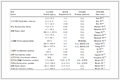
Table 1 lists the sample frequency distribution. In terms of gender, sample distribution approaches 50% with there being 61 more males than females. In terms of age, there were 469 people sampled that are over 60 years old—accounting for 26.5% of the total samples taken, which reflects the obvious tendency towards an aging Shanghai population. The number of people interviewed with an educational background higher than college accounted for 18.2% of the total samples, which shows the education of Shanghai's population is relatively high. Simultaneously, the difference in education among age groups is clearly evident. People with an education of junior middle school or below can be seen in higher numbers amongst the middle aged and elderly groups and people with higher education in the young people group exceeds 30%. Because the survey took samples from the data at the residents' committee, the proportion of people interviewed with a registered residence outside Shanghai was relatively low, with a total of 277. In the young people group, the number of people with a registered residence outside Shanghai was 187. In the middle aged and elderly groups, the number of people with a registered residence outside Shanghai respectively were 76 and 14.
|
Table 1 Sample Characteristics of "CFPS in 2008—Shanghai" |
The dependent variable in the study is mental health, which is measured using the method of directly asking surveyed people the frequency of occurrences of a negative mental state in the past month. Negative mental state includes six aspects: feeling depressed, mental stress, anxiety, having no hope for the future, feeling that it is difficult to do certain things and feeling life is meaningless. The surveyed people can choose the frequency of occurrence of such states between 0-4, with 0 representing nonoccurrence and 4 representing occurrence almost every day. Many empirical studies regarding mental health use such relatively simple questions to reflect people's mental state in social surveys. For instance, the American General Social Survey has used similar series questions to measure American people's mental heath.1
1. Detailed information for the survey can be obtained from the General Social Survey official website at the address: http://www.norc.org/GSS+Website/.
After testing, Cronbach's alpha for the scale which consists of the six indicators is 0.83, which is higher than 0.70. This shows the scale has a high consistency. In the later statistical analysis, first used 4 to respectively minus the six variables to represent the frequency of nonoccurrence of a negative mental state, thereby reflecting the positive side of mental health, and then exploratory factor analysis was carried out on the six indicators to obtain the "mental health" factor which can better represent all indicators. The factor was the dependent variable in the succeeding regression analysis. The total number of samples after deducting samples with incomplete data was 1, 749.
The study aims to analyze the influence of social and economic factors on mental health. Dependent variables include: education, personal income, social class identity, occupation, financial difficulties, unfair treatment and age.
(1) Education. Education is divided into three levels: junior middle school and below, senior high school or vocational school, and college and above. In the regression analysis, we use two dummy variables to represent different levels of education.
(2) Personal income. Personal income in the survey was the total salary income of the surveyed person for the whole of last year. For incomplete data, the surveyed person's family income that was divided by family members was used as their personal income. For the 17 samples that had no family income information, the average income of the total samples was used as their personal income. After data was processed, the average personal income was 25, 567 and variance was 134, 085. Finally, the logarithm of all of the original income was taken and used as income level indicator values to put in the regression analysis models to reduce income distribution Skewness and Kurtosis.
(3) Social class identity. The surveyed person chose his/her social class based on individual conditions from the following five social classes: upper class, middle to upper class, middle class, lower to middle class, and lower class. Because only 24 surveyed people were considered to be upper class, we merged upper class and middle to upper class together. Therefore, there are four types of social classes: middle to upper class, middle class, lower to middle class, and lower class. In the regression analysis, we used a group of dummy variables to represent different classes.
(4) Occupation. In the survey, occupations were classified into 8 categories and 44 sub-categories. After adding the registered residence factor, we finally classified occupations into 9 types: government and enterprise along with public institution administrative staff, professional and technical staff, technology migrants, business service providers, workers, common migrant workers, farmers, local Shanghai retired or other jobless people, and retired or other jobless people from outside Shanghai. In the regression analysis, we used a group of dummy variables to represent different occupations.
(5) Financial difficulties. The survey also asked the surveyed person if they accepted financial assistance from relatives, friends or the government, or sought loans, or received help in looking for jobs during the previous year. We fixed a dummy variable to reflect whether or not they have accepted such assistance. "1" represents people who have accepted or sought the above financial assistance and "0" represents they have not sought such assistance.
(6) Unfair treatment. The survey also asked people if they experienced unfair treatment during the previous year. The study set a dummy variable to reflect whether or not people have experienced unfair treatment. "1" shows that people have experienced unfair treatment during the previous year and "0" shows they have not.
(7) Age. In order to discover the influence of age in life, we used two different age variables. First, we considered age as a continuous variable and included squared age to analyze its linear and quadratic relationships. In the models for interaction between age and other variables, the total samples were divided into three age groups: young people (below 40), middle aged (40-59) and elderly (60 and above). We respectively analyze the effect of social and economic factors on mental health for the three age groups.
The study also involves several controlled variables: gender, marital status and health status. Gender was taken as a dummy variable (0=female, 1=male). Marital status was also taken as a dummy variable: divorced or single (reference group) and married. Health status was taken as a variable and the surveyed person made judgments based on his/her own conditions: very good, good, average or poor. Physical health and mental health are reciprocal causations and it is difficult to discover the causal relationship between the two. Therefore, in order to simplify the study, we considered physical health as a controlled variable and assumed physical health determines mental health.
ModelsThe study adopts three steps to analyze the different influences of social and economic factors on mental health for people of different age groups. In the correlation analysis and descriptive analysis, we considered the factor score obtained from factor analysis as a continuous variable that represents the level of mental health and the data following a normal distribution. Because independent variables consist of several dummy variables and categorical variables, we adopted Robust variance estimation to adjust parameters.
For the first step, we observed the simple correlation between mental health and variables such as education, personal income, relative income and social class identity, and the distribution of the mean value for mental health.
For the second step, based on the total samples, we tested the influence of economic and social factors on mental health for all age groups. In order to test the effect of each independent variable in the models, we adopted the stepwise regression method for multiple linear regression analysis. The first regression model only includes education, age, marital status and gender. Income is added in the second model. Occupation is added in the third model. Social class, financial difficulties and unfair treatment are added in the fourth model. Subjective health level is added in the fifth model.
In the third step, we introduced age group as a dummy variable and after all variables were multiplied by the dummy variable of age group, we put them in the regression model to analyze if the influence of social and economic factors on mental health for different age groups is different from the statistical perspective. These interactive variables can reduce the degree of freedom for the equation, in later analysis we gradually deleted interactive variables that have no significant difference from a statistical perspective to try to increase the degree of freedom for the equation on the condition of ensuring the explanatory power of the equation.
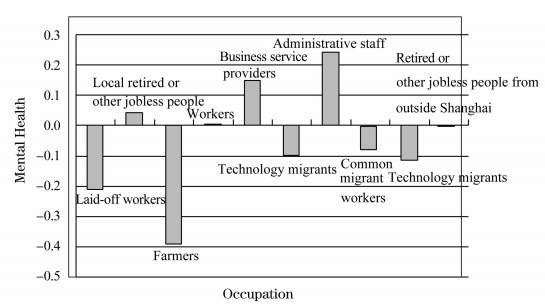
STATISTICAL RESULTS Descriptive ResultsFrom Figure 1 we can see that people with different occupations have evident differences in their state of mental health. Farmers have the lowest occupational position and their state of mental health is the worst. Administrative staff have the highest occupational position and their level of mental health is the highest. Workers and business service providers are located between the two extremes. Laid-off workers in the city have lower levels of mental health than people with other occupations, except for farmers, and rank second to lowest. Technical staff and technology migrants evidently have lower levels of mental health than people in the city with other occupations. The level of mental health for common migrant workers is not high, and lower than workers and business service providers that have a registered Shanghai residence, but similar to technical staff that have higher educational backgrounds. The levels of mental health for the retired or other jobless people are not influenced by registered residence, which approaches the average line.
|
Figure 1 Occupation and Mental Health |
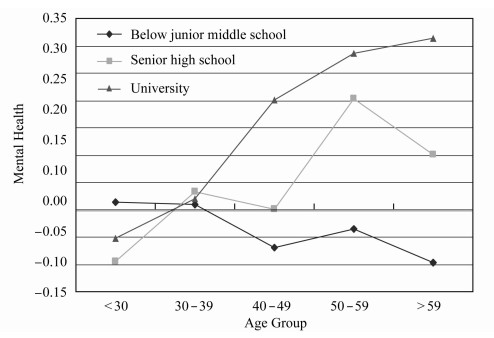
Figure 2 shows the relationship between age and mental health for people with three levels of education. For people below 30 years old, education and mental health problems show a negative correlation, i.e. people with an education of junior middle school or below have the best state of mental health, whereas people with education of senior high school, college and above have a low state of mental health. This negative correlation weakens for the age group around 30.
|
Figure 2 Educational Background, Age and Mental Health |
For middle aged and the elderly (over 40 years old), people with different educational backgrounds show obvious differences in mental health. The higher the level of education they have, the lower the frequency of occurrence of mental health problems. The mental health levels for those people with below senior high school education declines with their age. People with high school or above start to experience good states of mental health after they reach 50. People with university educations show more evidence of mental advantages with age. The results to a certain extent support the cumulative effect theory of education (Miech & Shanahan, 2000).
Regression Results for Socioeconomic Status and Mental HealthBecause various social and economic factors are highly correlated, we adopted the stepwise regression method to test the influence of education, income, occupation and other social and economic variables on mental health (see Table 2). First, model 1 includes five variables namely education, age, age squared, gender and marital status. The influence of education on mental health is obvious, i.e. the higher the levels of education people have, the higher their levels of mental health. This result supports Assumption 1. Age and gender also show a significant influence on mental health, but age squared does not. The positive effect shown by the male group indicates that under normal circumstances, males have higher levels of mental health than females. This point is consistent with previous relevant research results. R2 in model 1 is 0.01 showing the explanatory power of the model is weak and that more influential factors need to be put into the model. Personal income is added in model 2 and the explanatory power of the model is enhanced (R2=0.02). As expected, higher personal income can enhance mental health levels.
|
|
Table 2 Estimation of Normal Linear Regression for Social and Economic Factors and Mental Health |
9 dummy variables regarding occupation are added in model 3 and the explanatory power of the model is enhanced from 0.02 to 0.05. This seems to indicate occupation can better explain mental health level than income and education. As a reference group, the mental health of working class people is in a central position compared to people with other occupations. Shanghai farmers have the lowest levels of mental health, but the mental state of administrative staff is much better. It is worth noting that although laid-off workers and professional and technical staff have relatively poor mental states, this is not significant from a statistical perspective. Generally speaking, occupation and mental health are positively correlated, which is consistent with Assumption 3 but requires further proof. Retired and other jobless people have a better state of mental health than working class people, which is not consistent with Assumption 4. It is also worth noting that at this time, age squared shows a strong negative correlation. This indicates that age and mental health have a "∩" shape relationship, which provides evidence to support Assumption 9.
The additional three factors that reflect social and economic environment are added in model 4, namely social class identity, financial difficulties and whether or not people have experienced unfair treatment. Compared to the first three models, the explanatory power of the model is significantly enhanced with an R2 of 0.11. The regression coefficients for the variables: education, personal income and occupation are different from other models and the explanatory power declines to varying extents. Differences in terms of education disappear and the influence of personal income is weakened, but this is still meaningful from a statistical perspective. Some changes can also be seen in the differences in mental health for people with different occupations. The psychological gap between local retired or other jobless people and farmers and working class people disappear, whereas professional and technical staff show more serious mental health problems, and retired or other jobless people from outside Shanghai show strong psychological advantages.
The three variables social class identity, financial difficulties and whether or not people have experienced unfair treatment, exhibit very high explanatory powers. First, people that believe they have high social positions have better mental heath. Second, those people that have sought financial assistance clearly come across more mental health problems than other people. Third, people that have experienced unfair treatment have a much worse state of mental health than other people. This provides powerful support for Assumptions 6, 7 and 8.
After adding health level which is a subjective variable (model 5), the explanatory power of the model rises to 0.17, but the effects of certain social and economic factors are weakened. The more physically healthy people believe they are, the less mental health problems they are faced with. After controlling physical health level, people that have received higher education have a better state of mental health than people with other educational backgrounds. The influence of personal income has no significant changes across several models. In terms of occupation, retired or other jobless people show a better state of mental health. Professional and technical staff still show noticeably poor states of mental health. The influences of social class, financial assistance and unfair treatment on mental health are reduced, but still significant. Age squared still exhibits a strong effect, which shows Assumption 9 is consistent with actual circumstances.
Results of the Reciprocal Model Regarding AgeIn order to further study the changes of influence of various social and economic factors on mental health, based on model 5, we introduced the reciprocal influence of age and other exogenous variables. In the model, the reference group is the young people group (aged < 40). We also introduced two dummy variables which are the middle aged group and the elderly group, and the reciprocal influence of the two dummy variables, and other socially independent variables. Because there are no laid-off workers and technology migrants in the elderly group, the saturated model for the reciprocal model regarding age total includes 60 independent variables and other relevant statistical information is: N=1, 749, R2=0.20. In order to reduce the number of independent variables for the model and increase the degrees of freedom, we deleted variables of reciprocal influence with no significant influence and ultimately retained the reciprocal influences of education with age group, and occupation with group, thereby obtaining model 6 as shown in Table 3.
|
|
Table 3 Estimated Results of the Reciprocal Model for Age and Mental Health (model 6) |
In general, it is clear that the influence of social and economic factors on mental health changes with age. First, the effect of education on the middle aged group is higher than the young people group. In the young people group which is the reference group, people with an education of senior high school have lower levels of mental health than people with an education of junior middle school or below. In the middle aged group, the mental health levels for people with senior high school education on average are 0.11 units higher than people with lower educational backgrounds. Although the difference of influence of education between the young people group and the middle aged group is not statistically significant, it still shows a strong tendency (up from 0.03 to 0.14). Although it is not statistically significant, we can still see the influence of education in the elderly group tends to be high. This result supports Assumption 10: the positive influence of education on mental health increases with age.
The negative influence of losing one's job shows large differences between age groups. However, the difference is opposite to Assumption 11. Results show that young people suffer a heavy blow by losing their jobs and their levels of mental health fall by 0.84 units. In the middle aged group, laid-off workers show a more positive mental state than working class people (1.10-0.84=0.26). This not only means we can reject Assumption 11, but also indicates that Assumption 5 cannot be accepted probably due to the different influences of losing jobs on the two age groups.
The influence of occupation on mental health is different for different age groups. It is not necessary for young people with high level occupations to have good mental health. Administrative staff do not show statistical significance in terms of advantages in their mental health. Whereas professional and technical staff that have a registered Shanghai residence show much worse states of mental health than working class people. In addition, business service providers that have similar occupational positions to working class people have better levels of mental health. This shows the nature and tasks involved in occupations generate a certain influence on young people's mental health.
For the middle aged group, the influence of most occupations has not significantly changed, with only the mental advantage of technology migrants being significantly strengthened. It is worth noting that the reciprocal influence of groups with other occupations and mental health show the tendency towards narrowing occupational differences to varying extents. This signifies that the influence of occupation among middle aged people is weaker than for young people.
For the elderly group, the relationship between occupational position and mental health is clear. Professional and technical staff along with administrative staff show stronger mental states compared to working class people. In general, there is strong evidence to support Assumption 12 which states that mental health levels are diversely distributed among young and elderly professional and technical staff.
In this model, the effects of variables such as income, social class, financial assistance, unfair treatment, health and gender are basically the same for different age groups and there are no changes from a statistical perspective. In addition, the regression coefficients for these variables are not noticeably different to those in the last model. This shows there is not much difference between the effects of these variables in each age group.
DISCUSSIONS AND CONCLUSIONSThis study analyzes the relationship between people's mental health levels and economic and social structures in contemporary Shanghai. Education, income and occupation are correlated with mental health to varying extents. People with higher educational backgrounds have better mental health than people with lower educational backgrounds. The higher a person's income is, the less frequent mental health problems occur. Social class identity plays a significant part in determining levels of mental health. Negative events such as being faced with financial difficulties and unfair treatment can reduce people's levels of mental health to a large extent. These results show that the distribution of mental health is closely related to social hierarchy.
This study attempts to test the cumulative theory of mental health from the perspective of age. Previous research shows differences in education can be gradually reflected in aspects such as personal income, occupation and economic pressure with age and the difference of these aspects can intensify the effect of education on mental health. The results under this study are consistent with this conclusion, i.e. people with an education of junior middle school or below are always in a poor state of mental health, while although young people with higher educational backgrounds have a relatively poor state of mental health, their mental health improves with age. This provides evidence to support the long term cumulative effect of education on mental health.
It is worth noting that the mental health levels of professional and technical staff show clear differences in different age groups. Because these people always engage in mental work, it is understandable that people with these occupations have certain mental health problems. However, results from this study show that this negative influence can only clearly be seen in young local Shanghai people. For the middle aged group, technology migrants have evident advantages in terms of mental health while in the elderly group, professional and technical staff with a registered Shanghai residence also have high levels of mental health. If one postulates that too much work using their mental facilities is likely the cause of poor mental health in young technical staff, then we cannot explain why technology migrants and migrant workers that engage in similar work in other age groups have relatively better states of mental health. Li Youmei (2005) pointed out anxiety and pressure for Shanghai white collar workers not only comes from occupational crisis, but also from irregular operations in areas such as stock markets, real estate markets, western influences, consumption approaches and current income levels. The differing social experiences and values of the younger generation compared to middle aged and elderly people lead to young Shanghai technical staff suffering the above mentioned anxiety and pressure. Therefore we have discovered through this study that young technical staff have low levels of mental health. Of course, we need to carry out further study to pinpoint its deeper influence.
In addition, it is also worth us carrying out further study on the good state of mental health exhibited by young business service providers. This group of people have no advantage in terms of their occupational position, education and personal income compared to working class people and even worse compared to professional, technical, and administrative staff (Lu Xueyi, 2002), but what causes this group of people to have a clearly better state of mental health than the groups of people with other occupations? There is no reasonable explanation for this issue in this study, so further studies are needed.
Different from our assumptions, after having controlled various external factors, laid-off workers in the middle aged group have a better state of mental health than working class people (reference group). Possible explanations could be first, that Shanghai has a relatively higher level of insurance, so this group of people mainly with a Shanghai registered residence can still obtain basic living insurance after they have lost their jobs and many of them can obtain income from other resources. Shanghai's common workers do not receive higher income than the subsidy obtained by those losing their jobs, after they deduct high transportation fees for work and other expenses from their salaries. Second, there was no information for when people were laid off in our survey data, so probably a large portion of laid-off workers have become accustomed to their status after a long period of unemployment, thereby weakening the negative influence of losing their jobs (Clark et al., 2008). Third, fierce competition and the threat of unemployment that may occur at any time in the job market generate a strong negative influence on the mental health of working class people. Therefore, after controlling other factors such as income, laid-off workers are likely to have better states of mental health than working class people. However, these explanations lack support from detailed empirical data and further studies must be carried out to accurately analyze the mental health problems of laid-off workers.
In general, factors regarding social hierarchy are highly correlated with one's level of mental health, in particular the influence of one's education and occupation show clear differences in the different ages. The status of young business service providers, white collar workers in the city and laid-off workers indicate some social structure factors may change the distribution of mental health levels in social groups. However, mental health scales used in the models for this study are simple and did not adopt other social and economic factors such as working environment, lifestyle and consumption approach. Therefore this study can not only provide perfect explanations for some circumstances which show the limitation of this study, but also provide an opportunity for further studies.
Aneshensel and S. Carol. 2002. "Answers and Questions in the Sociology of Mental Health." Journal of Health and Social Behavior, (2). |
Clark, E. Andrew, Diener Ed, Georgellis Yannis and Richard E. Lucas. 2008. "Lags and Leads in Life Satisfaction: A Test of the Baseline Hypothesis." The Economic Journal, (6). |
Glenn, D. Norval and Charles N. Weaver. 1981. "Education's Effects on Psychological Well-Being." The Public Opinion Quarterly, (1). |
He, Xuesong, Fu Keung Wong and Shouchui Zeng. 2010. "Rural-Urban Migration and Mental Health: Evidence from Shanghai." Sociological Studies, (1). [ 何雪松, 黄富强, 曾守锤. 2010. 城乡迁移与精神健康:基于上海的实证研究. 社会学研究, (1).] |
Hudson and G. Christopher. 2005. "Socioeconomic Status and Mental Illness: Tests of the Social Causation and Selection Hypotheses." American Journal of Orthopsychiatry, (1). |
Jiang, Shan, Lu Zhang and Weihong Wang. 2007. "The Mental Health of Migrant Workers in Chongqing City." Psychological Science, (1). [ 蒋善, 张璐, 王卫红. 2007. 重庆市农民工心理健康状况调查. 心理科学, (1).] |
Li, Youmei. 2005. "'White Collar' and Its Function in Social Structure:A Case Study of Shanghai since 1990's." Sociological Research, (6). [ 李友梅. 2005. 社会结构中的"白领"及其社会功能——以20世纪90年代以来的上海为例. 社会学研究, (6).] |
Littlewood, Rol. 1995. "Mental Health in Low-Income Countries." Anthropology Today, (6). |
Liu, Guoquan and Chongyong Sun. 2008. "A Study of Mental Health Situation of Peasants." Journal of Jilin Normal University (Humanities & Social Science Edition), (5). [ 刘国权, 孙崇勇. 2008. 农民心理健康状况调查研究. 吉林师范大学学报(人文社会科学版), (5).] |
Lu Xueyi. 2002. Report on Social Stratification in Contemporary China. Beijing: Social Sciences Academic Press. 陆学艺, 主编. 2002. 当代中国社会阶层研究报告[M]. 北京: 社会科学文献出版社. |
Miech, A. Richard, Caspi Avshalom, Terrie E. Moffitt, R. Entner Wright Bradley and Phil A. Silva. 1999. "Low Socioeconomic Status and Mental Disorders: A Longitudinal Study of Selection and Causation during Young Adulthood." American Journal of Sociology, (4). |
Miech, A. Richard and Michael J. Shanahan. 2000. "Socioeconomic Status and Depression over the Life Course." Jounal of Health and Social Behavior, (2). |
Mirowsky, John and Catherine E. Ross. 1992. "Age and Depression." Journal of Health and Social Behavior, (3). |
Reynolds, R. John and Catherine E. Ross. 1998. "Social Stratification and Health: Education's Benefit beyond Economic Status and Social Origins." Social Problems, (45). |
Ross, E. Catherine and Chia-Ling Wu. 1996. "Education, Age, and the Cumulative Advantage in Health." Journal of Health and Social Behavior, (2). |
Ross, Catherine E. and John Mirowsky. 2003. "Social Structure and Psychological Functioning: Distress, Perceived Control, and Trust. " In John Delamater (ed. ), Handbook of Social Psychology. New York: KluwerAcademic/Plenum Publisher.
|
Ross, E. Catherine and Van Willigen Marieke. 1996. "Gender, Parenthood and Anger." Journal of Marriage and Family, (58). |
Sun Liping. 2005. Game: Interest Conflicts and Harmony in Broken Society. Beijing: Social Sciences Academic Press. 孙立平. 2005. 博弈: 断裂社会的利益冲突与和谐[M]. 北京: 社会科学文献出版社. |
World Health Organization. 2001. The World Health Report 2001—Mental Health: New Understanding, New Hope. Switzerland: World Health Organization.
|
Wu, Zhen, Qiong Wang and Jie Li. 2009. "Investigation on the Status and Related Factors of the Mental Health of Coal Miners Who Worked Underground." China Journal of Health Psychology, (12). [ 吴真, 王琼, 李洁. 2009. 井下矿工心理健康状况及相关因素调查研究. 中国健康心理学杂志, (12).] |
Xu, Huilan, Shuiyuan Xiao and Jiping Chen. 2001. "Study on the Mental Health Level of the Laid-off Workers." Chinese Journal of Clinical Psychology, (4). [ 徐慧兰, 肖水源, 陈继萍. 2001. 下岗工人心理健康状况研究. 中国临床心理学杂志, (4).] |
Zhang, Lei. 2007. "Mental Health & Quality of Life." Wuhan University Journal(Philosophy & Social Sciences), (2). [ 张蕾. 2007. 精神健康与生活质量——城市弱势群体的社会学关注. 武汉大学学报(哲学社会科学版), (2).] |
Zhang, Wenhong and Kaichun Lei. 2008. "The Urban New Immigrants' Social Inclusion: Internal Structure, Present Situation and Influential Factors." Sociological Studies, (5). [ 张文宏, 雷开春. 2008. 城市新移民社会融合的结构、现状与影响因素分析. 社会学研究, (5).] |