 2020,
Vol. 29
2020,
Vol. 29


刀鲚(Coilia nasus)隶属于鲱形目(Clupeiformes)鳀科(Engraulidae)鲚属(Coilia),属于降海洄游性鱼类,分布于中国、朝鲜半岛和日本,在我国主要分布于东海、黄海、渤海及各通海江河水系的中下游[1]。长江口是中国刀鲚最大的河口渔场,每年2月初亲鱼从此由海入江,3—4月逐步聚集,上溯至长江中下游通海江河中繁殖,产卵后的亲鱼和早期幼鱼陆续降海洄游,分散到附近海域生长、育肥和越冬[2]。刀鲚作为长江淡水鱼类资源中重要的经济品种,近年来由于人类捕获力度增加、水质污染和航道建设等行为,其资源数量逐年减少,因此对于刀鲚资源的保护刻不容缓。潮汐节律是影响鱼类生殖周期以及漂流模式的一种重要的环境因素,一些生活在河口的生物群落都表现出随潮水变化的规律性,其中,仔稚鱼的涨退潮变化具有种间差异性,一些仔稚鱼利用潮汐完成接岸洄游,从近岸海域逐步漂流至内湾区域,从而寻求更稳定的庇护。在仔稚鱼的垂直分布上,许多鱼类具有明显倾向性,例如密歇根湖的拟沙西鲱(Alosa pseudoharengus)和河黄鲈(Perca flavescens)主要处于上层,深水床杜父鱼(Myoxocephalus thompsonii)则主要处于下层[3]。为了探究刀鲚仔稚鱼在长江口南支水域表层和中层的分布情况及潮汐作用对刀鲚仔稚鱼漂流机制,根据潮汐规律在长江口南支水域进行分层调查采样,探讨了潮汐对长江口南支刀鲚仔稚鱼垂直分布及昼夜变化的影响,旨在为长江口刀鲚早期渔业资源的保护提供一些重要的科学依据。
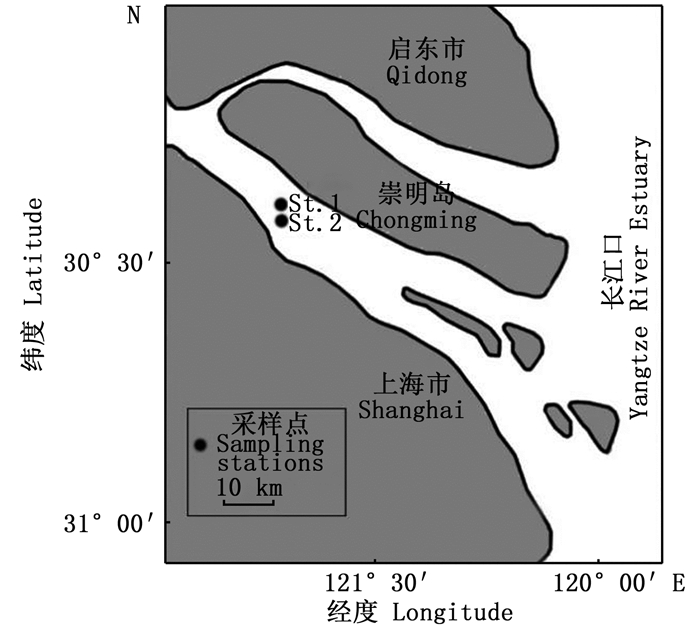
1 材料与方法 1.1 调查方法在长江口南支南北纵向断面设立2个平行站位点(St.1:31°35.500'N,121°20.004'E; St.2:31°33.500'N,121°20.000'E),见图 1,2017年5—9月每月大潮期间进行调查,每次调查从上午第一次涨潮开始使用大型仔稚鱼网(口径1.3 m,网目0.5 mm)进行水平拖网采集(沪崇渔10688,66.2马力,2 nmi/h),全天涨潮、退潮各进行4次采集(平潮期间不采集),在每站位的每次采集分别进行表、中层拖网1次,每次拖网10 min,总计拖网32次,用网口流量计(KC Denmark A/S Model 23.090)记录拖网流量值。现场用5%甲醛海水溶液固定样品,测量并记录各站位点表层和中层的水温、盐度、溶氧量和pH等数据。所有数据分析均用excel 2016、IBM SPSS Statistics 21。
|
图 1 采样站位点图 Fig. 1 Sampling stations |
室内在Olympus SZX7解剖镜下将采集到的样本按照KENDALL等[4]的方法划分为5个发育阶段:卵黄囊期(yolk-sac larval stage)为孵化后到卵黄囊消失;前弯曲期(pre-flexion larval stage)为脊索末端向上弯曲;弯曲期(flexion larval stage)为脊索末端上弯,尾下骨出现但后缘与体轴倾斜,鳞片开始出现;后弯曲期(post-flexion larval stage)为脊索末端向上弯,尾下骨的后缘与体轴成垂直;稚鱼期(juvenile stage)为鳍发育完成,出现鳞片,臀鳍鳍数达90条以上,并趋于成体形态。同时通过游标卡尺来测量仔稚鱼的体长(BL),前弯曲期仔鱼和弯曲期仔鱼测量脊索长度(NL),后弯曲期仔鱼测量标准体长(SL)并计算仔稚鱼的密度。刀鲚仔稚鱼的密度计算采用公式:
 (1)
(1)
式中:G表示单位体积水体中仔稚鱼个体数,尾/100 m3;N为每网所采集到的刀鲚仔稚鱼个体数,尾;S为网口面积,㎡;L为流量计转数;C为流量计校正值(C=0.3)[5]。本研究以G作为单位捕捞努力量渔获量(catch per unit effort, CPUE)比较各月与站位点的刀鲚仔稚鱼密度。
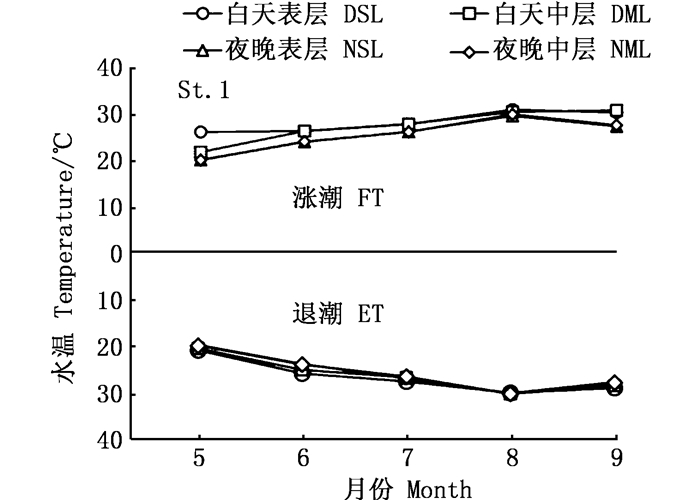
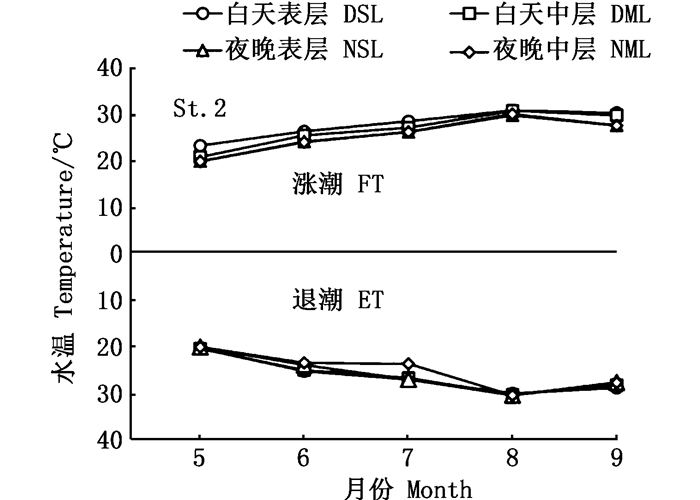
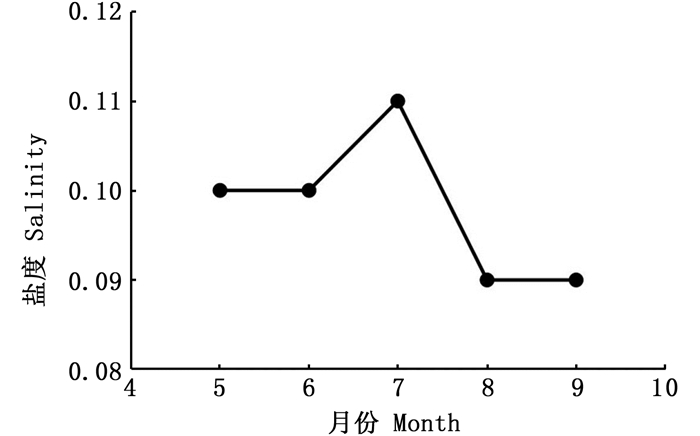
2 结果与分析 2.1 水温与盐度白天表层(day surface layer,DSL)和白天中层(day middle layer,DML)、夜晚表层(night surface layer,NSL)和夜晚中层(night middle layer,NML)、涨潮(flood tide,FT)和退潮(ebb tide,ET)时水温变化基本一致。表层和中层平均水温,均为5月最低,8月最高(图 2和3)。因受长江径流量的影响,平均盐度较低,为0.098。对各月平均水温与各月表层和中层刀鲚仔稚鱼CPUE做相关性分析,结果P < 0.01,表明各月平均水温与各月刀鲚仔稚鱼CPUE存在极显著相关性(图 2和3)。对各月盐度与各月表中层刀鲚仔稚鱼CPUE做相关性分析,结果P>0.05,表明各月盐度与各月表层和中层刀鲚仔稚鱼CPUE无显著相关性(图 4~6)。
|
图 2 St.1月平均水温变化 Fig. 2 Monthly changes of average water temperature in the surface layer and middle layer at St.1 |
|
图 3 St.2月平均水温变化 Fig. 3 Monthly changes of average water temperature in the surface layer and middle layer at St.2 |
|
图 4 平均盐度月变化 Fig. 4 Monthly changes of average salinity |
|
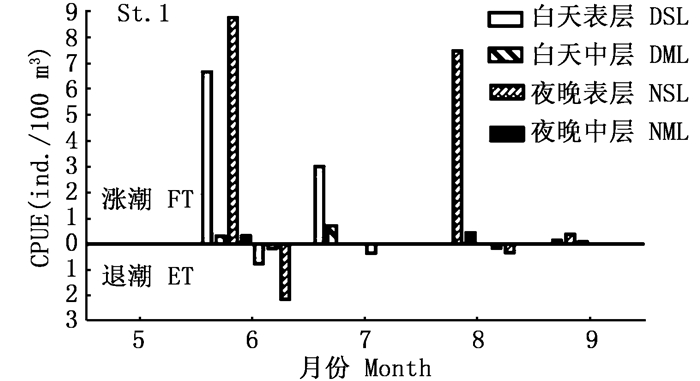
图 5 St.1刀鲚仔稚鱼月平均密度变化 Fig. 5 Monthly changes of average density of Coilia nasus larvae and juveniles at St.1 |
|
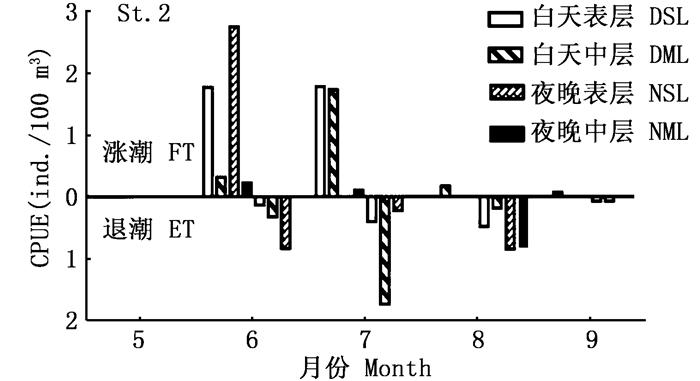
图 6 St.2刀鲚仔稚鱼月平均密度变化 Fig. 6 Monthly changes of average density of Coilia nasus larvae and juveniles at St.2 |
5—9月共拖网160次,采集到刀鲚仔稚鱼369尾,表层平均密度0.851尾/100 m3,以6月的平均密度为最高,密度为2.381尾/100 m3,9月最低,密度为0.032尾/100m3(图 5和6)。中层平均密度为0.145尾/100 m3,7月的平均密度最高,密度为0.319尾/100 m3,9月最低,密度为0.034尾/100m3(图 5和6)。St.1站位点表层,在各月涨潮的平均密度大于退潮的平均密度。8月夜间涨潮密度较大,在St.1站位点中层结果也相同(图 5),而白天涨潮时7月刀鲚仔稚鱼密度大于其他各月,6月和7月表层的刀鲚仔稚鱼密度显然大于中层。
在St.2站位点表层,各月刀鲚仔稚鱼密度涨潮大于退潮,涨潮时6月平均密度大于其他月,在8月夜间退潮时的刀鲚仔稚鱼密度较大;在St.2站位点中层,刀鲚仔稚鱼密度涨潮时大于退潮,7月白天涨潮时刀鲚仔稚鱼密度最高大于其他各月,6和7月表层仔稚鱼密度明显大于中层仔稚鱼密度(图 6)。比较St.1站位点表层和St.2站位点表层,St.1站位点刀鲚仔稚鱼平均密度大于St.2站位点(图 5和6)。
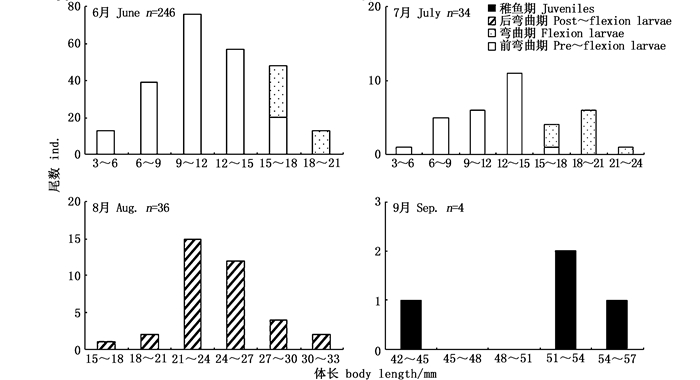
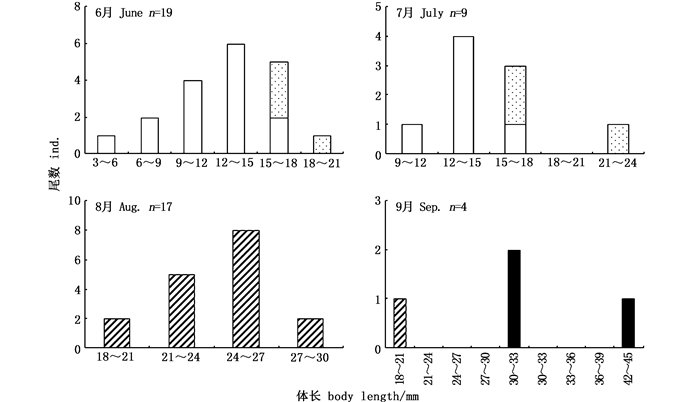
2.3 体长变化本研究没有采集到卵黄囊期仔鱼。表层采样结果表明:6月、7月刀鲚仔稚鱼前弯曲期仔鱼和弯曲期仔鱼数量较多,后弯曲期仔鱼和稚鱼数量较少,且各个发育阶段体长分布较为集中;中层采样结果表明:6—9月采集刀鲚仔稚鱼各个发育阶段相对较少,且体长分布和表层体长分布基本相同(图 7和8)。这表明刀鲚仔稚鱼数量在表层分布较多,体长变化在表层和中层的分布趋势相同。
|
图 7 表层刀鲚仔稚鱼各发育阶段和体长月变化 Fig. 7 Monthly changes of body length and development stages of Coilia nasus larvae and juveniles in the surface layer |
|
图 8 中层刀鲚仔稚鱼各发育阶段和体长月变化 Fig. 8 Monthly changes of body length and development stages of Coilia nasus larvae and juveniles in the middle layer |
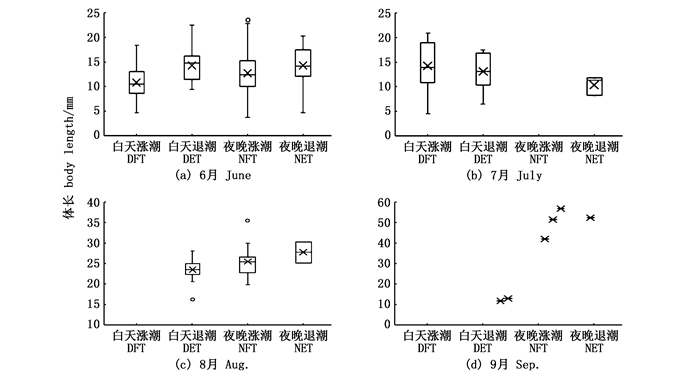
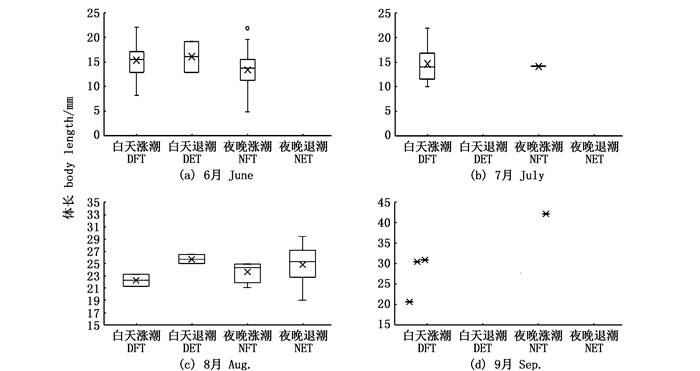
图 9表明, 6月和7月表层刀鲚仔稚鱼体长变化不明显。表层采样结果表明:6月白天涨潮(day flood tide, DFT),白天退潮(day ebb tide, DET)都有采集到(图 9),且采集到的刀鲚仔稚鱼体长都相对较小;中层采样结果表明:8月白天涨潮,白天退潮,夜间涨潮(night flood tide, NFT),夜间退潮(night ebb tide, NET)都有采集到,且体长大小和表层趋势差别不大(图 10)。且无论表层还是中层,到9月刀鲚仔稚鱼数量已经明显减少,且体长分布与6月和7月相比都明显变大(图 9和10)。
|
×.刀鲚仔稚鱼的平均体长; ○.刀鲚仔稚鱼体长的最大值和最小值 ×.The average body length of Coilia nasus larva and juveniles; ○.The maximum value or the minimal value of average body length of Coilia nasus larva and juveniles 图 9 表层刀鲚仔稚鱼体长分布情况 Fig. 9 Distribution of Coilia nasus larvae and juveniles in the surface layer |
|
×.刀鲚仔稚鱼的平均体长; ○.刀鲚仔稚鱼体长的最大值和最小值 ×.The average body length of Coilia nasus larva and juveniles; ○.The maximum value or the minimal value of average body length of Coilia nasus larva and juveniles 图 10 中层刀鲚仔稚鱼分布情况 Fig. 10 Distribution of Coilia nasus larvae and juveniles in the middle layer |
从表 1可知:刀鲚前弯曲期仔鱼CPUE在白天涨潮、白天退潮、夜间涨潮、夜间退潮的条件下, 表层大于中层;白天退潮时,弯曲期仔鱼CPUE表层0.39尾/100 m3, 中层0.38尾/100 m3, 表层和中层基本相同,在白天涨潮、夜间涨潮、夜间退潮时,表层CPUE都大于中层;后弯曲期和稚鱼白天涨潮时趋于中层水域,白天退潮时又趋于表层的漂流机制;后弯曲仔鱼夜间涨潮时表层CPUE为1.50尾/100 m3,大于中层0.57尾/100 m3,夜间退潮时表层小于中层;稚鱼夜间涨潮时表层CPUE为0.38尾/100 m3大于中层。夜间退潮时稚鱼CPUE为0,未采集到刀鲚稚鱼,至于夜间退潮稚鱼漂向何处有待研究。前弯曲期仔鱼和弯曲期仔鱼表层和中层的CPUE相差较大,表层CPUE较大,中层较小,而弯曲期仔鱼表层和中层CPUE相差较小。随着发育阶段的进行,刀鲚仔稚鱼可能向中层漂流。

|
表 1 刀鲚仔稚鱼各发育阶段昼夜涨退潮表、中层的CPUE比较 Tab.1 The comparision of development stage of Coilia nasus larvae and juveniles' CPUE at flood and ebb tide in the surface and middle layers in the Yangtze River estuary in day and night |
WEINSTEIN等[6]对鲆类(Paralichthys spp.)和波纹绒须石首鱼(Micropogonias undulatus)后期仔鱼的研究表明,鲆类和波纹绒须石首鱼利用潮汐作用来使自身滞留在河口水域,涨潮时向较浅水层移动,退潮时则向较深水层移动,进而提出选择性潮汐输送机制。本研究在长江口水域进行分层调查来探究刀鲚仔稚鱼在河口水域的漂流机制,发现前弯曲期和弯曲期仔鱼表层CPUE相对较大,中层相对较小,到后弯曲期和稚鱼期则表层和中层CPUE基本相同,随着发育阶段的进行和体长的变化,刀鲚仔稚鱼可能向中层水域移动进行生活。前弯曲期和弯曲期白天CPUE大于夜间,而后弯曲期和稚鱼则夜间大于白天,不同发育阶段昼夜分布情况也不同。后弯曲期仔鱼和稚鱼白天涨潮时趋于中层,白天退潮时又趋于表层。李安东等[7]对长江口南支水域刀鲚仔稚鱼数量变动的研究表明,刀鲚仔稚鱼夜间涨潮密度小于白天密度,夜间退潮密度小于白天退潮密度与本研究结果相同。侯世挺等[8]对长江口南支仔稚鱼数量随潮汐变化的研究表明,各月涨潮时的种类数均大于退潮时的种类数,其中对一站位点进行中层水平拖网结果表明,种类组成与表层差异不明显,但多样性均不如表层。本研究中长江口南支刀鲚前弯曲期仔鱼、弯曲期仔鱼、稚鱼密度均涨潮时大于退潮,和侯世挺研究结果相同,然而在后弯曲期仔鱼平均密度,夜间退潮大于涨潮;在表层分布中,前弯曲期平均密度远大于弯曲期仔鱼平均密度的结果与侯世挺等[8]研究一致;在中层分布中,后弯曲期仔鱼和稚鱼的平均密度基本相同,即使同一种鱼在不同的发育时期在表层和中层分布也不相同,刀鲚仔稚鱼到后弯曲期和稚鱼时期进入中层生活有待于研究。葛珂珂等[9]在长江口碎波带对刀鲚仔稚鱼数量分布的研究显示碎波带中主要以弯曲期仔鱼和后弯曲期仔鱼为主,卵黄囊期和前弯曲期仔鱼则较少,推断刀鲚仔鱼是在达到一定的体长或发育阶段才进入碎波带,而本研究在长江口南支上的采样在6月和7月主要采集到刀鲚前弯曲期仔鱼,8月和9月则没有采集到该发育阶段的仔鱼,在一定程度上可以推断弯曲期仔鱼前的刀鲚在江中心漂流,弯曲期仔鱼后的刀鲚将生活在碎波带。
3.2 刀鲚仔稚鱼的资源保护仔稚鱼作为鱼类早期资源的一个重要阶段,自然状态下能存活的个体仅有不到1%[10]。鱼类种群的年际补充强度的一个重要指标就是仔稚鱼阶段的成活率,是种群结构变化的主要因素,也是种群数量变动的主要因素[11]。由于人为的一些因素,例如航道和水利工程的建设,为了获得更大经济利益而大力捕捞,生态环境栖息地的破坏等行为使得刀鲚资源数量逐年急剧减少。在20世纪60年代的调查结果显示,那时刀鲚资源量虽然不高,但基本上能保持原始状态不至于下降。70年代刀鲚数量很多[12-13]。能捕捞的产量大,80年代已很少[14-15]。90年代相关学者在长江至南通调查发现产量有一定波动[13]。刀鲚资源量已经处于极度贫乏的地步,施德龙等[16]在上海崇明县对刀鲚资源的调查结果也吻合了上述结果。以往的调查数据显示,刀鲚捕捞量从2001年开始下降,至2010年产量出现一定的增加,后来又持续下降[17-19]。相关学者对早期资源损伤、水体污染等方面做了相关调查[20]。对于刀鲚种类地位,相关学者在长江口碎波带进行相关调查,结果显示刀鲚数量处于领先地位[21-23]。董文霞等[24]也对刀鲚的地位状况进行了调查研究,结果显示在刀鲚种群资源急剧衰退的情况下,丰富度越来越低,生存的时间和体长都变小,但可以有生长发育的空间。此次调查发现,6月和7月刀鲚仔稚鱼的数量较多,然而成鱼数量却相对较少,除了自然状态下死亡外,鳗苗网也有很大影响。尤其在长江口北支和南支口的鳗苗定置网等网具的不当设置对刀鲚仔稚鱼造成了巨大的损害,因其网目仅1 mm,铺设范围广,下网时间和刀鲚游动时间相同等特点,造成大量刀鲚仔稚鱼与鳗苗一同被捕获,引起资源量的降低。葛成冈等[25]也提出鳗苗定置网在长江口的铺设数量太大,这是造成刀鲚资源数量下降的重要原因,因此不仅要保护刀鲚本身发育外,对其他破坏因素也要加强管理,从而更好利用刀鲚资源。
| [1] |
中国水产科学研究院东海水产研究所, 上海水产研究所. 上海鱼类志[M]. 上海: 上海科学技术出版社, 1990. East China Sea Fisheries Research Institute, Chinese Academy of Fisheries Science and Shanghai Fisheries Research Institute. The fishes of Shanghai area[M]. Shanghai: Shanghai Scientific & Technical Publishers, 1990. |
| [2] |
袁传宓, 秦安舲. 我国近海鲚鱼生态习性及其产量变动状况[J]. 海洋科学, 1984(5): 35-37. YUAN C M, QIN A L. Ecological habits and distribution of Coilia along the Chinese coast and its changes of output[J]. Marine Science, 1984(5): 35-37. |
| [3] |
MARTIN B T, CZESNY S J, WAHL D H. Vertical dis-tribution of larval fish in pelagic waters of southwest Lake Michigan:Implications for growth, survival, and dispersal[J]. Journal of Great Lakes Research, 2011, 37(2): 279-288. DOI:10.1016/j.jglr.2011.01.006 |
| [4] |
KENDALL A W JR, AHLSTROM E H, MOSER H G. Early life history stages of fishes and their characters[M]//MOSER H G, RICHARDS W J, COHEN D M, et al. Ontogeny and Systematics of Fishes. Lawrence: The American Society of Ichthyologists Herpetologists, Spec Publ, 1984.
|
| [5] |
国家海洋局908专项办公室. 海洋生物生态调查技术规程[M]. 北京: 海洋出版社, 2006: 908. Office of the State Oceanic Administration. Technical specification for ecological surveys of marine life[M]. Beijing: Ocean Press, 2006. |
| [6] |
WEINSTEI N, MICHAEL P. Population dynamics of an estuarine-dependent fish, the spot (Leiostomusxanthurus), along a tidal creek-seagrass meadow coenocline[J]. Canadian Journal of Fisheries and Aquatic Sciences, 1983, 40(10): 1633-1638. DOI:10.1139/f83-189 |
| [7] |
李安东, 钟俊生, 罗一鸣, 等. 长江口南支水域刀鲚仔稚鱼数量变动的研究[J]. 上海海洋大学学报, 2015, 24(5): 745-753. LI A D, ZHONG J S, LUO Y M, et al. Distribution and abundance of Coilia nasus larvae and juveniles in the southern branch of Yangtze River Estuary[J]. Journal of Shanghai Ocean University, 2015, 24(5): 745-753. |
| [8] |
侯世挺, 钟俊生, 王晓东, 等. 长江口南支仔稚鱼数量随潮汐变化的研究[J]. 上海海洋大学学报, 2018, 27(2): 250-258. HOU S T, ZHONG J S, WANG X D, et al. The study on the amount changes of fish larvae during flood and ebb in the south branch of Yangtze River Estuary[J]. Journal of Shanghai Ocean University, 2018, 27(2): 250-258. |
| [9] |
葛珂珂, 钟俊生, 吴美琴, 等. 长江口沿岸碎波带刀鲚仔稚鱼的数量分布[J]. 中国水产科学, 2009, 16(6): 923-930. GE K K, ZHONG J S, WU M Q, et al. Distribution and abundance of larval japanese grenadier anchovy Coilia nasus in the surf zone of the Yangtze River estuary[J]. Journal of Fishery Sciences of China, 2009, 16(6): 923-930. DOI:10.3321/j.issn:1005-8737.2009.06.013 |
| [10] |
CHAMBERS R C, TRIPPEL E A. Early life history and recruitment in fish populations[M]. Switzerland: Springer Netherlands, 1997.
|
| [11] |
曹文宣, 常剑波, 乔晔, 等. 长江鱼类早期资源[M]. 北京: 中国水利水电出版社, 2007. CAO W X, CHANG J B, QIAO Y, et al. Fish resources of early life history stages in Yangtze River[M]. Beijing: China Water Power Press, 2007. |
| [12] |
倪勇, 伍汉霖. 江苏鱼类志[M]. 北京: 中国农业出版社, 2006. NI Y, WU H L. Fishes of Jiangsu province[M]. Beijing: China Agriculture Press, 2006. |
| [13] |
张敏莹, 徐东坡, 刘凯, 等. 长江下游刀鲚生物学及最大持续产量研究[J]. 长江流域资源与环境, 2005, 14(6): 694-698. ZHANG M Y, XU D P, LIU K, et al. Studies on biological characteristics and change of resource of Coilia nasus schlegel in the lower reaches of the Yangtze River[J]. Resources and Environment in the Yangtze Basin, 2005, 14(6): 694-698. DOI:10.3969/j.issn.1004-8227.2005.06.005 |
| [14] |
郭弘艺, 周天舒, 唐文乔, 等. 长江近口段沿岸刀鲚生物量的时间格局[J]. 长江流域资源与环境, 2015, 24(4): 565-571. GUO H Y, ZHOU T S, TANG W Q, et al. Temporal pattern of coilianasus biomass along the Jingjiang section of the Yangtze River over the last decade[J]. Resources and Environment in the Yangtze Basin, 2015, 24(4): 565-571. DOI:10.11870/cjlyzyyhj201504005 |
| [15] |
袁传宓. 长江中下游刀鲚资源和种群组成变动状况及其原因[J]. 动物学杂志, 1988, 23(3): 12-14. YUAN C M. Yangtze River Coilia nasus resources and population changes in the composition of the situation and its causes[J]. Zoological Research, 1988, 23(3): 12-14. |
| [16] |
施德龙, 龚洪新. 关于保护长江口刀鲚资源的建议[J]. 海洋渔业, 2003, 25(2): 96-97. SHI D L, GONG H X. Recommendations for the protection of resources Coilia nasus[J]. Marine Fisheries, 2003, 25(2): 96-97. DOI:10.3969/j.issn.1004-2490.2003.02.018 |
| [17] |
刘洪波, 姜涛, 杨健. 日本有明海水域刀鲚资源现状及存在的问题[J]. 渔业信息与战略, 2019, 34(1): 48-52. LIU H B, JIANG T, YANG J. Current status and problems of estuarine tapertail anchovy(Coilia nasus) resource in the Ariake Sea of Japan[J]. Fishery Information & Strategy, 2019, 34(1): 48-52. |
| [18] |
刘凯, 段金荣, 徐东坡, 等. 长江口刀鲚渔汛特征及捕捞量现状[J]. 生态学杂志, 2012, 31(12): 3138-3143. LIU K, DUAN J R, XU D P, et al. Present situation of Coilia nasus population features and yield in Yangtze River estuary waters in fishing season[J]. Chinese Journal of Ecology, 2012, 31(12): 3138-3143. |
| [19] |
郭弘艺, 张旭光, 唐文乔, 等. 长江靖江段刀鲚捕捞量的时间变化及相关环境因子分析[J]. 长江流域资源与环境, 2016, 25(12): 1850-1859. GUO H Y, ZHANG X G, TANG W Q, et al. Temporal variations of Coilia nasus catches at Jingjiang section of the Yangtze river in fishing season in relation to environmental factors[J]. Resources and Environment in the Yangtze Basin, 2016, 25(12): 1850-1859. DOI:10.11870/cjlyzyyhj201612008 |
| [20] |
毛成责, 矫新明, 钟俊生, 等. 长江口刀鲚资源现状及保护研究进展[J]. 淮海工学院学报(自然科学版), 2015, 24(3): 78-83. MAO C Z, JIAO X M, ZHONG J S, et al. Research progress on resource status and protection of Coilia nasus in Yangtze River Estuary[J]. Journal of Huaihai Institute of Technology(Natural Sciences Edition), 2015, 24(3): 78-83. DOI:10.3969/j.issn.1672-6685.2015.03.018 |
| [21] |
钟俊生, 郁蔚文, 刘必林, 等. 长江口沿岸碎波带仔稚鱼种类组成和季节性变化[J]. 上海水产大学学报, 2005, 14(4): 375-382. ZHONG J S, YU W W, LIU B L, et al. Seasonal occurrences of fish larvae and juveniles in the surf zone of the Yangtze River estuary[J]. Journal of Shanghai Fisheries University, 2005, 14(4): 375-382. |
| [22] |
钟俊生, 吴美琴, 练青平. 春、夏季长江口沿岸碎波带仔稚鱼的种类组成[J]. 中国水产科学, 2007, 14(3): 436-443. ZHONG J S, WU M Q, LIAN Q P. Composition of fish larvae and juveniles in spring and summer in surf zone of Yangtze River estuary[J]. Journal of Fishery Sciences of China, 2007, 14(3): 436-443. DOI:10.3321/j.issn:1005-8737.2007.03.014 |
| [23] |
葛珂珂, 钟俊生, 吴美琴, 等. 长江口沿岸碎波带刀鲚仔稚鱼的数量分布[J]. 中国水产科学, 2009, 16(6): 923-930. GE K K, ZHONG J S, WU M Q, et al. Distribution and abundance of larval Japanese grenadier anchovy Coilia nasus in the surf zone of the Yangtze River estuary[J]. Journal of Fishery Sciences of China, 2009, 16(6): 923-930. DOI:10.3321/j.issn:1005-8737.2009.06.013 |
| [24] |
董文霞, 唐文乔, 王磊. 长江刀鲚繁殖群体的生长特性[J]. 上海海洋大学学报, 2014, 23(5): 669-674. DONG W X, TANG W Q, WANG L. Growth characteristics of reproductive population of Coilia nasus in the Yangtze River[J]. Journal of Shanghai Ocean University, 2014, 23(5): 669-674. |
| [25] |
葛成冈, 钟俊生, 葛珂珂, 等. 长江口鳗苗网兼捕鱼类组成分析及其管理建议[J]. 上海海洋大学学报, 2013, 22(3): 391-396. GE C G, ZHONG J S, GE K K, et al. Analysis on the composition of by-catch in elver nets and the suggestions on the management of elver nets in Yangtze River estuary[J]. Journal of Shanghai Ocean University, 2013, 22(3): 391-396. |