 2020,
Vol. 29
2020,
Vol. 29


诺氟沙星(norfloxacin, NFLX)属第三代氟喹诺酮(fluoroquinolones, FQs)抗菌药,作为一种人畜共用药物,约60%~70%NFLX在代谢过程中进入环境,进而吸附于沉积物中[1]。我国农业农村部于2015年发布2293号公告,禁止NFLX等4类FQs用于家禽及水产养殖。但在环境样品,特别是土壤、沉积物中NFLX被广泛检出[2-3]。同时FQs结构中含有带正电荷的氮原子[4]及较多的离子型官能团[5]易吸附在沉积物中因而能长久存在,其潜在风险不容忽视。
预测无效应浓度(predicted no effect concentration, PNEC)是欧盟风险技术指导文件(technical guidance document on risk assessment, TGD)针对现有的化合物风险评价提出的生态安全阈值,是化合物生态风险评价和管理的重要依据[6]。常见的PNEC的计算方法有因子评价法、毒性百分数排序法和物种敏感度分布(species sensitivity distributions,SSDs)法。其中物种敏感度分布法通过多个物种暴露在同一毒性物质下的反应来估计一定比例下物种受有害影响时对应的污染浓度,相较于国内普遍使用单一物种的毒性数据进行风险评估更具有确定性和整体性[7]。李霁等[6]依据TGD推导出我国淡水沉积物环境中荧蒽的PNEC值,陈心悦等[8]使用SSDs法推导出林丹在淡水沉积物中的质量基准。然而,针对NFLX在淡水沉积物中的风险和对应基准尚未报道。
基于我国本土淡水生物毒性数据并结合欧盟风险评价技术导则文件中推荐的平衡分配法推导出诺氟沙星的淡水沉积物中PNECsed,并结合中国现存淡水沉积物中诺氟沙星的含量数据评价其生态风险,为以NFLX为代表的FQs等物质在淡水沉积物中标准的制定及风险衡量提供基础。
1 材料与方法 1.1 慢性毒性数据的获取与选择本研究毒性数据获取于美国环保署(US EPA)ECOTOX数据库(https://cfpub.epa.gov/ecotox/index.cfm)、瑞典环境策略研究基金会WikiPharma药物毒性数据库(http://www.wikipharma.org/api_data.asp)以及中国知网、Web of Science文献中筛选获得的部分毒性数据。数据的挑选需满足以下条件:尽量选取中国本地物种;毒性试验方法需与相关标准试验方法一致;试验用水为淡水;急性数据选择24~96 h的EC50或LC50,慢性数据选择以最低可见效应浓度LOEC或NOEC为标准。当针对有同一暴露时间、同一暴露终点的毒性数据则使用多个敏感数据的几何均值[9]。欧盟TGD准则中要求SSDs法中至少获得的8个物种10组不同类别的慢性数据,由于慢性毒性试验时间较长,所收集到的数据无法满足欧盟“8种10组”的要求,结合使用US EPA提供的Web-ICE预测平台(https://www3.epa.gov/ceampubl/fchain/webice/index.html)并结合急慢性比(acute and chronic ratio, ACR)进行部分物种慢性毒性外推。
1.2 物种敏感性分布(SSDs)曲线拟合与淡水中PNECwater计算SSDs拟合模型的选择是污染物环境基准研究的关键因素,但尚无通用模型适合于所有毒性物质、毒性试验动物[10]。因此在进行模型拟合时,采用R(R Develop Core Team 2008)将所获得的慢性数据分别使用log-normal(对数正态模型)、log-logistic(对数逻辑斯蒂模型)、log-Gumbel(对数耿贝尔模型)、Gamma(伽马模型)、Weibull(韦布尔模型)等5个常用模型进行拟合并生成SSD曲线。对于最佳模型的选择,根据上述5个模型的贝叶斯信息度量(bayesian information criterion, BIC)及赤池信息量(akaike information criterion, AIC)[11]选择最佳模型,并将拟合程度最好的SSD曲线上对应5%累计概率时污染物浓度作为淡水水体中诺氟沙星的危害浓度(HC5)。
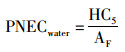
为减小由于统计外推所造成的误差,根据US EPA所推荐的计算方式,诺氟沙星水环境预测慢性无效浓度计算公式:
 (1)
(1)
式中:PNECwater为水环境预测无效浓度,μg/L;AF为评价因子,根据不同污染情况,本着生态风险评价中“最坏情况”原则,在本推导过程中AF取值为5。
1.3 诺氟沙星淡水沉积物中PNECsed计算诺氟沙星在淡水沉积物中无效浓度采用TGD推荐的分配平衡法,参考公式(2)~(5),其中参数依据TGD中默认值[12]及JANSSEM等[13]针对TGD的解释说明中获得。平衡分配法主要基于3个假设[14]:沉积物环境中与水体中生活的生物对污染物的敏感性相同;污染物在底栖生物、沉积物和间隙水中浓度处于热力学平衡状态,可用分配系数来预测在任意一相中的浓度;沉积物中化学物质的生物毒性有效性仅取决于孔隙水相的游离态浓度。
 (2)
(2)
 (3)
(3)
 (4)
(4)
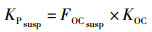 (5)
(5)
式中:PNECsed为淡水沉积物环境预测无效应浓度(干质量计),μg/g;Ksusp-water为悬浮物-水分配系数;KPsusp为诺氟沙星在悬浮物中的固-水分配系数;RHOsusp为悬浮物湿体积密度,取1 150 kg/m3;RHOwater为水的密度,取1 000 kg/m3;RHOsolid为固相的密度,取2 500 kg/m3;4.6为的干、湿质量转化系数;Fsoildsusp为悬浮物中固体的体积分数,取0.1;Fwatersusp为悬浮物中水的体积分数,取0.9;FOCsusp为悬浮物中有机碳的质量分数;KOC为诺氟沙星有机碳-水分配系数,L/kg。
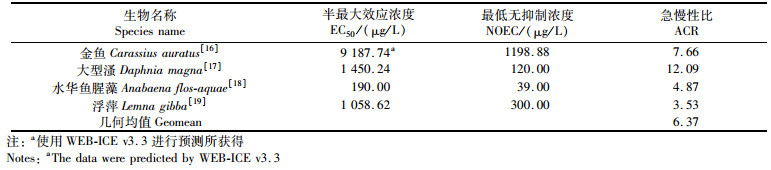
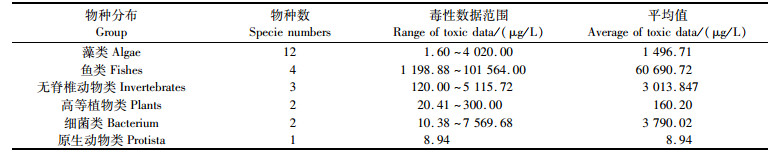
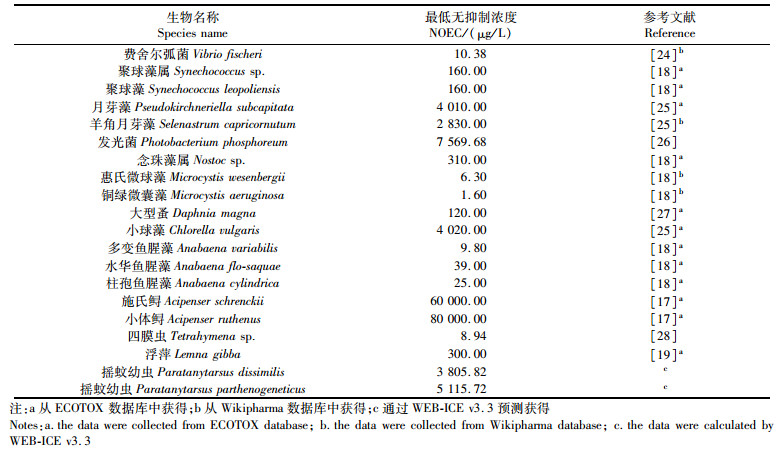
2 结果 2.1 水生动物对诺氟沙星的敏感响应根据“US EPA导则”要求,用于推导ACR的毒性数据至少为3个门类,分别为鱼类、无脊椎动物和另一敏感水生动物[9],物种的选择见表 1,计算得诺氟沙星ACR取值为6.37。按照1.1中毒性数据选择原则和要求,共从公共数据库、US EPA ICE预测以及ACR方法获得淡水中8门15属14科的24个物种慢性毒性,其详细数据及分组统计见表 2~6。
|
表 1 急慢性比物种选择及相应毒性数据 Tab.1 The species selected and data used to calculate acute and chronic ratio |
|
表 2 慢性物种毒性分组 Tab.2 The summary of grouping statistics in chronic toxicity |
|
表 3 数据库及文献中诺氟沙星的最低无抑制浓度 Tab.3 The NOEC data were collected in the database and reference |

|
表 4 使用ACR推导获得的最低无抑制浓度 Tab.4 The NOEC data calculated by ACR method |
|
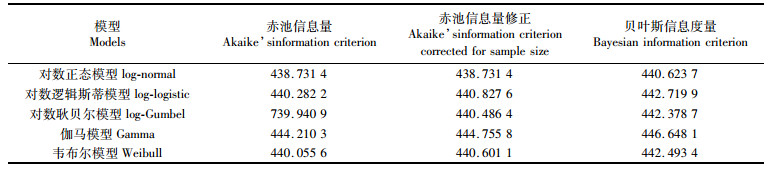
表 5 五类模型AIC和BIC打分情况 Tab.5 The AIC and BIC information of 5 different models |
|
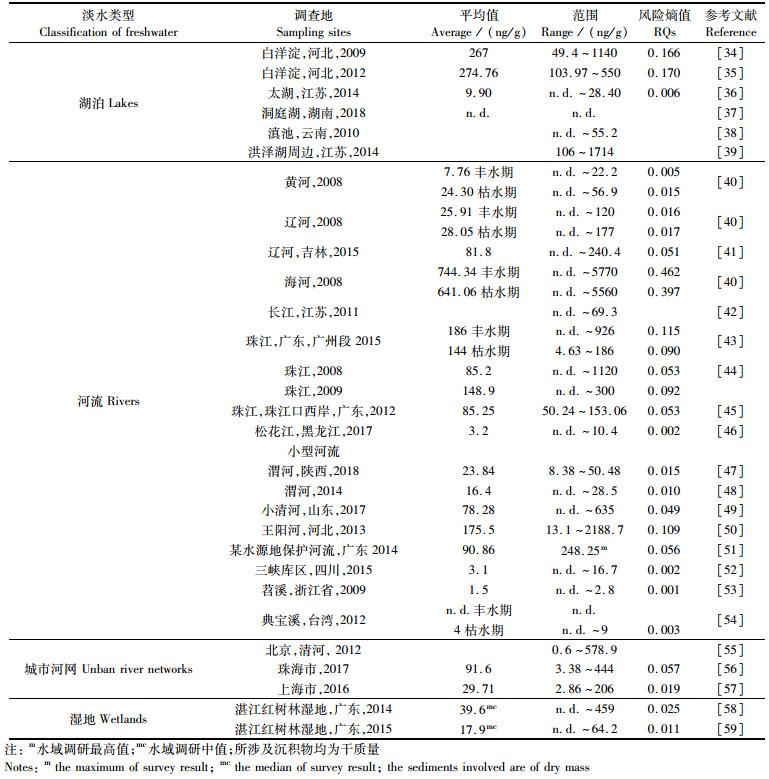
表 6 我国现存淡水沉积物中诺氟沙星含量 Tab.6 Distributions of NFLX in sediment of freshwater in China |
由表 2可得,诺氟沙星在淡水中的毒性测定中藻类占据多数,占到了52%,其次为鱼类、高等植物类。作为两类快速的水质毒性测试物种,细菌与原生生物类占到了筛选到物种的12%。从物种的平均敏感性来看,原生动物类对诺氟沙星较为敏感,植物类和藻类其次,最不敏感的为鱼类。其中鱼类慢性毒性数据均值是藻类慢性数据均值的40倍。在剔除基于微观作用观察指标的慢性毒性数据后,藻类与鱼类在慢性毒性敏感度上存在显著差异(P=0.022 < 0.05)。LÜTZHØFT等[20]研究表明,抗生素对鱼类的影响要小于藻类的影响。同时,鱼类体内抗生素积累要远远高于藻类[21],这主要是因为鱼类具有较复杂的代谢机制进而代谢部分毒性物质。同时有研究[22-23]指出甲壳纲对多种污染物敏感性远远大于鱼类,本研究由于收集到甲壳纲种类较少(n=1),因此无法通过统计学手段说明其差异性。总体而言,物种对毒性物质的敏感度是一个复杂问题,还需进行大量的毒理学研究。同时,针对于诺氟沙星一类的抗菌剂,未来增加甲壳纲个体毒性试验,同时关注鱼类受到污染后体内微观指标变化,这将有助于使用SSDs这一类统计外推所获得的PNEC精度。
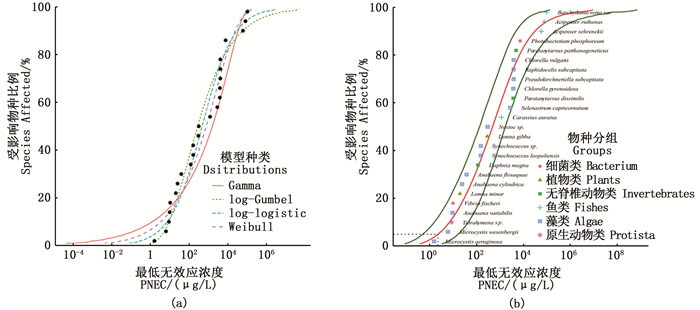
2.2 SSD模型拟合结果诺氟沙星淡水PNECsed的推导经过筛选及预测,淡水生物慢性满足TGD要求的“8种10组”的数据要求。将已获得的慢性数据进行对数转换后,使用Shapiro-Wilk进行正态分布检验得到P=0.885 8(P>0.05),说明所获得的数据符合正态分布。使用log-normal、log-logistic、log-Gumbel、Gamma和Weibull共5个模型对所获得数据进行拟合,结果见图 1。通过AIC及BIC对上述5个模型进行打分,打分结果见表 5。其中log-normal模型的AIC打分、BIC打分、AIC修正结果均最小,确定log-normal为拟合诺氟沙星在淡水环境中慢性毒性的最佳模型[11]。根据图 1b可得,所有物种均在log-normal模型计算的5 %误差之内,说明模型拟合置信度高,适用于统计外推。结合拟合方程推算得到诺氟沙星在淡水中慢性毒性为HC5=2.37 μg/L。另根据诺氟沙星lgKoc=1.964 L/kg[32],同时根据李霁等[33]推算出我国淡水水体内悬浮物中w(OC)(FOCsusp=0.02),将HC5代入公式(1)~(5)可得PNECwater=0.47 μg/L、PNECsed=1 612.822 ng/g。
|
图 1 不同模型拟合诺氟沙星SSDs曲线 Fig. 1 Different models fitted with chronic toxicity data of NFLX |
从Web of Science、CNKI收集截至2018年12月以来我国淡水沉积物中诺氟沙星的检测数据,同时数据需满足详细描述数据收集地点及实验质量控制方法,共收集到我国部分的淡水湖、大型淡水系、小型河流、湿地及城市水系等23个地区的淡水沉积物的诺氟沙星含量。除洞庭湖外,所有收集到地域淡水沉积物中均检出诺氟沙星。
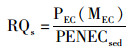
根据TGD关于风险评价的方法,药品残留在环境中的生态风险可以根据风险商值(RQs)的大小来评价:
 (6)
(6)
式中:PEC为环境污染物预测浓度,ng/g;MEC为污染物实际检测浓度,ng/g;PNECsed为沉积物中诺氟沙星预测无效浓度,ng/g。按照HERNANDO等[15]提出的RQs的风险表征分类方法:RQs≥1为高风险,0.1≤RQs<1为中等风险,RQs<0.1为最低风险。使用平均值计算国内主要淡水沉积物中诺氟沙星的RQs结果见表 6。
从收集到的淡水沉积物数据中,诺氟沙星淡水域检出的概率为96%,不同水域从2.8 ng/g至5 770 ng/g不等。从淡水域均值来看,淡水沉积物中诺氟沙星风险较低,RQs范围为0.001~0.462,其中低风险水域占已知水域的82.76%,中低风险占全部水域的17.24%,尚未发现高风险水域。其中海河区域由于距离城市较近且有较多的规模的养殖导致沉积物中诺氟沙星RQs最高[52]。采样点方面,在海河、洪泽湖及小阳河出现了3个的高风险样点,其沉积物浓度含量分别为5 770、1 714、2 188.7 ng/g。对比3个高风险采集点,采样时间均在农业部2293号公告颁布前,同时采样点距淡水及牲畜养殖区较近,这与诺氟沙星在水产及牲畜养殖过程中的广泛使用有密切联系,说明人类活动及畜禽养殖可能是淡水沉积物中诺氟沙星的重要输入。
2.4 不确定分析不确定分析是风险评价中不可缺少的一个重要步骤。文中涉及的不确定性风险主要源于以下方面:(1)暴露条件的不确定性。仅考虑了诺氟沙星单个物质对水生生物的影响,在实际水域环境中都是多种污染物同时存在,并存在一定相互作用机制。同时对诺氟沙星的毒性暴露并未考虑到食物摄取、生物富集等,仅考虑到污染物的直接作用,这可能在一定程度上低估诺氟沙星的风险。(2)模型选择的不确定性。模型作为简化的现实场景,在真实条件下可能具有一定的局限性,同时针对不同污染物最优模型选择尚存在争议[18]。本文使用5种模型进行了诺氟沙星慢性毒性的拟合,并使用AIC及BIC评估选取最佳模型,尽量减小模型选择所带来的误差,但仍不能做到完美拟合所有的数据点,这是预测风险评价所带来的不确定原因之一。(3)毒性数据的不确定性。本文由于采用了一部分Web-ICE及通过ACR进行预测的慢性毒性数据,这些预测数据使用虽然在统计上无法造成显著差异[60],会给风险评价带来一定的不确定性。同时,使用的慢性毒性均来自实验室模拟条件,这可能与真实条件下的环境条件有所差异。
3 讨论YAN等[61]使用评价因子法得到了诺氟沙星的PNEC值,其中PNECwater=2 μg/L。与该结果相比,本文结果较为保守,这可能是在使用SSDs法推算PNECwater时,根据生态风险中的“最坏情况”使用了一个较为保守的评价因子, 造成计算值偏小。秦延文等[62]结合BACKHAUS等[24]对V.fischeri的毒性结果,通过评价因子法得到了诺氟沙星的PNECwater=0.1038 μg/L,与本文推导出结果在同一个数量级内。但秦延文等与YAN等的推导出的PNECwater差距较大,说明确定性因子评价由于缺乏统计学和概率学上的意义,仅通过单一评价物种评价诺氟沙星的生态毒性可能会造成PNEC的误判,这会对污染物风险评价带来误差。SSDs法虽从生态系统的层面上考虑了不同物种对毒性物质的敏感性,但对于新发现或突发污染物条件下缺少满足条件的毒性数据时,SSDs法就有所局限。这时评价因子法可以用来初步研究污染物的潜在毒性,但从系统及环境长远性考虑,使用SSDs法相较于评价因子法更具有参考价值。
在使用SSDs法进行污染物HC5推算的过程中,不同模型选择可能导致不同的推算结果,因此模型选优至关重要。张姚姚等[63]使用Burrlizo中的Weibull模型进行了诺氟沙星淡水中急性PNEC的估算,但尚未考虑到不同拟合模型对统计外推的影响。同时,有些研究中针对不同模型污染物拟合优良的判定上只使用R2或Radj2,使得推算出的HC5具有一定的局限性。R2是以残差平方和为基础的拟合度量和检验程序,只有在关心样本内拟合或解释因变量的样本更具有高效性[64]。当拟合或建模是为了预测时,样本内度量就不一定最优,而且伴随数据增多可能会带来一定的模型“过拟合”。而在预测性框架中,引入AIC与BIC打分可以进一步比较不同模型的拟合精度和对未知参数的优化程度,可在一定程度上避免上述问题,从而更全面地评价不同拟合模型对毒性数据的拟合程度,进一步减少因模型选择给SSDs法带来的统计误差。
通过收集淡水沉积物中诺氟沙星的慢性毒性数据并结合WEB-ICE、ACR共获得了8门15属14科的慢性毒性数据。物种敏感度分析表示,藻类对于诺氟沙星的敏感性高于鱼类,且有显著差异。同时4类23个淡水沉积物采样点数据基本涵盖了我国不同形态淡水沉积物中诺氟沙星的污染现状。需要指出的是除用于构建SSD曲线的24个物种除小体鲟(Acipenser ruthenus)在我国小范围内分布外,其他物种在我国淡水中均有所分布。因此,该评价结论可以为我国淡水沉积物中诺氟沙星的生态风险评价提供可靠参考。
| [1] |
ÖZCAN A, ÖZCAN A A, DEMIRCI Y. Evaluation of mineralization kinetics and pathway of norfloxacin removal from water by electro-Fenton treatment[J]. Chemical Engineering Journal, 2016, 304: 518-526. DOI:10.1016/j.cej.2016.06.105 |
| [2] |
LEUNG H W, MINH T B, MURPHY M B, et al. Distribution, fate and risk assessment of antibiotics in sewage treatment plants in Hong Kong, South China[J]. Environment International, 2012, 42: 1-9. DOI:10.1016/j.envint.2011.03.004 |
| [3] |
DíAZ-CRUZ M S, BARCELÓD. Determination of antimicrobial residues and metabolites in the aquatic environment by liquid chromatography tandem mass spectrometry[J]. Analytical and Bioanalytical Chemistry, 2006, 386(4): 973-985. DOI:10.1007/s00216-006-0444-z |
| [4] |
JIA A, WAN Y, XIAO Y, et al. Occurrence and fate of quinolone and fluoroquinolone antibiotics in a municipal sewage treatment plant[J]. Water Research, 2012, 46(2): 387-394. DOI:10.1016/j.watres.2011.10.055 |
| [5] |
WANG S L, WANG H. Adsorption behavior of antibiotic in soil environment:a critical review[J]. Frontiers of Environmental Science, 2015, 9(4): 565-574. DOI:10.1007/s11783-015-0801-2 |
| [6] |
李霁, 周俊丽, 曹莹, 等. 荧蒽的淡水沉积物预测无效应浓度推导及生态风险评价[J]. 环境化学, 2015, 34(4): 664-670. LI J, ZHOU J L, CAO Y, et al. Derivation of predicted no effect concentration and ecological risk assessment of fluoranthene in freshwater sediment[J]. Environmental Chemistry, 2015, 34(4): 664-670. |
| [7] |
张国栋, 董文平, 刘晓晖, 等. 我国水环境中抗生素赋存、归趋及风险评估研究进展[J]. 环境化学, 2018, 37(7): 1491-1500. ZHANG G D, DONG W P, LIU X H, et al. Occurrence, fate and risk assessment of antibiotics in water environment of China[J]. Environmental Chemistry, 2018, 37(7): 1491-1500. |
| [8] |
陈心悦, 张彦峰, 沈兆爽, 等. 中国七大水系淡水沉积物中林丹(γ-HCH)的生态风险评估[J]. 生态毒理学报, 2018, 13(3): 103-111. CHEN X Y, ZHANG Y F, SHEN Z S, et al. Ecological risk assessment of γ-HCH for freshwater sediment of seven major river systems in China[J]. Asian Journal of Ecotoxicology, 2018, 13(3): 103-111. |
| [9] |
USEPA. Guidelines for deriving numerical national water quality criteria for the protection of aquatic organisms and their uses[R].Washington, DC: USEPA, 1985.
|
| [10] |
穆景利, 王莹, 张志锋, 等. 我国近海镉的水质基准及生态风险研究[J]. 海洋学报, 2013, 35(3): 137-146. MU J L, WANG Y, ZHANG Z F, et al. Marine water quality criteria for cadmium with a view to protecting aquatic life in China and ecological risk assessment[J]. Acta Oceanologica Sinica, 2013, 35(3): 137-146. DOI:10.3969/j.issn.0253-4193.2013.03.016 |
| [11] |
BURNHAM K P, ANDERSON D R, HUYVAERT K P. AIC model selection and multimodel inference in behavioral ecology:some background, observations, and comparisons[J]. Behavioral Ecology and Sociobiology, 2011, 65(1): 23-35. DOI:10.1007/s00265-010-1029-6 |
| [12] |
DE BRUIJN J, GAARN H B, MARITA L. Technical guidance document on risk assessment[EB/OL]. Institute for Health and Consumer Protection, European Chemicals Bureau. Part Ⅱ. http://echa.europa.eu/documents/10162/16960216/tgdpart2_2ed_en.pdf.2002.
|
| [13] |
JANSSEN M P M, TRAAS T P, RILA J P, et al. Guidance for deriving Dutch environmental risk limits from EU-risk assessment reports of existing substances[J]. Rijksinstituutvoor Volksgezondheiden Milieu RIVM, 2004. |
| [14] |
滕涌, 周启星. 平衡分配法在土壤环境质量基准推导中的相关问题研究[J]. 生态毒理学报, 2015, 10(1): 58-65. TENG Y, ZHOU Q X. Some relative problems of the equilibrium partition method for derivation of soil-evironmental quality criteria[J]. Asian Journal of Ecotoxicology, 2015, 10(1): 58-65. |
| [15] |
HERNANDO M D, MEZCUA M, FERNÁNDEZ-ALBA A R, et al. Environmental risk assessment of pharmaceutical residues in wastewater effluents, surface waters and sediments[J]. Talanta, 2006, 69(2): 334-342. DOI:10.1016/j.talanta.2005.09.037 |
| [16] |
LIU J C, LU G H, WU D H, et al. A multi-biomarker assessment of single and combined effects of norfloxacin and sulfamethoxazole on male goldfish (Carassius auratus)[J]. Ecotoxicology and Environmental Safety, 2014, 102: 12-17. DOI:10.1016/j.ecoenv.2014.01.014 |
| [17] |
LI S W, WANG D, LIU H B, et al. Effects of norfloxacin on the drug metabolism enzymes of two sturgeon species (Acipenser schrencki and Acipenser ruthenus)[J]. Journal of Applied Ichthyology, 2013, 29(6): 1204-1207. DOI:10.1111/jai.12239 |
| [18] |
ANDO T, NAGASE H, EGUCHI K, et al. A novel method using cyanobacteria for ecotoxicity test of veterinary antimicrobial agents[J]. Environmental Toxicology and Chemistry, 2007, 26(4): 601-606. DOI:10.1897/06-195R.1 |
| [19] |
BRAIN R A, JOHNSON D J, RICHARDS S M, et al. Effects of 25 pharmaceutical compounds to Lemna gibba using a seven-day static-renewal test[J]. Environmental Toxicology and Chemistry, 2004, 23(2): 371-382. DOI:10.1897/02-576 |
| [20] |
LÜTZHØFT H C H, HALLING-SØRENSEN B, JØRGENSEN S E. Algal toxicity of antibacterial agents applied in Danish fish farming[J]. Archives of Environmental Contamination and Toxicology, 1999, 36(1): 1-6. |
| [21] |
FENT K, WESTON A A, CAMINADA D. Ecotoxicology of human pharmaceuticals[J]. Aquatic Toxicology, 2006, 76(2): 122-159. |
| [22] |
陈曲, 郭继香, 孙乾耀, 等. 甲萘威的淡水水生生物水质基准研究[J]. 环境科学研究, 2016, 29(1): 84-91. CHEN Q, GUO J X, SUN Q Y, et al. Aquatic life ambient freshwater quality criteria for carbaryl in China[J]. Research of Environmental Sciences, 2016, 29(1): 84-91. |
| [23] |
张瑞卿, 吴丰昌, 李会仙, 等. 应用物种敏感度分布法研究中国无机汞的水生生物水质基准[J]. 环境科学学报, 2012, 32(2): 440-449. ZHANG R Q, WU F C, LI H X, et al. Deriving aquatic water quality criteria for inorganic mercury in China by species sensitivity distributions[J]. Acta Scientiae Circumstantiae, 2012, 32(2): 440-449. |
| [24] |
BACKHAUS T, SCHOLZE M, GRIMME L H. The single substance and mixture toxicity of quinolones to the bioluminescent bacterium Vibrio fischeri[J]. Aquatic Toxicology, 2000, 49(1/2): 49-61. |
| [25] |
EGUCHI K, NAGASE H, OZAWA M, et al. Evaluation of antimicrobial agents for veterinary use in the ecotoxicity test using microalgae[J]. Chemosphere, 2004, 57(11): 1733-1738. DOI:10.1016/j.chemosphere.2004.07.017 |
| [26] |
汪皓琦, 董玉瑛, 汪灵伟, 等. 4种喹诺酮类抗生素对发光菌毒性作用研究[J]. 生态毒理学报, 2017, 12(3): 453-459. WANG H Q, DONG Y Y, WANG L W, et al. The toxicity of four quinolones to Photobacterium phosphoreum[J]. Asian Journal of Ecotoxicology, 2017, 12(3): 453-459. |
| [27] |
LU G H, LI Z H, LIU J C. Effects of selected pharmaceuticals on growth, reproduction and feeding of Daphnia magna[J]. Fresenius Environmental Bulletin, 2013, 22(9): 2583-2589. |
| [28] |
LUO H, LI X, WANG C G, et al. Biological effect studies of norfloxacin complexes on Tetrahymena and Escherichia coli by microcalorimetry[J]. Journal of Wuhan University of Technology-Mater.Sci. Ed, 2016, 31(3): 684-688. DOI:10.1007/s11595-016-1429-1 |
| [29] |
蔡梦婷, 侯国权, 奚豪, 等. 典型抗生素与重金属铜复合暴露对淡水绿藻和斑马鱼的联合毒性[J]. 浙江树人大学学报, 2018, 18(2): 11-15. CAI M T, HOU G Q, XI H, et al. Combined toxicity of co-exposure of typical antibiotic and heavy metal copper on freshwater green algae and zebrafish[J]. Journal of Zhejiang Shuren niversity, 2018, 18(2): 11-15. |
| [30] |
聂湘平, 鹿金雁, 李潇, 等. 诺氟沙星(Norfloxacin)对蛋白核小球藻(Chlorella pyrenoidosa)生长及抗氧化酶活性的影响[J]. 生态毒理学报, 2007, 2(3): 327-332. NIE X P, LU J Y, LI X, et al. Toxic efects of Norfloxacin on the growth and the activity of antioxidase of Chlorella pyrenoidosa[J]. Asian Journal of Ecotoxicolog, 2007, 2(3): 327-332. |
| [31] |
WAGIL M, KUMIRSKA J, STOLTE S, et al. Development of sensitive and reliable LC-MS/MS methods for the determination of three fluoroquinolones in water and fish tissue samples and preliminary environmental risk assessment of their presence in two rivers in northern Poland[J]. Science of the Total Environment, 2014, 493: 1006-1013. DOI:10.1016/j.scitotenv.2014.06.082 |
| [32] |
PEREIRA A M P T, SILVA L J G, MEISEL L M, et al. Fluoroquinolones and tetracycline antibiotics in a portuguese aquaculture system and aquatic surroundings:occurrence and environmental impact[J]. Journal of Toxicology and Environmental Health, Part A, 2015, 78(15): 959-975. DOI:10.1080/15287394.2015.1036185 |
| [33] |
李霁, 刘征涛, 刘秀华, 等. 菲的淡水沉积物环境预测无效应浓度推导[J]. 环境科学研究, 2014, 27(7): 790-796. LI J, LIU Z T, LIU X H, et al. Derivation of predicted no effect concentrations for phenanthrene in freshwater sediments[J]. Research of Environmental Sciences, 2014, 27(7): 790-796. |
| [34] |
LI W H, SHI Y L, GAO L H, et al. Occurrence of antibiotics in water, sediments, aquatic plants, and animals from Baiyangdian Lake in North China[J]. Chemosphere, 2012, 89(11): 1307-1315. DOI:10.1016/j.chemosphere.2012.05.079 |
| [35] |
CHENG D M, LIU X H, WANG L, et al. Seasonal variation and sediment-water exchange of antibiotics in a shallower large lake in North China[J]. Science of the Total Environment, 2014, 476-477: 266-275. DOI:10.1016/j.scitotenv.2014.01.010 |
| [36] |
XU J, ZHANG Y, ZHOU C B, et al. Distribution, sources and composition of antibiotics in sediment, overlying water and pore water from Taihu Lake, China[J]. Science of the Total Environment, 2014, 497/498: 267-273. DOI:10.1016/j.scitotenv.2014.07.114 |
| [37] |
LIU X H, LU S Y, GUO W, et al. Antibiotics in the aquatic environments:a review of lakes, China[J]. Science of the Total Environment, 2018, 627: 1195-1208. DOI:10.1016/j.scitotenv.2018.01.271 |
| [38] |
WEI Y M, ZHANG Y, XU J, et al. Simultaneous quantification of several classes of antibiotics in water, sediments, and fish muscles by liquid chromatography-tandem mass spectrometry[J]. Frontiers of Environmental Science & Engineering, 2014, 8(3): 357-371. |
| [39] |
孙凯.洪泽湖湿地典型抗生素污染特征与生态风险[D].南京: 南京林业大学, 2015. SUN K. Contamination characteristics and ecological risk assessment of typical antibiotics in the water of the HongzeLake[D]. Nanjing: Nanjing Forestry University, 2015. http://cdmd.cnki.com.cn/Article/CDMD-10298-1015809188.htm |
| [40] |
ZHOU L J, YING G G, ZHAO J L, et al. Trends in the occurrence of human and veterinary antibiotics in the sediments of the Yellow River, Hai River and Liao River in northern China[J]. Environmental Pollution, 2011, 159(7): 1877-1885. DOI:10.1016/j.envpol.2011.03.034 |
| [41] |
刘爽.辽河吉林省段典型多环芳烃和抗生素的污染特征研究[D].吉林: 吉林大学, 2016. LIU S. Study on contamination characteristics of polyeyelic aromatic hydrocarbons and antibiotic of Liaohe River in Jilin province[D]. Jilin: Jilin University, 2016. http://cdmd.cnki.com.cn/Article/CDMD-10183-1016187828.htm |
| [42] |
SHI H, YANG Y, LIU M, et al. Occurrence and distribution of antibiotics in the surface sediments of the Yangtze Estuary and nearby coastal areas[J]. Marine Pollution Bulletin, 2014, 83(1): 317-323. DOI:10.1016/j.marpolbul.2014.04.034 |
| [43] |
刘叶新, 周志洪, 区晖, 等. 珠江广州河段沉积物中典型抗生素的污染特征[J]. 华南师范大学学报(自然科学版), 2018, 50(4): 48-54. LIU Y X, ZHOU Z H, OU H, et al. Occurrence of typical antibiotics in sediments of Guangzhou section of the Pearl River[J]. Journal of South China Normal University(Natural Science Edition), 2018, 50(4): 48-54. |
| [44] |
YANG J F, YING G G, ZHAO J L, et al. Simultaneous determination of four classes of antibiotics in sediments of the Pearl Rivers using RRLC-MS/MS[J]. Science of the Total Environment, 2010, 408(16): 3424-3432. DOI:10.1016/j.scitotenv.2010.03.049 |
| [45] |
梁惜梅, 施震, 黄小平. 珠江口典型水产养殖区抗生素的污染特征[J]. 生态环境学报, 2013, 22(2): 304-310. LIANG X M, SHI Z, HUANG X P. Occurrence of antibiotics in typical aquaculture of the Pearl River Estuary[J]. Ecology and Environment Sciences, 2013, 22(2): 304-310. DOI:10.3969/j.issn.1674-5906.2013.02.022 |
| [46] |
HE S N, DONG D M, ZHANG X, et al. Occurrence and ecological risk assessment of 22 emerging contaminants in the Jilin Songhua River (Northeast China)[J]. Environmental Science and Pollution Research, 2018, 25(24): 24003-24012. DOI:10.1007/s11356-018-2459-3 |
| [47] |
朱涛, 周敏, 杨胜科, 等. 渭河陕西段抗生素分布特征与生态风险评估[J]. 人民黄河, 2018, 40(12): 85-91. ZHU T, ZHOU M, YANG S K, et al. Distribution characteristics and ecological risk assessment of antibiotic pollution in the Weihe River basin[J]. Yellow River, 2018, 40(12): 85-91. DOI:10.3969/j.issn.1000-1379.2018.12.020 |
| [48] |
LI Q Z, GAO J X, ZHANG Q L, et al. Distribution and risk assessment of antibiotics in a typical river in north china plain[J]. Bulletin of Environmental Contamination and Toxicology, 2017, 98(4): 478-483. DOI:10.1007/s00128-016-2023-0 |
| [49] |
闫先收.小清河流域典型抗生素分布、来源及风险评价[D].济南: 山东师范大学, 2018. YAN X S. Distribution, sources and risk evaluation of typical antibiotics in Xiaoqing River basin[D]. Ji'an: Shandong Normal University, 2018. http://cdmd.cnki.com.cn/Article/CDMD-10445-1018221170.htm |
| [50] |
JIANG Y H, LI M X, GUO C S, et al. Distribution and ecological risk of antibiotics in a typical effluent-receiving river (Wangyang River) in north China[J]. Chemosphere, 2014, 112: 267-274. DOI:10.1016/j.chemosphere.2014.04.075 |
| [51] |
任珂君, 刘玉, 徐健荣, 等. 广东一饮用水源地河流沉积物及鱼体中氟喹诺酮类(FQs)抗生素残留特征研究[J]. 环境科学学报, 2016, 36(3): 760-766. REN K J, LIU Y, XU J R, et al. Residues characteristics of fluoroquinolones (FQs) in the river sediments and fish tissues in a drinking water protection area of Guangdong Province[J]. Acta Scientiae Circumstantiae, 2016, 36(3): 760-766. |
| [52] |
ZHANG Q Q, YING G G, PAN C G, et al. Comprehensive evaluation of antibiotics emission and fate in the river basins of china:source analysis, multimedia modeling, and linkage to bacterial resistance[J]. Environmental Science & Technology, 2015, 49(11): 6772-6782. |
| [53] |
陈永山, 章海波, 骆永明, 等. 苕溪流域典型断面底泥14种抗生素污染特征[J]. 环境科学, 2011, 32(3): 667-672. CHEN Y S, ZHANG H B, LUO Y M, et al. Investigation of 14 selected antibiotics in sediments of the typical cross sections of Tiaoxi River[J]. Environmental Science, 2011, 32(3): 667-672. |
| [54] |
YANG G C C, WANG C L, CHIU Y H. Occurrence and distribution of phthalate esters and pharmaceuticals in Taiwan river sediments[J]. Journal of Soils and Sediments, 2015, 15(1): 198-210. DOI:10.1007/s11368-014-1003-4 |
| [55] |
高丽, 李翔, 张远, 等. 北京市清河中抗生素的污染特征研究[J]. 生态科学, 2014, 33(1): 83-92. GAO L, LI X, ZHANG Y, et al. Research on pollution characteristics of antibiotics in Qinghe River in Beijing[J]. Ecological Science, 2014, 33(1): 83-92. |
| [56] |
LI S, SHI W Z, LI H M, et al. Antibiotics in water and sediments of rivers and coastal area of Zhuhai City, Pearl River estuary, south China[J]. Science of the Total Environment, 2018, 636: 1009-1019. DOI:10.1016/j.scitotenv.2018.04.358 |
| [57] |
朱春红.上海市城市河网抗生素、抗性基因时空分布特征及其与环境因子相关性研究[D].上海: 华东师范大学, 2018. ZHU C H. Temporal and spatial distribution of antibiotics and ARGs and their correlations with environmental factors in urban river network of Shanghai[D]. Shanghai: East China Normal University, 2018. http://cdmd.cnki.com.cn/Article/CDMD-10269-1018822189.htm |
| [58] |
LI Y, LI Q, ZHOU K, et al. Occurrence and distribution of the environmental pollutant antibiotics in Gaoqiao mangrove area, China[J]. Chemosphere, 2016, 147: 25-35. DOI:10.1016/j.chemosphere.2015.12.107 |
| [59] |
LIU X, LIU Y, XU J R, et al. Tracking aquaculture-derived fluoroquinolones in a mangrove wetland, south China[J]. Environmental Pollution, 2016, 219: 916-923. DOI:10.1016/j.envpol.2016.09.011 |
| [60] |
ZHANG S X, WANG L, WANG Z, et al. Derivation of freshwater water quality criteria for dibutyltindilaurate from measured data and data predicted using interspecies correlation estimate models[J]. Chemosphere, 2017, 171: 142-148. DOI:10.1016/j.chemosphere.2016.12.046 |
| [61] |
YAN Q, GAO X, CHEN Y P, et al. Occurrence, fate and ecotoxicological assessment of pharmaceutically active compounds in wastewater and sludge from wastewater treatment plants in Chongqing, the Three Gorges Reservoir area[J]. Science of the Total Environment, 2014, 470-471: 618-630. DOI:10.1016/j.scitotenv.2013.09.032 |
| [62] |
秦延文, 张雷, 时瑶, 等. 大辽河表层水体典型抗生素污染特征与生态风险评价[J]. 环境科学研究, 2015, 28(3): 361-368. QIN Y W, ZHANG L, SHI Y, et al. Contamination characteristics and ecological risk assessment of typical antibiotics in surface water of the Daliao River, China[J]. Research of Environmental Sciences, 2015, 28(3): 361-368. |
| [63] |
张姚姚, 杨再福, 汪涛, 等. 地表水中氟喹诺酮类抗生素的生态风险评价与水质基准研究[J]. 环境与健康杂志, 2018, 35(6): 531-535. ZHANG YY, YANG Z F, WANG T, et al. Risk assessment and water quality criteria of fluoroquinolones in surface water[J]. Journal of Environment and Health, 2018, 35(6): 531-535. |
| [64] |
彼得·肯尼迪.计量经济学原理[M]. 6版.周尧, 张伟, 译.北京: 中国人民大学出版社, 2014. KENNEDY P.A guide to econometrics[M]. 6th ed. ZHOU Y, ZHANG W, trans. Beijing: China Renmin University Press, 2014. |