 2017, Vol. 31
The Chinese Meteorological Society
Article Information
- TANG, Fei, and Xiaolei ZOU, 2017.
- Liquid Water Path Retrieval Using the Lowest Frequency Channels of Fengyun-3C Microwave Radiation Imager (MWRI) . 2017.
- J. Meteor. Res., 31(6): 1109-1122
- http://dx.doi.org/10.1007/s13351-017-7012-7
Article History
- Received February 1, 2017
- in final form July 31, 2017


2. State Key Laboratory of Severe Weather, Chinese Academy of Meteorological Sciences, China Meteorological Administration, Beijing 100081, China;
3. Earth System Science Interdisciplinary Center, University of Maryland, College Park, MD 20740-3823, USA
China successfully launched two experimental satellites Fengyun-3A (FY-3A) and FY-3B in May 2008 and December 2010, respectively. The FY-3 satellite series is the second generation of Chinese polar-orbiting meteorological satellites, which symbolizes a new era for quantitative applications and services of Chinese satellites (Yang and Dong, 2010). FY-3C was launched in September 2013 as an operational satellite. The Microwave Radiation Imager (MWRI) was on board FY-3A, FY-3B, and FY-3C satellites. Since FY-3B is an afternoon satellite with a local equator crossing time (LECT) at 13:38 pm at its ascending nodes and FY-3C is a morning satellite with its LECT at 10:15 am at its descending nodes, FY-3C and FY-3B satellites together provide global MWRI observations 4 times daily for the first time (Tang et al., 2016). The MWRI aboard FY-3 series satellites has 5 frequencies at 10.65, 18.7, 23.8, 36.5, and 89.0 GHz with both horizontal and vertical polarizations. It has the capability for retrieving liquid water path (LWP) in different clouds and other atmospheric and surface parameters (e.g., soil moisture, snow depth, total precipitable water, and land surface temperature). In this study, we focus on an improved LWP retrieval from FY-3C MWRI measurements.
Measurements of LWP are important for numerical weather prediction (NWP) and climate change research (Paltridge, 1980; Stephens and Greenwald, 1991) in terms of understanding the macro and micro properties of clouds, the effects of different clouds on energy, hydrological cycle and climate radiation budget, as well as the development and utilization of water vapor resource. Measurements of LWP could also contribute to developments and validations of NWP (Fowler et al., 1996) and climate models.
LWP is a measure of the total liquid water content consisting of cloud droplets and raindrops in an atmosphere column above a unit area on the earth surface. It could be obtained either from in-situ measurements by airborne instruments or indirect remote sensing measurements by ground-based microwave radiometers, radars, and space-based polar-orbiting environmental satellites (POES) and geostationary environmental satellites (GOES) at visible, infrared, and microwave frequencies. Compared with visible and infrared remote sensing techniques, microwave remote sensing technique is capable of penetrating clouds to obtain radiation measurements from all altitudes, i.e., even below cloud top. It is also reminded that the atmosphere is the most transparent to radiation from the earth surface at the lowest frequency of MWRI, which is also lower than other microwave temperature and water vapor sounding instruments such as the Advanced Microwave Sounding Unit (AMSU-A).
The first passive microwave measurements from space were made from the Cosmos-243 and Cosmos-384 satellites from the Soviet Union (Basharinov et al., 1969). Measurements of brightness temperatures from various meteorological satellite instruments had been used for retrieving atmospheric variables and surface parameters since the 1970s. Grody (1976) and Grody et al. (1980) used Nimbus-6 scanning microwave spectrometer (SCAMS) to firstly derive a statistical relationship of LWP to brightness temperatures at two frequencies—21 and 31 GHz, which was then used to obtain LWP distributions over the Pacific Ocean.Prabhakara et al. (1983) retrieved LWP by use of Nimbus-7 multichannel scanning microwave spectrometer (SMMR) data at the frequencies of 6.6 and 10.7 GHz. Since the 1990s, numerous retrieval algorithms were developed to obtain LWP based on brightness temperature observations from Special Sensor Microwave/Imager (SSM/I) onboard Defense Meteorological Satellite Program (DMSP) (Alishouse et al., 1990; Hargens et al., 1992; Greenwald et al., 1993; Liu and Curry, 1993; Weng and Grody, 1994; Wentz, 1997), as well as brightness temperatures from AMSU-A (Weng et al., 2003). These early LWP retrieval algorithms mainly used those channels with central frequencies less than 37 GHz. They are usually applicable when the LWP is greater than 0.2 mm in clouds. Petty and Katsaros (1992) and Weng and Grody (1994) pointed out that the brightness temperatures at frequencies higher than 37 GHz could be employed for retrieving the LWP in low stratus clouds with LWP being smaller than 0.2 mm.
This study will utilize the FY-3C MWRI brightness temperatures at all measured frequencies to retrieval LWP in both non-raining and raining clouds. Section 2 provides a brief description of the MWRI channel characteristics. The physical considerations and technical details of an LWP retrieval algorithm for FY-3C MWRI are provided in Section 3. Numerical results of the LWP distributions over the global ocean as well as within a typi-cal hurricane are presented in Section 4. Section 5 gives summary and conclusions.
2 MWRI channel characteristicsThe space-based microwave imager MWRI onboard FY-3 satellite is similar to the Advanced Microwave Scanning Radiometer for Earth Observing System (AMSR-E) onboard NASA’s Aqua spacecraft launched on May 4, 2002 (Kawanishi et al., 2003), the Advanced Microwave Scanning Radiometer 2 (AMSR2) onboard the Japan Aerospace Exploration Agency (JAXA) Global Change Observation Mission (GCOM) water cycle (GCOM-W1) launched on May 18, 2012 (JAXA, 2013) and the Tropical Rainfall Measuring Mission (TRMM) Microwave Imager (TMI) (Kummerow et al., 2000). MWRI provides brightness temperature measurements at 10 channels to cover 5 frequencies from 10.65 to 89.0 GHz. Each frequency has dual-polarization information. The MWRI scans the earth at an angle of 45° and completes a single scan line at 1.7 s. The swath width is 1400 km. For each scanning cycle, it collects 254 samples of the earth scenes. The highest spatial resolution of 9 km × 15 km is achieved at the highest frequency of 89.0 GHz. Cross calibration results given by Wu and Chen (2016) show that the differences between FY-3C MWRI and FY-3BMWRI, DMSP/SSMIS, TRMM/TMI are less than 3.4 K in bias and 3.6 K in root mean square error. A summary of the MWRI channel characteristics is provided in Table 1.
| Channel number | Frequency (GHz) | Polarization | IFOV (km × km) | Band width (MHz) | NEΔT |
| 1/2 | 10.65 | V/H | 51 × 85 | 180 | 0.39/0.29 |
| 3/4 | 18.7 | V/H | 30 × 50 | 200 | 0.40/0.42 |
| 5/6 | 23.8 | V/H | 27 × 45 | 400 | 0.33/0.39 |
| 7/8 | 36.5 | V/H | 18 × 30 | 400 | 0.26/0.26 |
| 9/10 | 89.0 | V/H | 9 × 15 | 3000 | 0.40/0.40 |
| Note: IFOV: instantaneous field of view; NEΔT: noise-equivalent brightness temperature. | |||||
Under the condition of a plane-parallel atmosphere, the Planck’s function at low frequencies can be approximately assumed as a linear function, which is the so-called Rayleigh–Jeans law. Then the satellite microwave radiation transfer equation is given by Weng and Grody (1994)
| (1) |
where
| (2) |
where
| (3) |
where ζ0 is the transmittance function of oxygen, which is nearly a constant, and ζ1 is the transmittance function of both cloud liquid water and water vapor that can be approximately expressed as
| (4) |
where
| (5) |
where LWPchan is the LWP retrieved by different channels; TBchan is the brightness temperatures of a channel that is sensitive to LWP; TB2 is the brightness temperatures of a channel different from TBchan and is located on the water vapor absorption line. The coefficients a0, a1, and a2 are dependent on brightness temperatures of different channels and their values can be obtained through a statistical regression of simulated brightness temperatures to observed brightness temperatures.
3.2 Determination of regression coefficients in the LWP retrieval algorithmModel simulations of brightness temperatures for all channels of MWRI are generated by using the community radiative transfer model (CRTM) developed by Joint Center for Satellite Data Assimilation (JCSDA). The required satellite geometry parameters (e.g., azimuth angle and zenith angle) are obtained from the MWRI L1 dataset. The model has 100 layers from 0.01 hPa at top atmosphere to the surface. A total of 51106 profiles of atmospheric moisture and temperature cover 30°S–30°N on July 1, 2014 from the ECMWF reanalyzed data with a 0.25° × 0.25° resolution and 91 layers. The rain-free cloud is preset at the vertical layer between 625 and 725 hPa (approximately 3–4 km), while rain-bearing cloud is below zero temperature level. Cloud water path (CWP) and rainwater path (RWP) are randomly selected from 0 to 10 mm, with CWP smaller than 0.4 mm and RWP ranging from 0.4 to 10 mm. CRTM has an independent scattering module, which takes account of absorption and scattering processes of clouds and precipitation, as well as the satellite radiation simulation of aerosol absorption and scattering effects in cloudy and rainy areas. Cloud and precipitation optical parameters are calculated with the Mie theory using a distribution function given byHansen and Travis (1974) and Han et al. (2005) as below:
| (6) |
where r is the radius of cloud water droplets, a is the effective radii, and b is the effective variance. Those parameters such as extinction efficiencies, single scattering albedo, and phase matrix elements are pre-calculated and stored as a lookup table on the basis of previous publications (e.g., Yang and Liou, 1995; Macke et al., 1996; Baum et al., 2005; Yang et al., 2005, 2013). The lookup table is searched with mean particle size and cloud water content (Liu and Weng, 2006; Weng, 2007).
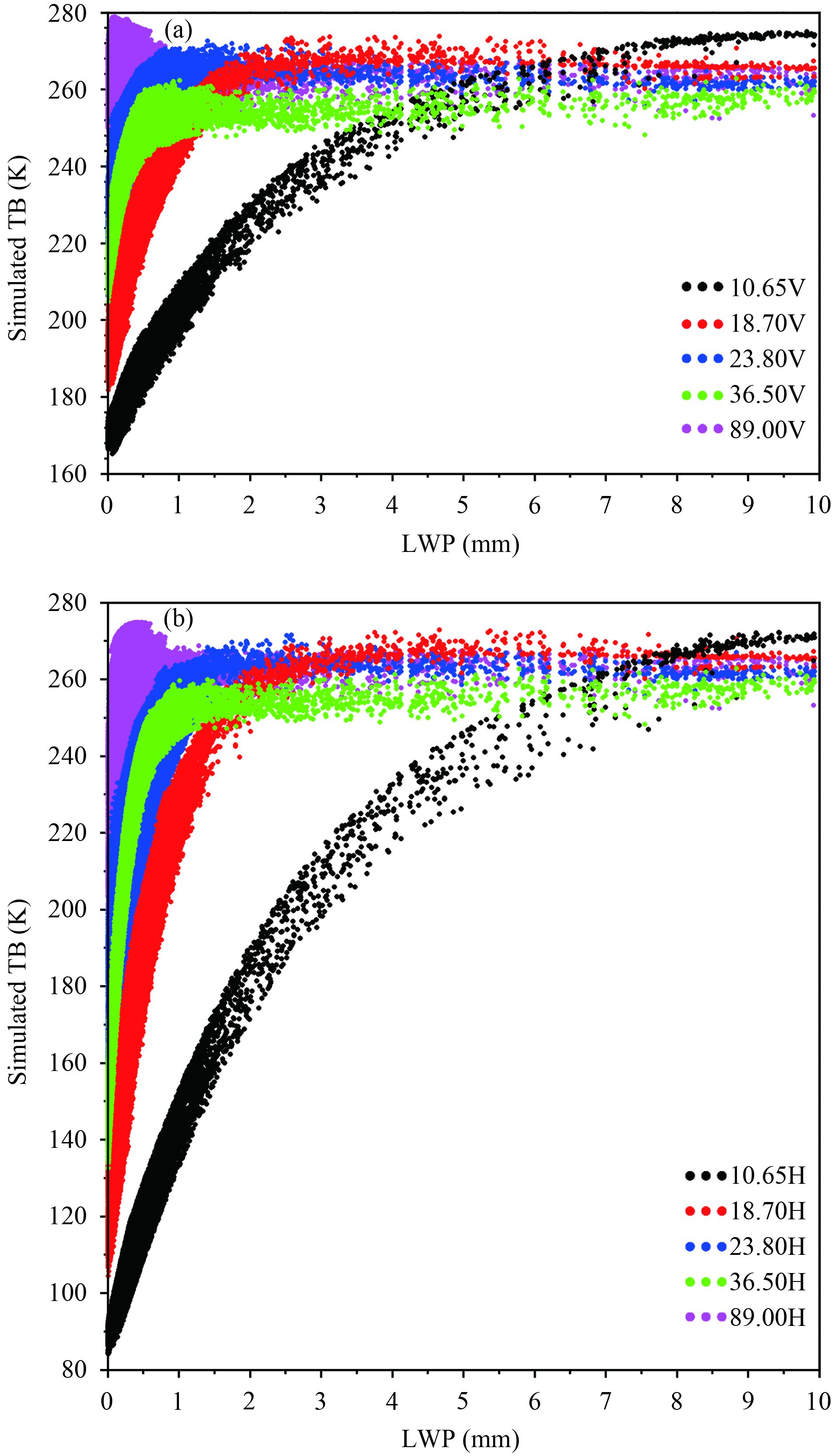
Figure 1 presents the CRTM simulated brightness temperatures over ocean with input of the ECMWF data on July 1, 2014 between 30°S and 30°N. LWP is randomly generated from 0 to 10 mm. The rain free clouds are assumed to have LWP less than 0.4 mm, while the rain-bearing clouds have LWP values ranging from 0.4 to 10 mm. Under clear-sky conditions, brightness temperatures from all horizontal channels are lower than those of vertical channels at the same frequency. This is because the sea surface emissivity for horizontal polarization is lower than that for vertical polarization (Weng et al., 2003).
|
| Figure 1 Variations of simulated brightness temperatures with respect to LWP for (a) vertically and (b) horizontally polarized channels. |
Based on the results in Fig. 1, we find that when LWP is greater than 0.3 mm, brightness temperatures of all MWRI channels increase linearly except for the 89.0- GHz channel at vertical polarization. At the same frequency, horizontally polarized channel is more sensitive to LWP than vertically polarized channel. The lower the central frequency of a channel, the higher the sensitivity of the brightness temperatures to LWP. For the 89.0-GHz channel at horizontal polarization, brightness temperatures slightly increase with LWP when it is smaller than 0.3 mm, then decrease slowly when LWP becomes larger than 0.3 mm. Saturation at 36.5 GHz for both verti-cal and horizontal polarization occurs when the LWP value reaches 1 mm. Brightness temperatures at 18.7 GHz approach the temperature of the cloud tops, which is near freezing level, and saturate when LWP increases to about 3 mm. Because the frequency of 10.65 GHz is less sensitive to raining clouds, brightness temperatures at this frequency do not get saturated until reaching a value of about 8 mm. Brightness temperatures from vertically polarized channels are often more appropriate for the LWP retrieval (Weng et al., 2003).
Brightness temperatures with different values of LWP are firstly simulated by using CRTM. The regression coefficients in the retrieval algorithm [i.e., Eq. (5)] can then be obtained through a statistical regression by using the LWPchan inputted into CRTM as the truth. Results are provided in Table 2, which provides the values of the regression coefficients obtained by such model simulations. It is seen that correlations between the true LWPs and those calculated by the regression Eq. (5) are very high except for those derived at 89.0 GHz. The root-mean-square errors between the regression model derived and the true LWPs are on the order of 10–2 mm. Since the atmospheric scattering is ignored in deriving the retrieval Eq. (5) of LWPchan but not in CRTM simulations, the scattering effects, although small, would be included in the regression coefficients.
| LWPchan | TB1 | TB2 | a0 | a1 | a2 | r | RMSE |
| LWP10.65V | TB10.65V | TB23.8V | –3.87 | 4.48 | 0.07 | 0.96 | 0.11 |
| LWP10.65H | TB10.65H | TB23.8V | –3.54 | 5.13 | 0.04 | 0.97 | 0.09 |
| LWP18.7V | TB18.7V | TB23.8V | –1.94 | 2.92 | 0.40 | 0.96 | 0.06 |
| LWP18.7H | TB18.7H | TB23.8V | –1.45 | 3.75 | 0.33 | 0.97 | 0.06 |
| LWP36.5V | TB36.5V | TB23.8V | –0.97 | 2.85 | 0.34 | 0.90 | 0.04 |
| LWP36.5H | TB36.5H | TB23.8V | –0.60 | 3.48 | 0.34 | 0.98 | 0.02 |
| LWP89V | TB89V | TB23.8V | –0.40 | –4.13 | 1.78 | 0.58 | 0.04 |
| LWP89H | TB89H | TB23.8V | –0.37 | –2.91 | 1.65 | 0.87 | 0.02 |
In principle, once the regression coefficients (
| (7) |
The coefficients a1 and a2 in Eq. (7) can be determined through a linear regression method using the MWRI brightness temperature observations in clear-sky conditions over ocean.
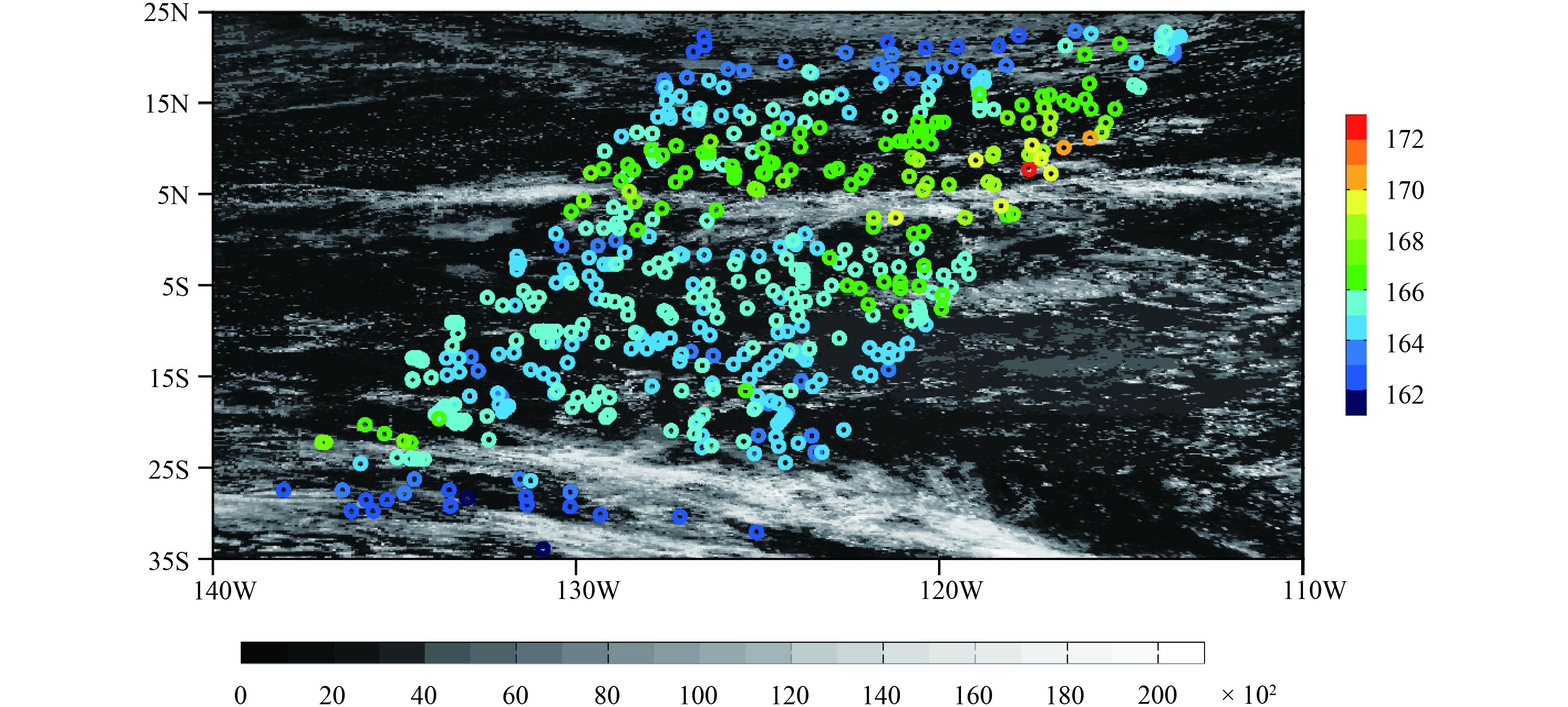
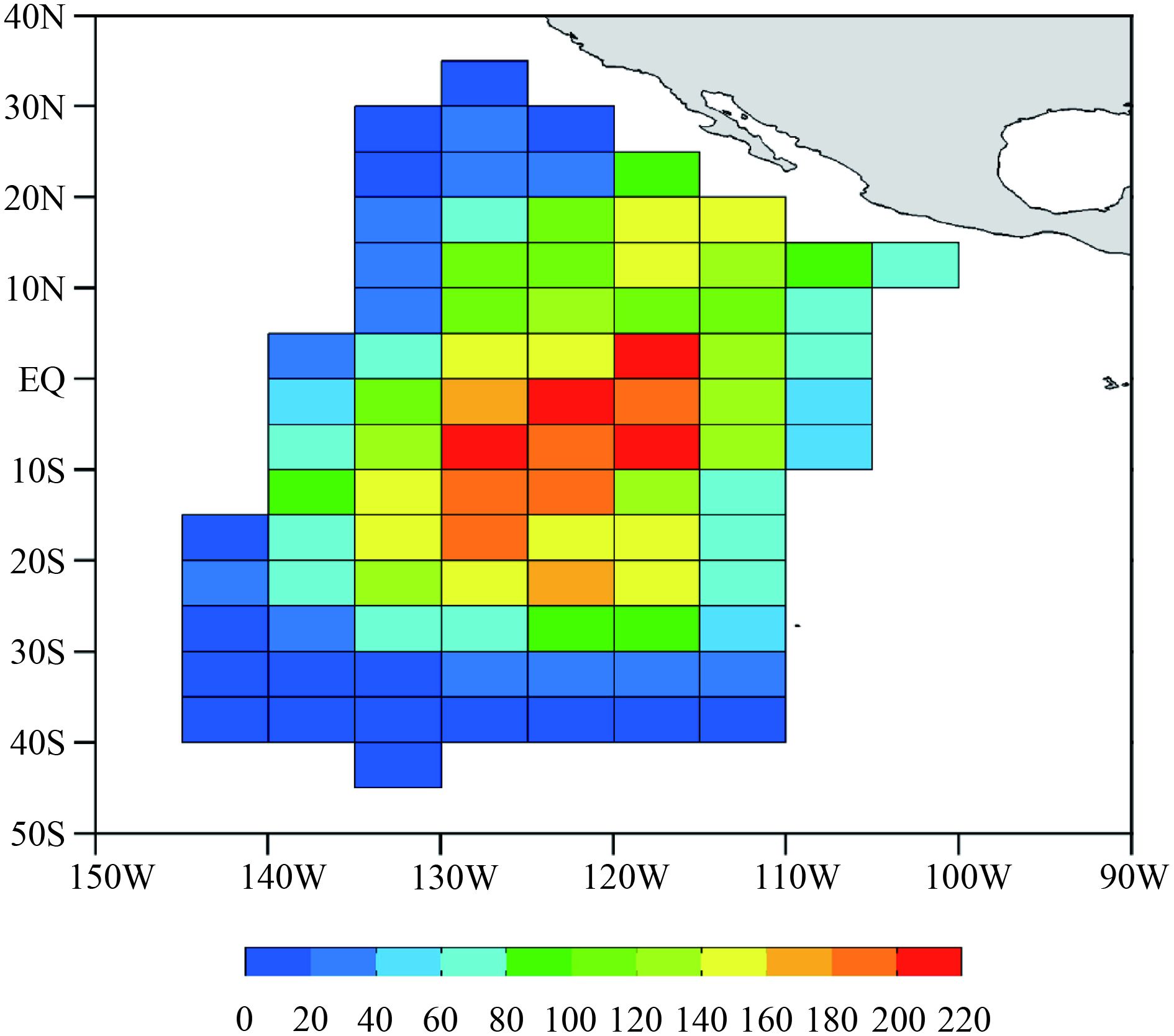
The remaining key step is to choose clear-sky MWRI data. Because the cloud and clear areas in visible imagery are often contrastively exhibited, the observations for the visible channel with its central wavelength of 0.63 μm from the geostationary satellite GOES-15 imagery are firstly collocated with MWRI observations with a temporal separation of less than 30 min and a spatial separation of less than 50 km. The GOES-15 imager scans the earth to complete a full-disc view every 3 h, while FY-3C satellite crosses the equator around 10:15 am at its descending nodes. When the FY-3C MWRI passed the GOES-15’s scanning area, those MWRI observations with their centers of the field of view (FOV) being the nearest to a visible channel’s FOV whose count value is less than 4000 are chosen as the clear-sky MWRI observations. An example illustrating such a choice of clear MWRI data is provided in Fig. 2. Specifically, a spatial distribution of clear-sky brightness temperatures from the vertical polarized channel at 10.65 GHz is overlapped onto the GOES-15 visible imagery in Fig. 2. Around 1814 UTC 1 January 2015, the FY-3C MWRI of a descending node crossed over the GOES-15’s scanning area. The MWRI observations (colored circles) over the darker areas on the visible imagery indicate clear-sky MWRI observations. Based on the above-mentioned collocation criteria, a total of 8213 clear-sky observations of MWRI are selected from the first 5 days of each of the 4 months (January, April, August, and October) of 2015, which is used as a training sample dataset. Figure 3 displays the data counts in each 5° × 5° latitude and longitude box. The reason for using data in regions indicated in Fig. 3 is due to the fact that GOES-15 imager visible channel data are used for finding MWRI observations in clear-sky conditions. In order to have a relatively large range of conditions (e.g., water vapor, wind speed, and sea surface temperature), we used data in the first 5 days in 4 months (e.g., January, April, August, and October 2015) for the clear-sky observations used to calibrate the method. In fact, the SSW, SST, and water vapor near the surface from these data vary between 0 and 14 m s–1, between 288 and 303 K, and between 5 and 19 g kg–1, respectively (figures omitted). These ranges of atmospheric conditions are thought to be broad enough for using the local observations to represent the clear-sky conditions over the globe.
|
| Figure 2 Brightness temperatures (color circles with scale bar on the right) of MWRI at 10.65-GHz vertical polarization under clear-sky conditions at 1814 UTC mapped on GOES-15 visible imagery (scale bar on the bottom) at 1800 UTC 1 January 2015. |
|
| Figure 3 Distribution of the number of clear-sky observations within each 5° × 5° grid box, which are collocated with MWRI and GOES-15 Imager visible channel data during 1–5 January, April, August, and October 2015. The total data number is 8213. |
A set of the logarithmic scattering relationships of MWRI observations between the LWP-sensitive channel (e.g., 10.65, 18.7, 36.5, or 89.0 GHz) and the water vapor absorption channel at 23.8 GHz for all the data in the training sample dataset is shown in Fig. 4. It is seen that the left-hand-side of Eq. (7),

|
| Figure 4 Scatter plots of MWRI observations from channels at 10.65, 18.7, 36.5, and 89.0 GHz with vertical (left panels) and horizontal (right panels) polarizations against the 23.8-GHz vertical polarization channel for clear-sky data during the last 6 days (25–30) of January (black dot), April (red dot), August (blue dot), and October (green dot) 2015. The linear regression functions are indicated by black lines. |
The regression coefficients
| LWPchan | a0M | a0O | a1M | a1O | a2M | a2O |
| LWP10.65V | –3.87 | –3.20 | 4.48 | 4.47/4.45 | 0.07 | 0.09/0.09 |
| LWP10.65H | –3.54 | –3.15 | 5.13 | 5.09 | 0.04 | 0.06 |
| LWP18.7V | –1.94 | –1.84 | 2.92 | 3.03/3.03 | 0.40 | 0.37/0.37 |
| LWP18.7H | –1.45 | –1.43 | 3.75 | 3.65 | 0.33 | 0.36 |
| LWP36.5V | –0.97 | –0.93 | 2.85 | 2.74 | 0.34 | 0.39 |
| LWP36.5H | –0.60 | –0.66 | 3.48 | 3.33 | 0.34 | 0.38 |
| LWP89.0V | –0.40 | –0.38 | –4.13 | –3.44 | 1.78 | 1.60 |
| LWP89.0H | –0.37 | –0.40 | –2.91 | –3.08 | 1.65 | 1.68 |
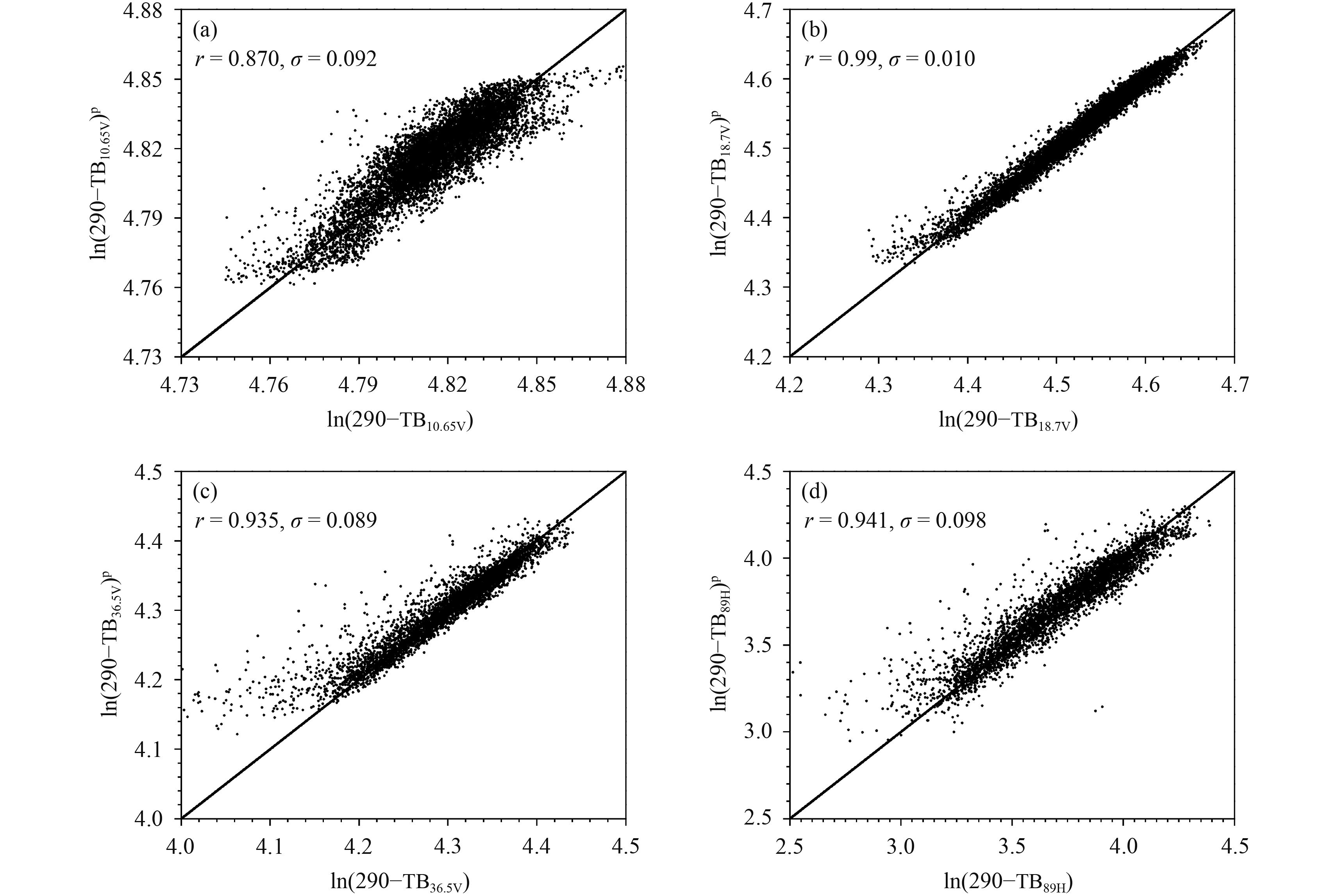
Figure 5 compares the logarithm values of the differences between 290 K and the brightness temperature observations at 10.65, 18.7, 36.5, and 89.0 GHz [i.e.,
|
| Figure 5 Scatter plots of the brightness temperatures at (a) 10.65, (b) 18.7, and (c) 36.5 GHz at vertical polarization and (d) 89.0 GHz at horizon-tal polarization derived from the MWRI observations of the channel with frequency 23.8 GHz at vertical polarization using the regression Eq. (7) and the MWRI brightness temperature observations of the same frequency for all clear-sky data in the first 5 days (1–5) of January, April, August, and October 2015. The total number of MWRI clear data is 8213, which are collocated with and determined by GOES-15 imager visible channel. Black line indicates the 1:1 line. |
The linearity at 10.65 GHz is relatively lower than that at higher frequencies, with 0.87 at vertically polarized channel. However, the correlation coefficient of higher frequencies is over 0.9. In addition, vertically polarized channels are highly correlated than horizontally polarized channels with minor root mean square error, except for channel 89.0 GHz. The other four channels are employed for retrieving LWP from FY-3C MWRI observations.
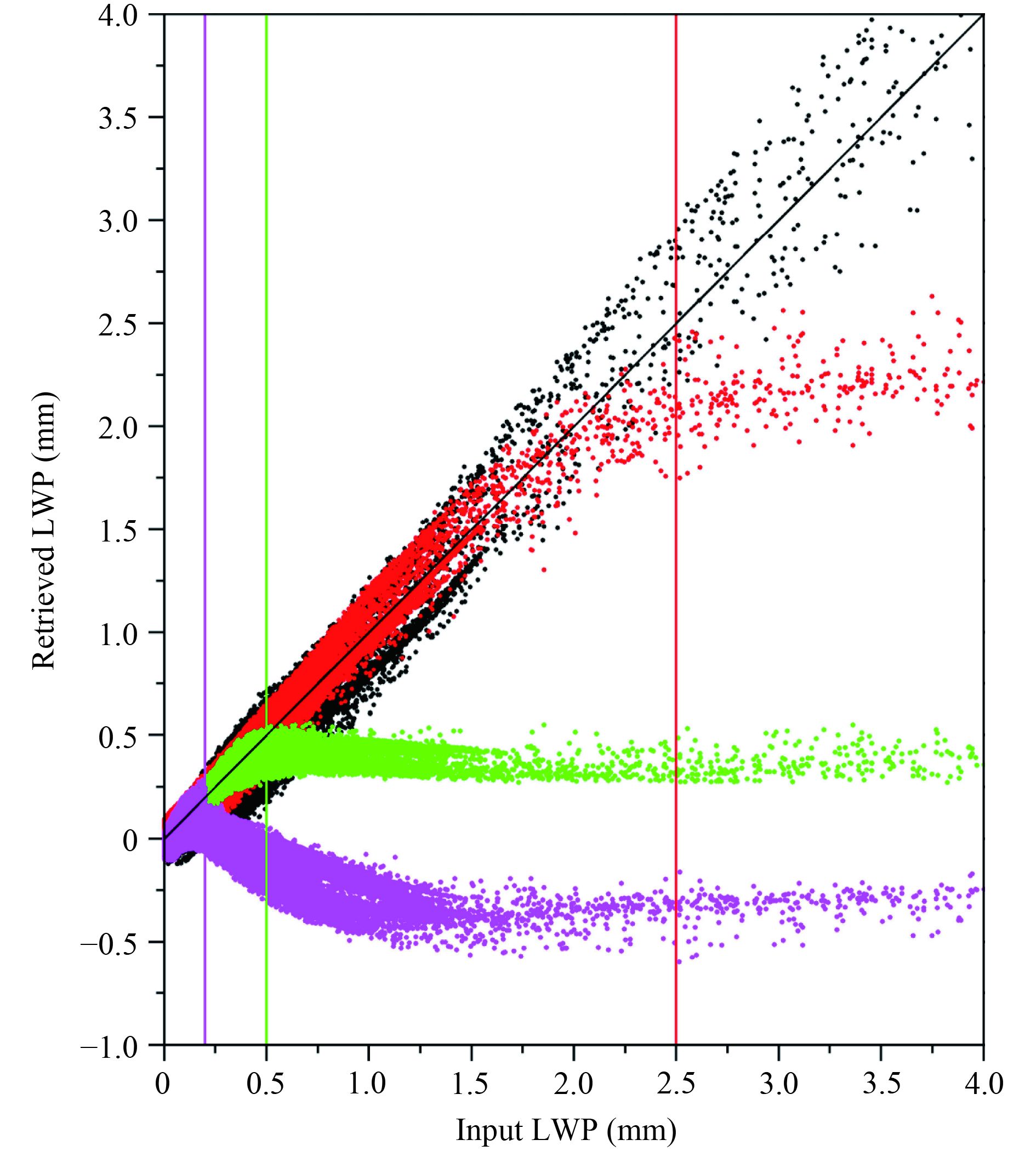
Figure 6 describes the relationships between the retrieved LWP from the simulated brightness temperatures using Eq. (7) and the actual LWP inputted to CRTM simulations. Channel 10.65 GHz shows a good linear relation for LWP in the range from 0 to 8 mm. The linear relationships between the retrieved LWP and the true LWP for channels at 18.7, 36.5, and 89.0 GHz tend to reach a saturation value of LWP at 2.5, 0.5, and 0.2 mm, respectively. Channel 89.0 GHz becomes negative when LWP exceeds 0.2 mm. Based on the results in Fig. 6, a retrie-val algorithm that combines brightness temperatures of these four channels is proposed, which can be written as
| (8) |
|
| Figure 6 Variations of LWP retrieved from the simulated brightness temperatures at 10.65- (black dots), 18.7- (red dots), and 36.5-GHz (green dots) vertical polarizations, and 89.0-GHz horizontal polarization (magenta) with respect to the true LWP inputted to CRTM for generating the brightness temperatures. Vertical colored lines indicate the saturation point at the frequency of the channel for LWP in the same color. Black line indicates the 1:1 line. |
where WVP is the vertically integrated water vapor calculated by the following formula (Alishouse et al., 1990):
| (9) |
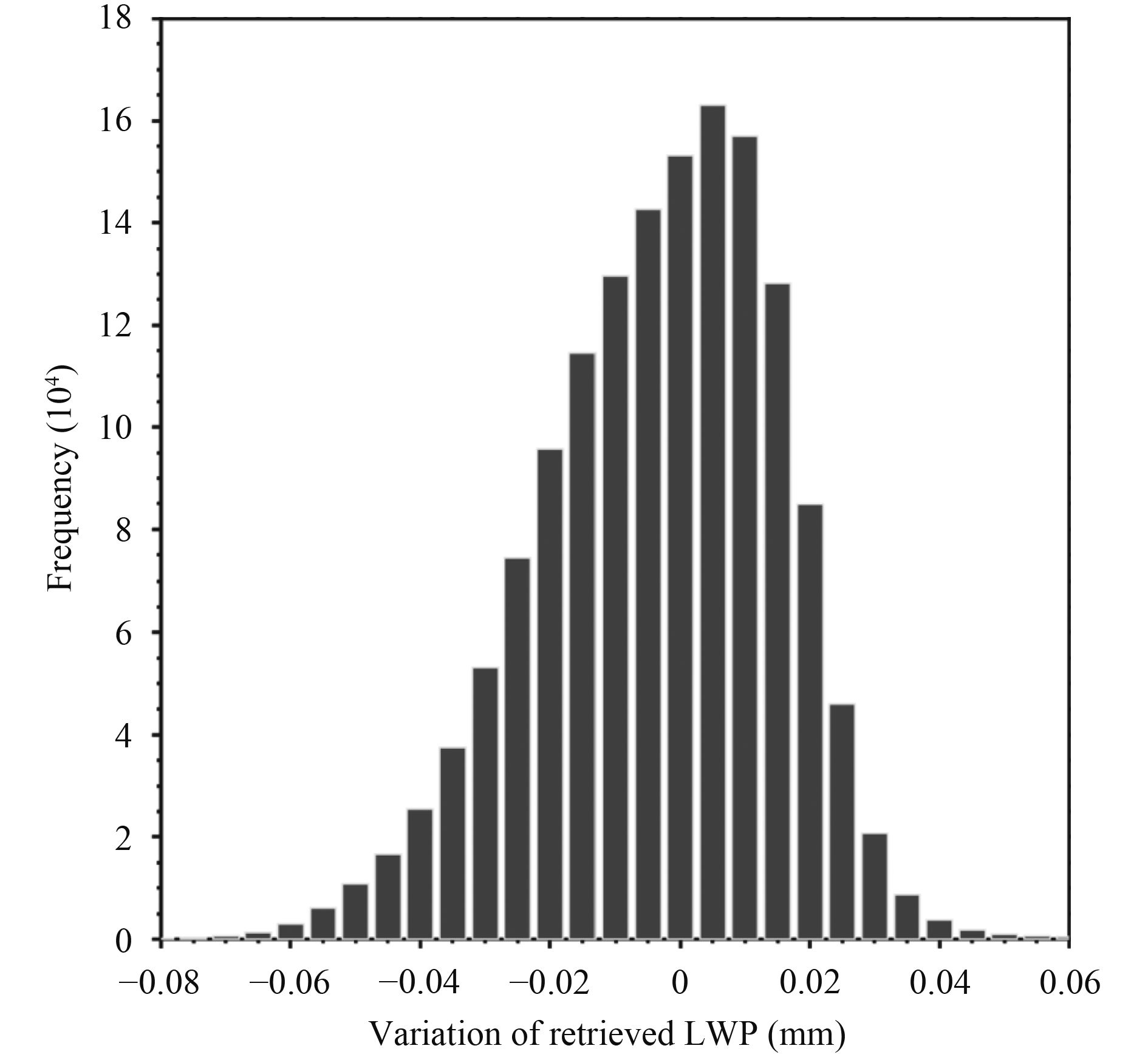
It is difficult to validate the accuracy of retrieved LWP due to lack of in situ measurements. A simple way to estimate the minimum retrieval errors is to quantify the variation of the LWP retrievals in clear skies (Greenwald et al., 2007; Horváth and Gentemann, 2007; Seethala and Horváth, 2010; Lebsock and Su, 2014; Painemal et al., 2016). Figure 7 presents a frequency distribution of LWP values derived from the proposed LWP retrieval algorithm for cloud-free data in the first 5 days of each month in 2014. The frequency distribution is asymmetric. The mean and media values are –3.3 × 10⁻³ and –1.5 × 10⁻³ mm, respectively. The standard deviation is 0.02 mm, which could represent the uncertainty in the LWP retrievals.
|
| Figure 7 Frequency distribution of LWP variations in clear-sky conditions, derived from data in the first five days of each month in 2014 over the Pacific Ocean. The mean and the median are –0.003 and –0.002 mm, respectively. The standard deviation is 0.019 mm. |
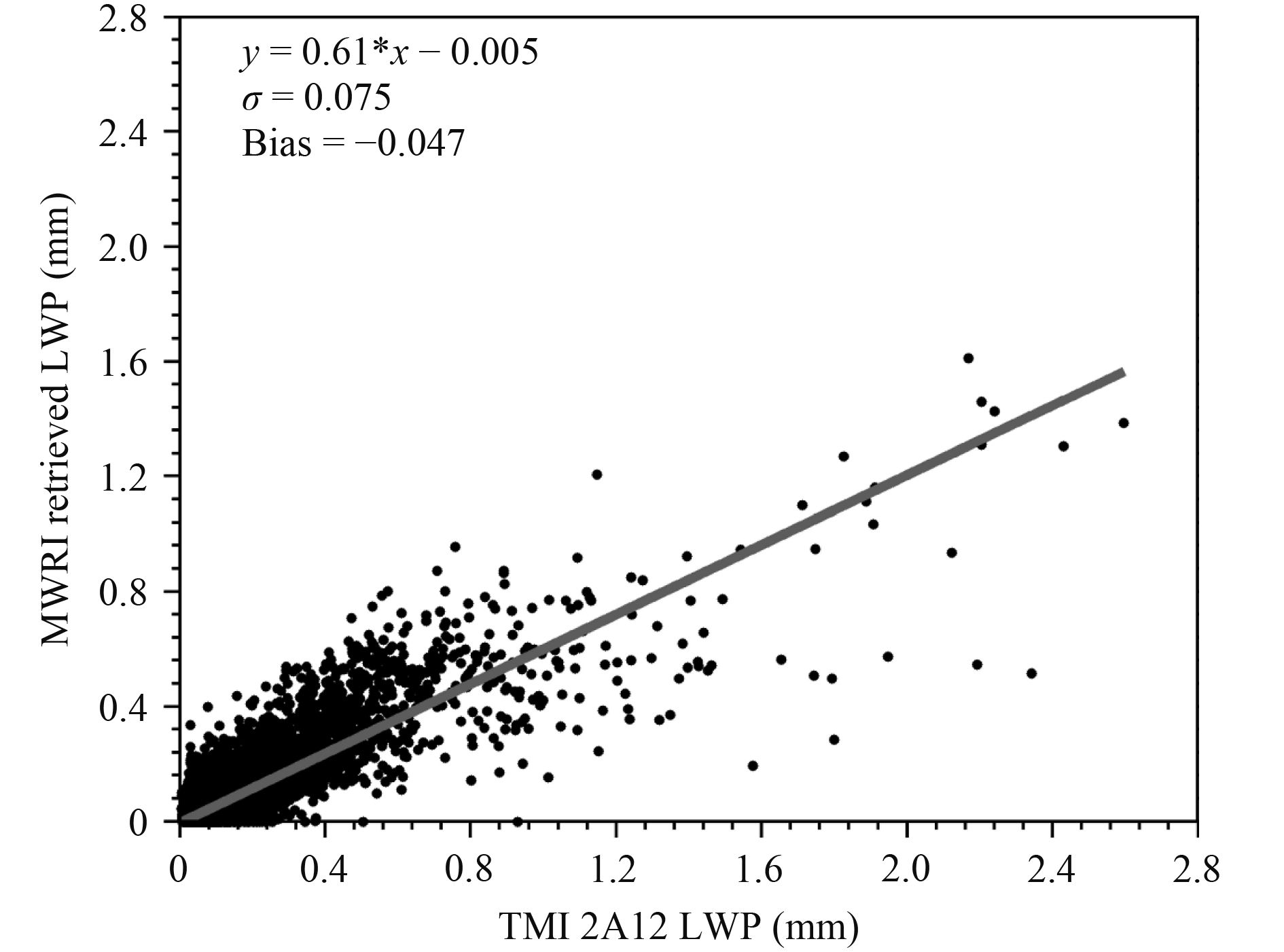
The retrieval results of LWP obtained from FY-3C MWRI brightness temperature observations can be compared with the TMI LWP data, which are calculated as the sum of vertically integrated cloud liquid water and precipitation water profiles from the TMI Level 2 Hydrometeor Profile Product (i.e., TRMM Product 2A12). The TMI data are made available for public and can be downloaded from the Goddard Earth Science (GES) Data and Information Services Center (DISC) web page. TMI is a conically scanning total power microwave radiometer on board TRMM that was successfully launched in November 1997 into a non sun-synchronous orbit with a low inclination of 35°. Since TMI is in a low inclination orbit and MWRI is in a high inclination, near polar orbit, there are many near-simultaneous orbital intersections over a wide range of latitudes, which facilitates an inter-comparison between the two. A total of 17979 MWRI measurements in January 2014 were collocated with TMI LWP retrieval data under the collocation criteria of 10-min maximum time difference and 1-km maximum distance between the two sensors’ observations. Figure 8 displays the scattering plot of collocated MWRI and TMI LWPs. It is seen that the MWRI retrieved LWPs correlate quite well with those derived from TMI data. However, the MWRI retrieved LWPs are systematically smaller than those of TMI. The reason for the MWRI LWP retrievals to be systematically smaller than the TMI product is probably due to a lack of considering the so-called beam-filling effects in the former method whereas the TMI method did (Bremen et al., 2002).
|
| Figure 8 Scattering plot of LWP over ocean from MWRI ascending orbits collocated with TMI LWP products in January 2014. The total number of collocated data points is 17979. |
Figure 9 shows the GOES-15 visible imagery (Fig. 9a), the LWPs retrieved by the four multi-channel algorithms (Fig. 9b), as well as four single channel algorithms at frequencies 10.65 (Fig. 9c), 18.7 (Fig. 9d), 36.5 (Fig. 9e), and 89.0 (Fig. 9f) GHz at two continuous orbital times of 1712 and 1853 UTC 1 July 2014. Coefficients derived from observations are used in the retrieval. Compared with the GOES-15 visible imagery (Fig. 9a), the proposed multi-channel LWP retrieval algorithms can retrieve reasonably well the spatial distribution of LWP for most clouds (Fig. 9b). The 36.5-GHz algorithm seems to produce the best estimates over a wider range of conditions than the other channels. However, the single channel algorithm cannot retrieve the overall features of the LWP distribution.

|
| Figure 9 (a) GOES-15 imager visible imagery and (b–f) LWP fields retrieved from MWRI data using (b) the multi-channel algorithm and (c–f) single channel algorithm for (c) 10.65, (d) 18.7, (e) 36.5, and (f) 89.0 GHz at 1712 and 1853 UTC 1 July 2014. |
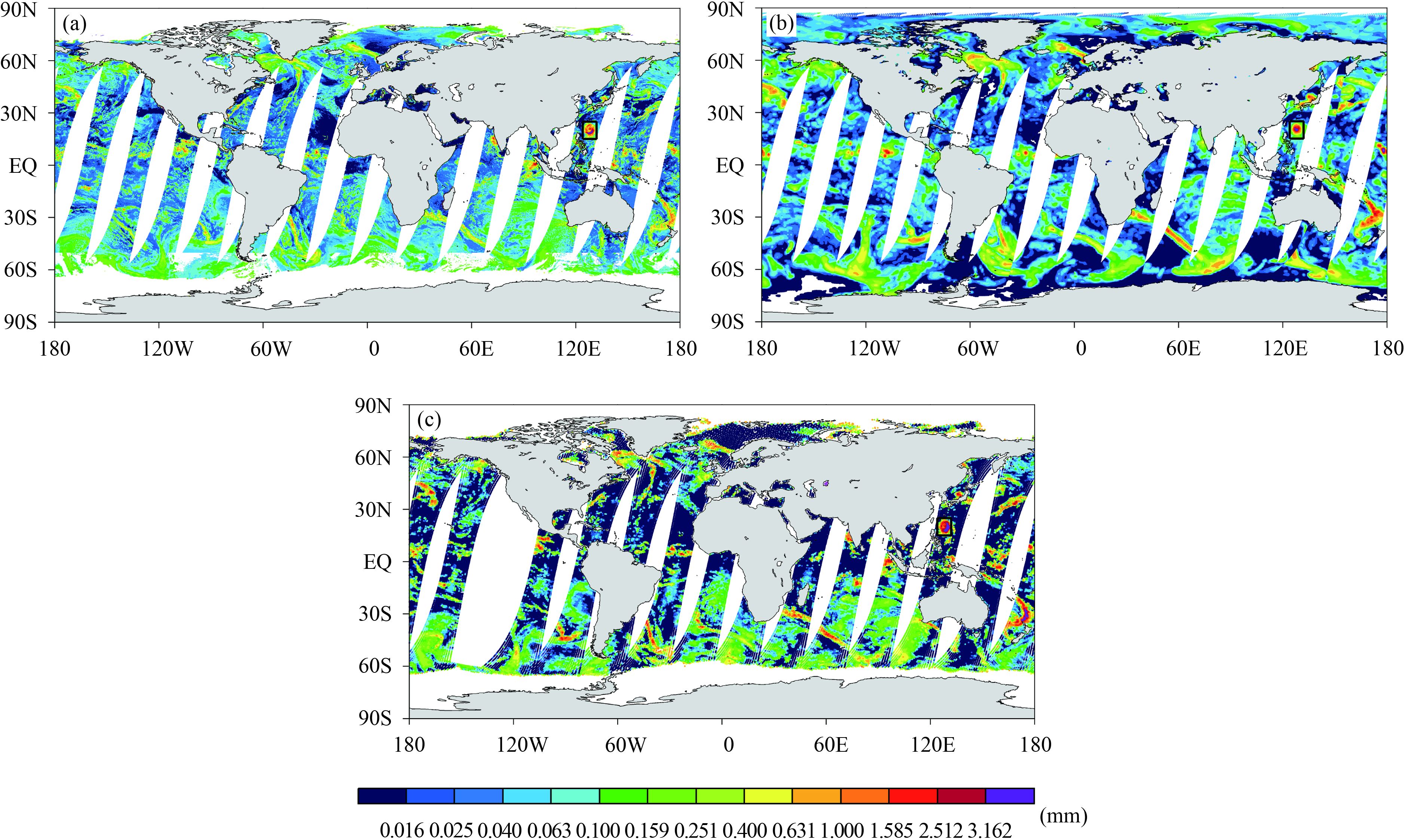
Figure 10a displays the spatial distribution of LWP retrieved from MWRI observations on FY-3C descending orbits on July 7, 2014. Since the strong scattering effects of sea ice are not considered, the proposed LWP retrie-val algorithms are not applicable over sea ice. Figure 10 only shows the LWP retrievals over ocean without sea ice, which is determined by an empirical scattering index (SI) (Sun and Weng, 2008):
| (10) |
In the presence of sea ice, SI values could be greater than 70%.
Compared with the LWP products from ECMWF (Fig. 10b) and MetOp-B AMSU-A (Fig. 10c), the LWP retrieved by the proposed multi-channel algorithm agrees well with the other two types of LWP products. The typhoon area with large LWP values located in the southeast of Taiwan island is clearly displayed, as well as the low cloud area over global oceans, such as the ocean west of South America where the LWP value is small.
|
| Figure 10 LWP from (a) MWRI 10.65-, 18.7-, 36.5-, and 23.8-GHz vertical polarization channels’ brightness temperatures combined channel algorithm, (b) ECMWF, and (c) MetOp-B AMSU-A product, on July 7, 2014 over ocean at descending orbits (MetOp-B is a sun-synchronous polar orbit satellite with local cross time 9:30 am descending, while FY-3C is 10:15 am descending). The black box in the upper right portion of each panel indicates location of Typhoon Neoguri. |
The LWP distributions for the mature Typhoon Neoguri retrieved by MWRI brightness temperature observations at 0205 UTC 7 July 2014 are shown in Fig. 11. A typhoon cloud system is usually composed of central cloud system, inner spiral cloud system, and outer spiral cloud system. Figure 11 displays the highest LWP (Fig. 11d) at typhoon’s inner spiral cloud system using either the lowest frequency channel (Fig. 11a) or the multi-channels (Fig. 11d). Since the size of field of views for channel 18.7 GHz is smaller than that of channel 10.65 GHz, the retrieval results from 18.7 GHz (Fig. 11b) depict a clearer feature of typhoon center and eyewall than that of 10.65 GHz (Fig. 11a). Because there are intense updrafts in the typhoon eyewall region, rainstorm usually appears under the cloud wall. The LWP value for this region is as high as 1.5–2.5 mm. As having been discussed in the previous section, saturation for the 18.7-GHz channel occurs at an LWP value of 2.5 mm. Therefore, the retrieval results at this frequency are not reliable for LWP exceeding 2.5 mm. Channel 10.65 GHz can be used for retrieving the LWP greater than 2.5 mm at the typhoon inner spiral cloud band. Channels 36.5 and 23.8 GHz can be used for retrieving the low values of LWP in cirrus cloud located at the typhoon outer spiral cloud band. However, for the regions around typhoon eyewall, the retrieved LWPs at the 36.5-GHz frequency are lower because saturation occurs at 36.5 GHz when LWP reaches 0.5 mm.

|
| Figure 11 LWP of Typhoon Neoguri as indicated in the black box in Fig. 10, retrieved from MWRI (a) 10.65–23.8V, (b) 18.7–23.8V, and (c) 36.5–23.8V GHz vertical polarization single channel algorithms, and (d) multi-channel algorithm at 0205 UTC 7 July 2014. |
Figure 12 presents temporal evolution of the spatial structure of LWP during the development period of Typhoon Neoguri from 4 to 8 July 2014. The formation, maturation, and decaying of Typhoon Neoguri are clearly seen. At 0205 UTC 7 July 2014, the typhoon developed into its peak intensity with LWP values exceeding 3.5 mm around its eyewall.

|
| Figure 12 LWP retrieved twice daily from FY-3C MWRI during the development period of Typhoon Neoguri from 4 to 8 July 2014. |
This paper develops a new algorithm for retrieving LWP from the Chinese FY-3C MWRI brightness temperature observations based on the LWP retrieval algorithm proposed by Weng and Grody (1994) for other satellite instruments. The brightness temperatures at 10.65 GHz are most appropriate for retrieving the high LWP values within typhoons. The study uses CRTM to simulate brightness temperatures and analyzes the sensitivity of brightness temperatures at different frequencies to LWP. Regression coefficients are obtained by statistical methods. The data from the visible channel of GOES-15 are matched up with brightness temperatures from MWRI to select clear-sky data. The results show great conformance. By using a multi-channel retrieval algorithm, the LWP distribution in typhoon structure of different intensity can be obtained. The theoretical estimates of the LWP retrieval errors vary between 0.11 and 0.06 mm for 10.65- and 18.7-GHz channels, and between 0.02 and 0.04 for 36.5- and 89.0-GHz channels.
It has long been recognized that the accuracy of LWP retrieval is hard to estimate. Further investigation is needed to quantify the MWRI LWP retrieval accuracy using the proposed algorithm in comparison with the CloudSat Cloud Profiling Radar measurement in warm rain conditions, for which the CloudSat CPR derived LWP retrievals are most reliable.
Acknowledgment. The authors would like to thank the National Satellite Meteorological Center of the China Meteorological Administration for providing the FY-3C MWRI data (http://satellite.nsmc.org.cn/PortalSite/Data/Satellite.aspx). All data used in this study are available from the authors upon request (tangfei@nuist.edu.cn).
| Alishouse, J. C., J. B. Snider, E. R. Westwater, et al., 1990: Determination of cloud liquid water content using the SSM/I. IEEE Trans. Geosci. Remote Sens., 28, 817–822. DOI:10.1109/36.58968 |
| Basharinov, A. E., A. S. Gurvich, and S. T. Egorov, 1969: Determination of geophysical parameters from data on thermally-induced radioemission obtained with the Kosmos 243 satellite. Dokl. Akad. Nauk SSSR, 188, 1273–1276. |
| Baum, B. A., P. Yang, A. J. Heymsfield, et al., 2005: Bulk scattering properties for the remote sensing of ice cloud. Part II: Narrowband models. J. Appl. Meteor., 44, 1896–1911. DOI:10.1175/JAM2309.1 |
| Bremen, L. V., E. Ruprecht, and A. Macke, 2002: Errors in liquid water path retrieval arising from cloud inhomogeneities: The beam-filling effect. Meteor. Z., 11, 13–19. DOI:10.1127/0941-2948/2002/0011-0013 |
| Fowler, L. D., D. A. Rall, and S. A. Rutledge, 1996: Liquid and ice cloud microphysics in the CSU general circulation model. Part 1: Model description and simulated microphysical processes. J. Climate, 9, 489–529. DOI:10.1175/1520-0442(1996)009<0489:LAICMI>2.0.CO;2 |
| Grody, N. C., 1976: Remote sensing of atmospheric water content from satellites using microwave radiometry. IEEE Trans. Antennas Propag., 24, 155–162. DOI:10.1109/TAP.1976.1141324 |
| Grody, N. C., A. Gruber, and W. C. Shen, 1980: Atmospheric water content over the tropical Pacific derived from the Nimbus-6 Scanning Microwave Spectrometer. J. Appl. Meteor., 8, 986–996. DOI:10.1175/1520-0450(1980)019<0986:AWCOTT>2.0.CO;2 |
| Grody, N. C., and R. R. Ferraro, 1992: A comparison of passive microwave rainfall retrieval methods. Proceedings of the Sixth Conference on Meteorology and Oceanography, Washington, DC, American Meteorological Society, 60–65. |
| Greenwald, T. J., G. L. Stephens, T. H. V. Haar, et al., 1993: A physical retrieval of cloud liquid water over the global oceans using special sensor microwave/imager (SSM/I) observations. J. Geophys. Res., 98, 18471–18488. DOI:10.1029/93JD00339 |
| Greenwald, J., S. L’Ecuyer T., and A. Christopher T., 2007: Evaluating specific error characteristics of microwave-derived cloud liquid water products. Geophys. Res. Lett., 34, L22807. DOI:10.1029/2007GL031180 |
| Han, Y., P. van Delst, Q. H. Liu, et al., 2005: JCSDA Community Radiative Transfer Model (CRTM)-Version 1. NOAA Technical Report NESDIS, 122, Washington, DC. 33 pp. Available at https://repository.library.noaa.gov/view/noaa/1157. |
| Hansen, J. E., and L. D. Travis, 1974: Light scattering in planetary atmospheres. Space Science Reviews, 16, 527–610. DOI:10.1007/BF00168069 |
| Hargens, U., C. Simmer, and E. Ruprecht, 1992: Remote sensing of cloud liquid water during ICE’89. Third Specialists Meeting on Microwave Radiometry and Remote Sensing Applications, Boulder, Colorado, IEEE, 27–31. |
| Horváth, Gentemann, 2007: Cloud-fraction-dependent bias in satellite liquid water path retrievals of shallow, non-precipitating marine clouds. Geophys. Res. Lett., 34, L22806. DOI:10.1029/2007GL030625 |
| JAXA, 2013: GCOM-W1 SHIZUKU Data Users Handbook. Japan Aerospace Exploration Agency, Tsukuba, Japan. 125 pp. Available at http://gcom-w1.jaxa.jp/contents/GCOM-W1_SHIZUKU_Data_Users_Handbook_EN.pdf. |
| Kawanishi, T., T. Sezai, Y. Ito, et al., 2003: The advanced microwave scanning radiometer for the Earth observing system (AMSR-E), NASDA’S contribution to the EOS for global energy and water cycle studies. IEEE Trans. Geosci. Remote Sens., 41, 184–194. DOI:10.1109/TGRS.2002.808331 |
| Kummerow, C., J. Simpson, O. Thiele, et al., 2000: The status of the Tropical Rainfall Measuring Mission (TRMM) after two years in orbit. J. Appl. Meteor., 39, 1965–1982. DOI:10.1175/1520-0450(2001)040<1965:TSOTTR>2.0.CO;2 |
| Lebsock, M., and H. Su, 2014: Application of active spaceborne remote sensing for understanding biases between passive cloud water path retrievals. J. Geophys. Res., 119, 8962–8979. DOI:10.1002/2014JD021568 |
| Liou, K. N., 2002: An Introduction to Atmospheric Radiation. Academic Press, 425–430. |
| Liu, G. S., and J. A. Curry, 1993: Determination of characteristic features of cloud liquid water from satellite microwave measurements. J. Geophys. Res., 98, 5069–5092. DOI:10.1029/92JD02888 |
| Liu, Q. H., and F. Z. Weng, 2006: Advanced doubling-adding method for radiative transfer in planetary atmospheres. J. Atmos. Sci., 63, 3459–3465. DOI:10.1175/JAS3808.1 |
| Macke, A., J. Mueller, and E. Raschke, 1996: Single scattering properties of atmospheric ice crystals. J. Atmos. Sci., 53, 2813–2825. DOI:10.1175/1520-0469(1996)053<2813:SSPOAI>2.0.CO;2 |
| Painemal, D., T. Greenwald, M. Cadeddu, et al., 2016: First extended validation of satellite microwave liquid water path with ship-based observations of marine low clouds. Geophys. Res. Lett., 43, 6563–6570. DOI:10.1002/2016GL069061 |
| Paltridge, G. W., 1980: Cloud–radiation feedback to climate. Quart. J. Roy. Meteor. Soc., 106, 895–899. DOI:10.1002/qj.49710645018 |
| Petty, G. W., and K. B. Katsaros, 1992: The response of the SSM/I to the marine environment. Part I: An analytic model for the atmospheric component of observed brightness temperatures. J. Atmos. Oceanic Technol., 9, 746–761. DOI:10.1175/1520-0426(1992)009<0746:TROTST>2.0.CO;2 |
| Prabhakara, C., J. Wang, A. T. C. Chang, et al., 1983: A statistical examination of Nimbus-7 SMMR data and remote sensing of sea surface temperature, liquid water content in the atmosphere and surface wind speed. J. Climate Appl. Meteor., 22, 2033–2037. DOI:10.1175/1520-0450(1983)022<2023:ASEONS>2.0.CO;2 |
| Seethala, Horváth, 2010: Global assessment of AMSR-E and MODIS cloud liquid water path retrievals in warm oceanic clouds. J. Geophys. Res., 115, D13202. DOI:10.1029/2009JD012662 |
| Stephens, G. L., and T. J. Greenwald, 1991: The Earth’s radiation budget and its relation to atmospheric hydrology. 2: Observations of cloud effects. J. Geophys. Res., 96, 15325–15340. DOI:10.1029/91JD00972 |
| Sun, N. H., and F. Z. Weng, 2008: Evaluation of special sensor microwave imager/sounder (SSMIS) environmental data records. IEEE Trans. Geosci. Remote Sens., 46, 1006–1016. DOI:10.1109/TGRS.2008.917368 |
| Tang, F., X. L. Zou, H. Yang, et al., 2016: Estimation and correction of geolocation errors in FengYun-3C microwave radiation imager data . IEEE Trans. Geosci. Remote Sens., 54, 407–420. DOI:10.1109/TGRS.2015.2458851 |
| Weng, F. Z., 2007: Advances in radiative transfer modeling in support of satellite data assimilation. J. Atmos. Sci., 64, 3799–3807. DOI:10.1175/2007JAS2112.1 |
| Weng, F. Z., and N. C. Grody, 1994: Retrieval of cloud liquid water using the special sensor microwave imager (SSM/I). J. Geophys. Res., 99, 25535–25551. DOI:10.1029/94JD02304 |
| Weng, F. Z., L. M. Zhao, R. R. Ferraro, et al., 2003: Advanced microwave sounding unit cloud and precipitation algorithms. Radio Sci., 38, 8068. DOI:10.1029/2002RS002679 |
| Wentz, F. J., 1997: A well-calibrated ocean algorithm for special sensor microwave/imager. J. Geophys. Res., 102, 8703–8718. DOI:10.1029/96JC01751 |
| Wu, S. L., and J. Chen, 2016: Instrument performance and cross calibration of FY-3C MWRI. 2016 IEEE International Geoscience and Remote Sensing Symposium (IGARSS), Beijing, China, 10–15 July, IEEE, 388–391, doi: 10.1109/IGARSS.2016.7729095. |
| Yang, J., and C. H. Dong, 2010: Operational Products and Application of the New Generation Polar-Orbiting Meteorological Satellite of China. Science Press, Beijing, 368 pp. (in Chinese) |
| Yang, P., and K. N. Liou, 1995: Light scattering by hexagonal ice crystals: Comparison of finite-difference time domain and geometric optics models. J. Opt. Soc. Amer. A, 12, 162–176. DOI:10.1364/JOSAA.12.000162 |
| Yang, P., H. L. Wei, H. L. Huang, et al., 2005: Scattering and absorption property database for nonspherical ice particles in the near-through far-infrared spectral region. Appl. Opt., 44, 5512–5523. DOI:10.1364/AO.44.005512 |
| Yang, P., L. Bi, B. A. Baum, et al., 2013: Spectrally consistent scattering, absorption, and polarization properties of atmospheric ice crystals at wavelengths from 0.2 to 100 μm. J. Atmos. Sci., 70, 330–347. DOI:10.1175/JAS-D-12-039.1 |