 2015, Vol. 28
The Chinese Meteorological Society
Article Information
- WANG Wencai, SHENG Lifang, JIN Hongchun, HAN Yongqing. 2015.
- Dust Aerosol Effects on Cirrus and Altocumulus Clouds in Northwest China
- J. Meteor. Res., 28(5): 793-805
- http://dx.doi.org/10.1007/s13351-015-4116-9
Article History
- Received November 20, 2014;
- in final form July 21, 2015


2 Key Laboratory for Semi-Arid Climate Change of the Ministry of Education, College of Atmospheric Sciences, Lanzhou University, Lanzhou 730000;
3 Shandong Provincial Meteorological Bureau, Jinan 250031
Dust aerosols are an important and complicated component in the earth–climate system. They influence climate forcing by scattering and absorbing solar and terrestrial radiation(direct effects)(Sokolik and Toon, 1996; Demott et al., 2003; Shi et al., 2005; Huang et al., 2006a), and affect cloud properties and precipitation processes by their indirect/semidirect effects(Albrecht, 1989; Sassen, 2002; Yin et al., 2002, 2007; Huang et al., 2006b, c). Furthermore, dust aerosols play important roles in regional climate due to massive emissions of dust aerosols into the atmosphere from arid/semi-arid regions(Zhang et al., 1997). Additionally, dust aerosols can influence urban air quality, human health, marine ecosystems, and biogeochemical cycles through their transportation mechanisms(Gong et al., 2003; Zhang et al., 2003; Zhang, 2007; Huang et al., 2008; Liu et al., 2008; Wang and Huang, 2009; Tao M. H. et al., 2012;, 2013;).
The Loess Plateau and the Gobi Desert, which are the main source areas of dust aerosols in northwestern China, are exp and ing(Fu et al., 2008; Wang et al., 2008; Huang J. P. et al., 2010). Zhang et al.(1997)estimated that the annual mean emission of dust is about 800 kt from China. For the past few decades, the dramatic increase in the human population has had a significant impact on the earth’s dryl and s. Major anthropogenic drivers affect dryl and s in complex ways and on multiple scales, such as the recovery of vegetation, unsuitable irrigation practices, and wind erosion caused by humans(Huang et al., 2014). These activities produce a large amount of anthropogenic dust aerosols, which also contribute to the uncertainties of the climate forcing(Mao et al., 2002; Zhang and Christopher, 2003; Zhang, 2007; Wang W. C. et al., 2006, 2010).
Previous studies suggest that mineral dust particles, one of the most common ingredients acting as cloud condensation nuclei(CCN) and ice nuclei(IN), can be transported into the atmosphere and influence cloud formation(e.g., Min et al., 2009; Stith et al., 2009; Twohy et al., 2009; Huang J. P. et al., 2010; Wang W. C. et al., 2010). They may suppress precipitation due to the changes in cloud properties(e.g., Rosenfeld et al., 2001; Andreae et al., 2004; Huang et al., 2009, 2010).
Through theoretical hypotheses and model simulation, Tao W. -K. et al.(2012) reported that aerosols have different influences on stratiform clouds and convective clouds. Rosenfeld(1999) and Rosenfeld and Woodley(2000)proposed that polluted aerosols invigorate deep convective clouds but suppress warm shallow clouds, based on aircraft and satellite data. Fan et al.(2012)simulated convective and frontal cloud systems over China with a cloud-resolving model, in comparison with observational data, during the EASTAIRC(East Asian Studies of Tropospheric Aerosols and their Impact on Regional Climate)project(Li J. et al., 2011), and suggested that aerosols had a significant invigoration effect on clouds. Satellite observations have revealed that desert dust and heavy air pollution over East Asia glaciated the tops of growing convective clouds, producing ice precipitation(Rosenfeld et al., 2011). Using a 10-yr ground-based dataset and global A-Train satellite measurements, Li Z. Q. et al.(2011) found that precipitation increased with the aerosol concentration when the liquid water path(LWP)was greater than 0.8 mm, but decreased with the aerosol concentration when it was less than 0.8 mm, in deep clouds. The above results imply that dust aerosols have different and uncertain effects on different cloud types.
Due to the lack of ground observations over the Asian arid/semi-arid regions, satellite observations are widely used to study dust aerosol effects on clouds and precipitation(Huang et al., 2006a, b, 2010; Wang W. C. et al., 2010, 2013). Huang et al.(2006a)found that dust aerosols decreased the cloud effective particle diameter(De) and cloud optical depth(OPD)by 11% and 33%, after comparing cloud properties existing in dusty and pure conditions under the same meteorological environment in northwestern China. Wang W. C. et al.(2010)compared dust aerosol effects on cloud over the dust source region and the downwind region, and found consistent results with those of Huang et al.(2006b, c). In addition, the investigations by Kawamoto et al.(2004) and Huang J. P. et al.(2010)over the Asian arid and semi-arid regions also demonstrated similar results, indicating that dust aerosols can change cloud properties.
Previous studies have shown that the main cloud types in Northwest China are cirrus clouds and cumulus clouds(Chen et al., 2007; Ding et al., 2012). Dust aerosols originating from the Taklimakan Desert and the Gobi Desert are often transported into the atmosphere, mixed with clouds, and involved in cloud formation(Rosenfeld et al., 2001). Although special attention has been paid to dust aerosol effects on clouds over Northwest China(Huang et al., 2006c, 2007a, b, 2010; Su et al., 2008; Wang W. C. et al., 2010), few studies have focused on the dust aerosol impact on different cloud types. This paper extends our previous research(Wang W. C. et al., 2010), but further investigates the influence of dust aerosols on altocumulus and cirrus clouds over the arid and semi-arid regions of Northwest China. Satellite data and cloud type definitions are described in Section 2. Section 3 presents an analysis of the results. Conclusions and further discussion are provided in Section 4.
2. Data and methodsThe Cloud-Aerosol Lidar and Infrared Pathfinder Satellite Observations(CALIPSO)level-2 data, the Clouds and the Earth’s Radiant Energy System(CERES)on the Aqua satellite, and CloudSat vertical profiles and cloud mask data were obtained for the period between March and May 2007 to identify dusty clouds, with the purpose of studying the dust aerosol effect on cirrus and altocumulus clouds. Aqua, CALIPSO, and CloudSat are part of the A-Train constellation of satellites that fly in close formation to each other(CloudSat and CALIPSO trail Aqua by only 54 and 75 s, respectively), providing near simultaneous and collocated cloud observations.
2.1 CALIPSOThe CALIPSO payload was launched in 2006, and provides a wealth of information on cloud and aerosols globally(Winker et al., 2006; Hu et al., 2007a, b; Liu et al., 2008; Li J. et al., 2011; Liu et al., 2014). The main instrument onboard CALIPSO is CALIOP(Cloud-Aerosol Lidar with Orthogonal Polarization), which is a two-wavelength, polarization-sensitive lidar operating at 532 and 1064 nm(Winker et al., 2004; Liu et al., 2008; Hu et al., 2009, 2010; Chen et al., 2010, 2014; Huang Z. W. et al., 2010; Zhang et al., 2011). The linear depolarization acquired by CALIOP is used operationally to discriminate ice-phase clouds, liquidphase clouds, and non-spherical aerosols(Hu et al., 2009; Zhou et al., 2013). The horizontal and vertical resolutions for CALIOP distributions are as follows: from the surface to 8.2 km, the horizontal and vertical resolutions are 333 and 30 m, respectively; and above 8.2 km, the values are 1000 and 60 m. Moreover, the CALIOP level-2 Vertical Feature Mask(VFM)product consists of cloud and aerosol types according to their optical and physical properties(Liu et al., 2004, 2009).
2.2 CERESThe CERES Aqua Single Scanner Footprint(SSF)datasets are used in this study, which consist of comprehensive and high-quality satellite-derived data by combining radiation measurements from CERES, cloud properties from MODIS(Moderate Resolution Imaging Spectroradiometer), and the ancillary meteorology fields. Five SSF parameters are utilized in the current analysis, including OPD, LWP, cloud ice water path(IWP), cloud effective particle radius(Re), and De.
2.3 CloudSatThe CloudSat satellite flies closely with Aqua and CALIPSO. It carries a millimeter-wavelength cloud profiling radar, which is more sensitive to cloud particles than existing weather radars, thus allowing the detection of smaller(i.e., cloud droplet-sized)liquid water and ice particles. In this study, the CloudSat 2B-GEOPROF vertical profiles and cloud mask data are used to identify clouds.
2.4 MethodTo study dust aerosol influences on cirrus and altocumulus clouds in Northwest China, it is necessary to distinguish dusty clouds(a mixture of dust and cloud). In this study, dusty cloud is defined as those mixed with dust aerosols, or the distance between the cloud and dust layer is less than 50 m in the same field of view when combined with CALIPSO and CloudSat measurements(see Wang W. C. et al., 2010 for details).
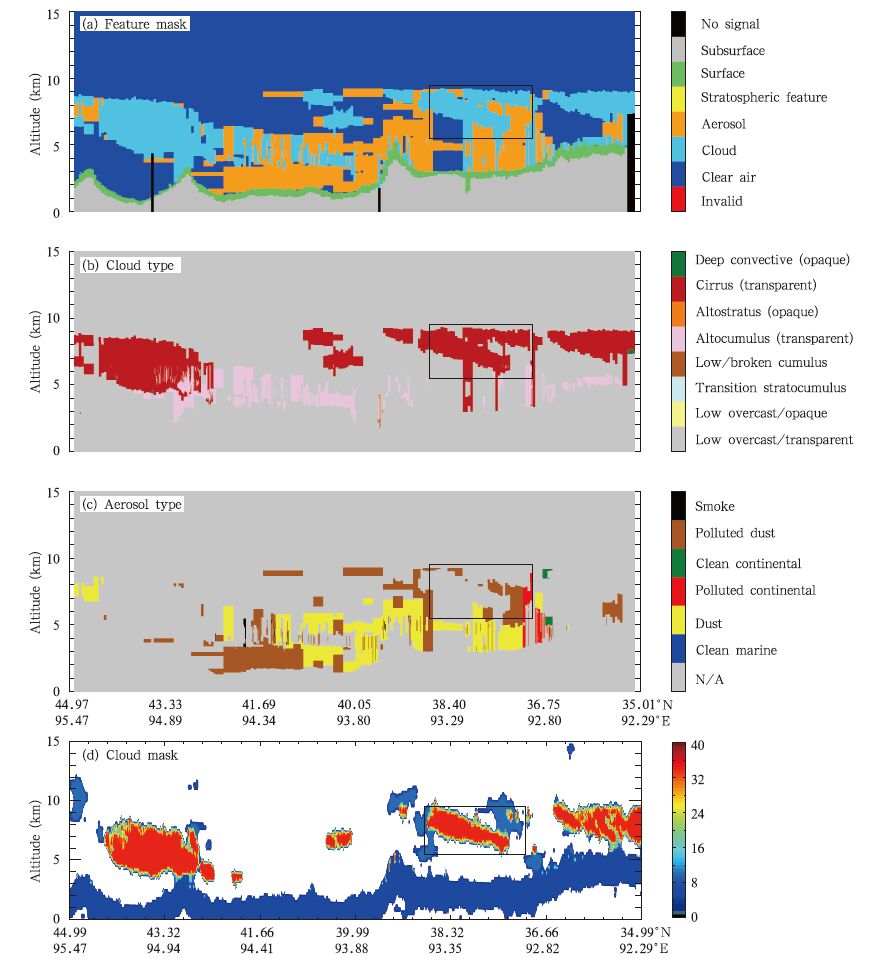
2.5 Dusty cloud casesA typical example of dusty cirrus cloud, captured on 3 March 2007, is displayed in Fig. 1. The CALIPSO VFM information in Fig. 1a suggests that cloud and aerosols both existed in the region denoted by the black rectangle. Moreover, aerosols were next to and below the clouds. Figures 1b and 1c show the cloud and aerosol types from CALIPSO VFM. Cirrus clouds were found in the black rectangular region(Fig. 1b), with the presence of dust aerosols denoted in Fig. 1c. Additionally, the red coloring in Fig. 1d shows high confidence in the identification of clouds by CloudSat, confirming the existence of clouds. Based on the aforementioned analysis from Fig. 1, this cirrus cloud, with the presence of dust aerosols in the same scene, is defined as a dusty cirrus cloud(the black rectangular region).
|
| Fig. 1 Vertical profiles of dusty cirrus cloud on 3 March 2007: (a) CALIPSO VFM, (b) CALIPSO cloud type, (c)CALIPSO aerosol type, and (d) CloudSat cloud mask image. |
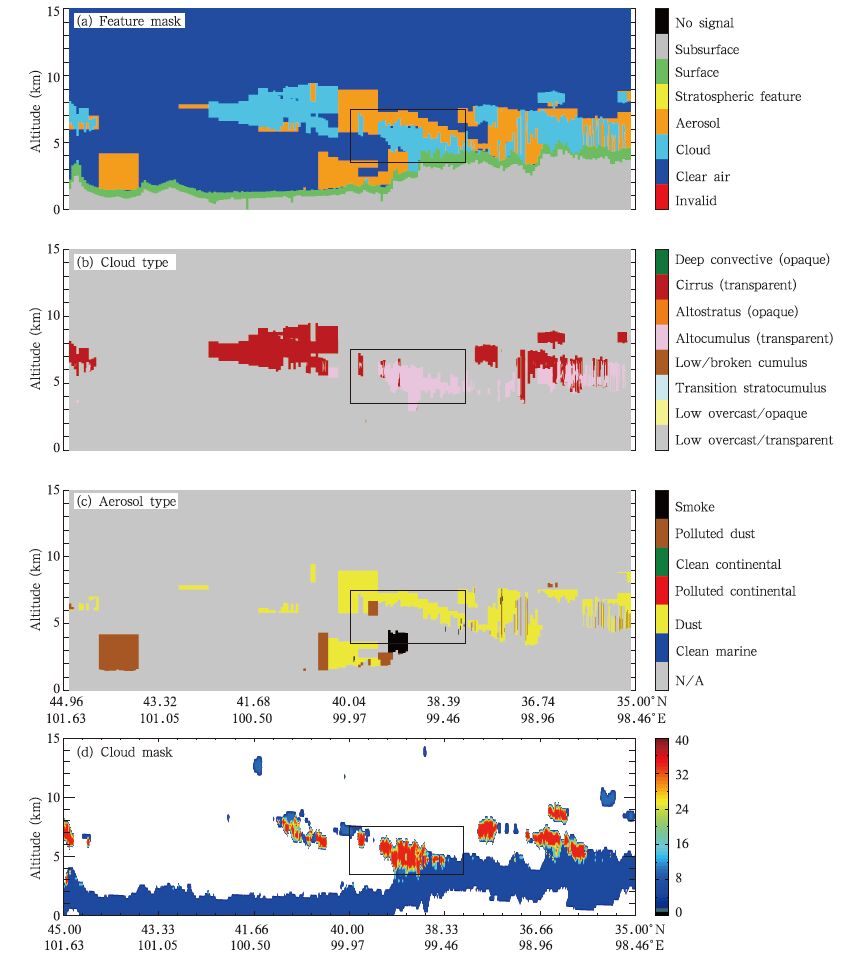
A similar observation for a dusty altocumulus cloud is shown in Fig. 2, captured on 23 March 2007. The black rectangle shown in Fig. 2a denotes aerosols above and below cloud. Figure 2b illustrates that the cloud type was altocumulus cloud. The aerosol type plotted in Fig. 2c denotes that the aerosol type was dust aerosol, and the red areas in Fig. 2d confirm the existence of clouds. The area denoted by the black rectangle in Figs. 2a–d shows dust aerosols mixed with altocumulus clouds.
|
| Fig. 2 As in Fig. 1, but for dusty altocumulus clouds on 23 March 2007. |
Following the criterion of distinguishing dusty clouds described in Section 2.4(for more information, see Wang W. C. et al.(2010b) and Jin et al.(2015)), we firstly selected single-layered dusty altocumulus and single-layered dusty cirrus clouds using the CALIPSO VFM products. Secondly, the CloudSat cloud mask observations were used to further identify the existence of clouds, as CALIPSO may falsely distinguish dense dust layers as clouds. Following this method, 18 dusty cirrus clouds and 18 dusty altocumulus clouds were selected, as shown in Tables 1 and 2, from all the data during March to May 2007 in Northwest China(35◦–45◦N, 70◦–110◦E). To detect the influence of dust aerosol on clouds, we r and omly selected 18 pure single-layered altocumulus cloud cases and 18 pure single-layered cirrus clouds. The criterion to select the pure cloud cases was a difference of less than 5 hPa in the mean cloud top(base)pressure between dusty and pure clouds. This should minimize the interference effects from other factors such as cloud height, meaning the property differences between pure and dusty clouds are most likely attributable to dust aerosols.
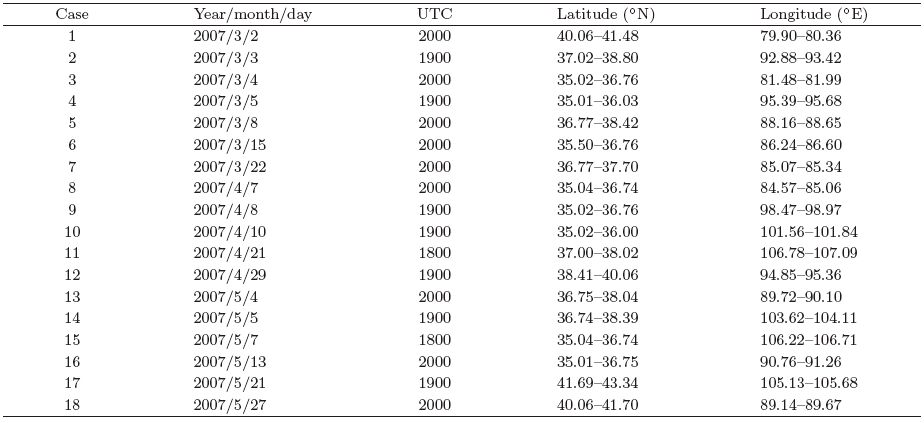
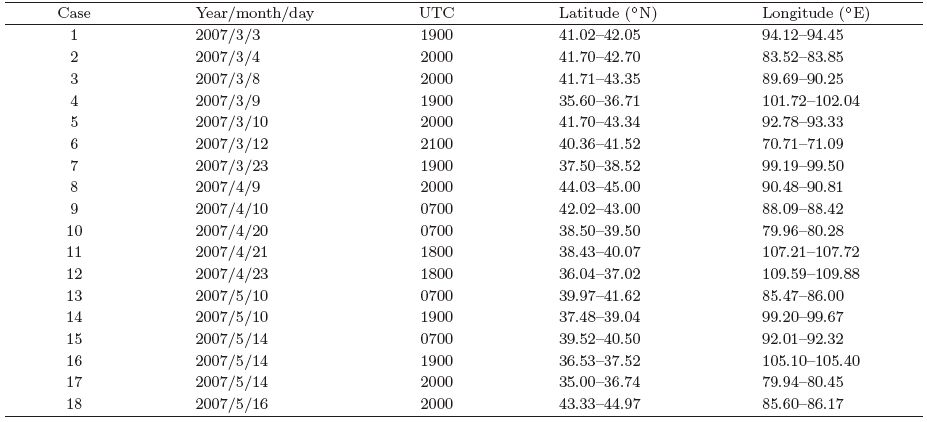
Table 3 lists the cloud top pressure(pt), cloud effective pressure(pe), cloud effective temperature(Te), cloud effective height(He), and cloud base pressure(pb)for altocumulus and cirrus clouds in this study. For water-phase altocumulus clouds, the differences of pt, pe, Te, He, and pb between dusty clouds and pure clouds were –1.81 hPa, –0.86 hPa, –0.44 K, –0.14 km, and –0.85 hPa, respectively. For ice-phase altocumulus clouds, the differences of pt, pe, Te, He, and pb between dusty clouds and pure clouds were 0.32 hPa, –1.48 hPa, 1.17 K, 0.17 km, and –2.66 hPa, respectively. For ice-phase cirrus clouds, the differences of the above five values were 0.88 hPa, 1.66 hPa, 3.92 K, –0.23 km, and –4.76 hPa, respectively. Since the differences in pt, pe, Te, He, and pb between dusty clouds and pure clouds were subtle for both altocumulus and cirrus clouds, it is likely that meteorological and other factors(e.g., cloud height)will not significantly influence our analysis of the two dusty cloud scenarios.

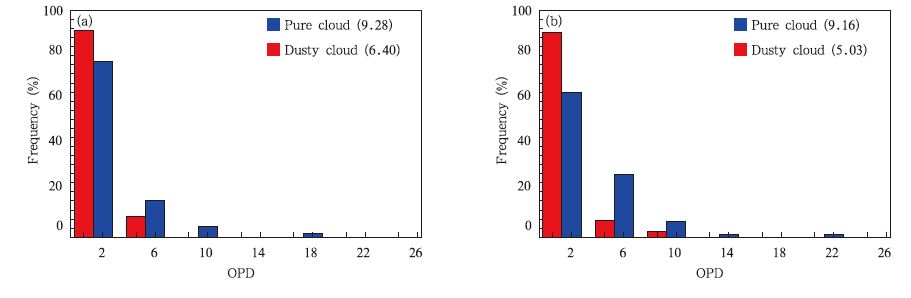
The cases in Tables 1 and 2 are presented as histograms of liquid water and ice water properties(OPD, LWP, IWP, Re, and De)for cirrus and altocumulus clouds in Figs. 3–6, where dusty and pure clouds are displayed with red- and blue-colored bars, respectively. Figure 3 shows the OPD for dusty and pure altocumulus cloud. The majority of the OPDs for these dusty clouds are approximately distributed between 0 and 4.0. For water-phase altocumulus(Fig. 3a), the mean OPDs for pure altocumulus clouds and dusty altocumulus clouds are 9.28 and 6.40. Similarly, regarding the ice-phase altocumulus, the mean OPDs for pure altocumulus clouds and dusty altocumulus clouds are 9.16 and 5.03. These results show decreases of around 31% and 45% in OPD for water- and icephase altocumulus clouds due to the presence of dust aerosols.
|
| Fig. 3 Frequency distributions of dusty and pure OPD for (a) water altocumulus and (b) ice altocumulus clouds. |
|
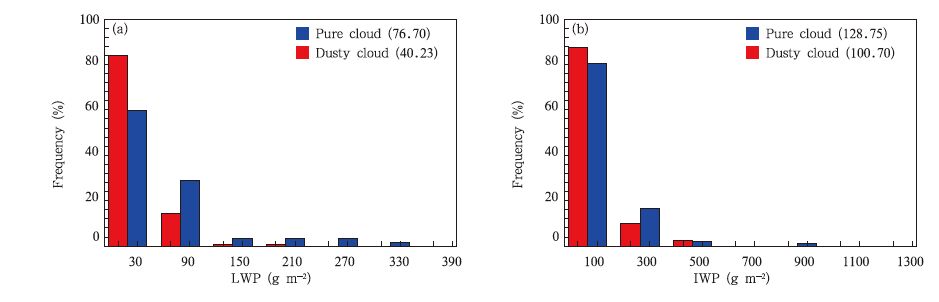
| Fig. 4 As in Fig. 3, but for (a) LWP and (b) IWP for dusty altocumulus and pure altocumulus clouds. |
|
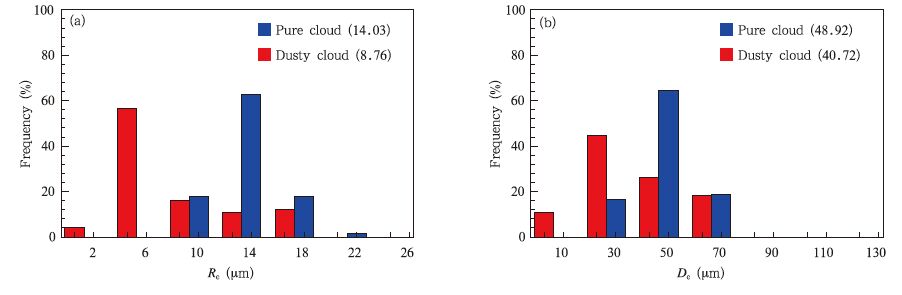
| Fig. 5 As in Fig. 3, but for (a) Re and (b) De for dusty and pure altocumulus clouds. |
|
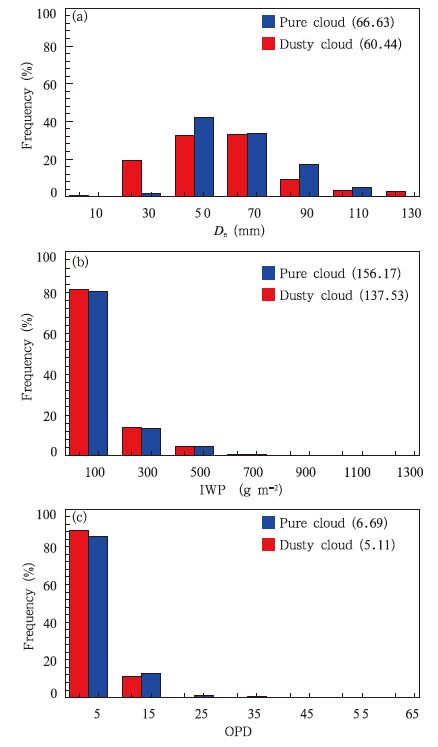
| Fig. 6 Comparison of (a) De, (b) IWP, and (c) OPD for dusty and pure cirrus clouds. |
The frequency distributions of LWP and IWP for pure altocumulus clouds and dusty altocumulus clouds are displayed in Fig. 4. The mean values of LWP for dusty altocumulus clouds and pure altocumulus cloud are 40.23 and 76.70 g m−2, respectively. Larger values of LWP occur more frequently in pure altocumulus clouds than in dusty altocumulus clouds. Similarly, regarding the ice-phase altocumulus, the mean IWP for pure altocumulus clouds is 128.75 g m−2, and for dusty altocumulus clouds the value is 100.70 g m−2(Fig. 4b). As expected, the corresponding mean values of IWP for pure altocumulus clouds are considerably larger than those for dusty altocumulus clouds(Fig. 4b).
The above results demonstrate that dust aerosols could warm mid-level altocumulus clouds by absorbing solar radiation, enhance cloud droplet evaporation, reduce the cloud water path, and further suppress precipitation via the semi-direct effect. This result agrees with previous work by Huang et al.(2006a) and Wang W. C. et al.(2010). Moreover, the cloud evaporation and cloud water path reduction will influence the redistribution of hydrometeors within the atmosphere(Twomey, 1977).
The results of similar analysis procedures for Re and De are given in Fig. 5. The mean values of m−2 for dusty altocumulus and pure altocumulus clouds are 8.76 and 14.03 μm, as shown in Fig. 5a. However, it is evident that the mean values of De decrease from 48.92 μm for pure altocumulus clouds to 40.72 μm for dusty altocumulus clouds(Fig. 5b). These results show a 38% decrease in m−2 and a 17% decrease in De. In addition, the cloud properties have larger differences for liquid-phase clouds than ice-phase clouds.
Cirrus clouds play a major role in the earth– climate system(Manabe and Strickler, 1964; Hallett, 1996). The ice crystals of cirrus clouds are formed on aerosol particles. The finer dust particles floating in the atmosphere are lifted into the upper troposphere, making them a primary IN source in the troposphere(Pruppacher and Klett, 1997; Huang et al., 2007a). Therefore, cirrus clouds may be mainly affected by finer dust aerosols(Jin et al., 2015).
The frequency distributions of De, IWP, and OPD of dusty and pure cirrus clouds are shown in Fig. 6. Figure 6a shows the mean value of De for dusty cirrus clouds to be 60.44 μm, while the pure cirrus clouds mean value is 66.63 μm—a decrease of roughly 10% compared to pure cirrus clouds. Moreover, a value of De between 20 and 40 μm(approximately 30 μm in Fig. 6a)is more frequent for dusty cirrus clouds than for pure clouds, while a value of De between 80 and 100 μm(about 90 μm in Fig. 6a)is more frequent for pure cirrus clouds than for dusty cirrus clouds. The frequency of IWP for dusty cirrus and pure cirrus clouds is shown in Fig. 6b. The mean value of IWP is 156.17 g m−2 for pure cirrus clouds, while the mean value is 137.53 g m−2 for dusty cirrus clouds. In addition, the OPD distribution displayed in Fig. 6c is similar to the IWP in Fig. 6b, as expected. The mean value of OPD for pure cirrus clouds is 6.69. In contrast, for dusty cirrus clouds, the mean value is 5.11, with a decrease of 24% as a result of dust aerosols. These results agree with those of Jin et al.(2014), indicating the evaporation of large ice crystals due to dust aerosols.
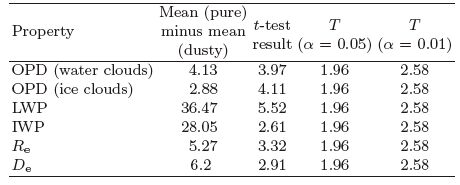
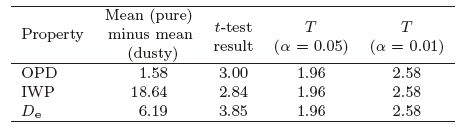
The significance of the above differences in cloud properties between dusty and pure clouds for both altocumulus and cirrus was tested statistically. Although there were 18 cases for dusty altocumulus and dusty cirrus clouds, the samples for the statistical tests were based on individual pixels that were greater than 500, sufficient for justifying the test. The significance test results for altocumulus clouds in Table 4 show that the differences between dusty and pure altocumulus were all significant at the 99% confidence level. Table 5 lists the statistical significance of the differences between dusty and pure cirrus clouds; the differences also passed the significance tests at the 99% confidence level.
 |
 |
Chen et al.(2006)indicated that LWP/IWP can be regarded as the latent capacity index of artificial precipitation. For dusty altocumulus clouds, the latent capacity index of artificial precipitation is –1.75, while for pure altocumulus, the index is –1.55. The precipitation potential for altocumulus clouds decreases by 11% due to dust aerosols.
Our results show that cloud microphysical properties can be significantly changed by dust aerosols. The values of particle sizes, OPDs, and water paths for dusty clouds are smaller than pure clouds both for altocumulus and cirrus clouds, indicating that dust aerosols can cause the evaporation of clouds, thus decreasing the precipitation potential for the cloud, which may prolong the lifetime of the cloud(cloud lifetime effect) and scatter more radiation back to space(cloud albedo effect). These results show good agreement with a series of previous studies in Northwest China(Huang et al., 2006b, c, 2010; Wang W. C. et al., 2010). Furthermore, dust has a greater influence on altocumulus clouds than on cirrus clouds.
4. Conclusions and discussionDust aerosols and clouds play important roles in the earth–atmosphere system. The interactions between dust and cloud have attracted increasing attention of research, especially over arid/semi-arid regions. Dust aerosols influence the climate system and cloud microphysics in multiple ways. Jin et al.(2015)showed that dust aerosols have great impacts on the cloud thermodynamic phase, which can further alter the climate forcing. For instance, they disturb the radiation of the climate system by scattering and partly absorbing shortwave and longwave radiation(e.g., Sokolik and Toon, 1996; Demott et al., 2003; Shi et al., 2005; Han et al., 2012, 2013)—semi-directly by changing the cloud cover through evaporation of cloud droplets, and indirectly by serving as CCN(e.g., Albrecht, 1989; Sassen, 2002; Yin et al., 2002; Huang et al., 2006b, c; Yin and Chen, 2007). This changes the optical properties of clouds(first indirect effect), and may decrease or increase precipitation formation(second indirect effect). Interactions between dust and clouds have become one of the major subjects for the aerosol and climate change research(Mahowald and Kiehl, 2003).
Although particular attention has been directed towards dust aerosol effects on cloud over Northwest China, there is a lack of knowledge about the dust aerosol impacts on different cloud types. In the present study, we investigated the dust aerosol effects on the properties of cirrus and altocumulus cloud by using CALIPSO, CERES onboard Aqua, and CloudSat in the A-Train constellation of satellites. For dusty altocumulus clouds, the mean values of OPD, LWP, IWP, Re, and De showed a decrease of 31%, 48%, 22%, 38%, and 17% because of the existence of dust aerosols, respectively. Moreover, dust aerosols had larger effects on liquid-phase altocumulus clouds than for ice-phase altocumulus clouds. Regarding dusty cirrus clouds, there was a 24% decrease in OPD, a 12% decrease in IWP, and a 9% decrease in De, respectively. These results clearly indicate that dust aerosols modify cloud properties, leading to a reduction in cloud optical depth, water path, and effective particle size for both mid-level altocumulus clouds and high-level cirrus clouds in Northwest China. Moreover, statistical analysis proved that the differences are significant.
The reduction of cloud water path may result in a lower level of cloud amount, and may contribute to the reduction of precipitation through the semi-direct effect over arid/semi-arid regions in Northwest China. Our results indicate that the precipitation potential for altocumulus clouds decreased by 11% due to dust aerosols, which might lead to the occurrence of more dust storms, and accelerated occurrence of more arid conditions in northwestern China. Our results also demonstrate that dust aerosol had a greater effect on altocumulus clouds than on cirrus clouds.
It is important to note that the present investigation was limited to short-term statistics, based on mainly satellite remote sensing datasets. Meteorological factors also have effects on cloud formation and properties. Such effects require detailed model simulations, the analysis of which was beyond the scope of this paper. In addition, our previous results(Wang W. C. et al., 2010)also indicate that meteorological factors(such as humidity)had little effect on the differences between dusty and pure clouds, based on our criterion. In the future, larger-scale and longer-term monitoring, and detailed analysis, particularly cloudresolving model simulations, are needed to investigate dust aerosols effects on different cloud types.
Acknowledgments. The satellite data of CALIPSO, CERES, and CloudSat were obtained from NASA.
| Albrecht, B. A., 1989: Aerosols, cloud microphysics, and fractional cloudiness. Science, 245, 1227-1230. |
| Andreae, M. Q., D. Rosenfeld, P. Artaxo, et al., 2004: Smoking rain clouds over the Amazon. Science, 303,1337-1342, doi: 10.1126/science.1092779. |
| Chen, B., J. Huang, P. Minnis, et al., 2010: Detection of dust aerosol by combining CALIPSO active li-dar and passive IIR measurements. Atmos. Chem. Phys., 10, 4241-4251, doi: 10.5194/acp-10-4241-2010. |
| Chen Bin, Zhang Peng, Zhang Beidou, et al., 2014: An overview of passive and active dust detection meth-ods using satellite measurements. J. Meteor. Res.,28, 1029-1040, doi: 10.1007/s13351-014-4032-4. |
| Chen Qian, Chen Tianyu, and Zhang Hong, 2006: Esti-mates of precipitation efficiency and latent capacity of artificial precipitation over Northwest China using Aqua/CERES data retrieval of cloud parameters. Arid Meteor., 24, 1-8. (in Chinese) |
| Chen Yonghang, Chen Yan, Huang Jianping, et al., 2007: Distribution and variation trend of cloud over north-western China. Plateau Meteor., 26, 741-748. (in Chinese) |
| DeMott, P. J., D. J. Cziczo, A. J. Prenni, et al., 2003: Measurements of the concentration and composition of nuclei for cirrus formation. Proc. Nat. Acad. Sci. USA, 100, 14655-14660. |
| Ding Xiaodong, Huang Jianping, Li Jiming, et al., 2012: Study on cloud vertical structure feature over North-west China based on active satellite remote sensing and its influence on precipitation enhancement. Arid Meteor., 30, 529-538. (in Chinese) |
| Fan, J. W., L. Ruby Leung, Z. Q. Li, et al., 2012: Aerosol impacts on clouds and precipitation in eastern China: Results from bin and bulk micro-physics. J. Geophys. Res., 117, D00K36, doi: 10.1029/2011JD016537. |
| Fu, P. J., J. P. Huang, C. W. Li, et al., 2008: The proper-ties of dust aerosol and reducing tendency of the dust storms in Northwest China. Atmos. Environ., 42, 5896-5904, doi: 10.1016/j.atmosenv.2008.03.041. |
|
Gong, S. L., X. Y. Zhang, T. L. Zhao, et al., 2003: Characterization of soil dust aerosol in China and its
[11] transport and distribution during 2001 ACE-Asia. Part II: Model simulation and validation. J. Geo-phys. Res., 108, 4262, doi: 10.1029/2002JD002633. |
| Hallett, J., 1996: Freeze frame. Science, 36, 22-26. |
| Han, Z. W., J. W. Li, X. G. Xia, et al., 2012: Investi-gation of direct radiative effects of aerosols in dust storm season over East Asia with an online coupled regional climate-chemistry-aerosol model. Atmos. Environ., 54, 688-699. |
| Han, Z. W., J. W. Li, W. D. Guo, et al., 2013: A study of dust radiative feedback on dust cycle and meteorology over East Asia by a coupled regional climate-chemistry-aerosol model. Atmos. Environ., 68, 54-63. |
| Hu, Y. X., M. Vaughan, Z. Y. Liu, et al., 2007a: The depolarization-attenuated backscatter relation: CALIPSO lidar measurements vs. theory. Optics Express, 15, 5327-5332. |
| Hu, Y. X., M. Vaughan, C. Mcclain, et al., 2007b: Global statistics of liquid water content and effective num-ber concentration of water clouds over ocean derived from combined CALIPSO and MODIS measure-ments. Atmos. Chem. Phys., 7, 3353-3359. |
| Hu, Y. X., D. Winker, M. Vaughan, et al., 2009: CALIPSO/CALIOP cloud phase discrimination al-gorithm. J. Atmos. Oceanic Technol., 26, 2293-2309. |
| Hu, Y. X., S. Rodier, K. M. Xu, et al., 2010: Occurrence, liquid water content, and fraction of supercooled water clouds from combined CALIOP/IIR/MODIS measurements. J. Geophys. Res., 115, D00H34, doi: 10.1029/2009JD012384. |
| Huang, J. P., Y. J. Wang, T. H. Wang, et al., 2006a: Dusty cloud radiative forcing derived from satellite data for midlatitude regions of East Asia. Prog. Nat. Sci., 16, 1084-1089. |
| Huang, J. P., P. Minnis, B. Lin, et al., 2006b: Possible influences of Asian dust aerosols on cloud proper-ties and radiative forcing observed from MODIS and CERES. Geophys. Res. Lett., 33, L06824, doi: 10.1029/2005GL024724. |
| Huang, J. P., B. Lin, P. Minnis, et al., 2006c: Satellite-based assessment of possible dust aerosols semi-direct effect on cloud water path over East Asia. Geophys. Res. Lett., 33, L19802, doi: 10.1029/2006GL026561. |
| Huang, J. P., P. Minnis, Y. H. Yi, et al., 2007a: Sum-mer dust aerosols detected from CALIPSO over the Tibetan Plateau. Geophys. Res. Lett., 34, L18805, doi: 10.1029/2007GL029938. |
| Huang, J. P., J. M. Ge, and F. Z. Weng, 2007b: Detection of Asia dust storms using multisensor satellite mea-surements. Remote Sens. Environ., 110, 186-191. |
| Huang, J. P., P. Minnis, B. Chen, et al., 2008: Long-range transport and vertical structure of Asian dust from CALIPSO and surface. J. Geophys. Res., 113, D23212, doi: 10.1029/2008JD010620. |
| Huang, J. P., Q. Fu, J. Su, et al., 2009: Taklimakan dust aerosol radiative heating derived from CALIPSO ob-servations using the Fu-Liou radiation model with CERES constraints. Atmos. Chem. Phys., 9, 4011-4021. |
| Huang, J. P., P. Minnis, H. Yan, et al., 2010: Dust aerosol effect on semi-arid climate over Northwest China de-tected from A-Train satellite measurements. Atmos. Chem. Phys., 10, 6863-6872. |
| Huang, J. P., T. H. Wang, W. C. Wang, et al., 2014: Climate effects of dust aerosols over East Asian arid and semiarid regions. J. Geophys. Res., 119, 11398-11416. |
| Huang, Z. W., J. P. Huang, J. R. Bi, et al., 2010: Dust aerosol vertical structure measurements using three MPL lidars during 2008 China-U. S. joint dust field experiment. J. Geophys. Res., 115, D00K15, doi: 10.1029/2009JD013273. |
| Jin, H. C., and S. L. Nasiri, 2014: Evaluation of AIRS cloud-thermodynamic-phase determination with CALIPSO. J. Appl. Meteor. Climatol., 53, 1012-1027, doi: 10.1175/JAMC-D-13-0137.1. |
| Jin, H. C., Y. H. Yi, S. L. Nasiri, et al., 2015: Im-pacts of Asian dust on the determination of cloud thermodynamic phase from satellite observations. Environ. Res. Lett., 10, 034006, doi: 10.1088/1748-9326/10/3/034006. |
| Kawamoto, K., T. Nakajima, D. Streets, et al., 2004: Examining the aerosol indirect effect over China us-ing an SO2 emission inventory. Atmos. Res., 72, 353-363, doi: 10.1016/j.atmosres. |
| Li, J., Y. Hu, J. Huang, et al., 2011: A new method for retrieval of the extinction coefficient of water clouds by using the tail of the CALIOP signal. Atmos. Chem. Phys., 11, 2903-2916. |
| Li, Z. Q., F. Niu, J. W. Fan, et al., 2011: Long-termimpacts of aerosols on the vertical development of clouds and precipitation. Nature Geosci., 4, 888-894, doi: 10.1038/ngeo1313. |
| Liu, D., Z. E. Wang, Z. Y. Liu, et al., 2008: A height resolved global view of dust aerosols from the first year CALIPSO lidar measurements. J. Geophys. Res., 113, D16214, doi: 10.1029/2007JD009776. |
| Liu Jingjing, Chen Bin, and Huang Jianping, 2014: Discrimination and validation of clouds and dust aerosol layers over the Sahara desert with combined CALIOP and IIR measurements. J. Meteor. Res., 28, 185-198, doi: 10.1007/s13351-014-3051-5. |
| Liu, Z. Y., M. A. Vaughan, D. M. Winker, et al., 2004: Use of probability distribution functions for discrim-inating between cloud and aerosol in lidar backscat-ter data. J. Geophys. Res., 109, D15202, doi: 10.1029/2004JD004732. |
| Liu, Z. Y., M. Vaughan, D. Winker, et al., 2009: The CALIPSO lidar cloud and aerosol discrimination: Version 2 algorithm and initial assessment of perfor-mance. J. Atmos. Ocean. Technol., 26, 1198-1213. |
| Mahowald, N. M., and M. L. Kiehl, 2003: Mineral aerosol and cloud interactions. Geophys. Res. Lett., 30, 1475, doi: 10.1029/2002GL016762. |
| Manabe, S., and R. F. Strickler, 1964: Thermal equilib-rium of the atmosphere with a convective adjust-ment. J. Atmos. Sci., 21, 361-385. |
| Mao Jietai, Zhang Junhua, and Wang Meihua, 2002: Summary comment on research of atmospheric aerosol in China. Acta Meteor. Sinica, 60, 625-634. (in Chinese) |
| Min, Q., R. Li, B. Lin, et al., 2009: Evidence of min-eral dust altering cloud microphysics and precipi-tation. Atmos. Chem. Phys., 9, 3223-3231, doi: 10.5194/acp-9-3223-2009. |
| Pruppacher, H. R., and J. D. Klett, 1997: Microphysics of Clouds and Precipitation. Kluwer Academic Pub-lishers, Dordrecht, the Netherlands, 714 pp. |
| Rosenfeld, D., 1999: TRMM observed first direct ev-idence of smoke from forest fires inhibiting rain-fall. Geophys. Res. Lett., 26, 3105-3108, doi:10.1029/1999GL006066. |
| Rosenfeld, D., and W. L. Woodley, 2000: Convective clouds with sustained highly supercooled liquid water down to -37℃. Nature, 405, 440-442, doi:10.1038/35013030. |
| Rosenfeld, D., Y. Rudich, and R. Lahav, 2001: Desert dust suppressing precipitation: A possible desertifi-cation feedback loop. Proc. Nat. Acad. Sci. USA, 98, 5975-5980, doi: 10.1073/pnas.101122798. |
| Rosenfeld, D., X. Yu, G. H. Liu, et al., 2011: Glaciation temperatures of convective clouds ingesting desert dust, air pollution and smoke from for-est fires. Geophys. Res. Lett., 38, L21804, doi: 10.1029/2011GL049423. |
| Sassen, K., 2002: Indirect climate forcing over the west-ern US from Asian dust storms. Geophys. Res. Lett., 29, 103-1-103-4, doi: 10.1029/2001GL014051. |
| Shi, G. Y., H. Wang, B. Wang, et al., 2005: Sensitivity experiments on the effects of optical properties of dust aerosols on their radiative forcing under clear sky condition. J. Meteor. Soc. Japan, 83A, 333-346, doi: 10.2151/jmsj.83A.333. |
| Sokolik, I. N., and O. B. Toon, 1996: Direct radiative forcing by anthropogenic airborne mineral aerosols. Nature, 381, 681-683. |
| Stith, J. L., V. Ramanathan, W. A. Cooper, et al., 2009: An overview of aircraft observations from the Pacific Dust Experiment campaign. J. Geophys. Res., 114, D05207, doi: 10.1029/2008jd010924. |
| Su, J., J. P. Huang, Q. Fu, et al., 2008: Estimation of Asian dust aerosol effect on cloud radiation forcing using Fu-Liou radiative model and CERES measure-ments. Atmos. Chem. Phys., 8, 2763-2771. |
| Tao, M. H., L. F. Chen, L. Su, et al., 2012: Satellite ob-servation of regional haze pollution over the North China Plain. J. Geophys. Res., 117, D12203, doi: 10.1029/2012JD017915. |
| Tao, M. H., L. F. Chen, Z. F. Wang, et al., 2013: Satel-lite observation of abnormal yellow haze clouds over East China during summer agricultural burning sea-son. Atmos. Environ., 79, 632-640. |
| Tao, W.-K., J.-P. Chen, Z. Q. Li, et al., 2012: Im-pact of aerosols on convective clouds and precipi-tation. Rev. Geophys., 50, RG2001, doi: 10.1029/2011RG000369. |
| Twohy, C. H., S. M. Kreidenweis, T. Eidhammer, et al., 2009: Saharan dust particles nucleate droplets in eastern Atlantic clouds. Geophys. Res. Lett., 36, L01807, doi: 10.1029/2008gl035846. |
| Twomey, S., 1977: The influence of pollution on the shortwave albedo of clouds. J. Atmos. Sci., 34, 1149-1152. |
| Wang, H., G. Y. Shi, S. Y. Li, et al., 2006: The impacts of optical properties on radiative forcing due to dust aerosol. Adv. Atmos. Sci., 23, 431-441. |
| Wang, H., X. Y. Zhang, S. L. Gong, et al., 2010: Ra-diative feedback of dust aerosols on the East Asian dust storms. J. Geophys. Res., 115, D23214, doi: 10.1029/2009JD013430. |
| Wang, T. H., and J. P. Huang, 2009: A method for es-timating optical properties of dusty cloud. Chinese Optics Letters, 7, 368-372. |
| Wang, W. C., J. P. Huang, P. Minnis, et al., 2010: Dusty cloud properties and radiative forcing over dust source and downwind regions derived from A-Train data during the Pacific Dust Experi-ment. J. Geophys. Res., 115, D00H35, doi: 10.1029/2010JD014109. |
| Wang, W. C., J. P. Huang, T. Zhou, et al., 2013: Esti-mation of radiative effect of a heavy dust storm over Northwest China using Fu-Liou model and ground measurements. Journal of Quantitative Spectroscopy and Radiative Transfer, 122, 114-126. |
| Wang, X., J. Huang, M. Ji, et al., 2008: Variability of East Asian dust events and their long-term trend. Atmos. Environ., 42, 3156-3165, doi: 10.1016/j.atmosenv.2007.07.046. |
| Winker, D. M., W. H. Hunt, and C. Hostetler, 2004: Status and performance of the CALIOP lidar. Proc. SPIE, 5575, 8-15, doi: 10.1117/12.571955. |
| Winker, D. M., J. Pelon, and M. Patrick McCormick, 2006: Initial results from CALIPSO. 23rd Interna-tional Laser Radar Conference. Nara, Japan, July 2006, Tokyo Metropolitan Univ., 991-994. |
| Yin, Y., and L. Chen, 2007: The effects of heating by transported dust layers on cloud and precipitation: A numerical study. Atmos. Chem. Phys., 7, 3497-3505. |
| Yin, Y., S. Wurzler, Z. Levin, et al., 2002: Interac-tions of mineral dust particles and clouds: Effects on precipitation and cloud optical properties. J. Geophys. Res., 107, AAC 19-1-AAC 19-14, doi: 10.1029/2001JD001544. |
| Zhang, J. L., and S. A. Christopher, 2003: Long-wave radiative forcing of Saharan dust aerosols from Terra. Geophys. Res. Lett., 30, 2188, doi: 10.1029/2003GL018479. |
| Zhang, J. L., J. R. Campbell, J. S. Reid, et al., 2011: Evaluating the impact of assimilating CALIOP-derived aerosol extinction profiles on a global mass transport model. Geophys. Res. Lett., 38, L14801, doi: 10.1029/2011GL047737. |
| Zhang Xiaoye, 2007: Aerosol over China and their climate effect. Adv. Earth Sci., 22, 12-16. (in Chinese) |
| Zhang, X. Y., R. Arimoto, and Z. S. An, 1997: Dust emission from Chinese desert sources linked to vari-ations in atmospheric circulation. J. Geophys. Res., 102, 28041-28047. |
| Zhang, X. Y., S. L. Gong, Z. X. Shen, et al., 2003: Char-acterization of soil dust aerosol in China and its transport and distribution during 2001 ACE-Asia. Part 1: Network observations. J. Geophys. Res., 108, 4261, doi: 10.1029/2002JD002632. |
| Zhou, T., J. P. Huang, Z. W. Huang, et al., 2013: The depolarization-attenuated backscatter relation-ship for dust plumes. Optic Express, 21, 15195-15204, doi: 10.1364/OE.21.015195. |