 2013, Vol. 27
The Chinese Meteorological Society
Article Information
- WANG Jiuke, MAo Jietai, ZHAo Chunsheng, YAN Peng, MA Nan, LIU Pengfei and LIU Xiaoyang. 2013.
- A Novel Four-Wavelength Transmissometer for Distinguishing Haze and Fog
- J. Meteor. Res., 27(4): 556-565
- http://dx.doi.org/10.1007/s13351-013-0411-5
-
Article History
- Received January 24, 2013
- in final form April 6, 2013


2 National Marine Environmental Forecasting Center, State oceanic Administration, Beijing 100081;
3 Chinese Academy of Meteorological Sciences, China Meteorological Administration, Beijing 100081;
4 Meteorological observation Center, China Meteorological Administration, Beijing 100081
Low atmospheric visibility has a significant negativeimpact on life and road traffic, as well as humanhealth(Deng et al., 2008; Leitte et al., 2011). Fogis the usual cause of low visibility. However, in somepolluted situations, especially in China, high aerosolloading and strong hygroscopic growth of aerosol particlescan also lead to low visibility(Anderson et al., 2003; Quinn and Bates, 2003; Cheng et al., 2008; Yan et al., 2009). A method of objectively distinguishingbetween fog and haze is a necessary prerequisite forthe forecasting of low visibility.
A fog monitor is important for identifying the occurrenceof fog, but it is not suitable for routine observations.Theoretically, fog can only occur in saturatedair whereas haze can occur at any relative humidity(RH)value. Therefore, RH and visibility arecommonly used as the criteria to distinguish betweenfog and haze. The World Meteorological Organization(WMO)considers fog to occur if the visibility is lessthan 1 km; haze is defined as visibility lower than 5km but higher than 1 km. Wu(2006)considered fogto occur when RH was higher than 90% while belowthis figure visibility reductions were considered to bethe result of haze. However, the visibility during hazeevents can be lower than 1 km in some highly pollutedcircumstances. Visibility during fog can also behigher than 1 km. Therefore, visibility is not an objectivecriterion in distinguishing between fog and haze.The measurement of high RH is difficult and is limitedby technology. Automatic weather stations(AWSs)have a low bias in the measurement of RH under highhumidity conditions and therefore the RH is also notsuitable for distinguishing between fog and haze. Aparameterization of low visibility was developed byincorporating the RH and aerosol volume concentrationsinto the Mie model(Chen et al., 2012). However, the aerosol volume concentrations used in theparameterization were not available via routine measurements.Moreover, because of the unreliable RHmeasurements, the parameterization cannot be usedto distinguish between fog and haze by comparing thecalculated and measured visibility.
There is a significant difference between the microphysicalcharacteristics of haze and fog with anapparent difference in particle size. For haze particles, the geometric mean radius is around 0.2 μm, whereas the mean diameter of fog droplets is around5 μm(Pinnick et al., 1978). This difference in particlesize generates different optical characteristics. FromMie scattering theory(Mie, 1908), in the visible and near-infrared b and s, smaller particles(e.g., haze particles)scatter more radiation at short wavelengthsthan longer wavelengths. For larger particles(e.g., fogdroplets), light extinction at the shorter wavelengthsis similar to that at longer wavelengths. Theoretical and experimental results have indicated that light extinctionat longer wavelengths in the visible range isgreater than at shorter wavelengths in fog(Eldridge, 1969; Garland and Rae, 1970). When haze particlesgrow to the size of fog droplets, the extinctionof light at all wavelengths slowly becomes similar untilneutral extinction occurs(Houghton and Chalker, 1949). Anomalous extinction in rural fog was clearlyindicated by an experiment utilizing trichromatic distantcontrasts, which also fitted well with theoreticalconsiderations(Gazzi et al., 1985, 2001). In the experimentof Gazzi, the extinction coefficient was indirectlyacquired through the sunlight distant contrastmethod. However, this method is limited because itcan only work in the daytime.
On the basis of the different extinction characteristicsbetween fog and haze, a novel fourwavelengthtransmissometer based on charge-coupleddevice(CCD)imaging was designed to provide an objectivedistinction between haze and fog with the centralwavelengths at 415, 516, 650, and 850 nm, respectively.The meter can operate automatically for 24 hwith an interval of 4 min.2. Theoretical basis
From Mie scattering theory, for smaller particlessuch as haze particles, the extinction coefficient atshorter wavelengths is higher than at longer wavelengths.For larger particles, such as fog droplets, theextinction coefficient at shorter wavelengths is slightlysmaller than at longer wavelengths. Therefore, therelative size of the extinction coefficients at differentwavelengths indicates the different extinction characteristicof haze and fog. Using the extinction coefficientsat a wavelength of 516 nm as the denominator, the relative size of the extinction coefficients at differentwavelengths is expressed by the ratios of theother three extinction coefficients, which is defined asvariable Ratio in Eq.(1)below:
where the Ratioλ/516 is the quotient of the extinctioncoefficient at λ(kex, λ) and the extinction coefficient at516 nm(kex, 516). Therefore, the variable Ratio indicatesthe relative size of the extinction coefficients atdifferent wavelengths.
The extinction coefficients at four wavelengthswere calculated using the Mie scatting model(Bohren and Huffman, 1983)under a set of single-mode aerosollog-normal spectrum types. The geometric mean particlediameter of the aerosol spectrum ranged from 10nm to 10 μm. We assume that all particles have thesame complex refractive index(1.50–0i), and the geometricst and ard deviation was assumed to be 1.9.
Figure 1 shows the theoretical result for the relativesize of the extinction coefficients at different wavelengthsusing Mie scatting theory. In haze, the variableRatio at 415 nm was larger than 1. The Ratio valuesat 650 and 850 nm were less than 1. This indicatesthat the light extinction at shorter wavelengths is morethan that at longer wavelengths during haze events.During the growth of the particle size, the ratios at650 and 850 nm increased until becoming close to 1 orslightly greater. The ratio at 415 nm decreased to lessthan 1, indicating that the light extinction at longerwavelengths is more than that at shorter wavelengthsduring fog. The transmission extinction characteristicsat different wavelengths are an apparent differencebetween haze and fog.
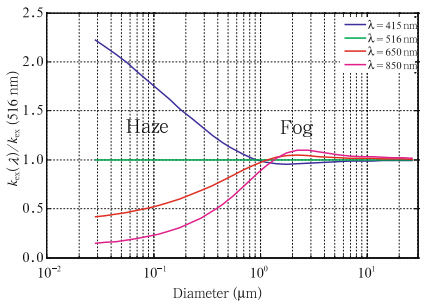 |
| Fig. 1. Theoretical results based on Mie scatting theory.The x-axis is the particle diameter. The y-axis is the extinctioncoefficient ratio. Color lines represent changes inthe extinction coefficient ratios at different wavelengths. |
In order to quantify the difference in dispersion ofthe extinction coefficients at the four wavelengths, thevariable DIS is defined as
where kex, 415, kex, 516, kex, 650, and kex, 850 represent theextinction coefficients at 415, 516, 650, and 850 nm, respectively.According to Fig. 1, as the particle radiusincreases during the transition from haze to fog, theextinction coefficients at the four wavelengths becomecentralized, and thus the DIS will decrease. Therefore, a change in the variable DIS can indicate a change inthe particle radius. Because Fig. 1 is plotted for idealassumptions of the aerosol spectrum and refractive index, the threshold of DIS used as a criterion for distinguishingbetween fog and haze has to be determinedfrom an in-situ experiment(see Section 4).3. Setup of the four-wavelength transmissometer
The four-wavelength transmissometer is composedof a CCD camera(Santa Barbara InstrumentGroup, Pleasanton, CA, USA), an inc and escent lightsource, two reflecting mirrors, and a control personalcomputer(PC). Each pixel of an image taken by theCCD had a value of 0–65535. Four color filters werefixed in a computer-controlled wheel inside the CCD.The central wavelengths of the four filters were 415, 516, 650, and 850 nm. The light source(HL-2000-HP-232: Ocean Optics, Dunedin, FL, USA)produced acontinuous spectra covering wavelengths from 360 nmto 2 μm. The two reflecting mirrors ensured that thelight was reflected back in the original direction. Themirrors doubled the optical path length when installedat a fixed distance.
Figure 2 shows a schematic diagram of the transmissometer.The operational process is as follows. Thecontrol program drives the filter wheel and places thefirst color filter(415 nm)in front of the CCD camera.Light is then emitted from the fiber fixed besidethe CCD camera and reflected via the reflecting mirrorsback to the CCD. The variables I and I' are theintensities of the reflected light if there is no atmosphereextinction. I1 and I2 are the reflected beamsfollowing atmospheric extinction by the air. Whenthe light is on, the control program takes a photograph, which is a record of the light reflected by themirrors plus the background light(Fig. 3a). After thephotograph is stored, the control program turns off thelight and takes another photograph using the same exposuretime to record the background light(Fig. 3b).The subtraction of the two images(Figs. 3a and 3b)gives the points of light I1 and I2 without backgroundlight(Fig. 3c). The process is repeated for anothercolor filter until photographs of four wavelengths aretaken. The time required to take photographs at thefour wavelengths is about 4 min.
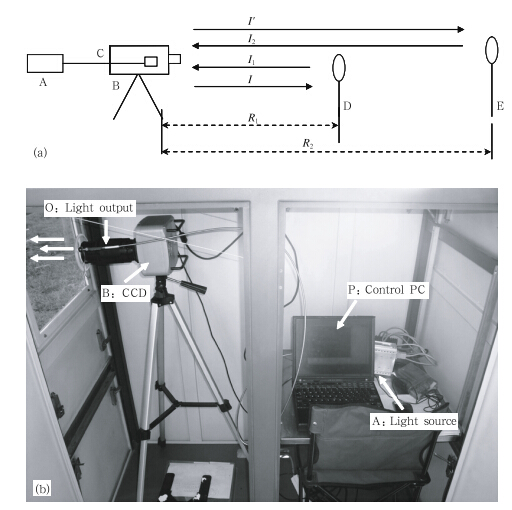 |
| Fig. 2. A schematic diagram and photographs of the four-wavelength transmissometer. In(a), letter A is the lightsource, and B is the CCD, which contains four color filters: 415, 516, 650, and 850 nm. The light source is generatedthrough a fiber represented by letter C. Letters D and E denote reflecting mirrors. The distances from D and E to Bare R1 and R2, respectively. Light reflected from D and E is denoted as I1 and I2, respectively. In(b), the light source, CCD camera, control PC, and light output are marked as A, B, P, and O. |
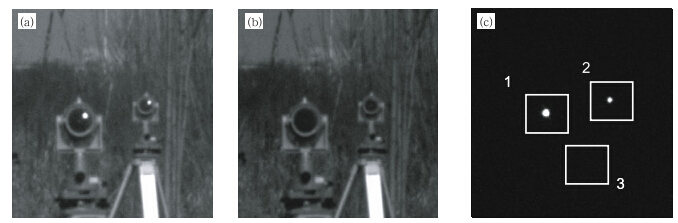 |
| Fig. 3. Photographs with the light source(a)on and (b)off(i.e., background light); and (c)the subtraction of(a) and (b), showing the points of light I1 and I2. In(c), area 1 includes the point of light, which is reflected from the nearmirror; area 2 includes the point of light, which is reflected from the far mirror; and area 3 is used to calculate the signalto noise ratio. |
The Beer-Lambert law is used to calculate the extinctioncoefficient of each wavelength:
Equation(3)is used for the near mirror. The variableI denotes the intensity of the light reflected if thereis no light extinction, I1 is the intensity of the lightreflected following extinction, R1 is the distance fromthe CCD to the near mirror, and kex, λ is the extinctioncoefficient at wavelength λ. By assuming that theextinction coefficient is constant with the distance R, Eq.(3)can be rewritten as:Equation(5)is used for the far mirror. Here, I' isthe intensity of the light reflected if there is no lightextinction, I2 is the intensity of the light reflected followingextinction, R2 is the distance from the CCD tothe far mirror, and kex, λ is the extinction coefficientat wavelength λ.


In Eqs.(4) and (5), I1, and I2 could be derived bysumming the pixel values of the point of light in Fig. 3c. The distances R2 and R1 can be measured. If thevalues of I and I' are determined, Eqs.(4) and (5)will give the extinction coefficients at the four wavelengths.Because I and I' are the intensities of light reflectedif there is no extinction and I1 and I2 are theintensities of the light reflected following extinction, with a decrease in light extinction, I1 and I2 will approachI and I'. I1 and I2 will increase, becomingcloser to I and I' when visibility increases. I1 and I2can be considered to be equivalent to I and I' whenthe CCD pixels are no longer sensitive to an increasein visibility.
Therefore, Eqs.(4) and (5)can both give theextinction coefficient at each wavelength. The signalto-noise ratio(SNR)is calculated to select which extinctioncoefficient will be used. In Fig. 3c, threerectangular regions(areas 1, 2, and 3)with an equalareal size are identified. Areas 1 and 2 include thepoint of light which is reflected from the near and farmirrors. Area 3 does not include any point of light.Under the assumption that the background light doesnot change during the process of taking the light-on and light-off photographs, because Fig. 3c is obtainedby subtracting the background light, the pixel valueof the “black area”(area 3)in Fig. 3c should be 0.However, because of noise effects, the pixel value ofthe “black area”(area 3)is actually slightly above 0.
The SNR of each wavelength is defined as:
where Iarea1(2) is the “signal value”, which is obtainedby summing the pixel values in area 1 or 2 in Fig. 3c, and Iarea3 is the “noise value”, which is obtained bysumming the pixel values in area 3 in Fig. 3c. TheSNR is the “signal value” divided by the “noise value”.Therefore, under conditions of high visibility, high levelsof reflected light will lead to a high SNR. The intensityof the reflected light will decrease along with adecrease in visibility and the proportional increase innoise effects will lead to a decrease in the SNR.
We set an SNR of 100 as the criterion to choosewhich point of light was used to calculate the extinctioncoefficient. Because the far mirror makes the opticpath longer, changes in the point of light are moresensitive to the visibility variations. If the SNR of thepoint of light from the far mirror was higher than 100, we used the result calculated from the far mirror usingEq.(5)as the extinction coefficient. Under low visibilityconditions, the point of light reflected from the nearmirror is stronger and has a higher SNR. If the SNR ofthe point of light from the far mirror was lower than100 and the point of light from the near mirror wasover 100, the point of light from the near mirror wasused to determine the extinction coefficient using Eq.(4). Under some circumstances, with an extremely lowvisibility, if the SNRs of both points of light were lowerthan 100, invalid data would be recorded.4. The experiment and results
The four-wavelength transmissometer was testedas part of the HaChi(Haze in China)campaign(Liu et al., 2011). The experiment was conducted in Wuqing, Tianjin, China. Wuqing is located in between the twomajor cities Beijing and Tianjin(each with a populationof over 10 million)on the North China Plain.Because of its location and the rapid development ofthe construction industry, there is an abundant supplyof aerosol in Wuqing. Both fog and haze often occurduring winter(Deng et al., 2011; Ma et al., 2011).
Together with the four-wavelength transmissometer, an AWS, a fog monitor, and a forward scatter meter(FD12; Vaisala, Helsinki, Finl and )were used in theexperiment. The type of the fog monitor is FM-100.It is a production of Droplet Measurement Techniquewith a detection range of 2–50 μm, including 19 rangebins. The whole range was divided into three sectionsof ≤ 3, 3–7, and ≥ 7 μm. The forward scatter meterwas used as a reference for the four-wavelength transmissometer.The AWS provided measurements of RH.
The field experiment began on 15 November 2009 and ended on 20 January 2010. Two fog events(9December 2009 and 16 January 2010)during the fieldcampaign occurred and were used to validate the performanceof the four-wavelength meter.
The fog process observed on 9 December 2009 isshown in Fig. 4. Overall, the extinction coefficients atfour wavelengths were similar when the number concentrationof fog droplets increased or the percentageof large droplets increased. By comparing the changesof DIS defined in Eq.(2) and the variation of the fogdroplet number concentration(Fig. 4c), it was observedthat the DIS decreased when the fog dropletnumber concentration increased. From Fig. 4c, DIS= 2 can be defined as a qualitative criterion to distinguishbetween fog and haze. Fog is considered to occurwhen the DIS is lower than 2 and the correspondingfog droplet number concentration is about 10 cm−3;haze is considered to occur when the DIS is larger than 2.
From 1200 to 1700 BT(Beijing Time)9 Decemberthe visibility was over 1000 m and the RH wasbelow 80%(Fig. 4d). The number concentration waslower than 5 cm−3(Fig. 4c). The extinction coefficientat shorter wavelengths was larger than at longerwavelengths, which is the normal condition(Fig. 4a).The DIS was also larger than 2. Therefore, this periodwas recognized as a haze period.
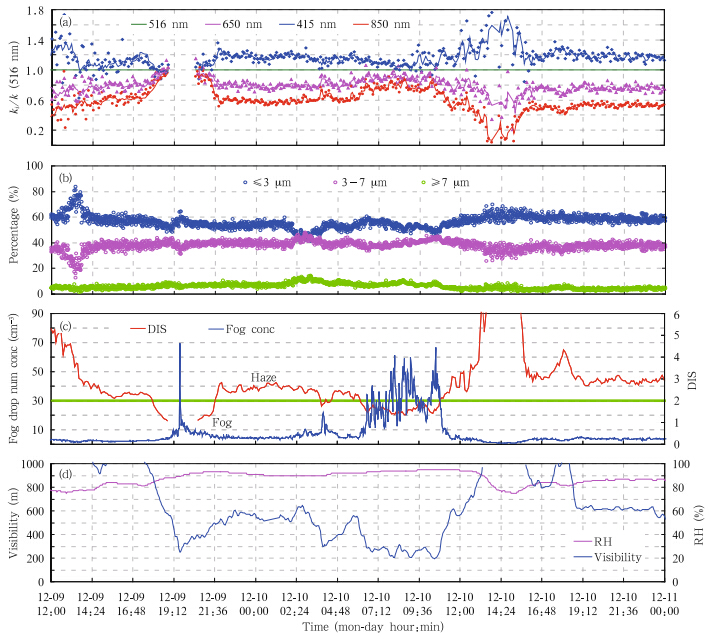 |
| Fig. 4. Observed attributes of the fog event during 9–11 December 2009.(a)Variations of the extinction coefficientratio at the four different wavelengths. Dots denote the observed extinction coefficient and lines represent the movingaverage.(b)Percentage changes in the number of particles of different sizes over time.(c)Changes in the fog dropletnumber concentration(blue line) and the DIS value(red line). The DIS = 2 line is plotted as the green line, whichdistinguishes fog from haze.(d)Change in visibility(blue line)derived from an FD12 monitor, and the change in relativehumidity(pink line)derived from an automatic weather station. Note: the x-axis indicates Beijing Time. |
At around 1900 BT 9 December, there was a sharppeak in the fog droplet number concentration and thevisibility also rapidly decreased. In response, the extinctioncoefficients at different wavelengths quicklybecame similar. The blank section in Fig. 4a around1900 BT was due to excluded data because the lightreflected from both mirrors was too weak to generatean SNR higher than 100. Before this section of excludeddata, the ratio of the extinction coefficients atfour wavelengths was close to 1 and the DIS was lessthan 2. Therefore, this period was associated withoccurrence of fog. From 2200 BT 9 to 0600 BT 10 December, although the visibility was only around 600m and the RH was above 90%, the extinction coefficientat 415 nm was 2.1 times higher than that at850 nm. The DIS was above 2, which indicated thatthis period was occupied by haze. Accordingly, thefog droplet number concentration recorded by the fogmonitor was almost 0 cm−3, which also indicated occurrenceof haze during this period. From 0600 to 1200BT 10 December, the visibility decreased to 300 m and the RH increased to almost 95%. During this period, the extinction coefficient at 415 nm was only 1.3times higher than at 850 nm, i.e., much smaller thanat 0600 BT 10 December. The similarity of the extinctioncoefficients at the four wavelengths indicatedthat the size of the particles had increased and theDIS was below 2. The fog monitor observations alsoconfirmed that during this period, the number concentrationof fog droplets increased, as did the percentageof bigger particles. Therefore, during this period, theconclusions drawn from the results obtained from thefour-wavelength transmissometer and the fog monitorwere consistent. From 1200 to 1912 BT 10 December, the visibility rapidly improved, the RH decreasedto around 80%, the number concentration of the fogdroplets decreased to almost 0 cm−3, and the percentageof small fog droplets increased. Correspondingly, the extinction coefficients at the different wavelengthsrapidly diverged. The extinction coefficient at 415 nmwas 7 times larger than at 850 nm, while the ratio was1.3 times larger at 0936 BT 10 December. The DISvalue increased quickly and rose above 2. Therefore, the period was recognized to be with haze.
During this fog event, the determination of fog and haze, which was based on the dispersion of theextinction coefficients at four wavelengths, was consistentwith the fog monitor determination. The extinctioncoefficients at 650 or 850 nm were not higherthan those at 415 or 650 nm, probably due to the lownumber concentration of fog droplets. However, theextinction coefficients at different wavelengths did becomesimilar during the fog period. A dimmer glasswas installed in front of the lens and the exposure timewas increased to archive a higher SNR under low visibilityconditions.
The transition between haze and fog from 18 to20 January 2010 is shown in Fig. 5. From 2100 BT18 January to 1600 BT 19 January, the RH increasedfrom 70% to almost 90%, and the visibility decreasedfrom 1000 m to around 600 m. During this period, althoughthe fog number concentration was low, the proportionof 3–7 μm particles increased gradually, whilethe proportion of ≤ 3 μm particles decreased. Correspondingly, as shown in Fig. 5a, the extinction coefficientat shorter wavelengths was much larger than thatat longer wavelengths and the DIS value was higherthan 2. However, along with the increase in the proportionof large particles, the extinction coefficients atthe four wavelengths gradually became similar and theDIS decreased. From the four-wavelength transmissometer and the fog monitor readings, this period wasdetermined to be with haze. From 1600 to 2200 BT 19January, the visibility decreased to a low value of 200m and the RH increased to a maximum of 95%. Thefog droplet number concentration reached 100 cm−3.Accordingly, as shown in Fig. 5a, the extinction coefficientat the four wavelengths rapidly became similar.The extinction coefficient at 415 nm was only 1.2times higher than at 850 nm. Because the DIS waslower than 2, this period was determined to be withfog. From 2330 BT 18 to 0100 BT 19 January, theAWS was saturated, the RH was 95%, and the visibilitydecreased to 100 m. The fog droplet numberconcentration reached 180 cm−3. During this period, the extinction coefficients at the four wavelengthswere almost identical and the DIS was still lower than2. Therefore, this period was determined to be withfog.
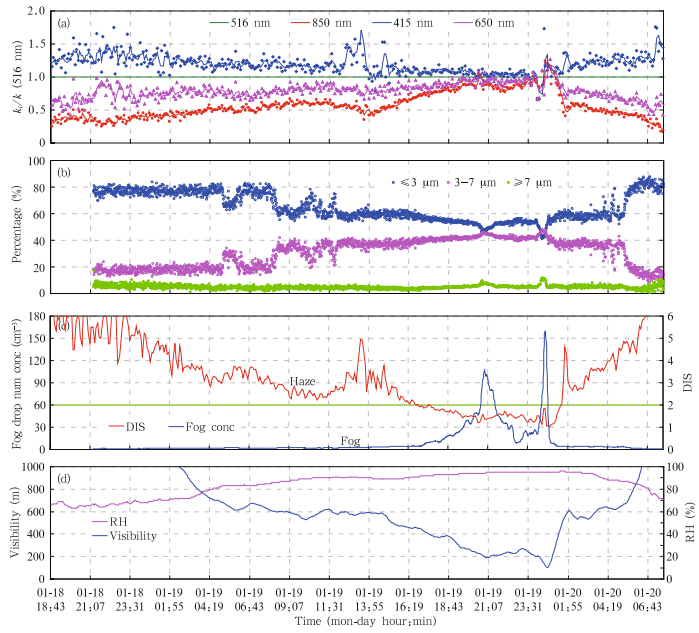 |
| Fig. 5. As in Fig. 4, but for the fog event during 18–20 January 2010. |
After 0100 BT 20 January, the visibility began toincrease but was still lower than 1000 m. It shouldbe noted that, from 0155 to 0300 BT 20 January, althoughthe RH was maintained at 95%, the fog monitorrecorded only a few fog droplets. Accordingly, theextinction coefficients at the four wavelengths had alsodiverged from each other. The extinction coefficient atthe shorter wavelengths was larger than at the longerwavelengths and the DIS was larger than 2. Both thefour-wavelength transmissometer and the fog monitordetermined this period to be with haze. Therefore, under high RH conditions, the four-wavelength transmissometercan make determinations that are as preciseas the fog monitor. After 0300 BT 20 January, theRH decreased to 70% and visibility increased to over1000 m. The difference between the four wavelengthsincreased, indicating the extinction characteristics ofhaze.
During the two periods discussed above, the determination of fog and haze from the four-wavelengthtransmissometer was consistent with that of the fogmonitor. At high fog droplet concentrations, the extinctioncoefficients at the four wavelengths were similar, which meets the criteria for light extinction by fog.When the fog droplet concentration was close to zero, the extinction coefficient at shorter wavelengths wassignificantly larger than at longer wavelengths, whichmeets the criteria for light extinction by haze. Duringboth monitoring periods, the use of a DIS threshold of2 provided an accurate discrimination between haze and fog, particularly under conditions of high RH.Therefore, the four-wavelength transmissometer provideda distinct identification of fog and haze duringfog-haze transitional periods and produced measurementsconsistent with the fog monitor.5. Conclusions
Haze and fog are responsible for low visibility and have negative impacts on people’s lives. Haze and fogare two different weather phenomena with distinctlydifferent causes. The RH and visibility are commonlyused but are not objective criterions to distinguish fogfrom haze, especially under conditions of high RH and low visibility. Therefore, a method of objectively distinguishingbetween fog and haze is necessary and ofgreat importance.
The significant difference in the size of fog and haze particles leads to an apparent difference in lightextinction characteristics. From Mie scattering theory, for haze with particles of less than 1 μm, the extinctioncoefficient at shorter wavelengths is larger than atlonger wavelengths. During the transition from hazeto fog, as a result of the hygroscopic growth of theparticles, the difference between the extinction coefficientsat different wavelengths decreases, falling into anarrow range of variation.
On the basis of the above theoretical conclusions, a four-wavelength transmissometer based onCCD imaging was built with the central wavelengthsof 415, 516, 650, and 850 nm, respectively. Light wasgenerated from an inc and escent source installed besidethe CCD, before passing through air where extinctioncould occur and then be reflected by mirrors and finally received by the CCD. The Beer-Lambertlaw was used to calculate the extinction coefficients atthe four wavelengths. The DIS value, which indicatesthe relative size of the extinction coefficients at thefour wavelengths, was used to distinguish between fog and haze. Fog was determined to occur when the extinctioncoefficients at four wavelengths became equal, while haze was determined when the light at shorterwavelengths was significantly more reduced than thatat longer wavelengths.
The four-wavelength transmissometer was testedin the field during the winter of 2009. A fog monitorwas used to confirm the fog measurement and tovalidate the performance of the four-wavelength transmissometer.The visibility data provided by an FD12forward scattering meter and RH data from an AWSwere used as reference values. A DIS threshold of 2 wasused as the criterion to determine fog or haze. Fromexperimental observations during the two fog events on15 November 2009 and 20 January 2010, when the fogmonitor recorded a high fog number concentration, theDIS was lower than 2 and the extinction coefficients atthe four wavelengths were similar, which met the criteriafor light extinction by fog. When the fog dropletnumber concentration was low, even though the visibilitydropped below 1000 m and the RH was higherthan 90%, the DIS was higher than 2, and the extinctioncoefficient at shorter wavelengths was larger thanthat at longer wavelengths, which indicated a hazeevent rather than fog. The four-wavelength transmissometerprovided measurements consistent with thefog monitor during several fog and haze events, especiallyunder low visibility and high RH conditions.
In summary, the four-wavelength transmissometercan distinguish between fog and haze according tothe different extinction characteristics of fog and haze.The experimental results suggest that the method ofCCD four-wavelength imaging could also be used todetermine other optical features of haze or fog. Accordingto the observations of two fog events duringthe field measurements, a DIS threshold of 2 isobtained to distinguish between fog and haze. Undernatural conditions, the aerosol spectrum spectralchanged significantly and the DIS value is highly affectedby the fog drops and aerosols spectrums. Due tothe difference of the fog drop and aerosols spectrumsin the two cases, we do not have sufficient data to obtaina more representative DIS. The transmissometershould still be tested through a series of theoreticalcalculations and practical experiments.
Acknowledgments. We thank the HaChi(Haze in China)campaign for providing the preciousrelative humidity and visibility data and other importantsupport.
| [1] | Anderson, T. L., Charlson, R. J., Schwartz, S. E., Knutti, R., Boucher, O., Rodhe, H., and Heintzenberg, J., 2003: Climate forcing by aerosols - a hazy picture, Science, 300, 1103-1104, . |
| [2] | Bohren, C. F. and Huffman, D. R., 1983: Absorption and Scattering of Light by Small Particles, John Wiley, Hoboken, 477-482. |
| [3] | Chen Jing, Zhao Chunsheng, Ma Nan, Liu Pengfei, T. Göbel, E. Hallbauer, Deng Zhaoze, Ran Liang, Xu Wanyun, Liang Zhi, Liu Hongjian, Yan Peng, Zhou Xiuji, and A. Wiedensohler, 2012: A parameterization of low visibilities for hazy days in the North China Plain. Atmos. Chem. Phys., 12, 4935-4950.doi:10.5194/acp-12-4935-2012 |
| [4] | Cheng, Y. F., Wiedensohler, A., Eichler, H., Heintzenberg, J., Tesche, M., Ansmann, A., Wendisch, M., Su, H., Althausen, D., Herrmann, H., Gnauk, T., Brüggemann, E., Hu, M., and Zhang, Y. H., 2008: Relative humidity dependence of aerosol optical properties and direct radiative forcing in the surface boundary layer at Xinken in Pearl River Delta of China: An observation based numerical study, Atmos. Environ., 42, 6373-6397. |
| [5] | Deng Xuejiao, Tie Xuexi, Wu Dui, Zhou Xiuji, Bi Xueyan, Tan Hanbo, Li Fei, and Jiang Chenglin, 2008: Long-term trend of visibility and its characterizations in the Pearl River Delta Region (PRD), China, Atmos. Environ., 42, 1424-1435. |
| [6] | Deng Zhaoze, Zhao Chunsheng, Ma Nan, Liu Pengfei, Ran Liang, Xu Wanyun, Chen Jing, Liang Zhi, Liang Si, Huang Mengyu, Ma, X. C., Zhang, Q., Quan, J. N., Yan, P., Henning, S., Mildenberger, K., Sommerhage, E., Schäfer, M., Stratmann, F., and Wiedensohler, A., 2011: Size-resolved and bulk activation properties of aerosols in the North China Plain, Atmos. Chem. Phys., 11, 3835-3846, doi:10.5194/acp-11-3835-2011. |
| [7] | Garland, J. A., Rae, J. B., 1970: An integrating nephelometer for atmospheric studies and visibility warning devices. J. Physics. E. Sci. Instr., 3, 275-280. |
| [8] | Gazzi, M., Vicentini, V., Pesci, C., Bonafe, U., 1985: Integrating nephelometer performance in fog and thick haze. Il Nuovo Cimento C. 8, 869. |
| [9] | Gazzi, M., Georgiadis, T., Vicentini, V. 2001: Apparent anomalous extinction in fog. Atmos. Environ. 35, 5151-5156. |
| [10] | Houghton, H.G., Chalker, W.R., 1949: The scattering cross section of water drops in air for visible light. Journal of the Optical Society of America 39, 955-957. |
| [10] | Leitte, A. M., Schlink, U., Herbarth, O., Wiedensohler, A., Pan, X.-C., Hu, M., Richter, M., Wehner, B., Tuch, T., Wu, Z., Yang, M., Liu, L., Breitner, S., Cyrys, J., Peters, A., Wichmann, H. E., and Franck, U., 2011: Size-segregated particle number concentrations and respiratory emergency room visits in Beijing, China, Environ. Health Perspect., 119, 508-513, doi:10.1289/ehp.1002203. |
| [11] | Liu Pengfei, Zhao Chunsheng, Göbel, T., Hallbauer, E., Nowak, A., Ran Liang, Xu Wanyun, Deng Zhaoze, Ma Nan, Mildenberger, K., Henning, S., Stratmann, F., and Wiedensohler, A., 2011: Hygroscopic properties of aerosol particles at high relative humidity and their diurnal variations in the North China Plain, Atmos. Chem. Phys., 11, 3479-3494, doi:10.5194/acp-11-3479-2011. |
| [12] | Ma Nan., Zhao Chunsheng, Nowak, A., Müller, T., Pfeifer, S., Cheng, Y.F., Deng Zhaoze, Liu Pengfei, Xu Wanyun, Ran Liang, Yan Peng, Göbel, T., Hallbauer, E., Mildenberger, K., Henning, S., Chen Jing, L. L., Zhou Xiuji, Stratmann, F., and Wiedensohler, A., 2011: Aerosol optical properties in the North China Plain during HaChi campaign: an in-situ optical closure study, Atmos. Chem. Phys., 11, 5959-5973, doi:10.5194/acp-11-5959-2011. |
| [13] | Mie, G., 1908: Beiträge zur optic trüber Medien speziell kolloidaler Metallosungen, Ann. Phys., 25, 377-445. |
| [14] | Pinnick, R.G., Hoihjelle, D.L., Fernandez, G., Stenmark, E.B., Lindberg, J.D., and Hoidale, G.B., 1978: Vertical structure in atmospheric fog and haze and its effects on visible and infrared extinction, J. Atmos. Sci. 35, 2020-2032. |
| [15] | Quinn, P. K. and Bates, T., 2003: North American, Asian, and Indian haze: similar regional impacts on climate, Geophys. Res. Lett., 30, 1555. |
| [16] | R. G. Eldridge, 1969: Mist-the transition from haze to fog, Bull. Am. Meteorological Soc., 50, 422-426. |
| [17] | Wu Dui, 2006: A discussion on the significance of relative humidity to the distinction between haze and fog in the city, Guangdong Meteorology, 1, 9-13. (in Chinese) |
| [18] | Yan Peng, Pan Xiaole, Tang Jie, Zhou Xiuji, Zhang Renjian, and Zeng Liming, 2009: Hygroscopic growth of aerosol scattering coefficient: A comparative analysis between urban and suburban sites at winter in Beijing, Particuology, 7, 50-60. |