 2013, Vol. 27
The Chinese Meteorological Society
Article Information
- GUo Jianping, NIU Tao, WANG Fu, DENG Minjun and WANG Yaqiang. 2013.
- Integration of Multi-source Measurements to Monitor Dust over North China:A Case Study
- J. Meteor. Res., 27(4): 566-576
- http://dx.doi.org/10.1007/s13351-013-0409-z
-
Article History
- Received July 18, 2012
- in final form March 25, 2013


2 School of Automation, University of Electronic Science and Technology of China, Chengdu 611731
It is well known that deserts are one importantsource of large amount of mineral dust particles thatgreatly reduce visibility and degrade air quality. Dustparticles affect the global climate by scattering and absorbingsolar radiation, as well as absorbing and emittingoutgoing longwave radiation(Slingo et al., 2006).Dust transported from inl and deserts is often mixedwith large concentrations of locally generated pollutionaerosols. The local pollution alone can enhancethe solar heating of the low atmosphere by 50%(Ramanathan et al., 2007). Moreover, s and -dust storms(SDSs)exert huge influences thous and s of kilometersaway from the source regions, over the distance ofwhich the dust is transported(Gong et al., 2006).
Due to the dust emission from several desertsource regions in Mongolia and northern and northwesternChina, SDSs are often reported in spring overnorthern China, even reaching the lower reaches of theYangtze River, Yellow Sea, Korean Peninsula, JapanIsl and , and North Pacific(Duce et al., 1980; Guo et al., 2010; Husar et al., 2001).
Studies based on ground station observations indicatea decreasing trend of dust events in Chinafor the past several decades(e.g., Qian et al., 2002).North China, comprising many industrial and pollutedcities such as Beijing, Tianjin, Shijiazhuang, etc., hasreceived special attention due to the increasing industrialization and population in these cities in the recentyears. Monitoring of SDSs over these cities is especiallyimportant.
Since the surface observations are sparse globally, it is frustratingly difficult to determine the dustsource regions and the transport pathways. The ModerateResolution Imaging Spectroradiometer(MODIS)deep blue algorithm can provide dust load informationover extensive areas, especially highly reflectiveregions such as urban areas and desert source regions, but can lead to an underestimation of the aerosol opticaldepth(AOD)associated with shallow dust plumesnear the earth’s surface(Hsu et al., 2004). The impactof dust aerosols appears to be unambiguously heightdependent, which is vital for a more accurate simulation and better three-dimensional structure monitoringof dust events.
There are several techniques to evaluate the verticaldistribution of aerosols, among which lidar observationis the most popular. Recently, spaceborne lidars(e.g., the Cloud-Aerosol LIdar with Orthogonal Polarization(CALIOP))have provided an unprecedentedway to examine the aerosol vertical distribution overthe globe(Brun et al., 2011; Guo et al., 2010; Liu et al., 2008; Mishra and Shibata, 2012; Winker et al., 2003, 2007), especially for SDS episodes(Liu et al., 2008), albeit a relatively long revisit period(16 days) and narrower swath(approximately 90 m).
CALIOP measurements have been applied in numerousstudies concerning dust monitoring(Ackerman et al., 2000; Chand et al., 2008; Huang et al., 2007, 2008; Uno et al., 2008). Unfortunately, few studieshave tried to present the integrated views of dust activitiesfrom multiple sensor measurements(e.g., groundbasedPM10 observations)over northern China, letalone the views of the CALIOP aerosol subtypes overthis region. This study will fill this gap.
Given the various limitations of a single sensor, such as long revisit period, narrow swath, and smallspatial coverage, multi-sensor measurements onboardmultiple satellites have been widely used to observedust storms since the A-Train satellites fly in formationsince the beginning of this century(Liu et al., 2008; Vishkaee et al., 2011; Vishkaee et al., 2012).
In our previous paper(Guo et al., 2010), aerosolparticles for the haze episodes over the Yellow Sea havebeen successfully identified from multi-sensor measurements.Back trajectory analysis indicates that thehaze can be traced back to biomass burning in Juneover eastern China. By means of applying altitude resolvedCALIOP level 2 aerosol subtypes product, thisstudy aims to extend our previous study in order tobetter underst and the whole SDS episode occurringin North China in the springtime of 2010. On topof this, three-dimensional view of dust occurrence and transport is expounded by a combined back trajectorymodel.
The organization of this paper is as follows. Data and methods are given in Section 2. Section 3 elucidatesthe main findings of SDS monitoring from multisensorobservations, and discusses the possible dustsources and the dust transport routes. Last, the mainconclusions are summarized in Section 4.2. Data and methods2.1 Data
In spring, North China is commonly influencedby dust storm episodes transported by northwesterly and westerly winds from desert source regions withinMongolia or northwestern China.In this study, we use ground-based PM10 observationsat 19 SDS sites in northern China(Table 1), together with coincident aerosol optical properties(such as AOD, and aerosol subtypes)to depict the SDSepisode during 17–21 March 2010 from multiple spaceborneremote sensing platforms, such as MODIS onboardAqua and CALIOP onboard the Cloud-AerosolLidar Infrared Pathfinder Satellite Observations(hereinaftercalled CALIPSO).
To temporally match the MODIS/Aqua and CALIPSO observations from the A-Train program, PM10 data at 1330 LT(local time)for each dayduring the SDS episode are collected by means ofa ground-based in-situ instrumentation(a ThermoScientific tapered element oscillating microbalance, TEOM-1400a), usually performed on dried aerosols(RH < 15%)to obtain measurements that are independentof the air flow relative humidity(RH). TheseTEOM instruments operate at 19 SDS stations(Table 1), which are part of the China Aerosol Remote SensingNetworks(CARSNET).
The issued MODIS AOD product is reported withan accuracy of Δτ = 0.05±0.15τ(τ represents AOD)over l and (Remer et al., 2005). In this study, the newgeneration(Collection 005)of MODIS/Aqua aerosolalgorithm(MOD08), complemented with the deepblue algorithm(Hsu et al., 2004), exhibits overwhelminglystrong capabilities over both dark and highly reflectivel and s. Therefore, this suite of AOD algorithmsis a complete overhaul from that developed previously(Levy et al., 2007).
Large amount of validations of MODIS deep blueAOD against AERONET sun/sky radiometer measurementsaround the world have been widely performed.The results show that the MODIS retrievedAOD is in good agreement with ground-based AerosolRobotic Network observations(i.e., with bias less than30%)(Hsu et al., 2004; Mishchenko et al., 2010; Wong et al., 2013).
The MODIS/Aqua AOD product used here isa level-3 gridded(1°×1°)product at 550 nm, representativeof the aerosol load at about 1330 LT.Meanwhile, CALIOP vertically resolved aerosol subtypesdata are collocated with MODIS/Aqua AOD and directly downloaded from the Giovanni web portal(http://disc.sci.gsfc.nasa.gov/giovanni).
Compared with the wide spatial coverage ofMODIS, CALIOP has a swath with essentially zerowidth(90 m)but can provide height resolved distributioninformation of dust up to 40-km height.CALIPSO satellite was launched in April 2006(Winker et al., 2003, 2007), designed to acquire verticalprofiles of elastic backscatter at two wavelengths(532 and 1064 nm)from a near nadir-viewing geometry during both day and night phases of the orbit.
CALIOP Level-2 vertical feature mask is utilizedto discriminate between aerosol and cloud, aswell as various aerosol subtypes. The performanceof the CALIOP aerosol classification algorithms hasalso been demonstrated to be excellent(Omar et al., 2009). Moreover, the CALIOP aerosol subtypeclassification is proved reliable through validatingagainst AERONET(Holben et al., 1998)aerosol subtypeproducts, since about 70% of the CALIOP and AERONET aerosol types are in agreement, particularlyfor dust and polluted dust types, but are subjectto misclassification errors under certain circumstances.The most prominent error is the misclassification ofdust or smoke as cloud, which often occurs when thedust or smoke layer is thick, and its optical propertiesbecome similar to those of cloud, or if the aerosol islocated near a cloud layer, but this type of error occursin less than 1% of the dust cases in the study of Liu et al.(2009).
On account of the accuracy described above, thisVertical Feature Mask(VFM)data can be used as akey complementary to ground-based PM10 measurements, largely due to the fact VFM can provide detailedvertical dust data over specific regions.2.2 Methods
The remotely sensed dust measurements usedhere is AOD, which is the vertically integrated aerosolextinction that optically quantifies the aerosol load inthe whole atmospheric column. Remote sensing ofAOD from MODIS represents a prospective tool tocomplement in-situ measurements of dust load(PM10)for its strong association with surface PM10 concentrations(Chu et al., 2003; Guo et al., 2009; Gupta and Christopher, 2009; Liu et al., 2009).
In order to comprehensively characterize the SDSevent in March 2010, MODIS AOD, together withPM10 concentrations and CALIOP aerosol subtypesproduct, are integrated in the analysis. The Aqua(main payload: MODIS) and CALIPSO(main payload:CALIOP)satellites are part of A-Train, whichcan view the atmosphere at about 1330 LT over thesame place. Hence, PM10 concentration is averagedbetween 1300–1400 LT for each SDS site in Table 1.This will make all the observations from multiple sensorsbe collocated.
Notably, when no valid AOD retrievals of MODISare available due to cloud cover or dense dust plumes, measurements of PM10 concentrations at the nearestSDS site where the SDS occurs can be utilized.Also, pixels from nearby MODIS true-colorimages are used to visually estimate the SDS eventwhenever possible. The sources and moving trajectoriesof this SDS event are identified using theHybrid Single-Particle Lagrangian Integrated Trajectory(HYSPLIT)model(Draxler and Rolph, 2013).Then, the HYSPLIT model output is combined withCALIOP aerosol subtype data to illustrate the pathwaysin three-dimensional views.3. Results and discussion
A blowing SDS swept through the northern partof China and southern Mongolia during 17–21 March2010. In the following, we will present the groundbaseddust weather report and PM10 observations, along with the MODIS and CALIOP measurementsfor simultaneously integrated monitoring of this SDSepisode.3.1 In-situ ground-based PM10 observations
Figure 1 shows the locations of the 19 groundbasedSDS monitoring sites and the main desert sourceregions of China(shaded area), which are of importancefor analyzing the spatial pattern and sources ofthe SDS episode observed over the North China Plain.The color-coded circles in Fig. 1 denote different PM10concentration levels at 1330 LT at each site during 17–19 March 2010.
 |
| Fig. 1. Map of the 19 SDS sites used in the study. The color coded circles show different PM10 concentration levels at1330 LT(a)17, (b)18, and (c)19 March 2010. The blue dashed lines from left to right refer to CALIPSO orbit pathson 17, 18, and 19 March, respectively. |
At sites TZ and HT in the Taklimakan desert, west of the left CALIPSO track in Fig. 1, PM10 concentrationsalways stay at high levels(above 100 μg m−3). Conversely, at sites like EJN near the middleCALIPSO track, and sites like BJ, ZB, and HMnear the right CALIPSO track, there is a distinct upwardtrend in PM10 concentration, indicating a possibleSDS event occurring at these sites.
As demonstrated in Fig. 2a, the PM10 concentrationat BJ(39.8°N, 116.47°E)reaches the highestvalue of 283 μg m−3 on 20 March 2010 from the backgroundvalue of 15 μg m−3 measured on 17 March2010, then drops to 176 μg m−3 on 21 March 2010.MODIS AOD exhibits the same increasing tendencywith ground-based PM10 measurements during 17–20 March 2010. Unfortunately, we cannot compareground-based PM10 and space-borne AOD directly atthis time due to missing values on 20 March 2010.Similar to PM10, AOD decreases to 0.56 on 21 March2010, suggesting the end of this dust storm. The casefor BJ suggests that the dust episode in the NorthChina Plain lasts for two days(19–20 March).
 |
| Fig. 2. Time series of PM10 concentration and AOD from MODIS/Aqua at 1330 LT of each day of the period 17–21March 2010 at(a)BJ(39.8°N, 116.47°E) and (b)EJN(41.95°N, 101.07°E). |
In contrast, as can be seen from Fig. 2b, bothPM10 and collocated MODIS AOD reflect the samevariation of dust load during 18–20 March 2010 at EJN(41.95°N, 101.07°E), rising to the peak values of PM10(1320 μg m−3) and AOD(1.73)on 19 March 2010.3.2 MODIS AOD distributions
According to the above PM10 analysis, we suspectthat a severe s and -dust storm occurred on 19 March2010. In this subsection, we will elucidate the SDSepisode from the MODIS image and the aerosol opticalproperties(i.e., AOD).
Figure 3 shows the area of this study in RGB truecolor from three MODIS wavelengths(i.e., R: 670 nm, G: 550 nm, and B: 470 nm). The MODIS images onboardthe Aqua satellite were acquired on 17, 18, and 19 March 2010, respectively.
 |
| Fig. 3. The RGB(R: 670 nm; G: 550 nm; B: 470 nm)true color MODIS images showing the study area of northernChina on(a)17, (b)18, and (c)19 March 2010. The corresponding CALIPSO orbit paths are denoted by black dashedlines. |
Due to the dense cloud cover over this region, thespace-borne optical sensor like MODIS cannot penetratethe cloud layers(Remer et al., 2005) and detectthis dust event, as shown in the RGB plot in Fig. 3c. The time series of RGB true color MODIS imagesserves as the base layer in this study, from whichMODIS AOD product from the deep blue algorithmis produced(Hsu et al., 2004).
As shown in Fig. 3, cloud is found almost every-where over the whole study area, and dust is oftenmixed with cloud, which seems to be difficult to distinguishbetween cloud and aerosol using the MODISimages alone, although some SDS plumes can be distinguishedby their yellow coloration.
Fortunately, the MODIS AOD using the deep bluealgorithm provides quantitative dust load informationto some extent over cloud free and cloud transitionregion in Fig. 4. Figure 4 shows wide white areas, indicatingmissing AOD values due to cloud cover, wheresurface weather observations recorded dust events instead.For example, the SDS was observed in northeasternChina, the North China Plain, the central partof Inner Mongolia, and almost the whole Mongolia on19 March 2010. As seen in Fig. 4, AOD also reachesvalues as high as 2.0 in southern Mongolia and westernpart of Inner Mongolia of China.
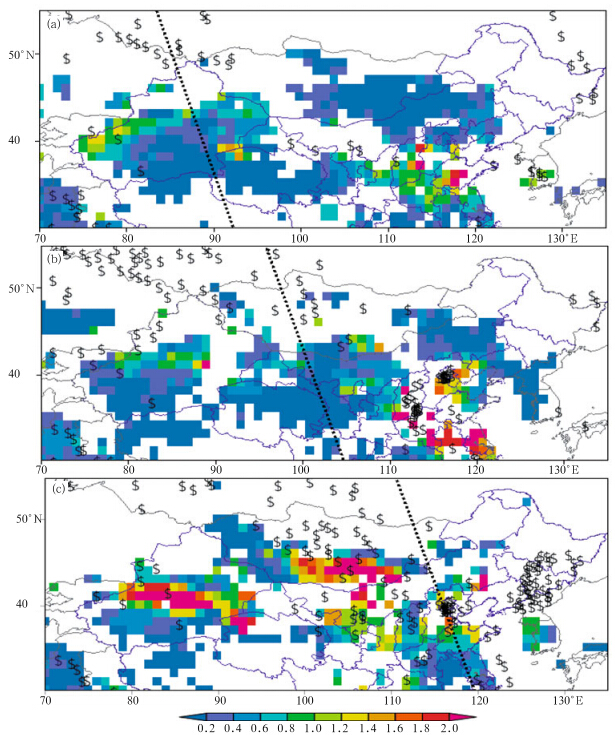 |
| Fig. 4. MODIS AOD distribution(color-shaded)over North China on(a)17, (b)18, and (c)19 March 2010, overlaidwith ground dust observations and CALIPSO track. The weather symbol $ refers to dust(storm) and black dashed linesrefer to CALIPSO tracks. MODIS AOD in the white regions is missing due to extensive cloud cover. |
We can use the space-borne CALIOP records tofurther investigate the day-to-day variability of the 17–19 March 2010 dust episode and the vertical distributionof dust load. To illustrate the dust transportin a three-dimensional view, the vertical cross-sectionof the CALIOP aerosol subtypes combined with theHYSPLIT transport routes is shown in Fig. 5. TheCALIOP retrieved aerosol subtypes product indicatesthat dust may be lifted to altitudes as high as about3.5 km over northern China, as shown in Fig. 5.
The dense plume appears over the Tarim basin, with its top reaching 3 km, indicating that the airbornedusts over the Tarim area are associated withdust activities in the Taklimakan desert where groundstations recorded dust events during 17–19 March2010. In addition, on 18 March, similar dust plumesare registered by both CALISOP and surface weatherstations over Gansu Province where there exist manydesert source regions nearby Inner Mongolia.
As illustrated in Fig. 5, a three-day back trajectoryanalysis using the HYSPLIT model suggeststhat dust originates in the desert source regions overnorthwestern China, passes over the Loess Plateau, and then reaches the North China Plain. Figure 5reveals that dust from the Gobi desert on 18 Marchtravels approximately 1200–1500 km day−1 eastward and passes over the North China Plain on 19 March2010, remarkably consistent with findings of Uno etal.(2008). The climatology of planetary boundarylayer(PBL)height by radiosonde data reveals that thePBL is typically less than 1 km during daytime and less than 0.5 km at night over continental areas(Seidel et al., 2012). It is interesting to find that the SDSepisode is largely constrained in the height range of3.0–3.5 km along the transport pathway, presumablyowing to the dust transport in the free atmosphere.By and large, the influence of the Taklimakan deserton the dust episode observed over the North ChinaPlain appears to be very little.
As expected, these measurements show the largestdegree of similarity in the dust distribution patternsover the source regions of northwestern China, wheredust is the dominant aerosol type.3.4 Integrated analysis using multi-sensor measurements
It has proved frustratingly difficult to characterizethe dust episode by using a single sensor alone. We emphasizethat the CALIPSO aerosol subtypes product and surface PM10 observations, together with groundbasedweather reports and back trajectory analysis, are generally complementary to MODIS AOD measurements.
The MODIS AOD provides spatial context aboutthe distribution of dust load, basically consistent withground-level PM10 data, especially for areas free ofcloud contamination, as illustrated in Fig. 4. SurfacePM10 data are slightly more reliable than MODISAOD in regions with cloud cover because surface measurementscannot be easily affected by the cloud. However, PM10 measurements cannot identify differentaerosol subtypes, which can be provided by CALIOPinstead. Due to its low sampling frequency comparedto MODIS and TEOM instrument(PM10), CALIOPdoes not observe the dust plumes at places whereCALIPSO orbit pathways cannot pass over, althoughit can provide height resolved dust information(Fig. 5).
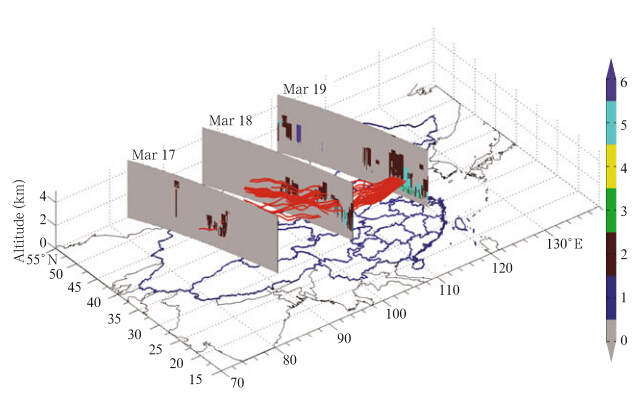 |
| Fig. 5. The HYSPLIT model derived 48-h backward trajectories ending in the North China Plain at 1500 m above sealevel during 17–19 March 2010. The color types in the right-h and legend correspond to the following aerosol subtypes: 0:not determined; 1: clean marine; 2: dust; 3: polluted continental; 4: clean continental; 5: polluted dust; and 6: smoke. |
For instance, Fig. 5 demonstrates that there wasan SDS event in Ejina on 18 March while it was notdetectable nearby Minqin to the south. This is corroboratedby the relatively low PM10 concentration and the CALIOP vertical cross-section map.Integrating available data from multiple sensorscreates a three-dimensional picture of dust characteristics and dust transport path that are not readily discerniblefrom satellite data products(or surface measurements)alone. The MODIS true-color images serveas the base layer in this analysis, upon which othersatellite data and HYSPLIT trajectories analysis arebased.
Three consecutive observational maps fromMODIS, CALIPSO, and in-situ PM10 measurementsin northern China during 17–19 March 2010 show aclear temporal shift of the dust episode, with maximumAOD and PM10 values recorded on 19 March(Figs. 1 and 4). Marked differences among surfacePM10 concentrations, altitude resolved CALIOP dustlayers, and MODIS AOD are registered in regionswhere cloud contamination happens.4. Conclusions
Transport of an SDS event over northern China inthe springtime of 2010 has been studied using a suiteof ground-based and space-borne remote sensing platformsas well as modeling tools. Particularly, a threedimensionalview of dust spatial distribution, temporalvariation, source locations, and plume transportare obtained by integrating multi-sensor data sources, serving as a powerful tool in prospective environmentapplications. Furthermore, the cross-comparison ofmultiple satellite data products not only takes advantageof each sensor’s strengths, but also helps identifyareas for future improvement. Ground-based PM10observations obtained from CAWSNET allow new insightinto dust episodes when covered by extensiveclouds. The analysis here clarifies the importance ofSDSs transported from desert sources of Mongolia and northwestern China for air quality issues in large citiessuch as Beijing of North China.
Overall, this study demonstrates the potential useof multi-sensory measurements for the real-time duststorm monitoring purposes on the basis of both insitu and vertically resolved dust observations, whichcomplement each other. Furthermore, it highlightsthe need for taking the aerosol vertical profile intoaccount to unravel the problems of the dust observationalintricacy from space when cloud contaminationoccurs.
Further investigation is needed to determine theseasonal frequency of dust events over northern Chinathrough the vertically resolved dust layers provided byCALIPSO lidar data. Moreover, ground-based aerosollidar profiling instruments at SDS sites of CARSNETare expected to fill the wide gaps of CALIPSO orbitpathways due to its narrow swath in the near future.Acknowledgments. The MODIS AOD dataused in this study were acquired from the GoddardEarth Sciences(GES)Data and Information ServicesCenter(DISC)Distributed Active Archive Center(DAAC). The CALIOP data were obtained from theNASA Langley Research Center Atmospheric SciencesData Center. The authors gratefully acknowledge theNOAA Air Resources Laboratory(ARL)for provisionof the HYSPLIT transport and dispersion model usedin this study.
| [1] | Ackerman, A.S., O.B. Toon, D.E. Stevens, et al., 2000: Reduction of tropical cloudiness by soot. Science, 288, 1042-1047. |
| [2] | Brun, J., P. Shrestha, A.P. Barros, 2011: Mapping aerosol intrusion in Himalayan valleys using the Moderate Resolution Imaging Spectroradiometer (MODIS) and Cloud-Aerosol Lidar and Infrared Pathfinder Satellite Observation (CALIPSO). Atmos. Environ., 45, 6382-6392. |
| [3] | Chand, D., T. Anderson, R. Wood, et al., 2008: Quantifying above-cloud aerosol using spaceborne lidar for improved understanding of cloudy-sky direct climate forcing. J. Geophys. Res., 113, D13206., doi: 10.1029/2007JD009433. |
| [4] | Chu, D.A., Y.J. Kaufman, G. Zibordi, et al., 2003: Global monitoring of air pollution over land from the Earth Observing System-Terra Moderate Resolution Imaging Spectroradiometer (MODIS). J. Geophys. Res., 108. 4661, doi: 10.1029/2002JD003179. |
| [5] | Draxler, R., G. Rolph, 2013. HYSPLIT (HYbrid Single-Particle Lagrangian Integrated Trajectory) Model. NOAA Air Resources Laboratory, Silver Spring, Silver Spring, MD. (April 11, 2012) [March 25, 2013]. http://ready.arl.noaa.gov.HYSPLIT.php. |
| [6] | Duce, R., C. Unni, B. Ray, et al., 1980: Long-range atmospheric transport of soil dust from Asia to the tropical North Pacific: Temporal variability. Science, 209, 1522-1524. |
| [6] | Gong, S.L., X.Y. Zhang, T. Zhao, et al., 2006: A simulated climatology of Asian dust aerosol and its trans-Pacific transport. Part II: Interannual variability and climate connections. J. Climate, 19, 104-122. |
| [7] | Guo, J.P., X.Y. Zhang, C. C. Cao, et al., 2010: Monitoring haze episodes over the Yellow Sea by combining multisensor measurements. Int. J. of Remote Sens., 31(17-18), 4743-4755. |
| [8] | ——, ——, H. Z. Che, et al., 2009: Correlation between PM concentrations and aerosol optical depth in eastern China. Atmos. Environ., 43(37), 5876-5886. |
| [9] | Gupta, P., S.A. Christopher, 2009: Particulate matter air quality assessment using integrated surface, satellite, and meteorological products: 2. A neural network approach. J. Geophys. Res., 114(D20), doi: 10.1029/2008JD011497. |
| [10] | Holben, B., T. Eck, I. Slutsker, et al., 1998: AERONET—A federated instrument network and data archive for aerosol characterization. Remote Sens. of Environ., 66, 1-16. |
| [11] | Hsu, N.C., S.C. Tsay, M.D. King, et al., 2004: Aerosol properties over bright-reflecting source regions. IEEE Trans. Geosci. Remote Sens., 42, 557-569. |
| [12] | Huang, J.P., P. Minnis, B. Chen, et al., 2008: Long-range transport and vertical structure of Asian dust from CALIPSO and surface measurements during PACDEX. J. Geophys. Res. Lett., 34, L18805, doi: 10.1029/2007GL029938. |
| [13] | ——, P. Minnis, Y. Yi, et al., 2007: Summer dust aerosols detected from CALIPSO over the Tibetan Plateau. Geophys. Res. Lett., 113, D23212, doi: 10.1029/2008JD010620. |
| [14] | Husar, R.B., D. Tratt, B. Schichtel, et al., 2001: Asian dust events of April 1998. J. Geophys. Res., 106, 18317-18330. |
| [15] | Levy, R.C., L.A. Remer, S. Mattoo, et al., 2007: Second-generation operational algorithm: Retrieval of aerosol properties over land from inversion of Moderate Resolution Imaging Spectroradiometer spectral reflectance. J. Geophys. Res., 112(D13), doi: 10.1029/2006JD007811. |
| [16] | Liu, Y., C.J. Paciorek, P. Koutrakis, 2009: Estimating regional spatial and temporal variability of PM(2. 5) concentrations using satellite data, meteorology, and land use information. Environ. Health Persp., 117, 886-892. |
| [17] | Liu, Z., D. Liu, J. Huang, et al., 2008: Airborne dust distributions over the Tibetan Plateau and surrounding areas derived from the first year of CALIPSO lidar observations. Atmos. Chem. Phys., 8, 5045-5060. |
| [18] | Mishchenko, M.I., L., Liu, L.D., Travis, et al., 2010: Toward unified satellite climatology of aerosol properties: 3. MODIS versus MISR versus AERONET. J. Quant. Spectrosc. Radiat. Transfer, 111, 540-552. |
| [19] | Mishra, A.K., T. Shibata, 2012: Climatological aspects of seasonal variation of aerosol vertical distribution over central Indo-Gangetic belt (IGB) inferred by the space-borne lidar CALIOP. Atmos. Environ., 46, 365-375. |
| [20] | Omar, A.H., D.M. Winker, M.A. Vaughan, et al., 2009: The CALIPSO automated aerosol classification and lidar ratio selection algorithm. J. Atmos. Ocean Tech., 26, 1994-2014. |
| [21] | Qian, W., L. Quan, S. Shi, 2002: Variations of the dust storm in China and its climatic control. J. Climate, 15, 1216-1229. |
| [22] | Ramanathan, V., M.V. Ramana, G. Roberts, et al., 2007: Warming trends in Asia amplified by brown cloud solar absorption. Nature, 448, 575-578. |
| [23] | Remer, L.A., Y. Kaufman, D. Tanré, et al., 2005: The MODIS aerosol algorithm, products, and validation. J. Atmos. Sci., 62, 947-973. |
| [24] | Seidel, D. J., Y. Zhang, A. Beljaars, et al., 2012: Climatology of the planetary boundary layer over the continental United States and Europe, J. Geophys. Res., 117, D17106, doi:10.1029/2012JD018143. |
| [25] | Slingo, A., T.P. Ackerman, R. Allan, et al., 2006: Observations of the impact of a major Saharan dust storm on the atmospheric radiation balance. Geophys. Res. Lett., 33, L24817, doi:10.1029/2006GL027869. |
| [26] | Uno, I., K. Yumimoto, A. Shimizu, et al., 2008: 3D structure of Asian dust transport revealed by CALIPSO lidar and a 4DVAR dust model. Geophys. Res. Lett., 35(6), doi: 10.1029/2007GL032329. |
| [27] | Vishkaee, F.A., C. Flamant, J. Cuesta, et al., 2011: Multiplatform observations of dust vertical distribution during transport over northwest Iran in the summertime. J. Geophys. Res., 116, D05206, doi:10.1029/2010JD014573. |
| [28] | ——, C. Flamant, J. Cuesta, et al., 2012: Dust transport over Iraq and northwest Iran associated with winter Shamal: A case study. J. Geophys. Res., 117, D03201, doi: 10.1029/2011JD016339. |
| [29] | Winker, D. M., J. Pelon, and M. P. McCormick, 2003: The CALIPSO mission: Spaceborne lidar for observation of aerosols and clouds. Proceedings of SPIE Conference on Lidar Remote Sensing for Industry and Environment Monitoring III. U. N. Singh, T. Itabe, and Z. Liu, Eds.. Hangzhou, P. R. China, 1–11. |
| [30] | —–, W. H. Hunt, and M. J. McGill, 2007: Initial performance assessment of CALIOP. Geophys. Res. Lett., 34(19), L19803, doi: 10.1029/2007GL030135. |
| [31] | Wong, M.S., Shahzad, M.I., Nichol, J.E., et al., 2013: Validation of MODIS, MISR, OMI, and CALIPSO aerosol optical thickness using ground-based sunphotometers in Hong Kong. Int. J. of Remote Sens, 34(3), 897-918. |