 2012, Vol. 26
The Chinese Meteorological Society
Article Information
- SHI Ning and BUEH Cholaw. 2012.
- The COWL Pattern Identified with a Large AO Index and Its Impact on Annular Surface Temperature Anomalies
- J. Meteor. Res., 26(4): 410-419
- http://dx.doi.org/10.1007/s13351-012-0402-y
-
Article History
- Received August 18, 2011
- in final form December 6, 2011


2 Nansen-Zhu International Research Centre, Institute of Atmospheric Physics, Chinese Academy of Sciences, Beijing 100029;
3 Climate Change Research Center, Chinese Academy of Sciences, Beijing 100029;
4 International Center for Climate and Environment Sciences, Institute of Atmospheric Physics, Chinese Academy of Sciences, Beijing 100029
The Arctic Oscillation(AO), also known as theNorthern Annular Mode(NAM), is defined as the leading empirical orthogonal function(EOF)of the sealevel pressure(SLP)field poleward of 20°N(Thompson and Wallace, 1998, 2000). The AO consists ofthree centers of action, one over the Arctic and twoover the Euro-Atlantic and Pacific sectors with opposite signs, which constitute a high-degree annularstructure(Wang et al., 2008). Thompson and Wallace(1998, 2000)found that the AO had a significantinfluence on the winter climate over northern Eurasia and North America, and the increasing trend of theAO index can explain a large fraction of the warmingtrend of the surface air temperature(SAT)over thel and of the Northern Hemisphere during the last century. If the positive phase of the AO dominates, boththe Aleutian low and the Siberian high would be weak.Consistently, the East Asian winter monsoon wouldbe weak, and vice versa(Gong et al., 2001; Wu and Wang, 2002; Chen and Kang, 2006; Yang and Li, 2008). Correspondingly, the breakup date of the riversin Northeast China was significantly modulated by theAO(Wang and Sun, 2009).
However, the observed fact that the Pacific and Euro-Atlantic centers of action of the AO are uncorrelated raises the question of whether its Pacific centercould be an artifact of the EOF analysis(Deser, 2000;Ambaum et al., 2001). To clarify this issue, Wallace and Thompson(2002)argued that the Pacific centercan be significantly correlated with the Atlantic center if the pattern that represents the inversely correlated fluctuations over the North Atlantic and NorthPacific, called the augmented Pacific/North Americanpattern(PNA), is eliminated. In other words, the AOis still an annular mode and its interaction with theaugmented PNA leads to the insignificant relationshipbetween the two centers of action over the two oceans.Similarly, Honda et al.(2001) and Honda and Nakamura(2001)argued that the AO may be interpreted asa superposition of the Aleutian low-Icel and ic low seesaw upon a dominant signal of the Arctic-midlatitudedipole. Despite this debate, the AO index is currentlywidely utilized for weather monitoring and forecasting. Even on a shorter time scale, i.e., the intraseasonal time scale, McDaniel and Black(2005)investigated the dynamical evolution of the AO event and observed a remarkable degree of annular structure ofplanetary scale anomalies. They emphasized that theanomalous stationary wave forcing plays the primaryrole in both the maturing and decaying stages of theAO event.
Another dominant circulation pattern of naturalvariability in the Northern Hemisphere is the coldocean/warm l and (COWL)pattern(Wallace et al., 1995, 1996). In its positive phase, this pattern is characterized by prominent negative SLP anomalies overthe Arctic and North Pacific and positive anomaliesover the North Atlantic, and vice versa. Thus, thetwo centers of action of the COWL pattern over thetwo oceanic basins are negatively correlated, whichis different from the situation of the AO, but theNorth Atlantic part of the COWL pattern is verysimilar to that of AO. Notably, Quadrelli and Wallace(2004)found that the COWL pattern is indistinguishable from the leading EOF of the monthlySLP field. In other words, the COWL pattern wouldbe, to a certain degree, projected onto the AO. Wallace et al.(1995, 1996)revealed that the observedmonthly time series of SAT anomalies averaged overthe Northern Hemisphere could be partitioned intoa very slowly varying "radiative" component, and acomponent exhibiting rapid year-to-year and monthto-month fluctuations. They found that the lattercomponent corresponds to the COWL pattern. Theobserved Northern Hemisphere-averaged SAT trend inthe recent decades is consistent with the strong positive bias of the COWL pattern index during the coldseason(Wallace et al., 1996; Wu and Straus, 2004).
However, the following three questions remainunanswered:(1)If all AO events are identified withmonthly AO indices, whether the two midlatitude centers of action always show the same polarity in thesame phase as shown by Thompson and Wallace(1998, 2000)?(2)Since the COWL pattern shares much resemblance with AO in the spatial structure and in theincreasing trend of their indices, can the COWL pattern be identified from the monthly AO events withstrong amplitudes of AO indices?(3)Compared withall AO events, how does the COWL pattern identifiedin this manner contribute to the global SAT anomalies? The present study primarily focuses on thesethree questions.
This paper is organized as follows. Section 2 describes the data and analysis methods. The resultsbased on the composite analysis are presented in Section 3. The final section consists of a summary and discussion.2. Data and methods
The data used in this study are the monthly meanmeteorological reanalysis product from the US National Centers for Environmental Prediction(NCEP) and the US Department of Energy(DOE)Atmospheric Model Intercomparison Project(AMIP-II)(Kanamitsu et al., 2002)during the period of 1979-2009. The variables include SLP, geopotential height, and SAT, which are available on a global regular longitude/latitude grid with intervals of 2.5°.
The AO indices were derived in a similar manneras in Baldwin and Thompson(2009). First, the principal component(PC)time series of the leading EOF ofthe zonal-mean 1000-hPa geopotential height(Z1000)anomalies north of 20°N were calculated for 5 wintermonths from November to March. Figure 1 shows theregression anomalies of Z1000, SLP, and SAT on theAO index in the 5 winter months; the results are consistent with those of Thompson and Wallace(1998, 2000). Moreover, the regression of Z1000 anomalieswas regarded as the monthly spatial pattern of theAO. The AO indices(AOI), spanning the entire 31-yrdata period, were derived by projecting the monthlymean Z1000 anomalies onto the monthly spatial pattern. A positive(negative)AO event was then definedwith the normalized AOI ≥ 0.5(≤ -0.5)for a particular calendar month. Other thresholds of the AOI werealso examined, and the corresponding results do notqualitatively alter the conclusion obtained here; thisissue will be further discussed in Section 4.
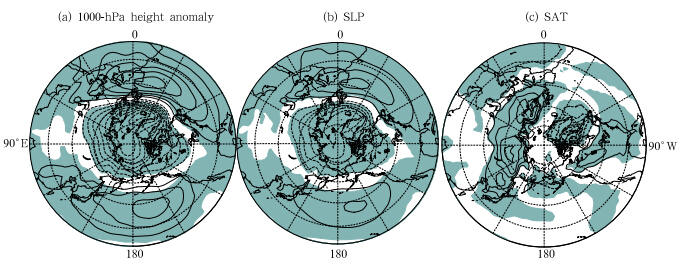 |
| Fig. 1. Regression of(a)height anomalies at 1000 hPa, (b)SLP, and (c)SAT on the AO index. Contour intervals are5 m, 1 hPa, and 0.5°C in(a), (b) and (c), respectively. Solid(dashed)lines are positive(negative)anomalies and zerolines are omitted. The shadings in(a)mark the three areas to be averaged to represent the strength of the local centersof action(see text for further detail), while the shadings in(b) and (c)indicate the regions at the 95% confidence level. |
To examine the COWL pattern contained in allAO events defined with the AOI(i.e., |AOI| ≥ 0.5), we calculated the area-mean(area-weighted)heightanomalies over the Arctic(65°-90°N) and the NorthPacific(30°-50°N, 160°-220°E). For brevity, thesearea-mean monthly height anomalies are called AI and NPI, respectively, after normalized by their means and st and ard deviations for the 31-yr data period. Amonthly COWL event(or pattern)can be defined ifthe monthly AI and NPI have the same sign and theirabsolute values exceed 0.3(approximately 10 m inthe Z1000 anomalies). The positive(negative)COWLpattern corresponds to the positive(negative)AI and NPI. As shown in Table 1, 10 positive COWL eventswere identified from the total 24 positive AO events, and 10 negative COWL events were identified from thetotal 28 negative AO events. Therefore, it is clear thatmore than one-third of the AO events can be classifiedas COWL events(Table 1).
 |
Two types of composites were performed to analyze the spatial patterns of all AO and COWL events.For the first composite, the 5-month mean meteorological fields around each calendar month were removedprior to the analysis to focus only on the month-to-month variability. The second composite method isalmost identical to the first one except that the 5-month mean fields are retained. Thus, in additionto the month-to-month variability, interannual variability that might depend on the external forcing(forexample, the El Niño/Southern Oscillation)was alsoconsidered in the second composite. For brevity, thefirst and second composites are called composite-M and composite-N, respectively. The statistical significance of the composite anomalies is assessed by applying Student's t-test.3. Results3.1 Positive phase
Figure 2 depicts the composite anomalies of Z1000 and SAT for the positive events. Here, the composite-M was performed to consider only the month-to-monthvariability. The composite map of the total AO events(Fig. 2a)projects to a greater degree on the NAOpattern rather than the NAM pattern derived fromthe regression map of the leading EOF of the Z1000field(Figs. 1a and 1b). Compared with Fig. 2a, theCOWL pattern(Fig. 2b)still shares the elements ofthe NAO pattern, but its distinct feature is that ithas a center of action over the North Pacific with thesame sign as the Arctic center and the opposite signas the North Atlantic center. The composite for theremainder of the AO events(hereafter, RM events, forbrevity), as shown in Fig. 2c, shows a typical annularstructure of the AO pattern in Fig. 1a. However, forthe RM events, the center of action over the NorthAtlantic is considerably weak, whereas that over theNorth Pacific becomes strikingly prominent. Notably, as seen in Figs. 2a-2c, the NAO pattern seems tohave a closer association with the COWL event thanthe RM event, as apparently strong height anomalieshave been observed over the midlatitude North Atlantic in the composite of the COWL events. Figures2d-2f present the composite SAT anomalies related tothe AO events. For the total AO events, positiveSAT anomalies cover the high-latitude regions of thetwo continents of the Northern Hemisphere while significant negative ones cover the region around theGreenl and , consistent with those shown in Fig. 1c and the results of earlier studies(Thompson and Wallace, 1998, 2000). As shown in Figs. 2d and 2e, the anomalous SAT distribution in the COWL eventsbears strong resemblance to that in the total AOevents, particularly over the high-latitude l and whilethe SAT anomalies in the RM events show little significance. This result suggests that the annular SATanomaly distribution over the high-latitude regions ofthe two continents in the Northern Hemisphere primarily results from the COWL event. For the COWLpattern, the negative height anomalies over the NorthPacific correspond to the enhancement of the AleutianLow and , thus, the enhanced warm advection over thewestern and northwestern parts of the North Americancontinent. Consequently, the positive SAT anomaliesare formed in that region(Fig. 2e). For the COWLpattern, the negative height anomalies over the Arcticare extended even more toward the Eurasian continent(Fig. 2b)than those in Figs. 2a and 2c. Such a flowpattern is favorable for an anomalous warm air advection and hence the positive SAT anomalies over thehigh-latitude region of the Eurasia continent.
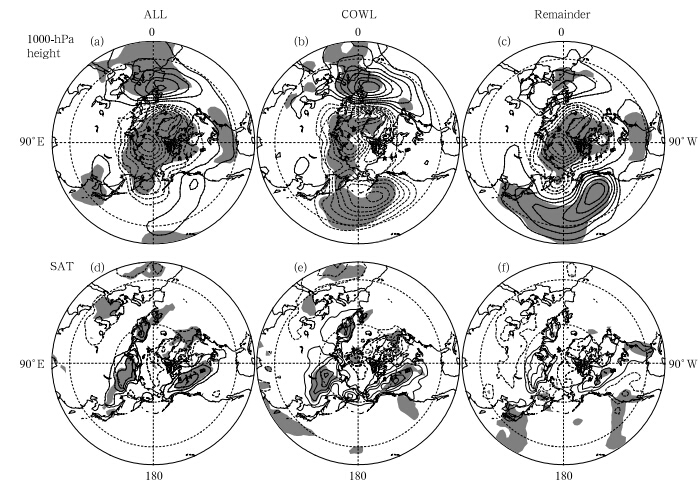 |
| Fig. 2.(a)-(c)Composite geopotential height anomalies(m; contours with intervals of 5 m) and (d)-(f)the corre-sponding anomalous SAT(℃; contours with intervals of 0.5 ℃)of the positive AO events at 1000 hPa. Solid(dashed)lines represent positive(negative)anomalies and zero lines are eliminated in all panels. Shading marks the region at the95% confidence level. |
Figure 3 shows the composite Z1000 and SATanomalies for the positive events, for which thecomposite-N was performed. If the year-to-year variability is taken into account, the horizontal pattern ofZ1000 anomalies(Figs. 3a-3c)also retains the structure in the composite-M, but the corresponding amplitudes of the center of action become conspicuouslystronger than in the composite-M(Figs. 2a-2c). Forinstance, the height anomalies over the North Atlantic and North Pacific centers in Fig. 3 are twice as strongas those in Fig. 2, for both the COWL event and theRM event. In line with this feature, the regions at the95% significance level are also extended to cover evenwider extents. These features are also true for thecomposite SAT anomaly distribution(Figs. 3d-3f).Some differences, however, can be found between theSAT anomalies of the two types of composites. Specifically, in contrast to that in Fig. 2f, the RM eventin the composite-N can significantly influence thehigh-latitude Eurasian continent, from northern Europe to northeastern Asia(Fig. 3f). However, thepositive SAT anomalies over the North American continent shown in Fig. 3d are absent in Fig. 3f, implying that the COWL pattern would be responsiblefor the positive SAT anomalies. Importantly, it canbe inferred from Figs. 2 and 3 that both the monthto-month and year-to-year variability are of equivalentimportance to the total AO events.
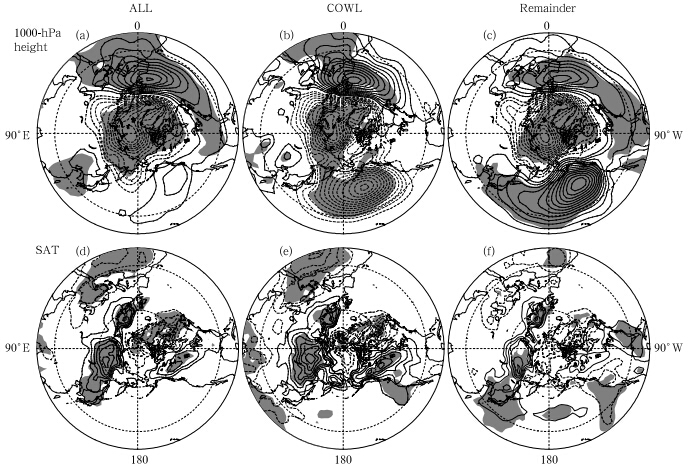 |
| Fig. 3. As in Fig. 2, but for the composite in which the year-to-year variability is taken into account. |
The height anomalies in the upper troposphere and mid-stratosphere are displayed in Fig. 4, usingthe composite-M. Overall, as indicated in Figs. 2a-2c and Fig. 4, all AO events are manifested in the quasibarotropic height structure from the troposphere tothe stratosphere. The annularity of height anomaliesin the RM event is more obvious than in the COWLevent in the whole troposphere and stratosphere. Interestingly, as shown in Fig. 4b, the COWL patternalso contains elements of a PNA-like pattern, whichsuggests that both the NAO pattern and the PNA-likepattern have possibly contributed to the occurrence ofthe COWL pattern and thus the related global SATanomaly distribution. At 50 hPa, the COWL eventexhibits positive height anomalies over the Asian continent and the North American continent(Fig. 4e), while the RM event is accompanied by positive anomalies over the Europe/North Atlantic sector and overthe North Pacific(Fig. 4f). Consequently, the composite map of height anomalies in the total AO events(Fig. 4d)has a high degree of annularity. Similar features in the upper troposphere and mid-stratosphereare also found for the analysis of composite-N(figureommited).
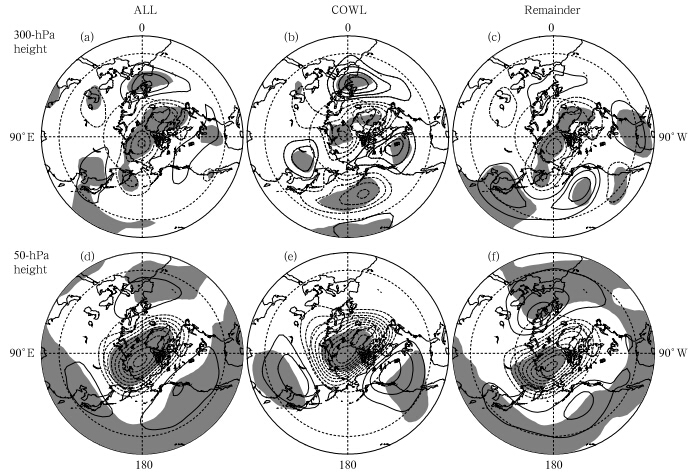 |
| Fig. 4. As in Fig. 2, but for the height anomalies at 300(upper panels) and 50 hPa(lower panels)with intervals of15 m. |
Figures 5 and 6 present the Z1000 and SATanomalies for the negative events in the composite-M and composite-N, respectively. Many features ofAO events in the negative phase are similar to thosein the positive phase, except for the opposite polarities. In contrast to the situation of the positive phase, a distinct feature shown in Figs. 5a and 6a is that thenegative height anomalies cover the mid- and highlatitude Asian continent, indicating a suppressedSiberian high. As such, the Z1000 anomalies in theNorthern Hemisphere show a high degree of annularity over a vast region from North Europe, via NorthAsia, to northwestern Pacific. Consistent with thesuppressed Siberian high, warm SAT anomalies areobserved over East Asia in Figs. 5d and 6d. It can beinferred from Figs. 5a-5c and 6a-6c that the COWLpattern has primarily contributed to the weakenedSiberian high and hence the warm SAT anomalies overEast Asia. The well-organized annularity of the SATanomalies over the high-latitude l and in Figs. 5d and 6d is mainly ascribed to the influence of the COWLpattern(Figs. 5e, 5f, 6e, and 6f). Again, the comparison between Figs. 5 and 6 suggests that the monthto-month and year-to-year variability are equally important to all AO events.
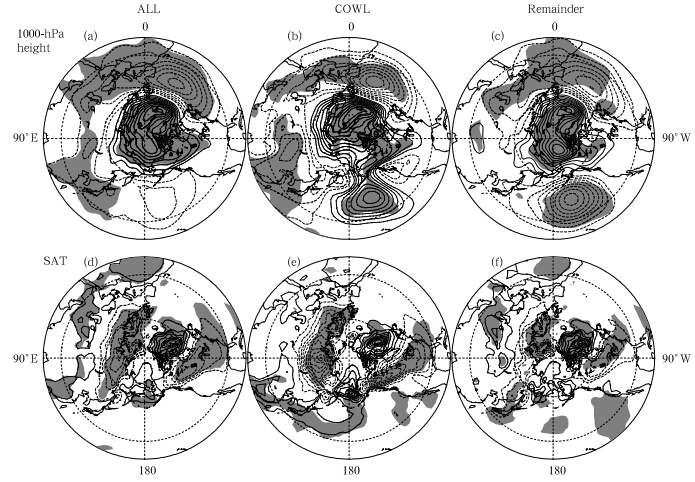 |
| Fig. 5. As in Fig. 2, but for the negative phase. |
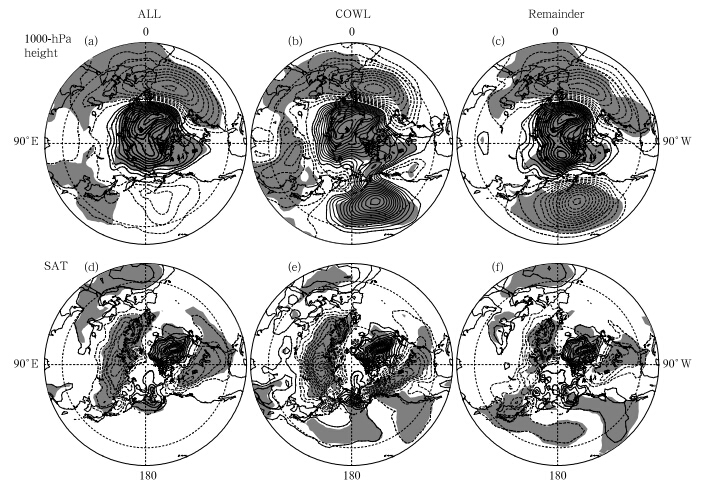 |
| Fig. 6. As in Fig. 5, but for the composite in which the year-to-year variability is taken into account. |
The height anomalies at 300 and 50 hPa inthe negative phase are presented in Fig. 7 in thecomposite-M. As analogues to these anomalies in thepositive phase, both the COWL and RM events show aquasi-barotropic height structure throughout the troposphere and stratosphere. At 300 hPa, the RMevent is associated with a greater annular structureof height anomalies than in the COWL event, constituting the annularity feature of the total AO events(Figs. 7a-7c). The positive anomalies over the Arcticare also stronger in the RM event than in the COWLevent. At 50 hPa, the anomalous stratospheric signal over the Arctic in the COWL event has less significance than that in the RM event, which meansthat the significant height anomalies in the composite of total AO events mainly result from those of theRM events. In other words, the anomalous signal ofthe COWL event becomes considerably weak in thestratosphere.
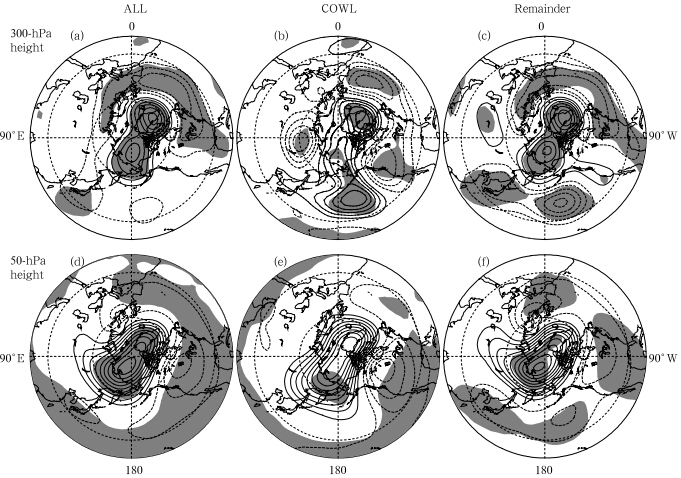 |
| Fig. 7. As in Fig. 4, but for the negative phase. |
In this study, based on the wintertime monthlymean reanalysis data of the NCEP-DOE AMIP-II and the leading empirical orthogonal function(EOF)of themonthly Z1000 field poleward of 20°N, the total AOevents were identified by the magnitude of the leadingPC. These events were further partitioned intoCOWL events and RM events. The COWL eventsaccounts for 42% of the total AO events in the positive phase and for 36% in the negative phase. Similar to the traditional AO events, the COWL eventsshow a quasi-barotropic NAO pattern in the Atlanticsector throughout the troposphere and stratosphere.However, the COWL events have an anomalous Pacificcenter of action that is out-of-phase with the North Atlantic center of action, especially in the troposphere, which leads to the less-annular feature in the heightanomaly distribution for total AO events. Moreover, the COWL pattern has a weaker anomaly signal inthe stratosphere than the RM pattern. The COWLpattern contributes to the annular surface air temperature anomalies over the high-latitude region of bothcontinents in the Northern Hemisphere.
Since the amplitude of the COWL and RM eventsin the composite-N are almost twice as large as thosein the composite-M, the monthly variability and theinterannual variability are equally important to all theAO events. In other words, AO events can be intensified under the influence of external forcing.
As for the dynamic mechanism of the COWL, Wallace et al.(1996) and Broccoli et al.(1998)revealed that the anomalous contrast in thermal inertia between l and and ocean was the primary factorfor the existence of the COWL pattern. However, such a mechanism could not completely explain itsquasi-barotropic structure. Many studies have demonstrated that the anomalous vertical propagation ofplanetary waves(PWs)is a key role in the formationof the AO(Limpasuvan and Hartmann, 1999, 2000;Christiansen, 2001; Lorenz and Hartmann, 2003; Vallis et al., 2004; McDaniel and Black, 2005). Analogously, we speculate that the anomalous vertical propagation of PWs, which can be induced by those external forcing, such as the anomalous thermal contrast, ENSO, snow cover, also favors the formation of COWLpattern. But this hypothesis still requires in-depth examination and validation.
The identification of the total AO events and thepartitioning of them into the COWL and RM eventsare perhaps sensitive to the AOI threshold chosen inthe present work. To examine this possibility, we reidentified the numbers of all AO events, COWL events and RM events with varying AOI thresholds, as presented in Fig. 8. Obviously, for both the positive and negative AO events, the COWL events account for atleast one-third of all AO events when the AOI threshold varies between 0.3 and 1.5. If the AOI exceeds 1.5, only 10 or fewer samples of AO events(thick solid linesin Fig. 8)can be identified, and thus there is no statistical meaning. Therefore, we confirm that the AOIthreshold of 0.5 chosen in this study is appropriate, and choosing other AOI threshold values will not alterour final conclusion qualitatively.
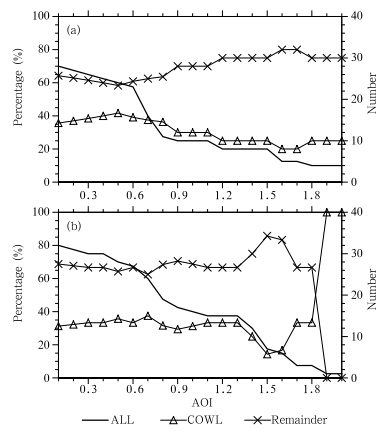 |
| Fig. 8. Total numbers of "ALL" AO events(thick solidline) and percentage of numbers of COWL events and RMevents(thin marked lines)in the total numbers of all AOevents.(a)The positive phase and (b)the negative phase.The abscissa is the varying threshold value of AOI for identifying AO events. |
The existence of the COWL events contained inthe total AO events might well explain the reason forthe lack of positive correlations between the two centers of action over the two oceanic basins revealed by Deser(2000) and Ambaum et al.(2001).
In addition, based on the coupled general circulation models participating in the Fourth AssessmentReport of the Intergovernmental Panel on ClimateChange(IPCC AR4), Zhu and Wang(2010)reportedan increasing tendency of the AO index under theA1B scenario. However, it is not known whether thepercentage of COWL events increases or decreases inthe global warming background, a question that alsodeserves further investigations.
| [1] | Ambaum, M. H. P., B. J. Hoskins, and D. B. Stephenson, 2001: Arctic Oscillation or North Atlantic Oscillation? J. Climate, 14, 3495-3507. |
| [2] | Baldwin, M. P., and D. W. J. Thompson, 2009: A critical comparison of stratosphere-troposphere coupling indices. Quart. J. Roy. Meteor. Soc., 135(644), 1661-1672. |
| [3] | Broccoli, A. J., N. C. Lau, and M. J. Nath, 1998: The cold ocean-warm land pattern: Model simulation and relevance to climate change detection. J. Climate, 11, 2743-2763. |
| [4] | Chen Wen and Kang Lihua, 2006: Linkage between the Arctic Oscillation and winter climate over East Asia on the interannual timescale: Roles of quasistationary planetary waves. Chinese J. Atmos. Sci., 30(5), 863-870. (in Chinese) |
| [5] | Christiansen, B., 2001: Downward propagation of zonal mean zonal wind anomalies from the stratosphere to the troposphere: Model and reanalysis. J. Geophys. Res., 106(D21), doi: 10.1029/2000jd000214. |
| [6] | Deser, C., 2000: On the teleconnectivity of the "Arctic Oscillation". Geophys. Res. Lett., 27(6), 779-782. |
| [7] | Gong, D., S. Wang, and J. Zhu, 2001: East Asian winter monsoon and Arctic Oscillation. Geophys. Res. Lett., 28(10), 2073-2076. |
| [8] | Honda, M., and H. Nakamura, 2001: Interannual seesaw between the Aleutian and Icelandic lows. Part II: Its significance in the interannual variability over the wintertime Northern Hemisphere. J. Climate, 14(24), 4512-4529. |
| [9] | --, --, J. Ukita, et al., 2001: Interannual seesaw between the Aleutian and Icelandic lows. Part I: Seasonal dependence and life cycle. J. Climate, 14(6), 1029-1042. |
| [10] | Kanamitsu, M., W. Ebisuzaki, J. Woollen, et al., 2002: NCEP-DOE AMIP-II reanalysis (R-2). Bull. Amer. Meteor. Soc., 83(11), 1631-1643. |
| [11] | Limpasuvan, V., and D. L. Hartmann, 1999: Eddies and the annular modes of climate variability. Geophys. Res. Lett., 26(20), doi: 10.1029/1999gl010478. |
| [12] | --, and --, 2000: Wave-maintained annular modes of climate variability. J. Climate, 13(24), doi:10.1175/1520-0442(2000)013<4414:WMAMOC>2.0.CO;2. |
| [13] | Lorenz, D. J., and D. L. Hartmann, 2003: Eddy-zonal flow feedback in the Northern Hemisphere winter. J. Climate, 16, 1212-1227. |
| [14] | McDaniel, B. A., and R. X. Black, 2005: Intraseasonal dynamical evolution of the northern annular mode. J. Climate, 18(18), doi:10.1175/JCLI3467.1. |
| [15] | Quadrelli, R., and J. Wallace, 2004: A simplified linear framework for interpreting patterns of Northern Hemisphere wintertime climate variability. J. Climate, 17(19), 3728-3744. |
| [16] | Thompson, D. W. J., and J. M.Wallace, 1998: The Arctic Oscillation signature in the wintertime geopotential height and temperature fields. Geophys. Res. Lett., 25, 1297-1300. |
| [17] | --, and --, 2000: Annular modes in the extratropical circulation. Part I: Month-to-month variability. J. Climate, 13(5), 1000-1016. |
| [18] | Vallis, G. K., E. P. Gerber, P. J. Kushner, et al., 2004: A mechanism and simple dynamical model of the North Atlantic Oscillation and annular modes. J. Atmos. Sci., 61(3), 264-280. |
| [19] | Wallace, J., and D. Thompson, 2002: The Pacific center of action of the Northern Hemisphere annular mode: Real or artifact? J. Climate, 15, 1987-1991. |
| [20] | --, Y. Zhang, and J. A. Renwick, 1995: Dynamic contribution to hemispheric mean temperature trends. Science, 270(5237), 780-783. |
| [21] | --, --, and L. Bajuk, 1996: Interpretation of interdecadal trends in Northern Hemisphere surface air temperature. J. Climate, 9(2), 249-259. |
| [22] | Wang, H., J. Sun, and J. Su, 2008: The northern annular mode: More zonal symmetric than the southern annular mode. Chinese Sci. Bull., 53(11), doi: 10.1007/s11434-008-0114-y. |
| [23] | Wang, H. J., and J. Q. Sun, 2009: Variability of Northeast China river break-up date. Adv. Atmos. Sci., 26(4), 701-706. |
| [24] | Wu, B., and J. Wang, 2002: Possible impacts of winter Arctic Oscillation on Siberian high, the East Asian winter monsoon and sea-ice extent. Adv. Atmos. Sci., 19(2), 297-320. |
| [25] | Wu, Q., and D. M. Straus, 2004: AO, COWL, and observed climate trends. J. Climate, 17(11), 2139-2156. |
| [26] | Yang Hui and Li Chongyin, 2008: Influence of Arctic Oscillation on temperature and precipitation in winter. Climatic Environ. Res., 13(4), 395-404. (in Chinese) |
| [27] | Zhu Yali and Wang Huijun, 2010: The Arctic and Antarctic oscillations in the IPCC AR4 coupled models. Acta Meteor. Sinica, 24(2), 176-188. |