 2012, Vol. 26
The Chinese Meteorological Society
Article Information
- Wang Zunya, Ding Yihui, Zhang Qiang, and Song Yafang. 2012.
- Changing Trends of Daily Temperature Extremes with Different Intensities in China
- J. Meteor. Res., 26(4): 399-409
- http://dx.doi.org/10.1007/s13351-012-0401-z
-
Article History
- Received October 18, 2011
- in final form June 4, 2012


2 China Meteorological Administration, Beijing 100081
It is pointed out that global surface temperaturehas increased 0.74℃ in recent 100 years in Intergovernmental Panel on Climate Change(IPCC)Fourth Assessment Report(AR4)(Solomon et al., 2007). Underthe background of global warming, the surface temperature has increased significantly in China, with theamplitude of 0.5-0.8℃ in recent 100 years and the increasing speed of 0.22℃(10 yr)-1 in recent 50 years(Compiling Committee of China's National Assessment on Climate Change, 2007). Because both theshifts in climatic mean values and changes in anomalies can affect the probability of frequency of extremes(Ding et al., 2003), changing trends of extreme events, especially temperature extremes, have been paid greatattention and regarded as an important part of globalchange. Many studies(Karl et al., 1993; Cooter and Leduk, 1993; Easterling et al., 2000)have shown thatglobal frequencies of both extreme low temperatureevents and frost days decreased in the past decades.Similar changes were observed in the U.S. and Canada(Karl et al., 1984; Cooter and Leduk, 1993; Bonsal et al., 2001; Alexander et al., 2006). Manton et al.(2001)found that hot days and warm nights increased obviously while cold days and cold nights decreased.As shown in IPCC AR4, changes of temperature extremes have been observed worldwide in the recent 50years: the frequencies of cold days, cold nights, and frost days decreased while the frequencies of hot days, warm nights, and heat waves increased(Solomon et al., 2007).
Characters and changes of temperature extremes and correlated extreme events in China were studied.The trends of extreme temperatures in China were analyzed(Ren and Zhai, 1998; Ma et al., 2003; Zhai and Pan, 2003a, b). It is found that both the lowest and the highest temperatures increased in recentdecades, with the increasing trend of the lowest temperature being much greater than that of the highestone. On the other h and , varieties of indices of temperature extremes were defined and relevant changeswere discussed(Huang and Qian, 2008, 2009; Zhou and Ren, 2010). Despite of differences in definition, similar results were obtained as that the frequenciesof low temperature extremes decreased significantly inChina, especially over Northeast China, North China, and the Tibetan Plateau. Additionally, some extremelow temperature events have changed. For example, numbers of days with daily minimum temperature below 0℃ in northern China decreased obviously, suggesting that non-frost period has gradually lengthenedthere(Ding et al., 2003); and frequencies of cold wavessignificantly decreased over the past five decades inChina(Wang and Ding, 2006).
Previous studies revealed that both extreme temperature events and temperature extremes showed significant changing trends not only in China but in otherregions of the world under global warming during pastdecades. However, there are still questions to be answered:(1)What differences are there in changingtrends of temperature extreme indices with varyingintensities?(2)What are the characters of the evolution trends of temperature extreme indices in recentdecades in China?(3)How does the inhomogeneityimpact changing trends of temperature extreme indices? The above problems will be discussed in thispaper. Moreover, another important purpose of thispaper is to compare and validate previous results ofchanges of temperature extremes in China, using theupdated high quality datasets.
In Section 2, the datasets, methods, and temperature extreme indices are introduced. Section 3discusses the impact of inhomogeneity of datasets onchanging trends. Long-term trends of temperature extreme indices with different intensities in China areanalyzed in Section 4. Evolution characters of temperature extremes are shown in Section 5. Finally, themain results are concluded in Section 6.2. Data, indices, and methods2.1 Data quality and homogeneity
Two datasets compiled and provided by the National Meteorological Information Center(NMIC), China Meteorological Administration(CMA)areadopted in this study. One is daily mean, maximum, and minimum surface temperature records from 731surface weather stations in China from 1 January 1951to 31 December 2004, with the inhomogeneity detection and adjustment being carried out(Liu and Li, 2003; Li et al., 2004); the other is the dataset ofthe same variables from the same 731 stations from1 January 1951 to 31 December 2010, but without theinhomogeneity detection and adjustment being processed. As there were few observation stations in western China before 1956, both datasets are analyzedfrom then on.
The data quality control was conducted by theNMIC, which includes extreme value control, consistency check, and spatial consistency test(Liu and Li, 2003). During these processes, data at 48 stations wereeliminated for insu°cient records, and data at additional 29 stations were not used in this study becausetheir time series are shorter than 30 yr. Finally, datafrom the same 654 stations were chosen from the twodatasets.
Additionally, spatial and internal consistencychecks were performed to minimize the impact of taking the error records as climatic extremes, using themethod introduced by Pan and Zhai(2002).2.2 Definition of temperature extreme indicesThe World Meteorological Organization(WMO)Commission for Climatology/CLIVAR Expert Teamon Climate Change Detection Monitoring and Indices(ETCCDMI)developed a set of extreme indices.Among them, the 10th percentile was used to defineoccurrences of cold nights, cold days, warm nights, and warm days. In this paper, the 10th(90th), 5th(95th), and 1st(99th)percentile were individually chosen toget the thresholds of the above 4 indices.
The threshold was calculated for each calendarday and for each station. Then, 366 thresholds wereobtained for any station. Specifically, for a given dayk, the minimum(maximum)temperature of each dayfrom k-3 to k+3 in each year during 1971-2000 werearranged in ascending(descending)order. For this series, the following equation was used to calculate theserial number m corresponding to the probability P:
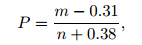
That is, when P = 0.05, m =<0.05×(n+0.38)+0.31>, where < > denotes rounding down to the nearestinteger. Then, the threshold of the 5th percentile forday k was obtained by interpolation of the sample xm and xm+1 in the ascending(descending)series. For example, the 5th percentile threshold of a series with 30samples is the interpolation of x1 and x1. This methodis easy to calculate, with results similar to those of theGammar distribution(Bonsal et al., 2001).2.3 Methods
The least square method was used to calculatethe linear trend coe°cient, and the correlation testwas conducted to verity the significance(Wei, 1999).The time series for China were derived by grid-boxarea weighted averages(Jones and Hulme, 1996).The Mann-Kendall test(Mann, 1945; Goossens and Berger, 1986)was carried out to check the climaticabrupt changing point.3. Impacts of inhomogeneity on changing trends
Figure 1 shows two time series of annual occurrence of cold nights with the 10th percentile thresholdfor China derived individually from the homogeneous and the inhomogeneous datasets. It can be seen thatthe difference was not obvious and mainly observedbefore the mid 1960s. Decreasing trends were also significant under the confidence level of 5%, with lineartrend coefficients being -8.28 and -7.82 day(10 yr)-1for the homogeneous and the inhomogenous dataset, respectively. The magnitude of decreasing trend derived from the inhomogeneous dataset was only 5.9%greater than that from the homogenous dataset, suggesting that the impact of inhomogeneity on the longterm changing trend averaged over an extensive regionis limited.
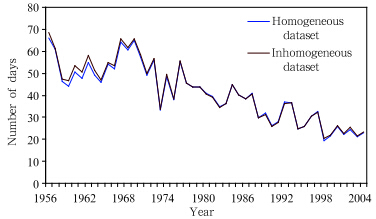 |
| Fig. 1. Time series of annual occurrence of cold nightswith the 10th percentile threshold for China derived individually from the homogenous and the inhomogeneousdatasets during 1956-2004. |
Differences of changing trends for annual occurrence of cold nights with the 10th percentile thresholds between the homogeneous and the inhomogeneousdatasets for each station of China were calculated and st and ardized. Figure 2 shows that absolute st and ardized differences were below 2 for most stations but upto 2 at 83 stations. After those 83 stations were excluded, two time series of annual occurrence of coldnights with the 10th percentile threshold derived individually from the homogeneous and the inhomogeneous datasets were almost the same(Fig. 3), withthe changing trends being nearly identical.
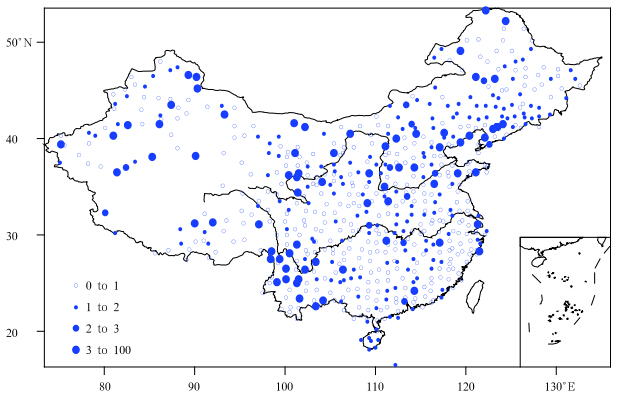 |
| Fig. 2. Absolute st and ardized differences for changing trends of annual occurrence of cold nights with the 10th percentilethreshold between the homogenous and inhomogeneous datasets during 1956-2004. |
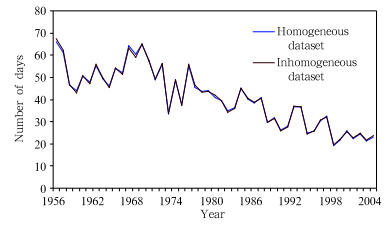 |
| Fig. 3. As in Fig. 1, but for 83 stations with relativelyobvious impact of inhomogeneity. These stations were removed from the inhomogeneous dataset. |
Same analyses were carried out to all four temperature extreme indices with varying intensities, and similar results were obtained. The impact of inhomogeneity on changing trends of the 4 extreme indiceswas below 10%. In the following analysis, above 83 stations were removed from the inhomogeneous datasetto minimize the impact of inhomogeneity. That is, data from 571 stations were used to recalculate thechanging trends of the 4 extreme indices.4. Trends of temperature extreme indices with different intensities in China4.1 Temporal features
Figure 4 shows time series of annual occurrenceof temperature extreme indices with varying intensities between 1956 and 2010. It can be seen that annual occurrences of both cold nights and cold daysdecreased, while those of warm nights and warm daysincreased significantly. Oscillations were obvious before the 1970s and annual occurrence of cold nights decreased from then on. The Mann-Kendall test showedan abrupt decreasing point in the early 1980s. Afterthen, annual numbers of cold nights were almost below normal. The annual number of cold days after thelate 1980s was less than the climatic mean value and the decreasing magnitude was much smaller than thatof cold nights. Increasing trends of annual occurrencesof warm nights and warm days were similar and significant, especially in the recent two decades, but themagnitude of the former was greater than that of thelatter. All these results were coherent with those revealed by previous studies(Zhou and Ren, 2010; Zhai and Pan, 2003a, b). Even linear trend coefficients ofannual numbers of the 4 extreme indices with the 10thpercentile threshold were much close to those calculated by Zhou and Ren(2010).
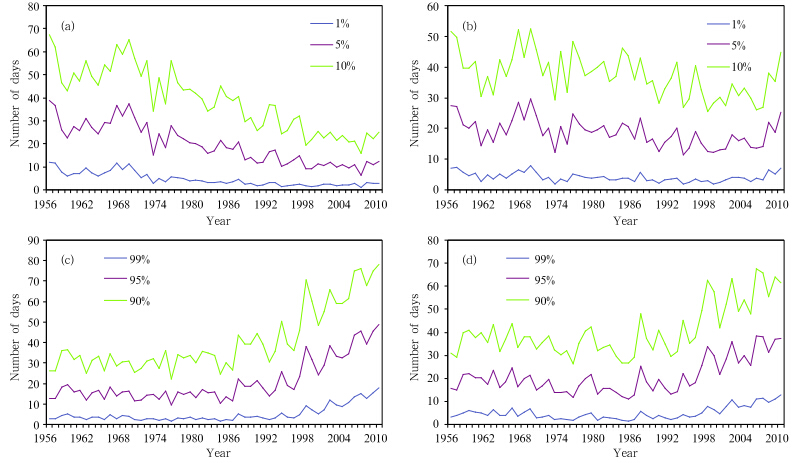 |
| Fig. 4. Time series of annual occurrences of(a)cold nights, (b)cold days, (c)warm nights, and (d)warm days withthe 10th, 5th, and 1st percentile thresholds during 1956-2010 for China. |
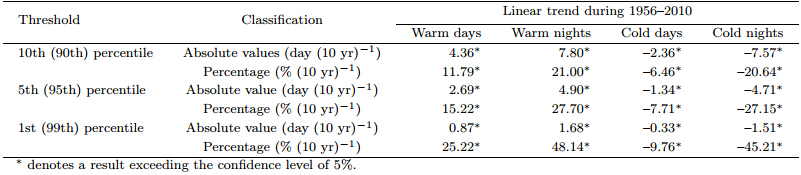
Except the above findings, a few new results wereobtained. First, with the strengthening of the intensity, the magnitude of changing trends for annual occurrences of a temperature extreme index increasedcorrespondingly. Table 1 shows that the absolute magnitude of changing trends with the 10th(90th)percentile threshold was smaller than that with the 5th(95th)percentile threshold, and it is the same betweenthe 5th(95th) and the 1st(99th)percentile thresholds.Actually, this comparison is not reasonable as differences of annual occurrence of extreme indices betweenvarying intensities were great. To unify the base ofcomparison, the absolute trend was transformed to therelative value and expressed in percentage, divided bythe climatic mean of annual numbers of correspondingindices according to intensities during 1971-2000. It isobvious that the situation reversed: the magnitude oftrends with the 1st(99th)percentile threshold becamethe greatest, the 5th(95th)percentile threshold thesecond, and the 10th(90th)percentile threshold thesmallest. For annual occurrence of cold nights(warmnights)with the 1st(99th)percentile threshold, its decreasing(increasing)rate was even close to half of theclimatic mean per decade. That is, the more extremethe event is, the greater the magnitude of changingtrends for occurrence of four temperature extreme indices is.
 |
Second, an obvious increasing trend was observedin annual occurrence of cold days in the recent fouryears. A similar trend can also be found in time seriesof annual occurrence of cold nights but the magnitudewas relatively smaller. This signal is worth being notified as a possible climatic change point.
Lastly, the magnitude of changing trends of warmextreme indices was greater than that of cold extremeindices, which is different from the conclusion of Zhou and Ren(2010), as time series were longer in thepresent analysis.4.2 Spatial features
Changing trends for the 10%(90%)thresholdwere analyzed for each station of China. Figure 5shows that annual numbers of cold nights(cold days)decreased during 1956-2010 at 538(471)stations, accounting for about 94%(83%)of all stations. Changing trends of annual numbers of cold nights(cold days)were statistically significant for 91%(42%)stations ofChina. As pointed out by previous studies, the magnitude of decreasing trends of the annual number ofcold nights was generally greater than that of colddays, with decreasing speed of -10-5 and -2.5-0 day(10 yr)-1 for the former and latter at almost half ofthe total stations. For both cold nights and cold days, decreasing trends were greater in northern than southern China. Especially, in some regions such as Northeast China, North China, mid-eastern Inner Mongolia, eastern Northwest China, and western SouthwestChina, the annual occurrence of cold nights(cold days)decreased more than 10(5)day(10 yr)-1. Decreasesof the annual number of cold days were not so significant in the Yangtze River valley, mid-eastern Southwest China, and South China, with even weak increasing trends being observed in some local areas.
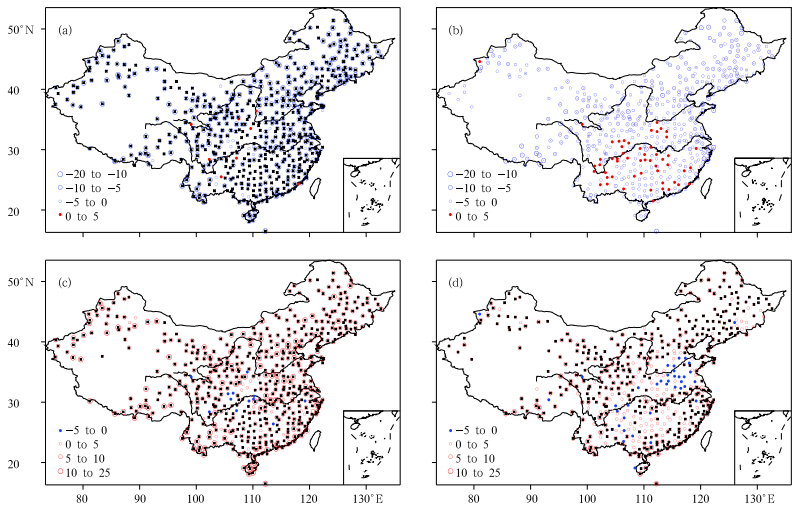 |
| Fig. 5. Trends(day(10 yr)-1)for annual series of the 10th percentile temperature extreme indices for 1956-2010 for(a)cold nights, (b)cold days, (c)warm nights, and (d)warm days. Trends were calculated for stations with sufficientdata(at least 30-yr data during the period). The symbol × denotes a result exceeding the confidence level of 5%. |
Annual numbers of warm nights(warm days)wereobserved to have increased during the recent 55 yearsat 533(484)stations, accounting for about 93%(85%)of all stations. Changing trends of annual occurrenceof warm nights(warm days)were statistically significant at 89%(66%)stations of China. The magnitude of increasing trends for annual numbers of warmnights was generally greater than that of warm days.The annual number of warm nights increased at thespeed of 5-10 day(10 yr)-1 for 52% of all stations and 0-5 day(10 yr)-1 for 21% of all stations, whilethe increasing rate of the annual number of warm dayswas smaller, 0-5 day(10 yr)-1 for 54% of all stations. The magnitude of increasing trends was relatively smaller in eastern Southwest China and the areato the south of the mid-lower reaches of the YangtzeRiver for warm nights and in more extensive regionsfor warm days, with weak decreasing trends being observed in some parts of the region between the lowerreaches of the Yellow River and the mid-lower reachesof the Yangtze River, mid-eastern Southwest China, and South China.4.3 Seasonal features
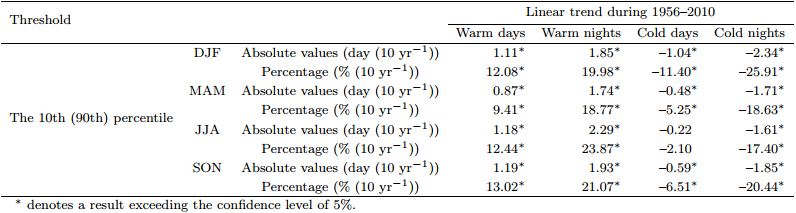
Time series of seasonal occurrence of the fourtemperature extreme indices with the 10th percentilethreshold are shown in Fig. 6. Obviously, interdecadalvariations and trends were similar to each other between different seasons and all close to those of annualoccurrence for the same index. However, numbers ofboth cold days and cold nights and their variabilitywere the greatest in DJF, especially before the mid1980s, but the least in JJA. The occurrence of warmnights and its variability were the greatest in JJA butclose to each other between different seasons. Interestingly, though the occurrence of warm nights was theleast in DJF, its variability was the greatest amongthe four seasons.
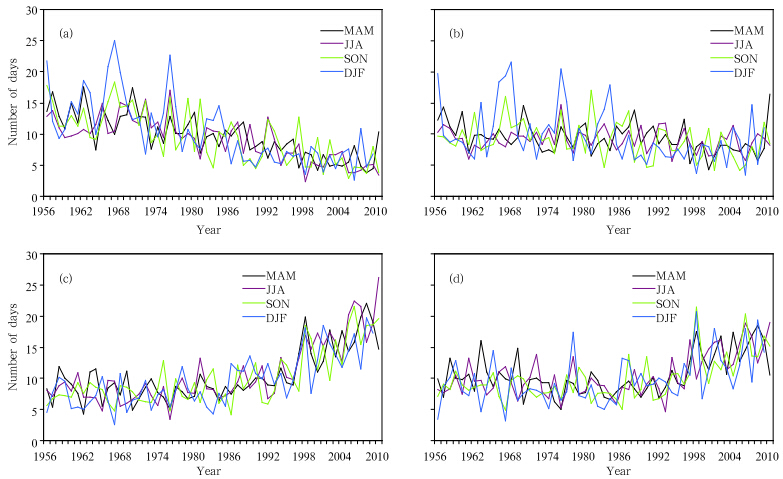 |
| Fig. 6. Time series of seasonal occurrence of(a)cold nights, (b)cold days, (c)warm nights, and (d)warm days withthe 10th percentile thresholds during 1956-2010 for China. |
Linear trend coefficients of seasonal occurrenceof the 4 temperature extreme indices with the 10th(90th)percentile threshold were calculated and presented in Table 2. Except summer cold days, changingtrends of other indices were all statistically significant.Decreasing trends of both cold nights and cold dayswere the greatest in DJF but the least in JJA, whileincreasing trends of warm nights were the greatest inJJA. Trends of seasonal occurrence of the 4 temperature extreme indices with the 1st(99th) and the 5th(95th)thresholds were not discussed because therewere too few samples to obtain reliable results.
 |
It is found from the above analyses that decreases(increases)of cold nights(warm nights)were more dramatic than those of cold days(warm days). This suggests that the daily minimum temperature increasedmore dramatically than daily maximum temperature, which has been observed and confirmed before. Thehigh correlation between the daily minimum(maximum)temperature with annual numbers of cold nights and warm nights(cold days and warm days)suggeststhat significant increases of temperature may cause decreases of cold extreme indices and increases of warmextreme indices. This can also shed light on why weakor opposite trends were observed in eastern and southern parts of Southwest China, where increasing trendsof mean temperature are not so significant in recentdecades(Wang et al., 2004).5. Evolution of changing trends of temperature extreme indices with varying intensities in China
Moving trends were calculated to underst and theevolution of changes in annual occurrence of the fourtemperature extreme indices with varying intensitiesin China. According to the WMO st and ards, a timeseries with at least 25 years can be used to analyze achanging trend. The 25-yr moving trends were calculated in this paper, and relative trends were presentedto compare the results with different intensities. InFig. 7, each point of the curves represents the lineartrend coe°cient of temperature extreme indices fromthe 25 years before to the current year. That is, thevalue in 1980 indicates the trend during 1956-1980, the value in 1981 shows the trend during 1957-1981, and the rest can be deduced in the same manner. Increases of the curve indicate acceleration of decreasing trends or slowdown of increasing trends, while decreases suggest slowdown of increasing trends or acceleration of decreasing trends.
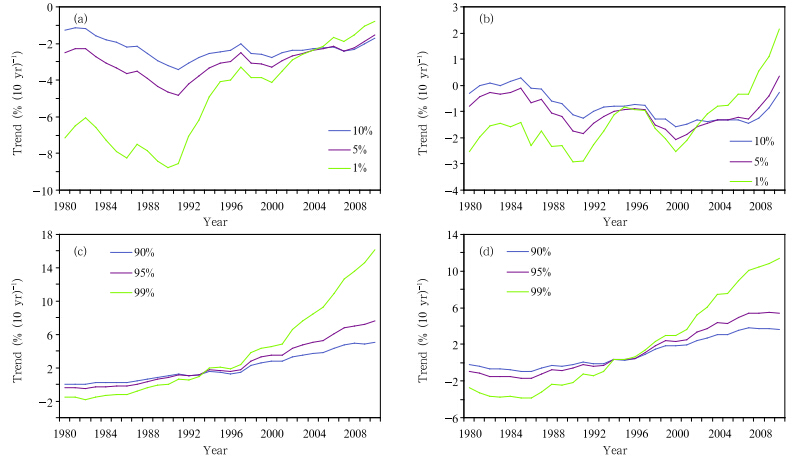 |
| Fig. 7. 25-yr moving relative trends of annual occurrence(%(10 yr)-1)of(a)cold nights, (b)cold days, (c)warmnights, and (d)warm days with varying intensities averaged over China during 1956-2010, with the value at 1980 beingthe trend during 1956-1980 and the rest being deduced by analogy. |
As shown in Fig. 7a, cold nights significantlydecreased from 1956 to 1990, and then the decreasing trend considerably weakened. The number of colddays also decreased during the first 35 years, but maintained a relatively constant decreasing rate since 1990, and the decreasing trend showed an obvious slowdownin recent years. As for warm days and warm nights, their increasing trends have been accelerated continuously during the recent decades. Additionally, itcan be noted that, the more extreme, the more intensive the acceleration(slowdown)of increasing(decreasing)trends. Especially, for annual occurrenceof cold nights and cold days with the 1st percentilethreshold, their current decreasing trends were muchweaker than those 30 years before, and even numbersof cold days with the 1st percentile threshold showedincreasing trends in the recent 4 years.
Another interesting phenomenon was observed bycomparing moving trends of occurrence of temperatureextreme indices between northern China and southernChina, which are divided by 35°N. As shown in Fig. 8, 25-yr moving trends of occurrence of cold nights withthe 10th percentile threshold for North China weresimilar to those for entire China(Fig. 7a), and thecontinuous weakening of decreasing trends was significant after the 1990s. On the contrary, decreasingtrends for South China did not slow down obviouslyin the recent 2 decades, maintaining -1 to -0.6 day(10 yr)-1. The difference, which was mainly observedafter the 1990s, suggests that changes in occurrence ofcold nights in northern China are dominant. Same situations were also observed for the other three indiceswith varying intensities.
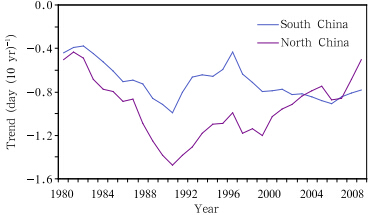 |
| Fig. 8. 25-yr moving trends of annual occurrence of coldnights(day(10 yr)-1)with the 10th percentile thresholdaveraged over North and South China. |
Using two sets of quality-controlled daily temperature observation data, with and without the inhomogeneity test and adjustment, from 654 stations ofChina during 1956-2004 and 1956-2010, impacts of inhomogeneity on changing trends of four types of percentile temperature extreme indices, i.e., cold days, cold nights, warm days, and warm nights with varying intensities, were discussed firstly. It is found thatthe inhomogeneity affected long-term trends averagedover extensive regions limitedly. After we removed 83stations with obvious inhomogeneity impacts, from theinhomogeneous dataset, an updated analysis of changing trends of four temperature extreme indices withvarying intensities during 1956-2010 was performed and the following conclusions were obtained:
(1)In addition to findings pointed out by previousstudies that annual occurrences of both cold nights and cold days decreased greatly and occurrences ofwarm nights and warm days increased significantlyduring the recent 20 years, a few new results wereobtained. Firstly, the more extreme the event is, the greater the magnitude of changing trends for atemperature extreme index is. Secondly, an obviousincreasing trend was observed in annual occurrencesof cold days and cold nights in the recent four years.Lastly, the magnitude of changing trends of warm extreme indices was greater than that of cold extremeindices.
(2)The magnitude of changing trends was greaterin northern China than in southern China. Trends forsummer occurrence of cold days were not significant.Decreasing trends of occurrences of both cold nights and cold days were the greatest in DJF but the leastin JJA, while increasing trends of occurrence of warmnights were the greatest in JJA.
(3)Occurrence of cold nights significantly decreased from 1956 to 1990, and then the decreasingtrend considerably weakened. The decreasing trendfor occurrence of cold days also showed an obviousslowdown in recent years. However, increasing trendsof occurrence of both warm nights and warm dayshave been accelerated continuously since the recentdecades. Further analysis presents that evolution oftrends for occurrence of the four temperature extremeindices was dominated by changes in northern China.
It should be pointed out that many studies havediscussed the impact of urbanization on trends of meantemperature(Jones et al., 1990, 2008; Zhou and Ren, 2005; Ren el al., 2008; Zhou and Ren, 2009)as well asextreme temperature indices in local regions(Zhang et al., 2011). However, urbanization is much fasterin China, so the assessment of its impacts is complicated. This problem should be discussed in the future.
| Alexander, L. V., V. X. Zhang, T. C. Peterson, et al., 2006: Global observed changes in daily climate extremes of temperature and precipitation. J. Geophys. Res., 111, 22-31. |
| Bonsal, B. R., X. B. Zhang, L. A. Vincent, et al., 2001: Characteristics of daily and extreme temperature over Canada. J. Climate, 5(14), 1959-1976. |
| Compiling Committee of China's National Assessment Report on Climate Change, 2007: China's National Assessment Report on Climate Change. Science Press, Beijing, 8-11. (in Chinese) |
| Cooter, E. J., and S. K. Leduk, 1993: Recent frost data trends in the northern United States. Int. J. Climatol., 15, 65-75. |
| Ding Yihui, Zhang Jin, Xu Ying, et al., 2003: Evolution and Prediction of Climate System. China Meteoro-logical Press, Beijing, 4-6. (in Chinese) |
| Easterling, D. R., J. L. Evana, P. Y. Grosman, et al., 2000: Observed variability and trends in extreme climate events: A brief review. Bull. Amer. Meteor. Soc., 81, 417-425. |
| Goossens, C. H., and A. Berger, 1986: Annual and seasonal climatic variations over the Northern Hemisphere and Europe during the last centrury. Ann. Geophys., 4, 385-400. |
| Huang Danqing and Qian Yongfu, 2008: The definition of daily mean temperature extremes over China and its trend. Acta Scientiarum Naturalium Universitatis Sunyatseni, 47(3), 112-116. (in Chinese) |
| -- and --, 2009: The analysis method of regional characteristics of extreme temperature and its results. Journal of Nanjing University (Natural Sciences), 45(6), 715-723. (in Chinese) |
| Jones, P. D., P. Y. Groisman, M. Coughlan, et al., 1990: Assessment of urbanization effects in time series of surface air temperature over land. Nature, 347, 169-172. |
| --, and M. Hulme, 1996: Calculating regional climatic time series for temperature and precipitation: Methods and illustrations. Int. J. Climatol., 16, 361-377. |
| --, D. H. Lister, and Q. Li, 2008: Urbanization effects in large-scale temperature records with an emphasis on China. J. Geophys. Res., 113, D16122, doi: 10.1029/2008JD009916. |
| Karl, T. R., G. Kukla, and J. Gavin, 1984: Decreasing diurnal temperature range in the Unite States and Canada from 1941-1980. J. Climate Appl. Meteor., 23, 1489-1504. |
| --, P. D. Jones, R. W. Knight, et al., 1993: A new perspective on recent global warming: Asymmetric trends of daily maximum and minimum temperature. Bull. Amer. Meteor. Soc., 74(6), 1007-1023. |
| Li Qingxiang, Liu Xiaoning, Zhang Zheng, et al., 2004: Detecting and adjusting the temporal inhomogeneity in Chinese mean surface air temperature dataset. Adv. Atmos. Sci., 21(4), 260-268. (in Chinese) |
| Liu Xiaoning and Li Qingxiang, 2003: Research of the inhomogeneity test of climatological data series in China. Acta Meteor. Sinica, 17(4), 492-502. (in Chinese) |
| Ma Zhuguo, Fu Congbin, Ren Xiaobo, et al., 2003: Trend of annual extreme temperature and its relationship to regional warming in northern China. Acta Geographica Sinica, 58, 11-20. (in Chinese) |
| Mann, H. B., 1945: Non-parametric test against trend. Econometrika, 13, 245-259. |
| Manton, M. J., P. M. Della-Marta, M. R. Haylock, et al., 2001: Trend in extreme daily rainfall and temperature in Southeast Asia and South Pacific: 1961-1998. Int. J. Climatol., 21, 269-284. |
| Pan Xiaohua and Zhai Panmao, 2002: Analysis of surface air temperature extreme. Meteor. Mon., 28, 28-31. (in Chinese) |
| Ren Fumin and Zhai Panmao, 1998: Study on changes of China's extreme temperatures during 1951-1990. Scientia Atmospherica Sinica, 22(2), 217-227. (in Chinese) |
| Ren Guoyu, Zhou Yaqing, Chu Ziying, et al., 2008: Urbanization effects on observed surface air temperature trends in North China. J. Climate, 21, 1333-1348. |
| Solomon, S., D. Qin, M. Manning, et al., 2007: Climate Change 2007: The Physical Science Basis. Contribution of Working Group I to the Fourth Assessment Report of the Intergovernmental Panel on Climate Change. Cambridge University Press, Cambridge, 13. |
| Wei Fengying, 1999: Diagnosis and Forecasting Methods of Modern Climatic Statistics. China Meteorological Press, Beijing, 43-45. (in Chinese) |
| Wang Zunya, Ding Yihui, He Jinhai, et al., 2004: An updated analysis of the climate change in China in recent 50 years. Acta Meteor. Sinica, 62(2), 228-236. (in Chinese) |
| -- and Ding Yihui, 2006: Climate change of the cold wave frequency of China in the last 53 years and the possible reasons. Chinese J. Atmos. Sci., 30(6), 1068-1076. (in Chinese) |
| Zhai Panmao and Pan Xiaohua, 2003a: Changes in extreme temperature and precipitation over northern China during the second half of the 20th century. Acta Geographica Sinica, 58, 1-10. (in Chinese) |
| -- and --, 2003b: Trends in temperature extremes during 1951-1999 in China. Geophy. Res. Lett., 30(17), 1913, doi: 10.1029/2003GL018004. |
| Zhou Yaqing and Ren Guoyu, 2005: Identifying and correcting urban bias for regional surface air temperature series of North China over period of 1961-2000. Climatic Environ. Res., 10(4), 743-753. (in Chinese) |
| -- and --, 2009: The effect of urbanization on maximum, minimum temperatures and daily temperature range in North China. Plateau Meteorology, 28(5), 1158-1166. (in Chinese) |
| -- and --, 2010: Variation characteristics of extreme temperature indices in mainland China during 1956-2008. Climatic Environ. Res., 15(4), 405-417. (in Chinese) |
| Zhang Lei, Ren Guoyu, Liu Jiang, et al., 2011: Urban effect on trends of extreme temperature indices at Beijing meteorological station. Chinese J. Geophy., 54(5), 1150-1159. (in Chinese) |