 2018, Vol. 20


2. 农业农村部农产品质量安全风险评估实验室 (海口),海口 570228
2. Agricultural Products Quality and Safety Risk Assessment Laboratory of Ministry of Agriculture and Rural Affairs (Haikou), Haikou 570228, China
随着农药的大量使用,农药对地下水的污染问题受到研究者的广泛关注[1-2]。土壤是农药施用后的一个重要归宿[3],农药在土壤中的归趋途径主要包括挥发、地表径流、淋溶、横向移动、排水、渗出和吸附等[4],其中农药的迁移和持久性是影响农药是否对地下水产生污染的一个重要要素[5]。淋溶是指由于土壤间隙水的作用,土壤中的污染物不断向下渗滤从而造成地下水污染[6]。
拟除虫菊酯类农药是一类广谱、高效和低毒的杀虫剂,广泛用于农业生产、公共卫生、林业、园艺与兽医等领域[7-8]。有研究表明,拟除虫菊酯类农药对大鼠的生殖、免疫和心血管等都有明显的毒副作用[9-10]。拟除虫菊酯类农药大多淋溶性较差。王文蝶等采用土柱淋溶法测定了不同浓度的溴氰菊酯在土壤中的淋溶特性,发现溴氰菊酯的浓度越高在土壤中的迁移能力越小,即淋溶性越差[11]。Rani等研究了氯氰菊酯在砂壤土中的淋溶行为,发现其主要残留于0~10 cm的土壤中,在砂壤土最大持水量条件下迁移率较低,不会对地下水造成污染[12];石健等采用土柱淋溶法研究了氯氰菊酯在不同介质中的穿透行为,探讨了不同介质自身特性对氯氰菊酯纵向弥散行为的影响,发现氯氰菊酯在水中的迁移性能良好,淋滤作用较强,有可能对地下水造成污染[13];Gupta等采用土柱淋溶法对β-氟氯氰菊酯的淋溶特性进行了研究,发现其主要存在于0~5 cm的土壤中,淋出液中未检测出,表明其几乎不会淋溶到地下水中[14];赵华等采用土壤薄层层析法研究了甲氰菊酯的迁移性能,发现其在3种土壤中均属于不移动或不易移动的农药[15]。孙扬等采用土壤薄层层析法研究了氰戊菊酯的迁移能力,发现其迁移能力与土壤有机质含量、阳离子交换量和土壤黏粒含量有关[16]。
本研究通过室内土柱淋溶法,采用气相色谱法研究了3种拟除虫菊酯类农药在海南砂土和壤土2种土壤中的淋溶特性,以期为热带地区土壤和地下水中农药污染修复提供参考。
1 材料与方法 1.1 试验材料 1.1.1 仪器及药剂安捷伦Agilent 6890N气相色谱仪[配电子捕获检测器 (63Ni-ECD)]和安捷伦BD-1色谱柱 (30 m × 250 μm, 0.25 μm),安捷伦科技有限公司(California,USA);湘仪H1850R高速冷冻离心机,湘仪离心机有限公司(湖南,中国);Heidolph LABOROTA 4000 efficient旋转蒸发仪,德国海道夫(Heidolph)公司。
三氟氯氰菊酯 (cyfluthrin)、高效氯氰菊酯 (beta-cypermethrin) 和联苯菊酯 (bifenthrin) 标准品,纯度均大于等于99%,购自Dr.Ehrenstorfer Gmbh (Augsburg,Germany);正己烷 (色谱纯) 购自赛默飞世尔科技有限公司 (上海,中国),其余分析纯试剂正己烷、丙酮、无水硫酸钠和二水合氯化钙,均购自广州化学试剂厂 (广州,中国)。
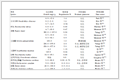
1.1.2 供试土壤供试土壤砂土和壤土均采集于海南大学儋州校区实验基地0~15 cm的表层土壤,经自然风干研磨后过20目 (粒径840 μm) 标准筛保存,备用,土壤理化性质见表1。
|
表 1 供试土壤理化性质 Table 1 Physical and chemical properties of the tested soils |
1.2 标准溶液配制
分别称取0.01 g (精确至0.000 1 g) 三氟氯氰菊酯、高效氯氰菊酯和联苯菊酯标准品于10.00 mL容量瓶中,用色谱纯正己烷定容,配制成1 000 mg/L母液,于3–20 ℃保存,备用。将母液用色谱纯正己烷逐级稀释成100、10、2、1、0.8、0.4、0.2、0.1、0.05和0.01 mg/L的系列标准工作液,于4 ℃保存,备用。
1.3 试验方法采用土柱淋溶法[17]。称取经风干、研磨、过20目筛的供试土壤500 g,制成5 cm × 15 cm的土柱,调节土壤水分含量,使其为土壤最大持水量的60%。将5 mL 100 mg/kg供试农药均匀滴加于土柱上层,添加量为0.5 mg。用300 mL 0.01 mol/L 的CaCl2溶液淋洗,滴加速率30 mL/h,相当于降雨150 mm/h。收集淋出液并将土柱均匀切成3段,分别测定各段土壤及淋出液中拟除虫菊酯的含量。
1.4 样品制备土壤样品:称取淋溶后的待测土壤10 g (精确至0.001 g) 于三角瓶中,加入50 mL丙酮,振荡2 h,于5 000 r/min下离心10 min;取30 mL上清液,加入40 mL正己烷,振荡3 min;取水相,再加入10 mL正己烷重复上述操作;合并有机相,旋转蒸发至近干,用2 mL正己烷定容,待GC测定。
水样品:量取10 mL淋出液,加入20 mL正己烷,振荡3 min;水相再加入10 mL正己烷,振荡3 min;合并有机相,旋转蒸发至近干,用2 mL正己烷定容,待GC测定。
1.5 色谱检测条件采用Agilent 6890N气相色谱仪,配ECD检测器,BD-1色谱柱 (30 m × 250 μm, 0.25 μm),升温程序为150 ℃保持1 min,以6 ℃/min升至270 ℃保持6 min;进样口温度260 ℃;检测器温度320 ℃;分流进样,分流比10:1;进样量1.0 μL;载气为氮气 (纯度 ≥ 99.999%),流速为1.0 mL/min。
1.6 添加回收试验在土壤和0.01 mol/L的 CaCl2水溶液中分别添加供试3种农药,进行添加回收试验,添加水平分别为0.01、0.1和1 mg/kg 。样品在通风柜中静置30 min,按1.4节方法制备样品,按1.5节方法测定。重复5次。
1.7 农药在土壤中的淋溶性等级划分根据各段土壤及淋出液中农药的含量,按公式 (1) 分别求出其占添加总量的质量分数 (Ri)。按Ri值的大小,将农药在土壤中的移动性能划分为4级:I级为R4 > 50%,属于易淋溶;II级为 R3 + R4 > 50%,属于可淋溶;III级为 R2 + R3 + R4 > 50%,属于较难淋溶;IV为 R1 > 50%,属于难淋溶 [17]。
| ${R_i}/{\text{%}}= \frac{{{m_i}}}{{{m_0}}} \times 100$ | (1) |
式中:Ri—各段土壤及土壤淋出液中农药占添加总量的质量分数;mi—各段土壤及淋出液中农药质量,mg;i = 1、2、3、4,分别表示0~5、> 5~10、> 10~15 cm土层土壤和土壤淋出液;m0—农药添加总质量,mg。
2 结果与分析 2.1 三种农药标准曲线的建立分别将0.001、0.1、1、2、5和10 mg/kg的三氟氯氰菊酯、高效氯氰菊酯和联苯菊酯标准品进行气相色谱分析,以确定保留时间以及标准曲线。结果 (图1) 表明:3种农药的保留时间分别为:三氟氯氰菊酯19.303 min,高效氯氰菊酯22.095和22.161 min,联苯菊酯17.832 min;以农药质量浓度为横坐标,峰面积为纵坐标作图,3种农药的标准曲线分别为:三氟氯氰菊酯y = 3 504.4x + 117.44 (R2 = 0.999 4),高效氯氰菊酯y = 15 324x + 790.19 (R2 = 0.999 5),联苯菊酯y = 8 140.5x + 311.5 (R2 = 0.999 8)。3种农药的检出限均为10–5 mg/kg,定量限均为3.3 × 10–5 mg/kg。

|
图 1 三氟氯氰菊酯、高效氯氰菊酯和联苯菊酯色谱图 Fig. 1 Chromatogram of cyhalothrin, beta-cypermethrin and bifenthrin |
2.2 三种农药在土壤和水中的添加回收率及相对标准偏差
结果 (表2) 表明:3种农药在砂土、壤土和水中的平均回收率在73%~105%之间,相对标准偏差在1.4%~7.7%之间;均符合农药残留分析试验要求[18]。最小添加水平 (0.01 mg /kg) 的典型色谱图见图2 (以三氟氯氰菊酯为例)。
|
|
表 2 三种农药在土壤和0.01 mol/L的CaCl2水溶液中的添加回收率及相对标准偏差 Table 2 Recoveries of cyhalothrin, bifenthrin and beta-cypermethrin in soil and 0.01 mol/L CaCl2 aqueous solution |

|
图 2 三氟氯氰菊酯在砂土、壤土和水中最小添加水平 (0.01 mg/kg) 的典型色谱图 Fig. 2 Typical chromatography of the minimum addition level (0.01 mg/kg) of cyhalothrin in sandy soil, loam and water |
2.3 三种农药在土壤中的淋溶特性
土柱淋溶法试验结果 (表3) 表明:三氟氯氰菊酯、高效氯氰菊酯和联苯菊酯主要残留于第1段土壤 (0~5 cm) 中,其在砂土中的Ri值分别为52.86%、94.73%和83.19% ,在壤土中的Ri值分别为54.70%、77.28%和55.33%,均大于50%,根据农药在土壤中的淋溶性等级划分标准,均属于难淋溶农药[17]。从表中还可看出3种农药的驻留量随土壤深度增加而减少。3种农药在砂土中的淋出率分别为1.83%、0.013%和0.31%,在壤土中的分别为0.03%、0.007%和0.13%,可见3种农药在砂土中的淋溶性均大于在壤土中的淋溶性。
|
|
表 3 三种农药在各段土壤及土壤淋出液中的Ri值 Table 3 The Ri values in soil and effluent of three pyrethroids |
3 讨论与结论
本研究结果表明,三氟氯氰菊酯、联苯菊酯和高效氯氰菊酯在砂土和壤土中主要驻留在0~5 cm的土柱中,驻留量随深度增加而减少,这与吴萍[19]的研究结果相符;3种拟除虫菊酯类农药淋溶性的大小为三氟氯氰菊酯 > 联苯菊酯 > 高效氯氰菊酯,与Reichenberger等 [20]和徐鹏等[21]的研究结果相符;而李睿[22]的研究则认为,尽管3种农药淋溶后也是主要集中在0~6 cm的土壤中,但氯氟氰菊酯的迁移能力较联苯菊酯的弱,是因为农药在环境中的迁移不仅跟农药本身的性质有关,还和土壤性质及气候条件等有关[23]。影响农药淋溶的因素很多,包括自身理化性质、施药方式和土壤理化性质等[24],通常土壤中的黏粒含量越大,pH越小,有机质含量越高,阳离子交换量越大,农药在土壤中的淋溶性就越小[25]。本研究中三氟氯氰菊酯、联苯菊酯和高效氯氰菊酯均属于难淋溶农药,且3种农药在砂土中的淋出率均大于在壤土中的。
虽然这3种拟除虫菊酯类农药在淋出液中均能检出,但均低于中国国家标准规定的食品中农药最大残留限量[26]。前人研究指出,土壤中三氟氯氰菊酯的半衰期为0.96~17.20 d[27-29],联苯菊酯的为6.4~19.3 d[30-31],高效氯氰菊酯的为5.30 d[32],均属于易降解农药,且这3种农药在海南砂土和壤土中均属于难淋溶农药,因此三氟氯氰菊酯、联苯菊酯和高效氯氰菊酯不易对地下水造成污染。
| [1] |
SCHIPPER P N M, VISSERS M J M, VAN DER LINDEN A M A. Pesticides in groundwater and drinking water wells: overview of the situation in the Netherlands[J]. Water Sci Technol, 2008, 57(8): 1277-1286. DOI:10.2166/wst.2008.255 |
| [2] |
陈洋, 周军英, 程燕, 等. 农药在稻田使用对地下水的风险评估研究进展[J]. 生态毒理学报, 2016, 11(1): 70-79. CHEN Y, ZHOU J Y, CHENG Y, et al. Progress of ground water risk assessment for pesticides used in rice paddy[J]. Asian J Ecotoxicol, 2016, 11(1): 70-79. |
| [3] |
冯玉洁, 谢圣华, 田海, 等. 异丙甲草胺在不同类型土壤中的吸附和淋溶特性研究[J]. 西南农业学报, 2017, 30(12): 2751-2755. FENG Y J, XIE S H, TIAN H, et al. Adsorption and leaching behavior of metolachlor in different soils[J]. Southwest China J Agric Sci, 2017, 30(12): 2751-2755. |
| [4] |
CARTER A D. Herbicide movement in soils: principles, pathways and processes[J]. Weed Res, 2000, 40(1): 113-122. DOI:10.1046/j.1365-3180.2000.00157.x |
| [5] |
VEZ M A, PEZ-Periago E L, NEZ-Carballo E M, et al. The mobility and degradation of pesticides in soils and the pollution of groundwater resources[J]. Agric Ecosysts Environ, 2007, 123(4): 247-260. |
| [6] |
张瑾, 闫书军. 农药在土壤中淋溶迁移影响因素研究进展[J]. 安徽建筑工业学院学报(自然科学版), 2008, 16(4): 38-45. ZHANG J, YAN S J. Development of effect of factors on the leaching and movement of pesticides in soil[J]. J Anhui Inst Architect Ind: Nat Sci Ed, 2008, 16(4): 38-45. |
| [7] |
CHENG J H, LIU M, YU Y, et al. Determination of pyrethroids in porcine tissues by matrix solid-phase dispersion extraction and high-performance liquid chromatography[J]. Meat Sci, 2009, 82(4): 407-412. DOI:10.1016/j.meatsci.2008.09.011 |
| [8] |
李玲玉, 刘艳, 颜冬云, 等. 拟除虫菊酯类农药的降解与代谢研究进展[J]. 环境科学与技术, 2010, 33(4): 65-71. LI L Y, LIU Y, YAN D Y, et al. Research progress on degradation and metabolism of pyrethroid insecticides[J]. Environ Sci Technol, 2010, 33(4): 65-71. DOI:10.3969/j.issn.1003-6504.2010.04.016 |
| [9] |
胡春容. 拟除虫菊酯农药的毒性研究进展[J]. 毒理学杂志, 2005, 19(3): 239-241. HU C R. Research progress on the toxicity of pyrethroid pesticides[J]. Toxicol Sept, 2005, 19(3): 239-241. DOI:10.3969/j.issn.1002-3127.2005.03.138 |
| [10] |
ELBETIEHA A, DA'AS S I, KHAMAS W, et al. Evaluation of the toxic potentials of cypermethrin pesticide on some reproductive and fertility parameters in the male rats[J]. Arch Environ Contam Toxicol, 2001, 41(4): 522-528. DOI:10.1007/s002440010280 |
| [11] |
王文蝶, 邓玉君, 钱坤. 溴氰菊酯农药在土壤中的残留•迁移研究[J]. 安徽农业科学, 2011, 39(21): 12782-12783. WANG W D, DENG Y J, QIAN K. Study on residues and migration of deltamethrin in soil[J]. J Anhui Agric Sci, 2011, 39(21): 12782-12783. DOI:10.3969/j.issn.0517-6611.2011.21.052 |
| [12] |
RANI M, SAINI S, KUMARI B. Leaching behaviour of chlorpyriphos and cypermethrin in sandy loam soil[J]. Environ Monit Assess, 2014, 186(1): 175-182. DOI:10.1007/s10661-013-3364-3 |
| [13] |
石健, 张彦, 邹开云, 等. 氯氰菊酯在土柱淋滤实验中的迁移行为[J]. 安徽农学通报, 2013, 19(19): 18-20. SHI J, ZHANG Y, ZOU K Y, et al. Research on the migration behavior of cypermethrin in the leaching experiment by soil column[J]. Anhui Agric Sci Bull, 2013, 19(19): 18-20. DOI:10.3969/j.issn.1007-7731.2013.19.010 |
| [14] |
GUPTA S, GAJBHIYE V T. Persistence and leaching of β-cyfluthrin in alluvial soil of India
[J]. Pest Manag Sci, 2002, 58(12): 1259-1265. DOI:10.1002/(ISSN)1526-4998 |
| [15] |
赵华, 李康, 徐浩, 等. 甲氰菊酯农药环境行为研究[J]. 浙江农业学报, 2004, 16(5): 299-304. ZHAO H, LI K, XU H, et al. Study on environmental behavior of fenpropathrin[J]. Acta Agriculturae Zhejiangensis, 2004, 16(5): 299-304. DOI:10.3969/j.issn.1004-1524.2004.05.013 |
| [16] |
孙扬, 杨挺, 皇甫伟国, 等. 毒死蜱和氰戊菊酯在土壤中的吸附与迁移[J]. 农药学学报, 2007, 9(4): 397-404. SUN Y, YANG T, HUANGPU W G, et al. Adsorption and mobility of chlorpyrifos and fenvalerate in soils[J]. Chin J Pest Sci, 2007, 9(4): 397-404. DOI:10.3321/j.issn:1008-7303.2007.04.014 |
| [17] |
化学农药环境安全评价试验准则 第5部分: 土壤淋溶试验: GB/T 31270.1—2014[S]. 北京: 中国标准出版社, 2015. Test guidelines on environmental safety assessment for chemical pesticides—Part 5: Leaching experiment in soils: GB/T 31270.1—2014[S]. Beijing: Standards Press of China, 2015. |
| [18] |
农作物中农药残留试验准则: NY/T 788—2018[S]. 北京: 中国农业出版社, 2018. Guideline for teseing of pesticide residues in crops: NY/T 788—2018[S]. Beijing: China Agriculture Press, 2018. |
| [19] |
吴萍. 乐果、氰戊菊酯在小麦上的残留动态及拟除虫菊酯农药在土壤中的迁移研究[D]. 南京: 南京农业大学, 2008. WU P. Decomposition of fenvalerate-dimethoate in wheat and transportation of pyrethroids in soil[D]. Nanjing: Nanjing Agricultural University, 2008. |
| [20] |
REICHENBERGER S, AMELUNG W, LAABS V, et al. Pesticide displacement along preferential flow pathways in a Brazilian Oxisol[J]. Geoderma, 2002, 110(1-2): 63-86. DOI:10.1016/S0016-7061(02)00182-9 |
| [21] |
徐鹏. 手性农药高效氯氟氰菊酯选择性降解研究[D]. 长沙: 湖南农业大学, 2012. XU P. Studies on the enantioselective degradation of chiral pesticides lambda-cyhalothrin[D]. Changsha: Hunan Agricultural University, 2012. |
| [22] |
李睿. 拟除虫菊酯在土壤中迁移降解规律的研究[D]. 南京: 南京理工大学, 2005. LI R. Study on the migration and degradation of pyrethroid in soil[D]. Nanjing: Nanjing University of Science and Technology, 2005. |
| [23] |
梅立永, 赵智杰, 璇尹, 等. 拟除虫菊酯类农药环境行为与归趋模拟[J]. 农业环境科学学报, 2007, 26(6): 2316-2322. MEI L Y, ZHAO Z J, XUAN Y, et al. Simulating the environment behavior and fate of synthetic pyrethroids[J]. J Agro-Environ Sci, 2007, 26(6): 2316-2322. DOI:10.3321/j.issn:1672-2043.2007.06.056 |
| [24] |
朱峰, 董丰收, 刘新刚, 等. 新型杀菌剂苯菌酮在3种典型土壤中的淋溶行为[J]. 农药学学报, 2015, 17(6): 763-768. ZHU F, DONG F S, LIU X G, et al. Study on leaching behavior of metrafenone in three typical soils[J]. Chin J Pest Sci, 2015, 17(6): 763-768. DOI:10.3969/j.issn.1008-7303.2015.06.019 |
| [25] |
鞠超, 徐军, 董丰收, 等. 磺草酮在土壤中的淋溶特性研究[J]. 农药学学报, 2015, 17(2): 246-250. JU C, XU J, DONG F S, et al. Study on the leaching behavior of sulcotrione in soil[J]. Chin J Pest Sci, 2015, 17(2): 246-250. DOI:10.3969/j.issn.1008-7303.2015.02.20 |
| [26] |
食品安全国家标准 食品中农药最大残留限量: GB 2763—2016 [S]. 2016. National food safety standard-Maximum residue limits for pesticides in food: GB 2763—2016 [S].2016. |
| [27] |
GU B G, WANG H M, CHEN W L, et al. Risk assessment of λ-cyhalothrin on aquatic organisms in paddy field in China[J]. Regul Toxicol Pharmacol, 2007, 48(1): 69-74. DOI:10.1016/j.yrtph.2007.01.005 |
| [28] |
刘少平, 龚道新, 卫麦霞, 等. 功夫菊酯在植烟土壤中的降解[J]. 湖南农业科学, 2009(12): 59-61. LIU S P, GONG D X, WEI M X, et al. Degradation of cyhalothrin in tobacco planted soil[J]. Hunan Agric Sci, 2009(12): 59-61. DOI:10.3969/j.issn.1006-060X.2009.12.020 |
| [29] |
丁明, 方学智, 费学谦, 等. 柿果和土壤中菊酯类农药的残留检测和消解动态研究[J]. 江西农业大学学报, 2006, 28(4): 512-515. DING M, FANG X Z, FEI X Q, et al. Quick determination and degradation of pyrethrins residuses in non-environmental pollution persimmon fruit and soil[J]. Acta Agriculturae Universitatis Jiangxiensis, 2006, 28(4): 512-515. DOI:10.3969/j.issn.1000-2286.2006.04.007 |
| [30] |
王世英, 黄日林, 李梓豪, 等. 联苯菊酯在甘蓝及土壤中的消解动态[J]. 华南农业大学学报, 2016, 37(3): 82-85. WANG S Y, HUANG R L, LI Z H, et al. Degradation dynamics of bifenthrin in cabbage and soil[J]. J South China Agric Univ, 2016, 37(3): 82-85. |
| [31] |
杜红霞, 张树秋, 陈子雷, 等. 联苯菊酯在小麦和土壤中的残留和降解行为研究[J]. 山东农业科学, 2016, 48(10): 125-128. DU H X, ZHANG S Q, CHEN Z L, et al. Study on residue and degradation behavior of bifenthrin in wheat and soil[J]. Shandong Agric Sci, 2016, 48(10): 125-128. |
| [32] |
龚勇, 张伟, 李晓鹏, 等. 高效氯氟氰菊酯在田间环境中的消解行为研究[J]. 中国科学: 化学, 2013, 43(2): 226-233. GONG Y, ZHANG W, LI X P, et al. Study on degradation behavior of lambda-cyhalothrin in field environment [J]. Scientia Sinica Chimica, 2013, 43(2): 226-233. |