 2018, Vol. 20


2. 宁波市农业科学研究院,浙江 宁波 315040;
3. 通标标准技术服务有限公司宁波分公司,浙江 宁波 315040
2. The Ningbo Academy of Agricultural Sciences, Ningbo 315040, Zhejiang Province, China;
3. SGS-CSTC Standards Technical Services (Ningbo) Co., Ltd., Ningbo 315040, Zhejiang Province, China
氟虫双酰胺和噻嗪酮是两种作用机理不同的新型杀虫剂。氟虫双酰胺的作用机理是激活昆虫鱼尼丁受体细胞内的钙释放通道,导致贮存钙离子的失控性释放;而噻嗪酮则是一种抑制昆虫几丁质合成和干扰新陈代谢的新型选择性杀虫剂[1-2],与现有杀虫剂无交互抗性,适宜于对现有杀虫剂产生抗性的害虫的防治,可有效防治水果、蔬菜和水稻上的鳞翅目害虫,且对各龄期害虫均有优良的活性且作用持久[3-4]。
茭白易被病虫害侵染,但在茭白上登记的农药品种较少,不能满足抗病虫害的需求,在实际生产中加大用药剂量或使用未登记农药现象比较普遍,如氟虫双酰胺和噻嗪酮常被用来防治水稻和蔬菜上长绿飞虱、螟虫和蚜虫等虫害[5-6]。氟虫双酰胺在茭白上并未登记,噻嗪酮虽在茭白上登记过,但推荐剂量为有效成分146.25~195 g/hm2,农户在实际生产中用药量远远高于推荐剂量,可能导致茭白中农药残留量超标隐患。
关于氟虫双酰胺和噻嗪酮水稻和蔬菜水果上残留的分析方法国内外均有相关报道[7-13],但两者在茭白上的残留分析和消解动态未见报道。为此,本研究针对这两种药剂建立了其在茭白上残留的分析方法,并于2016年在浙江省余姚市河姆渡田间进行了氟虫双酰胺和噻嗪酮在茭白上消解动态和最终残留试验的研究。
1 材料与方法 1.1 仪器与药剂超高效液相色谱-串联四极杆质谱仪 (美国Waters 公司);KS4000ic恒温振荡器和GENIUS3旋涡混合器 (IKA公司);3K15高速离心机 (Sigma公司)。
97.0%氟虫双酰胺 (flubendiamid) 和99.5%噻嗪酮 (buprofezin) 标准品均购于Dr.Ehrenstorfer GmbH;10% 阿维·氟酰胺悬浮剂 (阿维菌素含量为3.3%,氟虫双酰胺含量为6.7%) 由拜耳公司提供;25% 噻嗪酮可湿性粉剂由浙江天一农化有限公司提供。乙腈、乙酸和甲醇均为市售色谱纯;乙二胺-N-丙基硅烷 (PSA) 填料 (40~63 μm,安谱公司)。
1.2 田间试验设计 1.2.1 消解动态试验按农药残留试验准则[14]要求设计试验。分别按厂家推荐的在水稻上的制剂用量的1.5倍施药,即10% 阿维·氟酰胺悬浮剂为675 g/hm2,25% 噻嗪酮可湿性粉剂为900 g/hm2,于8~9叶期施药1次,小区面积为30 m2,3次重复,小区间设保护行。另设空白对照。分别于施药后 0 (2 h) 及1、3、5、7、14、21、28 d 随机取样,采集土表以上生长正常的植株,取样量不少于1 kg。
1.2.2 最终残留试验设低、高两个施药剂量,即10% 阿维·氟酰胺悬浮剂分别为450和675 g/hm2,25% 噻嗪酮可湿性粉剂分别为600和900 g/hm2。各设2次和3次施药,间隔期为7 d,3次重复,小区面积30 m2,随机排列,处理间设保护带。另设清水空白对照。分别于施药后7、14和21 d随机采集12个点以上的茭白,取样量不少于1 kg。
1.3 分析方法 1.3.1 样品的制备茭白植株样品:将茭白植株样品剪成1 cm以下的小段,混匀,四分法缩分留样100 g,于–20 ℃保存,备用。
茭白样品:将茭白样品去除叶片,匀浆,混匀,四分法缩分留样150 g,于–20 ℃保存,备用。
1.3.2 样品的提取和净化准确称取茭白样品5 g或植株样品2 g(精确至0.01 g) 于50 mL聚丙烯离心管中,加入10 mL乙腈,于350 r/min下振荡提取30 min,加入5 g氯化钠剧烈振荡1 min,于9 500 r/min下离心3 min;取5 mL上清液,氮吹至近干,用1 mL甲醇溶解,加入25 mg PSA,漩涡振摇1 min,于9 500 r/min下离心1 min;取上清液0.2 mL至另一试管中,加入0.1%甲酸溶液定容至1.0 mL,混匀,过0.22 μm滤膜,待UPLC-MS/MS测定。
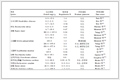
1.3.3 检测条件色谱条件:Acquity UPLC BEH C18 色谱柱 (2.1 mm × 100 mm, 1.7 μm),柱温30 ℃;以0.1%甲酸溶液为流动相A,以甲醇为流动相B,按表1的梯度洗脱条件进行分离,进样量为10 μL。
|
表 1 流动相及流速 Table 1 The mobile phase and the flow rate |
质谱条件:电喷雾离子源;正离子扫描ESI(+);多反应监测 (MRM) 模式,具体参数见表2;电离电压3.40 kV;雾化气流速1 000 L/h;锥孔气流速50 L/h;离子源温150 ℃;雾化气温度500 ℃。
在此条件下氟虫双酰胺的保留时间为5.05 min左右,噻嗪酮的保留时间为6.15 min左右。
|
|
表 2 质谱分析参数 Table 2 MS/MS parameters |
1.3.4 定量方法
准确称取氟虫双酰胺和噻嗪酮标准品各10.3和10.0 mg(精确至0.000 1 g),用乙腈溶解并定容,配成质量浓度为1 000 mg/L的标准品储备液。准确移取标准品储备液各1 mL,分别用乙腈稀释,配成质量浓度为100 mg/L的标准工作液。外标法定量。
吸取一定量的标准工作液,用茭白植株和茭白的空白基质分别逐级稀释,配成质量浓度分别为0.000 1、0.001、0.01、0.1、0.5、1 mg/L(噻嗪酮) 和0.005、0.05、0.1、0.5、1、5 mg/L(氟虫双酰胺) 的混合标准工作溶液。按1.3.3节的条件测定,以进样质量浓度 (x) 为横坐标、相应峰面积 (y) 为纵坐标绘制标准曲线。
1.3.5 添加回收试验在茭白植株和茭白空白样品中,分别添加0.01、0.5、1 mg/kg的氟虫双酰胺和0.005、0.5、1 mg/kg噻嗪酮3个水平的混合标准工作液。按1.3.3节的条件测定,每个水平重复5次,计算添加回收率及相对标准偏差。
2 结果与分析 2.1 方法的线性范围、检出限及定量限结果 (表3) 表明:在0.005~5 mg/L(氟虫双酰胺) 和0.000 1~1 mg/L(噻嗪酮) 范围内,各自的质量浓度与对应的峰面积间均呈良好的线性关系,R2均大于0.99。氟虫双酰胺和噻嗪酮的检出限分别为0.05 ng 和0.001 ng,定量限分别为0.01 mg/kg和0.005 mg/kg。
|
|
表 3 氟虫双酰胺和噻嗪酮的线性回归方程 Table 3 Equation of linear regression of flubendiamide and buprofezin |
2.2 方法的准确度和精密度
在0.01、0.5和1 mg/kg 3个添加水平下,氟虫双酰胺在茭白植株和茭白中的平均回收率在81%~93%之间,相对标准偏差 (RSD) 在5.5%~9.6%之间。在0.005、0.5和1 mg/kg 3个添加水平下,噻嗪酮在茭白植株和茭白中的平均回收率在91%~107%之间,RSD在4.2%~11%之间 (表4)。两者均符合农药残留检测的要求[14]。
|
|
表 4 氟虫双酰胺和噻嗪酮在茭白植株和茭白中的添加回收率及相对标准偏差 (n = 5) Table 4 Recoveries and relative standard deviation of flubendiamide and buprofezin in brcct and stem at three spiked levels (n = 5) |
在1.3.3节的检测条件下,氟虫双酰胺和噻嗪酮的样品添加总离子流色谱图见图1。从中可以看出,氟虫双酰胺和噻嗪酮色谱峰形良好,空白基质样品色谱图显示无内源性杂质干扰。

|
a. 0.001 mg/kg 基质匹配标准溶液; b. 植株空白样品; c. 植株中添加0.01 mg/kg氟虫双酰胺和0.005 mg/kg噻嗪酮。 a. Matrix-matched standard solution of 0.001 mg/kg; b. Blank control of bract; c. Fortified 0.01 mg/kg flubendiamide and 0.005 mg/kg buprofezin in bract matrix. 图 1 氟虫双酰胺和噻嗪酮在茭白植株中的色谱图 Fig. 1 The chromatogram of flubendiamide and buprofezin in bract matrix |
2.3 氟虫双酰胺和噻嗪酮在茭白植株中的消解动态
结果 (表5) 表明:氟虫双酰胺和噻嗪酮在茭白植株中的半衰期分别为2.3 d和2.8 d,其消解动态符合一级动力学方程,消解曲线见图2。氟虫双酰胺和噻嗪酮在茭白植株上的降解速度较快,属易降解农药 (t1/2 < 30 d) [15]。可能是由于茭白种植在淤泥中,一部分农药溶解在水中被稀释,只有少量农药残留在茭白植株中,加上浙江省秋季气候温暖,加速了农药的降解。
|
|
表 5 不同采样时间氟虫双酰胺和噻嗪酮在茭白植株中的残留量 Table 5 Residues of flubendiamide and buprofezin in bract at different sampling time |

|
图 2 氟虫双酰胺和噻嗪酮在茭白植株中的消解曲线 Fig. 2 The residue dynamic curves of flubendiamide and buprofezin in bract |
2.4 氟虫双酰胺和噻嗪酮在茭白中的最终残留量
结果 (表6) 表明:10% 阿维·氟酰胺悬浮剂分别按制剂用量450 g/hm2和600 g/hm2,施药次数为2次和3次,间隔期5 d,距最后一次施药7 d后采样,氟虫双酰胺在茭白中的残留量均 < 0.01 mg/kg。由于氟虫双酰胺在植株表面喷施,茭白被植株叶鞘层层包裹,且在植株中的消解速度较快,不易渗透,故在茭白中的残留量较少。
25% 噻嗪酮可湿性粉剂在施药次数为2次和3次、间隔期5 d条件下,当制剂用量为675 g/hm2时,噻嗪酮在茭白中的残留量为 < 0.005~0.034 mg/kg;当制剂用量为900 g/hm 2时,残留量为 < 0.005~0.078 mg/kg。噻嗪酮在茭白植株中的消解也较快,但其在土壤中的滞留时间较长 [16],而茭白长在淤泥中,因此扩散到淤泥和水中的农药可渗透到茭白中,使茭白在施药21 d还有残留 (表7)。
|
|
表 6 不同采样时间氟虫双酰胺在茭白中的最终残留量 Table 6 Final residue of flubendiamide in stem at different sampling time |
|
|
表 7 不同采样时间噻嗪酮在茭白中的最终残留量 Table 7 Final residue of buprofezin in stem at different sampling time |
3 结论与讨论
郑圣发等[17]发现,使用阿维菌素和氟虫双酰胺混剂——10% 阿维菌素·氟虫双酰胺悬浮剂防治水稻虫害,比单剂氟虫双酰胺效果更显著。因此本研究选用了复配制剂10% 阿维·氟酰胺悬浮剂进行田间试验。
杨德毅[18]研究了1.8%阿维菌素乳油在茭白上的残留动态,半衰期小于1 d,阿维菌素在茭白上易降解,并推荐阿维菌素用药量为有效成分16.2 g /hm2,施药2次。经计算,本研究中阿维菌素用药量为有效成分14.85 g /hm2,施药2次,用药量更低。表明本研究推荐的10% 阿维·氟酰胺悬浮剂,最高制剂用量为450 g/hm2时,在茭白上使用是安全的。
根据10% 阿维·氟酰胺悬浮剂和25% 噻嗪酮可湿性粉剂的消解动态试验和最终残留试验结果,建议10% 阿维·氟酰胺悬浮剂,用于防治茭白螟虫时,最高制剂用量为450 g/hm2,最多施药2次,施药效果良好;25% 噻嗪酮可湿性粉剂,用于防治茭白长绿飞虱时,最高制剂用量为675 g/hm2,最多施药2次,施药效果良好。中国制定了噻嗪酮在水稻上的最大残留限量 (MRL) 为0.3 mg/kg,而氟虫双酰胺在任何作物上均未制定MRL值[19]。中国和其他相关国家组织均未制定两者在茭白上的MRL值。从安全角度考虑,推荐10% 阿维·氟酰胺悬浮剂安全间隔期以7 d为宜,25% 噻嗪酮可湿性粉剂安全间隔期以21 d为宜。
| [1] |
NISHIMATSU T, HIROOKA T. Flubendiamide: a new insecticide for controlling lepidopterous pests[C]//Brit Crop Prot Counciled. Proceedings of the BCPC International Congress-Crop Science Technology. Glasgow: Brit Crop Prot Council, 2005: 57-63.
|
| [2] |
KANNO H. An approach to a novel insect growth regulator buprofezin (Applaud)[J]. Pure Appl Chem, 1987, 59(8): 1027-1032. DOI:10.1351/pac198759081027 |
| [3] |
陈新. 10%氟虫双酰胺·阿维菌素SC防治水稻二化螟田间药效试验[J]. 安徽农业通报, 2016, 22(9): 99, 138. CHEN X. Field test of 10% flubendiamide·avermection SC in control of rice stem borer[J]. J Anhui Agric Bull, 2016, 22(9): 99, 138. |
| [4] |
吕敏, 陆玉荣, 苏建坤. 烯啶虫胺和噻嗪酮复配防治灰飞虱的增效作用[J]. 安徽农业科学, 2017, 45(10): 155-156, 158. LV M, LU Y R, SU J K. Study on synergism of nitenpyram and buprofezin to Laodelphax striatellus [J]. J Anhui Agric Sci, 2017, 45(10): 155-156, 158. DOI:10.3969/j.issn.0517-6611.2017.10.051 |
| [5] |
张珏锋, 陈建明, 何月平. 8种杀虫剂对茭白长绿飞虱的生物活性[J]. 浙江农业科学, 2016, 57(10): 1673-1675. ZHANG J F, CHEN J M, HE Y P. Bioactivity of 8 fungicides on Zizania latifolia of Saccharosydne procerus [J]. J Zhejiang Agric Sci, 2016, 57(10): 1673-1675. |
| [6] |
李洋, 李淼, 柴宝山, 等. 新型杀虫剂氟虫酰胺[J]. 农药, 2006, 45(10): 697-699. LI Y, LI M, CHAI B S, et al. A new insecticide flubendiamide[J]. Agrochemicals, 2006, 45(10): 697-699. DOI:10.3969/j.issn.1006-0413.2006.10.018 |
| [7] |
刘金凤, 朱国念, 丁伟, 等. 超高效液相色谱-串联质谱法分析氟虫双酰胺在稻田生态系统中的消解动态[J]. 农药学学报, 2011, 13(3): 310-313. LIU J F, ZHU G N, DING W, et al. Residue decline study of flubendiamide in rice ecosyetem by UPLC-MS/MS[J]. Chin J Pestic Sci, 2011, 13(3): 310-313. |
| [8] |
SAHOO S K, SHARMA R K, BATTU R S, et al. Dissipation kinetics of flubendiamide on chili and soil[J]. Bull Environ Contam Toxicol, 2009, 83(3): 384-387. doi: 10.1007/s00128-009-9782-9.
|
| [9] |
BATTU R S, SINGH B, KOONER R, et al. Simple and efficient method for the estimation of residues of flubendiamide and its metabolite desiodo flubendiamide[J]. J Agric Food Chem, 2008, 56(7): 2299-2302. doi: 10.1021/jf073081s.
|
| [10] |
汪芙蓉, 张家俊, 吴萍, 等. 噻嗪酮-烯啶虫胺在水稻田样品中的残留检测方法[J]. 南京农业大学学报, 2013, 36(6): 128-134. WANG F R, ZHANG J J, WU P, et al. Determination method of buprofezin and nitenpyram residues in rice field[J]. J Nanjing Agric Univ, 2013, 36(6): 128-134. DOI:10.7685/j.issn.1000-2030.2013.06.021 |
| [11] |
龙家寰, 李刚, 张盈, 等. 气相色谱-质谱联用快速检测杨梅中噻嗪酮残留[J]. 贵州农业科学, 2017, 45(10): 131-133. LONG J H, LI G, ZHANG Y, et al. Rapid detection of buprofezin residues in Myrica rubra by gas chromatograph-mass spectrometry [J]. Guizhou Agric Sci, 2017, 45(10): 131-133. DOI:10.3969/j.issn.1001-3601.2017.10.032 |
| [12] |
FENOLL J, RUIZ E, HELLÍN P, et al. Dissipation rates of insecticides and fungicides in peppers grown in greenhouse and under cold storage conditions[J]. Food Chem, 2009, 113(2): 727-732. doi: 10.1016/j.foodchem.2008.08.007.
|
| [13] |
GRIMALT S, POZO Ó J, SANCHO J V, et al. Use of liquid chromatography coupled to quadrupole time-of-flight mass spectrometry to investigate pesticide residues in fruits[J]. Anal Chem, 2007, 79(7): 2833-2843. doi: 10.1021/ac061233x.
|
| [14] |
农药残留试验准则: NY/T 788—2004[S]. 北京: 中国农业出版社, 2004. Guideline on pesticide residue trials: NY/T 788—2004[S]. Beijing: China Agriculture Press, 2004. |
| [15] |
化学农药环境安全评价试验准则: GB/T 31270—2014[S]. 北京: 中国标准出版社, 2014. Test guidelines on environmental safety assessment for chemical pesticides: GB/T 31270—2014[S]. Beijing: Standards Press of China, 2014. |
| [16] |
胡莲英. 噻嗪酮在水稻及土壤中的残留与消解[J]. 农药, 1990, 29(6): 37-38. HU L Y. Residue and dissipation of buprofezin in rice and soil[J]. Agrochemicals, 1990, 29(6): 37-38. |
| [17] |
郑圣发, 周爱贤, 郑礼旺. 10%氟虫双酰胺·阿维菌素悬浮剂防治稻纵卷叶螟的效果研究[J]. 现代农业科技, 2014(10): 133, 136. ZHENG S F, ZHOU A X, ZHENG L W. The effect research of 10% flubendiamide·abamectin to control rice leaf-folder[J]. Mod Agric Sci Technol, 2014(10): 133, 136. |
| [18] |
杨德毅. 茭白中阿维菌素和甲氨基阿维菌素苯甲酸盐的残留检测及降解规律研究[D]. 杭州: 浙江农林大学, 2015. YANG D Y. Study on residual detection and degradation rule of avermectin and emamectin benzoate in water bamboo[D]. Hangzhou: Zhejiang A&F University, 2015. |
| [19] |
农业部农药检定所. 中国农药信息网-农药登记数据查询系统[DB/OL]. [2018-02-01]. http://www.chinapesticide.gov.cn/hysj/index.jhtml. Institute for the Control of Agrochemicals, Ministry of Agriculture. Pesticide registration data query system in China pesticide information network[DB/OL]. [2018-02-01].http://www.chinapesticide.gov.cn/hysj/index.jhtml. |