 2018, Vol. 20


2. 江苏省农业科学院 农产品质量安全与营养研究所,南京 210014;
3. 扬州大学 生物科学与技术学院,江苏 扬州 225009
2. Institute of Food Safety and Nutrition, Jiangsu Academy of Agricultural Sciences, Nanjing 210014, China;
3. College of Biology Science and Technology, Yangzhou University, Yangzhou 225009, Jiangsu Province, China
多氯联苯 (polychlorinated biphenyls,PCBs) 和重金属均属于环境持久性有毒污染物,该类化合物能够在大气、水体和土壤中迁移,对环境造成严重污染,并可通过多种途径进入生物体内富集,且不易被降解[1-2],影响生物生理生化功能,导致病变和突变[3-7]。PCBs是被《斯德哥尔摩公约》列为优先控制的12类持久性有机污染物之一,曾先后在日本福冈、长崎及中国台湾地区造成“米糠油”中毒事件[8]。重金属亦可引起严重的环境污染与食品安全问题,其中汞中毒引发的水俣病和稻米镉污染造成的骨痛病,引起了人们对环境污染与健康的担忧[9]。斑点叉尾鮰Ictalurus punctatus主要分布在美国和墨西哥北部,其产量占美国淡水养殖总产量的1/2以上。该鱼具有适应范围广、食性杂、适温广、抗病力强、生长快、产量高、易饲养、肉质鲜嫩和易捕捞等特点。20世纪80年代中期,斑点叉尾鮰由美国引入中国,现已成为中国重要的淡水经济鱼类之一,也是中国重要的出口水产品。江苏沿海地区是该鱼种的重要养殖出口区域,但同时作为工业发达地区,工业污染物排放对环境的影响日益影响着水产品生产的安全,且有毒污染物在水产品中的富集可随食物链发生生物放大,进而危害人类健康。研究发现,PCBs可以影响鱼卵母细胞的形成及其后代成活率,且强烈影响肝脏的脱乙基酶 (7-ethoxyresorufin-O-diehthylase, EROD) 活性[10]。人类长期食用含有有毒污染物残留的水产品,不仅具有“三致作用”(即致癌、致畸、致突变) 危险,还会对免疫、生殖、神经和内分泌系统产生不良影响[7, 11]。因此对水产养殖地区PCBs、重金属污染现状的调查与风险评估尤为必要。欧盟对不同鱼类及组织中的二鰁英、类二鰁英及指示类PCBs的限量有不同的规定,其中对6种PCBs的总和限量为125~300 ng/g鲜重,对二鰁英和类二鰁英PCBs的总和限量为65~200 pg/g鲜重,对鱼油中二鰁英的限量为35~175 pg/g,但尚未规定本研究中18种PCBs总和的限量[12]。以PCB28、PCB52、PCB101、PCB118、PCB138、PCB153和PCB180总和计,中国规定水产品中多氯联苯的MRL值为500 ng/g[13]。
已有研究者对环境中持久性有毒污染物及其生物富集效应进行了研究[14-16],本研究拟通过调查分析江苏地区斑点叉尾鮰养殖环境及鱼体中多氯联苯和重金属的污染状况,明晰污染物浓度水平、分布规律及污染来源,并进行初步的生态与健康风险评估。
1 材料与方法 1.1 样品采集江苏省内斑点叉尾鮰主要养殖区域 (养殖面积):海安 (333.33 hm2)、东台 (1 000 hm2)、大丰 (1 333.33 hm2)、射阳 (1 333.33 hm2)。
底泥与水样的采集:根据区域养殖面积及鱼塘面积大小,采用随机取样法均匀覆盖采样,每公顷取15个点以代表该区域的养殖环境情况,水样每点取3 L,底泥每点取2~4 kg,四分法缩分留样不少于500 g。
鱼样的采集:以生长期及大小均一致的鱼样为主要采集对象,每塘口按每公顷水面随机取10~15条,可视鱼的大小及生长期适当调整采样数量,每塘口所取鱼样混合后,四分法缩分留样不少于500 g。
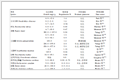
所有样品分别于每年4月、6月、9月和12月采集。样品采集地信息见表1。
|
表 1 样品采集地的地理信息 Table 1 Geography information of sampling |

|
图 1 江苏省斑点叉尾鮰养殖环境和鱼体中各PCB成分含量分布 Fig. 1 Dissipation and composition of PCBs in water, sediment and fish bodies from Ictalurus punctatus farm of Jiangsu Province |
1.2 样品处理与分析
水、底泥和鮰鱼组织器官中多氯联苯的分析方法参考GB 5009.190—2014与文献[17],重金属的测定详见参考文献[18]。
1.3 风险评估 1.3.1 生态风险评估采用世界卫生组织 (WHO) 的12 种类二鰁英PCBs的毒性当量因子法 (toxic equivalency factors, TEFs) 进行生态风险评估,该体系通常被称作WHO-TEF体系[19],类二鰁英PCBs的毒性当量 (TEQ) 浓度按公式 (1) 计算,水样单位为ng/L,底泥和鱼为pg/g。
| $TEQ = c \times TEF$ | (1) |
(1) 式中,c为样品中目标物的浓度 (pg/g),TEF为毒性当量因子。
单项重金属污染潜在生态危害系数 (potential ecological risk index, E) 按公式 (2) 计算。
| $E = \frac{{C_{\text{实测}}^i \times T}}{{C_n^i}}$ | (2) |
(2) 式中,T为Hankanson标准化重金属毒性响应系数[20-21],
常用的多种重金属污染生态风险评价方法为潜在生态风险指数法 (potential ecological risk index, RI),该法侧重于多元素的协同作用,同时考虑了各重金属元素的毒性,适用于评价区域环境的潜在生态风险。潜在生态风险指数 (RI) 按公式 (3) 计算。
| $RI = \sum\limits_{{{i}} = 1}^{{m}} {E_i} $ | (3) |
(3) 式中,Ei为单项重金属污染潜在生态危害系数;i为单项污染物;m为重金属的数量。
1.3.2 人体健康风险评估采用估计每日摄入量 (EDI) 对鱼肉中PCBs和重金属进行暴露评估,采用美国环境保护署 (EPA) 目标风险商 (THQ) 和风险系数 (R) 方法对非致癌和致癌风险进行评估。当暴露于多种污染物的情况下,采用风险增加假设,将每个化合物的THQ和R相加得到总的非致癌风险 (HI) 和致癌风险 (RT)。THQ为暴露量和参考剂量的比率。当THQ < 1时,表明暴露量低于参考剂量,污染物造成的不良影响可以忽略;当 THQ > 1时,表明暴露量高于参考剂量,污染物造成不良影响的风险较高。可接受 R的范围通常为 1 × 10⁻⁶~1 × 10⁻⁴,当R > 1 × 10 –4,表明致癌风险较高。计算公式[22]见式 (4)~(8)。
| $EDI = \frac{{c \times {F_{\rm {IR}}}}}{{{W_{\rm {AB}}}}}$ | (4) |
| $THQ = \frac{{{E_{\rm F}} \times {E_{\rm D}} \times {F_{\rm {IR}}} \times c}}{{{R_{\rm {FD}}} \times {W_{\rm {AB}}} \times {T_{\rm A}}}} \times {10^{ - 3}}$ | (5) |
| $R = \frac{{{E_{\rm F}} \times {E_{\rm D}} \times {F_{\rm {IR}}} \times SF \times c}}{{{W_{\rm {AB}}} \times {T_{\rm A}}}} \times {10^{ - 3}}$ | (6) |
| $HI = \sum\limits_{{{i}} = 1}^{{m}} {THQ} $ | (7) |
| $R_{\rm T} = \sum\limits_{{{i}} = 1}^{{m}} {{R_{{i}}}} $ | (8) |
式 (4)~(8) 中,c:样品中目标物的浓度;FIR:每日鱼肉平均摄入量[根据江苏省的人口和年水产品消费量[23],设为 75 g/(d·人)];WAB:成年人平均体重 (70 kg)[24];EF:暴露频率 (350 d/year)[25];ED:暴露持续时间 (30 年);RFD:口服参考剂量 [mg/(kg bw·d)]。TA:平均暴露时间 (183 d/年 × 平均寿命[26], 设为 70 年);SF:口服致癌斜率因子 [mg/(kg·d)]–1;Ri:单项污染物的致癌风险;i:单项污染物;m:污染物数量。
2 结果与分析 2.1 PCBs在斑点叉尾鮰养殖环境及鱼体中的污染水平与分布特征 2.1.1 PCBs在斑点叉尾鮰养殖环境及鱼体中的污染水平结果表明:PCBs在斑点叉尾鮰养殖水中的含量为0.2~11.9 ng/L,与珠江入海口深层水中PCBs含量相近[27],是韩国城市河水中PCBs含量的4倍[28];PCBs在底泥中的含量为178.4~457.2 pg/g ,仅为珠江广州段沉积物样品中PCBs含量的1%[27],是长江口九段沙水域滩涂泥样中PCBs总含量的1/10[29];在鱼肉、鱼肝和鱼肠胃中的含量分别为 1.28~267.96、0.64~95.46和1.20~45.94 pg/g(见电子版附加材料附表),其中鱼肉组织中PCBs含量是印度北部杰纳布河鱼肉样品中PCBs含量的1/5[30],远低于北美伊利湖中所采集鱼样品中PCBs的含量[31]。与以上地区比较,本研究中PCBs在底泥和鱼组织器官中尚处于较低含量水平,水体中为中等含量水平。
独立样本t检验表明,PCBs在养殖环境水体、底泥和鱼组织器官样品中的含量无显著性差异,但在鱼肉、肝脏、肠胃中的分布差异显著,PCBs更容易在鱼肉中富集,是鱼肝脏、鱼肠胃中的3~6倍,鱼肝中PCBs的含量约是肠胃中的2倍,此结果与长江流域检出的鲢鱼和鳙鱼鱼肝中PCBs含量约是鱼肉中4倍的结果不同[32]。与鲢鱼和鳙鱼相比,斑点叉尾鮰体表无鳞,鱼皮和鱼肉中鱼油与脂肪的含量较高,可能是PCBs在鱼肉中富集较多的原因。
2.1.2 PCBs在斑点叉尾鮰养殖环境及鱼体中的分布特征由图1A可知:海安和射阳水样中PCBs成分含量相近,PCB28(26.5%)、52(22.5%)、169(16.3%) 和77(9.3%) 在所有同系物中占主导地位;东台水样中以PCB114(60%) 为主,其次是PCB28(20%);大丰水样以PCB28(25.7%) 和PCB114(22.5%) 为主。海安、射阳水样中PCBs平均含量是东台、大丰的10倍,应重点关注其污染源。
海安、射阳和大丰的底泥样中PCBs均以PCB114为主 (42.1%),其次依次为PCB28(19.4%)、PCB126(7.6%) 和PCB52(6.7%);而东台底泥样以PCB28为主 (45.2%),其次依次为PCB52(20.6%)、PCB126(10.8%) 和PCB77(9.7%)。按PCBs平均含量由高到低依次为东台 (395pg/g)﹥海安 (345.6 pg/g)﹥大丰 (327 pg/g)﹥射阳 (189.2 pg/g)。其中,东台PCB52的平均含量 (81.4 pg/g) 是其他3个地区平均含量 (19.4 pg/g) 的4倍 (图1B)。
鱼体 (图1C) 中占主导地位的PCBs有PCB28、52和114,3者总和占PCBs总含量的 72 %,与水样和底泥样中占主导地位的PCBs单体相一致。

|
图 2 江苏省斑点叉尾鮰养殖环境及鱼体中PCBs主成分分析 Fig. 2 Principal component analysis of PCBs in environmental media and fish from Ictalurus punctatus farm of Jiangsu Province |
2.1.3 PCBs在斑点叉尾鮰养殖环境及鱼体中的污染来源解析
残留的PCBs,一部分随工业废水进入河流或沿岸,另一部分渗漏到地下或随垃圾焚烧释放到空气中,然后经过干湿沉降再转入河流、湖泊、海洋或者直接排放进入土壤。进入环境中的PCBs最终贮存场所主要是河流沿岸水体的底泥中。在本研究中,与其他样品相比,水体中PCBs的含量最少,4个地区虽有所变化,但各采样点间无显著性差异,这可能与淡水养殖水域的独立性有关。海安采样点位于居民区,其水体中PCBs含量最高,东台位于新工业区,其底泥中PCBs含量最高,鱼组织中PCBs含量以海安最高。水体中PCBs含量与鱼组织中含量呈明显正相关,说明PCBs存在向生物体转移富集的过程。
通过对水、底泥和鱼体采样点PCBs的来源进行主成分分析 (图2) 发现:主成分1和主成分2的累积贡献率为90.28%,其中主成分1代表以五氯代PCB114为主的污染源,主成分2代表以三氯代PCB28为主的污染源。大部分采样点聚集在主成分1的右端,表明大部分采样点的PCBs来源相似,均以五氯代为主;少部分采样点聚集在主成分2的上端,表明少部分PCBs的来源以三氯代为主;而大丰鱼样中四氯代PCB52含量明显高于其他采样点,因此单独成点。四氯代联苯主要污染来源与采样地区密布的风力发电设备相关,为电力设备的绝缘油;三氯代的成分组成与中国生产的PCBs产品组成相似,主要污染来源于日常生活中的蜡、塑料、液压油、油漆和润滑剂。海安和射阳PCBs的成分组成相似,水样中以三氯代PCBs为主,实地调查发现,两个采样点的养殖鱼塘均位于村落、人口密集地带,生活垃圾可能是水中三氯代PCBs的主要污染来源。低氯代的PCBs挥发性较强,可通过空气进行长距离转移,并且在转移的过程中易被降解[33];五氯代PCBs主要用作电介质、增塑剂、变压器油、油漆添加剂。东台和大丰的养殖鱼塘面积大,集中在海边,污染物主要为五氯联苯。实地调查发现,东台采样点附近冷冻设备、机械钢架板材类工厂较多,五氯代PCBs易从大气中沉降,因而造成五氯代PCBs 在样品中的含量显著高于其他PCB同系物[34]。推测工业污染及游客的出行垃圾可能是其污染的主要来源。

|
图 3 重金属在水、底泥及鱼组织中的分布特征 Fig. 3 Distribution features of heavy metals in water, sediment and fish tissues |
2.2 重金属在斑点叉尾鮰养殖环境及鱼体中的污染水平与分布特征 2.2.1 重金属在斑点叉尾鮰养殖环境及鱼体中的污染水平
Pb、As、Cd和Hg在鱼体各组织器官、水体、底泥中的污染水平均见电子版附加材料。
4种重金属在底泥中的含量均最高,在水样中的最低;水样中未检出Cd和Hg,可能与这两种金属脂溶性较强相关。独立样本t检验表明,各采样点重金属含量无显著性差异。除Hg外,鱼组织器官中的重金属含量以肝脏中相对较高,说明As、Cd和Pb较易在肝脏中富集。鱼体内重金属平均含量从大到小依次为Pb﹥As﹥Cd﹥Hg,不同组织中4种重金属总含量由高到低的顺序为肝脏﹥肠胃﹥肉。
2.2.2 重金属在斑点叉尾鮰养殖环境及鱼体中的分布特征沉积物是大多数重金属的最后归宿,含量通常很高。本研究中4种重金属在底泥中的含量占 60%~100%。相关性分析表明,Cd、Hg的生物富集效应高于As和Pb。其中,Cd易在肝中富集,高达 21%,是鱼肉的 7 倍;Hg易在肠胃中富集,高达 17%(图3)。鱼体对As和Pb的富集效应不如Cd和Hg明显,As和Pb更易进入沉积物中,在底泥中的比例分别为 99%和100%。
2.3 斑点叉尾鮰养殖环境生态毒理风险评估从表2中数据可以看出:江苏省鮰鱼养殖体系中重金属的潜在生态风险程度为中等。关于参比值的选择,各国学者的差别较大,有以当地土壤背景值为参比值的,也有以国家土壤质量标准为参比值的。本研究以 2013年江苏省地质调查研究院的全省深层土壤地球化学指标调查数据 (中值) 为主要评价参比值[35],表2中土壤环境背景值为GB15618—1995《土壤环境质量标准》中的第3级标准,为保障农林业生产和植物正常生长的土壤临界值[21]。毒性响应系数 (T) 见文献[20]。
|
|
表 2 重金属风险评价参数 Table 2 Calculation parameter used in the risk assessment of heavy metals |
类二鰁英的PCBs可以对环境和人类产生类似二鰁英的毒性,被认为是毒性最高的PCBs。由表3可知:PCB126和PCB169是该区域DL-PCBs TEQ浓度的主要贡献者,该区域底泥、鱼肠胃中DL-PCBs TEQ的浓度范围与PCB126基本一致。水体中DL-PCBs总TEQ浓度约是印度首都一个主要池塘中DL-PCBs总TEQ浓度的1.5 倍[36];底泥中DL-PCBs总TEQ浓度约是渤海表层沉积物中DL-PCBs总TEQ浓度的1/4[37];鱼肉中DL-PCBs总TEQ浓度为1.9 pg/g,低于欧盟对鱼肉中DL-PCBs的TEQ限量标准 (6.5 pg/g)[38];鱼肝中DL-PCBs总TEQ浓度是鱼肉中DL-PCBs总TEQ浓度的1/10,略大于鱼肠胃中DL-PCBs的总TEQ浓度。生态毒理风险评估结果表明,江苏省斑点叉尾鮰养殖环境水体中PCBs的TEQ浓度相对较高,为0.2~11.9 ng/L,但均低于中国地表水 (20 ng/L) 和美国应用水 (500 ngL) 的PCBs标准[32],表明江苏省斑点叉尾鮰养殖环境水体中的PCBs对人类和生物体系的潜在风险较低。底泥中DL-PCBs的TEQ浓度相对较低,为178.4~457.2 pg/g,亦远小于《海洋沉积物质量标准》第1类的20 000 pg/g[39]。
综上所述,该养殖区域水中DL-PCBs TEQ浓度的主要贡献者为PCB169,而在底泥中以PCB 126为主要成分,且TEQ浓度较高 (> 4.00),应引起重视,并溯源其可能的污染来源,以减少环境中的负荷与累积。
|
|
表 3 斑点叉尾鮰养殖环境及鱼组织中二鰁英类PCBs的TEQ浓度 Table 3 The TEQ concentration of dioxin-like PCBs in environment media and Ictalurus punctatus tissues |
2.4 PCBs和重金属对人体健康风险的评估
结果 (表4) 表明:各污染物的EDI均远低于参考值,表明该地区人群因食用鱼类而暴露的风险可忽略。由表5可知:所有采样点的THQs均低于阈值 1.0,其中PCBs和As的THQ远大于其他污染物,危害相对较大;4个地区的HI分别为0.308、0.094、0.220和0.254,均低于1.0,表明食用该地区鮰鱼的非致癌性风险水平较低。另外,除海安采样点鱼体中As的4个地区非致癌风险总和(Rs)和各个地区致癌风险(RT)处于临界值 1 × 10⁻⁴外,其他地区鱼体中PCBs的Rs和RT均低于 1 × 10⁻⁴,表明这些地区鱼类中PCBs造成的致癌风险较低,但海安地区As污染风险应引起关注。由于本研究未考虑不同年龄人群和不同性别的风险差异,以及生物可利用率,所得到的风险值可能高于实际风险值。
|
|
表 4 鱼肉中PCBs和重金属的EDI与相关参考值比较 Table 4 Comparison of EDI of PCBs and heavy metals in fish meat and corresponding reference values |
|
|
表 5 PCBs和重金属的非致癌风险和致癌风险评估 Table 5 Carcinogen and non-carcinogen risk assessment of PCBs and heavy metals |
3 结论
对江苏地区斑点叉尾鮰养殖环境、鱼体中 18种PCBs和 4种重金属的研究表明,该区域鱼体内的污染物水平尚处于相对较低水平,该地区人群通过食用该种鱼类而暴露的风险可以忽略。风险评估表明,该地区人群通过食用鮰鱼的非致癌性风险和致癌性风险水平都较低,斑点叉尾鮰养殖环境水体中PCBs的TEQ浓度相对较高,为0.2~11.9 ng/L,但均低于中国地表水 (20 ng/L) 和美国应用水 (500 ngL) 的PCBs标准[32],表明江苏省斑点叉尾鮰养殖环境水体中的PCBs对人类和生物体系的潜在风险较低。底泥中DL-PCBs的TEQ浓度相对较低,为178.4~457.2 pg/g,亦远低于《海洋沉积物质量标准》第1类的20 000 pg/g[39]。
| [1] | OCKENDEN W A, BREIVIK K, MEIJER S N, et al. The global ,re-cycling of persistent organic pollutants is strongly retarded by soils[J]. Environ Pollut, 2003, 121(1): 75–80. doi:10.1016/S0269-7491(02)00204-X |
| [2] | RISEBROUGH R W, RIECHE P, PEAKALL D B, et al. Polychlorinated biphenyls in the global ecosystem[J]. Nature, 1968, 220(5172): 1098–1102. doi:10.1038/2201098a0 |
| [3] | REUTERGARDH L B, PARKPIAN P, CHAIYARAKSA C. Supercritical fluid extraction of planar and mono-ortho PCB in selected tropical soils[J]. Chemosphere, 1998, 36(7): 1565–1573. doi:10.1016/S0045-6535(97)10054-6 |
| [4] | BOCIO A, DOMINGO J L. Daily intake of polychlorinated dibenzo-p-dioxins/polychlorinated dibenzofurans (PCDD/PCDFs) in foodstuffs consumed in Tarragona, Spain: a review of recent studies (2001-2003) on human PCDD/PCDF exposure through the diet [J]. Environ Res, 2005, 97(1): 1–9. doi:10.1016/j.envres.2004.01.012 |
| [5] | SASAMOTO T, USHIO F, KIKUTANI N, et al. Estimation of 1999-2004 dietary daily intake of PCDDs, PCDFs and dioxin-like PCBs by a total diet study in metropolitan Tokyo, Japan[J]. Chemosphere, 2006, 64(4): 634–641. doi:10.1016/j.chemosphere.2005.10.057 |
| [6] | SCHECTER A, CRAMER P, BOGGESS K, et al. Levels of dioxins, dibenzofurans, PCB and DDE congeners in pooled food samples collected in 1995 at supermarkets across the United States[J]. Chemosphere, 1997, 34(5-7): 1437–1447. doi:10.1016/S0045-6535(97)00440-2 |
| [7] | OHTA S, KURIYAMA S, AOZASA O, et al. Survey on levels of PCDDs, PCDFs, and Non-Ortho Co-PCBs in soil and sediment from a high cancer area near a batch-type municipal solid waste incinerator in Japan[J]. Bull Environ Contaminat Toxicol, 2000, 64(5): 630–637. doi:10.1007/s001280000050 |
| [8] | ROSS G. The public health implications of polychlorinated biphenyls (PCBs) in the environment[J]. Ecotoxicol Environ Safety, 2004, 59(3): 275–291. doi:10.1016/j.ecoenv.2004.06.003 |
| [9] |
甘居利, 吴光权. 鱼体内锌、镉和核酸的变化及其相互关系研究[J]. 水生生物学报, 1998, 22(1): 98–100.
GAN J L, WU G Q. Studies on the relationship among zinc, cadmium, nucleic acid and body length in grass carp[J]. Acta Hydrobiologica Sinica, 1998, 22(1): 98–100. |
| [10] | ÖRNS, ANDERSSONP L, FÖRLINL. The impact on reproduction of an orally administered mixture of selected PCBs in zebrafish (Danio rerio) [J]. Arch Environ Contaminat Toxicol, 1998, 35(1): 52–57. |
| [11] | BRANDT I, BERG C, HALLDIN K, et al. Developmental and reproductive toxicity of persistent environmental pollutants[M]//SEILER J P, AUTRUP J L, AUTRUP H. Diversification in toxicology-man and environment. Berlin Heidelberg: Springer, 1998: 111-119. |
| [12] | Commission Regulation. Commission Regulation (EC) No. 1259/2011 of 2 December 2011, amending Regulation (EC) No 1881/2006 as regards maximum levels for dioxins, dioxin-like PCBs and non dioxin-like PCBs in foodstuffs[J]. Off J Eur Union: L, 2011, 320: 3–12. |
| [13] |
食品安全国家标准 食品中污染物限量: GB2762—2017[S]. 北京: 国家食品药品监督管理总局, 2017.
National standard of food safety-maximum residue limit of pollutants in food China: GB2762—2017[S]. Beijing: China Food and Drug Administration. 2017. |
| [14] | TASDEMIR Y, ODABASI M, VARDAR N, et al. Dry deposition fluxes and velocities of polychlorinated biphenyls (PCBs) associated with particles[J]. Atmos Environ, 2004, 38(16): 2447–2456. doi:10.1016/j.atmosenv.2004.02.006 |
| [15] | TEIL M J, BLANCHARD M, CHESTERIKOFF A, et al. Transport mechanisms and fate of polychlorinated biphenyls in the Seine river (France)[J]. Sci Environ, 1998, 218(2/3): 103–112. |
| [16] |
曲蛟, 马振宇, 丛俏, 等. 钼矿区交通运输干线周边菜地土壤重金属污染分析与评价[J]. 农业环境科学学报, 2008, 27(1): 178–181.
QU J, MA Z Y, CONG Q, et al. Analysis and assessment on the heavy metals pollution in vegetable soil around the transportation skeleton line in molybdenum ore areas[J]. J Agro-Environ Sci, 2008, 27(1): 178–181. |
| [17] |
赵玲, 周蓓蕾, 沈燕, 等. 气相色谱-串联质谱法测定鮰鱼、底泥、水体中18种多氯联苯[J]. 江苏农业学报, 2017, 33(3): 701–708.
ZHAO L, ZHOU B L, SHEN Y, et al. Using gas chromatography-tandem mass spectrometry (GC-MS/MS) for 18 polychlorinated biphenyls detection in water, sediment and fish (Ictalurus punctatus) [J]. Jiangsu J Agric Sci, 2017, 33(3): 701–708. |
| [18] |
肖利. 洋山港及其邻近海域重金属污染研究[D]. 上海: 上海海洋大学, 2011.
XIAO L. Study on heavy metal contamination in Yangshan port and its adjacent sea areas[D]. Shanghai: Shanghai Ocean University, 2011. |
| [19] | VAN DEN BERG M, BIRNBAUM L S, DENISON M, et al. The 2005 World Health Organization reevaluation of human and mammalian toxic equivalency factors for dioxins and dioxin-like compounds[J]. Toxicol Sci, 2006, 93(2): 223–241. doi:10.1093/toxsci/kfl055 |
| [20] |
徐争启, 倪师军, 庹先国, 等. 潜在生态危害指数法评价中重金属毒性系数计算[J]. 环境科学与技术, 2008, 31(2): 112–115.
XU Z Q, NI S J, TUO X G, et al. Calculation of heavy metals’ toxicity coefficient in the evaluation of potential ecological risk index[J]. Environ Sci Technol, 2008, 31(2): 112–115. |
| [21] |
李瑞琴, 于安芬, 白滨, 等. 甘肃中部高原露地菜田土壤重金属污染及潜在生态风险分析[J]. 农业环境科学学报, 2013, 32(1): 103–110.
LI R Q, YU A F, BAI B, et al. Analysis on current situation and potential ecological risk and the characteristic of heavy metals pollution of soil in the central plateau of Gansu Province, China[J]. J Agro-Environ Sci, 2013, 32(1): 103–110. doi:10.11654/jaes.2013.01.016 |
| [22] | CUI L L, GE J, ZHU Y D, et al. Concentrations, bioaccumulation, and human health risk assessment of organochlorine pesticides and heavy metals in edible fish from Wuhan, China[J]. Environ Sci Pollut Res, 2015, 22(20): 15866–15879. doi:10.1007/s11356-015-4752-8 |
| [23] |
莫宝庆, 马凤楼, 胡春艳, 等. 江苏省城镇居民近年膳食营养摄取与疾病变化状况研究[J]. 中国食物与营养, 2007(4): 52–54.
MO B Q, MA F L, HU C Y, et al. Research on the changes of food consumption, nutrient intake and diseases of urban residents in Jiangsu Province in the recent years[J]. Food Nutr China, 2007(4): 52–54. |
| [24] |
中国体育总局, 教育部, 科技部, 等. 第二次国民体质监测公报[R]. 北京: 中国体育总局, 2005.
China’s General Administration of Sport, Ministry of Education, Ministry of Science and Technology, et al. The 2nd national physique monitoring report[R]. Beijing: China’s General Administration of Sport, 2005. |
| [25] | US. Environmental Protection Agency. Guidelines for exposure assessment[R]. Federal Register, 1992. |
| [26] | WHO. World Health Report[R]. Geneva, Switzerland: World Health Organization, 2007. |
| [27] |
聂湘平, 蓝崇钰, 栾天罡, 等. 珠江广州段水体、沉积物及底栖生物中的多氯联苯[J]. 中国环境科学, 2001, 21(5): 417–421.
NIE X P, LAN C Y, LUAN T G, et al. Polychlorinated biphenyls in the waters, sediments and benthic organisms from Guangzhou reach of Pearl River[J]. China Environ Sci, 2001, 21(5): 417–421. |
| [28] | KIM U J, KIM H Y, ALVAREZ D, et al. Using SPMDs for monitoring hydrophobic organic compounds in urban river water in Korea compared with using conventional water grab samples[J]. Sci Total Environ, 2014, 470-471: 1537–1544. doi:10.1016/j.scitotenv.2013.06.033 |
| [29] |
孙振中, 戚隽渊, 曾智超, 等. 长江口九段沙水域环境及生物体内多氯联苯分布[J]. 环境科学研究, 2008, 21(3): 92–97.
SUN Z Z, QI J Y, ZENG Z C, et al. Polychlorinated biphenyls in the water, soil and aquatic animals from the Jiuduansha wetland of Yangtze River estuary[J]. Res Environ Sci, 2008, 21(3): 92–97. |
| [30] | EQANI S A M A S, MALIK R N, CINCINELLI A, et al. Uptake of organochlorine pesticides (OCPs) and polychlorinated biphenyls (PCBs) by river water fish: the case of River Chenab[J]. Sci Total Environ, 2013, 450-451: 83–91. doi:10.1016/j.scitotenv.2013.01.052 |
| [31] | PÉREZ-FUENTETAJA A, LUPTON S, CLAPSADL M, et al. PCB and PBDE levels in wild common carp (Cyprinus carpio) from eastern Lake Erie [J]. Chemosphere, 2010, 81(4): 541–547. doi:10.1016/j.chemosphere.2010.06.033 |
| [32] | GE J, YUN X J, LIU M X, et al. Distribution, potential source and ecotoxicological risk of polychlorinated biphenyls and polybrominated diphenyl ethers in the surface water of the Three Gorges Dam region of the Yangtze River, China[J]. Ecotoxicology, 2014, 23(6): 978–987. doi:10.1007/s10646-014-1241-7 |
| [33] | ZHANG Z, LIU L Y, LI Y F, et al. Analysis of polychlorinated biphenyls in concurrently sampled Chinese air and surface soil[J]. Environ Sci Technol, 2008, 42(17): 6514–6518. doi:10.1021/es8004078 |
| [34] | DUAN X Y, LI Y X, LI X G, et al. Distributions and sources of polychlorinated biphenyls in the coastal East China Sea sediments[J]. Sci Total Environ, 2013, 463-464: 894–903. doi:10.1016/j.scitotenv.2013.06.102 |
| [35] |
廖启林, 刘聪, 金洋, 等. 江苏省域土壤元素地表富集及其与人为活动的关系研究[J]. 第四纪研究, 2013, 33(5): 972–985.
LIAO Q L, LIU C, JIN Y, et al. Surface environmental enrichment of some elements and its relationship between anthropogenic activity and elemental distribution in soil in Jiangsu Province[J]. Quat Sci, 2013, 33(5): 972–985. |
| [36] | JURY W A, SPENCER W F, FARMER W J. Behavior assessment model for trace organics in soil: I. model description[J]. J Environ Qual, 1983, 12(4): 558–564. |
| [37] |
杨丹丹. 渤海表层沉积物中多氯联苯(PCBs)的分布、来源及风险研究[D]. 青岛: 中国海洋大学. 2015.
YANG D D. Distrbution, sources and risk assessment of polychlornated biphenyl(PCBs) in surface sediments of Bohai Sea[D]. Qingdao: Ocean University of China, 2015. |
| [38] | BAARS A J, BAKKER M I, BAUMANN R A, et al. Dioxins, dioxin-like PCBs and non-dioxin-like PCBs in foodstuffs: occurrence and dietary intake in The Netherlands[J]. Toxicol Lett, 2004, 151(1): 51–61. doi:10.1016/j.toxlet.2004.01.028 |
| [39] |
中华人民共和国国家标准-海洋沉积物质量: GB18668—2002[S]. 北京: 中华人民共和国国家质量监督检验检疫总局, 2002.
National standard of the People's Republic of China -marine sediment quality: GB18668—2002[S]. Beijing: General Administration of Quality Supervision, Inspection and Quarantine of the People's Republic of China, 2002. |
| [40] | WHO Expert Committee on Food Additives. Joint FAO/WHO Expert Committee on food additives seventy-second meeting: summary and conclusions[R]. FAO/WHO, 2010. |
| [41] | BARNES D G, DOURSON M, PREUSS P, et al. Reference dose (RfD): description and use in health risk assessments [J]. Regul Toxicol Pharmacol, 1988, 8(4): 471–486. doi:10.1016/0273-2300(88)90047-5 |
| [42] | COGLIANO V J. Assessing the cancer risk from environmental PCBs[J]. Environ Health Perspect, 1998, 106(6): 317–323. doi:10.1289/ehp.98106317 |
| [43] | KARAGAS M R, STUKEL T A, TOSTESON T D. Assessment of cancer risk and environmental levels of arsenic in New Hampshire[J]. Int J Hyg Environ Health, 2002, 205(1/2): 85–94. |