 2017, Vol. 19


农药制剂通常是由农药有效成分与各种助剂混合而成[1],这些助剂对农药制剂使用效能等发挥着至关重要的作用[1],但一些助剂 (或其降解产物) 却具有潜在毒性[2-3],大量使用对环境、食品安全和人体健康会构成潜在威胁。
烷基酚聚氧乙烯醚 (alkylphenol ethoxylates, APEOs) (见图式 1a) 是一类常用的非离子表面活性剂类助剂,在杀虫剂、杀菌剂和除草剂等中均有应用[4]。在 APEOs 产品中,应用最多的是壬基酚聚氧乙烯醚 (nonylphenol ethoxylate, NPEO),占 80%~85%;剩下的主要是辛基酚聚氧乙烯醚 (octylphenol ethoxylate, OPEO)[4]。烷基酚聚氧乙烯醚释放到环境中会通过生物降解成为蓄积性更强、毒性更高的烷基酚(alkylphenols, APs) (见图式 1b),如壬基酚 (nonylphenol, NP) 和辛基酚 (octylphenol, OP) 等[5]。现有研究表明,烷基酚类物质具有内分泌干扰作用[6-8]。鉴于烷基酚的安全性问题,一些国家和组织已经禁止或限制 APEOs 和 APs 的使用[9-11],鼓励使用新型安全的表面活性剂替代壬基酚聚氧乙烯醚[12]。2015 年,中国农业部农药检定所起草的《农药助剂禁限用名单》 (征求意见稿) 已将壬基酚聚氧乙烯醚和壬基酚列为禁用助剂[13]。

|
图式 1 烷基酚聚氧乙烯醚及烷基酚的结构通式 Scheme1 Chemical structures of alkylphenol ethoxylates (APEOs) and alkylphenols (APs) |
一些研究认为,蔬菜等农产品中残留的 APEOs 和 APs,主要来源可能是所用农药中含有的 APEOs 等助剂[14-16],而目前对 APEOs 和 APs 检测的报道,主要集中在环境介质 (水体、污泥、底泥) [17-20]、纺织品[21-24]和食品[25-27]等,尚未见关于农药制剂中 APEOs 和 APs 检测的报道。已报道的分析方法主要为液相色谱-荧光法[20-22, 26-28]和液相色谱-质谱联用法等,其中液相色谱-荧光法是分析 APEOs 和 APs 使用最多的方法之一[20-22, 26-28],可满足大多数企业和基层检测的需求。因此,本研究针对 6 类常用液体农药制剂产品 (乳油、水剂、水乳剂、悬浮剂、可溶液剂和微乳剂),建立一种检测农药制剂中 APEOs 和 APs 的高效液相色谱-荧光分析方法,旨在为农药助剂的合理使用及监管提供依据和技术支持。
1 材料与方法 1.1 仪器和试剂Waters 2695 型高效液相色谱仪,配 2475 荧光检测器 (美国 Waters 公司);KQ-500DB 型数控超声波发生器 (昆山市超声仪器有限公司);XS105DU 电子天平 (0.000 1 g) (瑞士 Mettler Toledo 公司);Milli-Q 超纯水机 (美国 Millipore 公司)。
4-壬基酚 (4-NP, 99.5%)、4-正辛基酚 (4-n-OP, 99.5%) 和4-叔辛基酚 (4-t-OP, 99.0%),购于德国 Dr. E 公司;技术级标准品壬基酚聚氧乙烯醚 (NPEO) 和辛基酚聚氧乙烯醚 (OPEO) 购于美国 Chem Service 公司。甲醇、乙腈 (色谱纯,美国 MREDA 科技公司);水为 MilliQ 超纯水。聚丙烯 (PP) 微孔滤膜 (0.22 μm) 购于天津博纳艾杰尔。
用于添加回收试验的 6 类液体农药制剂:41% 草甘膦异丙胺盐水剂 (glyphosate isopropylamine salt, 41% AS),美国孟山都公司;1.7% 阿维•高氯氟可溶液剂 (abamectin•lambda-cyhalothrin, 1.7% SL),北京中农大生物技术股份有限公司;15% 三唑酮水乳剂 (triadimefon, 15% EW),济南绿霸农药有限公司;250 g/L 丙环唑乳油 (propiconazol, 250 g/L EC),山东滨农科技有限公司;687.5 g/L 氟菌•霜霉威悬浮剂 (fluopicolide•propamocarb hydrochloride, 687.5 g/L SC),拜耳作物科技 (中国) 有限公司;5% 啶虫脒微乳剂 (acetamiprid, 5% ME),贵州道元生物技术有限公司。
1.2 样品前处理准确称取 0.1 g (精确至0.000 1 g) 农药制剂样品于 10 mL 玻璃试管中,加入 8~9 mL 甲醇超声提取 2 min,用甲醇定容至 10 mL,摇匀备用。取上述农药试样 1 mL 再用甲醇定容至 10 mL。重复操作一次。得到稀释 1 × 10 4 倍的分散液,转移至玻璃离心管中,在 5 000 r/min 下离心 5 min。取 1 mL 上清液过 0.22 μm 聚丙烯微孔滤膜,待分析。
1.3 色谱分析条件Agilent Poroshell 120 EC-C 18 (4.6 mm × 100 mm, 2.7 μm) 色谱柱;柱温 30 ℃;荧光检测器激发波长为 230 nm,发射波长为 296 nm;流动相为: V (甲醇) : V (乙腈) : V (水) = 75.5 : 6.5 : 18.0;流速 0.8 mL/min;进样量 5 μL。
1.4 标准溶液的配制及标准曲线的绘制分别准确称量 4-NP、4-n-OP、4-t-OP、NPEO 和 OPEO 标准品 10 mg (精确至 0.0001 g) 于 10 mL 容量瓶中,用甲醇溶解并定容,得到 1 000 mg/L 的储备液。再用甲醇将其稀释成系列质量浓度的标准工作溶液。按 1.3 节条件进行分析。分别以 5 种分析物标准溶液的质量浓度 (x) 为横坐标,以相应的峰面积响应值 (y) 为纵坐标,建立线性回归方程,绘制标准曲线。
1.5 添加回收试验随机选取能代表乳油、悬浮剂、水乳剂、水剂、微乳剂、可溶液剂的农药制剂样品进行添加回收试验。APs (4-NP、4-n-OP、4-t-OP) 进行 3 个添加水平 (0.5、2、5 mg/g) 试验,每个水平 5 次重复;APEOs (NPEO、OPEO) 进行 4 个添加水平 (1、5、25、50 mg/g) 试验,每个水平 5 次重复。计算平均回收率和相对标准偏差 (RSD)。
2 结果与分析 2.1 色谱柱的选择分别考察了 Mixed-Mode HILIC-1 柱 (3.0 mm × 150 mm, 3 μm)、Dikma C 18 柱 (4.6 mm × 250 mm, 5 μm) 和 Poroshell 120 EC-C 18 柱 (4.6 mm × 100 mm, 2.7 μm) 对 5 种目标物的分离效果。在正相模式 (包括 HILIC 模式) 下,不同聚合度的 NPEO (OPEO) 因分子中含乙氧基数目不同而导致极性 (亲水性) 不同,可实现不同聚合度的 NPEO (或 OPEO) 的分离;而在反相模式下 (C 18 柱) 则按照疏水性大小进行分离,OPEO 和 NPEO 因分子中具有不同长度的烷基链而具有不同的保留时间,因而可将 OPEO 与 NPEO 分离,但不同聚合度的 OPEO 和不同聚合度的 NPEO 则无法分开,在谱图上均以单峰出现,且 OPEO 和 NPEO 的色谱峰较宽。
Mixed-Mode HILIC-1 柱具有 HILIC (亲水性液相色谱 hydrophilic interaction liquid chromatography) 和反相两种分离模式,在 HILIC 模式下,虽然对聚合度高的 NPEO 和 OPEO 分离效果较理想,但对极性相对较低的 4-NP、4-n-OP、4-t-OP 以及聚合度低的 NPEO 和 OPEO 的保留能力较差,无法实现完全分离;在反相模式下,可将 APs (4-NP、4-n-OP、4-t-OP) 与 APEOs (NPEO、OPEO) 基本分开,但分离效果不及 Dikma C 18 柱和 Poroshell 120 EC-C 18 柱。Dikma C 18 柱和 Poroshell 120 EC-C 18 柱对 4-NP、4-n-OP、4-t-OP、NPEO 及 OPEO 的分离效果均很好,但后者比前者的响应值更高,分析时间更短,更节省溶剂,因此,本研究最终选择 Poroshell 120 EC-C 18 柱在反相模式下对 5 种目标物进行分离。
2.2 流动相的优化考察了不同体积比的甲醇-水流动相体系 (体积比 60 : 40,70 : 30,80 : 20,90 : 10) 对 4-NP、4-n-OP、4-t-OP、NPEO 及 OPEO 5 种目标物的分离效果。结果表明,当 V (甲醇) : V (水) = 80 : 20 时,5 种目标物基本能达到分离。对甲醇的比例进行微调,结果显示,随着甲醇比例的增加,保留时间提前,峰宽变窄,响应值提高,但分离度有所下降。为了进一步改善分离效果,在流动相体系中加入一定比例的乙腈,结果发现,随乙腈比例的增加,响应值随之提高,色谱峰宽变窄,峰形尖锐。当 V (甲醇) : V (乙腈) : V (水) = 75.5 : 6.5 : 18.0 时,目标物之间的分离效果较好,最终确定以其为流动相。色谱图见图 1。

|
Poroshell 120 EC-C18 (4.6 mm ×100 mm, 2.7 μm) 色谱柱;柱温 30 ℃;流动相为:V(甲醇) : V(乙腈) : V(水)= 75.5 : 6.5 : 18.0;流速 0.8 mL/min。 Chromatographic column: Poroshell 120 EC-C18 (4.6 mm × 100 mm, 2.7 μm); column temperature: 30 ℃; mobile phase: V(methanol) : V(acetonitrile) : V(water)= 75.5 : 6.5 : 18.0, isocratic elution; flow rate: 0.8 mL/min. 图 1 混合标准溶液色谱图 (4-NP、4-n-OP 和 4-t-OP: 2 mg/L;NPEO 和 OPEO: 4 mg/L) Fig. 1 The chromatogram of mixed standard solutions (4-NP, 4-n-OP and 4-t-OP: 2 mg/L; NPEO and OPEO: 4 mg/L) |
2.3 样品前处理条件优化
2.3.1 稀释溶剂的选择 农药剂型种类繁多,本研究选择乳油、水剂、水乳剂、悬浮剂、可溶液剂和微乳剂为研究对象,研究了不同稀释溶剂 [水、甲醇和 V (甲醇) : V (水) = 1 : 1] 对不同剂型农药的溶解性以及对目标分析物回收率的影响。结果表明:用水或V (甲醇) : V (水) = 1 : 1 稀释后,水乳剂、可溶液剂、乳油、微乳剂为乳浊液,表面有泡沫,水剂为澄清透明溶液,悬浮剂为悬浊液;并且 5 种目标物的回收率均较低 (3.8%~57.3%),可能是因为 4-NP、4-n-OP、4-t-OP 的水溶性较差,NPEO、OPEO 产生乳化和起泡现象导致。而用甲醇稀释后,微乳剂、可溶液剂和乳油为澄清透明溶液,水乳剂、悬浮剂和水剂底部有沉淀,5 种目标分析物的回收率较满意 (76.0%~106.6%)。因此,最终确定以甲醇为所有农药的稀释溶剂。
2.3.2 稀释倍数的确定 根据文献报道,NPEO 与 OPEO 在农药中的含量通常为 1%~10%[4]。考虑到农药样品中目标物及干扰物的浓度,为了降低其对色谱柱以及色谱仪的污染,需要将农药样品稀释后进行测定。结果表明,当稀释 1 × 10 5 倍后,发现多数农药样品中目标物和干扰物的响应值均较低,部分目标物可能检测不到,造成假阴性结果;将农药样品稀释 1 × 10 4 倍后,发现目标物的响应值较满意,基线较平稳;同时还发现,虽然将农药样品稀释 1 × 10 3 倍后目标物响应值提高,但基线波动,干扰杂质峰响应值也大幅提高,并且可能对色谱柱以及仪器系统造成污染。综合考虑,将农药样品稀释 1 × 10⁴ 倍最为合适。
2.3.3 滤膜的选择 鉴于 APEOs 和 APs 作为抗氧化剂在塑料等制品中有应用,因此研究了玻璃纤维膜 (GF)、聚丙烯膜 (PP)、尼龙膜 (NL)、聚偏氟乙烯膜 (疏水,PVDF) 和聚四氟乙烯膜 (疏水,PTFE) 5 种 0.22 μm 微孔滤膜,考察过滤过程中 APEOs、APs 的溶出情况以及对 APEOs、APs 的吸附情况。首先,采用玻璃注射器吸取 2 mL 甲醇,分别通过 5 种微孔滤膜过滤后检测,分析 APEOs、APs的溶出情况。结果 (图 2) 表明:GF 膜存在 NPEO (或干扰物) 溶出现象,其他膜均无 APEOs、APs 溶出;PTFE、PVDF 和 NL 膜存在其他干扰峰,这可能是由于甲醇对这些滤膜具有一定的溶解作用。其次,将一定浓度的 APEOs 和 APs 标准溶液分别通过 5 种微孔滤膜过滤后检测。结果显示:PP、PTFE、PVDF 和 NL 膜对 APEOs 和 APs 均不存在吸附作用,而 NPEO 经 GF 膜过滤后,峰高增加,进一步验证了 GF 膜存在 NPEO (或干扰物) 溶出现象。综合考虑 APEOs、APs 溶出量以及干扰峰的存在,最终确定 PP 膜为该研究的滤膜。

|
a. 纯甲醇;b.混合标准溶液(4-NP、4-n-OP 和 4-t-OP: 0.05 mg/L;NPEO 和 OPEO: 0.1 mg/L);c. 玻璃纤维膜;d. 聚丙烯膜;e. 尼龙膜;f. 聚偏氟乙烯膜(疏水);g. 聚四氟乙烯膜(疏水). a. Methanol; b. Mixed standard solutions (4-NP, 4-n-OP, and 4-t-OP: 0.05 mg/L; NPEO, and OPEO: 0.1 mg/L); c. Glass fiber filter, GF; d. Polypropylene filter, PP; e. Nylon filter, NL; f. Polyvinylidene fluoride filter (hydrophobic), PVDF; g. Polytetrafluoroethylene filter (hydrophobic), PTFE. 图 2 不同滤膜的空白污染情况(甲醇过滤膜) Fig. 2 Blank contamination of different syringe filters (Methanol was passed the syring filter) |
2.4 分析方法评价
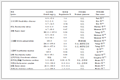
2.4.1 线性关系和灵敏度 经回归分析发现,在 0.05~10 mg/L 或 0.1~20 mg/L 质量浓度范围内,4-NP、4-n-OP、4-t-OP、NPEO 和 OPEO 的峰面积响应值与其质量浓度间线性关系良好,相关系数均大于 0.999 8 (表 1)。将添加回收试验的最低添加水平定为方法的定量限 (LOQ),而方法的检出限 (LOD) 定为 1/3 LOQ,则可确定方法的 LOD 和 LOQ 分别为 0.17~0.33 mg/g 和 0.5~1 mg/g (表 1)。
|
表 1 烷基酚及其聚氧乙烯醚的线性范围、线性方程、决定系数、检出限和定量限 Table 1 Linear ranges, regression equations, coefficient of determination (R2), limit of detection (LOD) and limit of quantitation(LOQ) for alkylphenols (APs) and alkylphenol ethoxylates (APEOs) |
2.4.2 准确度及精密度 结果 (表 2) 显示:在 3 个或 4 个添加水平范围内 (APs:0.5、2、5 mg/g;APEOs:1、5、25、50 mg/g),4-NP、4-n-OP、4-t-OP、NPEO 和 OPEO 的平均回收率为 73%~110%,RSD 为 0.6%~14.9%,表明该方法准确、可靠,可满足 APEOs、APs 分析的要求[29]。6 种液体农药制剂的添加回收谱图见图 3。
|
|
表 2 不同剂型农药中烷基酚及其聚氧乙烯醚的平均回收率和相对标准偏差 (n = 5) Table 2 Mean recoveries and relative standard deviation (RSD) for APs and APEOs in different kinds of pesticide formulations (n = 5) |

|
a. 乳油;b. 水剂;c. 水乳剂;d. 悬浮剂;e. 可溶液剂;f. 微乳剂。 a. Emulsifiable concentrate, EC; b. Aqueous solutions, AS; c. Emulsion in water, EW; d. Suspension concentrate, SC; e. Soluble concentrate, SL; f. Microemulsion, ME. 图 3 添加回收色谱图 (烷基酚:添加水平为 2 mg/g,烷基酚聚氧乙烯醚:添加水平为 5 mg/g) Fig. 3 Chromatograms of spiked samples (APs: spiked at 2 mg/g, APEOs: spiked at 5 mg/g) |
2.5 实际样品分析
为验证该方法的可靠性和适用性,应用本研究所建立的方法,从市场随机采购了 40 种不同液体剂型的农药样品进行实际样品分析测定。结果 (表 3) 显示:10 个样品中检出 NPEO,质量分数为 0.52%~9.84%;1 个样品中检出 OPEO,质量分数为 7.46%;4 个样品中检出 4-n-OP,质量分数为 0.35%~1.40%;1 个样品中检出 4-t-OP,质量分数为 0.32%。农药制剂中 NPEO 的检出率 (25%) 高于 OPEO 的检出率 (2.5%),这与 NPEO 的使用量高于 OPEO 相一致[4]。长链的 NPEO 和 OPEO 是作为助剂添加到农药制剂中的,而 4-NP、4-n-OP 和 4-t-OP 可能来源于合成 NPEO、OPEO 时未反应的底物 4-NP、4-n-OP 和 4-t-OP,也可能来源于长链 NPEO 和 OPEO 的降解[14];此外,还可能来源于塑料瓶、塑料袋中助剂的迁移。因为农药的包装材料多为塑料,而 APs 及其聚合物也在塑料制品加工过程中广泛使用,而乳油等农药剂型中含有大量有机溶剂,在生产、运输以及贮藏过程中,塑料包装中的 4-NP、4-n-OP 和 4-t-OP 可向农药中迁移[30]。
|
|
表 3 农药制剂样品信息及分析结果 Table 3 Information and analysis results of actual samples of pesticide formulations |
对比不同的农药剂型发现,在水剂、水乳剂及可溶液剂中均未检出 APs (4-NP、4-n-OP、4-t-OP)、APEOs (NPEO和OPEO),在悬浮剂和微乳剂中仅检出 NPEO,而乳油制剂中则 4-NP、4-n-OP、4-t-OP、NPEO 和 OPEO 均有检出。若仅从 APs 和 APEOs 的安全性来看,水剂、水乳剂和可溶液剂是相对安全、环保的剂型。对比不同的农药种类发现,在除草剂、杀虫剂、杀螨剂、杀菌剂以及植物生长调节剂中均有 4-NP、4-n-OP、4-t-OP、NPEO 和 OPEO 检出,说明 APEOs 助剂在各类农药中都有应用。杀虫剂中检出 NPEO 和 OPEO 的浓度较其他种类农药要高。除草剂中该类助剂检出率较低,可能是因为在除草剂中 APEOs 通常作为喷雾助剂使用而不是作为配方助剂[31]。
此外,在调查中发现,来源于两个生产厂家的 1.8% 阿维菌素乳油 (LPF-02 和 LPF-31) 所使用的 APEOs 不同,而农药助剂对农药制剂产品的物理化学性质和效能起到至关重要的作用,因此相关部门应该加强农药助剂的管理工作,促进农业生产者合理选择农药产品。
3 结论本研究建立了高效液相色谱-荧光法测定 6 类液体农药制剂产品中烷基酚及其聚氧乙烯醚类助剂含量的分析方法,该方法操作简单易行、结果准确可靠,能够满足定量分析的要求,可应用于目前市场上常见液体农药制剂产品中烷基酚及其聚氧乙烯醚类助剂含量调查,也可为我国农药助剂的合理使用、安全监管提供依据和技术支持。
| [1] | TOOSE L, WARREN C, MACKAY D, et al. Assessing the fate of an aromatic hydrocarbon fluid in agricultural spray applications using the three-stage ADVOCATE model framework[J]. J Agric Food Chem, 2015, 63(31): 6866–6875. doi:10.1021/acs.jafc.5b01076 |
| [2] | COX C, SURGAN M. Unidentified inert ingredients in pesticides: implications for human and environmental health[J]. Environ Health Perspect, 2006, 114(12): 1803–1806. |
| [3] | MULLIN C A. Effects of ‘inactive’ ingredients on bees[J]. Curr Opin Insect Sci, 2015, 10: 194–200. doi:10.1016/j.cois.2015.05.006 |
| [4] |
卜元卿, 王昝畅, 智勇, 等. 农药制剂中助剂使用状况调研及风险分析[J]. 农药, 2014, 53(12): 932–936.
BU Y Q, WANG Z C, ZHI Y, et al. Investigation and risk analysis of pesticide inert ingredients in pesticide products[J]. Agrochemicals, 2014, 53(12): 932–936. |
| [5] | YING G G, WILLIAMS B, KOOKANA R. Environmental fate of alkylphenols and alkylphenol ethoxylates—a review[J]. Environ Int, 2002, 28(3): 215–226. doi:10.1016/S0160-4120(02)00017-X |
| [6] | NIMROD A C, BENSON W H. Environmental estrogenic effects of alkylphenol ethoxylates[J]. Crit Rev Toxicol, 1996, 26(3): 335–364. doi:10.3109/10408449609012527 |
| [7] | WHITE R, JOBLING S, HOARE S A, et al. Environmentally persistent alkylphenolic compounds are estrogenic[J]. Endocrinology, 1994, 135(1): 175–182. doi:10.1210/endo.135.1.8013351 |
| [8] | BONEFELD-JØRGENSEN E C, LONG M H, HOFMEISTER M V, et al. Endocrine-disrupting potential of bisphenol A, bisphenol A dimethacrylate, 4-n-nonylphenol, and 4-n-octylphenol in vitro: new data and a brief review [J]. Environ Health Perspect, 2007, 115(S1): 69–76. |
| [9] | EU (European Union). Directive 2003/53/EC of the european parliament and of the council of 18 June 2003 amending for the 26th time council directive 76/769/EEC relating to restrictions on the marketing and use of certain dangerous substances and preparations (nonylphenol, nonylphenol ethoxylate and cement[EB/OL]. (2003-06-18) [2016-12-16]. http://eur-lex.europa.eu/legal-content/ EN/TXT/?qid=1489201055422&uri=CELEX:32003L0053. |
| [10] | GPO (The U.S. Government Publishing Office). Limits for Inert ingredients in pesticide formulations[EB/OL]. (2016-12-14) [2016-12-16]. http://www.ecfr.gov/cgi-bin/text-idx?SID= d41ca9f53c7e84e0c95b7f512946c0ae&mc=true&node=se40.24.180_1910&rgn=div8. |
| [11] |
环境标志产品技术要求: 家用洗涤剂: HJ 458—2009[S]. 北京: 中国环境科学出版社, 2009.
Technical requirement for environmental labeling products—household detergents: HJ 458—2009[S]. Beijing: China Environmental Science Press, 2009. |
| [12] | EPA (U.S. Environmental Protection Agency). Nonylphenol (NP) and nonylphenol ethoxylates (NPEs) action plan[EB/OL]. (2010-08-18) [2016-12-16]. https://www.epa.gov/sites/production/files/2015-09/documents/rin2070-za09_np-npes_action_plan_final_2010-08-09.pdf. |
| [13] |
农业部农药检定所. 关于征求《农药助剂禁限用名单》(征求意见稿)意见的通知[EB/OL]. (2015-07-13) [2016-12-16]. http://www.chinapesticide.gov.cn/zwtz/755.jhtml.
Institute for the Control of Agrochemicals. A consultation paper on prohibited and restricted lists of pesticide adjuvants [EB/OL]. (2015-07-13) [2016-12-16]. http://www.chinapesticide.gov.cn/ zwtz/755.jhtml. |
| [14] | HUANG S L, TUAN N N, LEE K. Occurrence, human intake and biodegradation of estrogen-like nonylphenols and octylphenols[J]. Curr Drug Metab, 2016, 17(3): 293–302. doi:10.2174/1389200217666151210124821 |
| [15] | FANG K, JIANG Z J, WANG J, et al. Simulation of nonylphenol degradation in leafy vegetables using a deuterated tracer[J]. Environ Sci Proc Impacts, 2015, 17(7): 1323–1330. doi:10.1039/C5EM00073D |
| [16] | CHEN J, MULLIN C A. Determination of nonylphenol ethoxylate and octylphenol ethoxylate surfactants in beehive samples by high performance liquid chromatography coupled to mass spectrometry[J]. Food Chem, 2014, 158: 473–479. doi:10.1016/j.foodchem.2014.03.004 |
| [17] | PETROVIC M, DIAZ A, VENTURA F, et al. Simultaneous determination of halogenated derivatives of alkylphenol ethoxylates and their metabolites in sludges, river sediments, and surface, drinking, and wastewaters by liquid chromatography-mass spectrometry[J]. Anal Chem, 2001, 73(24): 5886–5895. doi:10.1021/ac010677k |
| [18] | KOH Y K K, CHIU T Y, BOOBIS A R, et al. A sensitive and robust method for the determination of alkylphenol polyethoxylates and their carboxylic acids and their transformation in a trickling filter wastewater treatment plant[J]. Chemosphere, 2008, 73(4): 551–556. doi:10.1016/j.chemosphere.2008.06.016 |
| [19] | ÖMEROĞLUS, MURDOCHF K, SANINF D. Investigation of nonylphenol and nonylphenol ethoxylates in sewage sludge samples from a metropolitan wastewater treatment plant in Turkey[J]. Talanta, 2015, 131: 650–655. |
| [20] | NÚÑEZ L, TURIEL E, TADEO J L. Determination of nonylphenol and nonylphenol ethoxylates in environmental solid samples by ultrasonic-assisted extraction and high performance liquid chromatography-fluorescence detection[J]. J Chromatogr A, 2007, 1146(2): 157–163. doi:10.1016/j.chroma.2007.01.101 |
| [21] |
吕春华, 陈笑梅, 刘海山. 固相萃取净化-正相高效液相色谱测定纺织品中残留的烷基酚和烷基酚聚氧乙烯醚[J]. 色谱, 2009, 27(4): 458–462.
LÜ C H, CHAN X M, LIU H S. Determination of alkylphenols and alkylphenol polyethoxylates in textiles by normal-phase high performance liquid chromatography and solid-phase extraction[J]. Chin J Chromatogr, 2009, 27(4): 458–462. |
| [22] |
徐振东, 顾娟红, 黄丽娟, 等. 加速溶剂萃取-快速液相色谱法测定纺织品中烷基苯酚和烷基苯酚聚氧乙烯醚[J]. 分析试验室, 2012, 31(8): 112–115.
XU Z D, GU J H, HUANG L J, et al. Determination of alkylphenols and alkylpheol polyethoxylates in textile by accelerated solvent extraction and rapid liquid chromatography[J]. Chin J Anal Lab, 2012, 31(8): 112–115. |
| [23] |
马强, 王超, 王星, 等. 加速溶剂萃取-固相萃取-硅胶吸附色谱-电喷雾质谱法测定纺织品中的烷基酚聚氧乙烯醚[J]. 分析化学, 2009, 37(1): 46–52.
MA Q, WANG C, WANG X, et al. Determination of alkylphenol ethoxylates in textiles by accelerated solvent extraction-solid phase extraction-silica adsorption chromatography-electrospray mass spectrometry[J]. Chin J Anal Chem, 2009, 37(1): 46–52. |
| [24] | WANG C, MA Q, WANG X. Determination of alkylphenol ethoxylates in textiles by normal-phase liquid chromatography and reversed-phase liquid chromatography/electrospray mass spectrometry[J]. J AOAC Int, 2007, 90(5): 1411–1417. |
| [25] |
罗金辉, 吕岱竹, 林勇. 超高效液相色谱-串联质谱法测定香蕉中壬基酚聚氧乙烯醚及其降解产物[J]. 农药学学报, 2011, 13(5): 514–518.
LUO J H, LÜ D Z, LIN Y. Determination of nonylphenol polyethoxylates and its metabolite nonylphenol in banana by UPLC-MS/MS[J]. Chin J Pestic Sci, 2011, 13(5): 514–518. |
| [26] | MAO I F, LU Y Y, CHEN M L. A simplified method for simultaneous quantitation of alkylphenols and alkylphenol ethoxylates in meat and fish using high-performance liquid chromatography with fluorescence detection[J]. Int J Environ Anal Chem, 2006, 86(10): 713–722. doi:10.1080/03067310500391971 |
| [27] |
吕岱竹. 超声波提取-液相荧光法测定水果中壬基酚聚氧乙烯醚及其降解产物[J]. 食品科学, 2010, 31(12): 174–177.
LÜ D Z. Determination of alkylphenols and alkylphenol ethoxylates in tropical fruits by LC with ultrasonic-assisted extraction[J]. Food Sci, 2010, 31(12): 174–177. |
| [28] | CHENG C Y, DING W H. Determination of nonylphenol polyethoxylates in household detergents by high-performance liquid chromatography[J]. J Chromatogr A, 2002, 968(1-2): 143–150. doi:10.1016/S0021-9673(02)00959-7 |
| [29] | EC (European Commission). Guidance document on analytical quality control and method validation procedures for pesticides residues analysis in food and feed (SANTE/11945/2015)[EB/OL]. (2015-11-30) [2017-03-09]. http://ec.europa.eu/food/plant/ docs/plant_pesticides_mrl_guidelines_wrkdoc_11945_en.pdf. |
| [30] | GUART A, BONO-BLAY F, BORRELL A, et al. Migration of plasticizersphthalates, bisphenol A and alkylphenols from plastic containers and evaluation of risk[J]. Food Addit Contam A, 2011, 28(5): 676–685. doi:10.1080/19440049.2011.555845 |
| [31] | TU M, HURD C, RANDALL J M. Weed control methods handbook: tools & techniques for use in natural areas[R/OL]. (2003) [2017-02-03]. http://digitalcommons.usu.edu/govdocs/533. |