 2016, Vol. 18


2. 中国科学院兰州化学物理研究所/中国科学院西北特色植物资源化学重点实验室/甘肃省天然药物重点实验室, 兰州 730000
 , ZHANG Denghong1, WANG Dandan2, JIN Hui2, LI Xiuzhuang2, HE Xiaofeng2, YAN Zhiqiang2
 , SHEN Huimin1
2. Key Laboratory of Chemistry of Northwestern Plant Resources of CAS and Key Laboratory for Natural Medicine of Gansu Province, Lanzhou Institute of Chemical Physics, Chinese Academy of Sciences, Lanzhou 730000, China
化感作用 (allelopathy) 是植物将其在代谢活动中所产生的化感物质,通过茎叶挥发、茎叶淋溶、根系分泌以及植物残株的腐败降解等途径释放到环境中,进而对周围其他植物或微生物造成有利或不利的影响[1-4]。酚酸类化合物是一类重要的化感物质,广泛分布在农田土壤中,对农业生产造成了严重的影响[5-8]。研究表明,酚酸类化感物质能够影响植物生长[9-11],是引起农业生产中连作障碍的主要因素之一[12-13]。例如,由草莓根系分泌并累积的苯甲酸和对羟基苯甲酸等物质,是导致草莓植株生长不良、根部病害加重、产量和品质严重下降的主要因素[14-16];从化感水稻品系 PI312777的根系分泌物中鉴定出的水杨酸具有化感活性作用[17]。这3种酚酸被释放后能够进入作物的根际土壤中,例如:盆栽草莓土壤中对羟基苯甲酸的含量为1.74 mg/kg[18];甜瓜根系周围中苯甲酸的含量为0.14 mg/kg,水杨酸含量为0.33 mg/kg[19];苹果连作园0~30 cm 土层春季苯甲酸含量为6.670 mg/kg,水杨酸含量为5.870 mg/kg,对羟基苯甲酸含量为0.530 mg/kg,而秋季土壤中上述3种化合物的含量是春季的5倍左右[20],对苹果的生长发育有自毒作用[21-23];黑龙江省大豆重茬5 a 土壤中对羟基苯甲酸的含量为8.58 mg/kg[24];连作2年的地黄土壤中对羟基苯甲酸的含量为1.40 mg/kg[25]。以上研究表明,苯甲酸、水杨酸和对羟基苯甲酸能够在农田土壤中大量积累,对作物生长产生明显的化感作用。
虽然苯甲酸、水杨酸和对羟基苯甲酸很早就被确定为化感物质,并发现这些化合物对草莓、水稻和甜瓜等作物生长具有抑制作用,是导致连作障碍的重要因素,然而有关其影响受体植物生长的活性作用途径尚未完全明确。本研究选用对化感物质敏感的双子叶植物莴苣为受体材料,在评价3种酚酸类化合物对莴苣幼苗化感作用的同时,运用植物细胞和生理试验方法,初步探讨了该类化合物对受体植物的化感作用机理。
1 材料与方法 1.1 供试材料及仪器苯甲酸、水杨酸和对羟基苯甲酸,纯度均为95%,购于上海迈瑞尔化学技术有限公司。二氢乙锭 (dihydroethidium,DHE),纯度95%;荧光素二乙酸酯 (fluorescein diacetate,FDA),纯度98%;碘化丙啶 (propidium iodide,PI),纯度95%;以上3种试剂均购于百灵威科技有限公司。二甲基亚砜 (dimethyl sulfoxide,DMSO),纯度99.8%;丙酮,纯度99.5%;氯化钙 (CaCl2),纯度99%;以上3种试剂均购于上海阿拉丁生化科技股份有限公司。莴苣 (Lactuca sativa) 种子品种为‘丰农青笋’,购于兰州丰农种业科技有限公司。
HP150HS 恒温恒湿培养箱 (武汉瑞华仪器设备有限责任公司);DMI4000B 荧光显微镜 (德国 Leica 徕卡显微公司)。
1.2 化感作用测定方法参照 Yan 等[26]的方法,先用 DMSO 将苯甲酸、水杨酸和对羟基苯甲酸溶解并分别配制成100 mmol/L 的母液,再用 DMSO 进行梯度稀释。按体积分数为1% 的量将其添加到含1 mL 蒸馏水的6孔板中,摇匀后铺垫2层与孔径一样大小的滤纸,备用。以相同剂量的 DMSO 为对照。将莴苣种子置于铺有滤纸并湿润、直径为9 cm 的培养皿上,在恒温恒湿培养箱中25 ℃ 下无光照萌发24 h。选取长势大致相同的莴苣幼苗,转移到上述准备好的6孔板中,每个处理至少8株幼苗,在相同条件下继续培养48 h 后,用毫米尺测量幼苗根、茎长度。
1.3 细胞活力观察将处理后的莴苣幼苗在根尖处切取约0.5 cm,放入含有 FDA 和 PI 的染液中,避光着色10 min,再用蒸馏水将根尖残留的染液清洗干净,置于载玻片上,在荧光显微镜下分别在450~490 nm 激发光和520 nm 发射光下观察并拍照[27]。
1.4 活性氧累积的测定参考 Garnczarska[28] 的方法观察活性氧 (reactive oxygen species,ROS)。在25 ℃ 下,将处理后的莴苣根放入 DHE 染色液 (含10 mmol/L DHE,0.01% 丙酮和100 mmol/L CaCl2,pH 4.75) 中避光染色5 min,转移至100 mmol/L CaCl2 中振荡清洗去除残留染料,在荧光显微镜下分别在450~490 nm 激发光和520 nm 发射光下观察拍照。
1.5 数据处理所测的数据用 Excel 2007处理,用 SPSS 17.0进行相关性分析,用 Duncan 氏法进行方差显著性分析,用 Photoshop 8.0进行图片处理。
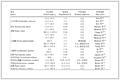
2 结果与分析 2.1 苯甲酸、水杨酸及对羟基苯甲酸对莴苣幼苗的化感效应结果 (表 1) 显示:苯甲酸在1 μmol/L 及以下浓度时对莴苣幼苗根的生长具有促进作用,在0.1 μmol/L 时促进作用可达到23.68%;10 μmol/L 及以上浓度时对根的生长具有抑制作用,1 000 μmol/L 时抑制率为56.02%。苯甲酸对茎的生长均具有较为明显的抑制作用,1 000 μmol/L 时的抑制率为31.21%。水杨酸在1 μmol/L 及以下浓度时对根、茎的生长均有明显的促进作用,其中在1 μmol/L 时其对根、茎的促进率分别为24.02% 和14.08%,但在10 μmol/L 及以上时则表现出抑制作用,其中在1 000 μmol/L 时其对根、茎的抑制作用最强,分别达到38.05% 和28.55%。对羟基苯甲酸在0.1 μmol/L 时对根和茎的生长均有一定的促进作用;在1 μmol/L 时对根具有促进作用,而对茎具有抑制作用;在10~100 μmol/L 时对根和茎的抑制率均为30% 左右,在1 000 μmol/L 时抑制作用最强,分别为54.72% 和35.10%。
|
表 1 苯甲酸、水杨酸和对羟基苯甲酸对莴苣幼苗的化感活性作用 Table 1 The allelopathic effects of benzoic acid, salicylic acid and 4-hydroxybenzoic acid on lettuce seedlings |
2.2 苯甲酸、水杨酸及对羟基苯甲酸对莴苣幼苗根尖细胞活力的影响
当植物受到外界胁迫时,细胞活力会发生变化,因此,细胞活力可以作为评价有毒物质诱导植物细胞死亡的重要指标[28]。本研究采用双荧光染料染色法检测莴苣幼苗经过酚酸处理后的细胞活力变化情况。FDA 能够使活细胞着色,PI 能使死细胞着色,在荧光显微镜下能够观察到莴苣根尖细胞活力。结果显示:在处理2 d 后,苯甲酸在0.1和1 μmol/L 时,其染色结果与对照基本一致 (图 1,A~C),说明苯甲酸在此浓度下不会使根尖细胞丧失活力,而在10~1 000 μmol/L 时红色区域有所增加 (图 1,D~F),说明苯甲酸在此浓度下能使莴苣根尖细胞活力降低,导致部分细胞死亡。水杨酸在0.1~10 μmol/L 时对莴苣根尖细胞活力影响不明显 (图 1,G~J),而当浓度升高到100 μmol/L 及以上时,莴苣根尖红色区域则明显增多,说明水杨酸在高浓度时对受体植物细胞活力有明显影响 (图 1,K~L)。对羟基苯甲酸在0.1 μmol/L 时与对照相比,不能使受体植物细胞活力丧失 (图 1,M),而在1 μmol/L 时红色区域开始出现 (图 1,N),在10~1 000 μmol/L (图 1,P~R) 时红色区域增加明显,说明丧失活性的细胞明显增多。

|
A~F 为苯甲酸、G~L 为水杨酸、M~R 为对羟基苯甲酸对莴苣细胞活力变化的影响,浓度依次为0、0.1、1、10、100和1 000 μmol/L,标尺为500 µm。
A-F, G-L and M-R were the cell viability of lettuce root tips treated by benzoic acid, salicylic acid and 4-hydroxybenzoic acid at the concentrations of 0, 0.1, 1, 10, 100 and 1 000 μmol/L, respectively. Bar=500 μm. 图 1 苯甲酸、水杨酸、对羟基苯甲酸对莴苣幼苗根尖细胞活力的影响 Fig. 1 The influence of cell viability of lettuce root tips by benzoic acid, salicylic acid and 4-hydroxybenzoic acid, respectively |
2.3 苯甲酸、水杨酸、对羟基苯甲酸对莴苣幼苗根部活性氧积累的影响
采用 DHE 荧光染料特异性显示活性氧积累的部位及程度[29]。结果显示:莴苣幼苗经苯甲酸处理2 d 后,其根部的活性氧随苯甲酸浓度的增加有一定程度的积累 (图 2,A~F),其中低浓度 (0.1 μmol/L) 下与对照组差异不明显 (图 2,A),当浓度达到1~1 000 μmol/L 时活性氧逐渐积累 (图 2,B~F)。经水杨酸处理2 d 后的莴苣幼苗根部活性氧,随水杨酸浓度的增加也有一定程度的积累 (图 2,G~L),其中在0.1~10 μmol/L 时活性氧累积程度与对照无明显差异 (图 2,G~J),在100 μmol/L 时明显增加(图 2,K),在1 000 μmol/L 时累积量达到最大 (图 2,L)。经对羟基苯甲酸处理2 d 后,莴苣根部活性氧也有一定程度的积累 (图 2,M~R),其中在0.1~1 μmol/L 时活性氧累积程度与对照无明显差异 (图 2,M~O),但在10~1 000 μmol/L 时明显增加 (图 2,P~R)。

|
A~F 为苯甲酸、G~L 为水杨酸、M~R 表示对羟基苯甲酸对莴苣活性氧的影响,浓度依次为0, 0.1, 1, 10, 100和1 000 μmol/L,标尺为200 µm。
A-F, G-L and M-R were the ROS of lettuce root tips treated by benzoic acid, salicylic acid and 4-hydroxybenzoic acid at the concentrations of 0, 0.1, 1, 10, 100 and 1 000 μmol/L, respectively. Bar=200 μm. 图 2 苯甲酸、水杨酸、对羟基苯甲酸对莴苣根尖活性氧积累的影响 Fig. 2 The influence of ROS accumulation of lettuce root tips by benzoic acid, salicylic acid and 4-hydroxybenzoic acid, respectively |
3 讨论
活性氧 (ROS) 是外源性氧化剂或细胞内有氧代谢过程中产生的具有很高生物活性的含氧化合物的总称,包括超氧阴离子 (O2-)、过氧化氢 (H2O2)、羟自由基 (HO·)、一氧化氮 (NO) 等。目前认为 ROS 不仅是一种毒性分子,而且具有很高的生物学活性[29-31]。植物在胁迫条件下,体内产生高反应性 ROS,ROS 在细胞内可引起生物膜过氧化损伤,破坏膜结构和功能,并使受体植物体内的抗氧化系统受到抑制,从而影响细胞活力,甚至造成细胞凋亡,最终导致受体植物生长被抑制或死亡[32]。
本研究通过对苯甲酸、水杨酸及对羟基苯甲酸的化感活性进行评价,明确了3个化合物对莴苣幼苗生长均表现出低浓度促进、高浓度抑制的作用模式,进一步运用植物细胞和生理学研究方法对其作用机理进行了探索,发现活性氧在这一过程中发挥了重要作用。化感物质能够引起活性氧的积累,且当抑制作用增强时,活性氧的累积也更加明显,同时细胞活力明显降低。根据本研究结果,可初步推测此类物质的化感作用途径为:通过诱导受体植物 ROS 大量积累,进而影响细胞活力,最终抑制植物生长。本研究通过对酚酸类化合物化感作用机理的初探,为作物连作障碍机制研究提供了一定的理论依据。
| [1] |
孔垂华. 植物化感作用研究中应注意的问题 [J]. 应用生态学报, 1998,9 (3)
:332–336.
KONG C H. Problems needed attention on plant allelopathy research [J]. Chin J Appl Ecol, 1998, 9 (3) :332–336 . |
| [2] | RICEE L. Allelopathy.2nd ed[M]. Oklahoma: University of Oklahoma Press, 1984 : 1320 -1344. |
| [3] | EINHELLIG F A, RASMUSSEN J A, HEJB A M, et al. Effects of root exudate sorgoleone on photosynthesis [J]. J Chem Ecol, 1993, 19 (2) :369–375 . |
| [4] | EINHELLING F A. Interactions involving allelopathy in cropping systems [J]. Agron J, 1996, 88 (6) :886–893 . |
| [5] | WU H W, HAIG T, PRATLEY J, et al. Allelochemicals in wheat (Triticum aestivum L.): cultivar difference in the exudation of phenolic acids [J]. J Agric Food Chem, 2001, 49 (8) :3742–3745 . |
| [6] | CARLSEN S C K, KUDSK P, LAURSEN B, et al. Allelochemicals in rye (Secale cereale L.): Cultivar and tissue differences in the production of benzoxazinoids and phenolic acids [J]. Nat Prod Commun, 2009, 4 (2) :199–208 . |
| [7] |
高李李, 郭沛涌. 酚酸类化感物质抑藻作用的研究进展 [J]. 水处理技术, 2012,38 (9)
:1–4.
GAO L L, GUO P Y. Research progress on the inhibitory effects of phenolic acid allelochemicals on algae [J]. Technol Water Treat, 2012, 38 (9) :1–4 . |
| [8] | WU H W, HAIG T, PRATLEY J, et al. Allelochemicals in wheat (Triticum aestivum L.): variation of phenolic acids in shoot tissues [J]. J Chem Ecol, 2001, 27 (1) :125–135 . |
| [9] | YU J Q, MATSUI Y. Effects of root exudates of cucumber (Cucumis sativus) and allelochemicals on ion uptake by cucumber seedling [J]. J Chem Ecol, 1997, 23 (3) :817–827 . |
| [10] | YE S F, YU J Q, PENG Y H, et al. Incidence of Fusarium wilt in Cucumis sativus L is promoted by cinnamic acid, an autotoxin in root exudates [J]. Plant Soil, 2004, 263 (1) :143–150 . |
| [11] | SCHUTTER M E, SANDENO J M, DICK R P. Seasonal soil type and alternative management influences on microbial communities of vegetable cropping systems [J]. Biol Fert Soils, 2001, 34 (6) :397–410 . |
| [12] | SINGH H P, BATISH D R, KOHLI R K. Allelopathy in agroecosystems: an overview [J]. J Crop Prod, 2001, 4 (2) :1–41 . |
| [13] | CALLAWAY R M, ASCHEHOUG E T. Invasive plants versus their new and old neighbors: A mechanism for exotic invasion [J]. Science, 2000, 290 (5491) :521–523 . |
| [14] |
张江红. 酚类物质对苹果的化感作用及重茬障碍影响机理的研究[D]. 泰安: 山东农业大学, 2005.
ZHANG J H. Allelopathic effect of phenolics and its role on apple replant disease mechanism[D]. Taian: Shandong Agricultural University, 2005. |
| [15] | BAI R, MA F W, LIANG D, et al. Phthalic acid induces oxidative stress and alters the activity of some antioxidant enzymes in roots of Malus prunifolia [J]. J Chem Ecol, 2009, 35 (4) :488–494 . |
| [16] | HAN C M, PAN K W, WU N, et al. Allelopathic effect of ginger on seed germination and seedling growth of soybean and chive [J]. Scientia Horticulturae, 2008, 116 (3) :330–336 . |
| [17] |
吴安平, 张庭廷, 何梅, 等. 水杨酸对水华鱼腥藻的化感抑制作用及相关毒理学的初步研究 [J]. 生物学杂志, 2008,25 (5)
:44–47.
WU A P, ZHANG T T, HE M, et al. A preliminary study on Anabena flos-aquae minitigation of salicylic acid and its related toxicity [J]. J Biol, 2008, 25 (5) :44–47 . |
| [18] |
田给林. 连作草莓土壤酚酸类物质的化感作用及其生物调控研究[D]. 北京: 中国农业大学, 2015.
TIAN G L. Allelopathic effect and biological regulation of phenolic acids in the continuous cropping strawberry soil[D]. Beijing: China Agricultural University, 2015. |
| [19] |
杨瑞秀. 甜瓜根系自毒物质在连作障碍中的化感作用及缓解机制研究[D]. 沈阳: 沈阳农业大学, 2014.
YANG R X. The allelopathy of autotoxic compounds in muskmelon continuous cropping obstacle and mitigation mechanism[D]. Shenyang: Shenyang Agricultural University, 2014. |
| [20] |
尹承苗. 连作苹果园土壤酚酸类物质的分布及其对真菌的影响[D]. 泰安: 山东农业大学, 2014.
YIN C M. Distribution of phenolic acids in apple replanted orchard soil and effects of phenolic acids on the fungi[D]. Taian: Shandong Agricultural University, 2014. |
| [21] |
张兆波, 毛志泉, 朱树华. 6种酚酸类物质对平邑甜茶幼苗根系线粒体及抗氧化酶活性的影响 [J]. 中国农业科学, 2011,44 (15)
:3177–3184.
ZHANG Z B, MAO Z Q, ZHU S H. Effects of phenolic acids on mitochondria and the activityof antioxidant enzymes in roots of seedlings of Malus hupehensis Rehd [J]. Scientia Agriculture Sinica, 2011, 44 (15) :3177–3184 . |
| [22] | QUAYYUM H A, MALLIKA A U, ORR D E, et al. Allelopathic potential of aquatic plants associated with wild rice: II. Isolation and identification of allelochemicals [J]. J Chem Ecol, 1999, 25 (1) :221–228 . |
| [23] | CECCHI A M, KOSKINEN W C, CHENG H H, et al. Sorptiondesorption of phenolic acids as affected by soil properties [J]. Biol Fertility Soils, 2004, 39 (4) :235–242 . |
| [24] |
张淑香, 高子勤, 刘海玲. 连作障碍与根际微生态研究Ⅲ. 土壤酚酸物质及其生物学效应 [J]. 应用生态学报, 2000,11 (5)
:741–744.
ZHANG S X, GAO Z Q, LIU H L. Continuous cropping obstacle and rhizospheric microecology Ⅲ.Soil phenolic acids and their biological effect [J]. Chin J Appl Eco, 2000, 11 (5) :741–744 . |
| [25] |
杜家方. 地黄 (Rehmannia glutinosa Libosch.) 根区土壤中酚酸类物质的化感作用研究[D]. 郑州: 河南农业大学, 2009.
DU J F. Research of phenolic acids allelopathy on soils around rhizosphere of Rehmannia glutinosa Libosch[D]. Zhengzhou: Henan Agricultural University, 2009. |
| [26] | YAN Z Q, WANG D D, DING L, et al. Mechanism of artemisinin phytotoxicity action: Induction of reactive oxygen species and cell death in lettuce seedlings [J]. Plant Physiol Biochem, 2015, 88 :53–59 . |
| [27] | BAKER C J, MOCK N M. An improved method for monitoring cell death in cell suspension and leaf disc assays using Evans blue [J]. Plant Cell Tissue Organ Cult, 1994, 39 (1) :7–12 . |
| [28] | GARNCZARSKA M. Response of the ascorbate-glutathione cycle to re-aeration following hypoxia in lupine roots [J]. Plant Physiol Biochem, 2005, 43 (6) :583–590 . |
| [29] | INOUE M, SATO E F, NISHIKAWA M, et al. Mitochondrial generation of reactive oxygen species and its role in aerobic life [J]. Curr Med Chem, 2003, 10 (23) :2495–2505 . |
| [30] |
刘建新, 胡浩斌, 雷蕊霞. 多裂骆驼蓬对紫花苜蓿化感作用的生理生化机理 [J]. 中国草地学报, 2007,29 (4)
:39–44.
LIU J X, HU H B, LEI R X. Physiological and biochemical mechanism of allelopathy of Peganum multisectum Bobr on alfalfa [J]. Chin J Grassland, 2007, 29 (4) :39–44 . |
| [31] |
陈丽萍, 范雪涛, 马丹炜. 入侵植物辣子草对油菜幼苗抗氧化系统的化感效应 [J]. 西南农业学报, 2008,21 (2)
:332–334.
CHEN L P, FAN X T, MA D W. Allelopathic effects of Galinsoga parviflora Cav. on antioxidant enzyme systems in rape seedlings [J]. Southwest China J Agric Sci, 2008, 21 (2) :332–334 . |
| [32] | KOODKAEW I, SUNOHARA Y, MATSUYAMA S, et al. Phytotoxic action mechanism of hapalocyclamide in lettuce seedlings [J]. Plant Physiol Biochem, 2012, 58 :23–28 . |