 2016, Vol. 18


2. 中国农业大学理学院, 北京 100193;
3. 中国农业科学院农业质量标准与检测技术研究所, 北京 100081
 , HUANG Ying1, LI Xuefeng2
 , WANG Chengju2, LUO Jianbo1, QIU Jing3, SHEN Gongming1, LI Yingren1
2. College of Sciences, China Agricultural University, Beijing 100193, China;
3. Institute of Quality Standard and Testing Technology for Agro-Products, Chinese Academy of Agricultural Sciences, Beijing 100081, China
持久性有机污染物 (persistent organic pollu- tants,简称 POPs)是指人类合成的、能持久存在于环境中、通过食物链累积后对动物和人类健康会造成有害影响的化学物质。此类化合物具有高毒性、持久性、生物累积性和远距离迁移性 4 大特性[1],可通过空气、水、土壤及食物链进行广泛传播,在空气、水体、土壤和生物体中均已检测到 POPs 的存在[2]。水是 POPs 在环境中迁移转化的重要介质,其在水体中可通过迁移、吸附、沉降等作用及食物链,对不同种类水生生物的生长、发育及生殖产生影响[3]。鱼类作为地表水生态系统中最主要的脊椎动物,是重要的环境指示生物。尽管目前关于 POPs 对鱼类毒性的研究较多,但是能反映这类污染物对实际环境中鱼类风险的综述性报道很少。为此,笔者整理了近年来关于我国水域中 POPs 检出的报道,拟对该类污染物在我国水体中的分布情况进行综述。同时结合 POPs 对鱼类毒性的研究数据,分析了该类污染物对我国主要水域中鱼类的风险。
1 持久性有机污染物简介2001 年 5 月签署的《斯德哥尔摩持久性有机污染物 (POPs) 公约》将第一批共 12 种化学物质列入了 POPs 名单 (dirty dozen) 中,其中包括艾氏剂 (aldrin)、狄氏剂 (dieldrin)、异狄氏剂 (endrin)、氯丹 (chlordane)、七氯 (heptachlor)、DDT(dichlo- rodiphenyltrichloroethane)、六氯苯 (hexachloro- benzene)、灭蚁灵 (mirex)、毒杀芬 (toxaphene) 共 9 种有机氯类农药 (organic chlorine pesticides,OCPs),以及多氯联苯 (polychlorinated biphenyl,PCBs)、多氯代二苯并二英 (polychlorinated dibenzodioxins,PCDDs) 和多氯代二苯并呋喃 (polychlorinated dibenzofurans,PCDFs)。
2009 年,又有 9 种化合物被添加到了 POPs 名单中,其中包括开蓬 (kepone)、林丹 (lindane)、α-六六六 (hexachlorocyolohexane) 和 β-六六六 4 种有机氯农药以及全氟辛基磺酸及其盐类 (perfluoro- octanesulfonic acid,PFOSs)、全氟辛基磺酰氯 (perfluorooctane sulfonyl chloride)、五氯苯 (penta- chlorobenzene)、多溴联苯醚 (poly brominated diphenyl ethers,PBDEs) 和六溴联苯 (hexa- bromobiphenyl)。
除已被明确列入 POPs 名单的化合物外,还 有一些化合物也具备持久性有机污染物的性质,属于尚在讨论中的准 POPs 化合物,如硫丹 (endo- sulfan)、多环芳烃 (poly aromatic hydrocarbons,PAHs) 等。
2 有机氯类农药(OCPs) 在我国水体中的分布有机氯类农药(OCPs) 在保护农作物生长、控制病虫害方面取得了相当显著的成效,但其大量使用也诱发了一系列环境问题,对环境、动物及人体健康构成了威胁。OCPs 化学性质稳定,在自然界中降解缓慢,可在水体、土壤和底泥等环境介质中存留长达数年,是环境中广泛存在的一类难降解的有机污染物。虽然自 20 世纪 70 年代起,全球许多国家已陆续禁止或限制使用 OCPs,以保护环境和维护人类健康,但目前在全球环境介质内仍残留着大量该类化合物。
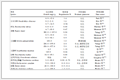
2.1 六六六表 1 中列出了六六六在我国主要水域中的检出情况。在所列出的报道中,总六六六 (Σ六六六) 的检出水平在未检出~1 228.6 ng/L 之间。其中,在大亚湾的检出浓度最高 (35.5~1 228.6 ng/L),其次为太湖 (237 ng/L) 和闽江入海口 (205.5 ng/L)。活性最高的六六六单体林丹 (γ-六六六) 的检出范围为未检出~973 ng/L,其最高检出浓度同样出现在大亚湾 (8.5~973 ng/L);活性最低的单体 β-六六六的检出水平为未检出~92.5 ng/L;α-六六六的检出水平为未检出~237 ng/L。
|
表 1 我国主要水域中六六六的检出情况 Table 1 The reported level of benzene hexachloride in main water areas of China |
总滴滴涕 (ΣDDTs) 在我国主要水域中的检出范围在未检出~975.9 ng/L 之间,其中也以大亚湾的检出质量浓度最高 (26.8~975.9 ng/L),其次是珠江入海口 (143 ng/L) 和闽江入海口 (142 ng/L),此外,太湖中 ΣDDTs 的平均质量浓度也已达 101.6 ng/L (表 2)。在松花江-吉林段,p,p-DDT 的最高检出浓度达到 479 ng/L,尽管该地区的 ΣDDTs 残留水平尚未见报道,但推测其应处于较高水平。
|
|
表 2 我国主要水域中滴滴涕的检出情况 Table 2 The reported level of DDTs in main water areas of China |
除六六六和 DDT 两种主要的有机氯农药外,其他被列入 POPs 名单的此类农药,如艾氏剂、狄氏剂、异狄氏剂和七氯等在我国水域中的检出也相当频繁 (表 3),这 4 种农药的检出范围分别为未检出~227 ng/L (艾氏剂)、未检出~26.44 ng/L(狄氏剂)、未检出~25.45 ng/L (异狄氏剂) 及未检出~3 626.5 ng/L (七氯)。
|
|
表 3 我国主要水域中艾氏剂、狄氏剂、异狄氏剂和七氯的检出情况 Table 3 The reported level of OCPs in main water areas of China |
我国的多氯联苯 (PCBs) 生产主要集中在 1965-1974 年间,总产量在 10 000 t 左右。其中,三氯联苯 (trichlorobiphenyl) 产量在 9 000 t 左右,主要用作电力电容器的浸渍剂;五氯联苯 (pentachlorobiphenyl) 产量在 1 000 t 左右,主要用作油漆等工业产品的添加剂[3, 4]。随着斯德哥尔摩公约于 2004 年 11 月 11 日起正式对中国生效,我国在全国范围内启动了调查 PCBs 污染、分布与来源的行动,履行控制与消除该类污染物的义务,因此关于 PCBs 在水环境中分布情况的研究近年来有了大幅增加。
在已报道的水域中,总多氯联苯 (ΣPCBs) 的检出范围在未检出~1 355.3 ng/L 之间 (表 4)。其中大亚湾的检出水平最高,在两次采样中,其残留质量浓度分别为 91.1~1 355.3 ng/L (1999 年) 和 1 306.3 ng/L (2003 年),均高于其他水域的检测值;其次为闽江入海口 (985.2 ng/L)、渤海湾潮间带 (115.1~741.6 pg/L) 及珠江口 (295 ng/L)。
|
|
表 4 我国主要水域中总多氯联苯的检出情况 Table 4 The reported level of ΣPCBs in main water areas of China |
多溴联苯醚 (PBDEs) 是在环境中广泛存在的一类有机污染物,其作为一种添加型阻燃剂,由于不受化学键的束缚,因此很容易释放到环境当中。环境中 PBDEs 的主要污染源是生产和使用该化合物的工厂。目前被广泛使用的 PBDEs 大多为高溴联苯醚,其极易被泥土和颗粒物吸附,在环境中比较稳定,在海洋生物体和人体中较少检出。而低溴联苯醚与高溴联苯醚相比具有更高的挥发性、易溶性和生物富集性,因此在空气、水体、底泥和生物体内均有存在。我国是 PBDEs 生产和使用大国,珠江三角洲地区不仅拥有世界上最大的电子产品生产基地,同时还存在着大规模的电子垃圾处理回收活动,因此大大增加了该地区的 PBDEs 暴露风险。
4.1 总多溴联苯醚 (ΣPBDEs)在已有报道的水域中,总多溴联苯醚 (ΣPBDEs) 的检出质量浓度范围为未检出~7.87 ng/L (表 5)。其中,珠江三角洲地区 PBDEs 的含量较高,东莞东江支流中最高,为 7.87 ng/L;2005 年,珠江口水体中 ΣPBDEs 的质量浓度为 108~5 788 pg/L。珠江三角洲地区较重的 PBDEs 污染很可能是由于该地区是我国电子产品生产的主要基地。此外,黑龙江哈尔滨市水体、武汉的东湖、南宁的邕江均检测出了较高的 ΣPBDEs 水平,质量浓度分别为 0.04~5、0.67~5.54 及 5.09 ng/L。
|
|
表 5 我国主要水域中总多溴联苯醚的检出情况 Table 5 The reported level of ΣPCBs in main water areas of China |
目前常用的环境指示性多溴联苯醚 (PBDEs) 单体包括 2,3,4,6-四溴联苯醚 (BDE-28)、2,2,4,4-四溴联苯醚 (BDE-47)、2,2,4,4,5-五溴联苯醚 (BDE-99)、2,2,4,4,6-五溴联苯醚 (BDE-100)、2,2,4,4,5,5-六溴联苯醚 (BDE-153)、2,2,4,4,5,6-六溴联苯醚 (BDE-154)、2,2',3,4,4',5',6-七溴联苯醚 (BDE-183) 和十溴联苯醚 (BDE-209) 8 种 (表 6)。其中,高溴代的 PBDEs 由于溶解性低且不易挥发,因此往往存在于水下沉积物和颗粒中;而低溴代的 PBDEs 因具有更高的水溶性,所以在水体中的检出频率和检出浓度均较高。由于 BDE-209 性质最稳定且毒性最低,已被广泛而大量使用,因此其检出浓度往往也较高。
|
|
表 6A 我国主要水域中多溴联苯醚单体的检出情况 Table 6A The reported level of ΣPCBs in main water areas of China |
|
|
表 6B 我国主要水域中多溴联苯醚单体的检出情况 Table 6B The reported level of PBDEs in main water areas of China |
我国的二英 (dioxins) 类污染物来源较为复杂,除化工冶金工业、垃圾焚烧及造纸等途径外,曾用于血吸虫病防治的灭钉螺药物五氯酚钠 (sodium pentachlorophenol) 的生产过程也会产生副产品二英。五氯酚钠作为首选的灭钉螺化学药物在我国已使用数十年,每年喷洒量约为 6 000 t,因此必然造成一定程度的二英沉积。另外,我国是氯碱生产大国,氯碱生产的废渣也可能是二英污染的主要来源之一。
5.1 多氯代二苯并二英(PCDDs)2,3,7,8-四氯二苯并对二英 (TCDD)、1,2,3,7,8-五氯二苯并对二英 (PeCDD)、1,2,3,4,7,8-六氯二苯并对二英 (HxCDD)、1,2,3,4,6,7,8-七氯二苯并对二英 (HpCDD) 和八氯二英 (OCDD) 是环境监测中较常见的 5 种多氯代二苯并二英 (PCDDs) 单体。整体来看,PCDDs 各单体的检出浓度均较低 (表 7A),尤其 是毒性最强的单体 TCDD,其最高检出水平仅为 0.2 pg/L;检出浓度最高的单体是 OCDD,其在洞庭湖的质量浓度范围为 14~ 87 pg/L。
|
|
表 7A 几种典型二英单体在我国水域中的检出情况 Table 7A The reported level of typical PCDDs in water areas of China |
2,3,7,8-四氯二苯并呋喃 (TCDF)、2,3,4,7,8-五氯二苯并呋喃 (PeCDF)、1,2,3,4,7,8-六氯二苯并呋喃 (HxCDF)、1,2,3,4,6,7,8-七氯二苯并呋喃 (HpCDF) 和八氯二苯并呋喃 (OCDF) 是环境监测中较常见的 5 种指示性多氯代二苯并呋喃 (PCDFs) 单体。PCDFs 各单体的检出浓度与 PCDDs 接近 (表 7B),其中 TCDF 的检出水平最低,最高质量浓度仅 0.1 pg/L。从地域看,长江-江苏段中 PCDFs各单体浓度较其他水域偏高。
|
|
表 7B 几种典型二英单体在我国水域中的检出情况 Table 7B The reported level of typical PCDFs in water areas of China |
水中多环芳烃 (PAHs) 的存在形式主要有吸附于固体颗粒物上、溶解于水中和乳化状态 3 种。因 PAHs 化合物脂溶分配系数大,溶解性小,易于和矿物质及有机质结合,故沉积物是该类化合物在水中的主要汇聚地。尽管如此,我国主要水域的水体中仍然可检测到溶解态的 PAHs。
6.1 总多环芳烃 (ΣPAHs)在已报道的水域中,多环芳烃的检出浓度普遍较高,同时其检出水平的地域差异性较大,范围在 0.128~6 680 ng/L 之间 (表 8)。其中,黄河兰州段总多环芳烃 (ΣPAHs) 的检出浓度最高,达 2 920~6 680 ng/L;松花江吉林段、太湖、洋浦湾、淮河和海门湾等地 ΣPAHs 的检出浓度较高,最高质量浓度均大于 1 μg/L;其余各水域的 ΣPAHs 质量浓度均低于 1 μg/L。
|
|
表 8 总多环芳烃在我国主要水域中的检出情况 Table 8 The reported level of ΣPAHs in main water areas of China |
萘 (naphthalene)、苊 (acenaphthylene)、芴 (fluorene)、菲 (phenanthrene)、蒽 (anthracene)、芘 (pyrene)、苯并蒽 (benzo(a)anthracene) 及苯并芘 (benzo(a)pyrene) 8 种多环芳烃单体在调研水域中的检出浓度范围见表 9。其中萘的检出浓度最高,其在松花江黑龙江段为 2.98~5.36 μg/L,黑龙江吉林段的最高检出浓度也超过 1 μg/L;苯并蒽、苯并芘和苊的检出浓度相对较低。
|
|
表 9A 环境指示性多环芳烃单体在我国主要水域中的检出情况 Table 9A The reported level of PAHs in main water areas of China |
|
|
表 9B 环境指示性多环芳烃单体在我国主要水域中的检出情况 Table 9B The reported level of PAHs in main water areas of China |
综合上述报道,被列入持久性有机污染物 (POPs) 名单的有机氯类农药中,六六六和 DDT 的检出频率及检出浓度均较高。而根据 Mayer 等[52] 的报道,DDT 和林丹对鱼类的急性毒性均为剧毒:DDT 对黑头呆鱼 Pimephales promelas、虹鳟鱼 Oncorhynchus mykiss 和青鳉鱼 Oryzias latipes 的 96 h-LC50 值分别为 12.4、4.1~11.4 和 31.6 μg/L;林丹对虹鳟鱼和黑头呆鱼的 96 h-LC50 值分别为 18~41 和 77 μg/L。此外,这两种农药对鱼类的慢性毒性更为明显:DDT 慢性暴露 (16 d) 对斑马鱼 Danio rerio 鱼苗的最低致死浓度仅 0.3 μg/L[53],对银鲑 Oncorhynchus kisutch 胚胎的慢性致死浓度范围在 0.01~10 μg/L[54];明玺等[55]的研究表明,1 μg/L 的林丹长期暴露即可造成斑马鱼鳃上皮细胞残损、脱落,鳃小片上皮细胞水肿以及柱细胞变形等组织损伤;还有研究发现,林丹对虹鳟鱼幼鱼的慢性最低致死浓度仅 2.8 μg/L[56]。除致死作用外,有机氯农药还能对鱼类的行为产生影响。Njiwa 等[57]发现,与对照组相比,5~50 μg/L DDT 慢性处理后的斑马鱼雄鱼游动明显减少,对异性的兴奋程度也明显下降;Nandan 等[58]发现,经 2~5 μg/L 林丹处理后,花斑腹丽鱼 Etroplus maculatus 会出现过度兴奋、突发性游动、抽搐及痉挛等多种行为异常,且这些毒性症状的出现频率随药剂浓度升高和暴露时间延长而增强。从表 2 中可知,DDT 在松花江吉林段、太湖、南四湖、钱塘江、长江口、珠江口、闽江口、大亚湾、渤海湾、中国南海、东寨港以及舟山渔场等多个水域中的分布浓度都接近或高于其慢性致死浓度,同时考虑到上述检测报道大部分出自近 5 年内,因此可认为 DDT 是我国目前对鱼类威胁较大的一种持久性有机污染物;而林丹在大亚湾地区的最高检出浓度也与其可导致慢性毒性的浓度相近,因此其对鱼类的影响也值得关注。
7.2 多氯联苯目前有关多氯联苯 (PCBs) 对鱼类急性毒性的研究以几种商用 PCBs 混合标准品 (Arochlor X) 为主。其中,Arochlor-1248 对大弹涂鱼 Boleophthalmus pectinirostris 的 96 h-LC50 值为 295.15 μg/L,为高毒[59];Aroclor-1254 对虹鳟鱼的 5 d-LC50 值为 142 μg/L[52];Aochlor-1260、Arochlor-1262 和 Arochlor-1268 对鱼类毒性相对较低,3 种混合标准品对割喉鳟鱼 Oncorhynchus clarkii 均为低毒[52]。PCBs 单体中以对类二英多氯联苯 PCB-126 的研究较多,其对青鳉鱼胚胎的 3 d-LC50 值为 0.25 μg/L[60]。除致死作用外,PCBs 还能影响鱼类胚胎发育。有研究发现,经 PCB-126、PCB-77 和 Arochlor-1254 处理的鱼类胚胎孵化后,仔鱼体长较对照组明显缩短[61, 62]。刘寒等[63]发现,经 16 μg/L 的 PCB-126 处理后,斑马鱼胚胎在受精后 96 h (96 hpf) 出现了明显的心包水肿和卵黄囊水肿,当 PCB-126 质量浓度达到 128 μg/L 时,还能进一步引起胚胎心率下降。从表 4 中可看出,PCBs 在我国水域中检出频繁,但其检出浓度普遍较低,在大多数地区,ΣPCBs 的检出值远低于各混合标准品的致死浓度。但也有部分水域,如闽江口、珠江口和大亚湾等地区,ΣPCBs 的检出浓度高于单体 PCB-126 的急性致死浓度 (0.25 μg/L)[60]。由于 PCB-126 是高毒单体,仅根据其毒性数据难以确定上述区域中 ΣPCBs 对鱼类的风险,因此,应对相关水域中的高毒 PCBs 单体含量进行进一步检测。
7.3 二英二英 (dioxins) 类化合物属于典型的高毒环境污染物,其中以 2,3,7,8-四氯二苯并对二英 (TCDD) 毒性最强,其对斑马鱼仔鱼的 150 h-LC50 值为 1.65 μg/L[64],对青鳉鱼胚胎的 3 d-LC50 值仅 0.013 μg/L[65],对金头鲷的 24 h-LC50 值更是低至 4.37 pg/L[66]。其他对鱼类具有毒性的二英化合物中,2,3,7,8-四氯二苯并呋喃 (TCDF) 对青鳉鱼胚胎的 3 d-LC50 值为 0.016 μg/L[65],对虹鳟鱼胚胎的 7 d-LD50 值为 8.086 ng/g egg[67];2,3,4,7,8 五氯二苯并呋喃 (PeCDF) 对虹鳟鱼胚胎的 7 d-LD50 值为0.7 ng/g egg[67]。虽然二英类化合物对鱼类毒性极强,但通过表 7 可知,其在我国主要水域水体中的检出浓度均很低,从已有数据看,TCDD 尚不会对表中所列水域的鱼类造成致死风险。Ortiz-Delgado 等[66]的研究证明,0.025 pg/L 的 TCDD 处理 1 d 后,金头鲷肝脏、鳃和脑等部位出现了 CYP1A 免疫反应。而长江湖北段、长江江苏段以及洞庭湖水体中检测到的 TCDD 浓度均已高于其可造成应激反应的浓度 (0.025 pg/L),因此笔者认为 TCDD 对这些水域中的鱼类存在非致死风险。
7.4 多溴联苯醚与有机氯类农药和二英类污染物不同,多溴联苯醚类 (PBDEs) 化合物对鱼类的致死作用较低,BDE-28、BDE-47 和 BDE-99 对斑马鱼胚胎的 168 h-LC50 值分别为 3.6、4.2 和 5.2 mg/L[68],与其对应的检出浓度 (表 6) 相差甚远。但 PBDEs 化合物对鱼类具有很强的内分泌干扰作用,包括干扰甲状腺素分泌和影响生殖。Yu 等[69]的研究表明,经 10 μg/L 的 PBDEs 混合标准品 (DE-71) 慢性处理后,斑马鱼胚胎甲状腺素 (T4) 含量下降,同时伴随促肾上腺皮质激素释放激素 (CRH)、促甲状腺激素 (TSHβ)、甲状腺激素和甲状腺球蛋白 (TG) 编码基因表达的上调,而甲状腺受体编码基因 TRα 和 TRβ 则下调。于 0.1~10 μg/L 的 BDE-209 下暴露 21 d 后,稀有鮈鲫 Gobiocypris rarus 成鱼脑中甲状腺素相关基因 dio2 和 nis 表达下调,同时其肝脏中甲状腺相关基因表达上调[70]。于 5 ng/L ~ 0.5 μg/L 的 DE-71 下暴露 120 d 后 (从胚胎开始处理至成年),斑马鱼雌鱼血浆中雌二醇含量显著下降,且下降幅度随暴露浓度升高而升高;斑马鱼雄鱼在 0.3~0.5 μg/L 的 DE-71 下暴露后,其血浆中睾丸酮含量显著上升,当暴露浓度达到 0.5 μg/L 时,血浆中雌二醇含量较对照组有所下降[71];斑马鱼胚胎于 5 ng/L 的 DE-71 下暴露 120 d,其 F0 代成鱼产卵量和受精成功率与对照相比均显著下降,所繁殖的 F1代胚胎的孵化率和成活率也明显下降[72]。结合表 5 不难发现,∑PBDEs 的检出浓度已非常接近于 DE-71 可引起鱼类生殖影响的浓度。因此,水体中 PBDEs 对鱼类的内分泌干扰作用应受到重视。
7.5 多环芳烃多环芳烃类 (PAHs) 污染物在我国水域中检出频繁,且检出浓度较高,但由于其毒性数据很少,因此缺乏评价其风险性的依据。苯并芘在已报道的 PAHs 单体中毒性相对较高,Ortiz-Delgado 等[66]研究发现,其对金头鲷仔鱼的 24 h-LC50 值为 0.81 μg/L,0.10 μg/L 的苯并芘即可引起金头鲷肝脏、鳃、脑等部位出现 CYP1A 免疫反应,当其浓度达到 0.56 μg/L 时,还能引起金头鲷的组织损伤,包括肝细胞胞质空泡化和躯干肌肉组织坏死。由表 9B 可知,我国部分水域 (如淮河和松花江吉林段) 中苯并芘的检出浓度与上述文献中报道的浓度相近,因此也应引起重视。
8 总结与讨论目前在我国的主要水域中,各种持久性有机污染物均有检出报道。多环芳烃类、有机氯类和多氯联苯的检出浓度相对较高,其中尤以多环芳烃类为最高,多个地区总多环芳烃 (ΣPAHs) 的质量浓度均在 1~10 μg/L 之间,在一些地区,仅单体萘的检出浓度就已超过 1 μg/L。一些有机氯类农药如六六六、DDT 及七氯等的最高检出浓度也接近或超过了 1 μg/L。大亚湾、闽江入海口和渤海湾等地区总多氯联苯 (ΣPCBs ) 的检出浓度超过了 0.5 μg/L。多溴联苯醚的检出浓度较低,大部分地区的检出范围在 0.1~5 ng/L。二英类污染物的检出浓度极低,TCDD、PeCDD、TCDF 等单体的检出浓度均低于 1 pg/L,PeCDF、HxCDD、HpCDD、PeCDF、HxCDF 和 OCDF 等单体的检出浓度也均低于 5 pg/L。
从地域分布看,我国持久性有机污染物水体污染较为严重的水域主要有大亚湾、太湖、珠江三角洲地区、松花江和闽江入海口等。大亚湾中多种有机氯类及多氯联苯的检出浓度在调研的各水域中处于前列;珠江三角洲地区的多溴联苯醚及二英类污染物含量普遍较高,这可能是由于该地区是我国重要的电子产品生产地,阻燃剂的使用量较大;太湖中的多环芳烃类、多溴联苯醚、DDT及六六六等多种污染物浓度均处于较高水平;松花江的多环芳烃类、DDT 和六六六等含量较高;此外,闽江入海口也检出了较高浓度的多氯联苯和六六六等。
尽管有机氯类农药早已被禁止使用,但从本文总结的结果看,DDT、林丹等高毒有机氯农药对我国环境水域中的鱼类仍可能造成影响。因此,应继续推进水环境中有机氯类农药的监测及治理工作,以降低并消除其对鱼类的毒性风险。
已有的毒性试验结果表明,二英类污染物对鱼类毒性极高,TCDD 在 5 pg/L 剂量下即可对鱼类产生急性致死作用。尽管所调研水域中二英类污染物的浓度与其致死浓度之间尚存在一定差距,但由于目前有关该类化合物对鱼类的慢性毒性数据很少,其安全浓度尚无法准确估计,因此对二英类污染物的控制和监测工作也应当引起重视。
部分持久性有机污染物如多溴联苯醚类,虽然其对鱼类的致死浓度较高,但在很低的剂量下即会产生一些非致死效应,如干扰甲状腺素分泌和影响生殖等,这些效应日积月累,很可能对鱼类种群的生长、繁殖和迁移等造成影响。此外,内分泌干扰和应激等毒性效应往往比传统毒性指标更灵敏,对确定持久性有机污染物对鱼类的安全剂量更具指导意义。因此,在持久性有机污染物治理、监测和鱼类保护工作中,不仅要考虑污染物的致死作用,更要重视其非致死效应影响。另外,由于多溴联苯醚和多氯联苯等污染物的单体数量较多,且不同单体之间毒性差别较大,因此在对此类污染物进行检测时,除检测其总量外,还应注意对一些典型高毒单体的检测,以便准确合理地评价其对环境生物的危害。
| [1] | 王佩华, 赵大伟, 聂春红, 等. 持久性有机污染物的污染现状与控制对策[J]. 应用化工, 2010, 39(11):1761-1765. WANG P H, ZHAO D W, NIE C H, et al. Current state of pollutions and control countermeasure about persistent organic pollutants[J]. Appl Chem Ind, 2010, 39(11):1761-1765. |
| [2] | 曹启民, 王华, 张黎明, 等. 中国持久性有机污染物污染现状及治理技术进展[J]. 中国农学通报, 2006, 22(2):361-365. CAO Q M, WANG H, ZHANG L M, et al. Contamination of persistent organic pollutants (POPs) and its progress in treatment technology in China[J]. Chin Agric Sci Bull, 2006, 22(2):361-365. |
| [3] | 穆希岩, 罗建波, 黄瑛, 等. 持久性有机污染物对鱼类生态毒性研究进展[J]. 安徽农业科学, 2015, 43(33):125-132. MU X Y, LUO J B, HUANG Y, et al. Research progress of the eco-toxicity effect of persistent organic pollutants to fish[J]. J Anhui Agri Sci, 2015, 43(33):125-132. |
| [4] | 刘宝林. 松花江流域(吉林省部分)水环境持久性污染物的环境特征[D]. 长春:吉林大学, 2013. LIU B L. Environmental characteristics of persistent pollutants in aquatic environment of Songhua River (Jilin province)[D]. Changchun:Jilin University, 2013. |
| [5] | 史鑫源. 松花江黑龙江段水体典型持久性有机污染物污染现状研究[D]. 哈尔滨:哈尔滨工业大学, 2007. SHI X Y. Research on selected persistent organic pollutents (POPs) in water of Songhua River[D]. Harbin:Harbin Institute of Technology, 2007. |
| [6] | 鲁玥. 太湖水体中几种持久性有机污染物的时空分布研究[D]. 呼和浩特:内蒙古大学,2011. LU Y. Distribution and sources of persistant organic pollutants in aquatic environment of Lake Taihu[D]. Hohhot:Inner Mongolia University, 2011. |
| [7] | 张桂斋. 两类持久性有机污染物和重金属在南四湖食物链中的分布和生物积累[D]. 济南:山东大学, 2014. ZHANG G Z. Distribution and bioaccumulation of two types of persistent organic pollutants and heavy metals in food web of Nansi Lake, China[D]. Ji'nan:Shandong University, 2014. |
| [8] | 吴玲玲. 长江口水体中典型有机污染物的分布及其对鱼类的毒性效应[D]. 上海:同济大学, 2007. WU L L. Distrubtion of two typical organic pollutants in the Yangtze River estuary and toxicology effects on fish[D]. Shanghai:Tongji University, 2007. |
| [9] | TANG Z W, YANG Z F, SHEN Z Y, et al. Residues of organochlorine pesticides in water and suspended particulate matter from the Yangtze River catchment of Wuhan, China[J]. Environ Monit Assess, 2008, 137(1-3):427-439. |
| [10] | ZHANG Z L, DAI M H, HONG H S, et al. Dissolved insecticides and polychlorinated biphenyls in the Pearl River Estuary and South China Sea[J]. J Environ Monit, 2002, 4(6):922-928. |
| [11] | 姚威风. 持久性有机污染物在贡湖沉积物和水体中的分布特征及源解析[D]. 长春:吉林农业大学, 2011. YAO W F. Distribution and source of persistent organic pollutants in sediments and water from Gong Lake[D]. Changchun:Jilin Agricultural University, 2011. |
| [12] | ZHOU R B, ZHU L Z, YANG K, et al. Distribution of organochlorine pesticides in surface water and sediments from Qiantang River, East China[J]. J Hazard Mater, 2006, 137(1):68-75. |
| [13] | YANG Y Y, YUN X Y, LIU M X, et al. Concentrations, distributions, sources, and risk assessment of organochlorine pesticides in surface water of the East Lake, China[J]. Environ Sci Pollut Res, 2014, 21(4):3041-3050. |
| [14] | HU Y, YUAN L X, QI S H, et al. Contamination of organochlorine pesticides in water and sediments from a waterbird-inhabited lake, East Central China[J]. Environ Sci Pollut Res, 2014, 21(15):9376-9384. |
| [15] | XU X Q, YANG H H, LI Q L, et al. Residues of organochlorine pesticides in near shore waters of Laizhou Bay and Jiaozhou Bay, Shandong Peninsula, China[J]. Chemosphere, 2007, 68(1):126-139. |
| [16] | LIU W X, HE W, QIN N, et al. Residues, distributions, sources, and ecological risks of OCPs in the water from Lake Chaohu, China[J]. Sci World J, 2012, 2012:897697,16p. |
| [17] | 周涛, 韩彬, 徐亚岩, 等. 南中国海海水中有机氯农药和多氯联苯的含量及分布特征[J]. 岩矿测试, 2014, 33(1):90-95. ZHOU T, HAN B, XU Y Y, et al. Concentrations and distribution characteristics of organochlorine pesticides and polychlorinated biphenyls in seawaters of the South Sea[J]. Rock Miner Anal, 2014, 33(1):90-95. |
| [18] | ZHANG Z L, HONG H S, ZHOU J L, et al. Fate and assessment of persistent organic pollutants in water and sediment from Minjiang River Estuary, Southeast China[J]. Chemosphere, 2003, 52(9):1423-1430. |
| [19] | 刘华峰, 祁士华, 李敏, 等. 海南岛东寨港区域水体中有机氯农药组成与时空分布[J]. 环境科学研究, 2007, 20(4):70-74. LIU H F, QI S H, LI M, et al. Composition and distribution of organochlorine pesticides in water from Dongzhai Harbor, Hainan Island[J]. Res Environ Sci, 2007, 20(4):70-74. |
| [20] | 甘志芬. 渤海湾西岸典型持久性有机污染物的环境行为初步研究[D]. 保定:河北大学, 2010. GAN Z F. Preliminary study on environmental behavior of typical persistent organic pollutants in the west bank of Bohai Bay[D]. Baoding:Hebei University, 2010. |
| [21] | ZHOU J L, MASKAOUI K, QIU Y W, et al. Polychlorinated biphenyl congeners and organochlorine insecticides in the water column and sediments of Daya Bay, China[J]. Environ Pollut, 2001, 113(3):373-384. |
| [22] | 姜重臣. 大亚湾海域有机污染物的来源及其分布特征研究[D]. 青岛:中国海洋大学, 2005. JIANG Z C. Study on organic pollutants sources and their distribution characteristics in Daya Bay waters[D]. Qingdao:Ocean University of China, 2005. |
| [23] | 郭岩. 汕头市典型区域持久性有毒污染物的污染现状与生态效应[D]. 汕头:汕头大学, 2007. GUO Y. Detection and ecological impact evaluation of persistent toxic substances in Shanto-a typical area with E-waste recycling[D]. Shantou:Shantou University, 2007. |
| [24] | 郭远明, 苗振清, 钟志, 等. 舟山渔场海域多氯联苯和有机氯农药污染状况调查[J]. 浙江海洋学院学报(自然科学版), 2009, 28(4):428-431. GUO Y M, MIAO Z Q, ZHONG Z, et al. Survey on pollution status of PCBs and OCPs in Zhoushan fisheries ground[J]. J Zhejiang Ocean Univ:Nat Sci, 2009, 28(4):428-431. |
| [25] | 王芹, 张秋丰, 胡跃城, 等. 渤海湾持久性有机污染物的分布特征及来源解析[J]. 海洋环境科学, 2013, 32(2):271-275. WANG Q, ZHANG Q F, HU Y C, et al. Distribution and sources of persistent organic pollutants in Bohai Bay[J]. Mar Environ Sci, 2013, 32(2):271-275. |
| [26] | 谭培功, 赵仕兰, 曾宪杰, 等. 莱州湾海域水体中有机氯农药和多氯联苯的浓度水平和分布特征[J]. 中国海洋大学学报, 2006, 36(3):439-446. TAN P G, ZHAO S L, ZENG X J, et al. Concentration and distribution characteristic of organochlrine pesticides and polychlorinated biphenyls in seawater of the Laizhou Bay[J]. Period Ocean Univ China, 2006, 36(3):439-446. |
| [27] | YOU H, DING J, ZHAO X S, et al. Spatial and seasonal variation of polychlorinated biphenyls in Songhua River[J]. Environ Geochem Health, 2011, 33(3):291-299. |
| [28] | WAN X, PAN X J, WANG B, et al. Distributions, historical trends, and source investigation of polychlorinated biphenyls in Dianchi Lake, China[J]. Chemosphere, 2011, 85(3):361-367. |
| [29] | ZHANG Z L, HUANG J, YU G, et al. Occurrence of PAHs, PCBs and organochlorine pesticides in the Tonghui River of Beijing, China[J]. Environ Pollut, 2004, 130(2):249-261. |
| [30] | ZHANG Q, GAO L R, ZHENG M H, et al. Polychlorinated dibenzo-p-dioxins (PCDDs) and dibenzofurans (PCDFs) and polychlorinated biphenyls (PCBs) in water samples from the middle reaches of the Yangtze River, China[J]. Bull Environ Contam Toxicol, 2014, 92(5):585-589. |
| [31] | HE H, HU G J, SUN C, et al. Trace analysis of persistent toxic substances in the main stream of Jiangsu section of the Yangtze River, China[J]. Environ Sci Pollut Res, 2011, 18(4):638-648. |
| [32] | ZHANG L F, SHI S X, DONG L, et al. Concentrations and possible sources of polychlorinated biphenyls in the surface water of the Yangtze River Delta, China[J]. Chemosphere, 2011, 85(3):399-405. |
| [33] | GE J, LIU M X, YUN X Y, et al. Occurrence, distribution and seasonal variations of polychlorinated biphenyls and polybrominated diphenyl ethers in surface waters of the East Lake, China[J]. Chemosphere, 2014, 103:256-262. |
| [34] | 俞景译. 钱塘江源头水体中多氯联苯和多环芳烃的残留水平、时空分布及来源的研究[D]. 杭州:浙江工业大学, 2013. YU J Y. Concentration and distribution of PCBs and PAHs in water and sediments from the source of the Qian Tang River, China[D]. Hangzhou:Zhejiang University of Technology, 2013. |
| [35] | CHEN J A, LUO J H, QIU Z Q, et al. PCDDs/PCDFs and PCBs in water samples from the Three Gorge Reservoir[J]. Chemosphere, 2008, 70(9):1545-1551. |
| [36] | WANG J X, BI Y H, HENKELMANN B, et al. Determination of PAH, PCB, and OCP in water from the Three Gorges Reservoir accumulated by semipermeable membrane devices (SPMD)[J]. Chemosphere, 2009, 75(8):1119-1127. |
| [37] | QIU X H, ZHU T, HU J X, et al. Polybrominated diphenyl ethers (PBDEs) and other flame retardants in the atmosphere and water from Taihu Lake, East China[J]. Chemosphere, 2010, 80(10):1207-1212. |
| [38] | 罗孝俊, 余梅, 麦碧娴, 等. 多溴联苯醚(PBDEs)在珠江口水体中的分布与分配[J]. 科学通报, 2008, 53(2):141-146. LUO X J, YU M, MAI B X, et al. Distribution and partition of polybrominated diphenyl ethers (PBDEs) in water of the Zhujiang River Estuary[J]. Chin Sci Bull, 2008, 53(3):493-500. |
| [39] | YANG Y Y, XIE Q L, LIU X Y, et al. Occurrence, distribution and risk assessment of polychlorinated bi-phenyls and polybrominated diphenyl ethers in nine water sources[J]. Ecotoxicol Environ Saf, 2015, 115:55-61. |
| [40] | WURL O, LAM P K S, OBBARD J P. Occurrence and distribution of polybrominated diphenyl ethers (PBDEs) in the dissolved and suspended phases of the sea-surface microlayer and seawater in Hong Kong, China[J]. Chemosphere, 2006, 65(9):1660-1666. |
| [41] | LIU Y L, PENG P A, LI X M, et al. Polychlorinated dibenzo-p-dioxins and dibenzofurans (PCDD/Fs) in water and suspended particulate matter from the Xijiang River, China[J]. J Hazard Mater, 2008, 152(1):40-47. |
| [42] | NIE Z Q, TANG Z W, ZHU X H, et al. Occurrence, possible sources, and temporal trends of polychlorinated dibenzo-p-dioxins and dibenzofurans in water and sediment from the lower Yangtze River basin, Jiangsu and Shanghai areas of Eastern China[J]. Environ Sci Pollut Res, 2013, 20(12):8751-8762. |
| [43] | GAO L R, ZHANG Q, ZHANG B, et al. Polychlorinated dibenzo-p-dioxins and dibenzofurans in water and six fish species from Dongting Lake, China[J]. Chemosphere, 2014, 114:150-157. |
| [44] | 杨宝. 洋浦湾典型海域海水中多环芳烃(PAHs)的分布特征及其对贝类的生态毒理效应研究[D]. 海口:海南大学, 2012. YANG B. Study on the distribution characteristic and the toxicological effects of mussel of polycyclic aromatic hydrocarbons (PAHs) of the typical seawater in Yangpu Bay[D]. Haikou:Hainan University, 2012. |
| [45] | 钟林仁. 渤海湾环境中多环芳烃及其代谢产物污染水平研究[D]. 石家庄:河北师范大学, 2012:28. ZHONG L R. The study of poly cyclic aromatic hydrocarbons and their metabolites pollution level in eco-environment of Bohai Bay[D]. Shijiazhuang:Hebei Normal University, 2012:28. |
| [46] | 赵彩平. 淮河中下游水生态系统中PAHs的生物地球化学研究[D]. 合肥:安徽大学, 2010. ZHAO C P. Study on biogeochemistry of PAHs in the aquatic eco-systems of the middle and low reaches of Huaihe river[D]. Hefei:Anhui University, 2010. |
| [47] | 郭志顺. 三峡库区重庆段典型持久性有机污染物的污染状况分析[D]. 重庆:重庆大学, 2006. GUO Z S. The analysis of the representative persistent organic pollution in the Three Gorgers Region in Chongqing[D]. Chongqing:Chongqing University, 2006. |
| [48] | 王平, 徐建, 郭炜锋, 等. 黄河兰州段水环境中多环芳烃污染初步研究[J]. 中国环境监测, 2007, 23(3):48-51. WANG P, XU J, GUO W F, et al. Preliminary study on PAHs in aquatic environment at Lanzhou reach of Yellow River[J]. Environ Monit China, 2007, 23(3):48-51. |
| [49] | 罗孝俊, 陈社军, 余梅, 等. 多环芳烃在珠江口表层水体中的分布与分配[J]. 环境科学,2008, 29(9):2385-2391. LUO X J, CHEN S J, YU M, et al. Distribution and partition of polycyclic aromatic hydrocarbons in surface water from the Pearl River Estuary[J]. Environ Sci, 2008, 29(9):2385-2391. |
| [50] | 王东辉. 松花江水体中多环芳烃类污染物的污染研究[J]. 环境科学与管理, 2006, 31(9):69-70. WANG D H. Study on the pollution of PAHs in Songhua River[J]. Environ Sci Manage, 2006, 31(9):69-70. |
| [51] | 刘绮. 鸭绿江(丹东段)江水中未知有机污染物分析鉴定与有毒有机物名录筛选[J]. 城市环境与城市生态, 2001, 14(2):41-43. LIU Q. Analysis and identification of organic compounds and sifting of items of toxic organic compounds for the Water of Yalu River[J]. Urban Environ Urban Ecol, 2001, 14(2):41-43. |
| [52] | MAYER F L JR, ELLERSIECK M R. Manual of acute toxicity:interpretation and database for 410 chemicals and 66 species of freshwater animals[M]. Washington, DC:US Department of the Interior, Fish and Wildlife Service, 1986. |
| [53] | WEIS P. Ultrastructural changes induced by low concentrations of DDT in the livers of the zebra fish and the guppy[J]. Chem Biol Interact, 1974, 8(1):25-30. |
| [54] | GLUBOKOV A I. Growth of three species of fish during early ontogeny under normal and toxic conditions[J]. J Ichthyol, 1990, 30(2):51-59. |
| [55] | 明玺, 吴玲玲, 陈玲, 等. 林丹短期暴露下的斑马鱼(Brachydanio rerio)组织学变化[J]. 生态毒理学报, 2006, 1(3):243-248. MING X, WU L L, CHEN L, et al. Histopathological alterations of zebrafish (Brachydanio rerio) in short-term Lindane exposure[J]. Asian J Ecotoxicol, 2006, 1(3):243-248. |
| [56] | U.S. Environmental Protection Agency, EPA. Pesticide ecotoxicity database (formerly:environmental effects database (EEDB))[M]. Washington, D.C:Environmental Fate and Effects Division, U.S. EPA, 1992. |
| [57] | NJIWA J R K, MÜLLER P, KLEIN R, et al. Binary mixture of DDT and arochlor1254:effects on sperm release by Danio rerio[J]. Ecotoxicol Environl Saf, 2004, 58(2):211-219. |
| [58] | NANDAN S B, NIMILA P J. Lindane toxicity:histopathological, behavioural and biochemical changes in Etroplus maculatus (Bloch, 1795)[J]. Mar Environ Res, 2012, 76:63-70. |
| [59] | 孙梦蝶, 马满华, 张倩, 等. 多氯联苯对大弹涂鱼的急性毒性以及氧化应激[J]. 河北渔业, 2010, (6):1-3. SUN M D, MA M H, ZHANG Q, et al. Effects of PCBs on acute toxication and oxdative stress in Boleophthalmus pectinirostris[J]. Hebei Fish, 2010, (6):1-3. |
| [60] | KIM Y, COOPER K R. Toxicity of 2, 3, 7, 8-tetrachlorodibenzo-p-dioxin (TCDD) and polychlorinated biphenyls (PCBs) in the embryos and newly hatched larvae of the Japanese medaka (Oryzias latipes)[J]. Chemosphere, 1999, 39(3):527-538. |
| [61] | RIGAUD C, COUILLARD C M, PELLERIN J, et al. Applicability of the TCDD-TEQ approach to predict sublethal embryo toxicity in Fundulus heteroclitus[J]. Aquat Toxicol, 2014, 149:133-144. |
| [62] | CHAMBERS R C, DAVIS D D, HABECK E A, et al. Toxic effects of PCB126 and TCDD on shortnose sturgeon and Atlantic sturgeon[J]. Environ Toxicol Chem, 2012, 31(10):2324-2337. |
| [63] | 刘寒, 林红英, 聂芳红, 等. 类二鰁英多氯联苯(PCB126)对斑马鱼胚胎的发育毒性研究[C]//中国毒理学会第三届中青年学者科技论坛暨2011年全国前列腺药理毒理学研讨会论文摘要. 北京:中国毒理学会, 2011 LIU H, LIN H Y, NIE F H, et al. The developmental toxicity of dioxin like polychlorinated biphenyls (PCB126) on zebrafish embryos[C]//2011 national symposium prostate toxicology abstracts. Beijing:Chinese Society of Toxicology, 2001. |
| [64] | PARK Y J, LEE M J, KIM H R, et al. Developmental toxicity of 2, 3, 7, 8-tetrachlorodibenzo-p-dioxin in artificially fertilized crucian carp (Carassius auratus) embryo[J]. Sci Total Environ, 2014, 491-492:271-278. |
| [65] | WISK J D, COOPER K R. Comparison of the toxicity of several polychlorinated dibenzo-p-dioxins and 2, 3, 7, 8-tetrachloro- dibenzofuran in embryos of the Japanese medaka (Oryzias latipes)[J]. Chemosphere, 1990, 20(3-4):361-377. |
| [66] | ORTIZ-DELGADO J B, SARASQUETE C. Toxicity, histo- pathological alterations and immunohistochemical CYP1A induction in the early life stages of the seabream, Sparus aurata, following waterborne exposure to B(a)P and TCDD[J]. J Mol Histol, 2004, 35(1):29-45. |
| [67] | WALKER M K, PETERSON R E. Potencies of polychlorinated dibenzo-p-dioxin, dibenzofuran, and biphenyl congeners, relative to 2,3,7,8-tetrachlorodibenzo-p-dioxin, for producing early life stage mortality in rainbow trout (Oncorhynchus mykiss)[J]. Aquat Toxicol, 1991, 21(3-4):219-237. |
| [68] | USENKO C Y, ROBINSON E M, USENKO S, et al. PBDE developmental effects on embryonic zebrafish[J]. Environ Toxicol Chem, 2011, 30(8):1865-1872. |
| [69] | YU L Q, DENG J, SHI X J, et al. Exposure to DE-71 alters thyroid hormone levels and gene transcription in the hypothalamic-pituitary-thyroid axis of zebrafish larvae[J]. Aquat Toxicol, 2010, 97(3):226-233. |
| [70] | LI W, ZHU L F, ZHA J M, et al. Effects of decabromodiphenyl ether (BDE-209) on mRNA transcription of thyroid hormone pathway and spermatogenesis associated genes in Chinese rare minnow (Gobiocypris rarus)[J]. Environ Toxicol, 2014, 29(1):1-9. |
| [71] | HAN X B, LEI E N Y, LAM M H W, et al. A whole life cycle assessment on effects of waterborne PBDEs on gene expression profile along the brain-pituitary-gonad axis and in the liver of zebrafish[J]. Mar Pollut Bull, 2011, 63(5-12):160-165. |
| [72] | HAN X B, YUEN K W Y, WU R S S. Polybrominated diphenyl ethers affect the reproduction and development, and alter the sex ratio of zebrafish (Danio rerio)[J]. Environ Pollut, 2013, 182:120-126. |