 2014, Vol. 16


2. 杭州师范大学 生命与环境科学学院, 杭州 310036
2. College of Life and Environment Science, Hangzhou Normal University, Hangzhou 310036, China
褐飞虱Nilaparvata lugens (Stål)是我国及东南亚国家水稻生产上一种重要的迁飞性害虫,严重威胁水稻生产安全。化学农药是目前防治褐飞虱的主要手段。由于滥用杀虫剂,已导致抗药性的产生,2005年全国大范围爆发褐飞虱的主要原因之一就是其对吡虫啉产生了高水平的抗药性——抗性增加了70~475倍[1]。因此,研究阐明褐飞虱抗药性的产生及发展机制、探索延缓及治理其抗性的途径是我国水稻生产中亟待解决的重要课题。
研究发现,褐飞虱对吡虫啉的抗性机制可能与羧酸酯酶、谷胱甘肽-S-转移酶和细胞色素P450单加氧酶等解毒酶的解毒作用增强以及乙酰胆碱受体敏感性下降等因素有关[2, 3, 4]。
同翅目昆虫(如飞虱、蚜虫)体内普遍存在共生菌(如类酵母共生菌、共生细菌),这些共生菌与寄主昆虫互惠互利、协同进化,在昆虫的生长发育及致害性变异过程中发挥重要作用[5, 6, 7, 8, 9, 10],也可能在昆虫产生抗药性的过程中发挥重要作用[11, 12, 13, 14, 15]。褐飞虱腹部脂肪体内存在大量类酵母共生菌(yeast-like symbiotes,简称YLS),该类共生菌可通过芽殖生殖,以卵母细胞垂直传递的方式直接传给子代[16],并且已明确肌动蛋白丝在类酵母共生菌传播给下一代的过程中起着重要作用[10]。Hou等[17]利用PCR-DGGE方法,分析了褐飞虱体内类酵母共生菌的多样性,检测出了Candida lipolytica、Pichia guilliermondii、Debaryomyces hansenii、Cryptococcus sp.、Saccharomycetales sp.等类酵母共生菌和一些不能培养的真菌。张珏锋等[18, 19]利用“卵块离体培养法”成功培养出褐飞虱类酵母共生菌,并通过分子技术分离鉴定出2株共生菌株。李娜等[20]用不同浓度吡虫啉诱导处理其中一株褐飞虱类酵母共生菌——解脂假丝酵母C.lipolytica,经过20代连续培养,获得了较为稳定的可抗2 000 mg/L吡虫啉的共生菌菌株。
本研究拟通过采用吡虫啉处理解脂假丝酵母的抗性菌株和敏感菌株,比较不同菌株在不同浓度吡虫啉胁迫下的生长差异,以明确吡虫啉对褐飞虱共生解脂假丝酵母抗性及敏感菌株生长的影响水平。
1 材料与方法 1.1 供试材料 1.1.1 菌株敏感菌株:解脂假丝酵母 Candida lipolytica 敏感菌株由浙江省农业科学院植物保护与微生物研究所从褐飞虱体内分离纯化得到,未接触过任何农药。 抗性菌株:将敏感菌株在含2 000 mg/L 吡虫啉的培养基中连续培养20代获得,已在低温下保存近3年。
1.1.2 培养基由浙江省农业科学院植物保护与微生物研究所植保工程研究室提供的改进后的综合马铃薯葡萄糖琼脂(CPDA)培养基,配方(g/L):马铃薯200,葡萄糖20,琼脂18,K2HPO4 2,MgSO4·7H2O 0.5(液体培养基不加琼脂)。
1.1.3 农药及试剂吡虫啉(imidacloprid,99.0%)原药,南京红太阳集团有限公司生产。丙酮(99.5%)、二甲苯(80.0%)、无水乙醇(99.7%)、草酸铵(99.5%),结晶紫染色液[精确称取2 g结晶紫,溶解于20 mL 95%的乙醇中(配成A液),再精确称取0.8 g草酸铵,溶解于80 mL的蒸馏水中(配成B液),然后将A、B液混合,静置48 h后使用]。
1.2 试验方法 1.2.1 菌株原菌液培养分别取活化后的斜面菌株1环,接入50 mL液体培养基中,于28 ℃、180 r/min 培养24 h,作为原菌液,备用。
1.2.2 吡虫啉对各菌株菌落数量的影响参考李娜等[20]的方法。将离体培养的解脂假丝酵母原菌液稀释至10-3倍,取2 mL加入装有200 mL CPDA 培养基的锥形瓶中,顺时针摇匀,使菌液的总稀释浓度达到10-5倍。将1.0 g吡虫啉原药先用5 mL分析纯丙酮溶解,再用无菌水稀释配制成2 000、1 000和500 mg/L 3个梯度质量浓度。分别取1 mL各浓度的吡虫啉药液加入到培养皿中,之后加入9 mL混有共生菌的培养基,迅速摇匀。待培养基凝固后,放入28 ℃恒温培养箱中培养,1 d后翻转平板,分别于2、3、4 d后观察共生菌生长情况,记录菌落数。以245 mL无菌水+5 mL丙酮混合液的处理为对照,每处理3个重复。
1.2.3 吡虫啉对各菌株菌丝体形态的影响参考李娜等[20]的方法。挑取1.2.2节中不同质量浓度吡虫啉处理后菌株的单菌落涂片,经轻微火焰加热固定,用二甲苯脱水透明处理2~3 h,再加热固定。加一滴结晶紫染色液,覆盖玻片,染色1~2 min后水洗(水流应避开涂菌处)。用吸水纸吸干,待制片干燥后,于显微镜下观察、拍照。
1.2.4 吡虫啉对各菌株生长速率的影响试验共设2 000、1 000和500 mg/L 3个质量浓度吡虫啉处理和1个空白对照(CK),培养时间分别为0、12、24、36、48、60、72、96和120 h。分别取10 mL各浓度的吡虫啉药液加入到250 mL灭菌锥形瓶中,再加入90 mL液体 CPDA培养基及0.1 mL原菌液,反复摇匀。培养0 h的处理及对照在摇匀后立即放入 4 ℃冰箱贮存,以减缓菌株生长;将其余处理和相应对照放入摇床中,于28 ℃、180 r/min黑暗培养,从培养12 h开始,每隔12 h取样测定OD600值。每处理重复3次,取平均值,以OD600值大小表示不同菌株的生长情况。
1.2.5 吡虫啉对各菌株菌丝体干重的影响参考马勇等[21]的方法。取1.2.4节中不同生长阶段的菌株培养液,放入已知质量的离心管中,3 000 r/min下离心5 min,收集菌体,用生理盐水洗涤2~3次,再重复离心1次,收集菌体,弃上清液后称取质量,确定各处理菌体湿重。将称过湿重的离心管置于65 ℃下干燥至恒重,冷却至室温后准确称量其质量,以该质量减去空离心管质量的差值作为菌体干重。每个样品重复3次,取平均值。
1.3 数据分析采用Excel软件进行数据统计并作图,利用SPSS 17.0数据处理系统进行方差分析和t检验。
2 结果与分析 2.1 吡虫啉对菌落数量的影响在不同浓度吡虫啉胁迫下,抗性菌株和敏感菌株在固体培养基上的菌落生长情况见表 1。可以看出,褐飞虱共生解脂假丝酵母敏感菌株的菌落数量因药剂浓度不同差异较大,吡虫啉浓度越高,菌落数量越少,生长受抑制状态越明显;经不同浓度吡虫啉处理4 d后,即使是500 mg/L低浓度组,菌落数量也仅有对照的46.61%,而1 000 和2 000 mg/L处理组的菌落数量仅为对照的27.58%和6.25%,均与对照差异显著;说明该菌株对吡虫啉非常敏感。抗性菌株经不同浓度吡虫啉处理4 d后,500 和1 000 mg/L 处理组菌落数量与对照无显著差异,而2 000 mg/L处理组与对照差异显著。
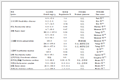 | 表 1 不同浓度吡虫啉胁迫对褐飞虱共生解脂假丝酵母菌落数量的影响Table 1 Effect of different concentrations of imidacloprid on colony numbers of C.lipolytica in N.lugens |
经不同浓度吡虫啉处理后,褐飞虱共生解脂假丝酵母敏感菌株和抗性菌株菌丝体的镜检结果分别见图 1和图 2。从中可看出:对照敏感菌株假菌丝形态比较规则,呈藕节状,酵母为椭圆形或卵形;经吡虫啉处理后,敏感菌株假菌丝形态变得不规则,部分假菌丝不舒展、萎缩或弯曲,部分假菌丝顶端出现膨大,酵母出现空泡等,且吡虫啉浓度越高,不规则程度越明显(图 1)。经不同浓度吡虫啉处理后,抗性菌株的假菌丝形态也有类似变化,部分假菌丝出现顶端膨大、菌丝体粗细不均匀、酵母空泡等不规则形态(图 2);但与敏感菌株相比,抗性菌株菌丝体不规则形态的比例明显下降。
 | 图 1 不同浓度吡虫啉胁迫4 d后褐飞虱共生解脂假丝酵母敏感菌株显微形态比较(光学显微镜,40×) Fig. 1 Micromorphology of susceptible strain of C.lipolytica in N.lugens after being treated with different concentrations of imidacloprid for 4 days (Light microscopy,40×) |
 | 图 2 不同浓度吡虫啉胁迫4 d后褐飞虱共生解脂假丝酵母抗性菌株显微形态比较(光学显微镜,40×) Fig. 2 Micromorphology of resistant strain of C.lipolytica in N.lugens after being treated with different concentrations of imidacloprid for 4 days (Light microscopy,40×) |
褐飞虱共生解脂假丝酵母敏感和抗性菌株培养不同时间的OD600值及其干重测定结果见图 3和图 4。从中可知,无论敏感还是抗性菌株,空白对照的生长量均在12 h开始剧增,48 h后增涨速率逐渐减缓,72 h开始有所下降。据此判断,敏感及抗性菌株均在0~12 h为生长停滞期,12~48 h为对数期,48~72 h为稳定期,72 h以后为衰亡期。
 | (S-CK:0 mg/L;S-500:500 mg/L;S-1000:1 000 mg/L;S-2000:2 000 mg/L)图 3 褐飞虱共生解脂假丝酵母敏感菌株在不同浓度吡虫啉处理下的生长量(OD600)及菌株干重比较 Fig. 3 Comparison for the growth increment(OD600) and dry weight of susceptible strain of C.lipolytica in N.lugens at different concentrations of imidacloprid |
 | 图 4 褐飞虱共生解脂假丝酵母抗性菌株在不同浓度吡虫啉处理下的生长量(OD600)及菌株干重比较 Fig. 4 Comparison for the growth incremente(OD600) and dry weight of resistant strain of C.lipolytica in N.lugens at different concentrations of imidacloprid |
在吡虫啉胁迫下,不同菌株各生长时期的生长量、菌丝干重与对照相比变得不规律。在低浓度(500 mg/L)吡虫啉处理下,抗性及敏感菌株的生长量及菌丝干重与对照均无显著差异;但在1 000 mg/L 吡虫啉胁迫下,抗性菌株各时期的生长量、菌丝干重与对照差异不明显,而敏感菌株在48 h前生长量与对照差异显著,48 h后没有明显差异;在2 000 mg/L吡虫啉胁迫下,敏感菌株在培养72 h前均没有生长,96 h后菌株生长量剧增,抗性菌株培养60 h就有一定的生长量,到72 h时生长量显著增加。综合上述结果说明,吡虫啉对褐飞虱共生解脂假丝酵母抗性菌株生长的影响显著小于对敏感菌株的影响。
3 小结与讨论共生微生物对外界环境变化的适应性要强于其寄主生物,这主要依赖于微生物世代交替短,基因组成相对简单,且具有较强的遗传变异性[22]。因此,当受到外界因子胁迫时,褐飞虱体内的类酵母共生菌比寄主褐飞虱更容易发生突变或者变异[23]。影响褐飞虱体内类酵母共生菌数量、菌落大小及菌株生长的外界因素较多,主要有环境温度[24]、CO2浓度[9]、寄主植物[7, 9, 25]、化学农药[26, 27]和抗生素[24]等。
研究表明:通过高温(35 ℃)处理褐飞虱初孵若虫,能显著降低其体内类酵母共生菌的数量[24];提高CO2浓度和采用转Bt基因水稻品种可影响褐飞虱体内类酵母共生菌的数量和菌落大小,进而影响褐飞虱的生长发育和繁殖[9];褐飞虱取食抗虫品种水稻既能显著减少其体内类酵母共生菌的数量[5, 6],也能显著降低类酵母共生菌的菌落大小[16];不同致害性褐飞虱种群(TN种群、Mudgo种群、ASD7种群)体内类酵母共生菌的形态和数量差异显著[7];以甲胺磷和氧化乐果等杀虫剂处理褐飞虱后,其短翅型雌成虫体内类酵母共生菌的数量仅为对照的20%左右[26];用抗生素处理褐飞虱后,其雌成虫体内类酵母共生菌数量比对照减少59.1%~95.2%[24]。
笔者等前期研究发现,稻田常用杀虫剂和杀菌剂对褐飞虱共生解脂假丝酵母敏感菌株的生长均有明显的抑制作用[27]。李娜等的研究表明,抗吡虫啉共生解脂假丝酵母菌株体内羧酸酯酶、多功能氧化酶、尿酸酶、超氧化物歧化酶及过氧化物酶等活性显著高于敏感菌株[14, 15],说明该菌株对吡虫啉的抗性与其体内酶活性增强有关。本研究发现,经吡虫啉处理后,褐飞虱共生解脂假丝酵母敏感菌株的生长受到明显抑制,且药剂浓度越高,菌株生长受抑制现象越严重;而抗性菌株在低浓度吡虫啉胁迫下其生长几乎不受影响,高浓度下前期生长受到一定抑制,后期可逐渐恢复正常,表明吡虫啉对褐飞虱共生解脂假丝酵母抗性菌株生长的影响显著小于对敏感菌株的影响。推测解脂假丝酵母对吡虫啉产生抗性的原因可能是由于其体内解毒酶活性增高或者相关解毒酶系被诱导激活所致。至于解脂假丝酵母与褐飞虱的抗药性是否有关还有待今后深入研究证实。
| [1] | 程家安, 祝增荣. 2005年长江流域稻区褐飞虱暴发成灾原因分析[J]. 植物保护, 2006, 32(4): 1-4. CHENG Jiaan, ZHU Zengrong. Analysis on the key factors causing the outbreak of brown planthopper in Yangtze Area, China in 2005[J]. Plant Protection, 2006, 32(4): 1-4. (in Chinese) |
| [2] | 王彦华, 沈晋良, 王鸣华. 褐飞虱抗药性机理及其治理研究进展[J]. 农药科学与管理, 2005, 26(4): 24-28. WANG Yanhua, SHEN Jinliang, WANG Minghua. Advance of research on resistance mechanism and management of Nilaparvata lugens Stål[J]. Pest Sci Adm, 2005, 26(4): 24-28. (in Chinese) |
| [3] | LIU Zewen, WILLIAMSON M S, LANSDELL S J, et al. A nicotinic acetylcholine receptor mutation conferring target-site resistance to imidacloprid in Nilaparvata lugens[J]. Proc Natl Acad Sci USA, 2005, 102(24): 8420-8425. |
| [4] | WEN Yucong, LIU Zewen, BAO Haibo, et al. Imidacloprid resistance and its mechanisms in field populations of brown planthopper, Nilaparvata lugens Stål in China[J]. Pestic Biochem Physiol, 2009, 94(1): 36-42. |
| [5] | 吕仲贤, 俞晓平, 陈建明, 等. 共生菌对褐飞虱生长发育和生殖的影响[J]. 植物保护学报, 2001, 28(3): 193-197. LV Zhongxian, YU Xiaoping, CHEN Jianming, et al. The effect of endosymbiote on the development and reproduction of brown planthopper, Nilaparvata lugens Stål[J]. Acta Phytophylacica Sinica, 2001, 28(3):193-197. (in Chinese) |
| [6] | 吕仲贤, 俞晓平, 陈建明, 等. 共生菌在褐飞虱致害性变化中的作用[J]. 昆虫学报, 2001, 44(2): 197-204. LV Zhongxian, YU Xiaoping, CHEN Jianming, et al. Role of endosymbiote in virulence change of the brown planthopper to rice resistant varieties[J]. Acta Entomologica Sinica, 2001, 44(2): 197-204. (in Chinese) |
| [7] | 孙佳音, 傅强, 赖凤香, 等. 不同褐飞虱寄主种群类酵母共生菌形态和数量的比较[J]. 中国水稻科学, 2009, 23(5): 546-550. SUN Jiayin, FU Qiang, LAI Fengxiang,et al. Comparison on morphology and number of yeast-like symbionts in different host-associated populations of Nilaparvata lugens[J]. Chinese J Rice Sci, 2009, 23(5): 546-550. (in Chinese) |
| [8] | GIBSON C M, HUNTER M S.Extraordinarily widespread and fantastically complex: comparative biology of endosymbiotic bacterial and fungal mutualists of insects[J]. Ecol Lett, 2010, 13(2): 223-234. |
| [9] | CHEN Xiaona, WEI Hui, XIAO Nengwen, et al. Effects of elevated CO2 and transgenic Bt rice on yeast-like endosymbiote and its host brown planthopper[J]. J Appl Entomol, 2011, 135(5): 333-342. |
| [10] | YUKUHIRO F, MIYOSHI T, NODA H. Actin-mediated transovarial transmission of a yeastlike symbiont in the brown planthopper[J]. J Insect Physiol, 2014, 60(1): 111-117. |
| [11] | 程新胜,薛宝燕,魏重生. 烟草甲体内类酵母共生菌与烟碱的互作效应研究[EB/OL].(2004-12-09). http://www.tobacco.org.cn/news/zt/2004nh/nhlw/ny/28.htm[ZZ)] CHENG Xinsheng, XUE Baoyan, WEI Chongsheng.Studies on the interaction effects of yeast-like symbionts of cigarette beetle and nicotine[EB/OL]. (2004-12-09). http://www.tobacco.org.cn/news/zt/2004nh/nhlw/ny/28.htm[ZZ)] |
| [12] | 薛宝燕. 食料与共生菌对烟草甲的影响及烟草甲防治技术研究[D]. 合肥: 安徽农业大学, 2005. XUE Baoyan. Studies on the effects of diets and yeast-like symbionts on cigarette beetle and the control techniques of cigarette beetle[D].Hefei: Anhui Agricultural University, 2005. (in Chinese) |
| [13] | 张晓梅, 薛宝燕, 程新胜, 等. 食料对烟草甲药剂敏感性及共生菌和解毒酶活性的影响[J]. 中国烟草科学, 2008, 29(5): 44-47. ZHANG Xiaomei, XUE Baoyan, CHENG Xinsheng,et al. Effects of diets on susceptibility to insecticides, yeast-like symbionts and activity of detoxifying enzymes in cigarette beetles[J]. Chinese Tobacco Sci, 2008, 29(5): 44-47. (in Chinese) |
| [14] | 李娜, 陈建明, 张珏锋, 等. 褐飞虱共生菌抗吡虫啉菌株和敏感菌株解毒酶活性的比较[J]. 浙江农业学报, 2010, 22(5): 653-659. LI Na, CHEN Jianming, ZHANG Juefeng,et al. Comparison for activities of detoxifying enzymes in resistant-and susceptible-imidacloprid endosymbiotic strains of rice brown planthopper, Nilaparvata lugens Stål[J]. Acta Agriculture Zhejiangensis, 2010, 22(5): 653-659. (in Chinese) |
| [15] | 李 娜, 陈建明, 张珏锋, 等. 褐飞虱共生菌抗感吡虫啉菌株体内抗氧化酶活性的比较[J]. 植物保护学报, 2011, 38(3): 258-264. LI Na, CHEN Jianming, ZHANG Juefeng,et al. Comparison for activities of antioxidant enzymes in imidacloprid resistant-and susceptible symbiotic strains in rice brown planthopper, Nilaparvata lugens Stål[J]. Acta Phytophylacica Sinica, 2011, 38(3): 258-264. (in Chinese) |
| [16] | 陈法军, 张珏锋, 夏湛恩, 等. 褐飞虱体内酵母类共生菌的形态观察[J]. 动物分类学报, 2006, 31(1): 55-62. CHEN Fajun, ZHANG Juefeng, XIA Zhan'en,et al. Morphological observation on the yeast-like endosymbiotes in brown planthopper, Nilaparvata lugens[J]. Acta Zootaxonomica Sinica, 2006, 31(1): 55-62. (in Chinese) |
| [17] | HOU Yan, MA Zheng, DONG Shengzhang,et al. Analysis of yeast-like symbiote diversity in the brown planthopper (BPH), Nilaparvata lugens Stål, using a novel nested PCR-DGGE protocol[J]. Current Microbiol, 2013, 67: 263-270 |
| [18] | 张珏锋, 吴鸿, 陈建明, 等. 一株褐飞虱内共生菌的分离及分子鉴定[J]. 中国水稻科学, 2007, 21(5): 551-554. ZHANG Juefeng, WU Hong, CHEN Jianming,et al. A strain isolated from brown planthopper and its molecular identification[J]. Chinese J Rice Sci, 2007, 21(5): 551-554. (in Chinese) |
| [19] | 张珏锋, 陈建明, 陈法军, 等. 褐飞虱内共生菌的分离及其 26S rDNA 部分序列分析[J]. 中国农业科学, 2009, 42(6): 2211-2216. ZHANG Juefeng, CHEN Jianming, CHEN Fajun,et al. The isolation of yeast-like-symbiots in the brown planthopper and the sequences analysis of its 26S rDNA[J]. Scientia Agricultura Sinica, 2009, 42(6): 2211-2216. (in Chinese) |
| [20] | 李娜, 陈建明, 张珏锋, 等. 褐飞虱共生解脂假丝酵母抗吡虫啉菌株的驯化[J]. 微生物学通报, 2011, 38(2): 237-241. LI Na, CHEN Jianming, ZHANG Juefeng,et al. Domestication for imidacloprid-resistant strain of rice brown planthopper, Nilaparvata lugens Stål, symbiote, Candida lipolytica[J]. Microbiology China, 2011, 38(2): 237-241. (in Chinese) |
| [21] | 马勇, 樊永军. 用OD值监测产油酵母培养过程中的菌体生物量变化[J]. 安徽农业科学, 2011, 39(12): 7342-7346. MA Yong, FAN Yongjun. Monitoring changes in biomass using OD in the culture process of the fermentation with the oleaginous yeast[J].J Anhui Agric Sci, 2011, 39(12): 7342-7346. (in Chinese) |
| [22] | SENEVIRATNE C J, WANG Yu, JIN Lijian, et al. Proteomics of drug resistance in Candida glabrata biofilms[J]. Proteomics, 2010, 10(7): 1444-1454. |
| [23] | BAUMANN P, BAUMANN L, LAI C Y, et al. Genetics, physiology, and evolutionary relationships of the genus Buchnera: intracellular symbionts of aphids[J]. Ann Rev Microbiol, 1995, 49: 55-94. |
| [24] | CHEN C C, CHENG L L, HOU R F. Studies on the intracellular yeast-like symbiote in the brown planthopper, Nilaparvata lugens Stål II. Effects of antibiotics and elevated temperature on the symbiote[J]. Zeitschrift für Angewandte Entomologi, 1981, 92(1-5): 440-449. |
| [25] | LU Zhongxian, YU Xiaoping, CHEN Jianming,et al. Dynamics of yeast-like symbiote and its relationship with the virulence of brown planthopper, Nilaparvata lugens Stål, to resistant rice varieties[J]. J Asia-Pacific Entomol, 2004, 7(3): 317-323. |
| [26] | 徐红星, 郑许松, 童中华, 等. 杀虫剂对褐飞虱体内共生菌的影响[J]. 浙江农业学报, 2000, 12(3): 126-128. XU Hongxing, ZHENG Xusong, TONG Zhonghua,et al. Effects of insecticides on the symbiotes in brown planthopper[J]. Acta Agriculturae Zhejiangensis, 2000, 12(3): 126-128. (in Chinese) |
| [27] | 陈建明, 何月平, 张珏锋, 等. 常用杀虫剂和杀菌剂对褐飞虱类酵母共生菌生长的影响[J]. 植物保护, 2009, 35(6): 47-51. CHEN Jianming, HE Yueping, ZHANG Juefeng,et al. Effects of insecticides and fungicides on growth of endosymbiotes isolated from the brown planthopper, Nilaparvata lugens[J]. Plant Protection, 2009, 35(6): 47-51.(in Chinese) |