 2022, Vol. 40


2. 内蒙古自治区电力系统智能化电网仿真企业重点实验室,呼和浩特 010020
2. Inner Mongolia Enterprise Key Laboratory of Smart Grid Simulation of Electrical Power System, Hohhot 010020, China
近年来,光伏电站不断接入电力系统,逐渐改变了电网运行特性,对电网短路电流分析、电流保护定值计算以及设备设计、选型等产生了较大影响,给电网安全稳定运行带来了一定风险[1-7]。为解决上述光伏系统并网带来的问题,亟待开展光伏系统短路电流特性研究。光伏经过逆变器接口并网,输出具有很强的非线性,传统的线性等值模型不再适用。有研究表明,由于光伏的发电单元和逆变器之间有大电容,故障时直流侧电压基本保持恒定,短路特性主要由逆变器的控制策略决定[8-15]。在此基础上,国内外学者根据不同工况和假设条件,提出了不同光伏系统短路电流计算模型[16-20]。然而,大部分研究工作是从理论控制方式、控制策略角度出发开展短路特性研究,短路电流计算模型复杂,缺乏实验结果验证,工程中应用较少。本文以内蒙古电网某光伏系统为研究对象,计及光伏系统低电压过渡控制策略,建立光伏系统短路电流计算实用等值模型,并对模型准确性进行验证,为开展电网短路电流计算提供模型基础。
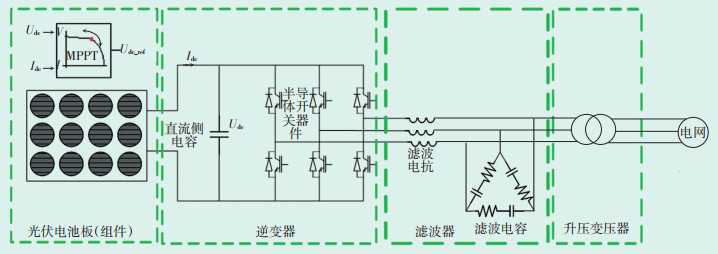
1 光伏系统本文研究的光伏系统(结构示意图见图 1)由光伏电池板(组件)、直流母线、电容器组、逆变器、滤波器和升压变压器组成。最大功率跟踪模块(MPPT)根据当前直流母线电压Udc和直流电流Idc,电压-功率特性曲线,计算电池板达到最大输出功率时的直流电压Udc_ref,作为直流母线电压的参考值。逆变器根据控制策略控制绝缘栅双极晶闸管(IGBT)的通断状态,将光伏电池板产生的直流电能转换为工频交流电能,并通过升压变压器输出到电网。
|
| 图 1 光伏系统结构示意图 Figure 1 Structure diagram of photovoltaic system |
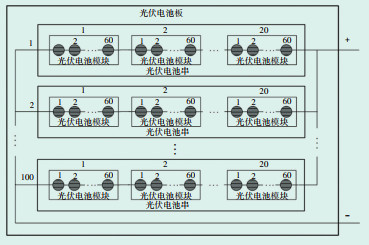
光伏系统电池板结构示意见图 2,由100个光伏电池串并联组成,其中每个电池串由20个光伏电池模块串联组成,而每个光伏电池模块由60个光伏电池单元串联组成,其中,光伏电池模块参数见表 1。
|
| 图 2 光伏电池板结构示意图 Figure 2 Schematic diagram of photovoltaic cell panels |
| 表 1 光伏电池模块参数 Table 1 Parameters of photovoltaic cell module |

|
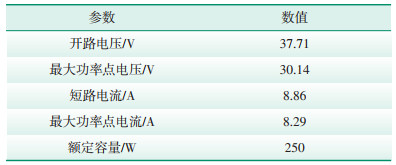
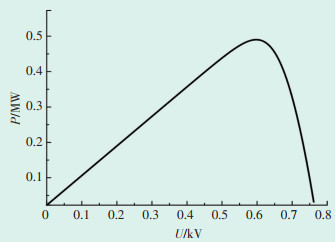
每个光伏电池模块容量为250 W,一个光伏电池板共包含2000个电池模块,总容量为0.5 MW,光伏电池板在标准条件下的电压-功率特性曲线见图 3。
|
| 图 3 光伏电池板标准条件下的电压-功率特性曲线 Figure 3 Voltage-power characteristic curve of photovoltaic system under standard conditions |
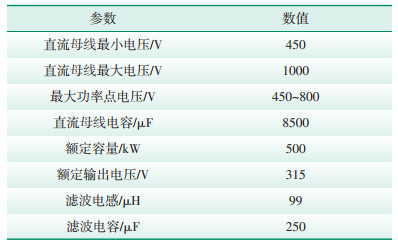
光伏逆变器采用经典三相桥结构,每个桥臂采用IGBT反并联二极管;滤波器采用三相LC型滤波器,并联在逆变器出口处,其具体参数见表 2。
| 表 2 光伏逆变器和滤波器参数 Table 2 Parameters of photovoltaic inverter and filter |
|
|
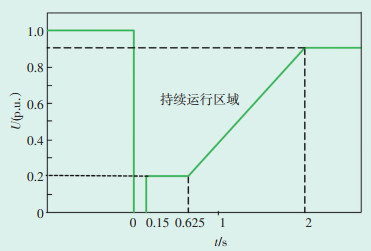
根据GB/T 19964—2012 《光伏发电站接入电力系统技术规定》,对于35 kV及以上电压等级并网的光伏电站以及通过10 kV电压等级与公共电网连接的新建、改建和扩建光伏电站,电网发生故障,并网点电压跌落时,须不脱网持续运行,并提供一定动态无功支撑,以帮助电网电压恢复,低电压过渡能力要求见图 4[21]。
|
| 图 4 光伏电站低电压过渡能力要求 Figure 4 Requirements for low voltage ride through capability of photovoltaic power station |
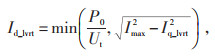
GB/T 32826—2016《光伏发电系统建模导则》对光伏系统在低电压过渡期间的动态无功支撑能力做出了要求,当并网点电压跌落0.2~0.9(p.u.)时,无功电流大小与电压跌落深度成比例,即电压跌落越大,无功电流越大[22]。目前典型的光伏系统低电压过渡控制策略,是在优先保证无功功率输出的条件下,根据逆变器容量兼顾有功电流分量,即在逆变器输出电流不过载(1.1倍额定电流)的情况下,尽可能输出无功功率,以支撑电网电压。无功和有功电流指令值见式(1)和式(2)。

|
(1) |
|
(2) |
式中:Iq_lvrt和Id_lvrt分别为低电压过渡期间无功和有功电流指令值;KQLV为无功电流支撑系数;Ut为并网点电压幅值标幺值;ULV为低电压过渡阈值,取0.9(p.u.);P0为故障前输出的有功功率;Imax为电流限制值。
在低电压故障发生的瞬间,由于并网点电压Ut降低而有功电流Id还未来得及变化,导致此时输出的有功功率下降。多余的有功功率对直流母线电容充电,致使直流母线电压上升,此时闭锁最大功率跟踪算法,根据低电压过渡期间无功和有功电流指令值控制逆变器,调节输出功率,使功率达到平衡,进而直流侧电压达到新的稳定状态,即低电压过渡稳态。之后,故障消失,并网点电压快速恢复,光伏系统退出低电压过渡控制策略,按照正常状态下有功和无功功率控制策略控制逆变器运行。
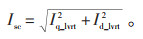
2 光伏系统三相短路电流等值计算模型当电网发生短路故障,导致光伏系统并网点电压降低至0.9(p.u.)以下时,光伏系统进入低电压过渡阶段,此时逆变器输出的无功和有功电流按照式(1)和式(2)计算。与此同时,光伏系统采用电压外环和电流内环的双环控制结构,且内环控制的时间常数很小,而无功和有功电流指令直接作用于内环,因此可以认为稳态期间短路电流无功和有功分量与其对应的控制指令值相同,故稳态短路电流Isc可表示为:
|
(3) |
将式(1)和式(2)代入式(3),可得:

|
(4) |
由式(4)可知,三相短路故障期间,光伏系统可等效为一个三相电流源,其有效值与故障前的P0、Ut、KQLV和Imax有关,具体数值可基于实验数据进行参数辨识和估计,以满足计算精度要求。
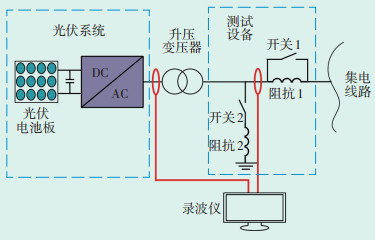
3 模型验证对某光伏电站系统进行三相短路电流测试,以验证短路电流等值计算模型的正确性和有效性。短路测试接线示意图见图 5,在升压变压器高压侧和集电线路之间串接测试设备,测试设备由开关1、阻抗1、开关2和阻抗2构成,通过阻抗1与阻抗2的不同组合,实现不同深度的电压跌落,利用电压和电流传感器将逆变器出口处和升压变压器高压侧的三相电压和电流信号传送到录波仪。
|
| 图 5 光伏系统三相短路测试接线示意图 Figure 5 Schematic diagram of three-phase short circuit test of photovoltaic system |
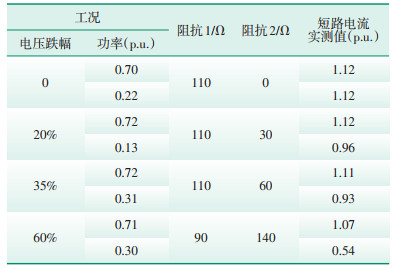
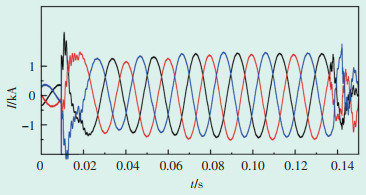
考虑功率大小和电压跌落深度等情况,不同工况下短路电流测试结果见表 3。以逆变器额定电流为基准电流,即Ib=916.4 A;以逆变器容量为基准容量,即Sb=0.5 MW;工况为小功率0.22(p.u.),电压跌落0时的典型短路电流波形见图 6。可知,故障时刻三相电流迅速增大,且畸变较严重;随后逐渐进入稳态短路期间,幅值约为1.45 kA。
| 表 3 不同工况下光伏系统短路电流测试结果 Table 3 Test results of short circuit current of photovoltaic system under different working conditions |
|
|
|
| 图 6 典型短路电流波形 Figure 6 Typical short⁃circuit current waveform |
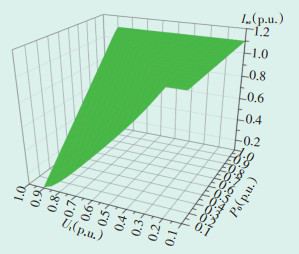
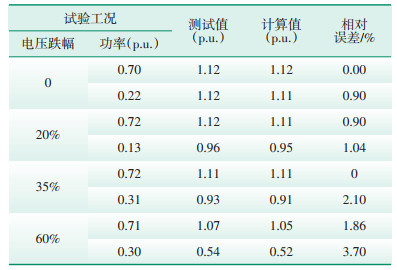
根据表 3,基于最小二乘法对式(4)中的参数KQLV进行辨识,设定误差不超过5%,辨识结果为KQLV=1.42,三相短路电流计算值与实测值的最大相对误差为3.7%,发生在小功率、电压跌落为60%的工况。Imax通常可由设备手册查到,光伏系统中Imax=1.1(p.u.)。因此,根据式(4)计算,在不同有功功率和电压跌落深度条件下,三相稳态短路电流有效值见图 7。
|
| 图 7 三相稳态短路电流有效值 Figure 7 Effective value of three⁃phase steady-state short-circuit current |
由图 7可知,光伏系统三相稳态短路电流有效值与故障前有功功率和故障时的电压跌落深度有关,有功功率越小,电压跌落深度越小,则短路电流有效值也越小。当故障前有功功率为满发时,电压跌落深度在0~0.9(p.u.),短路电流有效值达到最大值恒为1.12(p.u.)。与此同时,光伏系统短路电流测试值与计算值误差对比见表 4,可知短路电流等值模型计算的三相短路电流结果与试验结果一致,验证了模型的准确性和有效性。
| 表 4 光伏系统短路电流测试值与计算值误差对比 Table 4 Error comparison between test value and calculated value of short-circuit current of photovoltaic system |
|
|
本文基于光伏系统低电压过渡控制策略,研究了光伏系统三相稳态短路电流特性,提出了光伏系统三相短路电流计算模型,并进行了试验验证,得出以下结论。
(1)光伏系统在三相短路故障期间可等效为一个三相电流源,其稳态短路电流有效值与故障前的有功功率和故障时的电压跌落深度有关,具体定量关系取决于光伏系统低电压过渡控制策略。
(2)文中提出的光伏系统短路电流模型与实际稳态系统短路特性一致,验证了模型的正确性和有效性。模型具有实用、简单的特点,可推广应用于大电网短路电流计算。
| [1] |
李莉杰, 宋百川, 孙丹丹, 等. 基于大数据的分布式光伏接入配电网影响分析与功率预测研究[J].
电力大数据, 2021, 24(2): 1-9 LI Lijie, SONG Baichuan, SUN Dandan, et al. Research on influence analysis and power prediction of distributed photovoltaic access to distribution network based on big data[J]. Power Systems and Big Data, 2021, 24(2): 1-9 (  0) 0)
|
| [2] |
Nakayama K, Tsuji M, Chantana J, et al. Description of short circuit current of outdoor photovoltaic modules by multiple regression analysis under various solar irradiance levels[J].
Renewable Energy, 2020, 147 ( 0)
|
| [3] |
Swain S, Ray P K. Short circuit fault analysis in a grid connected DFIG based wind energy system with active crowbar protection circuit for ridethrough capability and power quality improvement[J].
International Journal of Electrical Power & Energy Systems, 2017(84): 64-75 ( 0)
|
| [4] |
曹斌, 刘文焯, 原帅, 等. 基于低电压穿越试验的光伏发电系统建模研究[J].
电力系统保护与控制, 2020, 48(18): 146-155 CAO Bin, LIU Wenzhuo, YUAN Shuai, et al. Modeling of photovoltaic power system based on low voltage ride-through test[J]. Power System Protection and Control, 2020, 48(18): 146-155 ( 0)
|
| [5] |
武小龙. 计及电网短路故障影响的光伏并网系统控制策略研究[D]. 合肥: 合肥工业大学, 2019.
WU Xiaolong. Study on control strategy of photovoltaic grid - connected system considering influence of power grid short - circuit fault[D]. Hefei: Hefei University of Technology, 2019. ( 0)
|
| [6] |
黄显斌, 林达, 王慧芳, 等. 并网光伏系统低电压穿越策略综述[J].
机电工程, 2016, 33(5)589-594, 601 HUANG Xianbin, LIN Da, WANG Huifang, et al. Review of low voltage ride through strategy in grid - connected photovoltaic system[J]. Mechanical & Electrical Engineering Magazine, 2016, 33(5)589-594, 601 ( 0)
|
| [7] |
马进, 赵大伟, 钱敏慧, 等. 大规模新能源接入弱同步支撑直流送端电网的运行控制技术综述[J].
电网技术, 2017(10): 3112-3120 MA Jin, ZHAO Dawei, QIAN Minhui, et al. Reviews of control technologies of large - scale renewable energy connected to weakly-synchronized sending-end DC power grid[J]. Power System Technology, 2017(10): 3112-3120 ( 0)
|
| [8] |
邢华栋, 张爱军, 孟庆天, 等. 多端风电汇集电网输电线路的功率极限研究[J].
内蒙古电力技术, 2017, 35(2)7-9, 14 XING Huadong, ZHANG Aijun, MENG Qingtian, et al. Research on transmission power limitation in multipleconverging wind Power System[J]. Inner Mongolia Electric Power, 2017, 35(2)7-9, 14 ( 0)
|
| [9] |
王乐媛, 刘琼. 基于PSD-BPA软件分析的风电场无功补偿仿真计算[J].
内蒙古电力技术, 2018, 36(6): 107-109 WANG Yueyuan, LIU Qiong. Simulation calculation of reactive power compensation in wind farm based on PSD-BPA software analysis[J]. Inner Mongolia Electric Power, 2018, 36(6): 107-109 ( 0)
|
| [10] |
丛雨, 赵永飞, 王乐媛, 等. 基于光伏逆变器无功控制的仿真研究与试验验证[J].
内蒙古电力技术, 2018, 36(4): 33-36 CONG Yu, ZHAO Yongfei, WANG Yueyuan, et al. Simulation research and test verification based on reactive power control of photovoltaic inverter[J]. Inner Mongolia Electric Power, 2018, 36(4): 33-36 ( 0)
|
| [11] |
习伟, 张哲, 陈卫, 等. 光伏逆变器短路特性分析[J].
电力系统保护与控制, 2015, 43(7): 70-75 XI Wei, ZHANG Zhe, CHEN Wei, et al. Research on fault characteristic of the PV inverter[J]. Power System Protection and Control, 2015, 43(7): 70-75 ( 0)
|
| [12] |
LIANG Z, LIN X, KANG Y, et al. Short circuit current characteristics analysis and improved current limiting strategy for three-phase three-leg inverter under asymmetric short circuit fault[J].
IEEE Transactions on Power Electronics, 2018, 33(8): 7214-7228 DOI:10.1109/TPEL.2017.2759161 ( 0)
|
| [13] |
Bracale A, Caramia P, Carpinelli G, et al. Modeling the three-phase short-circuit contribution of photovoltaic systems in balanced power systems[J].
International Journal of Electrical Power & Energy Systems, 2017, 93(Dec.): 204-215 ( 0)
|
| [14] |
Carpinelli G, Bracale A, Caramia P, et al. Threephase photovoltaic generators modeling in unbalanced short-circuit operating conditions[J].
International Journal of Electrical Power & Energy Systems, 2019, 113(dec): 941-951 ( 0)
|
| [15] |
Missrani G, Nabila N, Jufri F H, et al. Study on short circuit current contribution after photovoltaic solar plant integration in Lombok′ s distribution network [C]//2019 IEEE International Conference on Innovative Research and Development (ICIRD). IEEE, 2019.
( 0)
|
| [16] |
张铭路, 刘海涛, 王新宝. 光伏逆变器对称短路电流特性及等效模型研究[J].
电气传动, 2016, 46(9): 16-20 ZHANG Minglu, LIU Haitao, WANG Xinbao. Research on the characteristics of symmetrical short-circuit current and equivalent model for the photovoltaic inverter[J]. Electric Drive, 2016, 46(9): 16-20 DOI:10.3969/j.issn.1001-2095.2016.09.004 ( 0)
|
| [17] |
张尧, 晁勤, 李育强, 等. 基于三相对称的光伏逆变器输出短路电流研究[J].
电力电子技术, 2015, 49(12): 73-76 ZHANG Yao, CHAO Qin, LI Yuqiang, et al. Research on the output short-circuit current of PV inverter based on three-phase current symmetrical[J]. Power Electronics, 2015, 49(12): 73-76 DOI:10.3969/j.issn.1000-100X.2015.12.023 ( 0)
|
| [18] |
Kim I. A calculation method for the short-circuit cur rent contribution of current-control inverter-based distributed generation sources at balanced conditions[J].
Electric Power Systems Research, 2021, 190(Jan.): 106839.1-106839.9 ( 0)
|
| [19] |
Strezoski L, Prica M, Loparo K A. Sequence domain calculation of active unbalanced distribution systems affected by complex short-circuits[J].
IEEE Transations on Power Systems, 2017: 1 ( 0)
|
| [20] |
JIAO Y, LIANG X, JIANG C. Failure analysis method in distribution network considering LVRT control strategy of grid-connected photovoltaic station[J].
Automation of Electric Power Systems, 2016, 40(20): 92-99 ( 0)
|
| [21] |
中国电力企业联合会. 光伏发电站接入电力系统技术规定: GB/T 19964—2012[S]. 北京: 中国质量标准出版传媒有限公司, 2013.
China Electricity Council. Technical requirements for connecting photovoltaic power station to power system: GB/T 19964—2012[S]. Beijing: China Quality and Standards Publishing & Media Co., Ltd., 2013. ( 0)
|
| [22] |
中国电力企业联合会. 光伏发电系统建模导则: GB/T 32826—2016[S]. 北京: 中国质量标准出版传媒有限公司, 2016.
China Electricity Council. Guide for modeling photovoltaic power system: GB/T 32826—2016[S]. Beijing: China Quality and Standards Publishing & Media Co., Ltd., 2016. ( 0)
|