

文章信息
- 李东芹, 叶小丽, 朱姣姣, 潘俊廷, 常品品, 崔传磊, 朱旭君, 房婉萍, 王玉花
- LI Dongqin, YE Xiaoli, ZHU Jiaojiao, PAN Junting, CHANG Pinpin, CUI Chuanlei, ZHU Xujun, FANG Wanping, WANG Yuhua
- 氟对茶树花粉管抑制及其与NO关系的研究
- A study on fluorine inhibiting pollen tube growth and the relation with nitric oxide in tea plant(Camellia sinensis)
- 南京农业大学学报, 2017, 40(6): 993-997
- Journal of Nanjing Agricultural University, 2017, 40(6): 993-997.
- http://dx.doi.org/10.7685/jnau.201702005
-
文章历史
- 收稿日期: 2017-02-08


茶树(Camellia sinensis)是一种超富集氟(F)的植物[1], 但氟并非茶树必需元素, 高浓度的氟对茶树生长[2]与茶叶品质[3]均会造成危害。近年来, 由过量饮茶而引起人体的氟斑病和氟骨病等临床症状的报道日益增多[4]。沙济琴等[5]研究表明, 茶树花蕾中的氟含量仅次于叶, 是第二高的组织部位。同时, 花粉管是茶树有性生殖的雄性器官, 也是花蕾的重要组成部分, 小西茂毅等[6]研究发现氟显著缓解铝(Al)对花粉管生长的抑制, 而氟对花粉管的影响研究鲜有报道。花粉管作为极性生长的单细胞, 是研究离子动态变化的理想实验模型, 因此, 本文以茶树花粉管为试验材料, 研究茶树富集氟的可能机制。
一氧化氮(NO)作为植物体中普遍存在的关键信号分子[7], 对植物的呼吸[8]、光合磷酸化[9]、光形态的建成[10]、种子的萌发[11]、根的生长发育[12]、生物和非生物胁迫反应[13-14]等过程起着重要的调节作用。以往研究发现, NO作为负调控因子参与被子植物拟南芥和百合花粉管的极性生长和定向作用[15], NO还参与了UV-B胁迫下泡桐花粉管的生长[16]。此外, 前期研究表明, NO参与低温胁迫下茶树花粉管的生长, 并且外源NO供体DEA NONOate抑制茶树花粉萌发和花粉管的伸长, 同时表现出明显的浓度依赖性, 其抑制效应被NO清除剂(cPTIO)和一氧化氮合酶(NOS)抑制剂(L-NNA)所缓解[17]。上述研究表明, NO作为信号分子参与了茶树花粉管的极性生长, 但是关于NO参与氟胁迫的研究较少。
本研究通过不同质量浓度的氟处理, 并施加外源NO供体、NO清除剂, 来探讨氟对茶树花粉萌发和花粉管伸长的影响以及与NO的关系, 旨在为茶树聚氟机制的研究提供科学依据和理论基础。
1 材料与方法 1.1 植物材料供试材料为栽植于南京市中山陵茶园的茶树品种‘龙井长叶’。于2016年10月至11月上旬茶树盛花期期间, 采摘处于蕾白期(花蕾膨大欲展开, 色白)的花蕾, 置于硅胶干燥器内干燥后用毛笔将花粉轻轻刷下至硫酸纸上, 收集备用[18]。
1.2 花粉培养及萌发率、花粉管长度检测将新收集的茶树花粉置入含有不同质量浓度氟(0、8、16、32、64、128 mg·L-1)的花粉培养液中, 常温(25 ℃)下避光悬浮培养30、60、90 min, 检测萌发率和花粉管长度。以不同质量浓度F(0、32和64 mg·L-1)处理1 h的花粉作为对照组, 以不同质量浓度的氟加入200 μmol·L-1 NO清除剂cPTIO共处理1 h的花粉作为NO清除剂处理组, 以不同质量浓度的氟加入25 μmol·L-1 NO供体DEA NONOate共处理1 h的花粉作为外源NO处理组, 检测萌发率和花粉管长度。标准花粉培养液的配制参照陈暄等[18]的方法。每个试验至少设3次生物学重复。
吸取适量培养后的花粉悬浮液于普通光学显微镜(JNOEC XS-212-103, 10×10倍)下进行观察, 以花粉管的长度达到花粉粒直径的1/2以上视为花粉已萌发[19], 每片观察6个视野。花粉萌发率=萌发花粉粒数/观察花粉总粒数×100%。随机选取200个萌发的花粉, 在显微镜下拍照后用ImageJ软件测量长度。
1.3 测定花粉管内NO含量花粉经过不同的处理培养1 h后, 在液氮中研磨, 然后倒入含有4 mL 40 mmol·L-1 HEPES缓冲液(pH7.2)的离心管中, 13 000 g离心萃取20 min。总NO含量使用NO测定试剂盒(碧云天生物技术, 中国)并参照Liu等[20]的方法测定。
1.4 测定花粉管内NOS活性变化花粉经过不同的处理培养1 h后, 在液氮中研磨, 然后倒入含有1 mL提取缓冲液的离心管中4 ℃、13 000 g离心萃取20 min。1 mL提取缓冲液中含有100 mmol·L-1 HEPES(pH 7.5)、1 mmol·L-1乙二胺四乙酸(EDTA)、10%(体积分数)甘油、5 mmol·L-1二硫苏糖醇(DTT)、0.1%(体积分数)聚乙二醇辛基苯基醚(Triton X-100)、0.5 mmol·L-1苯甲基磺酰氟(PMSF)、20 μmol·L-1黄素腺嘌呤二核甘酸(FAD)、25 μmol·L-1亮抑酶肽、5 μmol·L-1钼酸钠和10 g·L-1聚乙烯吡咯烷酮(PVP)。取0.2 mL上清液, 使用一氧化氮合酶检测试剂盒(碧云天生物技术, 中国)进行NOS活性的测定。测定方法参照Ding等[21]的方法。
1.5 数据分析用Excel 2010与SPSS 22.0软件对数据进行整理和统计学分析, 处理间差异显著性用LSD法检验。
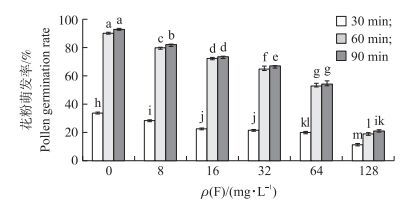
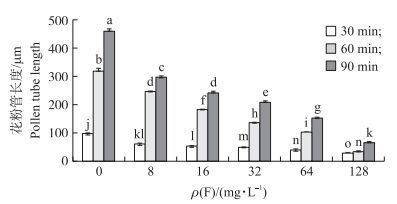
2 结果与分析 2.1 氟对茶树花粉萌发率和花粉管长度的影响由图 1和图 2可知:8、16、32、64、128 mg·L-1氟处理30 min后, 花粉萌发率较对照(0 mg·L-1氟处理)分别降低5.96%、11.31%、12.13%、13.86%和22.42%, 花粉管长度分别比对照短37.09、43.97、48.65、57.84和69.36 μm。当处理时间延长到60和90 min时, 随着氟浓度的增加, 花粉的萌发率显著降低, 且花粉管的长度也显著缩短。当处理时间为60和90 min时, 氟对茶树花粉萌发和花粉管伸长均具有显著的抑制效应。
|
图 1 不同质量浓度氟(F)对茶树花粉萌发率的影响 Figure 1 Effects of different concentrations of fluorine (F)on the pollen germination rate of Camellia sinesis 不同小写字母表示处理间差异显著(P<0.05)。下同。 Different lowercase letters indicate significant difference at 0.05 level in treatments. The same as follows. |
|
图 2 不同质量浓度氟对茶树花粉管长度的影响 Figure 2 Effects of different concentrations of fluorine on the pollen tube length of Camellia sinensis |
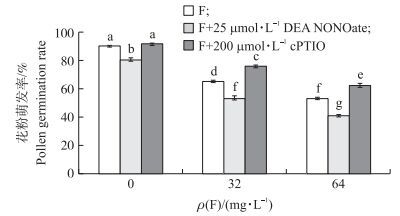
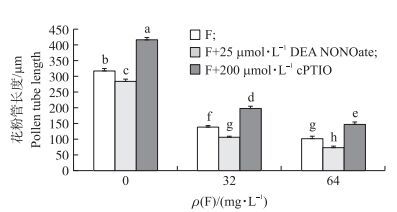
图 3和图 4显示:与0、32、64 mg·L-1氟处理相比, 0、32、64 mg·L-1氟与25 μmol·L-1 DEA NONOate共同处理的茶树花粉萌发率降低10.09%、12.30%和13.23%, 花粉管长度减少32.77、31.88和29.64 μm; 而0、32、64 mg·L-1氟与200 μmol·L-1 cPTIO共同处理的茶树花粉的萌发率则提高1.31%、10.62%和7.54%, 花粉管长度增加103.34、56.60和45.08 μm。
|
图 3 不同质量浓度氟处理下NO释放剂DEA NONOate和清除剂cPTIO对茶树花粉萌发率的影响 Figure 3 Effects of NO donor DEA NONOate and scavenger cPTIO on the tea pollen germination rate under different concentrations of fluorine treatments |
|
图 4 不同质量浓度氟处理下NO释放剂DEA NONOate和清除剂cPTIO对茶树花粉管长度的影响 Figure 4 Effects of NO donor DEA NONOate and scavenger cPTIO on the tea pollen tube length under different concentrations of fluorine treatments |
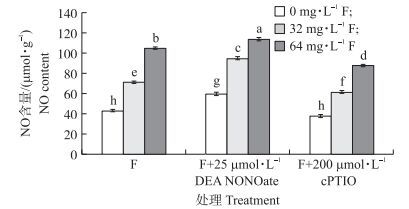
由图 5可见:随着氟处理浓度的增加, 花粉管内的NO含量显著增加。在氟处理中加入25 μmol·L-1DEA NONOate, NO含量显著增加, 而加入200 μmol·L-1 cPTIO, NO含量显著下降。表明氟可以增加茶树花粉管内NO含量。另外, 茶树花粉管在氟处理下, 外施DEA NONOate增加了花粉管内NO的含量, 而cPTIO降低了NO的含量。
|
图 5 不同质量浓度氟对茶树花粉管内NO含量的影响 Figure 5 Effects of different concentrations of fluorine on NO content in tea pollen tubes |
|
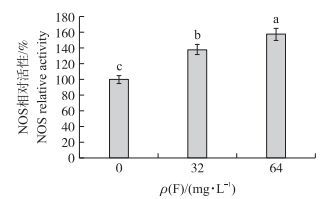
图 6 氟对茶树花粉管中NOS活性的影响 Figure 6 Effects of fluorine on NOS activity in tea pollen tubes |
由图 6可见:与对照相比, 32和64 mg·L-1氟处理后, NOS活性分别增加了38.48%和58.04%, 表明随着氟质量浓度的增加花粉管内的NOS活性显著提高。
3 讨论氟对植物的毒性作用主要表现在对新陈代谢的抑制和对细胞结构的破坏上[22-24]。研究表明, 外源高浓度氟处理下, 茶树叶片的叶绿素含量和净光合速率均有下降, 细胞的超微结构遭到破坏[25], 茶苗出现氟过量症, 如叶色发黄、顶芽停止生长、根系生长不良、叶片脱落、顶芽枯死、根系发黑、断裂直至植株死亡等[26]。这些研究表明, 高浓度的氟对植物的叶片和根具有显著抑制作用, 包括超富集氟植物茶树的根和叶也具有明显的破坏作用, 而对植物的生殖器官的影响鲜有研究。本研究发现, 氟对茶树的生殖器官花粉的萌发和花粉管的生长也有抑制作用, 而且呈现显著的浓度效应。
NO作为重要的信号分子在植物的种子萌发、叶片生长、根系伸长等生理过程以及生物胁迫和非生物胁迫下的病理过程中具有不同的功能[27-28]。值得关注的是, NO在植物生殖器官花粉管的极性生长中也具有重要作用。前人研究发现, NO通过cGMP途径调控裸子植物白皮松花粉管的生长速率和细胞壁建成[29]。本研究表明, 外源NO释放剂显著增强氟对花粉的萌发和花粉管伸长的抑制效应, 而外源NO清除剂能够显著缓解氟的抑制效应, 表明NO在氟胁迫下茶树花粉萌发和花粉管生长过程中起负调控作用, 这与Wang等[30]的研究结果一致。
关于NO来源, 在动物体内已经研究的较为清晰, 而在植物体中, 普遍认为NO来源主要有两种途径:一种是酶促反应途径, 另一种是非酶促反应途径[31]。迄今为止, 植物体内未发现与哺乳动物NOS同源的基因序列或蛋白质序列, 但利用动物NOS相关的抑制剂处理植物, 显示出相应的NO生成减少、NOS活性降低, 因此, 普遍认为植物中存在类似于动物NOS的活性物质。本试验发现, 随着氟浓度的提高花粉管内NO含量显著提高, 同时NOS活性显著增强, 这与前期研究发现的低温胁迫下茶树花粉管NO含量的升高部分依赖于NOS活性的结果相一致[30]。
综上所述, 氟显著抑制了茶树花粉的萌发和花粉管伸长并具有明显的浓度效应; NO作为负调控因子参与了氟对花粉萌发和花粉管伸长的抑制过程, 并且氟处理下茶树花粉管中NO含量的升高部分依赖于NOS活性的增加。
| [1] |
高绪萍, 王萍, 王之让, 等. 环境氟迁移与茶叶氟富集的关系[J].
植物资源与环境, 1997, 6(2): 43–47.
Gao X P, Wang P, Wang Z R, et al. Relationship between environment fluorine transportation and fluorine enrichment in tea[J]. Journal of Plant Resources and Environment, 1997, 6(2): 43–47. (in Chinese with English abstract) |
| [2] |
唐茜, 赵先明, 杜晓, 等. 氟对茶树生长、叶片生理生化指标与茶叶品质的影响[J].
植物营养与肥料学报, 2011, 17(1): 186–194.
Tang Q, Zhao X M, Du X, et al. Effects of fluorine on growth, leaf physiological and biochemical indexes and quality of tea[J]. Plant Nutrition and Fertilizer Science, 2011, 17(1): 186–194. DOI: 10.11674/zwyf.2011.0126 (in Chinese with English abstract) |
| [3] | Li C, Yang X, Hu J, et al. Effect of fluoride on aroma of tea leaves[J]. Fluoride, 2013, 46(1): 25–28. |
| [4] |
向勤锃, 刘德华. 氟对人体的作用及茶树富氟的研究进展与展望[J].
茶叶通讯, 2002(2): 34–37.
Xiang Q Z, Liu D H. Research progress and prospect of fluorine on human body and fluorine in tea plant[J]. Tea Communication, 2002(2): 34–37. (in Chinese with English abstract) |
| [5] |
沙济琴, 郑达贤. 福建茶树鲜叶含氟量的研究[J].
茶叶科学, 1994(1): 37–42.
Sha J Q, Zheng D X. Study on fluorine content of fresh tea leaves in Fujian[J]. Journal of Tea Science, 1994(1): 37–42. (in Chinese with English abstract) |
| [6] |
小西茂毅, 陈翠莲. 用氟刺激茶树花粉管生长和减轻铝对花粉管生长的抑制[J].
茶叶, 1986(4): 56–60.
Xiaoxi M Y, Chen C L. Alleviation of aluminum stress and stimulation of tea pollen tube growth by fluorine[J]. Tea, 1986(4): 56–60. (in Chinese with English abstract) |
| [7] | Wendehenne D, Pugin A, Klessig D F, et al. Nitric oxide:comparative synthesis and signaling in animal and plant cells[J]. Trends in Plant Science, 2001, 6(4): 177–183. DOI: 10.1016/S1360-1385(01)01893-3 |
| [8] | Zottini M, Formentin E, Scattolin M, et al. Nitric oxide affects plant mitochondrial functionality in vivo[J]. FEBS Letters, 2002, 515: 75–78. DOI: 10.1016/S0014-5793(02)02438-9 |
| [9] | Takahashi S, Yamasaki H. Reversible inhibition of photophosphorylation in chloroplasts by nitric oxide[J]. FEBS Letters, 2002, 512: 145–148. DOI: 10.1016/S0014-5793(02)02244-5 |
| [10] | Beligni M V, Lamattina L. Nitric oxide stimulates seed germination and de-etiolation, and inhibits hypocotyl elongation, three light-inducible responses in plants[J]. Planta, 2000, 210(2): 215–221. DOI: 10.1007/PL00008128 |
| [11] | Pagnussat G C, Simontacchi M, Puntarulo S, et al. Nitric oxide is required for root organogenesis[J]. Plant Physiology, 2002, 129(3): 954–956. DOI: 10.1104/pp.004036 |
| [12] | Leshem Y Y, Wills R, Ku V. Evidence for the function of the free radical gas-nitric oxide[NO(center dot)]:as an endogenous maturation and senescence regulating factor in higher plants[J]. Plant Physiology and Biochemistry, 1998, 36(11): 825–833. DOI: 10.1016/S0981-9428(99)80020-5 |
| [13] |
桑建荣, 蒋明义, 陈永昌. 水分胁迫下玉米叶片中一氧化氮与钙和钙调素的相互作用[J].
南京农业大学学报, 2010, 33(5): 111–115.
Sang J R, Jiang M Y, Chen Y C. Interplay between nitric oxide and calcium/calmodulin in maize leaves(Zea mays L.)exposed to water stress[J]. Journal of Nanjing Agricultural University, 2010, 33(5): 111–115. DOI: 10.7685/j.issn.1000-2030.2010.05.021 (in Chinese with English abstract) |
| [14] |
杨伟, 陈发棣, 陈素梅, 等. 一氧化氮对高温胁迫下菊花生理特性的影响[J].
南京农业大学学报, 2011, 34(1): 41–45.
Yang W, Chen F D, Chen S M, et al. Effects of exogenous nitric oxide on physiological characteristics in chrysanthemum under heat stress[J]. Journal of Nanjing Agricultural University, 2011, 34(1): 41–45. DOI: 10.7685/j.issn.1000-2030.2011.01.008 (in Chinese with English abstract) |
| [15] | Prado A M, Colaco R, Moreno N, et al. Targeting of pollen tubes to ovules is dependent on nitric oxide(NO)signaling[J]. Molecular Plant, 2008, 1(4): 703–714. DOI: 10.1093/mp/ssn034 |
| [16] | He J, Bai X, Wang R, et al. The involvement of nitric oxide in ultraviolet-B-inhibited pollen germination and tube growth of Paulownia tomentosa in vitro[J]. Physiologia Plantarum, 2007, 131(2): 273–282. |
| [17] |
王伟东, 蒋芯, 杜昱林, 等. 低温对茶树花粉管抑制作用与NO关系的研究[J].
园艺学报, 2013, 40(8): 1535–1540.
Wang W D, Jiang X, Du Y L, et al. A study on the involvement of nitric oxide in inhibiting pollen tube growth of tea plant(Camellia sinensis)under low-temperature[J]. Acta Horticulturae Sinica, 2013, 40(8): 1535–1540. (in Chinese with English abstract) |
| [18] |
陈暄, 彭英, 郝姗, 等. 茶树花粉的离体萌发研究[J].
江苏农业科学, 2010(6): 233–235.
Chen X, Peng Y, Hao S, et al. Study on in vitro germination of tea pollen[J]. Jiangsu Agricultural Sciences, 2010(6): 233–235. (in Chinese with English abstract) |
| [19] | Vaknin Y, Eisikowitch D. Effects of short-term storage on germinability of pistachio pollen[J]. Plant Breeding, 2000, 119(4): 347–350. DOI: 10.1046/j.1439-0523.2000.00508.x |
| [20] | Liu Y, He J, Jiang L, et al. Nitric oxide production is associated with response to brown planthopper infestation in rice[J]. Journal of Plant Physiology, 2011, 168(8): 739–745. DOI: 10.1016/j.jplph.2010.09.018 |
| [21] | Ding L, Zhang J. Glucagon-like peptide-1 activates endothelial nitric oxide synthase in human umbilical vein endothelial cells[J]. Acta Pharmacologica Sinica, 2012, 33(1): 75–81. DOI: 10.1038/aps.2011.149 |
| [22] | Sabal D, Khan T L, Saxena R. Effect of sodium fluoride on cluster bean(Cyamopsis tetragonoloba)seed germination and seedling growth[J]. Fluoride, 2006, 39(3): 228–230. |
| [23] | Fornasiero R B. Fluorides effects on Hypericum perforatum plants:first field observations[J]. Plant Science, 2003, 165(3): 507–513. DOI: 10.1016/S0168-9452(03)00205-X |
| [24] | Mcdonough A M, Dixon M J, Terry D T, et al. Probability of foliar injury for Acer sp. based on foliar fluoride concentrations[J]. Environmental Monitoring and Assessment, 2016, 188: 685. DOI: 10.1007/s10661-016-5672-x |
| [25] | Li C, Zheng Y, Zhou J, et al. Changes of leaf antioxidant system, photosynthesis and ultrastructure in tea plant under the stress of fluorine[J]. Biologia Plantarum, 2011, 55(3): 563–566. DOI: 10.1007/s10535-011-0126-3 |
| [26] | Yang X, Yu Z, Zhang B, et al. Effect of fluoride on the biosynthesis of catechins in tea[Camellia sinensis(L.)O. Kuntze]leaves[J]. Scientia Horticulturae, 2015, 184: 78–84. DOI: 10.1016/j.scienta.2014.12.031 |
| [27] | Singh N, Bhatla S C. Nitric oxide and iron modulate heme oxygenase activity as a long distance signaling response to salt stress in sunflower seedling cotyledons[J]. Nitric Oxide Biology and Chemistry, 2016, 53: 54–64. DOI: 10.1016/j.niox.2016.01.003 |
| [28] | Abramowski D, Arasimowicz-Jelonek M, Izbianska K, et al. Nitric oxide modulates redox-mediated defense in potato challenged with Phytophthora infestans[J]. European Journal of Plant Pathology, 2015, 143(2): 237–260. DOI: 10.1007/s10658-015-0677-9 |
| [29] | Wang Y, Chen T, Zhang C, et al. Nitric oxide modulates the influx of extracellular Ca2+ and actin filament organization during cell wall construction in Pinus bungeana pollen tubes[J]. New Phytologist, 2009, 182(4): 851–862. DOI: 10.1111/j.1469-8137.2009.02820.x |
| [30] | Wang Y, Li X, Zhuge Q, et al. Nitric oxide participates in cold-inhibited Camellia sinensis pollen germination and tube growth partly via cGMP in vitro[J]. PLoS ONE, 2012, 7(12): e52436. DOI: 10.1371/journal.pone.0052436 |
| [31] | Chandok M R, Ytterberg A J, van Wijk K J, et al. The pathogen-inducible nitric oxide synthase(iNOS)in plants is a variant of the protein of the glycine decarboxylase complex[J]. Cell, 2003, 113(4): 469–482. DOI: 10.1016/S0092-8674(03)00350-7 |