

文章信息
- 张庆玲, 王建, 强胜, 王晓蕾, 闫静, 伏建国, 宋小玲
- ZHANG Qingling, WANG Jian, QIANG Sheng, WANG Xiaolei, YAN Jing, FU Jianguo, SONG Xiaoling
- 抗草甘膦转基因油菜与野芥菜回交3代子1代和子2代的适合度研究
- Fitness of BC3F2 and BC3F3 between glyphosate-resistant transgenic oilseed rape and wild Brassica juncea
- 南京农业大学学报, 2017, 40(3): 434-443
- Journal of Nanjing Agricultural University, 2017, 40(3): 434-443.
- http://dx.doi.org/10.7685/jnau.201609030
-
文章历史
- 收稿日期: 2016-09-20


自1996年转基因作物商业化种植以来, 转基因作物的种植面积一直保持着持续增长的趋势。转基因作物的大面积种植在带来可观的经济和社会效益的同时, 由花粉介导的基因漂移也成为人们关注的焦点之一[1-2]。转基因能够通过花粉介导的基因漂移转移至非转基因作物、野生近缘种及近缘杂草中, 并可能带来潜在的生态风险[1, 3]。然而, 不是所有的有性杂交都能导致基因漂移, 成功的基因漂移还取决于杂种的生存和繁殖能力, 即后代的适合度[4-6]。在特定环境下, 携带转基因的野生近缘种可能会表现出自然选择优势而提高其适合度, 增强其生存竞争和繁殖能力, 并导致生态风险。因此, 可以通过对携带转基因的个体或群体生长和繁殖相关性状的测量, 分析其适合度来评价其潜在的生态风险。携带抗性基因后代的适合度是抗性基因能否渗入野生近缘种的重要依据[4-8], 且后代适合度受环境条件的影响, 例如竞争、种植密度和环境压力等[9-13]。
甘蓝型油菜(Brassica napus, AACC, 2n=38) 是主要的商业化转基因作物之一, 也是转基因研究最活跃的作物之一。转基因油菜的抗性基因向其野生近缘种的漂移问题也备受关注[3, 14-15]。油菜可通过花粉介导与芸薹属植物包括野生近缘种发生基因漂移。我国虽未有转基因油菜的商业化种植, 但每年进口大量的转基因油菜籽用于食用油的生产, 同时又有众多的芸薹属近缘种, 有的是危害严重的杂草, 因此在我国转基因油菜的基因漂移问题更应引起高度重视。油菜与芜菁(B.rapa, AA, 2n=20) 极易杂交而且杂交后代能够进一步与芜菁回交, 完成抗性基因的渗入[16-17]。野芥菜(wild B.juncea, AABB, 2n=36) 是广泛分布于我国西北地区和长江中、下游地区荒地和农田的杂草[15], 其与油菜杂交产生后代的能力仅次于芜菁[18]。油菜包括转基因油菜能与野芥菜发生基因漂移[15, 18-19]。虽然F1的花粉育性和结实率都很低, 但F1可与野芥菜回交, 得到回交1代[20-21]。
本实验室前期研究结果表明, 野芥菜与抗草甘膦转基因油菜的杂交1代自交几乎不结实[15], 回交1代的结实能力显著低于野芥菜, 回交2代和回交3代的结实率与野芥菜无显著差异[22]。但对回交后代自交子代的适合度尚未见报道。因此本试验以携带抗性基因的正、反回交3代子1代(BC3mF2和BC3pF2), 正、反回交3代子2代(BC3mF3和BC3pF3)(其中以野芥菜为母本进行回交获得的后代为正向后代, 反之为反向后代)为试验材料, 在田间设置单种和混种、低密度和高密度条件下, 研究这些回交后代与其野生杂草亲本野芥菜在无竞争和不同竞争条件下的适合度, 为评估抗除草剂转基因油菜的抗性基因向野芥菜的基因漂移可能导致的生态风险提供试验依据。
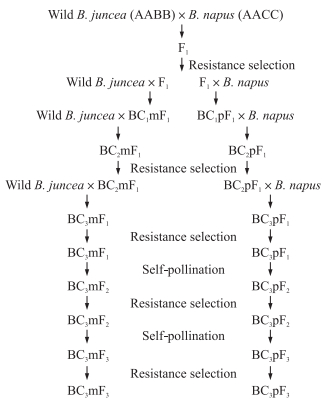
1 材料与方法 1.1 材料本试验以野芥菜, 携带抗性基因的正、反回交3代子1代(BC3mF2和BC3pF2), 正、反回交3代子2代(BC3mF3和BC3pF3)为试验材料。作为亲本的抗草甘膦转基因油菜(DS-Roughrider, Roundup Ready, event RT73) RT73是纯合的、含有1个完整的cp 4 epsps和gox基因, 以及它们各自的调控基因。野芥菜采集于江苏省南京市南京农业大学江浦试验基地。通过人工杂交方式, 以野芥菜为母本, 抗草甘膦油菜为父本获得了携带抗性基因的F1, 随后通过正、反回交(正向回交以野芥菜为母本, F1或回交后代为父本; 反向回交以F1或回交后代为母本, 野芥菜为父本)分别获得正向回交3代(BC3mF1)和反向回交3代(BC3pF1)。将回交3代(BC3F1)植株套袋自交即得到BC3F2和BC3F3, 试验材料的获得方法见图 1。
|
图 1 野芥菜和抗草甘膦转基因油菜杂交和回交框架图 Figure 1 Crossing scheme of hybridization and backcrossing between wild Brassica juncea and transgenic glyphosate-resistant oilseed rape “×”前面的作母本, 后面的作父本; “m”表示野芥菜为母本的后代; “p”表示野芥菜为父本的后代。 Combinations involved in this study are indicated as maternal plants×paternal plants. Populations in front of "×"are always maternal plants, and populations in the back of "×"are always paternal plants. "m"denotes backcross progeny obtained with wild B.juncea as maternal plants. "p"denotes backcross progeny obtained with wild B.juncea as paternal plants. |
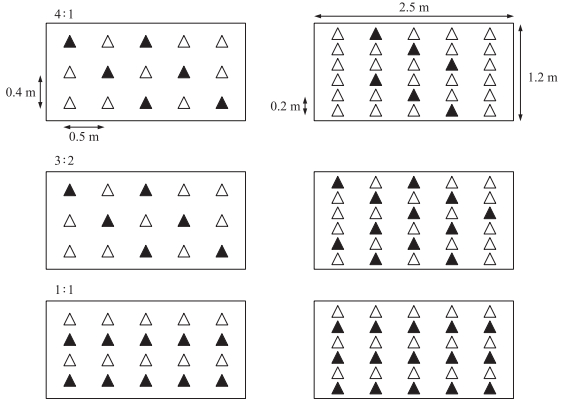
试验于2012和2013年进行, 每年11月初将经过抗性筛选的长势良好携带抗性基因的植株幼苗移栽至试验田。田间试验按照随机区组设计, 小区面积为3 m2(2.5 m×1.2 m), 重复3次。种植密度按照低、高2种密度(即每区15株和30株)进行种植。其中低密度1:1混种时, 为了使野芥菜与回交后代株数相同且不改变株距, 小区面积相应扩大, 统计每小区内的全部植株, 计算平均值。各密度处理下分别设计单种和混种, 混种时野芥菜与各回交后代两两混合种植, 野芥菜和回交后代的混种比例分别为4:1、3:2和1:1。小区内回交后代和野芥菜随机排列。其中低密度下每小区种植3行×5列, 行距为0.4 m, 株距为0.5 m。高密度下每小区种植6行×5列, 行距为0.2 m, 株距为0.5 m, 小区具体设计见图 2。单种时每小区只种1种供试材料, 行距和株距与混种时相同。
|
图 2 野芥菜与回交后代混种时小区植株分布图 Figure 2 Layout of field experiment in mixed plot △代表野芥菜; ▲代表回交后代 △ represents B.juncea; ▲ represents backcross offspring |
试验所测适合度性状包括营养生长指标和生殖生长指标。营养生长指标分别为株高、茎粗、一次分枝数和地上部干生物量; 生殖生长指标分别为单株有效角果数、角果长、每角果饱粒数和单株种子质量。株高的测量方法为在植株成熟后, 用直尺测量地上基部到主茎最高处的长度; 茎粗的测量与株高同步进行, 用直尺测量地上基部的直径; 一次分枝数为成熟后主茎上的分枝数目; 地上部单株干生物量即成熟后对单株干生物量进行测定; 单株有效角果数即每株含有1粒以上饱满或半饱满种子的角果数; 选择植株中下部的20个角果测量其长度并统计每个角果中的饱满种子数, 所得平均值即为该植株的角果长和每角果饱粒数。各适合度性状的相对适合度值的计算方法:以野芥菜为标准“1”, 相应回交后代的各项适合度性状与野芥菜的该适合度性状之比为相对适合度值, 总适合度(composite fitness)值是其各项适合度性状的相对适合度值的加权平均数[23-24], 本试验中总适合度=∑(各指标相对适合度值)/8。
1.3 数据的统计与分析使用SPSS 17.0统计软件进行数据的统计分析, 以小区为单位计算回交后代及亲本的各适合度性状的平均值, 每小区的平均值为1个独立变量。通过配对样本t测验, 检验混种条件下回交后代与亲本野芥菜的各适合度性状及总适合度的差异。单种条件下, 通过Duncan′s新复极差测验进行野芥菜和各回交后代间各性状及总适合度的多重比较。采用双因素方差分析来分析种植密度和比例对后代适合度性状的影响。
2 结果与分析 2.1 单种条件下BC3F2、BC3F3与野芥菜的适合度性状比较 2.1.1 低密度单种条件下BC3F2、BC3F3与野芥菜的适合度性状比较低密度单种条件下, 野芥菜与供试的回交后代生长良好。BC3mF2和BC3pF2的株高分别为134.69和127.87 cm, 茎粗分别为1.24和1.15 cm, 显著低于野芥菜, 其他适合度性状与野芥菜无显著性差异(表 1)。BC3mF3和BC3pF3的各适合度性状均与野芥菜无显著性差异(表 1)。
| 试验材料 Material |
株高/cm Plant height |
茎粗/cm Stem diameter |
一次分枝数 The first branchnumber |
单株有效角果数 Silique numberper plant |
单株干生物量/g Above-ground drybiomass per plant |
单株种子质量/g Total seed weightper plant |
角果长/cm Silique length |
每角果饱粒数 Seed numberper silique |
| Wild B.juncea | 157.93±7.62a | 1.43±0.02a | 13.67±0.83a | 1 887.93±83.27a | 151.66±8.77a | 34.67±2.46a | 4.03±0.09a | 17.98±0.37a |
| BC3mF2 | 134.69±6.22b | 1.24±0.08b | 12.78±1.18a | 1 762.88±83.86a | 140.81±3.48a | 35.17±0.62a | 3.85±0.16a | 16.91±0.53a |
| BC3pF2 | 127.87±5.87b | 1.15±0.03b | 13.53±1.34a | 1 783.13±32.74a | 138.98±3.30a | 34.29±2.27a | 3.80±0.02a | 16.81±0.72a |
| Wild B.juncea | 134.91±3.34a | 1.37±0.01a | 13.73±0.78a | 1 395.13±10.30a | 102.82±0.83a | 27.89±2.01a | 3.58±0.12a | 15.29±0.51a |
| BC3mF3 | 126.31±5.33a | 1.21±0.06a | 14.77±1.04a | 1 467.51±119.66a | 107.52±2.03a | 28.06±2.34a | 3.64±0.10a | 16.46±0.79a |
| BC3pF3 | 131.14±0.71a | 1.25±0.00a | 13.96±0.19a | 1 397.72±30.21a | 106.92±2.74a | 26.39±0.56a | 3.55±0.05a | 15.70±0.39a |
| 注:不同小写字母表示差异显著(P < 0.05)。数值为平均值±标准误。 Note:Different lowercase letters indicate significant differences(P < 0.05). Values are mean±standard error. The same as follows. |
||||||||
高密度单种条件下, BC3mF2和BC3pF2的株高分别为132.40和140.63 cm, 茎粗分别为1.15和1.22 cm, 显著低于野芥菜, 其他适合度性状与野芥菜无显著性差异(表 2)。BC3mF3和BC3pF3的株高分别为130.83和131.53 cm, 茎粗分别为1.21和1.20 cm, 显著低于野芥菜, 其他适合度性状与野芥菜无显著性差异(表 2)。
| 试验材料 Material |
株高/cm Plant height |
茎粗/cm Stemdiameter |
一次分枝数 The first branchnumber |
单株有效角果数 Silique numberper plant |
单株干生物量/g Above-ground drybiomass per plant |
单株种子质量/g Total seed weightper plant |
角果长/cm Silique length |
每角果饱粒数 Seed numberper silique |
| Wild B.juncea | 167.17±5.47a | 1.53±0.10a | 12.53±0.50a | 1 531.84±23.62a | 129.32±4.10a | 32.61±1.03a | 3.94±0.16a | 16.89±0.57a |
| BC3mF2 | 132.40±1.70b | 1.15±0.15b | 14.00±0.85a | 1 361.23±59.05a | 119.92±5.02a | 28.72±2.77a | 3.83±0.04a | 17.55±0.45a |
| BC3pF2 | 140.63±7.69b | 1.22±0.12b | 12.33±0.61a | 1 334.13±93.00a | 106.89±11.50a | 28.32±3.73a | 3.90±0.06a | 17.84±0.18a |
| Wild B.juncea | 142.83±2.17a | 1.36±0.09a | 13.06±0.06a | 1 254.50±66.50a | 96.99±1.44a | 22.71±0.66a | 3.64±0.04a | 15.04±0.50a |
| BC3mF3 | 130.83±2.10b | 1.21±0.03b | 13.89±0.86a | 1 224.64±41.64a | 91.01±2.23a | 23.84±0.74a | 3.64±0.05a | 16.53±0.48a |
| BC3pF3 | 131.53±1.76b | 1.20±0.02b | 12.34±0.92a | 1 115.43±67.03a | 91.22±3.78a | 21.89±0.51a | 3.61±0.03a | 16.00±0.21a |
在低密度混种条件下, 野芥菜与供试后代生长良好。当混种比例为4:1, 即野芥菜优势度最高时, BC3mF2的株高和茎粗均显著低于野芥菜约26和0.4 cm; BC3pF2表现为株高、茎粗和一次分枝数均显著低于野芥菜35 cm、0.3 cm和3;BC3mF2和BC3pF2其他性状均与野芥菜无显著性差异。当后代的混种比例为3:2和1:1时, BC3mF2和BC3pF2的适合度性状均与野芥菜无显著性差异。低密度混种条件下, BC3mF3和BC3pF3在3种混种比例下的各适合度性状均与野芥菜相当(表 3)。
| 种植比例 Proportion |
试验材料 Material |
株高/cm Plantheight |
茎粗/cm Stemdiameter |
一次分枝数 The first branchnumber |
单株有效角果数 Silique numberper plant |
单株干生物量/g Above-ground drybiomass per plant |
单株种子质量/g Total seed weightper plant |
角果长/cm Siliquelength |
每角果饱粒数 Seed numberper silique |
| 4:1 | Wild B.juncea | 154.42±1.55 | 1.31±0.02 | 13.26±0.12 | 1 588.05±44.88 | 137.29±2.72 | 27.85±1.14 | 3.91±0.05 | 16.78±0.35 |
| BC3mF2 | 128.56±4.45* | 0.94±0.07* | 14.11±0.59 | 1 364.00±56.25 | 116.44±9.13 | 24.76±0.84 | 3.95±0.07 | 16.57±0.09 | |
| Wild B.juncea | 153.91±5.05 | 1.27±0.09 | 12.91±0.42 | 1 579.18±22.09 | 132.65±9.73 | 24.38±2.42 | 3.98±0.06 | 16.52±0.06 | |
| BC3pF2 | 118.67±4.87* | 0.92±0.06* | 10.34±0.39* | 1 661.29±62.73 | 113.55±4.86 | 22.85±2.22 | 3.81±0.09 | 17.39±0.44 | |
| Wild B.juncea | 130.20±5.80 | 1.23±0.10 | 12.49±1.02 | 1 057.53±146.66 | 93.73±10.65 | 19.95±1.97 | 3.61±0.03 | 15.41±0.45 | |
| BC3mF3 | 116.06±10.50 | 1.16±0.10 | 13.22±1.06 | 1 190.83±126.14 | 99.05±9.43 | 22.52±2.82 | 3.43±0.13 | 15.53±1.00 | |
| Wild B.juncea | 127.70±3.68 | 1.27±0.05 | 13.00±0.55 | 1 232.80±89.97 | 89.23±7.87 | 22.23±1.49 | 3.56±0.13 | 15.43±0.68 | |
| BC3pF3 | 130.22±8.59 | 1.23±0.05 | 14.11±0.59 | 1 425.44±271.80 | 97.09±18.21 | 29.36±5.45 | 3.60±0.09 | 15.01±0.06 | |
| 3:2 | Wild B.juncea | 154.43±7.02 | 1.26±0.04 | 12.84±0.13 | 1 878.25±257.91 | 137.93±5.67 | 29.02±1.68 | 3.81±0.08 | 16.78±0.45 |
| BC3mF2 | 141.89±3.81 | 1.19±0.06 | 14.70±0.82 | 1 955.45±126.62 | 136.33±8.61 | 28.49±2.45 | 3.92±0.08 | 17.47±0.58 | |
| Wild B.juncea | 152.85±4.29 | 1.29±0.07 | 13.31±0.50 | 1 255.25±21.67 | 135.14±8.35 | 23.67±1.53 | 3.79±0.07 | 17.09±0.44 | |
| BC3pF2 | 142.66±7.33 | 1.19±0.13 | 13.41±0.49 | 1 359.13±117.21 | 132.67±8.58 | 24.76±2.48 | 3.89±0.06 | 16.67±0.85 | |
| Wild B.juncea | 135.50±3.09 | 1.31±0.06 | 12.11±0.68 | 1 115.41±194.86 | 91.10±15.95 | 19.80±3.13 | 3.49±0.07 | 14.92±0.02 | |
| BC3mF3 | 122.44±2.78 | 1.13±0.03 | 13.19±0.51 | 1 119.17±51.43 | 92.59±4.28 | 21.83±1.23 | 3.52±0.04 | 14.33±0.11 | |
| Wild B.juncea | 128.54±2.07 | 1.27±0.08 | 12.04±0.73 | 1 122.96±181.32 | 92.72±19.98 | 21.44±2.90 | 3.58±0.05 | 15.28±0.20 | |
| BC3pF3 | 120.49±3.70 | 1.11±0.04 | 12.28±1.95 | 1 074.61±147.00 | 84.83±15.71 | 19.47±2.05 | 3.60±0.20 | 15.76±0.48 | |
| 1:1 | Wild B.juncea | 147.63±7.31 | 1.29±0.03 | 12.16±0.47 | 1 305.69±175.15 | 144.27±15.94 | 26.35±4.24 | 3.86±0.08 | 16.11±0.40 |
| BC3mF2 | 129.12±10.32 | 1.15±0.02 | 12.38±0.29 | 1 284.40±92.31 | 137.14±10.11 | 26.56±2.98 | 3.70±0.10 | 16.09±0.87 | |
| Wild B.juncea | 151.37±0.92 | 1.34±0.02 | 13.67±0.34 | 1 248.94±44.43 | 133.42±3.29 | 26.35±0.31 | 3.74±0.01 | 16.53±0.05 | |
| BC3pF2 | 143.64±2.99 | 1.35±0.03 | 13.19±0.29 | 1 206.11±39.16 | 133.32±2.63 | 25.57±1.18 | 3.75±0.02 | 16.77±0.26 | |
| Wild B.juncea | 127.53±1.73 | 1.32±0.03 | 11.03±0.87 | 900.83±17.93 | 80.50±4.03 | 17.40±0.49 | 3.50±0.08 | 15.00±0.27 | |
| BC3mF3 | 120.91±3.79 | 1.24±0.04 | 13.36±0.82 | 910.44±53.16 | 76.64±2.13 | 17.78±1.17 | 3.57±0.27 | 14.38±1.02 | |
| Wild B.juncea | 134.72±3.53 | 1.31±0.03 | 12.61±0.42 | 1 173.69±192.57 | 97.39±16.04 | 21.61±3.16 | 3.44±0.07 | 14.72±0.72 | |
| BC3pF3 | 124.53±7.37 | 1.18±0.06 | 11.77±1.65 | 1 051.93±205.40 | 87.78±17.56 | 20.43±4.89 | 3.69±0.25 | 16.11±1.04 | |
| Note:*P < 0.05. The same as follows. | |||||||||
高密度混种条件下, 当混种比例为4:1时, BC3mF2和BC3pF2的株高分别显著低于野芥菜21和38 cm; 茎粗低于野芥菜0.4和0.6 cm; 单株干生物量低于野芥菜19和41 g。BC3mF2的一次分枝数、单株有效角果数和单株种子质量分别为10.83、922.74和20.29 g, 与野芥菜无显著性差异; 而BC3pF2的一次分枝数、单株有效角果数和单株种子质量均显著低于野芥菜1、395和10 g。BC3mF3和BC3pF3各适合度性状均与野芥菜无显著性差异(表 4)。
| 种植比例 Proportion |
试验材料 Material |
株高/cm Plant height |
茎粗/cm Stem diameter |
一次分枝数 The first branchnumber |
单株有效角果数 Silique numberper plant |
单株干生物量/g Above-ground drybiomass per plant |
单株种子质量/g Total seed weightper plant |
角果长/cm Siliquelength |
每角果饱粒数 Seed numberper silique |
| 4:1 | Wild B.juncea | 154.03±4.26 | 1.36±0.10 | 11.01±1.00 | 1 075.07±89.02 | 91.05±6.47 | 22.35±3.18 | 3.82±0.05 | 16.81±0.47 |
| BC3mF2 | 132.59±3.40* | 0.96±0.09* | 10.83±0.92 | 922.74±110.19 | 72.30±1.81* | 20.29±3.15 | 3.94±0.13 | 17.06±0.97 | |
| Wild B.juncea | 155.18±3.31 | 1.35±0.03 | 9.75±0.72 | 1 007.66±38.67 | 97.07±0.74 | 21.60±1.18 | 3.83±0.04 | 16.08±0.66 | |
| BC3pF2 | 116.77±6.95* | 0.78±0.01* | 8.81±0.54* | 613.23±51.29* | 56.13±4.48* | 12.48±0.83* | 3.78±0.08 | 15.47±1.13 | |
| Wild B.juncea | 127.23±5.11 | 1.26±0.07 | 10.75±0.42 | 882.83±62.36 | 69.34±5.10 | 16.09±1.01 | 3.50±0.02 | 15.85±0.17 | |
| BC3mF3 | 113.39±1.22 | 1.06±0.04 | 11.75±0.27 | 821.94±33.73 | 63.01±2.22 | 16.19±0.91 | 3.40±0.07 | 16.79±0.36 | |
| Wild B.juncea | 134.78±1.80 | 1.29±0.04 | 10.94±0.35 | 905.74±21.23 | 62.25±1.27 | 17.07±0.44 | 3.47±0.08 | 15.58±0.26 | |
| BC3pF3 | 127.16±4.73 | 1.09±0.05 | 11.86±0.74 | 969.66±102.51 | 61.60±6.20 | 19.84±1.74 | 3.55±0.14 | 15.55±0.47 | |
| 3:2 | Wild B.juncea | 151.66±7.53 | 1.31±0.09 | 10.91±1.20 | 1 133.14±94.61 | 95.04±9.31 | 21.29±1.97 | 3.83±0.11 | 16.10±0.28 |
| BC3mF2 | 127.76±2.29* | 0.95±0.04* | 10.18±0.40 | 965.27±91.58 | 68.03±10.98* | 19.00±1.38 | 3.93±0.14 | 16.43±0.39 | |
| Wild B.juncea | 160.01±2.47 | 1.43±0.05 | 11.51±0.50 | 1 148.20±69.66 | 101.43±5.56 | 21.94±0.65 | 3.78±0.04 | 16.97±0.19 | |
| BC3pF2 | 132.50±5.77* | 1.00±0.04* | 9.68±0.12* | 729.89±14.40* | 61.17±11.63* | 15.74±1.89* | 3.81±0.12 | 17.65±0.95 | |
| Wild B.juncea | 129.09±4.35 | 1.25±0.07 | 10.68±0.52 | 846.03±102.14 | 71.30±2.84 | 17.52±0.66 | 3.41±0.05 | 15.42±0.25 | |
| BC3mF3 | 110.64±8.25 | 1.02±0.10 | 10.47±0.11 | 830.01±100.80 | 66.49±8.30 | 17.23±1.13 | 3.53±0.09 | 15.28±0.16 | |
| Wild B.juncea | 132.21±4.68 | 1.27±0.05 | 11.68±0.09 | 904.99±47.80 | 68.43±3.89 | 16.70±1.11 | 3.48±0.06 | 14.96±0.08 | |
| BC3pF3 | 126.78±3.16 | 1.13±0.03 | 10.33±0.51 | 844.07±47.34 | 61.35±5.22 | 16.58±1.29 | 3.48±0.12 | 16.02±0.42 | |
| 1:1 | Wild B.juncea | 164.95±3.23 | 1.41±0.04 | 10.97±0.53 | 1 184.65±70.68 | 94.53±7.95 | 23.99±0.89 | 4.00±0.18 | 17.64±0.39 |
| BC3mF2 | 126.17±3.85* | 0.94±0.05* | 10.86±0.53 | 984.39±176.30 | 74.13±18.07* | 20.34±3.22 | 3.85±0.04 | 17.34±0.20 | |
| Wild B.juncea | 157.13±5.78 | 1.35±0.08 | 11.52±0.25 | 1 061.78±15.26 | 111.26±8.68 | 23.19±1.45 | 3.76±0.05 | 16.33±0.40 | |
| BC3pF2 | 120.24±4.23* | 0.93±0.07* | 8.60±0.64* | 619.11±102.00* | 52.97±4.11* | 13.01±1.56* | 3.78±0.04 | 16.26±0.69 | |
| Wild B.juncea | 123.62±3.80 | 1.16±0.02 | 11.24±0.51 | 793.92±47.58 | 68.49±6.90 | 17.13±0.39 | 3.57±0.05 | 15.66±0.49 | |
| BC3mF3 | 117.42±1.28 | 1.04±0.04 | 13.02±0.27 | 908.74±38.22 | 68.30±2.61 | 18.04±0.33 | 3.73±0.05 | 16.96±0.64 | |
| Wild B.juncea | 135.68±4.40 | 1.28±0.03 | 12.67±0.27 | 886.74±126.68 | 71.26±6.52 | 16.48±2.15 | 3.60±0.22 | 15.36±0.27 | |
| BC3pF3 | 129.53±1.64 | 1.15±0.04 | 13.47±0.63 | 943.24±80.48 | 73.71±6.63 | 17.87±1.65 | 3.41±0.06 | 15.75±0.17 |
当混种比例为3:2时, BC3mF2的株高、茎粗和单株干生物量分别显著低于野芥菜23.9 cm、0.3 cm和27 g, 其他性状与野芥菜无显著性差异。BC3pF2的株高、茎粗、一次分枝数、单株有效角果数、单株干生物量和单株种子质量分别显著低于野芥菜27 cm、0.4 cm、2、418、40 g和6 g, 其他性状与野芥菜无显著性差异。而BC3mF3和BC3pF3各适合度性状均与野芥菜无显著性差异(表 4)。
当混种比例为1:1时, BC3mF2和BC3pF2的株高显著低于野芥菜39和37 cm, 茎粗均显著低于野芥菜0.5 cm, 单株干生物量分别显著低于野芥菜20和58 g。BC3pF2的一次分枝数、单株有效角果数和单株种子质量分别为8.6、619.11和13.01 g, 显著低于野芥菜3、443、10 g; BC3mF2的一次分枝数、单株有效角果数和单株种子质量与野芥菜无显著性差异。BC3mF2和BC3pF2的角果长和每角果饱粒数均与野芥菜相当。该种植方式下的BC3mF3和BC3pF3各适合度性状均与野芥菜无显著性差异(表 4)。
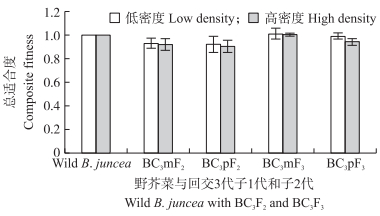
2.3 单种和混种条件下BC3F2、BC3F3与野芥菜的总适合度比较 2.3.1 单种条件下BC3F2、BC3F3与野芥菜的总适合度比较在单种低密度条件下, BC3mF2和BC3pF2的总适合度均与野芥菜相当, 分别为0.93和0.92;其自交产生的BC3mF3和BC3pF3在该种植条件下的总适合度也分别达到1.01和0.99, 均与野芥菜没有显著性差异(图 3)。
|
图 3 单种条件下BC3F2、BC3F3与野芥菜的总适合度比较 Figure 3 Composite fitness of wild B.juncea with BC3F2 and BC3F3 in pure plot |
在单种高密度条件下, BC3mF2和BC3pF2的总适合度分别为0.92和0.90, 与野芥菜无显著性差异; 其自交产生的BC3mF3和BC3pF3在该种植条件下的总适合度也分别达到1.00和0.94, 均与野芥菜没有显著性差异(图 3)。由此可见, BC3F2和BC3F3在单种2种密度下的总适合度均与野芥菜相当。
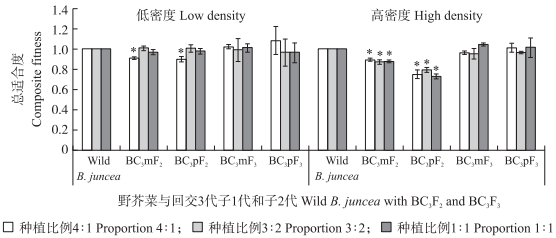
2.3.2 混种条件下BC3F2、BC3F3与野芥菜的总适合度比较低密度条件下, 在混种4:1时, BC3mF2和BC3pF2的总适合度均显著低于野芥菜, 但也分别高达0.91和0.90, 该种植条件下主要表现为对BC3F2的株高和茎粗的影响, 但当种植比例为3:2和1:1时, BC3mF2和BC3pF2的总适合度与野芥菜无显著性差异, 为0.96~1.01(图 4)。BC3mF3和BC3pF3在低密度各种种植比例下的总适合度均与野芥菜无显著差异, 为0.96~1.08(图 4)。
|
图 4 混种条件下BC3F2、BC3F3与野芥菜的总适合度比较 Figure 4 Composite fitness of wild B.juncea with BC3F2 and BC3F3 in mixed planting |
在高密度混种条件下, 各种植比例下的BC3mF2和BC3pF2的总适合度均显著低于野芥菜, 总适合度为0.73~0.89(图 4)。BC3mF3和BC3pF3在高密度各种植比例下的总适合度均与野芥菜无显著差异, 总适合度为0.95~1.04(图 4)。这说明:在本试验中BC3F3与野芥菜的混种条件下, BC3F3的总适合度能够达到与野芥菜相当的水平且不受二者间比例的影响。
2.4 种植密度和混合比例对野芥菜、BC3F2和BC3F3适合度性状的影响从表 5可知:种植密度(D)对野芥菜的有效角果数、单株干生物量、单株种子质量等适合度性状有显著影响, 但混合比例(P)及密度与比例的互作(D×P)对其影响不显著; BC3mF2的单株干生物量和单株种子质量仅受种植密度的影响, 单株有效角果数受种植密度和比例以及两者间互作的影响; BC3pF2的株高和茎粗受密度和比例的影响, 一次分枝数受两者及两者间互作的影响, 单株有效角果数受密度和两者间互作的影响, 单株干生物量和单株种子质量受密度的影响; BC3mF3和BC3pF3的单株有效角果数、单株干生物量和单株种子质量受密度的影响。由此可见, 种植密度能够显著影响野芥菜、回交3代子1代和回交3代子2代的主要适合度性状, 但回交3代子1代也受种植比例的影响。
| 植物种类 Plant type |
性状 Fitness traits |
种植密度(D)Density | 种植比例(P)Proportion | D×P | ||||||||
| DF | F value | P value | DF | F value | P value | DF | F value | P value | ||||
| Wild B.juncea | 株高Plant height | 1 | 14.71 | 0.009* | 2 | 0.49 | 0.636 | 2 | 4.71 | 0.059 | ||
| 茎粗Stem diameter | 1 | 26.42 | 0.002* | 2 | 1.01 | 0.419 | 2 | 2.63 | 0.151 | |||
| 一次分枝数The first branch number | 1 | 26.07 | 0.002* | 2 | 1.73 | 0.255 | 2 | 1.80 | 0.243 | |||
| 单株有效角果数Silique number per plant | 1 | 7.25 | 0.036* | 2 | 1.93 | 0.225 | 2 | 1.54 | 0.288 | |||
| 单株干生物量Above-ground dry biomass per plant | 1 | 123.09 | 0.000* | 2 | 1.75 | 0.253 | 2 | 0.49 | 0.634 | |||
| 单株种子质量Total seed weight per plant | 1 | 11.73 | 0.014* | 2 | 0.42 | 0.673 | 2 | 0.32 | 0.735 | |||
| 角果长Silique length | 1 | 0.06 | 0.813 | 2 | 1.03 | 0.414 | 2 | 4.53 | 0.290 | |||
| 每角果饱粒数Seed number per silique | 1 | 0.00 | 0.950 | 2 | 0.13 | 0.883 | 2 | 1.15 | 0.377 | |||
| BC3mF2 | 株高Plant height | 1 | 1.37 | 0.265 | 2 | 1.20 | 0.335 | 2 | 1.35 | 0.295 | ||
| 茎粗Stem diameter | 1 | 8.67 | 0.012* | 2 | 1.97 | 0.182 | 2 | 2.79 | 0.101 | |||
| 一次分枝数The first branch number | 1 | 36.52 | 0.000* | 2 | 1.17 | 0.342 | 2 | 2.86 | 0.096 | |||
| 单株有效角果数Silique number per plant | 1 | 50.64 | 0.000* | 2 | 6.33 | 0.013* | 2 | 4.52 | 0.034* | |||
| 单株干生物量Above-ground dry biomass per plant | 1 | 58.63 | 0.000* | 2 | 0.40 | 0.680 | 2 | 1.14 | 0.351 | |||
| 单株种子质量Total seed weight per plant | 1 | 14.87 | 0.002* | 2 | 0.02 | 0.984 | 2 | 1.21 | 0.334 | |||
| 角果长Silique length | 1 | 0.28 | 0.609 | 2 | 0.52 | 0.608 | 2 | 0.14 | 0.869 | |||
| 每角果饱粒数Seed number per silique | 1 | 0.57 | 0.466 | 2 | 0.52 | 0.605 | 2 | 1.75 | 0.216 | |||
| BC3pF2 | 株高Plant height | 1 | 7.41 | 0.020* | 2 | 5.30 | 0.024* | 2 | 1.67 | 0.233 | ||
| 茎粗Stem diameter | 1 | 20.27 | 0.001* | 2 | 9.82 | 0.004* | 2 | 2.23 | 0.154 | |||
| 一次分枝数The first branch number | 1 | 65.30 | 0.000* | 2 | 7.65 | 0.008* | 2 | 4.96 | 0.029* | |||
| 单株有效角果数Silique number per plant | 1 | 134.75 | 0.000* | 2 | 2.94 | 0.095 | 2 | 6.60 | 0.013* | |||
| 单株干生物量Above-ground dry biomass per plant | 1 | 148.69 | 0.000* | 2 | 0.97 | 0.408 | 2 | 1.47 | 0.271 | |||
| 单株种子质量Total seed weight per plant | 1 | 61.97 | 0.000* | 2 | 0.98 | 0.407 | 2 | 0.12 | 0.892 | |||
| 角果长Silique length | 1 | 0.28 | 0.609 | 2 | 0.52 | 0.608 | 2 | 0.14 | 0.869 | |||
| 每角果饱粒数Seed number per silique | 1 | 0.57 | 0.466 | 2 | 0.52 | 0.605 | 2 | 1.75 | 0.216 | |||
| Wild B.juncea | 株高Plant height | 1 | 0.01 | 0.932 | 2 | 0.07 | 0.93 | 2 | 0.15 | 0.863 | ||
| 茎粗Stem diameter | 1 | 2.17 | 0.191 | 2 | 0.09 | 0.919 | 2 | 2.39 | 0.173 | |||
| 一次分枝数The first branch number | 1 | 4.87 | 0.070 | 2 | 0.15 | 0.867 | 2 | 2.13 | 0.200 | |||
| 单株有效角果数Silique number per plant | 1 | 16.23 | 0.007* | 2 | 0.71 | 0.528 | 2 | 0.09 | 0.917 | |||
| 单株干生物量Above-ground dry biomass per plant | 1 | 47.63 | 0.000* | 2 | 0.17 | 0.850 | 2 | 0.35 | 0.718 | |||
| 单株种子质量Total seed weight per plant | 1 | 16.61 | 0.007* | 2 | 0.28 | 0.764 | 2 | 0.36 | 0.713 | |||
| 角果长Silique length | 1 | 0.85 | 0.393 | 2 | 1.42 | 0.314 | 2 | 8.20 | 0.019* | |||
| 每角果饱粒数Seed number per silique | 1 | 7.44 | 0.034* | 2 | 4.49 | 0.064 | 2 | 1.67 | 0.265 | |||
| BC3mF3 | 株高Plant height | 1 | 0.15 | 0.705 | 2 | 1.17 | 0.344 | 2 | 1.65 | 0.232 | ||
| 茎粗Stem diameter | 1 | 2.17 | 0.167 | 2 | 0.98 | 0.405 | 2 | 0.29 | 0.751 | |||
| 一次分枝数The first branch number | 1 | 7.85 | 0.016* | 2 | 2.59 | 0.116 | 2 | 2.06 | 0.170 | |||
| 单株有效角果数Silique number per plant | 1 | 12.34 | 0.004* | 2 | 0.96 | 0.410 | 2 | 3.49 | 0.064 | |||
| 单株干生物量Above-ground dry biomass per plant | 1 | 24.91 | 0.000* | 2 | 1.11 | 0.362 | 2 | 3.38 | 0.069 | |||
| 单株种子质量Total seed weight per plant | 1 | 8.69 | 0.012* | 2 | 0.73 | 0.504 | 2 | 2.68 | 0.109 | |||
| 角果长Silique length | 1 | 0.17 | 0.690 | 2 | 1.60 | 0.242 | 2 | 0.31 | 0.741 | |||
| 每角果饱粒数Seed number per silique | 1 | 8.79 | 0.012* | 2 | 2.15 | 0.159 | 2 | 0.87 | 0.444 | |||
| BC3pF3 | 株高Plant height | 1 | 0.14 | 0.717 | 2 | 0.87 | 0.442 | 2 | 0.52 | 0.605 | ||
| 茎粗Stem diameter | 1 | 3.71 | 0.078 | 2 | 1.22 | 0.330 | 2 | 2.23 | 0.150 | |||
| 一次分枝数The first branch number | 1 | 0.65 | 0.435 | 2 | 0.85 | 0.453 | 2 | 1.58 | 0.247 | |||
| 单株有效角果数Silique number per plant | 1 | 10.20 | 0.008* | 2 | 2.50 | 0.123 | 2 | 0.94 | 0.417 | |||
| 单株干生物量Above-ground dry biomass per plant | 1 | 9.14 | 0.011* | 2 | 0.54 | 0.597 | 2 | 0.25 | 0.780 | |||
| 单株种子质量Total seed weight per plant | 1 | 5.97 | 0.031* | 2 | 3.06 | 0.085 | 2 | 0.84 | 0.457 | |||
| 角果长Silique length | 1 | 1.42 | 0.257 | 2 | 0.03 | 0.976 | 2 | 0.28 | 0.758 | |||
| 每角果饱粒数Seed number per silique | 1 | 0.12 | 0.739 | 2 | 0.93 | 0.423 | 2 | 0.37 | 0.699 | |||
相比每区30株的种植密度, 在每区15株的种植密度下, 野芥菜、BC3F2和BC3F3的单株有效角果数、单株干生物量、单株种子质量性状呈现增大的趋势, 虽然种植密度能够显著影响适合度的主要性状, 但BC3F3不论在高密度还是低密度条件下的总适合度均与野芥菜相当, 说明BC3F3已具有与野芥菜相当的生存竞争能力。
3 讨论适合度是评价抗性基因能否成功渗入的重要因素[7], 由于环境条件对适合度有显著影响, 因此对适合度的评价要充分考虑环境条件[9, 12, 25]。本试验将BC3F2和BC3F3与野生亲本野芥菜以不同密度和比例进行种植, 研究了田间条件下BC3F2和BC3F3的适合度, 研究结果对正确评估抗草甘膦转基因油菜向野芥菜的基因漂移可能导致的生态风险提供了试验依据。
试验结果表明:在单种条件下, 供试的回交3代子1代和子2代的营养生长和生殖生长能力与野芥菜相当, 即使在竞争条件下, 回交3代子1代在低密度混种(3:2和1:1) 条件下以及回交3代子2代在各混种条件下也能和野芥菜具有相似的生存能力, 这说明在单种和竞争的环境条件下, 这些回交后代都能像野芥菜一样生存繁衍后代。如果在抗草甘膦转基因油菜的农田生态系统中, 使用草甘膦进行除草, 野芥菜及其他杂草由于没有抗性基因而无法生存, 但携带抗性基因的回交后代会生存下来, 这些后代给农田杂草防除及生态环境带来的潜在威胁不可忽视。因此抗草甘膦转基因油菜向野芥菜的基因漂移应该引起高度重视。
转基因作物和野生近缘种的杂种F1代的染色体组通常来源于两亲本, 由于两亲本的染色体组不同, 杂种在减数分裂中染色体不能进行正常的配对和分离, 从而导致F1代的育性降低甚至高度不育[15, 26]。即使F1代的适合度降低, 携带抗性基因的F1代还可与父母本不断的回交, 完成抗性基因渗入[22]。在转基因油菜与近缘种芜菁的研究中发现尽管F1和F2代的适合度较低[25, 27-28], 但回交后代适合度较F1和F2代有明显提高[27]。
油菜或转基因油菜能与野芥菜发生基因漂移[15, 18-19]。虽然F1代的花粉育性和结实率都很低, 但F1可与野芥菜回交; 回交得到回交1代的结实率虽然明显低于野芥菜[20-21], 但回交2代和3代的结实率能够提高到与野芥菜相当的水平[22]。这是因为F1代的染色体组成为AABC, 2n=37。而非整倍体在减数分裂过程中, 因染色体无法正常配对, 导致回交后代的染色体数目不稳定。从理论上讲回交后代的染色体数应该是变化的, 且变化范围介于20(2A)+8(B)+0-8(B)+0-9(C)之间, 最多的染色体数是45条。C染色体由于在减数分裂过程中没有同源染色体配对而在后代中随着代数的增加逐渐丢失[29]。随着回交次数或自交次数的增加, 回交后代的染色体组成趋向于稳定。本试验中, 在低密度4:1条件下和高密度3个供试比例下, BC3F2的总适合度均显著低于野芥菜, 但自交一次产生的后代即BC3F3, 单种和混种条件下, 其总适合度均与野芥菜无显著差异。这说明BC3F3的适合度本身已达到与野芥菜相当的水平, 不受种植密度和种植比例的影响。由于随着自交次数的增加, 后代的总适合度能够提高到与野芥菜相当的水平。因此在转基因油菜的基因漂移上, 除防范初始杂交的发生外, 还应该防范回交后代及其自交后代的产生。
竞争是作物产量的决定因素。范巧佳等[30]和朱兆坤等[31]的研究都表明油菜与产量相关的性状随种植密度的增加而降低。Hauser等[25]发现甘蓝型油菜与芜菁的杂交及回交后代在低密度条件下的结实量高于高密度下的结实量。Campbell等[9]的研究表明, 在无竞争的情况下, 野萝卜(Raphanus raphanistru)的结实能力明显大于栽培萝卜(R.sativus)和野萝卜的杂交后代, 但在竞争的条件下, 野萝卜的结实能力显著下降, 从而缩小了杂交后代与野萝卜在生殖适合度上的差异。Hovick等[12]的研究表明, 在竞争条件下, 野萝卜和栽培萝卜的杂交后代产生种子的量是野萝卜的3倍。这些都说明种植密度对后代适合度有显著影响。本试验发现,种植密度对野芥菜、BC3F2和BC3F3的单株有效角果数、单株干生物量、单株种子质量都有显著影响, 其中3:2和1:1条件下, 与低密度相比, 高密度下BC3F2的适合度显著下降。因此在田间或野外环境存在竞争的情况下, 携带抗性基因的BC3F2的生存竞争能力较弱。
Hauser等[25]发现甘蓝型油菜与芜菁的回交后代在单种时的结实量显著高于混种时, 在混种时的种植比例相对提高后, 其结实量也有所增加, 说明种植比例影响回交后代的适合度。本试验中, 混种比例影响BC3F2的总适合度。在单种无种间竞争的条件下, BC3F2的总适合度与野芥菜相当, 但在混种4:1的竞争条件下, BC3F2的总适合度显著低于野芥菜; 另外在低密度条件下, 当BC3F2的混种比例由4:1提高到3:2或1:1时, BC3F2的总适合度提高到与野芥菜相当的水平。经分析, 种植比例对BC3mF2的单株有效角果数和BC3pF2的株高、茎粗及一次分枝数有显著影响。可见种植比例对BC3F2的总适合度有明显影响。而BC3F3各适合度性状均不受种植比例的影响, 且各种种植条件下的总适合度均与野芥菜相当。因此本试验结果说明与亲本的混种比例对不同回交后代的影响不同。由于BC3F2通过一次自交产生的BC3F3的适合度不受混种比例的影响, 在各条件下已具备与野芥菜相当的生存竞争能力, 因此可能造成的生态风险明显增加。尽管BC3F2的适合度相对较低, 其适合度依然能够达到0.73以上, 平均单株能够产生的种子数量约1万粒, 因此BC3F2可能造成的生态风险也应引起重视。
转基因作物与野生近缘种间杂交及回交后代的适合度受多种因素的影响, 包括亲本的基因组组成和基因型、后代染色体的遗传稳定性以及试验环境条件等因素, 因此对适合度的研究要从多方面因素考虑[9-10, 25, 32-33]。而不同转基因油菜和不同近缘种的后代在不同环境条件下的适合度都可能有差别[21, 25]。因此在进行基于基因漂移的生态风险评估时应遵循转基因作物安全性评估的个案原则, 综合考虑转基因类型、转基因植物的种植环境等情况进行评估。
| [1] | Lu B R. Transgene escape from GM crops and potential biosafety consequences:an environmental perspective[J]. Collection of Biosafety Reviews, 2008, 4: 66–141. |
| [2] | Stewart C N, Jr, Halfhill M D, Warwick S I. Transgene introgression from genetically modified crops to their wild relatives[J]. Nature Reviews Genetics, 2003, 4(10): 806–817. DOI: 10.1038/nrg1179 |
| [3] | Andersson M S, de Vicente M C. Gene flow between crops and their wild relatives[J]. Evdutionary Applications, 2010, 3(4): 402–403. |
| [4] |
王建, 闫静, 张庆玲, 等. 从亲和性及F1的适合度评价抗除草剂转基因油菜向不同种群野芥菜的基因漂移风险[J].
南京农业大学学报, 2016, 39(4): 563–572.
Wang J, Yan J, Zhang Q L, et al. Risk assessment on gene flow from transgenic oilseed rape to different wild Brassica juncea based on the compatibility and fitness of F1[J]. Journal of Nanjing Agricultural University, 2016, 39(4): 563–572. DOI: 10.7685/jnau.201601050 (in Chinese) |
| [5] | Devos Y, de Schrijver A, Reheul D. Quantifying the introgressive hybridisation propensity between transgenic oilseed rape and its wild/weedy relatives[J]. Environmental Monitoring and Assessment, 2009, 149(1): 303–322. |
| [6] |
卢宝荣, 夏辉, 汪魏, 等. 天然杂交与遗传渐渗对植物入侵性的影响[J].
生物多样性, 2010, 18(6): 577–589.
Lu B R, Xia H, Wang W, et al. Impacts of natural hybridization and introgression on biological invasion of plant species[J]. Biodiversity Science, 2010, 18(6): 577–589. (in Chinese) |
| [7] | Jenczewski E, Ronfort J, Chevre A M. Crop-to-wild gene flow, introgression and possible fitness effects of transgenes[J]. Environmental Biosafety Researeh, 2003, 2(1): 9–24. DOI: 10.1051/ebr:2003001 |
| [8] | Dechaine J M, Burger J C, Chapman M A, et al. Fitness effects and genetic architecture of plant-herbivore interactions in sunflower crop-wild hybrids[J]. New Phytologist, 2009, 184(4): 828–841. DOI: 10.1111/j.1469-8137.2009.02964.x |
| [9] | Campbell L G, Snow A A. Competition alters life history and increases the relative fecundity of crop-wild radish hybrids(Raphanus spp.)[J]. New Phytologist, 2007, 173(3): 648–660. DOI: 10.1111/j.1469-8137.2006.01941.x |
| [10] | Mercer K L, Andow D A, Wyse D L, et al. Stress and domestication traits increase the relative fitness of crop-wild hybrids in sunflower[J]. Ecology Letters, 2007, 10(5): 383–393. DOI: 10.1111/ele.2007.10.issue-5 |
| [11] | Londo J P, Bollman M A, Sagers C L, et al. Changes in fitness-associated traits due to the stacking of transgenic glyphosate resistance and insect resistance in Brassica napus L.[J]. Heredity, 2011, 107(4): 328–337. DOI: 10.1038/hdy.2011.19 |
| [12] | Hovick S M, Campbell L G, Snow A A, et al. Hybridization alters early life-history traits and increases plant colonization success in a novel region[J]. The American Naturalist, 2012, 179(2): 192–203. DOI: 10.1086/663684 |
| [13] |
张宏彬. 抗虫转基因Bt/CpTI对不同组合栽培稻-杂草稻F2代适合度的影响[D]. 上海: 复旦大学, 2013: 57-66.
Zhang H B. Impact of insect-resistance transgene Bt/CpTI on fitness of different crop-weedy rice F2 progeny[D]. Shanghai:Fudan University, 2013:57-66(in Chinese with English abstract). |
| [14] | Ellstrand N C. When transgenes wander, should we worry?[J]. Plant Physiology, 2001, 125(4): 1543–1545. DOI: 10.1104/pp.125.4.1543 |
| [15] |
宋小玲, 皇甫超河, 强胜. 抗草丁膦和抗草甘膦转基因油菜的抗性基因向野芥菜的流动[J].
植物生态学报, 2007, 31(4): 729–737.
Song X L, Huangfu C H, Qiang S. Gene flow from transgenic glufosinate-or glyphosate-tolerant oilseed rape to wild rape[J]. Journal of Plant Ecology, 2007, 31(4): 729–737. (in Chinese) |
| [16] | Warwick S I, Simard M J, Légère A, et al. Hybridization between transgenic Brassica napus L. and its wild relatives:Brassica rapa L., Raphanusraphanistrum L., Sinapisarvensis L., and Erucastrum gallicum(Willd.)OE Schulz[J]. Theoretical and Applied Genetics, 2003, 107(3): 528–539. DOI: 10.1007/s00122-003-1278-0 |
| [17] | Halfhill M D, Zhu B, Warwick S I, et al. Hybridization and backcrossing between transgenic oilseed rape and two related weed species under field conditions[J]. Environmental Biosafety Research, 2004, 3(2): 73–81. DOI: 10.1051/ebr:2004007 |
| [18] | Scheffler J A, Dale P J. Opportunities for gene transfer from transgenic oilseed rape(Brassica napus)to related species[J]. Transgenic Research, 1994, 3(5): 263–278. DOI: 10.1007/BF01973586 |
| [19] |
浦惠明, 戚存扣, 张洁夫, 等. 转基因抗除草剂油菜对十字花科杂草的基因漂移[J].
生态学报, 2005, 25(4): 910–916.
Pu H M, Qi C K, Zhang J F, et al. The studies on gene flow from GM herbicide-tolerant rapeseed to cruciferous weeds[J]. Acta Ecologica Sinica, 2005, 25(4): 910–916. (in Chinese) |
| [20] | Frello S, Hansen K R, Jensen J, et al. Inheritance of rapeseed(Brassica napus)-specific RAPD markers and a transgene in the cross B. juncea×(B.juncea×B.napus)[J]. Theoretical and Applied Genetics, 1995, 91(2): 236–241. |
| [21] | Liu Y B, Wei W, Ma K P, et al. Backcrosses to Brassica napus of hybrids between B. juncea and B. napus as a source of herbicide-resistant volunteer-like feral populations[J]. Plant Science, 2010, 179(5): 459–465. DOI: 10.1016/j.plantsci.2010.07.005 |
| [22] | Song X L, Wang Z, Zuo J, et al. Potential gene flow of two herbicide-tolerant transgenes from oilseed rape to wild B. juncea var.gracilis[J]. Theoretical and Applied Genetics, 2010, 120(8): 1501–1510. DOI: 10.1007/s00122-010-1271-3 |
| [23] | Johnston J A, Arnold M L, Donovan L A. High hybrid fitness at seed and seedling life history stages in Louisiana irises[J]. Journal of Ecology, 2003, 91(3): 438–446. DOI: 10.1046/j.1365-2745.2003.00774.x |
| [24] | Song Z P, Lu B R, Wang B, et al. Fitness estimation through performance comparison of F1 hybrids with their parental species Oryza rufipogon and O.sativa[J]. Annals of Botany, 2004, 93(3): 311–316. DOI: 10.1093/aob/mch036 |
| [25] | Hauser T P, Damgaard C, Jørgensen R B. Frequency-dependent fitness of hybrids between oilseed rape(Brassica napus)and weedy B. rapa(Brassicaceae)[J]. American Journal of Botany, 2003, 90(4): 571–578. DOI: 10.3732/ajb.90.4.571 |
| [26] |
刘大钧.
细胞遗传学[M]. 北京: 中国农业出版社, 1999.
Liu D J. Cytogenetics[M]. Beijing: China Agriculture Press, 1999. (in Chinese) |
| [27] | Ammitzbøll H. Transgene expression and fitness of hybrids between GM oilseed rape and Brassica rapa[J]. Environmental Biosafety Research, 2005, 4(1): 3–12. DOI: 10.1051/ebr:2005010 |
| [28] | Allainguillaume J, Alexander M, Bullock J M, et al. Fitness of hybrids between rapeseed(Brassica napus)and wild Brassica rapa, in natural habitats[J]. Molecular Ecology, 2006, 15(4): 1175–1184. DOI: 10.1111/j.1365-294X.2006.02856.x |
| [29] | Mikkelsen T R, Andersen B, Jørgensen R B. The risk of crop transgene spread[J]. Nature, 1996, 380(7): 31. |
| [30] |
范巧佳, 袁继超, 牛应泽, 等. 不同种植密度对油菜产量构成及干物质分配的影响[J].
耕作与栽培, 1998(3): 26–29.
Fan Q J, Yuan J C, Niu Y Z, et al. Effects of different planting densities on yield components and dry matter distribution of rape[J]. Tillage and Cultivation, 1998(3): 26–29. (in Chinese) |
| [31] |
朱兆坤, 宋海星, 王继玥, 等. 施肥水平和种植密度对冬油菜生长的影响[J].
湖南农业科学, 2012(1): 20–23.
Zhu Z K, Song H X, Wang J Y, et al. Impacts of different fertilizer rates and planting densities on growth of winter rape[J]. Hunan Agricultural Sciences, 2012(1): 20–23. (in Chinese) |
| [32] | Yang X, Xia H, Wang W, et al. Transgenes for insect resistance reduce herbivory and enhance fecundity in advanced generations of crop-weed hybrids of rice[J]. Evolutionary Applications, 2011, 4(5): 672–684. DOI: 10.1111/eva.2011.4.issue-5 |
| [33] | Rose C W, Millwood R J, Moon H S, et al. Genetic load and transgenic mitigating genes in transgenic Brassica rapa(field mustard)×Brassica napus(oilseed rape)hybrid populations[J]. BMC Biotechnology, 2009, 9(1): 93. DOI: 10.1186/1472-6750-9-93 |