

文章信息
- 贺志远, 朱艳, 李艳大, 刘小军, 曹强, 曹卫星, 汤亮
- HE Zhiyuan, ZHU Yan, LI Yanda, LIU Xiaojun, CAO Qiang, CAO Weixing, TANG Liang
- 中国南方双季稻氮营养指数及产量估算模型研究
- Study on estimation model for nitrogen nutrition index and yield on double cropping rice in southern China
- 南京农业大学学报, 2017, 40(1): 11-19
- Journal of Nanjing Agricultural University (Social Science), 2017, 40(1): 11-19.
- http://dx.doi.org/10.7685/jnau.201604035
-
文章历史
- 收稿日期: 2016-04-12


2. 江西省农业科学院农业工程研究所, 江西 南昌 330200
2. Institute of Agricultural Engineering, Jiangxi Academy of Agricultural Sciences, Nanchang 330200, China
氮素是限制作物生长发育的重要因素之一[1],过少使用氮肥会使作物达不到正常的生物量和产量;过多使用氮肥会使作物贪青晚熟、抗性降低、病虫害增加。氮肥使用不当也会造成水体富营养化等面源污染[2]。而且作物氮营养状况诊断不精确、作物需氮量和土壤供氮量不确定、前茬作物施氮影响、气候变化以及高产需求等因素,导致了氮素过多的施用[1]。因此,氮素营养精确诊断,适时定量施肥已成为了现代农业所关注的热点问题[3]。
氮营养指数(NNI)能够评估植株氮营养状况,并得到广泛应用。Lemaire等[4]利用NNI对谷类和牧草类进行氮素诊断并调整施肥。Colnenne等[5]建立了NNI指数与油菜的生长速率、叶面积指数、氮素利用率以及产量的关系模型,用来定量诊断因氮营养胁迫对作物各项生长指标造成的损失。Ata-Ul-Karim等[6]建立了水稻差值NNI与氮素需求之间的关系,并依据NNI及移栽后时间定量计算水稻氮素需求。根据作物氮素稀释规律[7]及临界氮浓度概念[8],基于地上部干物质量的临界氮浓度稀释模型被提出。氮素的传统测定需要破坏植株以及时效性差,不利于快速确定氮营养指数。Lemaire等[9]提出积分氮营养指数(Integrated NNI,NNIint)概念,NNIint能够描述氮素不足的程度和间隔,更准确表征氮素亏缺。
目前,遥感等技术已广泛运用于测量土地覆盖度和生物量等[10]。而且已有一些研究利用遥感等无损监测技术对NNI进行估测。一些研究表明,利用SPAD可以估算NNI评估氮素亏缺状态[11]。Yuan等[12]分析了水稻不同时期NNI与不同叶位SPAD指数之间的关系,筛选出最优指数与测量时期。然而,SPAD是单点测量,氮素在群体水平或者叶片水平并不是均匀的[9]。因此,研究人员运用归一化差值植被指标(normalized difference vegetation index,NDVI)在冠层水平对不同作物进行氮素营养诊断,如玉米[13]、小麦[14]、水稻[15]、甘蔗[16]等。因此,NDVI可以作为一个氮素营养状况诊断指标。Mistele等[17]用3年冬小麦试验检验了冠层反射光谱与NNI的关系模型,其相关性R2均在0.95以上。Cao等[18]用冠层NDVI与NNI建立关系的结果表明,我国北方地区冬小麦氮素状况可以用NDVI进行估算。Yao等[19]在黑龙江省建立了NDVI和RVI(ratio vegetation index)与NNI的关系模型。Padilla等[20]构建了不同时期番茄NDVI和RVI与氮含量和NNI的模型,表明不同时期NDVI和RVI均能准确估算对应时期的植株氮含量和NNI。由于土壤氮供给受土壤有效氮含量、有机质库、温度等外界环境的影响以及水稻需氮量不断的变化,因此,NDVI在不同时间段也不断地即时变化,利用即时测得的NDVI进行施肥调控以及产量预测会存在不准确性。不同环境或者作物之间存在不同临界氮浓度稀释模型[9],并且中国双季稻区基于临界氮浓度模型的NNI的估算以及对产量的预测还鲜有报道。因此,本研究构建了中国南方双季稻区早稻和晚稻不同生育时期NDVI和NNI模型,比较各个生育时期NDVI对NNI和氮积累量预测的准确性,以期实现对双季稻氮素指标的实时动态诊断;建立并评估能量化基于生育阶段过程的积分NDVI与相对产量的关系,从而基于NDVI预测水稻最终产量。
1 材料与方法 1.1 试验地点试验主要在江西省南昌市南昌县涂家村试验田(28°33′N,115°57′E)进行。土壤含全氮1.65 g · kg-1,碱解氮84.3 mg · kg-1,有机质19.7 g · kg-1,速效磷13.9 mg · kg-1,速效钾59.2 mg · kg-1。
1.2 试验品种和设计供试品种:3年的早稻品种均为‘中嘉早17’(ZJZ-17)和‘潭两优83’(TLY-83);2013与2014年晚稻品种为‘天优华占’(TYHZ)和‘岳优9113’(YY-9113),2015年晚稻品种为‘湘优186’(XY-186)和‘五丰优788’(WFY-788)。试验共设3年氮肥试验,每年早、晚稻各一季(表 1),每个试验3次重复,随机区组设计。2年双季稻试验基追比均为:早稻6:4;晚稻5:3:2。磷肥(60 kg · hm-2)作为基肥一次性施入,钾肥(120 kg · hm-2)随氮肥同比例施入。两本移栽,行间距为14 cm×24 cm。利用试验1和2(表 1)的数据资料构建临界氮浓度稀释模型并根据此模型计算NNI,试验2的数据用来构建NDVI-NNI以及NDVIint-RY的模型并利用试验3资料进行检验。
| 试验序号 Experiment No. | 品种 Cultivars | 移栽/收获时间(月-日) Transplanting/harvest date (Month-date) | 氮肥水平/(kg·hm-2) N rate | 取样时间 Sampling date(Month-date) |
| 2013年试验1 Experiment1 in 2013 | 中嘉早17 Zhongjiazao 17 潭两优83 Tanliangyou 83 | 04-26/07-11 | 0(N0),75(N1), 150(N2),225(N3) | 05-14,05-21, 06-04,06-09, 06-24 |
| 天优华占 Tianyouhuazhan 岳优9113 Yueyou 9113 | 07-29/08-28 | 0(N0),90(N1), 180(N2),270(N3) | 08-19,08-28 09-02,09-09 09-16 | |
| 2014年试验2 Experiment 2 in 2014 | 中嘉早17 Zhongjiazao 17 潭两优83 Tanliangyou 83 | 04-24/07-13 | 0,75,150,225,300(N4) | 05-15,05-21 05-27,06-03 06-11,06-16 |
| 天优华占 Tianyouhuazhan 岳优9113 Yueyou 9113 | 07-27/10-22 | 0,90,180,270,360(N4) | 08-12,08-20 08-27,09-04 09-11,09-23 | |
| 2015年试验3 Experiment 3 in 2015 | 中嘉早17 Zhongjiazao 17 潭两优83 Tanliangyou 83 | 04-30/07-13 | 0,75,150,225,300 | 05-17,05-22 05-27,06-05 06-11,06-16 |
| 湘优186 Xiangyou 186 五丰优788 Wufengyou 788 | 07-20/10-26 | 0,90,180,270,360 | 08-03,08-12 08-18,08-24 09-02,09-08 |
水稻冠层光谱测试采用手持式GreenSeeker(N Tech,USA)主动光谱仪器,该仪器包括(780±25)nm近红外和(660±25)nm红光2个波段,测定值为归一化差值植被指数NDVI。测试时,每小区测量3行,每行重复测量5次,对所获得的光谱数据进行显著性分析后,取平均值作为该区的NDVI测量值。
1.3.2 植株干物质和氮素含量与光谱测量同步,每个小区连续取大小适中的植株3穴,然后在105 ℃下杀青0.5 h后,于80 ℃烘干至恒质量,称质量计算植株地上部干物质量。将烘干后的样品粉碎,通过凯氏定氮法测定植株全氮含量。
1.4 数据处理 1.4.1 NNI的确定双季稻的临界氮浓度曲线由公式(1)和(2)表示,利用公式(3)计算出NNI的值。
| ${{N}_{ce}}=3.37{{W}^{-0.44}}(早稻,W\ge 0.8\text{ }t\cdot h{{m}^{-2}},{{R}^{2}}=0.826)$ | (1) |
| ${{N}_{cl}}=3.69{{W}^{-0.34}}(晚稻,W\ge 1.37\text{ }t\cdot h{{m}^{-2}},{{R}^{2}}=0.783)$ | (2) |
| $NNI={{N}_{a}}/{{N}_{c}}$ | (3) |
式中:Nce为早稻临界氮浓度值(%);Ncl为晚稻临界氮浓度值(%);W是植株干物质量(t · hm-2);Na是植株体内实际氮含量(%);Nc代表作物临界氮浓度。
早、晚稻临界氮浓度曲线是由2年数据构建(2013年和2014年)。根据Justes等[21]提出的构建方法,计算临界氮浓度稀释模型的步骤如下:1)利用单因素方差分析,对不同氮处理地上部植株干物质量进行受氮素限制或不受氮素限制生长进行分类,当干物质量不随施氮量增加而显著增加,则视为不受氮素限制处理;2)以干物质量为横坐标、氮浓度为纵坐标,对受氮素限制处理的干物质量与氮浓度作线性拟合,对不受氮素限制处理的干物质量取平均值并通过平均值做垂直于横轴的垂线,2条直线的交点为临界氮浓度;3)对不同取样时期的临界氮浓度进行幂函数曲线拟合,得到临界氮浓度稀释曲线模型。
1.4.2 积分归一化植被指数根据Lemaire等[9]提出的积分氮营养指数的方法,NNIint的计算公式如下:
| $NN{{I}_{int}}=1/N\sum NN{{I}_{i}}\times {{n}_{i}}$ | (4) |
式中:NNIint为积分氮营养指数;N代表总持续时间(可以用天表示或者生长度日表示);NNIi为不同取样时期瞬时氮营养指数值;ni为间隔时间,本研究以天为单位,例如连续3次取样日为移栽后a1、a2和a3天,则ni=(a3-a1)/2+(a2-a1)/2=(a3-a1)/2。本研究将NDVI值代替NNI值,来计算积分NDVI,最后公式为:
| $NDV{{I}_{int}}=1/N\sum NDV{{I}_{i}}\times {{n}_{i}}$ | (5) |
相对产量(RY)的计算公式如下:
| $RY={{Y}_{a}}/{{Y}_{max}}$ | (6) |
式中:Ya是各处理实际产量;Ymax是最高产量处理的产量(0.05显著水平)的平均值。
1.4.4 模型检验本文主要基于Microsoft Excel 2010(Microsoft Cooperation,Redmond,WA,USA)进行数据处理。利用试验2的数据得到NDVI与NNI在各生育时期的模型,并用试验3进行验证。决定系数(R2)、均方根误差(RMSE)和相对均方根误差(RRMSE)用来评估模型在年际间的稳定性。
| $RMSE=\sqrt{\frac{1}{n}\times \sum\limits_{i=1}^{n}{{{\left( {{P}_{i}}-{{O}_{i}} \right)}^{2}}}}$ | (7) |
| $RRMSE=RMSE/{{\overline{O}}_{i}}\times 100%$ | (8) |
式中:n为模型测试检验样本数;Pi为模型预测值;Oi为试验观测值; i为观测值的平均值。RRMSE越小则模型的预测效果越好。
在模型检验过程中,本文引入准确度(accuracy)的概念[22],即截距等于0时的估算值和实测值之间线性回归方程的斜率。准确度值越接近1,模型的准确度越高。
1.4.5 模型的显著性分析模型之间的显著性分析利用SPSS 16.0软件进行方差分析。
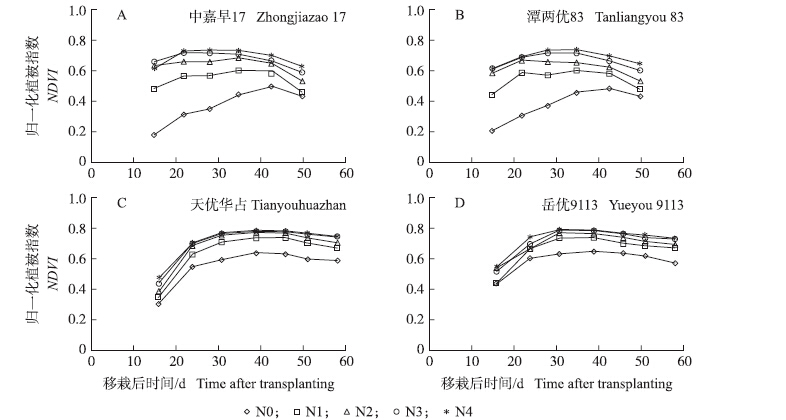
2 结果与分析 2.1 水稻冠层NDVI指数变化动态利用2014年双季稻试验数据,分析了早稻和晚稻分蘖期到灌浆期的NDVI指数动态变化(图 1)。由图 1可以得出,早稻和晚稻的NDVI值呈先快速上升,后缓慢增长,达到平台期后再逐渐下降的趋势。早稻NDVI值的变化范围为0.18~0.74,晚稻品种NDVI的变化范围为0.31~0.80。4个测试品种均在移栽后30 d左右,即拔节期达到最大值并进入平台期,灌浆期后有下降趋势。同时,氮素水平对NDVI有显著的影响,NDVI随施氮量的增加而增加。早稻NDVI值在不同氮素水平的差异要比晚稻的明显,并且平均值要低于晚稻。
|
图 1 2014年不同施氮水平下水稻群体冠层NDVI指数变化动态 Figure 1 NDVI dynamics of rice canopy under different N supply in 2014 A,B:早稻Early rice;C,D:晚稻Late rice |
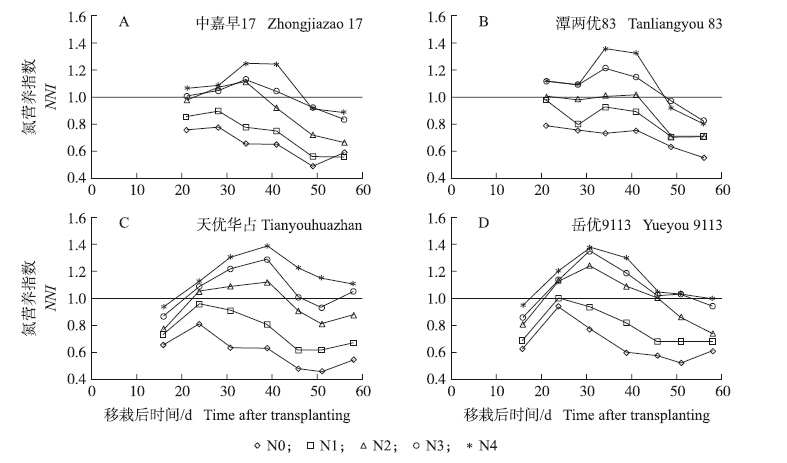
根据公式(1)和(2),基于不同时期的地上部植株干物质量计算出早稻和晚稻的NNI,其变化规律如图 2。NNI的动态变化与NDVI的变化趋势基本一致,也是先上升达到峰值再下降的一个过程。随着施氮水平的提高,NNI不断上升。早稻的NNI值为0.49~1.36,晚稻为0.45~1.39。其中,早稻和晚稻在N2处理(早稻:150 kg · hm-2;晚稻:180 kg · hm-2)下,NNI在1.0上下波动,可以认为N2处理是较为适宜的。
|
图 2 2014年不同施氮水平下双季稻冠层氮营养指数变化动态 Figure 2 NNI dynamics of rice canopy under different N supply in 2014 |
以2014年双季稻试验资料为基础,分析了早、晚稻不同时期及分蘖到孕穗阶段NDVI与NNI的定量关系。结果(表 2)表明:早、晚稻各时期NDVI与NNI均以指数函数形式的拟合效果最好,相关性最高。早稻和晚稻分别在孕穗期和拔节期决定系数(R2)最高,达到0.72和0.82。从分蘖到孕穗这一时间段,全部时期的NDVI与NNI拟合效果较差,早、晚稻的决定系数分别为0.57和0.38,均低于单个时期的拟合模型。
| 水稻类型Rice type | 生育时期Growth stage | 数据Data | 模型Model | 决定系数R2 |
| 早稻Early rice | 分蘖期Tillering | 30 | NNI=0.664e0.715NDVI | 0.68 |
| 拔节期Jointing | 30 | NNI=0.431e1.372NDVI | 0.71 | |
| 孕穗期Booting | 30 | NNI=0.397e1.375NDVI | 0.72 | |
| 分蘖到孕穗期Tillering to booting | 90 | NNI=0.556e0.946NDVI | 0.57 | |
| 晚稻Late rice | 分蘖期Tillering | 30 | NNI=0.344e1.655NDVI | 0.69 |
| 拔节期Jointing | 30 | NNI=0.075e3.471NDVI | 0.82 | |
| 孕穗期Booting | 30 | NNI=0.022e5.072NDVI | 0.79 | |
| 分蘖到孕穗期Tillering to booting | 90 | NNI=0.199e2.245NDVI | 0.38 |
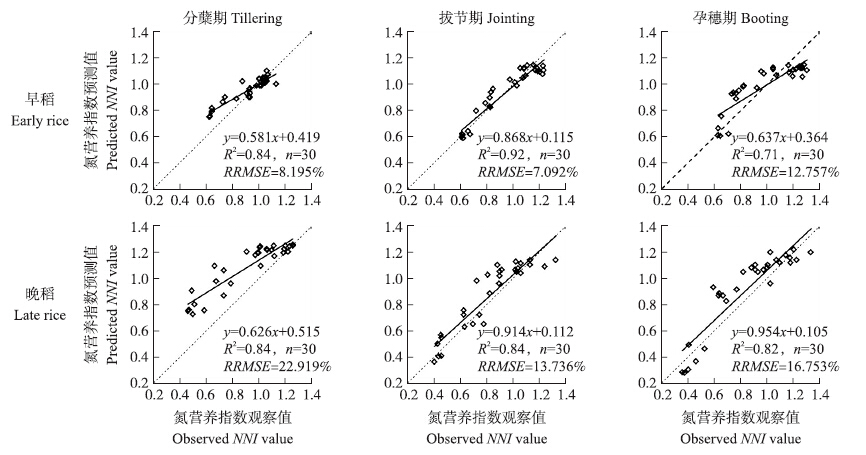
利用2015年数据对模型可靠性和普适性进行了检验。结果(图 3)表明:早稻和晚稻在拔节期的NDVI-NNI模型预测效果最好,预测值和实测值较好地分布在1 :1 线附近,早稻R2=0.92、RRMSE=7.092%,晚稻R2=0.84、RRMSE=13.736%。两者的准确度(accuracy)分别达到了0.868和0.914,表明拔节期的模型具有较好的准确性和可靠性,而其他时期的NNI预测模型准确度不高,除晚稻孕穗期外都存在前期预测偏大而后期预测偏小的问题。
|
图 3 早、晚稻不同生育时期NNI的预测值和实测值之间的关系 Figure 3 Relationships between observed and predicted NNI for early and late rice at different growth stages respectively |
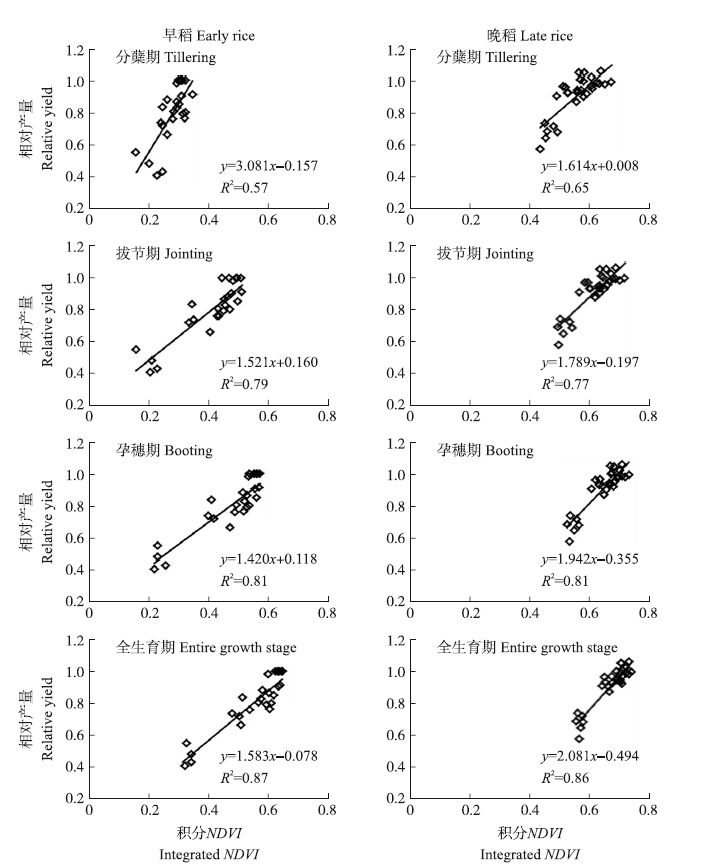
根据公式(6),利用2014年试验分别计算出早、晚稻分蘖期、拔节期、孕穗期及整个生育期的积分归一化植被指数(NDVIint),并分别建立NDVIint和RY的关系。结果表明:NDVIint和RY具有显著的线性关系(图 4),早稻和晚稻模型的决定系数分别为0.57~0.87和0.65~0.86。不同时期,积分归一化植被指数与RY的关系模型斜率和截距都有差别,斜率从拔节期开始逐渐降低。在相同生育期,早稻和晚稻也有一定的差别。
基于积分归一化植被指数对产量的预测,利用2015年产量数据对2014年所建模型进行检验。检验结果(表 3)表明:早稻全生育期的模型准确度(0.879)和晚稻全生育期模型的准确度(0.980)偏离1相对较小,而且两者的RRMSE相对最低。因此这2个模型在预测产量方面可靠性较高。
| 水稻类型 Rice type | 生育期 Growth stage | 数据 Data | 决定系数 R2 | 相对均方根误差/% RRMSE | 准确度 Accuracy |
| 早稻Early rice | 分蘖期Tillering | 30 | 0.93 | 9.075 | 0.814 |
| 拔节期Jointing | 30 | 0.92 | 9.978 | 0.899 | |
| 孕穗期Booting | 30 | 0.92 | 8.334 | 0.812 | |
| 全生育期Entire growth stage | 30 | 0.91 | 7.216 | 0.879 | |
| 晚稻Late rice | 分蘖期Tillering | 30 | 0.79 | 6.598 | 0.721 |
| 拔节期Jointing | 30 | 0.84 | 6.736 | 0.898 | |
| 孕穗期Booting | 30 | 0.87 | 5.986 | 0.935 | |
| 全生育期Entire growth stage | 30 | 0.89 | 5.134 | 0.980 |
|
图 4 早、晚稻积分归一化植被指数与相对产量的关系 Figure 4 Relationship between NDVIint and relative yield at different stages for early and late rice |
为了进一步验证不同生育时期以及早、晚稻之间模型的差异,验证不同生育期、收获期或早、晚稻之间的预测模型是否存在可以相互通用的可能性,本文对NDVIint-RY模型的斜率a和截距b进行了显著性分析(95%置信区间内)。结果(表 4)表明,早稻基于分蘖期的模型的斜率和截距与其他生育期的斜率两两之间具有显著差异,P值均小于0.05。因此,可以得出,早稻各生育期模型差异显著,同理可得,晚稻在每个生育期有独立的模型。在早稻和晚稻之间,模型也存在显著的差异。
| 参数 Parameter | 影响因素 Impact factors | P值 P values | ||||
| 早稻/晚稻Early rice/late rice | ||||||
| 分蘖期Tillering | 拔节期Jointing | 孕穗期Booting | 全生育期Entire growth stage | |||
| 斜率a | 生育期 | 分蘖期Tillering | — | 0.004*/0.615 | 0.002*/0.250 | 0.003*/0.216 |
| Growth stages | 拔节期Jointing | — | — | 0.651/0.483 | 0.769/0.368 | |
| 孕穗期Booting | — | — | — | 0.400/0.702 | ||
| 水稻类型Rice type | 0.005* | 0.540 | 0.108 | 0.218 | ||
| 截距b | 生育期 | 分蘖期Tillering | — | 0.000*/0.000* | 0.000*/0.000* | 0.000*/0.000* |
| Growth stages | 拔节期Jointing | — | — | 0.000*/0.000* | 0.000*/0.000* | |
| 孕穗期Booting | — | — | — | 0.000*/0.001* | ||
| 水稻类型Rice type | 0.000* | 0.000* | 0.000* | 0.001* | ||
| Note:* P<0.05. | ||||||
由于手持式GreenSeeker仅具有2个固定波段,而且输出的归一化植被指数算法比较简单,算式本身存在容易饱和的缺陷,在作物生育后期,较高的叶面积指数及高生物量会使归一化植被指数趋于饱和[23]。本研究中,NDVI值在30 d左右便达到最大,此时,早、晚稻处于拔节期,叶面积指数及生物量正处于上升阶段,但不同氮素水平之间具有显著性差异。因此,我们建立了单生育期的NDVI-NNI模型,经验证,能够基于NDVI较好地估算相同生育期的NNI值,尤其是在拔节期效果最好。这对水稻快速无损诊断植株氮素亏缺以及定量施追肥提供了较好的技术支持,但对跨生育期(分蘖—孕穗)的模型拟合效果并不好。
基于临界氮浓度的氮营养指数(NNI)是目前广泛应用于诊断作物实际氮素状况的工具[1]。在本文中,NNI在31 d左右出现峰值,早稻和晚稻分别达到1.51和1.53,其结果与已发表的禾本科作物结果[24]类似。之所以出现这种情况是因为在此之前施过追肥,导致土壤中的氮素含量快速上升,从而作物体内的氮含量也会上升。NNI作为一种瞬时值,可能会根据施肥或土壤状况产生较大波动[1]。这也是分蘖期—孕穗期NDVI值与NNI的构建关系并没有比单个生育期稳定的原因。虽然一些学者利用NDVI对植株氮含量或氮积累量准确监测[13-16],但是氮含量和氮积累量不能直接反映作物氮素过量或亏缺,而NNI可以反映作物氮素盈缺状态[21],因此,NDVI-NNI模型在作物氮素诊断以及定量施肥调控方面更具优势。由于不同品种及环境的临界氮浓度稀释模型不同,不同作物NNI具有差异,因此,在利用NDVI-NNI模型对作物进行氮素诊断时需要调整模型参数。
本研究结果显示,早、晚稻的NDVIint-RY在每个生育期都存在不同模型,可能是由于NDVI随着生育进程的动态变化导致了这个现象。而且在同一时期,早稻因为环境与品种原因[25],早稻NDVI比晚稻的要低,因此,造成了早、晚稻模型之间的差异。根据检验的结果,除晚稻的分蘖期,各生育期的模型都具有较好的准确性,因此,可根据需要利用不同时期NDVIint-RY模型预测产量。一些学者建立了瞬时NDVI与RY的关系模型[26-27],但是瞬时值会因为不同时期的土壤有机质、氮含量以及环境因素产生变化[28],使得作物氮吸收存在不确定性,从而造成模型预测的不准确。本研究计算积分NDVI类似于基于时间序列的加权平均,方法相对简单,而且避免了瞬时值以及单纯的平均值的缺点[9],能够在不同时期较好地预测中国南方双季稻的产量。
| [1] | Lemaire G, Jeuffroy M H, Gastal F. Diagnosis tool for plant and crop N status in vegetative stage:theory and practices for crop N management[J]. European Journal of Agronomy, 2008,28(4): 614–624. DOI: 10.1016/j.eja.2008.01.005 |
| [2] | Ju X T, Xing G X, Chen X P, et al. Reducing environmental risk by improving N management in intensive Chinese agricultural systems[J]. Proc Natl Acad Sci USA, 2009,106(9): 3041–3046. DOI: 10.1073/pnas.0813417106 |
| [3] | Cassman K G, Dobermann A, Walters D T. Agroecosystems, nitrogen-use efficiency, and nitrogen management[J]. Ambio, 2002,31(2): 132–140. DOI: 10.1579/0044-7447-31.2.132 |
| [4] | Lemaire G,Meynard J M. Use of the nitrogen nutrition index for the analysis of agronomical data[M]//Lemaire G. Diagnosis of the Nitrogen Status in Crops. Berlin:Springer-Verlag,Heidelberg,1997:44-45. http://link.springer.com/content/pdf/10.1007/978-3-642-60684-7_2.pdf |
| [5] | Colnenne C, Meynard J, Reau R, et al. Determination of a critical nitrogen dilution curve for winter oilseed rape[J]. Annals of Botany, 1998,81(2): 311–317. DOI: 10.1006/anbo.1997.0557 |
| [6] | Ata-Ul-Karim S T, Yao X, Liu X J, et al. Development of critical nitrogen dilution curve of Japonica rice in Yangtze River reaches[J]. Field Crops Research, 2013,149: 149–158. DOI: 10.1016/j.fcr.2013.03.012 |
| [7] | Caloin M, Yu O. Analysis of the time course of change in nitrogen content in Dactylis glomerata L.using a model of plant growth[J]. Annals of Botany, 1984,54(1): 69–76. |
| [8] | Ulrich A. Physiological bases for assessing the nutritional requirements of plants[J]. Annual Review of Plant Physiology, 1952,3(1): 207–228. DOI: 10.1146/annurev.pp.03.060152.001231 |
| [9] | Lemaire G,Gastal F. N uptake and distribution in plant canopies[M]//Lemaire G.Diagnosis of the Nitrogen Status in Crops. Berlin:Springer-Verlag,Heidelberg,1997:3-43. http://www.oalib.com/references/15808016 |
| [10] | Kogan F, Stark R, Gitelson A, et al. Derivation of pasture biomass in Mongolia from AVHRR-based vegetation health indices[J]. International Journal of Remote Sensing, 2004,25(14): 2889–2896. DOI: 10.1080/01431160410001697619 |
| [11] | Ziadi N, Brassard M, Bélanger G, et al. Chlorophyll measurements and nitrogen nutrition index for the evaluation of corn nitrogen status[J]. Agronomy Journal, 2008,100(5): 1264–1273. DOI: 10.2134/agronj2008.0016 |
| [12] | Yuan Z F, Ata-Ul-Karim S T, Cao Q, et al. Indicators for diagnosing nitrogen status of rice based on chlorophyll meter readings[J]. Field Crops Research, 2016,185: 12–20. DOI: 10.1016/j.fcr.2015.10.003 |
| [13] | 郭建华, 王秀, 孟志军, 等. 主动遥感光谱仪GreenSeeker与SPAD对玉米氮素营养诊断的研究[J]. 植物营养与肥料学报, 2008, 14(1): 43–47. Guo J H, Wang X, Meng Z J, et al. Study on diagnosing nitrogen nutrition status of cornusing GreenSeeker and SPAD meter[J]. Plant Nutrition and Fertilizer Science, 2008,14(1): 43–47. (in Chinese) |
| [14] | 胡昊, 白由路, 杨俐苹, 等. 基于SPAD-502与GreenSeeker的冬小麦氮营养诊断研究[J]. 中国生态农业学报, 2010, 18(4): 748–752. Hu H, Bai Y L, Yang L P, et al. Diagnosis of nitrogen nutrition in winter wheat (Triticumaestivum) via SPAD-502 and GreenSeeker[J]. Chinese Journal of Eco-Agriculture, 2010,18(4): 748–752. DOI: 10.3724/SP.J.1011.2010.00748 (in Chinese) |
| [15] | Bajwa S G, Mishra A R, Norman R J. Canopy reflectance response to plant nitrogen accumulation in rice[J]. Precision Agriculture, 2010,11(5): 488–506. DOI: 10.1007/s11119-009-9142-0 |
| [16] | Amaral L R, Molin J P, Portz G, et al. Comparison of crop canopy reflectance sensors used to identify sugarcane biomass and nitrogen status[J]. Precision Agriculture, 2015,16(1): 15–28. DOI: 10.1007/s11119-014-9377-2 |
| [17] | Mistele B, Schmidhalter U. Estimating the nitrogen nutrition index using spectral canopy reflectance measurements[J]. European Journal of Agronomy, 2008,29(4): 184–190. DOI: 10.1016/j.eja.2008.05.007 |
| [18] | Cao Q,Miao Y,Gao X,et al. Estimating the nitrogen nutrition index of winter wheat using an active canopy sensor in the North China Plain[R]. First International Conference on Agro-Geoinformatics(Agro-Geoinformatics),2012.DOI:10.1109/agro-geoinformatics.2012.6311634. https://www.researchgate.net/publication/261456435_Estimating_the_nitrogen_nutrition_index_of_winter_wheat_using_an_active_canopy_sensor_in_the_North_China_Plain |
| [19] | Yao Y, Miao Y, Cao Q, et al. In-season estimation of rice nitrogen status with an active crop canopy sensor[J]. IEEE Journal of Selected Topics in Applied Earth Observations and Remote Sensing, 2014,7(11): 4403–4413. DOI: 10.1109/JSTARS.2014.2322659 |
| [20] | Padilla F M, Peña-Fleitas M T, Gallardo M, et al. Threshold values of canopy reflectance indices and chlorophyll meter readings for optimal nitrogen nutrition of tomato[J]. Annals of Applied Biology, 2015,166(2): 271–285. DOI: 10.1111/aab.2015.166.issue-2 |
| [21] | Justes E, Mary B, Meynard J M, et al. Determination of a critical nitrogen dilution curve for winter wheat crops[J]. Annals of Botany, 1994,74(4): 397–407. DOI: 10.1006/anbo.1994.1133 |
| [22] | Massart D L, Vandeginste B G M, Deming S M. Chenometrics:A Text Book[M]. Amsterdam: Elsevier, 1988 . |
| [23] | Li F, Miao Y X, Chen X P, et al. Estimating winter wheat biomass and nitrogen status using an active crop sensor[J]. Intelligent Automation and Soft Computing, 2010,16(6): 1221–1230. |
| [24] | Ziadi N, Brassard M, Bélanger G, et al. Critical nitrogen curve and nitrogen nutrition index for corn in Eastern Canada[J]. Agronomy Journal, 2008,100(2): 271–276. DOI: 10.2134/agrojnl2007.0059 |
| [25] | Huang M, Zhang W X, Jiang L, et al. Impact of temperature changes on early-rice productivity in a subtropical environment of China[J]. Field Crops Research, 2013,146: 10–15. DOI: 10.1016/j.fcr.2013.03.007 |
| [26] | 王磊, 白由路, 卢艳丽, 等. 基于GreenSeeker的冬小麦NDVI分析与产量估算[J]. 作物学报, 2012, 38(4): 747–753. Wang L, Bai Y L, Lu Y L, et al. NDVI analysis and yield estimation in winter wheat based on GreenSeeker[J]. Acta Agronomica Sinica, 2012,38(4): 747–753. (in Chinese) |
| [27] | Yin X, McClure M A. Relationship of corn yield, biomass, and leaf nitrogen with normalized difference vegetation index and plant height[J]. Agronomy Journal, 2013,105(4): 1005–1016. DOI: 10.2134/agronj2012.0206 |
| [28] | Jones J R, Fleming C S, Pavuluri K, et al. Influence of soil, crop residue, and sensor orientations on NDVI readings[J]. Precision Agriculture, 2015,16: 690–704. DOI: 10.1007/s11119-015-9402-0 |