

文章信息
- 董炜华, 李晓强, 宋扬. 2016.
- DONG Weihua, LI Xiaoqiang, SONG Yang. 2016.
- 高速公路隔断对农田大型土壤动物多样性的影响——以京哈高速公路德惠路段为例
- Effect of the highway partition on soil macro-fauna diversity: a case study on Dehui section in Beijing-Harbin Highway
- 南京农业大学学报, 39(3): 425-432
- Journal of Nanjing Agricultural University, 39(3): 425-432.
- http://dx.doi.org/10.7685/jnau.201511026
-
文章历史
- 收稿日期:2015-11-13


高速公路的建设和运营能够引起周边地区空气、噪音和重金属污染等系列生态环境问题。目前学者们针对这些环境问题进行了大量的研究工作,主要集中在土壤和农作物的重金属污染[1, 2, 3]及破坏边坡的生态恢复[4]等方面的研究,而对公路旁土壤中微小动物分布及多样性等方面研究较少。土壤动物是土壤生态系统的重要组成部分,其生存活动可以改变土壤结构和土壤理化性质,影响土壤有机质的形成,对增强农作物产量有着积极的作用[5, 6, 7]。土壤动物种类多、数量大、移动范围小,其群落结构能指示土壤环境条件的变化[8, 9, 10, 11, 12]。近年来,公路路域土壤动物多样性的研究主要涉及公路边坡植被恢复过程中的指示及高速公路重金属污染对农田土壤动物群落结构的影响[13, 14, 15],农田生态系统土壤动物生态学的研究亦很少涉及公路隔断对农田土壤动物多样性的影响。本文以距离高速公路不同位置的农田土壤为研究对象,研究不同地点土壤动物群落结构和多样性动态,揭示高速公路隔断对两侧农田土壤动物的生态分布和多样性的影响,确定影响因素,以期为评价高速公路的生态影响和农田生态系统的土壤质量提供理论依据。
1 研究区概况与研究方法 1.1 研究区概况研究地点位于吉林省长春市中北部京哈高速德惠段路域,第二松花江中游。地理位置为44°02′50″N~ 44°53′55″N,125°14′30″E~126°24′43″E,海拔166~180 m。地处吉林省中部平原典型黑土区,属于中温带半湿润季风气候。春季短暂干燥多风,夏季温热多雨,秋季凉爽,冬季寒冷漫长,四季分明。全年平均气温4.5 ℃,无霜期140 d。年平均日照时数2 695 h,日照率为59%,年平均辐射量为496.2 kJ · cm-1。全年平均降水量520 mm,年季间变化较大。土壤类型以黑土、草甸土、黑钙土和冲积土为主,占全市总土地面积的90%以上。受人类长期活动的影响,原始森林、草原植被已基本不复存在,大部分地区已开垦为农田,开垦历史已有200~300年,仅存有小面积的天然次生植被和人工植被,主要以杨树为主。过去20年以来一直以种植玉米和大豆为主。近年来,由于玉米产量高,农民通常采用玉米连作,一年一熟。常规耕作,氮磷钾复合肥年施用量为1 500 kg · hm-2左右。
1.2 研究方法 1.2.1 样品采集与处理于2013年5月(玉米3叶期)、8月(玉米花期)和10月(玉米收获结束后)在京哈高速公路德惠段高速公路为中心,分别于垂直于高速公路两侧的南侧和北侧选择距公路5、20、100、200、400、800和1 600 m的样点进行大型土壤动物取样。大型土壤动物的取样面积为50 cm×50 cm,分别按照0~5 cm、5~10 cm、10~15 cm和15~20 cm土壤分层取样,设置3个重复,共采集504个样品(2生境×7样点×3样方×4层×3次取样时间),同时对样点土壤的理化性质(表 1)进行测定。为了便于统计,将4层大型土壤动物的数据合并。手捡大型土壤动物在75%的乙醇中保存,大型土壤动物样品鉴定主要依据《中国土壤动物检索图鉴》[16]《昆虫分类》[17]和《幼虫分类学》[18]等。根据土壤动物的幼虫和成虫有不同的生态功能,将幼虫和成虫分开统计个体数量[19]。个体数占总个体数的百分比大于10%的为优势类群,1%~10%为常见类群,小于1%为稀有类群。
| 月份
Month |
项目
Item |
公路南侧The south of highway | 公路北侧The north of highway | ||||||||||||
| 5 m | 20 m | 100 m | 200 m | 400 m | 800 m | 1 600 m | 5 m | 20 m | 100 m | 200 m | 400 m | 800 m | 1 600 m | ||
| 5月 | 土壤含水量/(g·kg-1) Soil moisture | 120.3 | 210.4 | 211.7 | 181.1 | 197.6 | 218.0 | 196.3 | 184.0 | 182.0 | 216.3 | 212.2 | 203.5 | 188.5 | 238.7 |
| May | 土壤pH值Soil pH value | 7.91 | 7.70 | 7.59 | 7.63 | 7.85 | 8.11 | 7.73 | 8.17 | 7.82 | 7.67 | 7.65 | 7.79 | 7.76 | 7.77 |
| 土壤有机质含量/(g·kg-1)
Soil organic matter content |
38.8 | 54.9 | 69.4 | 65.8 | 56.1 | 55.6 | 63.6 | 73.1 | 54.0 | 65.3 | 43.1 | 43.4 | 84.1 | 126.4 | |
| 海拔/m Elevation | 177.0 | 178.0 | 175.0 | 176.0 | 176.0 | 178.0 | 166.0 | 177.0 | 177.0 | 178.0 | 177.0 | 180.0 | 177.0 | 187.0 | |
| 气温/℃ Temperature | 17.9 | 17.9 | 17.9 | 17.9 | 17.9 | 17.9 | 17.9 | 17.9 | 17.9 | 17.9 | 17.9 | 17.9 | 17.9 | 17.9 | |
| 降水量/mm Precipitation | 38.9 | 38.9 | 38.9 | 38.9 | 38.9 | 38.9 | 38.9 | 38.9 | 38.9 | 38.9 | 38.9 | 38.9 | 38.9 | 38.9 | |
| 8月 | 土壤含水量/(g·kg-1) Soil moisture | 152.9 | 192.8 | 202.8 | 211.9 | 182.5 | 237.0 | 233.6 | 158.7 | 168.5 | 190.9 | 241.9 | 224.1 | 297.0 | 228.4 |
| August | 土壤pH值Soil pH value | 8.07 | 8.09 | 8.10 | 7.96 | 8.07 | 6.85 | 6.29 | 7.88 | 8.10 | 8.09 | 8.09 | 8.18 | 8.06 | 8.30 |
| 土壤有机质含量/(g·kg-1)
Soil organic matter content |
60.3 | 83.0 | 64.8 | 44.9 | 39.8 | 40.2 | 48.2 | 45.1 | 91.1 | 47.1 | 28.5 | 61.6 | 60.9 | 31.6 | |
| 海拔/m Elevation | 177.0 | 178.0 | 175.0 | 176.0 | 176.0 | 178.0 | 166.0 | 177.0 | 177.0 | 178.0 | 177.0 | 180.0 | 177.0 | 187.0 | |
| 气温/℃ Temperature | 22.3 | 22.3 | 22.3 | 22.3 | 22.3 | 22.3 | 22.3 | 22.3 | 22.3 | 22.3 | 22.3 | 22.3 | 22.3 | 22.3 | |
| 降水量/mm Precipitation | 120.8 | 120.8 | 120.8 | 120.8 | 120.8 | 120.8 | 120.8 | 120.8 | 120.8 | 120.8 | 120.8 | 120.8 | 120.8 | 120.8 | |
| 10月 | 土壤含水量/(g·kg-1) Soil moisture | 244.5 | 264.0 | 265.3 | 257.5 | 248.4 | 243.5 | 263.5 | 225.2 | 236.6 | 223.9 | 211.9 | 196.0 | 306.5 | 203.3 |
| October | 土壤pH值Soil pH value | 8.06 | 7.98 | 6.89 | 8.02 | 8.01 | 6.26 | 6.47 | 8.08 | 8.18 | 7.71 | 8.15 | 8.16 | 8.25 | 8.41 |
| 土壤有机质含量/(g·kg-1)
Soil organic matter content |
52.9 | 60.4 | 68.4 | 74.2 | 61.7 | 45.5 | 47.6 | 58.8 | 58.8 | 46.7 | 44.6 | 50.9 | 63.3 | 31.6 | |
| 海拔/m Elevation | 177.0 | 178.0 | 175.0 | 176.0 | 176.0 | 178.0 | 166.0 | 177.0 | 177.0 | 178.0 | 177.0 | 180.0 | 177.0 | 187.0 | |
| 气温/℃ Temperature | 7.3 | 7.3 | 7.3 | 7.3 | 7.3 | 7.3 | 7.3 | 7.3 | 7.3 | 7.3 | 7.3 | 7.3 | 7.3 | 7.3 | |
| 降水量/mm Precipitation | 67.6 | 67.6 | 67.6 | 67.6 | 67.6 | 67.6 | 67.6 | 67.6 | 67.6 | 67.6 | 67.6 | 67.6 | 67.6 | 67.6 | |
大型土壤动物群落的多样性指数通过以下几个参数来描述[20, 21],主要包括个体数、类群数、Shannon-Wiener多样性指数(H′)、Pielou均匀度指数(E)和Simpson优势度指数(C)。H′的计算公式: 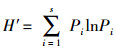 。式中:S为所有的类群数;Pi 为每个生境中第i个类群土壤动物的个体数占该生境土壤动物总数的比例。E的计算公式:E=H′/lnS。C的计算公式:
 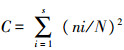 。式中:ni 为第i 个物种的个体密度量;N为土壤动物的总个体数;S为类群数。相似性指数(Sorensen index和Morisita-Horn index)分析高速公路两侧不同样点间大型土壤动物的相似性[22, 23]。
配对t测验分析同一取样时间相同样点高速公路两侧土壤pH值、有机质含量和含水量的差异。重复性方差分析样点和取样时间及二者相互作用对大型土壤动物个体数、类群数、多样性指数、均匀度指数和优势度指数的影响。单因素方差分析同一取样时间高速公路两侧不同样点间大型土壤动物个体数、类群数、多样性指数、均匀度指数和优势度指数的差异及同一样点不同取样时间大型土壤动物上述指数的差异。
对于不服从正态分布的数据,利用log(X)转换,LSD进行多重比较,SPSS 19.0 软件进行方差分析。典范对应分析(canonical correspondence analysis,CCA)定量研究环境因子(土壤有机质含量、土壤含水量、土壤pH值、海拔、降水量和气温)对大型土壤动物群落的影响。为了减少变量的个数,对优势类群和常见类群(占总个体密度超过95%)共15个类群进行统计分析。在进行排序分析之前,对大型土壤动物个体密度进行对数转换,应用排序软件CANOCO 4.5进行典范对应分析。
2 结果与分析 2.1 土壤动物群落组成从表 2可知:共捕获大型土壤动物3 091只,隶属6纲9目13科。总体上,链胃科、正蚓科、线蚓科和东京弓背蚁为优势类群,占土壤动物总个体数的63.05%。日本弓背蚁、地蜈蚣科、双齿多刺蚁、黑头酸臭蚁、隐翅虫科、隐翅虫科幼虫、步甲科、蝇科幼虫、摇蚊科幼虫、节板蛛科和步甲科幼虫为常见类群,占土壤动物总个体数的35.85%,其他为稀有类群。
| 土壤动物名称Name of soil fauna | 公路南侧The south of highway | 公路北侧The north of highway | 总计
Total |
||||||||||||||
| 5 m | 20 m | 100 m | 200 m | 400 m | 800 m | 1 600 m | 合计 | 5 m | 20 m | 100 m | 200 m | 400 m | 800 m | 1 600 m | 合计 | ||
| 蝇科幼虫Muscidae larva | 2 | 1 | 6 | 2 | 8 | 5 | 11 | 35 | 5 | 6 | 4 | 1 | 1 | 17 | 6 | 40 | 75 |
| 摇蚊科幼虫Chironomidae larva | 1 | 3 | 1 | 0 | 8 | 5 | 6 | 24 | 5 | 1 | 2 | 1 | 0 | 11 | 3 | 23 | 47 |
| 步甲科幼虫Carabidae larva | 4 | 7 | 0 | 0 | 1 | 1 | 3 | 16 | 1 | 3 | 2 | 1 | 3 | 6 | 2 | 18 | 34 |
| 隐翅虫科幼虫Staphylinidae larva | 2 | 9 | 5 | 12 | 10 | 0 | 6 | 44 | 1 | 1 | 22 | 0 | 5 | 12 | 15 | 56 | 100 |
| 步甲科Carabidae | 4 | 1 | 5 | 5 | 8 | 8 | 15 | 46 | 5 | 8 | 6 | 12 | 3 | 6 | 10 | 50 | 96 |
| 隐翅虫科Staphylinidae | 2 | 5 | 19 | 12 | 1 | 22 | 10 | 71 | 6 | 5 | 7 | 1 | 1 | 9 | 16 | 45 | 116 |
| 蜣螂亚科Scarabaeinae | 0 | 0 | 0 | 0 | 0 | 0 | 15 | 15 | 1 | 0 | 0 | 0 | 1 | 0 | 0 | 2 | 17 |
| 双齿多刺蚁 Polyrhachis dives | 18 | 4 | 1 | 1 | 0 | 4 | 5 | 33 | 41 | 0 | 3 | 29 | 15 | 10 | 7 | 105 | 138 |
| 东京弓背蚁Camponotus tokioensis | 6 | 3 | 3 | 10 | 114 | 11 | 8 | 155 | 70 | 9 | 40 | 29 | 13 | 10 | 14 | 185 | 340 |
| 黑头酸臭蚁Tapinoma melanocephalum | 26 | 0 | 2 | 11 | 0 | 2 | 4 | 45 | 22 | 0 | 36 | 18 | 8 | 2 | 3 | 89 | 134 |
| 日本弓背蚁Camponotus japonicus | 26 | 39 | 0 | 1 | 4 | 1 | 1 | 72 | 34 | 3 | 0 | 28 | 39 | 2 | 4 | 110 | 182 |
| 赤螨科Erythraeidae | 0 | 0 | 5 | 2 | 6 | 0 | 0 | 13 | 0 | 0 | 0 | 0 | 1 | 2 | 0 | 3 | 16 |
| 地蜈蚣科Geophilidae | 3 | 9 | 16 | 13 | 7 | 11 | 7 | 66 | 10 | 3 | 19 | 6 | 6 | 21 | 13 | 78 | 144 |
| 石蜈蚣科Lithobiidae | 0 | 0 | 0 | 0 | 0 | 0 | 0 | 0 | 0 | 0 | 1 | 0 | 0 | 0 | 0 | 1 | 1 |
| 正蚓科Lumbricidae | 6 | 38 | 28 | 28 | 34 | 72 | 110 | 316 | 36 | 12 | 69 | 21 | 7 | 25 | 33 | 203 | 519 |
| 链胃科Moniligastridae | 11 | 77 | 44 | 46 | 51 | 79 | 75 | 383 | 39 | 17 | 56 | 32 | 9 | 27 | 21 | 201 | 584 |
| 线蚓科Enchytraeidae | 4 | 39 | 9 | 25 | 22 | 132 | 106 | 337 | 55 | 22 | 44 | 26 | 2 | 2 | 18 | 169 | 506 |
| 节板蛛科Liphistiidae | 4 | 4 | 1 | 0 | 0 | 3 | 3 | 15 | 7 | 9 | 2 | 0 | 5 | 2 | 2 | 27 | 42 |
| 总个体数Number of individuals | 119 | 239 | 145 | 168 | 274 | 356 | 385 | 1 686 | 338 | 99 | 313 | 205 | 119 | 164 | 167 | 1 405 | 3 091 |
| 类群数Number of groups | 15 | 14 | 14 | 13 | 13 | 14 | 16 | 17 | 16 | 13 | 15 | 13 | 16 | 16 | 15 | 18 | 18 |
高速公路南侧和北侧大型土壤动物群落组成存在一定差异。高速公路南侧捕获大型土壤动物1 686只,链胃科、线蚓科和正蚓科为优势类群,占土壤动物总个体数的61.45%。东京弓背蚁、日本弓背蚁、隐翅虫科、地蜈蚣科、步甲科、黑头酸臭蚁、隐翅虫科幼虫、蝇科幼虫和摇蚊科幼虫为常见类群,占土壤动物总个体密度的35.05%,其他为稀有类群。高速公路北侧共捕获大型土壤动物1 405只,正蚓科、链胃科、东京弓背蚁和线蚓科为优势类群,占土壤动物总个体数的53.95%。日本弓背蚁、双齿多刺蚁、黑头酸臭蚁、隐翅虫科幼虫、步甲科、隐翅虫科、蝇科幼虫、节板蛛科、摇蚊科幼虫和步甲科幼虫为常见类群,占土壤动物总个体数的45.62%,其他为稀有类群(表 2)。
高速公路两侧各样点土壤动物群落的优势类群和常见类群也存在差异。高速公路南侧除5 m的样点和北侧除400 m的样点外,其他样点的共有优势类群为正蚓科和链胃科。南侧各样点的优势类群有3~4种,北侧有3~6种。南侧各样点间无共有常见类群,北侧各样点间共有常见类群为步甲科,不同样点间常见类群的多度差异较大。
2.2 土壤动物群落的多样性与相似性重复性方差分析(表 3)表明:高速公路两侧仅大型土壤动物个体数在样点、取样时间及相互作用间存在显著差异(P<0.05)。取样时间方面,公路两侧大型土壤动物个体数、类群数和均匀度指数存在显著差异(P<0.05),南侧动物的多样性指数也存在显著差异(P<0.05)。从两者间的相互作用看,个体数和多样性指数存在显著差异(P<0.05),北侧动物类群数和优势度指数也存在显著差异(P<0.05)。
|
生境
Habitat |
变异来源
Source of variance |
自由度
| 个体数
Individuals |
类群数
Groups |
多样性指数
Shannon-Wiener index |
均匀度指数
Pielou index | 优势度指数
Simpson index |
|||||
| F | P | F | P | F | P | F | P | F | P | |||
| 南侧
South |
样点
Sample site |
6 | 3.69 | 0.021 | 0.63 | 0.706 | 0.91 | 0.520 | 1.56 | 0.237 | 1.02 | 0.455 |
| 取样时间
Sampling period |
2 | 77.56 | <0.001 | 23.68 | <0.001 | 5.99 | 0.007 | 8.79 | 0.001 | 2.09 | 0.145 | |
| 样点×取样时间
Sample site×sampling period |
12 | 5.08 | <0.001 | 1.58 | 0.154 | 2.24 | 0.042 | 1.75 | 0.112 | 1.42 | 0.221 | |
| 北侧
North |
样点
Sample site |
6 | 4.54 | 0.009 | 3.62 | 0.022 | 2.79 | 0.054 | 1.42 | 0.273 | 1.97 | 0.138 |
| 取样时间
Sampling period |
2 | 13.73 | 0.001 | 5.60 | 0.009 | 1.86 | 0.174 | 6.30 | 0.019 | 1.40 | 0.262 | |
| 样点×取样时间
Sample site×sampling period |
12 | 2.76 | 0.040 | 5.65 | <0.001 | 5.06 | <0.001 | 0.95 | 0.499 | 2.94 | 0.009 | |
同一季节不同的样点之间大型土壤动物的个体数和类群数存在显著差异(图 1)。在高速公路北侧5月5和200 m样点的大型土壤动物个体数显著高于其他样点(P<0.05),而在10月100和800 m样点的大型土壤动物个体数显著高于其他样点(P<0.05)。在同一样点的大型土壤动物的个体数和类群数在不同季节间也存在显著差异。公路南北两侧8月20 m样点的大型土壤动物类群数和个体数显著高于5和10月(P<0.05),8月南侧200、400、800和1 600 m样点的个体数也显著高于5和10月的(P<0.05)。
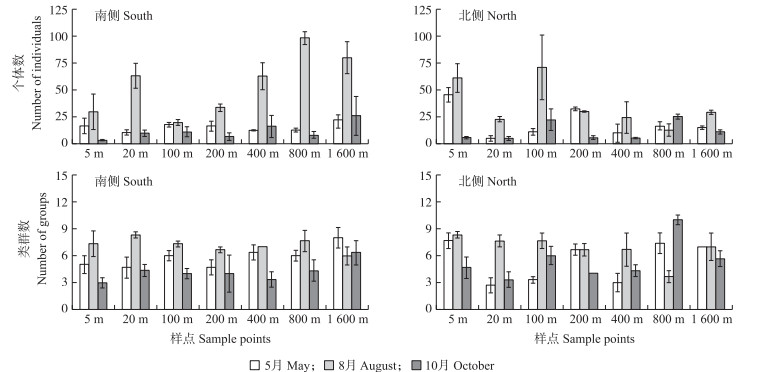 | 图 1 高速公路两侧大型土壤动物群落个体数和类群数比较(均值±标准误) Fig. 1 Comparison of individuals and groups of the soil macro-fauna communities on both sides of the highway (x±SE) |
由表 4和表 5可知:高速公路两侧800和1 600 m样点间土壤动物群落的Sorensen指数最高分别为0.829和0.737,表明南北两侧800和1 600 m样点间土壤动物群落比较相似,且其Morisita-Horn指数也较高,为0.953和0.871,表明公路两侧800和1 600 m样点间土壤动物群落优势类群也比较相似。南侧2个样点共有优势类群有正蚓科、链胃科和线蚓科,并且多度比较接近,其共有的常见类群较多,有蝇科幼虫、摇蚊科幼虫、步甲科、隐翅虫科、双齿多刺蚁、东京弓背蚁和地蜈蚣科。北侧2个样点的共有优势类群为链胃科和正蚓科,常见类群的共有类群10种,分别是摇蚊科幼虫、步甲科幼虫、隐翅虫科幼虫、步甲科、隐翅虫科、双齿多刺蚁、东京弓背蚁、黑头酸臭蚁、日本弓背蚁和节板蛛科(表 2)。
| 5 m | 20 m | 100 m | 200 m | 400 m | 800 m | 1 600 m | |
| 5 m | * | 0.528 | 0.344 | 0.443 | 0.287 | 0.277 | 0.301 |
| 20 m | 0.402 | * | 0.830 | 0.877 | 0.490 | 0.797 | 0.806 |
| 100 m | 0.318 | 0.563 | * | 0.935 | 0.504 | 0.711 | 0.760 |
| 200 m | 0.369 | 0.634 | 0.805 | * | 0.596 | 0.830 | 0.852 |
| 400 m | 0.229 | 0.534 | 0.544 | 0.606 | * | 0.475 | 0.486 |
| 800 m | 0.211 | 0.622 | 0.515 | 0.546 | 0.463 | * | 0.953 |
| 1 600 m | 0.226 | 0.606 | 0.460 | 0.517 | 0.464 | 0.829 | * |
| 注: 对角线下方数值是Sorensen指数,对角线上方是Morisita-Horn指数。The values below diagonal are Sorensen index,while the values above diagonal are Morisita-Horn index. The same as follows. | |||||||
| 5 m | 20 m | 100 m | 200 m | 400 m | 800 m | 1 600 m | |
| 5 m | * | 0.771 | 0.794 | 0.951 | 0.682 | 0.597 | 0.741 |
| 20 m | 0.416 | * | 0.807 | 0.733 | 0.377 | 0.660 | 0.820 |
| 100 m | 0.661 | 0.408 | * | 0.772 | 0.398 | 0.759 | 0.894 |
| 200 m | 0.729 | 0.513 | 0.560 | * | 0.769 | 0.628 | 0.730 |
| 400 m | 0.468 | 0.431 | 0.287 | 0.580 | * | 0.419 | 0.440 |
| 800 m | 0.450 | 0.525 | 0.516 | 0.488 | 0.452 | * | 0.871 |
| 1 600 m | 0.527 | 0.654 | 0.596 | 0.581 | 0.455 | 0.737 | * |
高速公路南北两侧降水量与轴1的相关系数最大,分别为0.934和0.856,南侧土壤含水量与轴2的相关系数最大为-0.401,北侧土壤有机质含量与轴2的相关系数最大为0.504。因此,降水量、土壤含水量和土壤有机质含量是影响高速公路两侧大型土壤动物群落的主要环境因子,排序轴2将8月与其他2个月分开(图 2)。
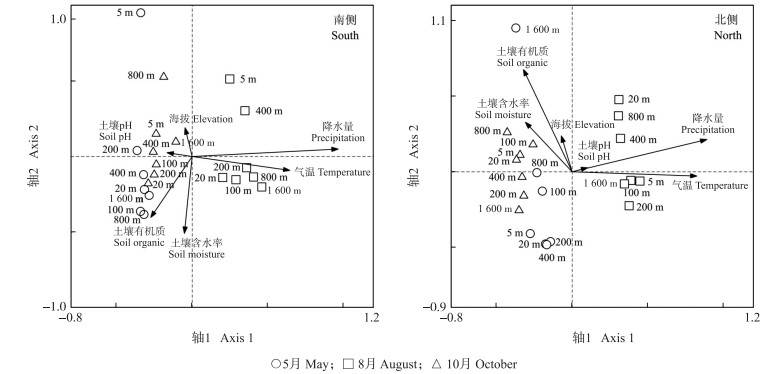 | 图 2 高速公路两侧环境因子与大型土壤动物群落的典范对应分析 Fig. 2 Canonical correspondence analysis of the relationships between environmental factors and soil macro-fauna communities on both sides of the highway |
土壤动物以土壤环境为生存空间,绝大部分的类群要终身生活在土壤中,所以土壤微环境对于土壤动物群落具有重要的影响。相关研究表明,土壤动物和土壤有机质呈正相关,与pH值呈负相关[19]。本研究中,公路北侧10月800 m样点土壤的有机质含量高于其他样点,是该点土壤动物个体数显著高于其他样点的主要影响因素。北侧5月份5 m样点土壤的pH值高于其他样点,200 m样点土壤的有机质含量低于其他样点,这些因素引起其土壤动物多样性指数降低。另外,土壤动物不同的类群对土壤理化性质的敏感反应也会存在差异。林英华等[24]对农田土壤动物与土壤理化性质关系的研究中指出土壤有机质、田间持水量和土壤全氮对线虫、蜱螨类和鞘翅目昆虫影响较大,而土壤有机质和土壤全氮对线虫、蜱螨类的作用最大。在本研究中高速公路北侧5和200 m样点双齿多刺蚁、东京弓背蚁、黑头酸臭蚁和日本弓背蚁的个体数高于其他样点,100 m样点正蚓科和链胃科的个体数高于其他样点;800 m样点蝇科幼虫和摇蚊科幼虫个体数高于其他样点,因此,不同类群土壤动物对土壤理化性质的敏感反应差异也是距高速公路不同距离样点间大型土壤动物多样性产生差异的重要原因。
高速公路大型土壤动物的多样性并不完全是随着距高速公路距离的增加而呈现增大的趋势。分析其原因,农田生态系统最主要的特点就是受人为干扰影响比较大,最明显的干扰就是长期耕作和施肥。研究[25]表明长期耕作和施肥能够明显改变土壤理化性质,影响土壤动物的群落特征[26, 27, 28],且农业生产活动会降低土壤动物的生物多样性[29, 30]。在这样的条件下,人为干扰对土壤动物多样性产生的影响减少了随着距高速公路距离的增加土壤动物多样性呈现增大的趋势。另外,本研究中农作物是玉米,由于作物的密度和植株的高度较高,这样就可以塑造相对稳定的局域环境。由于局域环境稳定,进而也减少了随着距高速公路距离的增加土壤动物多样性呈现增大的趋势。但是,本研究的相似性研究表明高速公路两侧800和1 600 m样点大型土壤动物群落相似性最高。
在人为干扰作用一致的前提下,环境变化也在发挥潜移默化的作用,特别是高速公路的建设和运营,引起空气、噪音和重金属污染等系列生态环境问题。已有研究表明,离高速公路越近,重金属等污染越严重[3, 15]。空气污染、噪音污染也随着距高速公路距离的增加而减少。土壤动物具有迁移能力弱、数量大、种类多等特点,其多样性和生态分布受土壤环境变化影响较大。因此,离高速公路越近土壤动物群落结构受高速公路的影响越明显,而远离高速公路大型土壤动物群落结构受高速公路的影响越小。从相似性的结果来看,高速公路隔断对距高速公路5 m至400 m样点的土壤动物群落结构影响较大,而对800和1 600 m样点的土壤动物群落结构影响较小。高速公路运营期间对其周边农田土壤动物群落的影响是否以800 m样点为界限,还需要进一步的研究和数据支持。
季节变化对高速公路两侧大型土壤动物的多样性也产生显著影响。本研究典范对应分析研究表明,降水量、土壤含水量和土壤有机质是影响高速公路两侧大型土壤动物群落分布的主要环境因子。研究[31]表明大型土壤动物受气候变化的影响,增温会导致土壤动物群落结构和组成发生变化,进而影响土壤动物多样性[32]。降水对土壤动物具有积极影响,且这种积极影响随处理时间的延长而加强[33]。研究区属于中温带半湿润季风气候,5、8和10月季节之间气候条件(如温度、降水等)存在很大的差异,导致土壤动物多样性在季节间存在较大的差异。高速公路的隔断对公路两侧的土壤动物的分布和多样性已经产生了影响,引起了公路两侧大型土壤动物群落的组成和结构的差异。随着时间延续,这种差异还在继续,是否会对公路两侧农田的作物产量和性质产生影响还需进一步研究探讨。
| [1] | 杜振宇,邢尚军,宋玉民,等. 山东省高速公路两侧土壤的铅污染及绿化带的防护作用[J]. 水土保持学报,2007,21(5):175-179. Du Z Y,Xing S J,Song Y M,et al. Lead pollution along expressways and its attenuation by green belts in Shandong Province[J]. Journal of Soil and Water Conservation,2007,21(5):175-179(in Chinese with English abstract). |
| [2] | 黄勇强,历晶晶. 高速公路路域土壤重金属污染及植物修复研究进展[J]. 安徽农业科学,2009,37(7):3216-3218. Huang Y Q,Li J J. Research progress on heavy-metal contaminated soil and the phytoremediation technology in highway road area[J]. Journal of Anhui Agriculture Science,2009,37(7):3216-3218(in Chinese with English abstract). |
| [3] | 冯金飞. 高速公路沿线农田土壤和作物的重金属污染特征及规律[D]. 南京:南京农业大学,2010. Feng J F. Characteristics and rules of heavy metal pollution on roadside soil and crop along highway[D]. Nanjing:Nanjing Agricultural University,2010(in Chinese with English abstract). |
| [4] | 刘春霞,韩烈保. 高速公路边坡植被恢复研究进展[J]. 生态学报,2007,27(5):2090-2098. Liu C X,Han L B. Review of researches in vegetation restoration of freeway slopes[J]. Acta Ecologica Sinica,2007,27(5):2090-2098(in Chinese with English abstract). |
| [5] | 张友梅,王振中. 稻田土壤动物群落初步调查[J]. 生态学杂志,1986(5):22-26. Zhang Y M,Wang Z Z. Preliminary investigation of soil animal community in paddy cropland[J]. Chinese Journal of Ecology,1986(5):22-26(in Chinese with English abstract). |
| [6] | 林英华. 长期施肥对农田土壤动物群落影响及安全评价[D]. 北京:中国农业科学院,2003. Lin Y H. Effect of long-term fertilization on agricultural soil fauna community and its evaluation[D]. Beijing:Chinese Academy of Agricultural Sciences,2003(in Chinese with English abstract). |
| [7] | 宋理洪,武海涛,吴东辉. 我国农田生态系统土壤动物生态学研究进展[J]. 生态学杂志,2011,30(12):2898-2906. Song L H,Wu H T,Wu D H. Soil fauna in China cropland ecosystems:research progress[J]. Chinese Journal of Ecology,2011,30(12):2898-2906(in Chinese with English abstract). |
| [8] | 孙儒泳. 动物学生态原理[M]. 北京:北京师范大学出版社,1987. Sun R Y. Principle of Zooecology[M]. Beijing:Beijing Normal University Press,1987(in Chinese). |
| [9] | Motohiro H. The relationship between the organic matter composition of a forest floor and the structure of a soil arthropod community[J]. European Journal of Soil Biology,2001,37:281-284. |
| [10] | 刘继亮,殷秀琴,邱丽丽. 左家自然保护区大型土壤动物与土壤因子关系研究[J]. 土壤学报,2008,45(1):130-136. Liu J L,Yin X Q,Qiu L L. Large-sized soil fauna and soil factors in zuojia nature reserve[J]. Acta Pedologica Sinica,2008,45(1):130-136(in Chinese with English abstract). |
| [11] | Salmon S,Artuso N,Frizzera L,et al. Relationships between soil fauna communities and humus forms:response to forest dynamics and solar radiation[J]. Soil Biology and Biochemistry,2008,40(7):1707-1715. |
| [12] | Song B,Yin X Q,Zhang Y,et al. Dynamics and relationships of Ca,Mg,Fe in litter,soil fauna and soil in Pinus koraiensis-Broadleaf mixed forest[J]. Chinese Geographical Science,2008,18(3):284-290. |
| [13] | 董炜华,殷秀琴,顾卫,等. 公路路域植被不同演替阶段土壤动物群落特征[J]. 土壤学报,2008,45(4):678-685. Dong W H,Yin X Q,Gu W,et al. Characteristics of soil fauna community related to vegetation succession alongside roads[J]. Acta Pedologica Sinica,2008,45(4):678-685(in Chinese with English abstract). |
| [14] | 殷秀琴,顾卫,董炜华,等. 公路边坡人工恢复植被后土壤动物群落变化及多样性[J]. 生态学报,2008,28(9):4295-4305. Yin X Q,Gu W,Dong W H,et al. The community change and diversity of soil fauna after artificial vegetation restoration in highway slope[J]. Acta Ecologica Sinica,2008,28(9):4295-4305(in Chinese with English abstract). |
| [15] | 李涛,李灿阳,俞丹娜,等. 交通要道重金属污染对农田土壤动物群落结构及空间分布的影响[J]. 生态学报,2010,30(18):5001-5011. Li T,Li C Y,Yu D N,et al. Effects of heavy metals from road traffic on the community structure and spatial distribution of cropland soil animals[J]. Acta Ecologica Sinica,2010,30(18):5001-5011(in Chinese with English abstract). |
| [16] | 尹文英. 中国土壤动物检索图鉴[M]. 北京:科学出版社,1998. Yin W Y. Chinese Soil Animal Retrieving Pictures[M]. Beijing:Science Press,1998(in Chinese). |
| [17] | 郑乐怡,归鸿. 昆虫分类[M]. 南京:南京师范大学出版社,1999. Zheng L Y,Gui H. Insect Classification[M]. Nanjing:Nanjing Normal University Press,1999(in Chinese). |
| [18] | 钟觉民. 幼虫分类学[M]. 北京:农业出版社,1990. Zhong J M. Larvae Taxonomy[M]. Beijing:Agriculture Press,1990(in Chinese). |
| [19] | 殷秀琴. 东北森林土壤动物研究[M]. 长春:东北师范大学出版社,2001. Yin X Q. Study on Forest Soil Animals in the Northeast of China[M]. Changchun:Northeast Normal University Press,2001(in Chinese). |
| [20] | Weaver W,Shannon C E. The Mathematical Theory of Communication[M]. Urbana:University of Illinois Press,1949. |
| [21] | Pielou E C. Ecological Diversity[M]. New York:John Wiley and Sons,1975. |
| [22] | Doblas-Miranda E,Sánchez-Piñero F,González-Megías A. Soil macroinvertebrate fauna of a Mediterranean arid system:compositionand temporal changes in the assemblage[J]. Soil Biology and Biochemistry,2007,39:1916-1925. |
| [23] | Magurran A E. Measuring Biological Diversity[M]. Malden:Wiley-Blackwell,2004. |
| [24] | 林英华,张夫道,杨学云,等. 农田土壤动物与土壤理化性质关系的研究[J]. 中国农业科学,2004,37(6):871-877. Lin Y H,Zhang F D,Yang X Y,et al. Study on the relationship between agricultural soil fauna and soil physicochemical properties[J]. Scientia Agricultura Sinica,2004,37(6):871-877(in Chinese with English abstract). |
| [25] | Mando A,Ouattara B,Sédogo M,et al. Long-term effect of tillage and manure application on soil organic fractions and crop performance under Sudano-Sahelian conditions[J]. Soil and Tillage Research,2005,80:95-101. |
| [26] | Cutz-Pool L Q,Palacios-Vargas J G,Castaño-Meneses G,et al. Edaphic Collembola from two agroecosystems with contrasting irrigation type in Hidalgo State,Mexico[J]. Applied Soil Ecology,2007,36(1):46-52. |
| [27] | Liang W J,Lou Y L,Li Q,et al. Nematode faunal response to long-term application of nitrogem fertilizer and organic manure in Northeast China[J]. Soil Biology and Biochemistry,2009,41:883-890. |
| [28] | 朱新玉,董志新,况福虹,等. 长期施肥对紫色土农田土壤动物群落的影响[J]. 生态学报,2013,33(2):464-474. Zhu X Y,Dong Z X,Kuang F H,et al. Effects of fertilization regimes on soil faunal communities in cropland of purple soil,China[J]. Acta Ecologica Sinica,2013,33(2):464-474(in Chinese with English abstract). |
| [29] | Jordan D,Miles R J,Hubbard V C,et al. Effect of management practices and cropping systems on earthworm abundance and microbial activity in Sanborn Field:a 115-year-old agricultural field[J]. Pedobiologia,2004,48:99-110. |
| [30] | Govaerts B,Mezzalarna M,Sayre K D,et al. Long-term consequences of tillage,residue management,and crop rotation on maize/wheat root rot and nematode populations in subtropical highlands[J]. Applied Soil Ecology,2006,32:305-315. |
| [31] | Wu P F,Zhang H Z,Wang Y. The response of soil macroinvertebrates to alpine meadow degradation in the Qinghai-Tibetan Plateau,China[J]. Applied Soil Ecology,2015,90:60-67. |
| [32] | Blankinship J C,Niklaus P A,Hungate B A. A meta-analysis of responses of soil biota to global change[J]. Oecologia,2011,165:553-565. |
| [33] | Eisenhauer N,Cesarz S,Koller R,et al. Global change belowground:impacts of elevated CO2,nitrogen,and summer drought on soil food webs and biodiversity[J]. Global Change Biology,2012,18:435-447. |