

文章信息
- 李静, 陶宝瑞, 焦美玲, 尹思慧, 朱利群. 2015.
- LI Jing, TAO Baorui, JIAO Meiling, YIN Sihui, ZHU Liqun. 2015.
- 秸秆还田下我国南方稻田表土固碳潜力研究——基于Meta分析
- Assessment on topsoil carbon sequestration potential under straw return modes in paddy fields in South China—based on a Meta-analysis
- 南京农业大学学报, 38(3): 351-359
- Journal of Nanjing Agricultural University, 38(3): 351-359.
- http://dx.doi.org/10.7685/j.issn.1000-2030.2015.03.001
-
文章历史
- 收稿日期:2014-11-06


2. 南京农业大学农学院, 江苏 南京 210095
2. College of Agriculture, Nanjing Agricultural University, Nanjing 210095, China
土壤是陆地生态系统的重要组成部分,它与大气以及陆地生物群落共同组成系统中碳的主要贮存和交换库[1]。农田土壤拥有相当可观的固碳潜力,在全球碳循环中具有不可取代的地位[2]。农田土壤碳库尤其是表层碳库受人类活动影响最为强烈,同时又可以在较短的时间尺度上进行人为调节[3, 4]。20世纪末以来,通过土壤固碳降低大气CO2浓度以减轻全球温室效应的研究得到越来越多的重视。研究表明,农业温室气体减排潜力有90%来自土壤固碳[5, 6]。农田土壤碳库除受温度、降水和植被类型的影响外,还在很大程度上受秸秆还田、耕作措施[7]、施肥量、施肥类型和灌溉等农田管理措施的影响。
从20世纪70年代末开始,我国在不同区域不同地点陆续开展了一些关于秸秆还田、耕作活动及施肥措施对农田生态系统影响的长期试验,许多学者开展了一系列关于不同农业管理措施对农田土壤有机碳含量影响的研究,研究结果为从区域角度研究不同农业管理措施对农田土壤固碳潜力的影响提供了丰富的基础数据。很多学者利用前述基础数据从全国尺度[8, 9, 10]、区域尺度[11, 12]、省域尺度[13]或通过长期试验区域对比[14]对我国农田在不同管理措施下的土壤有机碳动态和土壤固碳效应进行了大量研究。
我国稻田面积约占全国耕地面积的1/5,而南方稻田面积占全国总稻田面积的66%[15],明确我国南方地区稻田土壤有机碳在不同农业管理措施下的积累特点非常重要。到目前为止,尚无人从区域角度研究过不同秸秆还田方式对农田土壤固碳潜力的影响,亦无人研究过我国南方稻田土壤在不同秸秆还田方式下的固碳潜力。本研究旨在通过收集我国南方地区稻田长期试验点的试验资料,采用Meta分析法,研究长期不同秸秆还田方式下我国南方稻田表土有机碳含量的相对年变化量、固碳持续时间及固碳周期内的固碳量,以探究我国南方稻田不同秸秆还田方式下表土固碳潜力的大小。 1 材料与方法 1.1 数据来源
收集整理了1980—2013年38篇(表 1)国内外有关我国南方地区稻田秸秆还田定位试验的研究论文,并对论文进行筛选,提取试验站点位置、土壤类型、种植制度、耕层深度、试验年限、秸秆还田方式以及各种还田方式下的土壤有机质或者有机碳数据,建立了南方稻田表土有机碳数据库。
| 编号 Code | 试验地点 Site | 土壤类型 Soil type | 种植制度 Cropping system | 处理 Treatments | 试验周期/a Experiment duration | 文献序号 Reference No. |
| 1 | 江苏扬州 | 水稻土 | 稻-麦 | NTS、CTS | 3 | 16 |
| 2 | 江苏南通 | 潮土 | 稻-麦 | CTS、NTS、RTS | 2 | 17 |
| 3 | 湖南长沙 | 水稻土 | 早稻-晚稻 | CTS、NTS、RTS | 2 | 18 |
| 4 | 江苏丹阳 | 水稻土 | 稻-麦 | RTS | 3 | 19 |
| 5 | 湖南宁乡 | 水稻土 | 早稻-晚稻-冬闲 | CTS、NTS、RTS | 4 | 20 |
| 6 | 江苏扬中 | 水稻土 | 稻-麦 | CTS、RTS | 2 | 21 |
| 7 | 湖北潜江 | 潮土 | 稻-麦 | CTS | 2 | 22 |
| 8 | 四川成都 | 水稻土 | 稻-麦(油) | CTS | 4 | 23 |
| 9 | 四川简阳 | 水稻土 | 稻-麦(油) | NTS | 4 | 24 |
| 10 | 浙江杭州 | 水稻土 | 稻-麦 | RTS | 5 | 24 |
| 11 | 江苏南通 | 潮土 | 稻-麦 | CTS、NTS、RTS | 2 | 25 |
| 12 | 江西南昌 | 褐土 | 早稻-晚稻-绿肥 | NTS、RTS | 2 | 26 |
| 13 | 安徽肥东 | 褐土 | 稻-麦(油) | CTS | 2 | 27 |
| 14 | 安徽肥东 | 褐土 | 稻-麦(油) | CTS | 3 | 27 |
| 15 | 江苏苏州 | 水稻土 | 稻-麦 | CTS | 11 | 28 |
| 16 | 浙江杭州 | 水稻土 | 稻-麦 | RTS | 12 | 29 |
| 17 | 江苏苏州 | 水稻土 | 稻-麦 | RTS | 14 | 30 |
| 18 | 江西南昌 | 水稻土 | 早稻-晚稻-紫云英 | RTS | 15 | 30 |
| 19 | 重庆 | 水稻土 | 稻-麦 | CTS | 10 | 31 |
| 20 | 上海闵行区 | 水稻土 | 稻-麦 | CTS | 15 | 32 |
| 21 | 湖南望城 | 水稻土 | 早稻-晚稻 | CTS | 25 | 33 |
| 22 | 湖南望城 | 水稻土 | 早稻-晚稻 | CTS | 26 | 34 |
| 23 | 江苏吴江 | 水稻土 | 稻-油 | CTS | 16 | 35 |
| 24 | 江苏扬州 | 水稻土 | 稻-麦 | RTS | 2 | 36 |
| 25 | 江苏南通 | 潮土 | 稻-麦 | CTS、RTS、NTS | 2 | 37 |
| 26 | 湖南长沙 | 水稻土 | 早稻-晚稻-紫云英 | NTS、CTS | 2 | 38 |
| 27 | 安徽合肥 | 水稻土 | 稻-麦(油) | CTS、NTS | 2 | 39 |
| 28 | 湖南桃源 | 水稻土 | 稻-玉 | CTS | 6 | 40 |
| 29 | 江苏洪泽 | 水稻土 | 稻-麦 | CTS | 2 | 41 |
| 30 | 江苏靖江 | 水稻土 | 稻-麦 | CTS、NTS | 2 | 42 |
| 31 | 浙江江山 | 水稻土 | 稻-麦 | CTS、NTS | 4 | 43 |
| 32 | 江苏姜堰 | 水稻土 | 稻-麦 | CTS | 2 | 44 |
| 33 | 湖南宁乡 | 水稻土 | 早稻-晚稻-大麦 | CTS | 17 | 45 |
| 34 | 四川成都 | 水稻土 | 稻-麦 | CTS、NTS | 4 | 46 |
| 35 | 四川成都 | 水稻土 | 稻-麦 | CTS、NTS | 5 | 46 |
| 36 | 四川成都 | 水稻土 | 稻-麦(油) | NTS、RTS | 4 | 47 |
| 37 | 四川简阳 | 棕壤土 | 稻-麦(油) | NTS、RTS | 4 | 47 |
| 38 | 浙江杭州 | 水稻土 | 稻-麦 | RTS | 10 | 48 |
| 39 | 江苏吴江 | 水稻土 | 稻-油 | NTS、RTS | 17 | 49 |
| 40 | 江苏苏州 | 水稻土 | 稻-麦 | NTS | 27 | 50 |
| 41 | 江苏苏州 | 水稻土 | 稻-麦 | RTS | 3 | 50 |
| 42 | 江西余江 | 水稻土 | 早稻-晚稻 | NTS | 6 | 51 |
| 43 | 湖南祁阳 | 水稻土 | 早稻-晚稻 | NTS | 10 | 52 |
| 44 | 湖南祁阳 | 水稻土 | 早稻-晚稻 | NTS | 20 | 52 |
| 45 | 江苏张家港 | 潮土 | 稻-麦 | NTS、CTS | 12 | 53 |
| 注: CTS:翻耕秸秆还田Conventional tillage with straw return;NTS:免耕秸秆还田No tillage with straw return;RTS:旋耕秸秆还田Rotary tillage with straw return. 除编号33外,其余还田秸秆均粉碎。All returned straw was crushed,except code 33. The same as follows. | ||||||
本研究文献筛选的标准为:1)研究区域为我国南方地区,包括江西、湖南、湖北、广东、浙江、江苏、安徽、福建、云南、四川、广西、贵州12个省,重庆和上海2个市;2)农田耕作措施包含翻耕秸秆不还田(CK)、翻耕秸秆还田(CTS)、免耕秸秆还田(NTS)和旋耕秸秆还田(RTS);3)试验为长期定位田间试验,试验年限≥2年,试验的起止年份清楚;4)观测土样取自表土(0~20 cm),且土壤有机碳的试验初始值和试验最终值明确。
经过筛选,最终符合标准的文献有38篇,共涉及40个试验点(表 1)102组数据样本,其中两熟制77组(占75.5%),三熟制25组(占24.5%)。土壤类型多为水稻土,试验周期为2~27年,平均为5.82年,土壤样本平均深度为17.79 cm。翻耕秸秆还田(CTS)样本数为49,占总样本数的48.0%;免耕秸秆还田(NTS)样本数为31,占总样本数的30.4%;旋耕秸秆还田(RTS)样本数为22,占总样本数的21.6%。总样本中两熟制样本77个(占75.5%),三熟制样本25个(占24.5%)(表 2)。筛选的文献中,绝大多数秸秆还田试验为全量秸秆还田,秸秆种类多为麦秸和稻秸,少量的绿肥、油菜秸秆。采用的3种耕作措施中,翻耕秸秆还田的耕深约为15~25 cm,旋耕秸秆还田的耕深约为8~10 cm,免耕秸秆还田秸秆均匀覆盖在土壤表层,土壤扰动2~3 cm。
| 处理 Treatments | 两熟制Double cropping system | 三熟制Triple cropping system | 合计Total | |||
| 样本数 Sample number | 试验周期/a Experiment duration | 样本数 Sample number | 试验周期/a Experiment duration | 样本数 Sample number | 试验周期/a Experiment duration | |
| CTS | 38 | 5.68±4.29 | 11 | 5.31±4.12 | 49 | 5.60±4.30 |
| NTS | 23 | 5.74±5.12 | 8 | 7.25±3.23 | 31 | 6.15±5.45 |
| RTS | 16 | 5.35±2.56 | 6 | 7.15±4.23 | 22 | 5.83±4.32 |
| 合计/平均 Total/Mean | 77 | 5.57±3.19 | 25 | 6.48±6.18 | 102 | 5.82±5.07 |
数据来自文献中的正文、表和图。其中,图中数据采用Get Data V.2.23软件[54]提取。土壤有机质含量转化为土壤有机碳含量的转化系数为0.58。 1.2.1 试验期间不同处理下有机碳含量年变化量
有机碳含量年变化量(M)计算公式:

式中:t为试验时间(a),是试验观测终止年与起始年的差值;SOC0、SOCt分别是试验观测起始年和终止年的有机碳含量(g · kg-1)。 1.2.2 试验期间不同处理下有机碳含量相对年变化量
为了区分不同秸秆还田方式对土壤固碳能力的实际影响,需要扣除秸秆不还田(CK)下土壤有机碳的变化效应,即土壤有机碳含量的相对年变化量(RM)。任一种秸秆还田方式下土壤有机碳含量的相对年变化量为试验观测期限内该秸秆还田方式(TR)下有机碳含量年变化量扣除秸秆不还田(CK)下有机碳含量年变化量后的净年变化量[8]。

利用下面的公式可以计算出不同秸秆还田方式下土壤有机碳含量相对年变化率(Y)。

式中:(SOC0)TR是某种秸秆还田方式下试验观测起始年的有机碳含量。 1.2.4 不同处理下有机碳固碳持续时间及固碳比例
采用一定的农业管理措施后,土壤有机碳将在一定时期内达到新的平衡[55],达到新平衡需要的时间,即土壤有机碳从开始增加(减少)到结束增加(减少)的时间[56],为该农业管理措施的固碳持续时间。根据不同处理下有机碳含量相对年变化率,采用Sigmaplot 11.0软件[57]作出不同秸秆还田方式下固碳持续时间的非线性回归方程,可得到不同秸秆还田方式的固碳持续时间,采用微积分原理,可以估算出某种秸秆还田方式在整个固碳持续时间内所能增加的有机碳比例。 2 结果与分析 2.1 不同秸秆还田方式下稻田表土有机碳含量的相对年变化量
从图 1可以看出:与秸秆不还田相比,CTS、NTS和RTS 3种秸秆还田方式均能显著增加南方稻田表土有机碳含量,其表土有机碳含量相对年变化量分别为0.42、0.37和0.64 g · kg-1 · a-1,三者中,以RTS处理的有机碳含量相对年变化量为最大,其约为NTS的1.7倍,CTS的1.5倍。从图 2可以看出:秸秆还田下表土有机碳含量相对年变化量分布在-1.16~2.94 g · kg-1 · a-1之间,平均为0.45 g · kg-1 · a-1。其中,CTS处理表土有机碳含量相对年变化量分布在-1.16~2.32 g · kg-1 · a-1之间,NTS处理分布在0.21~2.94 g · kg-1 · a-1之间,RTS处理分布在0.23~2.45 g · kg-1 · a-1之间。102个试验样本中,仅有5.9%的样本有机碳含量相对年变化量减少,其他样本均增加。
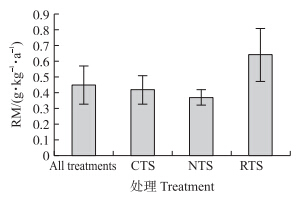 | 图 1 不同秸秆还田方式下我国南方稻田表土有机碳含量相对年变化量 Fig. 1 The RM under different straw return modes in paddy fields in South China RM:Relative annual change of topsoil organic content. The same as follows. |
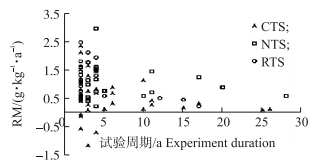 | 图 2 不同秸秆还田方式下我国南方稻田表土有机碳含量相对年变化量分布 Fig. 2 Distribution of RM under different straw return modes in paddy fields in South China |
从图 3可以看出:相较秸秆不还田,两熟制和三熟制稻田在秸秆还田下的表土有机碳含量相对年变化量均值分别为0.40和0.61 g · kg-1 · a-1,表明无论哪种种植制度,采取秸秆还田均能增加南方稻田表土有机碳含量。同一秸秆还田方式下,三熟制稻田的表土有机碳含量相对年变化量均显著高于两熟制,其中,NTS处理两者的差距最大,达2.0倍,CTS和RTS处理两者的差距稍小,但也分别达到了1.37和1.39倍。
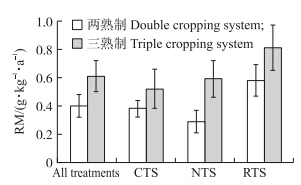 | 图 3 南方两熟制和三熟制稻田表土有机碳含量相对年变化量 Fig. 3 The RM under double cropping system and triple cropping system in paddy fields in South China |
从图 4可以看出:3种秸秆还田方式下表土有机碳含量相对年变化率在前5年的下降速率均较快,5年后速率逐渐变缓,并最终趋向于零,此时土壤有机碳达到了一种新的平衡。3种秸秆还田方式中,免耕秸秆还田的下降速率要低于其他2种还田方式。CTS、NTS和RTS 3种秸秆还田方式下的表土有机碳含量相对年变化率(Y)和持续时间(t)的关系可用以下3个非线性回归方程表达:



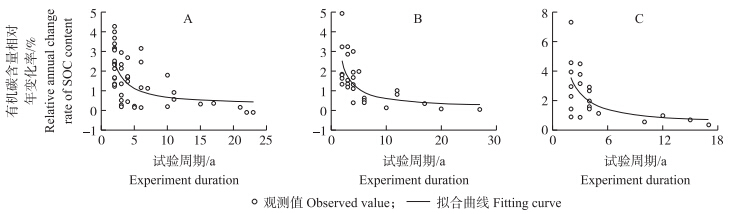 | 图 4 CTS(A)、NTS(B)和RTS(C)处理下土壤有机碳含量相对年变化率 Fig. 4 Relative annual change rate of soil organic carbon content under CTS(A),NTS(B)and RTS(C)treatments |
由上述公式计算得出,CTS、NTS和RTS 3种秸秆还田方式下,我国南方稻田表土有机碳固碳持续时间存在明显差异,分别是27、44和30年,以免耕秸秆还田方式为最长。根据3种秸秆还田方式下各自的固碳持续时间,依据微积分原理,可估算出CTS、NTS和RTS 3种秸秆还田方式在整个固碳持续时间内所能增加的有机碳比例分别为15.8%、23.3%和27.3%,其中旋耕秸秆还田处理增加的比例最高。 3 结论与讨论
本研究表明,我国南方稻田3种不同秸秆还田方式(CTS、NTS和RTS)下表土有机碳含量相对年变化量分别为0.42、0.37和0.64 g · kg-1 · a-1,说明秸秆还田有利于稻田土壤有机碳的积累[58]。本研究中,无论采取哪种秸秆还田方式,三熟制稻田表土有机碳含量相对年变化量都高于两熟制,这可能与一年三熟种植比两熟种植周年作物产量更高,从土壤中吸收走的物质更多,以及留给土壤的作物根茬和可能直接或者间接归还土壤的有机碳也相应增多有关[59]。本研究中,免耕秸秆还田下土壤表土有机碳含量的年增量稍低于翻耕秸秆还田,其原因可能是在免耕条件下土壤有机碳含量较低,免耕秸秆还田方式处理下秸秆位于土壤表层和上层,微生物总量较大、土壤酶活性较强,秸秆降解和再利用相对较快[17]。本研究还表明,旋耕秸秆还田下土壤表土有机碳含量显著高于免耕秸秆还田,其原因可能是免耕秸秆还田下有机碳含量主要附着于土壤表层,随着土壤深度的增加而逐渐递减,具有明显的表层富集现象,而旋耕秸秆还田则促进土壤扰动和植物残体输入,从而增加了耕层土壤有机碳含量[18],这与杨滨娟等[26]的研究结果相一致。且旋耕处理下土壤表土有机碳含量高于翻耕处理,因为秸秆还田后,旋耕处理能更加充分混合表层的作物秸秆与土壤,促进秸秆分解转化,减少有机碳以CO2的形式释放到大气中去[7]。
不同农业管理措施下土壤有机碳固定能力并不是无限的,土壤有机碳含量会在一段时间后达到一种饱和状态[55],该管理措施下土壤固碳的持续时间就是土壤有机碳达到稳定状态的时间[56]。本研究表明,翻耕秸秆还田下我国南方稻田表土固碳持续时间为27年,这与王成己等[10]估算得出的我国稻田秸秆还田下的固碳持续时间27年一致,但稍高于Rui等[11]估算出的我国长江三角洲地区稻田秸秆还田下的固碳持续时间20年。3种秸秆还田方式中,免耕秸秆还田的土壤固碳持续时间为44年,明显高于翻耕秸秆还田下的27年和旋耕秸秆还田下的30年,其原因可能是采取旋耕秸秆还田或翻耕秸秆还田的方式会导致土壤耕层松动,土壤中贮存的有机碳比较容易分解,而免耕秸秆还田则不受影响[60]。本研究还表明,在固碳周期内,CTS、NTS和RTS 3种秸秆还田方式下南方稻田所能增加的有机碳比例分别为15.8%、23.3%和27.3%,其中旋耕秸秆还田下的土壤表土有机碳增加的比例最高,这与段华平等[17]和胡乃娟等[7]的研究结果相一致。本研究中,翻耕秸秆还田在整个固碳周期27年内所增加的土壤有机碳比例为15.8%,此结果与聂军等[34]连续27年种植54季水稻后土壤所能增加的有机碳比例14.3%较为接近,说明本研究结果与现实情况较为吻合。本研究中,免耕秸秆还田在17年内所增加的土壤有机碳比例为12.5%,与潘根兴等[49]连续进行17年的免耕秸秆还田试验所得出的11.4%较为一致,旋耕秸秆还田在14年内所增加的土壤有机碳比例为15.6%,与孙星等[30]连续14年旋耕秸秆还田试验所得出的14.1%较为接近,均说明本研究所得结果较为可信;上述比例均明显低于免耕秸秆还田和旋耕秸秆还田在整个固碳周期内所增加的比例,可能是因为试验时间均远未达到农田土壤碳平衡点所致。
综上所述,相对于其他秸秆还田方式来说,旋耕秸秆还田处理下南方稻田表土有机碳含量相对年变化量最大,且在整个固碳持续时间内表土有机碳所能增加的比例也为最高。从各种秸秆还田的技术层面考虑,旋耕秸秆还田更易推广,因为此方法方便快捷,大大减少用工,且还田数量较多[61];而翻耕秸秆还田增加了用工量,免耕秸秆还田在南方地区较难推广,因为南方一般种植单季稻或者双季稻,稻秸秆量大覆盖还田秸秆腐熟慢,影响下季作物种植[62]。另外,虽然区域性的数据分析能够有效地反映不同的秸秆还田方式的固碳潜力,但由于本研究中稻田试验点主要集中在东南部,并未完全覆盖我国南方所有区域,而且试验期限较短,故本研究存在一定的瑕疵。与此同时,秸秆还田可以增加稻田表土有机碳含量,也可能会增加温室气体如CH4等的排放。因此,在今后的研究中,我们应在西南地区多开展稻田不同秸秆还田方式试验,而且在研究中应同时考虑温室气体的排放,以使研究结果更具说服力。
| [1] | 李正才, 傅懋毅, 杨校生. 经营干扰对森林土壤有机碳的影响研究概述[J]. 浙江林学院学报, 2005, 22(4):469-474[Li Z C, Fu M Y, Yang X S. Review on effects of management disturbance on forest soil organic carbon[J]. Journal of Zhejiang Forestry College, 2005, 22(4):469-474(in Chinese with English abstract)] |
| [2] | Lal R. Soil carbon sequestration impacts on global climate change and food security[J]. Science, 2004, 304(5677):1623-1627 |
| [3] | 潘根兴, 李恋卿, 张旭辉. 土壤有机碳库与全球变化研究的若干前沿问题——兼开展中国水稻土有机碳固定研究的建议[J]. 南京农业大学学报, 2002, 25(3):100-109. doi:10.7685/j.issn.1000-2030.2002.03.023[Pan G X, Li L Q, Zhang X H. Perspectives on issues of soil carbon pools and global change-with suggestions for studying organic carbon sequestration in paddy soils of China[J]. Journal of Nanjing Agricultural University, 2002, 25(3):100-109(in Chinese with English abstract)] |
| [4] | 潘根兴, 赵其国. 我国农田土壤碳库演变研究:全球变化和国家粮食安全[J]. 地球科学进展, 2005, 20(4):384-393[Pan G X, Zhao Q G. Study on evolution of organic carbon stock in agricultural soils of China:facing the challenge of global change and food security[J]. Advances in Earth Science, 2005, 20(4):384-393(in Chinese with English abstract)] |
| [5] | IPCC. Climate Change 2007:Mitigation of Climate Change of Working Groups Ⅲ to the Fourth Assessment Report of the Intergovernmental Panel on Climate Change[M]. Cambridge, UK:Cambridge University Press, 2007 |
| [6] | Smith P, Martino D, Cai Z C, et al. Policy and technological constraints to implementation of greenhouse gas mitigation options in agriculture[J]. Agriculture, Ecosystems and Environment, 2007, 118:6-28 |
| [7] | 胡乃娟, 张四伟, 杨敏芳, 等. 秸秆还田与耕作方式对稻麦轮作农田土壤碳库及结构的影响[J]. 南京农业大学学报, 2013, 36(4):7-12. doi:10.7685/j.issn.1000-2030.2013.04.002[Hu N J, Zhang S W, Yang M F, et al. Effects of different tillage and straw return on soil carbon pool and soil structure under rice-wheat rotation system[J]. Journal of Nanjing Agricultural University, 2013, 36(4):7-12(in Chinese with English abstract)] |
| [8] | Pan G X, Xu X W, Smith P, et al. An increase in topsoil SOC stock of China's croplands between 1985 and 2006 revealed by soil monitoring[J]. Agriculture, Ecosystems and Environment, 2010, 136:133-138 |
| [9] | 田康, 赵永存, 邢喆, 等. 中国保护性耕作农田土壤有机碳变化速率研究——基于长期试验点的Meta分析[J]. 土壤学报, 2013, 50(3):433-440[Tian K, Zhao Y C, Xing Z, et al. A Meta-analysis of long-term experiment data for characterizing the topsoil organic carbon Chinese under different conservation tillage in cropland of China[J]. Acta Pedologica Sinica, 2013, 50(3):433-440(in Chinese with English abstract)] |
| [10] | 王成己, 潘根兴, 田有国. 保护性耕作下农田表土有机碳含量变化特征分析——基于中国农业生态系统长期试验资料[J]. 农业环境科学学报, 2009, 28(12):2464-2475[Wang C J, Pan G X, Tian Y G. Characteristics of cropland topsoil organic carbon dynamics under different conservation tillage treatments based on long-term agro-ecosystem experiments across mainland China[J]. Journal of Agro-Environment Science, 2009, 28(12):2464-2475(in Chinese with English abstract)] |
| [11] | Rui W Y, Zhang W J. Effect size and duration of recommended management practices on carbon sequestration in paddy field in Yangtze Delta Plain of China:a meta-analysis[J]. Agrculture, Ecocystems and Environment, 2010, 135(3):199-205 |
| [12] | 朱利群, 杨敏芳, 徐敏轮, 等. 不同施肥措施对我国南方稻田表土有机碳含量及固碳持续时间的影响[J]. 应用生态学报, 2012, 23(1):87-95[Zhu L Q, Yang M F, Xu M L, et al. Effects of different fertilizations on topsoil organic carbon content and carbon sequestration duration in paddy fields in south China[J]. Chinese Journal of Applied Ecology, 2012, 23(1):87-95(in Chinese with English abstract)] |
| [13] | Liao Q L, Zhang X H, Li Z P, et al. Increase in soil organic carbon stock over the last two decades in China's Jiangsu Province[J]. Global Change Biology, 2009, 15:861-875 |
| [14] | 周萍, 潘根兴, 李恋卿, 等. 南方典型水稻土长期试验下有机碳积累机制. Ⅴ. 碳输入与土壤碳固定[J]. 中国农业科学, 2009, 42(12):4260-4268[Zhou P, Pan G X, Li L Q, et al. SOC enhancement in major types of paddy soils in a long-term agro-ecosystem experiment in South China. Ⅴ. Relationship between carbon input and soil carbon sequestration[J]. Scientia Agricultura Sinica, 2009, 42(12):4260-4268(in Chinese with English abstract)] |
| [15] | 国家统计局. 2013年中国统计年鉴[M]. 北京:中国统计出版社, 2013[National Bureau of Statistics. 2013 China Statistical Yearbook[M]. Beijing:China Statistics Press, 2013(in Chinese)] |
| [16] | 刘世平, 陈后庆, 聂新涛. 稻麦两熟制不同耕作方式与秸秆还田土壤肥力的综合评价[J]. 农业工程学报, 2008, 24(5):51-56[Liu S P, Chen H Q, Nie X T, et al. Comprehensive evaluation of tillage and straw returning on soil fertility in a wheat-rice double cropping system[J]. Transactions of the CSAE, 2008, 24(5):51-56(in Chinese with English abstract)] |
| [17] | 段华平, 牛永志, 李凤博, 等. 耕作方式和秸秆还田对直播稻产量及稻田土壤碳固定的影响[J]. 江苏农业学报, 2009, 25(3):706-708[Duan H P, Niu Y Z, Li F B, et al. Effects of tillage styles and straw return on soil carbon sequestration and crop yields of direct seeding rice[J]. Jiangsu Journal of Agricultural Sciences, 2009, 25(3):706-708(in Chinese with English abstract)] |
| [18] | 何莹莹, 张海林, 孙国锋, 等. 耕作措施对双季稻田土壤碳及有机碳储量的影响[J]. 农业环境科学学报, 2010, 29(1):200-204[He Y Y, Zhang H L, Sun G F, et al. Effect of different tillage on soil organic carbon and the organic carbon storage in two-crop paddy field[J]. Journal of Agro-Environment Science, 2010, 29(1):200-204(in Chinese with English abstract)] |
| [19] | 张永春, 汪吉东, 聂国书, 等. 不同量秸秆机械化还田对稻麦产量及土壤碳活性的影响[J]. 江苏农业学报, 2008, 24(6):833-838[Zhang Y C, Wang J D, Nie G S, et al. Effect of mechanized straw application on crop yields and soil labile carbon content[J]. Jiangsu Journal of Agricultural Sciences, 2008, 24(6):833-838(in Chinese with English abstract)] |
| [20] | 徐尚起, 崔思远, 陈阜, 等. 耕作方式对稻田土壤有机碳组分含量及其分布的影响[J]. 农业环境科学学报, 2011, 30(1):127-132[Xu S Q, Cui S Y, Chen F, et al. Effect of tillage on content of density fractions of paddy soil organic carbon and its spatial distribution[J]. Journal of Agro-Environment Science, 2011, 30(1):127-132(in Chinese with English abstract)] |
| [21] | 张四伟, 张武益, 王梁, 等. 耕作方式与秸秆还田对麦田土壤有机碳积累的影响[J]. 江西农业学报, 2012, 24(8):6-9[Zhang S W, Zhang W Y, Wang L, et al. Influences of tillage mode and straw returning on accumulation of organic carbon in soil of wheat field[J]. Acta Agriculturae Jiangxi, 2012, 24(8):6-9(in Chinese with English abstract)] |
| [22] | 余延丰, 熊桂云, 张继铭, 等. 秸秆还田对作物产量和土壤肥力的影响[J]. 湖北农业科学, 2008, 47(2):169-171[Yu Y F, Xiong G Y, Zhang J M, et al. The effect of straw reapplication on yields of grain crops and soil fertility in Jianghan Plain[J]. Hubei Agricultural Sciences, 2008, 47(2):169-171(in Chinese with English abstract)] |
| [23] | 朱钟麟, 舒丽, 刘定辉. 秸秆还田和免耕对水稻土微形态特征的影响[J]. 生态环境, 2008, 17(2):682-687[Zhu Z L, Shu L, Liu D H, et al. Effect of straw mulched and no tillage to paddy soils on micro-morphology features[J]. Ecology and Environment, 2008, 17(2):682-687(in Chinese with English abstract)] |
| [24] | 徐祖祥. 连续秸秆还田对作物产量和土壤养分的影响[J]. 浙江农业科学, 2003, 17(1):35-36[Xu Z X. Effects of applying crop stalk of each crop to fields on the crop yield and soil nutrients during 5 years[J]. Journal of Zhejiang Agricultural Sciences, 2003, 17(1):35-36(in Chinese with English abstract)] |
| [25] | 朱利群, 张大伟, 卞新民. 连续秸秆还田与耕作方式轮换对稻麦轮作田土壤理化性状变化及水稻产量构成的影响[J]. 土壤通报, 2011, 42(1):81-85[Zhu L Q, Zhang D W, Bian X M. Effects of continuous returning straw to field and shifting different tillage methods on changes of physical-chemical properties of soil and yield components of rice[J]. Chinese Journal of Soil Science, 2011, 42(1):81-85(in Chinese with English abstract)] |
| [26] | 杨滨娟, 黄国勤, 钱海燕, 等. 秸秆还田对稻田生态系统环境质量影响的初步研究[J]. 中国农学通报, 2012, 28(2):200-208[Yang B J, Huang G Q, Qian H Y, et al. The preliminary research about the influence of rice-straw returning on the rice ecosystem environment quality[J]. Chinese Agricultural Science Bulletin, 2012, 28(2):200-208(in Chinese with English abstract)] |
| [27] | 武际, 郭熙盛, 鲁剑巍, 等. 水旱轮作制下连续秸秆覆盖对土壤理化性质和作物产量的影响[J]. 植物营养与肥料学报, 2012, 18(3):587-594[Wu J, Guo X S, Lu J W, et al. Effects of continuous straw mulching on soil physical and chemical properties and crop yields in paddy-upland rotation system[J]. Plant Nutrition and Fertilizer Science, 2012, 18(3):587-594(in Chinese with English abstract)] |
| [28] | 李腊梅, 陆琴. 太湖地区稻麦二熟制下长期秸秆还田对土壤酶活性的影响[J]. 土壤, 2006, 38(4):422-428[Li L M, Lu Q. Effect of long-term straw incorporation on enzyme activity in paddy soil under rice-wheat rotation in Taihu region[J]. Soils, 2006, 38(4):422-428(in Chinese with English abstract)] |
| [29] | 徐祖祥. 长期定位施肥对水稻、小麦产量和土壤养分的影响[J]. 浙江农业学报, 2009, 21(5):485-489[Xu Z X. Effect of long-term located fertilization on the yields of rice and wheat and soil nutrient[J]. Acta Agriculturae Zhejiangensis, 2009, 21(5):485-489(in Chinese with English abstract)] |
| [30] | 孙星, 刘勤, 王德建, 等. 长期秸秆还田对土壤肥力质量的影响[J]. 土壤, 2007, 39(5):782-786[Sun X, Liu Q, Wang D J, et al. Effect of long-term straw application on soil fertility[J]. Soils, 2007, 39(5):782-786(in Chinese with English abstract)] |
| [31] | 邵景安, 唐晓红, 魏朝富, 等. 保护性耕作对稻田土壤有机质的影响[J]. 生态学报, 2007, 27(11):4434-4442[Shao J A, Tang X H, Wei C F, et al. Effects of conservation tillage on soil organic matter in paddy rice cultivation[J]. Acta Ecologica Sinica, 2007, 27(11):4434-4442(in English)] |
| [32] | 汪寅虎, 柯福源, 张明芝, 等. 长期定位条件下秸秆还田的综合效应研究[J]. 土壤通报, 1994, 25(7):53-56[Wang Y H, Ke F Y, Zhang M Z, et al. The combined effect of long-term conditions of straw to field[J]. Chinese Journal of Soil Science, 1994, 25(7):53-56(in Chinese)] |
| [33] | 向艳文, 郑圣先, 廖育林, 等. 长期施肥对红壤水稻土水稳性团聚体有机碳、氮分布与储量的影响[J]. 中国农业科学, 2009, 42(7):2415-2424[Xiang Y W, Zheng S X, Liao Y L, et al. Effects of long-term fertilization on distribution and storage of organic carbon and nitrogen in water-stable Aggregates of red paddy soil[J]. Scientia Agricultura Sinica, 2009, 42(7):2415-2424(in Chinese with English abstract)] |
| [34] | 聂军, 郑圣先, 杨曾平, 等. 长期施用化肥、猪粪和稻草对红壤性水稻土物理性质的影响[J]. 中国农业科学, 2010, 43(7):1404-1413[Nie J, Zheng S X, Yang Z P, et al. Effects of long-term application of chemical fertilizer, pig manure and rice straw on physical properties of a reddish paddy soil[J]. Scientia Agricultura Sinica, 2010, 43(7):1404-1413(in Chinese with English abstract)] |
| [35] | 周萍, 宋国菡, 潘根兴, 等. 南方三种典型水稻土长期试验下有机碳积累机制研究.Ⅰ. 团聚体物理保护作用[J]. 土壤学报, 2008, 45(6):1063-1071[Zhou P, Song G H, Pan G X, et al. SOC accumulation in three major types of paddy soils under long-term agro-ecosystem experiments from south China.Ⅰ. Physical protection in soil micro-aggregates[J]. Acta Pedologica Sinica, 2008, 45(6):1063-1071(in Chinese with English abstract)] |
| [36] | 徐国伟. 种植方式、秸秆还田与实地氮肥管理对水稻产量与品质的影响及其生理的研究[D]. 扬州:扬州大学, 2007[Xu G W. Effects of planting patterns, straw application and site specific nitrogen management on grain yield and quality of rice and their physiological mechanism[D]. Yangzhou:Yangzhou University, 2007(in Chinese with English abstract)] |
| [37] | 高洁. 耕作方式和秸秆还田对江苏沿江地区稻田土壤肥力的影响[D]. 南京:南京农业大学, 2012[Gao J. Impacts of soil tillage methods and crop straw recycling on the soil fertility of rice field in the region along Yangtze river of Jiangsu Province[D]. Nanjing:Nanjing Agricultural University, 2012(in Chinese with English abstract)] |
| [38] | 卜毓坚. 不同耕作方式和稻草还田量对晚稻生长发育与土壤肥力的影响[D]. 长沙:湖南农业大学, 2007[Bu Y J. The effects of different tillage and rice straw returning on the rice growth and soil fertility[D]. Changsha:Hunan Agricultural University, 2007(in Chinese with English abstract)] |
| [39] | 王允青, 郭熙盛. 不同水分管理条件下秸秆还田方式对作物养分吸收、产量及土壤培肥的影响[J]. 中国农学通报, 2008, 24(12):153-157[Wang Y Q, Guo X S. Effects of straw-returning manner on nutrient uptake, yield and soil fertility maintaining under different water managements[J]. Chinese Agricultural Science Bulletin, 2008, 24(12):153-157(in Chinese with English abstract)] |
| [40] | 高雪涛, 王卫, 谢小立, 等. 红壤旱地稻草覆盖对夏玉米抗旱性的影响[J]. 中国生态农业学报, 2013, 21(10):1193-1201[Gao X T, Wang W, Xie X L, et al. Effect of straw mulching on drought resistance of summer maize in upland red soils[J]. Chinese Journal of Eco-Agriculture, 2013, 21(10):1193-1201(in Chinese with English abstract)] |
| [41] | 肖丽霞, 解庆友, 郑建渠, 等. 稻麦双套不同秸秆还田方式对作物产量及土壤肥力的影响[J]. 上海农业科技, 2005(6):63-65[Xiao L X, Xie Q Y, Zheng J Q, et al. Dual sets of different ways of rice and wheat straw on crop yield and soil fertility[J]. Shanghai Agricultural Science and Technology, 2005(6):63-65(in Chinese)] |
| [42] | 周江明, 徐大连, 薛才余. 稻草还田综合效益研究[J]. 中国农学通报, 2002, 18(4):7-10[Zhou J M, Xu D L, Xue C Y. Study of comprehensive utilization efficiency of returning rice straw to field[J]. Chinese Agricultural Science Bulletin, 2002, 18(4):7-10(in Chinese with English abstract)] |
| [43] | 许仁良. 麦秸还田对水稻产量、品质及环境效应的影响[D]. 扬州:扬州大学, 2010[Xu R L. Effects of straw applying on rice yield, quality and environment[D]. Yangzhou:Yangzhou University, 2010(in Chinese with English abstract)] |
| [44] | 高凤云, 徐广辉, 居立海. 秸秆还田对水稻产量与土壤性状的影响[J]. 农技服务, 2012(1):33, 35[Gao F Y, Xu G H, Ju L H. Straw returning on rice yield and soil properties[J]. Agricultural Technology Service, 2012(1):33, 35(in Chinese)] |
| [45] | 杨志臣, 吕贻忠, 张凤荣, 等. 秸秆还田和腐熟有机肥对水稻土培肥效果对比分析[J]. 农业工程学报, 2008, 24(3):214-218[Yang Z C, Lu Y Z, Zhang F R, et al. Comparative analysis of the effects of straw-returning and decomposed manure on paddy soil fertility betterment[J]. Transactions of the CSAE, 2008, 24(3):214-218(in Chinese with English abstract)] |
| [46] | 严洁, 邓良基, 黄剑. 保护性耕作对土壤理化性质和作物产量的影响[J]. 中国农机化, 2005, 24(2):31-34[Yan J, Deng L J, Huang J. Effect of conservation tillage on soil physicochemical properties and crop yield[J]. Chinese Agricultural Mechanization, 2005, 24(2):31-34(in Chinese with English abstract)] |
| [47] | 陈尚洪, 朱钟麟, 刘定辉, 等. 秸秆还田和免耕对土壤养分及碳库管理指数的影响研究[J]. 植物营养与肥料学报, 2008, 14(4):806-809[Chen S H, Zhu Z L, Liu D H, et al. Influence of straw mulching with no-tillage on soil nutrients and carbon pool management index[J]. Plant Nutrition and Fertilizer Science, 2008, 14(4):806-809(in Chinese with English abstract)] |
| [48] | 徐祖祥. 长期不同施肥对作物产量和土壤肥力的影响[J]. 浙江农业科学, 2007(4):439-441, 444[Xu Z X. Long-term effects of different fertilization on crop yield and soil fertility[J]. Acta Agriculturae Zhejiangensis, 2007(4):439-441, 444(in Chinese)] |
| [49] | 潘根兴, 周萍, 张旭辉, 等. 不同施肥对水稻土作物碳同化与土壤碳固定的影响—以太湖地区黄泥土肥料长期试验为例[J]. 生态学报, 2006, 26(11):3704-3710[Pan G X, Zhou P, Zhang X H, et al. Effect of different fertilization practices on crop carbon assimilation and soil carbon sequestration:a case of a paddy under a long-term fertilization trial from the Tai Lake region, China[J]. Acta Ecologica Sinica, 2006, 26(11):3704-3710(in Chinese with English abstract)] |
| [50] | 顾丽. 长期与短期秸秆还田后稻米品质的差异性变化研究[D]. 扬州:扬州大学, 2008[Gu L. Different effects of long-term and short-term straw application on quality of rice[D]. Yangzhou:Yangzhou University, 2008(in Chinese with English abstract)] |
| [51] | 李大明. 免耕和秸秆覆盖旱作稻田甲烷排放及甲烷产生菌群落结构和数量的变化特征[D]. 南京:南京农业大学, 2010[Li D M. The dynamic of methane emission and the community structure and population of methanogens under no-tillage and non-flooded with straw mulching paddy field of southeast China[D]. Nanjing:Nanjing Agricultural University, 2010(in Chinese with English abstract)] |
| [52] | 潘世娟. 长期定位施肥条件下水田土壤有机质和全氮累积变化研究[D]. 杨凌:西北农林科技大学, 2011[Pan S J. Study on changes of soil organic matter and total nitrogen in paddy soil under long-term experiments[D]. Yangling:Northwest A&F University, 2011(in Chinese with English abstract)] |
| [53] | 高亚军, 朱培立, 黄东迈, 等. 稻麦轮作条件下长期不同土壤管理对有机质和全氮的影响[J]. 土壤与环境, 2000, 9(1):27-30[Gao Y J, Zhu P L, Huang D M, et al. Long-term impact of different soil management on organic matter and total nitrogen in rice-based cropping system[J]. Soil and Environmental Sciences, 2000, 9(1):27-30(in Chinese with English abstract)] |
| [54] | Fedorov S. Get Data Graph Digitizer Version 2.23. Russia:Get data-graph-digitizer-com. 2002 |
| [55] | Johnson M G, Levine E R, Kern J S. Soil organic matter:distribution, genesis and management to reduce green-house gas emissions[J]. Water, Air and Soil Pollution, 1995, 82:593-615 |
| [56] | West T O, Six J. Considering the influence of sequestration duration and carbon saturation on estimates of soil carbon capacity[J]. Climatic Change, 2007, 80:25-41 |
| [57] | Systat Software Incorporated. Sigmaplot 11.0. California:Systat Software Incorporated[M]. 2008 |
| [58] | 郝建华, 丁艳锋, 王强盛, 等. 麦秸还田对水稻群体质量和土壤特性的影响[J]. 南京农业大学学报, 2010, 33(3):13-18. doi:10.7685/j.issn.1000-2030.2010.03.003[Hao J H, Ding Y F, Wang Q S, et al. Effect of wheat crop straw application on the quality of rice population and soil properties[J]. Journal of Nanjing Agricultural University, 2010, 33(3):13-18(in Chinese with English abstract)] |
| [59] | Halvorson A D, Wienhold B J, Black A L. Tillage, nitrogen and cropping system effects on soil carbon sequestration[J]. Soil Sci Soc Am J, 2002, 66:906-912 |
| [60] | West T O, Post W M. Soil organic carbon sequestration rates by tillage and crop rotation:a global data analysis[J]. Soil Sci Soc Am J, 2002, 66:1930-1946 |
| [61] | 李启海. 秸秆还田技术的方式及影响[J]. 现代农业科技, 2010(15):322-323[Li Q H. The methods and effects of straw return technology[J]. Modern Agricultural Science and Technology, 2010(15):322-323(in Chinese)] |
| [62] | 潘宁, 张守成, 徐加健, 等. 秸秆还田对农作物生长土壤环境的影响及对策[J]. 上海农业科技, 2010(2):22-23[Pan N, Zhang S S, Xu J J, et al. Effects and countermeasures of straw return on soil environment for crop growth[J]. Shanghai AgriculturalScience and Technology, 2010(2):22-23(in Chinese)] |