 2019, Vol. 55
文章信息
- 单燕飞, 王为宇, 项伟霞, 宋丽丽, 周敏樱, 陈嘉伟, 索金伟, 喻卫武, 吴家胜, 胡渊渊.
- Shan Yanfei, Wang Weiyu, Xiang Weixia, Song Lili, Zhou Minyin, Chen Jiawei, Suo Jinwei, Yu Weiwu, Wu Jiasheng, Hu Yuanyuan.
- 堆沤温度对后熟过程中榧籽主要营养物质变化的影响
- Effect of Retting Temperature on Transformation of Main Nutrients in Seeds of Different Torreya grandis Cultivars during After-Ripening Period
- 林业科学, 2019, 55(7): 46-56.
- Scientia Silvae Sinicae, 2019, 55(7): 46-56.
- DOI: 10.11707/j.1001-7488.20190705
-
文章历史
- 收稿日期:2018-08-15
- 修回日期:2018-11-12
-
作者相关文章


2. 浙江省杭州临安区农技推广中心 杭州 311300
2. Agro Forestry Extension Center, Lin'an Districts Hangzhou Hangzhou 311300
后熟通常是指果实/种子离开植株后的成熟现象,是由收获成熟向食用成熟(生理成熟)过渡的过程。研究表明,果实/种子的后熟过程直接影响果实/种子的品质、贮运及后续的加工产品(贾祥祥等,2016;范昱等,2018)。淀粉、蛋白质和脂肪是植物果实/种子中的3大主要贮藏物质,随着后熟作用推进,种子/果实内部的淀粉、蛋白质、脂肪等含量会发生变化,且不同植物变化的趋势不同(吴震等,1997;芮海云,2009;段承俐等,2010;范昱等,2018)。温度是影响果实/种子后熟过程的重要外界因素之一,高温(30 ℃)会影响后熟过程中的物质转化,加快后熟过程中淀粉降解(庞学群等,2008),而低温则相反(齐秀东等,2015)。高温处理下(40 ℃)甘蓝型油菜(Brassica napus)籽粒后熟过程中的含油率始终显著高于对照温度处理下(32 ℃)的含油率,而蛋白质含量则对高温基本无响应(伊淑丽等,2008)。贾晓辉等(2014)研究发现,20 ℃处理下3种软肉梨淀粉降解速度快于26 ℃处理;与正常冷藏处理[(8±0.5) ℃]相比,冷激处理(3 ℃)6 h可使香蕉(Musa nana)中可溶性蛋白降解减缓(邱佳容等,2015)。可见,不同植物果实/种子后熟过程对温度的响应不同。
榧树是我国特有的珍稀经济树种之一,已有1 300多年的种植历史,主要分布于浙江、安徽、江苏、江西、福建、湖南、湖北南部及贵州东部(程晓建等,2007)。香榧(Torreya grandis)为榧树属(Torreya)经人工嫁接栽培而成的优良变异类型,其种仁风味独特,营养价值高,富含优质脂肪酸、蛋白质和多种微量元素(黎章矩等,2007;刘萌萌,2014)。香榧种仁内含单宁,必须经过后熟处理才能食用,生产上榧农通常于9月中下旬采摘开裂果,并置于室内进行堆沤(平均气温20~30 ℃)后熟。叶珊等(2017)研究不同采收成熟度和堆沤方式对香榧种子堆沤后熟品质的影响,初步揭示了香榧种子堆沤后熟过程中淀粉、含油率、可溶性蛋白含量和脂肪酸组分的变化规律。然而,榧树雌雄异株,异花授粉,种内变异多,栽培种种类丰富,不同栽培种之间的营养物质含量存在较大差异(马长乐等,2015),目前有关后熟过程中不同品种榧籽贮藏物质变化的研究还未见报道。明确后熟过程中不同品种榧籽的物质转化及对不同堆沤温度的响应机制,对提升榧籽后熟品质、科学量化榧籽堆沤工艺技术具有重要意义。鉴于此,本研究通过比较不同堆沤温度处理下(20 ℃和30 ℃)后熟过程中4种榧籽[栽培种:朱岩榧(T. grandis ‘zhuyan’)、丁香榧(T. grandis ‘Dingxiang’)和东榧3号(T. grandis ‘Dong No.3’);野生种:木榧(T. grandis Fort. Ex. Lind))种衣颜色及种仁中淀粉、可溶性蛋白、含油率和脂肪酸组分的变化,揭示不同品种榧籽后熟过程中主要营养物质变化规律的差异,阐明堆沤温度对不同品种榧籽后熟品质形成的调控机制,以期为提高榧籽后熟品质和香榧产业链的健康发展提供理论和实践指导。
1 材料与方法 1.1 试验材料试验所用朱岩榧、丁香榧、东榧3号3个栽培种和木榧野生种榧籽采自“香榧之乡”——浙江省东阳市虎鹿镇西垣村,该地海拔300~600 m。于2016年9月20日,假种皮为青绿色、已开裂时采收。采收后的种子置于阴凉通风处放置过夜,除去田间热,采用一次堆沤法,即人工剥去榧籽假种皮,堆积于人工气候室地面,堆积高度为(15±2)cm、长度和宽度均为(35±2)cm,种籽堆上方再铺一层黑纱,黑纱上铺2~3 cm草纸用于保温保湿,设置2个堆沤温度:(20±2)℃(T20)和(30±2)℃(T30);湿度保持在90%~95%,每天翻堆,堆积至榧籽完成后熟(堆沤20天)。堆沤期间每5天随机取样1次,每处理设置3次重复。取样时,人工剥去种壳和外种衣,取种仁中间部分切碎,液氮冷冻后-20 ℃保存备用。
1.2 试验方法 1.2.1 淀粉和可溶性蛋白含量测定淀粉含量参照崔喜燕(2008)蒽酮比色法进行测定,可溶性蛋白含量参照陈建勋等(2002)考马斯亮蓝染色法进行测定。每处理3次重复。
1.2.2 油脂含量及脂肪酸组分测定油脂提取参照国标GB/T 14772—2008索氏抽提法。脂肪酸组分测定采用气相色谱法,将提出的油进行甲酯化,方法参照国际GB/T 17376—2008甲酯交换法,采用Agilent 7890A气相色谱仪。GC条件:DB-WAX弹性石英毛细管柱(30 m×0.25 mm× 0.25 μm),载气为氦气,进样口温度220 ℃,1 μL进样量,分流比80:1,程序升温为初始温度150 ℃,保持1 min,再以4 ℃·min-1升至255 ℃。
1.3 数据分析处理采用Excel2010软件对数据进行整理,SPSS20软件对数据进行方差分析,利用LSD法进行多重比较,使用Sigma Plot 12.5软件进行图表绘制。
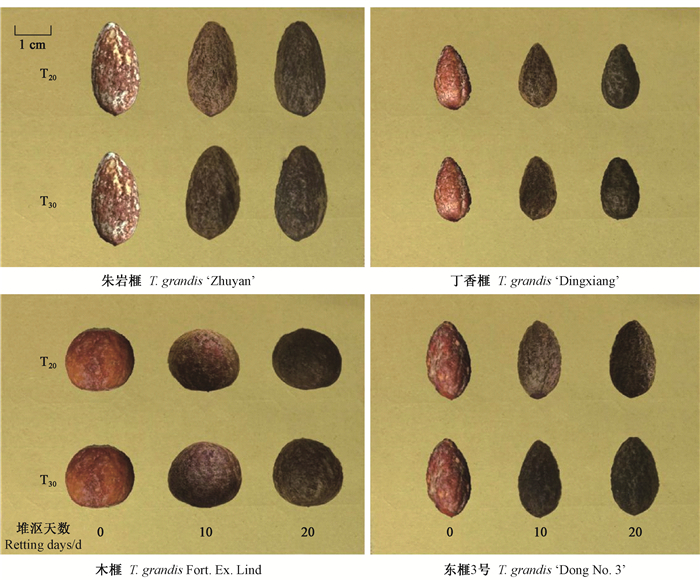
2 结果与分析 2.1 不同堆沤温度下后熟过程中4种榧籽种衣颜色的变化生产实践中,香榧后熟完成的标志为种衣由紫红色转黑褐色。由图 1可知,堆沤前,4种榧籽的种衣均呈淡紫红色。T20处理20天时,4种榧籽的种衣均呈深黑褐色,外观上已完成后熟。T30处理10天时,朱岩榧、丁香榧和东榧3号榧籽的种衣均已呈深黑褐色,木榧榧籽的种衣则呈浅黑褐色。
|
图 1 不同堆沤温度下后熟过程中4种榧籽种衣颜色的变化 Fig. 1 The changes in the color of inter seed coat of the four T. grandis cultivars with different retting temperature during after-ripening period T20:堆沤温度为20 ℃ The retting temperature is 20 ℃; T30:堆沤温度为30 ℃ The retting temperature is 30 ℃.下同The same below. |
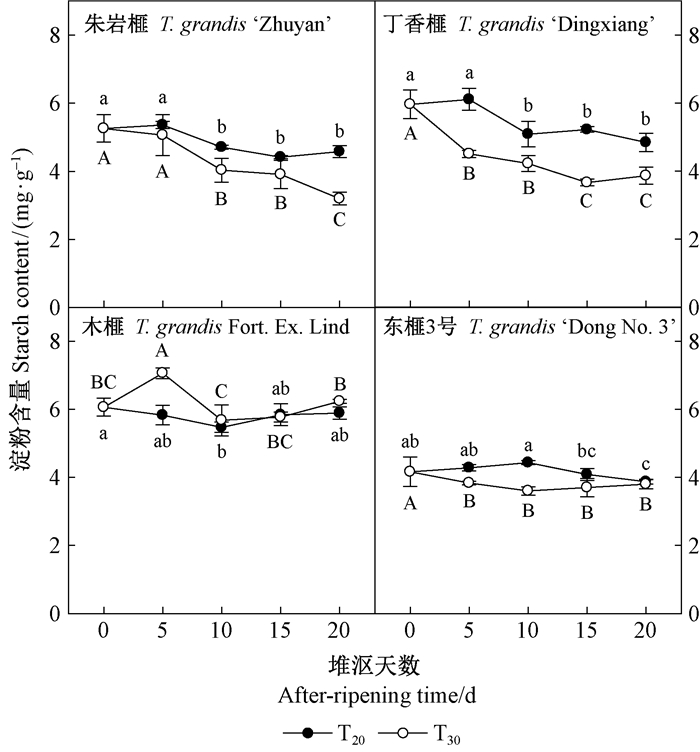
由图 2可知,堆沤前,4种榧籽的淀粉含量从高到低依次为木榧[(6.06±0.26)mg·g-1]、丁香榧[(5.96±0.42)mg·g-1]、朱岩榧[(5.26±0.40)mg·g-1]、东榧3号[(4.16±0.43)mg·g-1]。不同堆沤温度下,随着堆沤时间延长,4种榧籽的淀粉含量变化存在差异,除木榧的淀粉含量未发生明显变化外,其余3种榧籽的淀粉含量均呈明显下降趋势,其中T20处理20天和T30处理10天时,朱岩榧的淀粉含量较堆沤前下降12.92%和23.29%;丁香榧的淀粉含量较堆沤前下降18.75%和29.15%;东榧3号的淀粉含量较堆沤前下降7.67%和13.44%。
|
图 2 不同堆沤温度下后熟过程中4种榧籽淀粉含量的变化 Fig. 2 The changes in starch content of the four T. grandis cultivars with different retting temperature during after-ripening period 不同字母表示同一种相同堆沤温度下不同堆沤时间存在显著差异(P<0.05), 大写字母为30 ℃下的差异显著性分析, 小写字母为20 ℃下的差异显著性分析。下同。 The retting temperature is 30 ℃; The different letters in the same cultivar with the same rettingtemperature during different after-ripening time mean significant difference between them(P < 0.05), the capital letter means the significance of difference under 30 ℃, the small letter means the significance of difference under 20 ℃. The same below. |
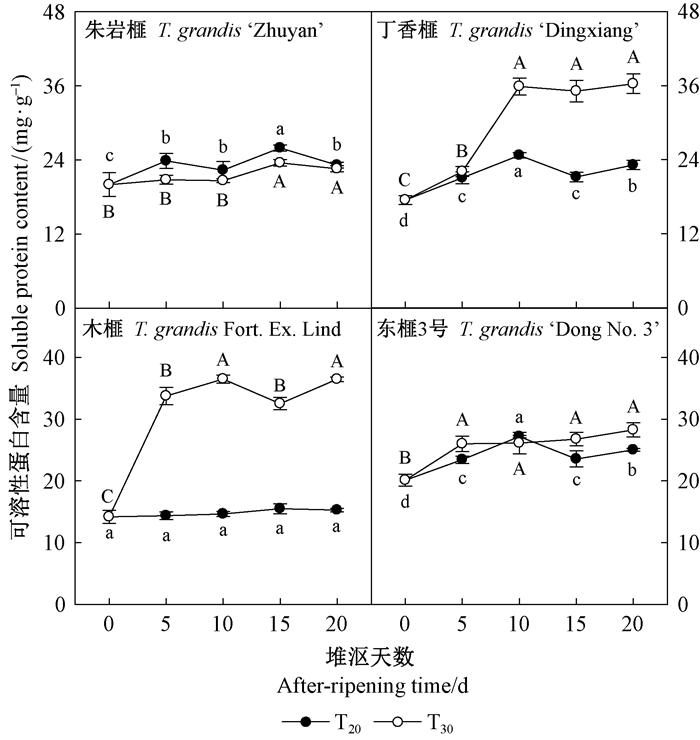
由图 3可知,堆沤前,4种榧籽的可溶性蛋白含量从高到低依次为东榧3号[(20.10± 0.96)mg·g-1]、朱岩榧[(19.99±1.92)mg·g-1]、丁香榧[(17.49±0.73)mg·g-1]、木榧[(14.18± 1.04)mg·g-1]。不同堆沤温度下,4种榧籽的可溶性蛋白含量变化存在差异。T20处理下,随着堆沤时间延长,除木榧外,其余3种榧籽的可溶性蛋白含量均呈逐渐增加趋势。对朱岩榧而言,T20处理20天时,其可溶性蛋白含量较堆沤前增加15.77%;T30处理10天时,其可溶性蛋白含量较堆沤前无明显变化。与堆沤前相比,T20处理20天时,丁香榧的可溶性蛋白含量增加32.43%;T30处理10天时,其可溶性蛋白含量增加105.11%。随着堆沤时间延长,T20处理下,东榧3号的可溶性蛋白含量呈先升高后降低趋势,堆沤处理20天时,其可溶性蛋白含量较堆沤前增加24.47%;T30处理10天时,其可溶性蛋白含量增加29.96%。对木榧而言,随堆沤时间延长,T20处理下,其可溶性蛋白含量较堆沤前未发生明显变化;T30处理下,其可溶性蛋白含量则显著升高,T30处理10天时,其可溶性蛋白含量增加157.36%。
|
图 3 不同堆沤温度下后熟过程中4种榧籽可溶性蛋白含量的变化 Fig. 3 The changes in soluble protein content of the four T. grandis cultivars with different retting temperature during after-ripening period |
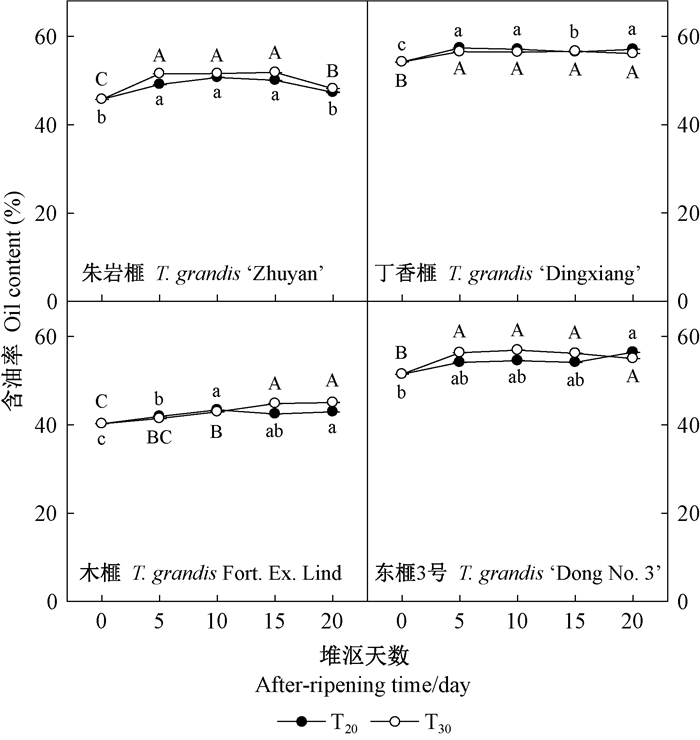
由图 4可知,堆沤前,4种榧籽的含油率从高到低依次为丁香榧(54.20%±0.3%)、东榧3号(51.46%±1.5%)、朱岩榧(45.76%±0.067%)、木榧(40.23%±0.88%)。不同堆沤温度下,4种榧籽的含油率变化存在差异。所有堆沤温度处理下,随着堆沤时间延长,朱岩榧榧籽的含油率均呈先升高后降低的趋势,且在堆沤处理5天时达到峰值,此后保持相对稳定,但在堆沤处理下15天后其含油率开始显著下降。所有堆沤温度处理下,堆沤处理5天时,丁香榧和东榧3号的含油率均达到峰值。T20处理下,丁香榧和东榧3号的含油率较堆沤前增加5.84%和5.21%,T30处理下分别增加4.30%和9.46%。所有堆沤温度处理下,随着堆沤时间延长,木榧榧籽的含油率均呈升高趋势,堆沤处理20天时,T20和T30处理下的木榧含油率分别增加6.73%和11.97%。
|
图 4 不同堆沤温度下后熟过程中4种榧籽含油率的变化 Fig. 4 The changes in oil content of the four T. grandis cultivars with different retting temperature during after-ripening period |
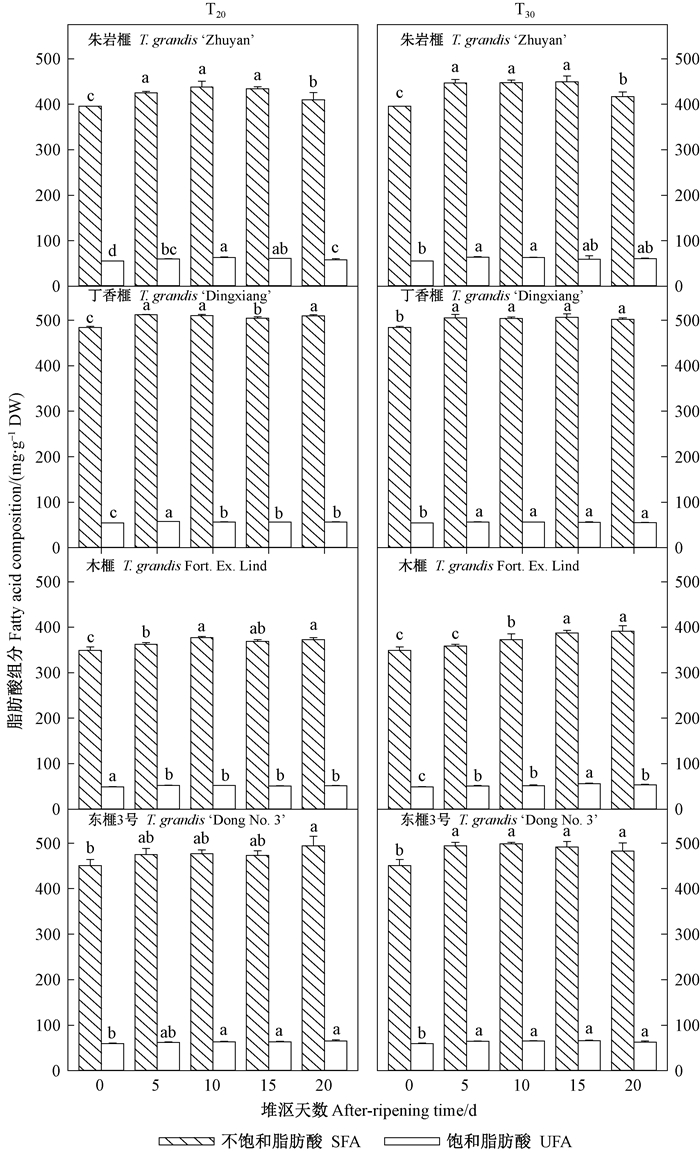
由图 5可知,堆沤前,4种榧籽的饱和脂肪酸含量从高到低依次为东榧3号[(59.3±1.72)mg·g-1]、朱岩榧[(55.1±0.08)mg·g-1]、丁香榧[(54.4±0.31)mg·g-1]、木榧[(48.7±1.07)mg·g-1];不饱和脂肪酸含量依次为丁香榧[(484.2±2.72)mg·g-1]、东榧3号[(451.0±13.1)mg·g-1]、朱岩榧[(395.4±0.58)mg·g-1]、木榧[(349.2±7.65)mg·g-1]。T20处理20天时,4种榧籽的饱和脂肪酸含量较堆沤前增加5.71%、3.79%、5.76%和9.65%;T30处理10天时,分别增加14.40%、3.45%、5.83%、10.39%。T20处理20天时,朱岩榧、丁香榧、木榧、东榧3号的不饱和脂肪酸含量较堆沤前分别增加3.67%、5.28%、6.78%和9.61%;T30处理10天时,分别增加13.22%、4.16%、6.65%和10.57%。
|
图 5 不同堆沤温度下后熟过程中4种榧籽不饱和脂肪酸、饱和脂肪酸含量的变化 Fig. 5 The changes in SFA content and UFA content of the four T. grandis cultivars with different retting temperature during after-ripening period |
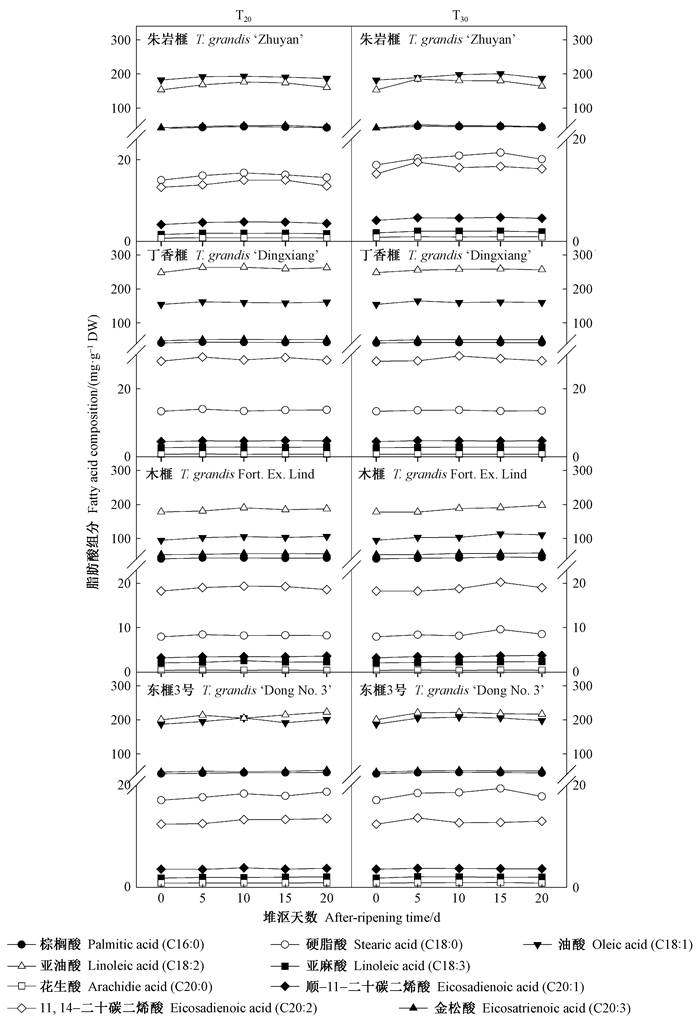
由图 6可知,4种榧籽中主要的脂肪酸组分为油酸、亚油酸、金松酸、亚麻酸、顺-11-二十碳烯酸、顺-11, 14-二十碳二烯酸、花生酸、棕榈酸、硬脂酸等9种脂肪酸,其中油酸、亚油酸和金松酸含量较高。堆沤前,4种榧籽的油酸含量从高到低依次为东榧3号[(187.01±5.45)mg·g-1]、朱岩榧[(181.74±0.27)mg·g-1]、丁香榧[(154.16±0.87)mg·g-1]、木榧[(94.86±2.08)mg·g-1];亚油酸含量依次为丁香榧[(247.98±1.40)mg·g-1]、东榧3号[(199.98±5.83)mg·g-1]、木榧[(178.05±3.90)mg·g-1]、朱岩榧[(152.87±0.22)mg·g-1];金松酸含量依次为木榧[(52.78±1.16)mg·g-1]、丁香榧[(46.89±0.26)mg·g-1]、东榧3号[(46.26±1.35)mg·g-1]、朱岩榧[(41.73±0.06)mg·g-1]。不同堆沤温度下,4种榧籽的脂肪酸组分变化存在差异。随着堆沤时间延长,不同温度处理下,朱岩榧的油酸、亚油酸和金松酸含量均呈先上升后下降的趋势;堆沤处理20天时,各组分含量较堆沤处理15天均明显下降。随着堆沤过程推进,丁香榧、木榧、东榧3号的油酸、亚油酸和金松酸含量均呈缓慢增加趋势。T20处理20天时,朱岩榧、丁香榧、木榧、东榧3号的油酸含量较堆沤前分别增加2.5%、4.28%、11.80%和7.33%,亚油酸含量分别增加4.5%、5.84%、5.09%和11.29%,金松酸含量分别增加6.4%、8.04%、4.70%和12.09%;T30处理10天时,朱岩榧、丁香榧、木榧、东榧3号的油酸含量分别增加8.9%、3.52%、8.97%和10.95%,亚油酸含量分别增加17.8%、4.00%、5.74%和10.84%,金松酸含量分别增加15.5%、6.11%、6.71%和10.46%。
|
图 6 不同堆沤温度下后熟过程中4种榧籽脂肪酸组分的变化 Fig. 6 The changes in fatty acid composition of the four T. grandis cultivars with different retting temperature during after-ripening period |
|
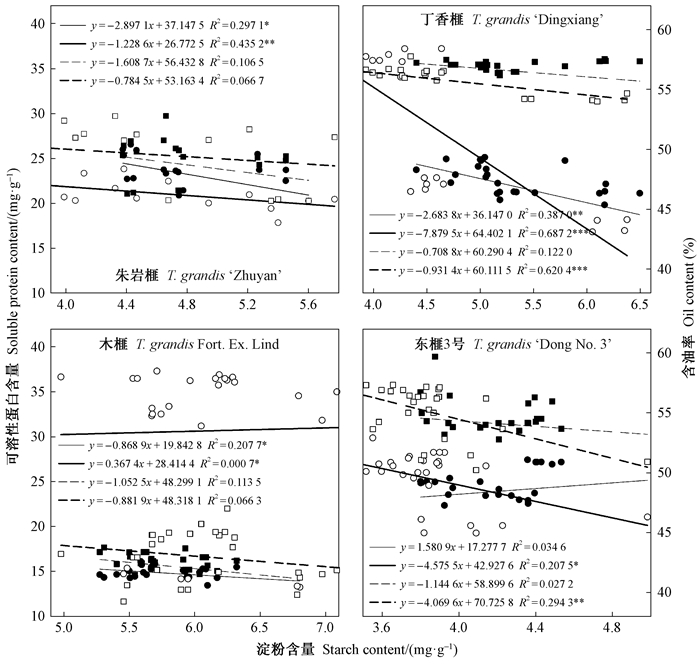
图 7 不同堆沤温度下后熟过程中4种榧籽淀粉与可溶性蛋白及含油率之间的相关性分析 Fig. 7 The correlation analysis between starch content to both soluble protein content and oil content of the four T. grandis cultivars with different retting temperature during after-ripening period
 :堆沤温度20 ℃处理下后熟过程榧籽中的淀粉含量与其对应可溶性蛋白含量之间的线性回归; :堆沤温度20 ℃处理下后熟过程榧籽中的淀粉含量与其对应可溶性蛋白含量之间的线性回归;  :堆沤温度20 ℃处理下后熟过程榧籽中的淀粉含量与其对应含油率之间的线性回归; :堆沤温度20 ℃处理下后熟过程榧籽中的淀粉含量与其对应含油率之间的线性回归;  :堆沤温度30 ℃处理下后熟过程榧籽中的淀粉含量与其对应可溶性蛋白含量之间的线性回归; ---:堆沤温度30 ℃处理下后熟过程榧籽中的淀粉含量与其对应含油率之间的线性回归. :堆沤温度30 ℃处理下后熟过程榧籽中的淀粉含量与其对应可溶性蛋白含量之间的线性回归; ---:堆沤温度30 ℃处理下后熟过程榧籽中的淀粉含量与其对应含油率之间的线性回归.
 : The best-fit linear regressions between the starch content and soluble protein content for each cultivars with 20 ℃ retting temperture during after-ripening period; : The best-fit linear regressions between the starch content and soluble protein content for each cultivars with 20 ℃ retting temperture during after-ripening period;  : The best-fit linear regressions between the starch content and oil content for each cultivars with 20 ℃ retting temperture during after-ripening period; : The best-fit linear regressions between the starch content and soluble protein content for each cultivars with 30 ℃ retting temperture during after-ripening period; ---: The best-fit linear regressions between the starch content and oil content for each cultivars with 30 ℃ retting temperture during after-ripening period. : The best-fit linear regressions between the starch content and oil content for each cultivars with 20 ℃ retting temperture during after-ripening period; : The best-fit linear regressions between the starch content and soluble protein content for each cultivars with 30 ℃ retting temperture during after-ripening period; ---: The best-fit linear regressions between the starch content and oil content for each cultivars with 30 ℃ retting temperture during after-ripening period.
|
随着果实/种子发育过程的推进,果实/种子的种皮颜色会发生变化(罗顺红,2006),如甘蓝型油菜(Brassica campestris)种子的种皮随种子发育由浅黄绿色逐渐变成褐色(史仕军等,2003);后熟过程中香蕉(Musa nana)果皮逐渐褪绿转黄,与20 ℃储藏温度相比,储藏温度30 ℃明显抑制果皮转黄(庞学群等,2008)。本研究结果显示,T20和T30处理下,朱岩榧、丁香榧和东榧3号榧籽种衣分别在第10天和第20天由紫红色转为深黑褐色(图 1),木榧榧籽均在第20天由紫红色转为深黑褐色,这表明T30处理能加快栽培种(朱岩榧、丁香榧和东榧3号)榧籽后熟品质的形成,但对野生种(木榧)的促进作用不太明显。
淀粉是种子碳水化合物的主要贮藏形式,后熟过程在淀粉酶作用下水解成糖,为其蛋白质和脂肪的合成提供原料和能量。随着后熟过程的推进,南果梨(Pyrus ussriensis)中的淀粉迅速水解,总蛋白质含量明显升高(吴震等,1997);油梨(Persea americana)含油率和可溶性蛋白含量显著增加(黄雪梅等,2015);三七(Panax notoginseng)种子中的淀粉、可溶性蛋白和粗脂肪含量逐渐下降,可溶性糖含量则逐渐增加(段承俐等,2010)。种子风味与淀粉、脂肪和蛋白质含量密切相关,如糯玉米(Zea mays)淀粉含量较低,口感会软但缺乏糯性(赵健等,2012),脂肪含量和蛋白质含量较高的口感较好(蒋永娇等,2017);而高蛋白和低油分的花生(Arachis hypogaea)种更宜鲜食,口感不腻(李林等,2003);榧籽种仁的风味、香脆程度与淀粉质量分数呈负相关,与蛋白质、油脂质量分数呈正相关(黎章矩等,2005)。本研究结果显示,堆沤前,栽培种榧籽具有较低的淀粉含量及较高的可溶性蛋白含量和含油率,可推测栽培种榧籽具有较好的堆沤前品质是其较野生榧籽风味好的基础。对京白梨(Pyrus ussriensis)的研究发现,在后熟过程中其淀粉含量逐渐下降,低温可明显抑制淀粉和葡萄糖含量下降(齐秀东等,2015)。与20 ℃相比,30 ℃的后熟温度可促进香蕉果皮中淀粉的降解(庞学群等,2008)。本研究结果显示,T30处理10天时,朱岩榧、丁香榧和东榧3号榧籽中淀粉含量较堆沤前明显降低,且其下降幅度均大于T20处理20天,但木榧的淀粉含量无明显变化,表明T30处理能促进栽培种(朱岩榧、丁香榧和东榧3号)榧籽中淀粉的快速分解,加快物质转化,但对木榧无明显促进作用。相较于常温(25 ℃),香榧在低温(4 ℃)堆沤时淀粉降解速率、蛋白含量与含油率上升速率均下降,后熟进程较缓慢(叶珊,2017)。本研究结果显示,T30处理10天时,丁香榧、木榧和东榧3号榧籽的可溶性蛋白含量明显高于T20处理20天时的含量(图 3B、C、D),但T30处理10天时,朱岩榧榧籽的可溶性蛋白含量明显低于T20处理20天时的含量(图 3A),表明T30处理能大大提高丁香榧、木榧和东榧3号榧籽中的蛋白质含量,利于其后熟品质的提高,但不利于朱岩榧榧籽中蛋白质的合成。含油率是评价油料植物品质的重要性状之一(叶珊等,2017)。研究表明,在7—9月,闽东油茶(Camellia oleifera)的含油率随着温度升高而下降(余会康,2014),且采后处理温度过高会破坏油茶果实内环境稳态,影响果实中油脂的积累(宋倩倩等,2017)。本研究结果显示,与堆沤前相比,无论哪种堆沤温度处理,4种榧籽的含油率均明显增加,其中东榧3号的增加幅度最大,朱岩榧的含油率均在15天后开始明显下降,表明堆沤过程能大大提高东榧3号的后熟品质,朱岩榧的堆沤进程可以短于其余3种。
果实/种子的成熟过程伴随着贮藏物质间的相互转化。种子后熟过程中,在淀粉酶的作用下淀粉水解为糖类,为其生理过程提供原料与能量(安娜等,2010)。随油茶成熟过程的推进,种仁内的含油率与淀粉含量之间存在显著负相关性,表明在此过程中油茶籽中的淀粉转化为脂肪(王东雪等,2017)。成熟期春小麦(Triticum aestivum)籽粒淀粉含量和蛋白质含量呈负相关性(刘晓冰,1996),表明淀粉分解可为蛋白质的积累提供碳架和能量的作用。本研究结果显示,在堆沤后熟期间,T20处理下,东榧3号的淀粉与其可溶性蛋白含量、含油率之间未发现显著负相关性,但T30处理下,东榧3号的淀粉与其可溶性蛋白含量、含油率之间存在显著负相关性,表明堆沤温度提高大大促进了东榧3号淀粉向可溶性蛋白和脂肪的转化,有助于加快物质的转化,利于后熟品质的形成。
脂肪酸是油脂的重要组成部分,有饱和脂肪酸与不饱和脂肪酸之分,其中不饱和脂肪酸组分常作为评价油料种子品质的重要指标之一(叶珊,2017)。本研究结果显示,堆沤前,丁香榧的不饱和脂肪酸含量明显高于东榧3号,但堆沤后二者之间的不饱和脂肪酸无明显差异,且明显高于其余2种榧籽,表明堆沤过程可明显促进东榧3号不饱和脂肪酸的合成。不饱和脂肪酸中油酸、亚油酸有降低胆固醇和血栓形成的风险(Grundy,1989),金松酸则有调节血脂和抗炎的作用(Berger et al., 2002;Chang et al., 2004;Endo et al., 2006)。大葱(Allium fistulosum)种子中的棕榈酸、硬脂酸、油酸、亚油酸、亚麻酸含量随着贮藏温度升高而升高(胡小荣等,2006)。本研究结果显示,4种榧籽中的不饱和脂肪酸均以油酸、亚油酸和金松酸为主;T30处理10天时,朱岩榧油酸、亚油酸和金松酸含量较堆沤前的增加幅度明显大于T20处理20天时;T30处理10天时,东榧3号油酸含量的增加幅度明显大于T20处理20天时;T30处理10天时,木榧亚油酸和金松酸含量的增加幅度明显大于T20处理20天时,这表明朱岩榧、木榧和东榧3号中油酸、亚油酸和金松酸合成对堆沤温度的响应不同。
4 结论堆沤前,栽培种(朱岩榧、丁香榧和东榧3号)榧籽的品质明显优于野生种(木榧);堆沤后熟处理后可促进4种榧籽的物质转化。与堆沤温度20 ℃相比,堆沤温度30 ℃可以明显加快4种榧籽的后熟进程,主要表现在明显促进栽培种(朱岩榧、丁香榧和东榧3号)榧籽中淀粉的降解,明显促进栽培种(丁香榧和东榧3号)榧籽中可溶性蛋白质的合成,能明显提高朱岩榧油酸、亚油酸和金松酸的含量及东榧3号油酸的含量;明显促进野生种木榧可溶性蛋白质和亚油酸和金松酸含量的合成。
安娜, 崔秀明, 黄璐琦, 等. 2010. 三七种子后熟期的生理生化动态研究Ⅱ.代谢物质含量变化分析. 西南农业学报, 23(4): 1090-1093. (An N, Cui X M, Huang L Q, et al. 2010. Studies on variation of physiology and biochemistry during post-maturation of seeds in Panax notoginseng Ⅱ. Analysis of variation of metabolic products in seeds. Southwest China Journal of Agricultural Sciences, 23(4): 1090-1093. DOI:10.3969/j.issn.1001-4829.2010.04.021 [in Chinese]) |
陈建勋, 王晓峰. 2002. 植物生理学实验指导. 广州: 华南理工大学出版社. (Chen J X, Wang X F. 2002. Experimental guide for plant physiology. Guangzhou: South China University of Technology Press. [in Chinese]) |
程晓建, 黎章矩, 喻卫武, 等. 2008.榧树种质资源收集与开发利用.哈尔滨: 中国林学会. (Cheng X J, Li Z J, Yu W W, et al. 2008. Collection, exploitation and utilization of Torreya grandis germplasm resource. Haerbin: Chinese Society of Forestry.[in Chinese]) http://www.wanfangdata.com.cn/details/detail.do?_type=conference&id=7139909 |
崔喜燕. 2008. 基础生物化学实验方法和技术. 北京: 中国林业出版社. (Cui X Y. 2008. Basic biochemistry experiments and techniques. Bejjing: China Forestry Publishing House. [in Chinese]) |
段承俐, 李章田, 丁金玲, 等. 2010. 三七种子的后熟生理特性研究. 中国中药杂志, 35(20): 2652-2656. (Duan C L, Li Z T, Ding J L, et al. 2010. Physiologic characteristics of Panax notoginseng seeds during after-ripening process. China Journal of Chinese Materia Medica, 35(20): 2652-2656. [in Chinese]) |
范昱, 王红力, 何凤, 等. 2018. 后熟对苦荞子粒营养品质的影响. 作物杂志, (1): 96-101. (Fan Y, Wang H L, He F, et al. 2018. Nutritional quality in seeds of Tartary Buckwheat affected by after-ripening. Crops, (1): 96-101. [in Chinese]) |
黄雪梅, 黄烈健, 王莹, 等. 2015. 油梨种桂垦3号和哈斯后熟生理和营养品质比较. 华南农业大学学报, 36(13): 59-64. (Huang X M, Huang L J, Wang Y, et al. 2015. A comparative study of post-harvest physiology and nutrient components between Guiken 3 and Hass avocado fruits. Journal of South China Agricultural University, 36(13): 59-64. [in Chinese]) |
胡小荣, 陶梅, 卢新雄. 2006. 不同含水量大葱种子贮藏后的脂肪代谢研究. 植物遗传资源学报, 7(4): 464-467. (Hu X R, Tao M, Lu X X. 2006. Studies on the fat metabolism in stored chinese onion seed with different moisture content. Journal of Plant Genetic Resources, 7(4): 464-467. DOI:10.3969/j.issn.1672-1810.2006.04.018 [in Chinese]) |
贾晓辉, 张文江, 夏玉静, 等. 2014. 不同温度和外源乙烯处理对软肉梨后熟的作用效果研究. 保鲜与加工, 14(3): 25-28, 36. (Jia X H, Zhang W J, Xia Y J, et al. 2014. Effects of different temperatures and exogenous ethylene treatment on ripening of soft pear. Storage and Process, 14(3): 25-28, 36. DOI:10.3969/j.issn.1009-6221.2014.03.006 [in Chinese]) |
贾祥祥, 丁卫星, 韩耀光, 等. 2016. 小麦后熟作用对面包品质影响研究. 现代面粉工业, (3): 14-18. (Jia X X, Ding W X, Han Y G, et al. 2016. Studies on the quality of bread in wheat affected by after-ripening. Modern Flour Milling Industry, (3): 14-18. [in Chinese]) |
蒋永娇, 丁增伟. 2017. 无公害香糯玉米高产高效种植管理. 吉林蔬菜, (3): 23. (Jiang Y J, Ding Z W. 2017. High yield and efficient cropping management of pollution-free Waxy Corn. Jilin Vegetable, (3): 23. [in Chinese]) |
李林, 刘海军, 孙玉桃, 等. 2003. 高亚油酸高蛋白低油分优质食用型花生新种湘花B的选育研究. 花生学报, 32(增刊): 220-223. (Li L, Liu H J, Sun Y T, et al. 2003. The breeding study on high linoleic acid, high protein and low oil content edible new peanut strain Xianghua B. Journal of Peanut Science, 32(sup): 220-223. [in Chinese]) |
黎章矩, 戴文圣. 2007. 中国香榧. 北京: 科学出版社. (Li Z J, Dai W S. 2007. China Torreya grandis. Beijing: Science Press. [in Chinese]) |
黎章矩, 骆成方, 程晓建, 等. 2005. 香榧种子成分分析及营养评价. 浙江林学院学报, 22(5): 540-544. (Li Z J, Luo C F, Cheng X J, et al. 2005. Component analysis and nutrition evaluation of seeds of Torreya grandis 'Merrillii'. Journal of Zhejiang Forestry College, 22(5): 540-544. DOI:10.3969/j.issn.2095-0756.2005.05.014 [in Chinese]) |
刘萌萌. 2014.香榧营养元素的动态分析与营养诊断初步研究.杭州: 浙江农林大学硕士学位论文. (Liu M M. 2014. Dynamic changes in nutrient elements and nutrient diagnosis in Torreya grandis 'Merrillii'. Hangzhou: MS thesis of Zhejiang Agricultural and Forestry University.[in Chinese]) http://cdmd.cnki.com.cn/Article/CDMD-10341-1015502377.htm |
刘晓冰, 李文雄. 1996. 春小麦籽粒灌浆过程中淀粉和蛋白质积累规律的初步研究. 作物学报, 22(6): 736-740. (Liu X B, Li W X. 1996. Preliminary studies on the accumulation of grain starch and protein during grain filling in wheat. Aata Agronomica Sinica, 22(6): 736-740. DOI:10.3321/j.issn:0496-3490.1996.06.016 [in Chinese]) |
罗顺红. 2006. 油菜的后熟作用. 云南农业, (12): 155. (Luo S H. 2006. The after-ripening in oilseed rape. Yunnan Agriculture, (12): 155. [in Chinese]) |
马长乐, 周稚凡, 李向楠, 等. 2015. 云南榧子和香榧子营养成分比较研究. 食品研究与开发, 36(14): 92-94. (Ma C L, Zhou Z F, Li X N, et al. 2015. Nutrients comparative study in seeds of Torreya yunnanensis and Torreya grandis. Food Research and Development, 36(14): 92-94. DOI:10.3969/j.issn.1005-6521.2015.14.023 [in Chinese]) |
庞学群, 李云, 徐兰英, 等. 2008. 不同温度下后熟香蕉果实果皮生理与颜色变化. 热带亚热带植物学报, 16(6): 531-536. (Pang X Q, Li Y, Xu L Y, et al. 2008. Effects of temperature on peel colour and physiological changes of banana fruits during ripening. Journal of Tropical and Subtropical Botany, 16(6): 531-536. DOI:10.3969/j.issn.1005-3395.2008.06.007 [in Chinese]) |
邱佳容, 王则金, 张良清, 等. 2015. 冷激处理对香蕉果实后熟及抗冷性的影响. 食品与机械, 31(4): 144-147. (Qiu J R, Wang Z J, Zhang L Q, et al. 2015. Effect of cold shock treatment on ripening and cold resistance of banana fruits. Food and Machinery, 31(4): 144-147. [in Chinese]) |
齐秀东, 魏建梅, 赵美微, 等. 2015. '京白梨'果实后熟软化与糖、淀粉代谢及其基因表达的关系. 中国农业科学, 48(13): 2591-2599. (Qi X D, Wei J M, Zhao M W, et al. 2015. Relationship between fruit softening and the metabolism of sugar and starch and their related-gene expression in post-harvest 'Jingbaili' fruits. Agricultural Sciences in China, 48(13): 2591-2599. DOI:10.3864/j.issn.0578-1752.2015.13.011 [in Chinese]) |
芮海云. 2009. 银杏种子发育和后熟生理研究. 廊坊师范学院学报:自然科学版, 9(3): 65-68. (Rui H Y. 2009. Studies on Development physiology and delayed-ripening physiology of ginkgo seeds. Journal of Langfang Teachers College:Natural Science Edition, 9(3): 65-68. DOI:10.3969/j.issn.1674-3229-B.2009.03.022 [in Chinese]) |
史仕军, 吴江生. 2003. 甘蓝型油菜黄籽粒色性状研究. 华中农业大学学报, 22(6): 608-612. (Shi S J, Wu J S. 2003. The study of seedcoat color in yellow-seeded Brassica napus. Journal of Huazhong Agricultural University, 22(6): 608-612. DOI:10.3321/j.issn:1000-2421.2003.06.021 [in Chinese]) |
宋倩倩, 白玮玮, 陈辉, 等. 2017. 采后处理对普通油茶'闽43'果实含油率影响的响应面优化. 安徽农业大学学报, 44(1): 65-70. (Song Q Q, Bai W W, Chen H, et al. 2017. Optimization of response surface for postharvest treatment on oil content in Camellia oleifera 'Min43' fruits. Journal of Anhui Agricultural University, 44(1): 65-70. [in Chinese]) |
王东雪, 江泽鹏, 刘凯, 等. 2017. 岑溪软枝油茶籽成熟过程中营养物质含量变化和萌发能力研究. 热带农业科学, 37(7): 51-55. (Wang D X, Jiang Z P, Liu K, et al. 2017. Change of nutrient contents and germination ability of seeds of Camellia oleifera cenxi ruanzhi during the mature stage. Chinese Journal of Tropical Agriculture, 37(7): 51-55. [in Chinese]) |
吴震, 别小妹, 王和福. 1997. 南果梨果实后熟过程生理生化变化的研究. 沈阳农业大学学报, 28(2): 111-115. (Wu Z, Bie X M, Wang H F. 1997. Studies on the physiological and biochemical changes after pear CV Nanguo's maturity. Journal of Shenyang Agricultural University, 28(2): 111-115. [in Chinese]) |
叶珊, 王为宇, 周敏樱, 等. 2017. 不同采收成熟度和堆沤方式对香榧种子堆沤后熟品质的影响. 林业科学, 53(11): 43-51. (Ye S, Wang W Y, Zhou M Y, et al. 2017. Effects of different harvest maturity and after-ripening ways on the harvested quality of Torreya grandis 'Merrillii' seeds. Scientia Silvae Sinicae, 53(11): 43-51. DOI:10.11707/j.1001-7488.20171105 [in Chinese]) |
叶珊. 2017.香榧种子堆沤后熟影响因素及脂肪酸合成调控机制研究.杭州: 浙江农林大学硕士学位论文. (Ye S. 2017. The impact factor of after-ripening process and regulatory mechanism of fatty acid synthesis in seeds of Torreya grandis 'Merrillii'. Hangzhou: MS thesis of Zhejiang Agricultural and Forestry University.[in Chinese]) http://cdmd.cnki.com.cn/Article/CDMD-10341-1018086385.htm |
伊淑丽, 梁颖, 代柳亭, 等. 2008. 高温对甘蓝型油菜籽粒后熟相关特性的影响. 西南大学学报:自然科学版, 30(2): 48-50. (Yi S L, Liang Y, Dai L T, et al. 2008. Effects of high temperature on post-harvest ripening-related characteristics in Brassica napus L. Journal of Southwest University:Natural Science Edition, 30(2): 48-50. [in Chinese]) |
余会康. 2014. 闽东油茶产量及含油率与气候条件分析. 贵州气象, 38(6): 7-12. (Yu H K. 2014. The analysis on output, oil content and climatic condition of Mindong Camellia oleifera. Journal of Guizhou Meteorology, 38(6): 7-12. DOI:10.3969/j.issn.1003-6598.2014.06.002 [in Chinese]) |
赵健, 罗艳, 王永宏, 等. 2012. 影响糯玉米鲜食品质的因素研究. 宁夏农林科技, 53(12): 1-3. (Zhao J, Luo Y, Wang Y H, et al. 2012. A study of factors affecting edible quality of Waxy Corn. Ningxia Journal of Agriculture and Forestry Science and Technology, 53(12): 1-3. DOI:10.3969/j.issn.1002-204X.2012.12.001 [in Chinese]) |
Berger A, Monnard I, Baur M, et al. 2002. Epidermal anti-inflammatory properties of 5, 11, 14 20:3:effects on mouse ear edema, PGE2 levels in cultured keratinocytes, and PPAR activation. Lipids in Health and Disease, 1(5): 1-12. |
Chang N W, Wu C T, Chen F N, et al. 2004. High polyunsaturated and monounsaturated fatty acid to saturated fatty acid ratio increases plasma very low density lipoprotein lipids and reduces the hepatic hypertriglyceridemic effect of dietary cholesterol in rats. Nutrition Research, 24(1): 73-83. DOI:10.1016/j.nutres.2003.09.002 |
Endo Y, Osada Y, Kimura F, et al. 2006. Effects of Japanese torreya (Torreya nucifera) seed oil on lipid metabolism in rats. Nutrition, 22(5): 553-558. DOI:10.1016/j.nut.2005.08.012 |
Grundy S M. 1989. Monounsaturated fatty acids and cholesterol metabolism:implications for dietary recommendations. Journal of Nutrition, 119(4): 529-533. DOI:10.1093/jn/119.4.529 |