 2019, Vol. 55
文章信息
- 古琳, 王成, 王艳英, 王晓磊, 孙振凯, 王茜, 孙睿霖.
- Gu Lin, Wang Cheng, Wang Yanying, Wang Xiaolei, Sun Zhenkai, Wang Qian, Sun Ruilin.
- 惠山国家森林公园游憩林小气候与人体舒适度变化规律
- Patterns of Temporal Variation of Microclimate and Extent of Human Comfort in the Recreation Forests in Huishan National Forest Park
- 林业科学, 2019, 55(6): 150-159.
- Scientia Silvae Sinicae, 2019, 55(6): 150-159.
- DOI: 10.11707/j.1001-7488.20190618
-
文章历史
- 收稿日期:2018-04-19
- 修回日期:2019-05-05
-
作者相关文章


2. 齐鲁工业大学(山东省科学院) 济南 250014;
3. 山东省东营市水务局 东营 257091;
4. 北京市园林科学研究院 北京 100102
2. Qilu University of Technology(Shandong Academy of Sciences) Jinan 250014;
3. Dongying Water Authority of Shandong Province Dongying 257091;
4. Beijing Institute of Landscape Architecture Beijing 100102
森林小气候是指森林植被与区域气候相互作用所形成的局地气候环境,常有别于周围大环境气候(谭正洪等, 2015)。森林通过遮挡太阳辐射和蒸腾作用达到降温增湿效应,也可通过枝叶摩擦而消耗穿过林带的气流动能减弱风速(纪鹏等, 2012;范志平等,2002);风向和风速又可通过改变林内气温、湿度来间接影响林内小气候(Koh et al., 2010)。具有面积大、长势好、绿量多、郁闭度大、林地垂直结构明显等森林群落特征的城市森林能够明显改善局地小气候(Zhang et al., 2013; Gaudio et al., 2017)。人体气候舒适度是以人体与近地大气环境之间热交换原理为基础,评价以环境空气温度、湿度、风速等为主的气象因子对人体舒适感综合作用的生物气象指标(Vanos et al., 2010; Ma et al., 2012)。空气温度、湿度和风速是决定人体对环境冷、热感觉的主要因素,体感最适的环境温度为16~24 ℃,空气相对湿度为40%~60%(Tiwary et al., 2009)。森林可通过调节和改善林内小气候,在一定程度上提升人体舒适度,有利于城市居民的身体健康。
近几年,国内外有关绿地小气候及其舒适度的研究主要针对森林公园、湿地公园、城市绿地、河流绿带等绿色游憩空间,通过监测气温、空气相对湿度、风速等气候指标,分析不同下垫面、群落结构、树种类型的绿地之间小气候指标在空间分布、时间变化上的差异,评估对人体舒适度的影响(Schinasi et al., 2017; 刘畅等, 2017; 王月容等, 2017; Arx et al., 2012; Chen et al., 2012),研究时间多集中在夏季,对城市公园绿地研究较多,且采用经验模型和机理模型评价为主,对游憩区的气候舒适度开展不同季节、日变化的持续监测不足,缺少对气候舒适度时间变化的影响机制研究。在森林旅游区开展小气候指标持续监测和人体气候舒适度的相关研究,对科学利用城市森林的生态服务功能有重要意义。
本研究以无锡市惠山国家森林公园的3种典型城市游憩林为对象,观测一年四季白天游憩时段内游憩林小气候及舒适度指数的时间变化规律,旨在探讨影响森林人体舒适度的主效因素,为惠山乃至江南地区游憩林的合理经营和生态效益评价提供基础科学数据,为当地市民选择合适的时间和衣着开展森林游憩活动提供参考。
1 研究区概况惠山国家森林公园位于惠山西北部(120°13′—120°15′E,31°33′—31°35′N),东西长3.9 km,南北宽3.6 km,面积约718 km2。该区属北亚热带季风气候,温暖湿润,四季分明,雨水充沛,无霜期长。年均气温15.4 ℃,年均降水量1 067 mm,年均日照时数2 035.3 h,以东南风为主。山地土壤以黄棕壤为主。惠山国家森林公园森林覆盖率为95%,有木本植物55科84属104种。其地带性森林植被为北亚热带落叶常绿阔叶混交林,现有林分为20世纪70、80年代人工营造的以湿地松(Pinus elliotii)等为主的针叶林以及栎属(Quercus)和香樟(Cinnamomum camphora)等为主的阔叶林和针阔混交林(丁铁城等, 2000)。
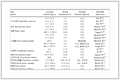
2 研究方法 2.1 观测点选择在惠山国家森林公园内,按照典型抽样法,分析森林公园图件资料并结合实地踏查,在最高峰三茅峰(海拔329 m)附近选择于20世纪80、90年代营造的位于山顶南坡的香樟林、湿地松林和山顶北坡的栓皮栎(Quercus variabilis)林3种典型人工游憩林为对象。在每个林分中央且距林缘30米以上的位置各设3个观测点作为重复,观测点之间距离10 m以上。将位于3个林分之间的防火道路作为对照,该道路为宽5 m左右的水泥路,是山脚通往山顶的唯一机动车道,也是游人量最大的道路,一般不允许机动车通行。道路对照点两侧乔木以黑松(Pinus thunbergii)和香樟为主。3种林分概况如表 1。
|
观测时间为2011年秋季(10月底至11月初)、冬季(12月)和2012年春季(4月)、夏季(7月),排除雨、雪、大雾、大风等特殊天气,在各季节分别选择晴朗或多云、无风或轻风的5天,作为观测日。观测时间为人们游憩较集中的时段(5:00—19:00),每隔2 h同步测定各观测点1.5 m高处的气温、空气相对湿度和平均风速。观测仪器使用Kestrel 3500(美国产,温度精度±1.0 ℃,湿度精度±3%,风速精度±3%)。
2.3 数据处理降温率、增湿率和降风率计算公式(秦仲等,2016)为:
| $ T_{\mathrm{N}}=\left(T_{\mathrm{n}}-T_{\mathrm{o}}\right) / T_{\mathrm{o}} \times 100 \%; $ | (1) |
| $ F_{\mathrm{N}}=\left(F_{\mathrm{o}}-F_{\mathrm{n}}\right) / H_{\mathrm{o}} \times 100 \%; $ | (2) |
| $ V_{\mathrm{N}}=\left(V_{\mathrm{o}}-V_{\mathrm{n}}\right) / V_{\mathrm{o}} \times 100 \%。$ | (3) |
式中:TN为降温率(%);To为对照点温度(℃);Tn为林内温度(℃);FN为增湿率(%);Fo为对照点湿度(%);Fn为林内湿度(%);VN为降风率(%);Vo为对照点风速(m·s-1);Vn为林内风速(m·s-1)。
人体舒适度采用舒适度指数进行评价(陆鼎煌等,1984),舒适度指数S计算公式如下:
| $ S=0.6(|T-24|)+0.07(|F-70|)+\\0.5(|V-2|)。$ | (4) |
式中:T为气温(℃);F为空气相对湿度(%);V为风速(m·s-1)。依据S划分人体舒适度等级(表 2)。
|
|
着装厚度气象指数H(mm)计算公式(朱凌云等,2001)为:
| $ \begin{align} & H=\left[ 1+0.4(F-60)/100 \right]\times 0.61(33-{{T}_{\text{M}}})/ \\ & \text{ }\ \ \ \ \ \ \ \ \ \ \ \ \ \ \ \ \ (1-\text{ }0.011\ 65\ {{V}^{2}}), ~ \\ & \ \ \ \ \ \ \ \ \ \ \ \ \ \ \ \ \ {{T}_{\text{M}}}\le 18℃\ 且F\ge 60; \\ \end{align} $ | (5) |
| $ \begin{align} & \ \ \ H=0.61\text{ }(33-~{{T}_{\text{M}}})/(1-0.011\ 65\ {{V}^{2}}), \text{ } \\ & 18\text{ ℃} <{{T}_{\text{M}}}<26\text{ ℃}或{{T}_{\text{M}}}\le 18\text{℃ }且F<60\text{ }或 \\ & \ \ \ \ \ \ \ \ \ \ \ \ \ \ \ \ \ \ \ \ {{T}_{\text{M}}}\ge 26\text{ ℃}且F<60; \\ \end{align} $ | (6) |
| $ \begin{align} & ~H=[1-0.4(F-60)/100]\text{ }\times 0.61\text{ }(33-{{T}_{\text{M}}})/ \\ & \text{ }\ \ \ \ \ \ \ \ \ \ \ \ \ \ \ \ \ (1-\text{ }0.011\text{ }65~\ {{V}^{2}}), ~ \\ & \ \ \ \ \ \ \ \ \ \ \ \ \ \ \ \ \ \ {{T}_{\text{M}}}\ge 26\text{ ℃}且F\ge 60 。\\ \end{align} $ | (7) |
按照朱凌云等(2001)的方法划分着装厚度气象指数并提出穿衣建议(表 3)。
|
|
针对每种林分,将试验期间各季节每天同一时刻3个测点的气温、空气相对湿度、风速值进行平均计算,即得到该时刻各小气候指标数据;将各季节每天8个观测时刻的气温、空气相对湿度、风速值加以算术平均,即得到该季节各小气候指标数据。采用双因素ANOVA检验林分类型、季节变化对舒适度指数的影响;采用单因素方差分析和Turkey HSD多重比较法,在季节变化分析中对每种林分在不同季节、相同季节不同林分之间的小气候指标、舒适度指数的差异性进行评价,在各季节的日内变化分析中评价同一林分在不同时刻的小气候指标、舒适度指数的差异性。利用Excel 2010软件对数据整理分析,数理统计分析利用SPSS 19.0软件,绘图由origin 9软件完成。
3 结果与分析 3.1 各林分小气候指标及人体舒适度的季节变化由表 4可知,从同一季节不同林分之间的气温差异性来看,除了在秋季香樟和湿地松林的气温显著低于栓皮栎林和道路(P < 0.05),其他季节各林分之间气温差异均不显著。相对于道路,3个林分在不同季节的降温效果有差异:香樟林的降温效果表现为秋季>春季>夏季>冬季,湿地松林表现为秋季>春季>冬季>夏季,栓皮栎林则表现为春季>夏季>秋季>冬季。在同一季节,各林分之间的空气相对湿度差异均不显著。从同一林分不同季节之间的空气相对湿度差异性来看,香樟和湿地松林的空气相对湿度均表现为夏季>秋季>春季>冬季,且冬季显著低于其他3个季节(P < 0.05),春、夏、秋季之间差异均不显著;栓皮栎林和道路的空气相对湿度均表现为秋季>夏季>春季>冬季,且秋、夏季显著高于春、冬季(P < 0.05)。在增湿效应方面,香樟和湿地松林除了在春季的增湿率为12.37%~14.14%外,其他季节的空气相对湿度都低于道路, 栓皮栎林在春、夏、秋季表现出增湿效应。相对于道路,湿地松林在4个季节均表现出降风功能,栓皮栎林仅在夏、秋季发挥降风效应,而香樟林除在秋季降风率最高(73.68%)外,其他季节的风速均高于道路。
|
|
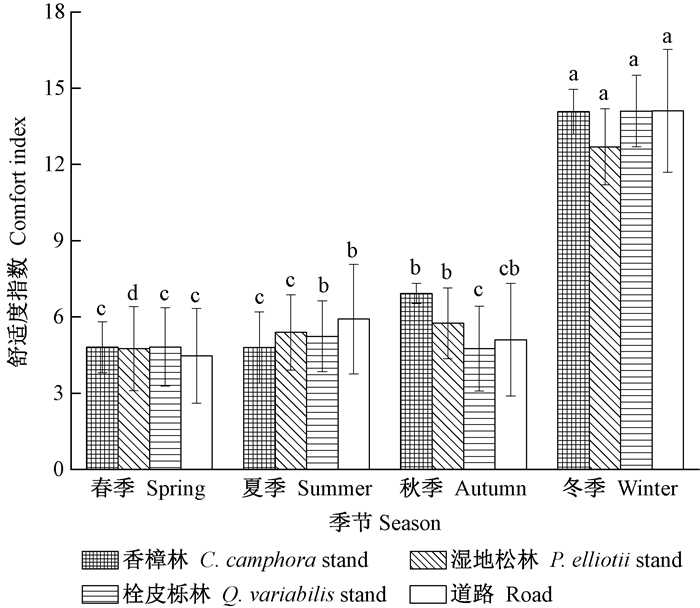
双因素方差分析结果显示,森林种类对舒适度指数的影响不显著,季节变化对舒适度指数的影响达到极显著水平,而森林种类和季节变化之间的交互作用也极显著(P < 0.01)。因此,季节变化对林内舒适度指数的影响比树种更明显。结合表 2的人体舒适度评价标准,由图 1可知,各林分在冬季的人体舒适度均属于极不舒适,其他3个季节为较舒适以上。香樟林和湿地松林的人体舒适度季节变化均表现为春季>夏季>秋季>冬季,其中湿地松林的舒适度指数在4个季节差异显著(P < 0.05),香樟林在春、夏季之间差异不显著;栓皮栎林的人体舒适度表现为秋季>春季>夏季>冬季,其中春、秋季之间的舒适度指数差异不显著,但与夏、冬季之间差异显著(P < 0.05);道路的人体舒适表现度为春季>秋季>夏季>冬季,且夏、秋季及春、秋季的舒适度指数差异不显著。
|
图 1 3种林分及对照点舒适度指数的季节变化 Fig. 1 Seasonal variation of comfort index in three stand types and the open space site 同一地点不同小写字母表示差异显著(P < 0.05)。 Different lowercase letters at the same site indicate significant differences (P < 0.05). |
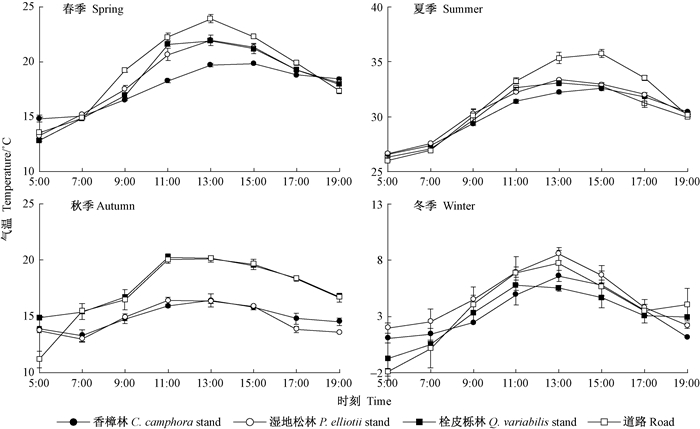
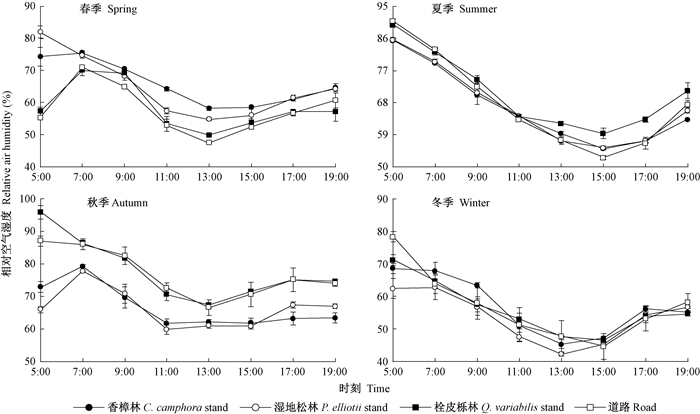
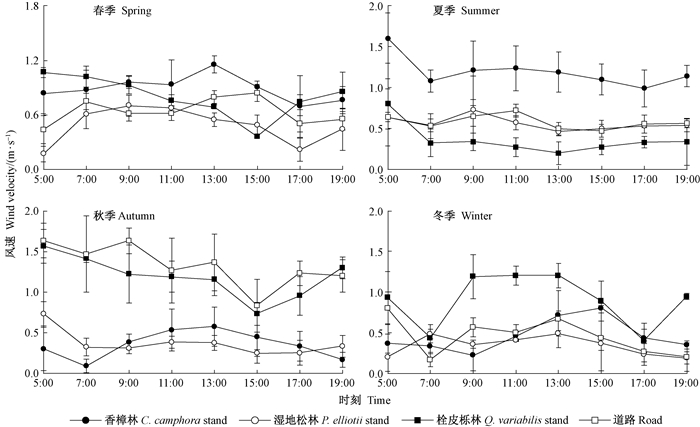
各林分在4个季节观测时段的气温日内变化均呈单峰趋势(图 2),全天气温最低值和最高值分别出现在5:00—7:00和11:00—15:00,且不同时刻之间的气温差异显著(P < 0.05)。春、夏季道路的气温日内变化曲线高于3个林分;秋季栓皮栎林和道路的日内变化较相似,均高于其他2个样地;冬季各林分气温日内变化差异较小。各林分的空气相对湿度在4个季节日内变化趋势与气温相反,均呈“U”型,最大值、最小值分别出现在5:00—7:00和11:00—15:00,且不同时刻之间的空气相对湿度差异显著(P < 0.05,图 3)。春季,香樟林和湿地松林的相对空气湿度日内变化曲线高于栓皮栎林和道路,秋季则相反;夏、冬季各林分之间的日内变化差异不明显。各林分平均风速的日内变化趋势不明显(图 4),春、夏、秋季风速的峰值多出现在5:00—9:00,最低值为13:00—15:00,冬季则相反。
|
图 2 3种林分及对照点气温的日内变化 Fig. 2 Diurnal variation of air temperature in three stand types and the open space site |
|
图 3 3种林分及对照点相对空气湿度的日内变化 Fig. 3 Diurnal variation of relative humidity in three stand types and the open space site |
|
图 4 3种林分及对照点风速的日内变化 Fig. 4 Diurnal variation of wind velocity in three stand types and the open space site |
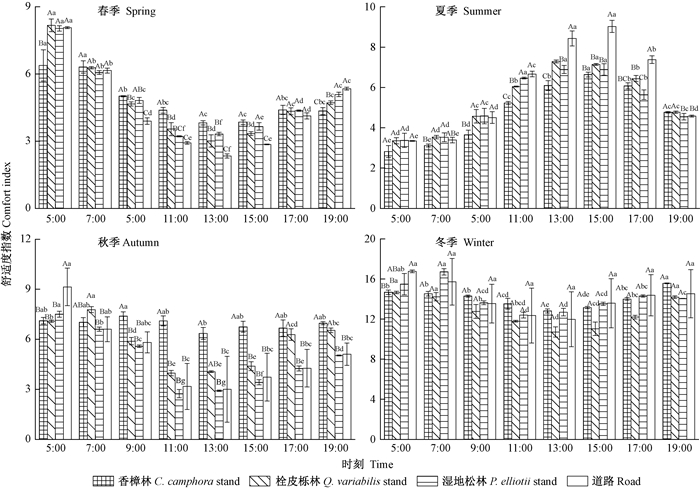
由于季节变化对各林分舒适度指数的影响最大,因此分不同季节进一步研究舒适度指数日内变化、林分类型对舒适度指数的影响。在4个季节中,林分类型、时刻变化对舒适度指数的影响都极显著(P < 0.01),而两者交互作用除冬季不显著外,在其他3个季节都极显著(P < 0.01,表 5)。
|
|
由表 2和图 5可知,各林分舒适度指数在不同季节观测时段的日内变化趋势较一致,且全天不同时刻的舒适度指数差异显著(P < 0.05)。在春、秋、冬季,各林分人体舒适度均在11:00—15:00达到最高,夏季则相反。在相同季节,各林分的人体舒适度日内变化有差异。春季,香樟林在观测时段内都达到较舒适以上,其中舒适持续时间占63%(11:00—19:00);湿地松林、栓皮林和道路除了早上5:00为不舒适,其余时间均为较舒适以上,其中舒适时间占50%(11:00—17:00)。夏季,各林分达到舒适的时间比例分别为:香樟林和道路38%(5:00—9:00)、湿地松林25%(5:00—7:00)、栓皮林38%(5:00—7:00、19:00)。秋季,香樟林在13:00~17:00属于较舒适,其余时间为不舒适;湿地松林的较舒适和舒适持续时间为9:00—19:00,在5:00—7:00为不舒适;栓皮栎林和道路在5:00分别属不舒适、极不舒适,其余时间为较舒适和舒适。各林分在冬季全天各时刻均属于极不舒适。
|
图 5 各季节3种林分及对照点舒适度指数的日内变化 Fig. 5 Diurnal variation of comfort index in three forest types and the open space site in different seasons 不同大写字母表示同一时刻不同林分差异显著(P < 0.05),不同小写字母表示各林分不同时刻差异显著。 The different uppercase letters indicate significant difference among the stand types in the same time(P < 0.05), and the different lowercase letters indicate the significant difference for each stand type in different times (P < 0.05). |
利用观测时段内所得的小气候数据,计算各林分在4个季节白天的着装厚度,并结合无锡市着装厚度气象指数分级表(表 3),得出游览惠山国家森林公园的穿衣建议(表 6)。春季,游览香樟林应穿衬衣加西装或毛衣,在湿地松和栓皮栎林应穿衬衣加马甲或夹克,在道路应穿长袖衬衣;夏季应穿短袖为主的炎夏装;秋季,在香樟林和湿地松林应穿衬衣加西装或毛衣,在栓皮栎林和道路则为衬衣加马夹或茄克;冬季建议穿1~2件毛衣加呢外套或薄棉衣。
|
|
本研究的各林分中,相同季节其温湿度差异不显著,说明林分小气候的季节变化主要受太阳辐射和区域水分通量差异影响(Rapp et al., 2012),受林分类型影响较小。有研究表明,与裸地或水泥地对照点相比,城市森林在夏季降温增湿效应最强,降温可达2 ℃左右,增湿5%左右(纪鹏等,2012;Jim, 2015;薛雪等,2016;赵文瑞等,2016)。当城市森林面积在3 000 m2以上、郁闭度在0.4以上,就可发挥显著的温湿效应(刘海轩等,2015;邓成等,2015)。本研究的3个林分面积远大于3 000 m2,且郁闭度高于0.7,然而与道路对照相比,在持续高温的夏季观测时段内,香樟林、湿地松林和栓皮栎林的日均降温量分别为1.16、0.71和1.04 ℃,香樟林和湿地松林的湿度日均值低于道路,栓皮栎林的增湿量为2.85%,其降温增湿效应低于其他相关研究,且3种林分的气温、湿度与道路对照差异均不显著,可能与微地形影响有关:一方面,由于夏季道路两侧森林的郁闭度较大,使道路受到周围森林植被的温湿效应辐射影响,故其温湿度与林内相差不大;另一方面,处于南坡的香樟林和湿地松林在夏季受偏南风影响,林内风速较大,增强了林内空气的流通,从而降低了相对湿度;尤其是林分结构单一、缺乏灌木层的香樟林,其通透的林下空间使林内平均风速显著高于其他观测点,空气相对湿度也最低(表 4)。本研究各观测点在不同季节的观测时段内,空气温度、相对湿度日变化都在11:00—15:00分别出现峰值、谷值,这与其他学者研究结果(薛雪等,2016;王霞等,2017)一致,说明下垫面的差异并不改变气象指标日变化规律(武峰等,2015)。
4.2 不同林分类型人体舒适度的时间变化差异本研究香樟林和湿地松林的人体舒适度在春、夏季显著高于秋季,这与其他研究采用相同舒适度指数的计算结果(段敏杰等,2017;王月容等,2017)一致。但栓皮栎林的气候舒适度为春、秋季显著高于夏季,可能与树种类型和所处坡向有关。栓皮栎林在春、秋季的叶量较小,林内空气流通,因而具有较高的人体舒适度;栓皮栎林的人体舒适度在夏季较低,且相对湿度最高、风速最低,这与其处于北坡的背风位置有关,加上夏季林内灌草茂盛,不利于林地内外冷热气流交换,使林内呈高湿闷热环境。因此,游憩林的坡向和通透性对林内人体舒适度的影响较大。
各林分的人体舒适度在春、秋、冬季均为中午最高,可能由于这3个季节的观测日期间,早上和傍晚多雾且低温高湿,空气相对湿度多数在70%以上,从而降低了人体舒适度。道路的人体舒适度日变化与3个林分差距不大,在春、秋季大部分时间和夏季的早晨、傍晚甚至高于3个林分,说明林中道路通透性好,在气候温和的情况下,相对于郁闭度较大的林内环境更能提高人体舒适度。夏季,各林分的人体舒适度在中午最低,道路的人体舒适度在11:00—17:00显著低于3个林分,说明在夏季持续高温天气条件下(气温高于30 ℃时),温度对人体舒适度的影响较大,且森林环境相对于水泥地面能明显提高人体舒适度。
舒适度指数反映的是人体裸露皮肤对气候的感觉,因此本研究采用无锡市着装厚度气象指数作为对外界环境偏离舒适水平的修正。人体舒适度除了受环境气候因素影响,还与人体热舒适感受、景观效果、不同气候区的人体生理等效温度等因素有关(Cohen et al., 2013;Ruiz et al., 2015;刘畅等,2017)。因此,今后研究森林旅游区气候舒适度时,需要结合游人行为调查、森林景观美景度评价等研究,构建真实反映当地宜人气候和地域特点的人体舒适度评价体系。
5 结论惠山的香樟林、湿地松林和栓皮栎林在春季均发挥降温增湿效应,湿地松林在4个季节都具有降风作用。从人体舒适度的时间变化来看,在同一季节不同林分之间的人体舒适度差异不显著,而各林分的人体舒适度季节变化差异显著,均为春季最高,冬季最低且为极不舒适;人体舒适度日内变化在春、秋、冬季的11:00—15:00期间达到观测时段内的最舒适,夏季则相反。研究发现,道路对照点的人体舒适度在春、秋、冬季与其他3个森林样地差异不大,体现了林中道路尽管下垫面为水泥地,但受到周围森林小气候环境的影响,且空气流通性强,人体舒适度也较好;在夏季气温高于30 ℃的持续高温天气下,森林环境发挥的调节小气候功能显著优于道路。
邓成, 张守攻, 陆元昌. 2015. 森林改善空气环境质量功能监测与评价研究. 生态环境学报, 24(1): 84-89. (Deng C, Zhang S G, Lu Y C. 2015. Research on the monitoring and evaluation of forest function in air environmental quality improvement. Ecology and Environmental Sciences, 24(1): 84-89. [in Chinese]) |
段敏杰, 王月容, 刘晶. 2017. 北京紫竹院公园绿地生态保健功能综合评价. 生态学杂志, 36(7): 1973-1983. (Duan M J, Wang Y R, Liu J. 2017. Comprehensive evaluation of ecological health functions of green space in Beijing Purple Bamboo Park. Chinese Journal of Ecology, 36(7): 1973-1983. [in Chinese]) |
范志平, 曾德慧, 朱教君, 等. 2002. 农田防护林生态作用特征研究. 水土保持学报, 16(4): 130-140. (Fan Z P, Zeng D H, Zhu J J, et al. 2002. Advance in characteristics of ecological effects of farmland shelterbelts. Journal of Soil and Water Conservation, 16(4): 130-140. DOI:10.3321/j.issn:1009-2242.2002.04.034 [in Chinese]) |
纪鹏, 朱春阳, 李树华. 2012. 河流廊道绿带结构的温湿效应. 林业科学, 48(3): 58-65. (Ji P, Zhu C Y, Li S H. 2012. Effects of the different structures of green belts on the temperature and humidity in river corridors. Scientia Silvae Sinicae, 48(3): 58-65. [in Chinese]) |
刘畅, 徐宁, 宋靖达, 等. 2017. 城市森林公园游人热舒适感受与空间选择. 生态学报, 37(10): 3561-3569. (Liu C, Xu N, Song J D, et al. 2017. Research on visitors' thermal sensation and space choices in an urban forest park. Acta Ecologica Sinica, 37(10): 3561-3569. [in Chinese]) |
刘海轩, 金桂香, 吴鞠, 等. 2015. 林分规模与结构对北京城市森林夏季温湿效应的影响. 北京林业大学学报, 37(10): 31-40. (Liu H X, Jin G X, Wu J, et al. 2015. Effects of scale andstructure of urban forest in lowering air temperature and increasing humidity in summer in Beijing. Journal of Beijing Forestry University, 37(10): 31-40. [in Chinese]) |
陆鼎煌, 崔森, 李重和. 1984.北京城市绿化夏季小气候条件对人体的适宜度//林业气象论文集.北京: 气象出版社, 144-152. (Lu D H, Cui S, Li C H. 1984. The influence of Beijing urban greening and summer microclimate conditions on human fitness//Forestry and metrology papers. Beijing: China Meteorological Press, 144-152.[in Chinese]) |
秦仲, 李湛东, 成仿云, 等. 2016. 北京园林绿地5种植物群落夏季降温增湿作用. 林业科学, 52(1): 38-47. (Qin Z, Li Z D, Cheng F Y, et al. 2016. Cooling and humidifying effects of five landscape plant communities on summer days in Beijing. Scientia Silvae Sinicae, 52(1): 38-47. [in Chinese]) |
谭正洪, 于贵瑞, 周国逸, 等. 2015. 亚洲东部森林的小气候特征:1. 辐射和能量的平衡.植物生态学报, 39(6): 541-553. (Tan Z H, Yu G R, Zhou G Y, et al. 2015. Microclimate of forests across East Asia biomes:1. radiation and energy balance. Chinese Journal of Plant Ecology, 39(6): 541-553. [in Chinese]) |
王霞, 李永涛, 魏海霞, 等. 2017. 黄河三角洲白蜡人工林小气候特征的时空动态变化. 东北林业大学学报, 45(4): 60-64. (Wang X, Li Y T, Wei H X, et al. 2017. Spatial temporal variation process of microclimate characteristics of Fraxinus chinensis plantation in the Yellow River delta. Journal of Northeast Forestry University, 45(4): 60-64. DOI:10.3969/j.issn.1000-5382.2017.04.012 [in Chinese]) |
王月容, 段敏杰, 刘晶. 2017. 北京市北小河公园绿地生态保健功能效应. 科学技术与工程, 17(18): 31-40. (Wang Y R, Duan M J, Liu J. 2017. The ecological health function effects of green spaces of Beixiaohe Park in Beijing. Science Technology and Engineering, 17(18): 31-40. DOI:10.3969/j.issn.1671-1815.2017.18.005 [in Chinese]) |
武锋, 郑松发, 陆钊华, 等. 2015. 珠海淇澳岛红树林的温湿效应与人体舒适度. 森林与环境学报, 35(2): 159-164. (Wu F, Zheng S F, Lu Z H, et al. 2015. Effects of mangrove temperature and humidity on human comfort in Qi'ao Island of Zhuhai, Guangdong Province. Journal of Forest and Environment, 35(2): 159-164. [in Chinese]) |
薛雪, 杨静, 郑云峰, 等. 2016. 南京城市杂交马褂木林小气候特征研究. 水土保持研究, 23(4): 226-232. (Xue X, Yang J, Zheng Y F, et al. 2016. Microclimate characteristics of Liriodendron chinense×tulipifera in Nanjing. Research of Soil and Water Conservation, 23(4): 226-232. [in Chinese]) |
赵文瑞, 刘鑫, 张金池, 等. 2016. 南京城郊典型树种光合蒸腾、固碳释氧及降温增湿能力. 林业科学, 52(9): 31-38. (Zhao W R, Liu X, Zhang J C, et al. 2016. Photosynthesis transpiration, the carbon fixation and oxygen release, and the cooling and humidificant capacity of typical tree species in Nanjing suburban. Scientia Silvae Sinicae, 52(9): 31-38. [in Chinese]) |
朱凌云, 钱培东, 钱鹰. 2001. 无锡着装气象指数研究. 气象科学, 21(4): 468-473. (Zhu L Y, Qian P D, Qian Y. 2001. Weather index study for clothing. Scientia Meteorologica Sinica, 21(4): 468-473. DOI:10.3969/j.issn.1009-0827.2001.04.011 [in Chinese]) |
Arx G V, Dobbertin M, Rebetez M. 2012. Spatio-temporal effects of forest canopy on understory microclimate in a long-term experiment in Switzerland. Agricultural and Forest Meteorology, 166/167(10): 144-155. |
Chen L, Ng E. 2012. Outdoor thermal comfort and outdoor activities:a review of research in the past decade. Cities, 29(2): 118-125. DOI:10.1016/j.cities.2011.08.006 |
Cohen P, Potchter O, Matzarakis A. 2013. Human thermal perception of Coastal Mediterranean outdoor urban environments. Applied Geography, 37(1913): 1-10. |
Gaudio N, Gendre X, Saudreau M, et al. 2017. Impact of tree canopy on thermal and radiative microclimates in a mixed temperate forest:a new statistical method to analyse hourly temporal dynamics. Agricultural and Forest Meteorology, 237-238: 71-79. DOI:10.1016/j.agrformet.2017.02.010 |
Jim C Y. 2015. Thermal performance of climber greenwalls:Effects of solar irradiance and orientation. Applied Energy, 154: 631-643. DOI:10.1016/j.apenergy.2015.05.077 |
Koh I, Kim S, Lee D. 2010. Effects of bibosoop plantation on wind speed, humidity, and evaporation in a traditional agricultural landscape of Korea:field measurements and modeling. Agriculture, Ecosystems and Environment, 135(4): 294-303. DOI:10.1016/j.agee.2009.10.008 |
Ma L J, Sun G N, Xie Y F, et al. 2012. Impact of climate change on tourism:quantitative analysis of 40 cities from the angle of climate comfort degree. Tourism Forum, 5(4): 35-40. |
Rapp J M, Silman M R. 2012. Diurnal, seasonal, and altitudinal trends in microclimate across a tropical montane cloud forest. Climate Research, 55(1): 17-32. DOI:10.3354/cr01127 |
Ruiz M A, Correa E N. 2015. Adaptive model for outdoor thermal comfort assessment in an Oasis city of arid climate. Building & Environment, 85: 40-51. |
Schinasi L H, Benmarhnia T, De Roos A J. 2017. Modification of the association between high ambient temperature and health by urban microclimate indicators:a systematic review and meta-analysis. Environmental Research, 161: 168-180. |
Tiwary A, Sinnet D, Peachey C, et al. 2009. An integrated tool to assess the role of new planting in PM capture and the human health benefits:a case study in London. Environmental Pollution, 157(10): 2645-2653. DOI:10.1016/j.envpol.2009.05.005 |
Vanos J K, Warland J S, Gillespie T J, et al. 2010. Review of the physiology of human thermal comfort while exercising in urban landscapes and implications for bioclimatic design. International Journal of Biometeorology, 54(4): 319-334. DOI:10.1007/s00484-010-0301-9 |
Zhang Z, Lv Y M, Pan H T. 2013. Cooling and humidifying effect of plant communities in subtropical urban parks. Urban Forestry & Urban Greening, 12(3): 323-329. |