 2019, Vol. 55
文章信息
- 巫志龙, 周成军, 周新年, 刘富万, 朱奇雄, 黄金湧, 陈文.
- Wu Zhilong, Zhou Chengjun, Zhou Xinnian, Liu Fuwan, Zhu Qixiong, Huang Jinyong, Chen Wen.
- 不同强度采伐5年后杉阔混交人工林土壤呼吸速率差异
- Difference in Soil Respiration Rates of the Mixed Plantations of Cunninghamia lanceolata and Broadleaved Trees 5 Years after Harvesting at Different Intensities
- 林业科学, 2019, 55(6): 142-149.
- Scientia Silvae Sinicae, 2019, 55(6): 142-149.
- DOI: 10.11707/j.1001-7488.20190617
-
文章历史
- 收稿日期:2017-10-17
- 修回日期:2019-05-15
-
作者相关文章


2. 国家林业和草原局杉木工程技术研究中心 福州 350002
2. National Forestry and Grassland Administration Engineering Research Center of Chinese Fir Fuzhou 350002
土壤呼吸是土壤释放CO2的过程,由土壤环境中的生物学过程(土壤微生物、根和土壤动物呼吸)和非生物学过程(含碳矿物质的化学氧化)组成(栾军伟等,2006),是大气CO2的重要来源。森林土壤呼吸作为陆地生态系统土壤呼吸的重要组成部分及全球碳循环的重要流通途径之一(Liu et al., 2010;Piao et al., 2009),在调节全球气候变化和碳平衡中发挥着重要作用(杨玉盛等,2004;张睿等,2015;Nave et al., 2010)。森林采伐是森林经营的主要措施之一,易引起林地的植被、水、热、光照以及微生物群落等因子的改变,进而影响林地土壤呼吸变化(Kurth et al., 2014;孟春等,2008;Wu et al., 2018)。研究森林采伐后土壤呼吸动态变化,对科学评价经营措施和准确评估土壤碳循环都有重要意义。
近些年来,虽然森林采伐对土壤呼吸的影响已有较多研究,但这些研究主要集中在北方温带森林以及皆伐和抚育间伐对土壤及其各组分的呼吸速率影响(杨玉盛等,2005;郭辉等,2010;曾翔亮等,2014),而对热带亚热带森林以及择伐对土壤及其各组分的呼吸速率影响则较少研究。目前,森林采伐对土壤及其各组分呼吸的影响程度尚无定论,其作用机理也尚未得到很好地揭示。已有的相关研究结果也存在较大差异,如美国的针叶混交林择伐后土壤呼吸速率提高43%(Concilio et al., 2005);不同强度择伐后,山西太岳山幼龄油松(Pinus tabulaeformis)人工林土壤呼吸速率均大于未采伐,且随择伐强度增大而增强(刘可等,2013);不同采伐剩余物管理措施处理15年,对中亚热带杉木(Cunninghamia lanceolata)人工林土壤呼吸速率无显著影响(胡振宏等,2013);不同强度采伐3年后,蛟河阔叶红松(Pinus koraiensis)混交林土壤呼吸速率无显著差异(左强等,2016);长白山西坡山杨(Populus davidiana)和白桦(Betula platyphylla)幼龄林抚育间伐使土壤呼吸速率有降低的趋势(梁晶等,2015),等等。这是由于森林采伐对土壤呼吸的影响存在很大不确定性,与研究区域、森林类型、采伐方式和采伐剩余物管理及采伐后不同时间间隔等诸多因素有关(雷蕾等,2015)。
随着人工林择伐理念得到重视,对坡度大于25°的人工用材林提倡实行择伐,在我国应该加大人工林择伐理念的普及,扩大人工林择伐与更新技术的推广(周新年等,2015)。杉木是中亚热带地区重要的速生造林树种,广泛种植于我国南方17个省区,在区域森林土壤碳循环和碳平衡中具有重要地位。然而,中亚热带杉木人工林择伐对林地土壤呼吸的影响研究还鲜见报道。本研究以闽北杉阔混交人工林为研究对象,比较不同采伐强度下林地土壤及其各组分的呼吸速率差异,揭示土壤总呼吸速率季节变化的主要影响因子,以期为区域森林采伐对土壤呼吸速率的影响研究提供科学依据。
1 研究区概况研究区位于福建省建瓯市墩阳林业采育场(118°37′17″E和26°16′36″N)的47林班08大班40小班。该区属中亚热带海洋性季风气候,年均气温15~17 ℃,年均降水量1 890 mm左右,年蒸发量1 327.3~1 605.4 mm,年均相对空气湿度83%;地形地貌属山地丘陵,海拔250~350 m,土壤为花岗片麻岩发育而成的山地黄红壤,土壤pH值6.5~7.0。未采伐和不同强度采伐的伐前本底为18年生杉阔混交人工林,按胸高断面积计算的树种组成为:阔叶树占51.88%,杉木占46.78%,马尾松(Pinus massoniana)占1.34%。基于试验样地本底调查,乔木优势树种有木荷(Schima superba)和杉木,主要灌木有檵木(Loropetalum chinense)、黄瑞木(Adinandra millettii)、三花冬青(Ilex triflora)、尖连蕊茶(Camellia cuspidata)和山樱花(Cerasus serrulata),灌木层盖度10%;主要草本有细齿叶柃(Eurya nitida)、五节芒(Miscanthus fIoridulus)、狗脊(Woodwardia japonica)、芒箕(Dicranopteris pedata)和淡竹叶(Lophatherum gracile),草本层盖度5%。
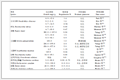
2 研究方法 2.1 样地设置和调查2011年7月,选择具有代表性的地段设置了10块20 m×20 m样地(由于坡长较短,在上、下坡位各设5块),每块样地四角用水泥桩长期固定,样地基本概况见表 1。2011年8月,对试验林实施了中度、强度和极强度择伐(实际择伐蓄积量占总蓄积量的比例分别为34.6%、48.6%和67.6%;实际择伐断面积占总断面积的比例分别为35.9%、50.1%和74.8%)以及皆伐,并与未采伐进行对照,每种处理分别在上、下坡位各有1块样地。在实施不同强度采伐后,均保持自然恢复。因为该试验林2011年8月前从未间伐,林分密度过大,为使择伐后释放充足的林分生长空间,所以没设置弱度择伐(巫志龙等,2015)。
|
择伐木的选择遵循“采坏留好、采弱留壮、采老留小和采密留稀”的原则;择伐作业按照单株择伐技术要求,择伐木和保留木分别作记号和挂号码牌;作业措施为油锯采伐,林内打枝造材,人力肩驮集材,≥5 cm以上的枝桠全部收集利用,其余归堆清理。2011年11月,未采伐的林分密度和树种组成都不变,皆伐当年的林分密度为零;中度、强度和极强度择伐当年的林分密度分别为1 650、17 25和1 350株·hm-2, 按胸高断面积计算树种组成分别为:阔叶树占57.33%,杉木占41.26%,马尾松占1.41%;阔叶树占61.01%,杉木占38.99%;阔叶树占72.74%,杉木占27.26%。2016年7月,对试验林开展了采伐5年后的植被、凋落物、土壤和细根(0~20 cm土层)的调查与试验。未采伐5年后,树种组成为阔叶树占58.98%,杉木占39.12%,马尾松占1.90%,林下植被盖度12%;中度、强度、极强度择伐5年后,树种组成分别为:阔叶树占60.72%,杉木占37.77%,马尾松占1.51%;阔叶树占62.58%,杉木占37.42%;阔叶树占71.65%,杉木占28.35%。3种强度择伐5年后林下植被盖度分别达到16%、21%和33%。皆伐5年后仍无胸径≥5 cm的乔木,灌木和草本盖度高达89%。各种强度采伐前和采伐5年后林分主要特征见表 2。
|
|
2015年7月,在每块标准样地分别做3种处理(孟春等,2008;刘可等,2013;Bond-Lamberty et al., 2004),处理A为保留凋落物层和根系;处理B为去除凋落物层,但保留根系;处理C为去除凋落物层和根系,切除根系采用壕沟法(1 m×1 m),挖壕沟至根系层以下,再用双层塑料布隔离。每种处理分别在样地内沿等高线上、中、下位置布设PVC土壤环(内径20 cm、高度10 cm,一端削尖),每块样地、每种处理分别设置了3个PVC土壤环。布设土壤环前先用相同规格的铁环敲入土壤中,而后取出铁环,再插入PVC环,深度为8 cm。土壤呼吸速率测试时间为2016年7月至2017年7月,每月中旬测定1次(避开雨天),共13次。在整个测试期间内,土壤环的位置保持不变。在每次测量前,去除处理A中新生长的植物,去除处理B和处理C中的凋落物和新生长的植物。测试仪器为Li-8100 A土壤呼吸自动测量系统,测量时间设定为2 min;测试时段为上午9:30至下午15:30,每个土壤环测试值为重复测量3次的平均值。运用Li-8100 A配套的土壤温度传感器和湿度传感器,分别测定土壤5 cm深处的温度和湿度(体积含水率),与土壤呼吸速率测定同时进行。
2.3 数据处理土壤及其各组分的呼吸速率计算公式(孟春等,2008;刘可等,2013)为:
| $ R_{\mathrm{s}}=R_{\mathrm{A}}; $ | (1) |
| $ R_{\mathrm{L}}=R_{\mathrm{A}}-R_{\mathrm{B}}; $ | (2) |
| $ R_{\mathrm{R}}=R_{\mathrm{B}}-R_{\mathrm{C}}; $ | (3) |
| $ R_{\mathrm{M}}=R_{\mathrm{c}}。$ | (4) |
式中:RS为土壤总呼吸速率(μmol·m-2s-1);RA为处理A(保留凋落物和根系)呼吸速率(μmol·m-2s-1);RL为凋落物层呼吸速率(μmol·m-2s-1);RB为处理B(去除凋落物,保留根系)呼吸速率(μmol·m-2s-1);RR为根系呼吸速率(μmol·m-2s-1);RC为处理C(去除凋落物和根系)呼吸速率(μmol·m-2s-1);RM为矿质土壤层呼吸速率(μmol·m-2s-1)。
每种采伐强度林地的A、B和C处理的每月测试值共3个数据,分别为2块标准样地内上、中、下对应位置的2个土壤环测试值的平均值。每种采伐强度林地共测试了13个月,由此得到39个数据。采用SPSS 20.0进行LSD(Least-significant difference)多重比较和模型拟合。
土壤总呼吸速率与温度、湿度相关关系拟合模型(刘可等,2013;左强等,2016)和温度敏感系数(杨玉盛等,2005)计算方法为:
| $ R_{\mathrm{s}}=a \mathrm{e}^{b T}; $ | (5) |
| $ R_{\mathrm{s}}=\alpha W+\beta; $ | (6) |
| $ R_{\mathrm{s}}=l+m T+n W; $ | (7) |
| $ Q_{10}=\mathrm{e}^{10b}。$ | (8) |
式中:T为5 cm深处土壤温度(℃);b为土壤温度反应系数;W为5 cm深处土壤湿度(%);a,m,n为系数;α为土壤水分反应系数;β,l为截距;Q10为温度敏感系数。
运用公式(9)衡量统计模型的拟合效果(宋喜芳等,2009):
| $ \mathrm{AIC}=n \ln \left(\frac{\mathrm{RSS}}{n}\right)+2(K+1)。$ | (9) |
式中:AIC为赤池信息准则;RSS为残差平方和;n为样本量;K为模型自变量个数。
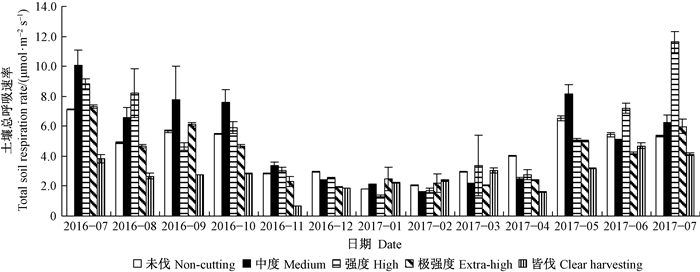
3 结果与分析 3.1 土壤呼吸速率及温湿度变化由图 1可看出,不同强度采伐5年后,杉阔混交人工林土壤总呼吸速率均呈明显的季节动态变化:未采伐和各种强度择伐林地土壤总呼吸速率月均值都在7月份达到最大值,在1—3月份达到最小值;皆伐林地的土壤总呼吸速率达到极值时间有所提前,其月均值在6月份达到最高,在11月份达到最低。
|
图 1 不同强度采伐5年后林地土壤总呼吸速率月变化 Fig. 1 Monthly variation in total soil respiration rate after 5 years under different harvesting intensities |
不同强度采伐5年后,杉阔混交人工林土壤及其各组分的呼吸速率变化见表 3。由表 3可知,不同强度择伐林地凋落物、矿质土壤和根系的呼吸速率都与未采伐没有显著差异(P>0.05);皆伐除了矿质土壤呼吸速率与未采伐没有显著差异(P>0.05)外,凋落物和根系的呼吸速率都显著低于未采伐(P<0.05),分别比未采伐减少了0.93和0.53 μmol·m-2s-1;不同强度择伐林地土壤总呼吸速率都与未采伐林地没有显著差异(P>0.05),皆伐林地土壤总呼吸速率则显著低于未采伐林地(P<0.05),比未采伐林地减少了1.64 μmol·m-2s-1。由此说明,在各种强度采伐5年后,择伐对土壤呼吸及各组分的呼吸速率没有产生显著影响,但皆伐显著降低了林地凋落物和根系的呼吸速率,从而使土壤总呼吸速率显著降低。
|
|
不同强度采伐5年后,杉阔混交人工林土壤温度和湿度变化见表 4。由表 4可知,不同强度择伐林地5 cm深处土壤温度都与未采伐林地没有显著差异(P>0.05),但皆伐林地显著高于未采伐林地(P<0.05),升高了4.7 ℃;中度、强度择伐林地5 cm深处土壤湿度都与未采伐林地没有显著差异(P>0.05),但极强度择伐、皆伐林地都显著低于未采伐林地(P<0.05),分别减少了2.17%和3.98%。
|
|
不同强度采伐5年后,杉阔混交人工林土壤总呼吸速率与土壤温度、湿度的拟合模型见表 5,其中AIC值越小的模型的拟合效果越好(宋喜芳等,2009)。由表 5可知,在不同采伐强度下,林地土壤总呼吸速率与土壤温度的指数单变量模型最优,能很好地解释未采伐和择伐林地土壤总呼吸速率变化的77.8%~83.3%,能较好地解释皆伐林地土壤总呼吸速率变化的35.5%,即土壤总呼吸速率与土壤温度显著指数相关(P<0.001);其次是土壤温度和湿度的双变量线性模型,优于土壤湿度的单变量线性模型,且在双变量模型中m皆大于n,说明土壤总呼吸速率受土壤温度的影响要大于受土壤湿度的影响;未采伐和择伐林地土壤总呼吸的温度敏感性系数Q10为1.77~2.72,高于皆伐林地的Q10值1.49。
|
|
森林采伐会导致林分密度、凋落物和土壤理化性质以及林木根系生物量等发生变化,进而影响林地土壤及其各组分的呼吸速率变化(孟春等,2008;郭辉等,2010;雷蕾等,2015)。不同强度择伐5年后林地土壤及其各组分的呼吸速率均与未采伐没有显著差异。这是因为择伐后林地凋落物储量、有机碳储量、土壤总孔隙度、有机质和有机碳含量,以及细根生物量仍能维持较高水平(表 2)。皆伐5年后林地凋落物和根系的呼吸速率,以及土壤总呼吸速率,都显著低于未采伐林地和不同强度择伐林地。这是因为皆伐后林地凋落物现存量、土壤总孔隙度、土壤有机质和林木细根生物量都出现了明显降低,导致土壤物质代谢和土壤有机质转化及氧化能力降低,如凋落物有机碳储量由皆伐前的9.1 g·m-2降低到皆伐5年后的2.0 g·m-2;土壤有机质含量由皆伐前的31.5 g·kg-1降低到皆伐5年后的20.2 g·kg-1,土壤有机碳含量由皆伐前的20.0 g·kg-1降低到皆伐5年后的17.5 g·kg-1(表 2)。
本研究没有对试验林分采伐后5年内的土壤呼吸速率进行连续监测,仅能得出试验林分在不同强度采伐5年后这个时间点的土壤呼吸速率变化规律,还应补充研究区域类似林分采伐后土壤呼吸速率变化最剧烈的时间内的观测。试验林分不同强度采伐后恢复时间尚短,其林分生长、林分结构、植被更新、物种多样性、凋落物和土壤理化性质等仍处于动态变化,要继续加强对该试验基地的长期定位研究。今后,基于时间序列基础数据,进一步深入研究采伐强度对试验林分植被恢复、凋落物及土壤理化性质、土壤呼吸等的长期动态影响,为确定其合理采伐强度提供科学依据(Zhou et al., 2015)。
4.2 采伐干扰下土壤呼吸速率与土壤温湿度的关系不同强度采伐5年后,中度、强度择伐林地土壤温度和湿度都与未采伐林地没有明显差异;极强度择伐林地土壤湿度显著降低;皆伐林地土壤温度显著升高和土壤湿度显著降低。这是因为极强度择伐后林分密度明显降低、皆伐后乔木层消失(表 2),林地光照强度显著增强,水分蒸发加剧。研究结果表明,林地土壤总呼吸速率与土壤温度的单变量指数模型最优,土壤温湿度的双变量线性模型优于土壤湿度的单变量线性模型,说明研究区土壤总呼吸速率的季节变化主要受土壤温度调节;在未采伐和不同强度择伐下,土壤温度能很好地解释土壤总呼吸速率变化的77.8%~83.3%;皆伐林地土壤温度仅能解释土壤总呼吸速率变化的35.5%,这是因为皆伐后林地土壤温度波动较大,且皆伐后凋落物现存量、土壤有机质含量和细根生物量等呼吸底物明显减少(表 2),降低了土壤呼吸速率对温度的响应。土壤温湿度是影响土壤呼吸变化的重要环境因子(杜倩等,2016;左强等,2016;Shi et al., 2017),但是土壤湿度只有在极端条件下才会成为土壤呼吸的主要调控因素(Rey et al., 2011)。研究区土壤湿度可能更多地受到降雨的影响,雨量充沛使其波动较小,对土壤总呼吸速率的季节变化影响也较小。
在全球尺度下,森林土壤呼吸的温度敏感性Q10值为1.57 (刘绍辉等,1997)。中国区域10个观测地点(5个森林1个草原和4个农田)的15个生态系统的Q10值为1.28~4.75 (Zheng et al., 2009)。从本研究中林地土壤总呼吸的温度敏感性来看,未采伐和各种强度择伐5年后Q10值为1.77~2.72,高于全球尺度下的Q10值;皆伐5年后Q10值1.49,略低于全球尺度下的Q10值。因为调控Q10值的主要因素之一是土壤呼吸底物的供应(Gershenson et al., 2009),皆伐后土壤呼吸底物数量明显减少(表 2),使得Q10值降低。这与杨玉盛等(2005)和王旭等(2007)的研究结果相似。
5 结论闽北杉阔混交人工林在不同强度采伐5年后,各种强度择伐林地土壤及其各组分的呼吸速率与未采伐林地没有显著差异,皆伐林地凋落物和根系的呼吸速率以及土壤总呼吸速率都显著低于未采伐林地和各种强度择伐林地;各种强度择伐并没有改变土壤总呼吸速率的季节变化规律,但皆伐使土壤总呼吸速率最高和最低值出现时间略有提前;土壤温度是研究区土壤总呼吸速率季节变化的主要影响因子。
杜倩, 梁素钰, 刘铁男, 等. 2016. 盐渍土壤人工林土壤呼吸日动态及影响因素. 森林工程, 32(1): 6-9. (Du Q, Liang S Y, Liu T N, et al. 2016. Daily dynamics and influence factors of soil respiration in alkali soil plantation. Forest Engineering, 32(1): 6-9. DOI:10.3969/j.issn.1001-005X.2016.01.002 [in Chinese]) |
郭辉, 董希斌, 姜帆. 2010. 采伐强度对小兴安岭低质林分土壤碳通量的影响. 林业科学, 46(2): 110-115. (Guo H, Dong X B, Jiang F. 2010. Impact of harvesting intensity on soil carbon flux in low-quality forest stands of Xiaoxing'an Mountain. Scientia Silvae Sinicae, 46(2): 110-115. DOI:10.3969/j.issn.1006-1126.2010.02.015 [in Chinese]) |
胡振宏, 范少辉, 黄志群, 等. 2013. 采伐剩余物管理措施对杉木人工林土壤呼吸的影响. 林业科学, 49(5): 24-29. (Hu Z H, Fan S H, Huang Z Q, et al. 2013. Effects of harvest residue management on soil respiration of Chinese fir plantation. Scientia Silvae Sinicae, 49(5): 24-29. DOI:10.3969/j.issn.1672-8246.2013.05.004 [in Chinese]) |
雷蕾, 肖文发. 2015. 采伐对森林土壤碳库影响的不确定性. 林业科学研究, 28(6): 892-899. (Lei L, Xiao W F. 2015. Uncertainty effect of forest harvest on soil carbon pool:a review. Forest Research, 28(6): 892-899. DOI:10.3969/j.issn.1001-1498.2015.06.020 [in Chinese]) |
梁晶, 王庆成, 许丽娟, 等. 2015. 抚育对长白山西坡杨桦幼龄林土壤呼吸及碳储量密度的影响. 植物研究, 35(1): 110-116. (Liang J, Wang Q C, Xu L J, et al. 2015. Effects of thinning on respiration rate and soil carbon density of young-age poplar-birch stands in western Changbai Mountains. Bulletin of Botanical Research, 35(1): 110-116. [in Chinese]) |
刘可, 韩海荣, 康峰峰, 等. 2013. 山西太岳山油松人工林生长季节土壤呼吸对择伐强度的响应. 生态学杂志, 32(12): 3173-3181. (Liu K, Han H R, Kang F F, et al. 2013. Responses of soil respiration to selective harvesting intensity in Pinus tabulaeformis plantation in Taiyue Mountain of China during growing season. Chinese Journal of Ecology, 32(12): 3173-3181. [in Chinese]) |
刘绍辉, 方精云. 1997. 土壤呼吸的影响因素及全球尺度下温度的影响. 生态学报, 17(5): 469-476. (Liu S H, Fang J Y. 1997. Effect factors of soil respiration and the temperature's effects on soil respiration in the global scale. Acta Ecologica Sinica, 17(5): 469-476. DOI:10.3321/j.issn:1000-0933.1997.05.003 [in Chinese]) |
栾军伟, 向成华, 骆宗诗. 2006. 森林土壤呼吸研究进展. 应用生态学报, 17(12): 2451-2456. (Luan J W, Xiang C H, Luo Z S. 2006. Research advances in forest soil respiration. Chinese Journal of Applied Ecology, 17(12): 2451-2456. DOI:10.3321/j.issn:1001-9332.2006.12.044 [in Chinese]) |
孟春, 王立海, 沈微. 2008. 择伐对生长季针阔混交林土壤分室呼吸的影响. 林业科学, 44(8): 23-28. (Meng C, Wang L H, Shen W. 2008. Effects of selective harvesting on soil partitioning respiration in a conifer-broadleaved mixed forest during growing season. Scientia Silvae Sinicae, 44(8): 23-28. DOI:10.3321/j.issn:1001-7488.2008.08.004 [in Chinese]) |
宋喜芳, 李建平, 胡希远. 2009. 模型选择信息量准则AIC及其在方差分析中的应用. 西北农林科技大学学报:自然科学版, 37(2): 88-92. (Song X F, Li J P, Hu X Y. 2009. Model selection criterion AIC and its application in ANOVA. Journal of Northwest Agricultural and Forestry University:Natural Science Edition, 37(2): 88-92. [in Chinese]) |
王旭, 周广胜, 蒋延玲, 等. 2007. 长白山阔叶红松林皆伐迹地土壤呼吸作用. 植物生态学报, 31(3): 355-362. (Wang X, Zhou G S, Jiang Y L, et al. 2007. Soil respiration in a clear-cut broad-leaved Korean pine forest of Changbai Mountain. Journal of Plant Ecology, 31(3): 355-362. DOI:10.3321/j.issn:1005-264X.2007.03.003 [in Chinese]) |
巫志龙, 周成军, 周新年, 等. 2015. 杉阔混交林不同强度择伐对土壤温度的影响. 森林与环境学报, 35(1): 8-12. (Wu Z L, Zhou CJ, Zhou X N, et al. 2015. Effects of different intensities of selective harvesting on soil temperature in Cunninghamia lanceolata-broadleaved mixed plantation. Journal of Forest and Environment, 35(1): 8-12. [in Chinese]) |
杨玉盛, 陈光水, 王小国, 等. 2005. 皆伐对杉木人工林土壤呼吸的影响. 土壤学报, 42(4): 584-590. (Yang Y S, Chen G S, Wang X G, et al. 2005. Effect of clear-harvesting on soil respiration of chinese fir plantation. Acta Pedologica Sinica, 42(4): 584-590. DOI:10.3321/j.issn:0564-3929.2005.04.008 [in Chinese]) |
杨玉盛, 董彬, 谢锦升, 等. 2004. 森林土壤呼吸及其对全球变化的响应. 生态学报, 24(3): 583-591. (Yang Y S, Dong B, Xie J S, et al. 2004. Soil respiration of forest ecosystems and its respondence to global change. Acta Ecologica Sinica, 24(3): 583-591. DOI:10.3321/j.issn:1000-0933.2004.03.028 [in Chinese]) |
曾翔亮, 董希斌. 2014. 采伐强度对大兴安岭用材林解冻初期土壤呼吸的影响. 东北林业大学学报, 42(4): 65-69. (Zeng X L, Dong X B. 2014. Influences of harvesting intensity on throwing soil respiration in Daxing'an Mountain timber forest. Journal of Northeast Forestry University, 42(4): 65-69. DOI:10.3969/j.issn.1000-5382.2014.04.014 [in Chinese]) |
张睿, 白杨, 刘娟, 等. 2015. 亚热带天然阔叶林转换为杉木人工林对土壤呼吸的影响. 应用生态学报, 26(10): 2946-2952. (Zhang R, Bai Y, Liu J, et al. 2015. Effects of conversion of natural broad-leaved forest to Chinese fir plantation on soil respiration in subtropical China. Chinese Journal of Applied Ecology, 26(10): 2946-2952. [in Chinese]) |
周新年, 赖阿红, 周成军, 等. 2015. 山地森林生态采运研究进展. 森林与环境学报, 35(2): 185-192. (Zhou X N, Lai A H, Zhou C J, et al. 2015. Advances in ecological logging of mountain forest. Journal of Forest and Environment, 35(2): 185-192. [in Chinese]) |
左强, 何怀江, 张春雨, 等. 2016. 采伐对蛟河阔叶红松混交林土壤呼吸的影响. 北京林业大学学报, 38(4): 71-76. (Zuo Q, He H J, Zhang C Y, et al. 2016. Effects of harvesting on soil respiration in a mixed broadleaf-Korean pine forest in western foothill of Changbai Mountain, northeast China. Journal of Beijing Forestry University, 38(4): 71-76. [in Chinese]) |
Bond-Lamberty B, Wang C K, Gower S T. 2004. Contribution of root respiration to soil surface CO2 flux in a boreal black spruce chronosequence. Tree Physiology, 24(12): 1387-1395. DOI:10.1093/treephys/24.12.1387 |
Concilio A, Ma S Y, Li Q L, et al. 2005. Soil respiration response to prescribed burning and thinning in mixed-conifer and hardwood forests. Canadian Journal of Forest Research, 35(7): 1581-1591. DOI:10.1139/x05-091 |
Gershenson A, Bader N E, Cheng W X. 2009. Effects of substrate availability on the temperature sensitivity of soil organic matter decomposition. Global Change Biology, 15(1): 176-183. DOI:10.1111/gcb.2009.15.issue-1 |
Kurth V J, Bradford J B, Slesak R A, et al. 2014. Initial soil respiration response to biomass harvesting and green-tree retention in aspen-dominated forests of the Great Lakes region. Forest Ecology and Management, 328: 342-352. DOI:10.1016/j.foreco.2014.05.052 |
Liu J X, Zhou G Y, Zhang D Q, et al. 2010. Carbon dynamics in subtropical forest soil:effects of atmospheric carbon dioxide enrichment and nitrogen addition. Journal of Soils and Sediments, 10(4): 730-738. DOI:10.1007/s11368-009-0178-6 |
Nave L E, Vance E D, Swanston C W, et al. 2010. Harvest impacts on soil carbon storage in temperate forests. Forest Ecology and Management, 259(5): 857-866. DOI:10.1016/j.foreco.2009.12.009 |
Piao S L, Fang J Y, Ciais P, et al. 2009. The carbon balance of terrestrial ecosystems in China. Nature, 458(7241): 1009-1013. DOI:10.1038/nature07944 |
Rey A, Pegoraro E, Oyonarte C, et al. 2011. Impact of land degradation on soil respiration in a steppe (Stipa tenacissima L.) semi-arid ecosystem in the SE of Spain. Soil Biology and Biochemistry, 43(2): 393-403. DOI:10.1016/j.soilbio.2010.11.007 |
Shi W Y, Du S, Morina J C, et al. 2017. Physical and biogeochemical controls on soil respiration along a topographical gradient in a semiarid forest. Agricultural and Forest Meteorology, 247: 1-11. DOI:10.1016/j.agrformet.2017.07.006 |
Wu Z L, Zhou C J, Zhou X N, et al. 2018. Variability after 15 years of vegetation recovery in natural secondary forest with timber harvesting at different intensities in southeastern China:community diversity and stability. Forests, 9(1): 1-16. |
Zheng Z M, Yu G R, Fu Y L, et al. 2009. Temperature sensitivity of soil respiration is affected by prevailing climatic conditions and soil organic carbon content:a trans-China based case study. Soil Biology and Biochemistry, 41(7): 1531-1540. DOI:10.1016/j.soilbio.2009.04.013 |
Zhou X N, Zhou Y, Zhou C J, et al. 2015. Effects of harvesting intensity on soil physical and chemical properties in a Mixed Natural Forest in Southeastern China. Forests, 6(12): 4495-4509. DOI:10.3390/f6124383 |