Response Spectrum Method for Extreme Wave Loading With Higher Order Components of Drag Force
1 Introduction
When designing a structure the engineer can use the concept of a response spectrum that represents a proper assessment of the structural behavior in extreme conditions. To design a structure, a response spectrum is more prevalent for seismic loads than ocean wave loads. Regarding special considerations for ocean wave loads, this method is not easily applicable. There exists a fundamental difference between a response spectrum of a structure affected by an earthquake and ocean wave loads. In seismic loading, besides the seismic loads characteristics, the response spectrum only depends on the natural vibration period of the structure and is independent from other factors such as geometrical specifications. While in wave loading, the response spectrum of a structure depends on the shape of the structural members, water depth, as well as the natural vibration period of the structure.
The second order drag force for the slender members was investigated using the Morison equation (Morison et al. 1950).
Borgman (1967) observed the so-called superharmonic phenomenon where significant peaks occured at the odd-order multiples of the peak wave frequency because of the nonlinear effect of a distributed drag force in a power spectrum of the wave force. Naess and Yim (1996) verified the Borgman observation experimentally by measuring force spectra at twice the peak wave frequency.
The concept of applying response spectra when designing a structure against wave loading was studied by a few researchers. Initially, Veletsos et al (1983) conducted a feasibility study on the utilization of the response spectrum concept when designing offshore structures against random waves by applying the respective simplifed assumptions.
Motivated by the Veletsos studies, Tung (1986) demonstrated that one can obtain response spectra of the offshore structures from an equal single degree of freedom model by applying deterministic wave theory and linearizing the drag term. In Tung's study, structural damping was not accounted for and only the hydrodynamic damping was considered. Furthermore, the effect of higher order factors in the drag term of the Morison equation were not taken into account. In later years, other researchers such as Hu and Manadato (1991), studied the concept of response spectra and developed a design response spectra against random ocean waves. The proposed spectra in these studies referred to a specific structure in various hydrodynamic conditions, which was not of interest to many designers.
Instead of a Volterra series based method, a method based on Price's theorem and Fourier transforms was proposed by Zheng and Liaw (2004) for evaluating the nonlinear response power spectra of fixed offshore structures modeled as finite-memory systems.
To convert the waves into structural loads, Morrison's equation is applied. This equation consists of two terms of inertia and drag which are explained in linear and non-linear forms, respectively. One can convert the non-linear drag term into a sum of Fourier components with incremental frequencies and decrementing amplitude. Even if the linear drag term is used, a single sinusoidal wave results in a harmonic response of a structure with at least two main frequencies and amplitudes; a considerable part of this load relies on the first frequency. Typically the offshore structures are designed in a way where their natural frequency is located far away from the frequency of the dominant wave. However, interference may occur between frequencies of other harmonics in higher order components of the drag term and the natural frequency of the structure, which eventually results in a resonance phenomenon for the structure. The goal of this study is to produce spectra for the response of fixed platforms with different alternating periods when the higher order factors of the drag term are considered. For this purpose, the equivalent single degree of freedom structure is used, and the motion equation of which is calculated through deterministic wave theory. By solving this equation in the time domain, the response spectra for different depths and different diameter to thickness ratios are computed.
2 Equation of Motion for the Equivalent Structural System
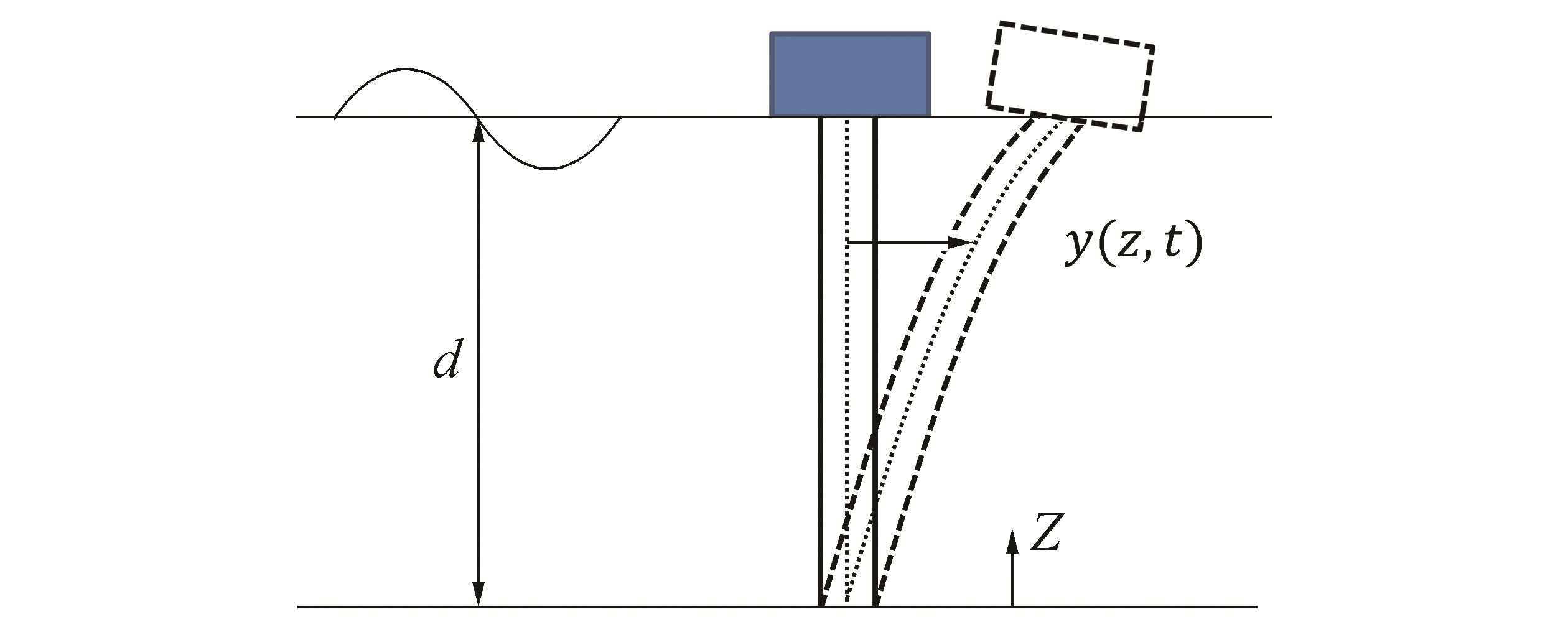
The equation of motion is calculated by the mass Mof the cantilever circular member with a specified diameter D, rigidness EI, and length d(Figure 1). Platform displacement in height z at time t is denoted by $ y(z, t) $. Ocean waves are modeled as simple airy waves with amplitude a and frequency ω. Accordingly, the water particle velocity and acceleration are calculated based on equation (1) and (2), respectively:
|
$
u(z, t) = \frac{{agk}}{\omega }\frac{{\cosh kz}}{{\cosh kd}}\cos \omega t
$
|
(1) |
|
$
\dot u(z, t) = - agk\frac{{\cosh kz}}{{\cosh kd}}\sin \omega t
$
|
(2) |
The wave loading of the structure is computed through Morrison's equation. The equation consists of terms of drag $ {{f}_{D}} $ and inertia $ {{f}_{I}} $, and the distributed load of drag and inertia terms are expressed as:
|
$
\begin{array}{l}
{f_D}(z, t) = \, \, \, \, {K_D}\left[ {u(z, t) - \dot y(z, t)} \right]\left| {u(z, t) - \dot y(z, t)} \right| = \\
\, \, \, \, \begin{array}{*{20}{c}}
{}&{}&{}
\end{array}{K_D}(u(z, t)\left| {u(z, t)} \right| - 2 < \left| {u(z, t)} \right| > \dot y(z, t))
\end{array}
$
|
(3) |
|
$
{f_I}(z, t) = {K_M}\dot u(z, t) - {M_a}\ddot y(z, t)
$
|
(4) |
where $ \dot{y} $ and $\ddot{y} $ denote the velocity and acceleration of the structure. Additionally, the time average of water particle velocity in a full wave cycle is calculated as
|
$
< u(z, t) > = \frac{2}{\pi }\frac{{agk\cosh kz}}{{\omega \cosh kd}}
$
|
(5) |
where $ {{K}_{D}} $, $ {{K}_{M}} $, and $ {{M}_{a}} $ are defined respectively:
|
$
{K_D} = {C_D}\frac{D}{2}\rho
$
|
(6) |
|
$
{K_M} = {C_m}\frac{{{\rm{\pi }}{D^2}}}{4}\rho
$
|
(7) |
|
$
{M_a} = {C_a}\frac{{{\rm{\pi }}{D^2}}}{4}\rho
$
|
(8) |
$ {{C}_{D}} $, $ {{C}_{m}} $, and ${{C}_{a}} $ denote the coefficients of drag, inertia and, added mass, respectively, and $ \rho $ is the density of the water. For modeling the structure, the equation of the generalized system corresponding to the single degree of freedom structural system is used. In this method $\psi (z) $ is described as the estimate of the structure's first mode of vibration. By showing the top (deck) displacement of the structure as $y(d, t)=Y(t) $, the deflection in each point of the generalized system is calculated by multiplying the shape function by the displacement of structure:
|
$
y(z, t) = \psi (z)Y(t)
$
|
(9) |
Accordingly, the motion equation for the top displacement of the structure can be written as:
|
$
({M_{{\rm{deck}}}} + {M_{st}})\ddot Y(t) + {C_{st}}\dot Y(t) + {K_{st}}Y(t)\, \, = {F_I} + {F_D}
$
|
(10) |
In equation (10), $ {{M}_{\text{deck}}} $ is the mass of the deck. $ {{M}_{\text{str}}} $, $ {{C}_{st}} $, $ {{K}_{st}}$, $ {{F}_{I}} $, and $ {{F}_{D}} $ are structural mass, structural damping, structural stiffness, inertial force, and drag force, respectively. They are defined as follows:
|
$
{M_{st}} = \int\limits_0^d {{{\bar M}_{st}}(z)\, \psi {{(z)}^2}} {\rm{d}}z
$
|
(11) |
|
$
{K_{st}} = \int\limits_0^d {EI(z)\psi ''{{(z)}^2}} {\rm{d}}z
$
|
(12) |
|
$
{C_{st}} = 2{\zeta _{st}}{M_{st}}\omega _n^{st}
$
|
(13) |
|
$
{F_I} = \int\limits_0^d {{f_I}(z, t)\psi (z){\rm{d}}z}
$
|
(14) |
|
$
{F_D} = \int\limits_0^d {{f_D}(z, t)\psi (z){\rm{d}}z}
$
|
(15) |
In these equations, $ {{\bar{M}}_{st}} $, E, and I are mass per length, module of elasticity, and moment of inertia of structure, respectively. $ {{\zeta }_{st}} $ is the damping ratio and $ \omega _{n}^{st} $ is the natural frequency of the structure and it is defined as:
|
$
\omega _n^{st} = \sqrt {\frac{{{K_{st}}}}{{{M_{st}}}}}
$
|
(16) |
To solve equation (10), it is assumed that variables ${{\bar{M}}_{st}} $, E, and I have constant values. Also, based on the first mode of vibration, the shape function is assumed as:
|
$
\psi (z) = \frac{{3{z^2}}}{{2{d^2}}} - \frac{{{z^3}}}{{2{d^3}}}
$
|
(17) |
Based on the aforementioned equations, the following integrals result $ \left(\alpha =kd \right) $:
|
$
\int\limits_0^d {{\psi ^2}(z){\rm{d}}z} = \frac{{33}}{{140}}d
$
|
(18) |
|
$
\int\limits_0^d {\psi ''{{(z)}^2}{\rm{d}}z} = \frac{3}{{{d^3}}}
$
|
(19) |
|
$
\int\limits_0^d {\dot u(z, t)\psi (z){\rm{d}}z = \frac{{ag}}{2}{q_1}(\alpha)\sin \omega t}
$
|
(20) |
|
$
\int\limits_0^d {u(z, t)\left| {u(z, t)} \right|\psi (z){\rm{d}}z} = \, \, \, {a^2}g\, {q_2}(\alpha)\, \cos \omega t.\left| {\cos \omega t} \right|
$
|
(21) |
|
$
\int\limits_0^d { < \left| {u(z, t)} \right| > {\psi ^2}(z){\rm{d}}z} = \frac{1}{{\rm{\pi }}}\frac{{ag}}{\omega }{q_3}(\alpha)
$
|
(22) |
The functions in these formulas are:
|
$
{q_1}(\alpha) = \frac{{ - 1}}{{{\alpha ^3}\cosh \alpha }}[2{\alpha ^3}\sinh \alpha - \, 3({\alpha ^2} - 2)\cosh \alpha - 6]
$
|
(23) |
|
$
\begin{array}{l}
{q_2}(\alpha) = \\
\frac{1}{{16{\alpha ^3}\sinh 2\alpha }}[3({\alpha ^4} - 1) + \, 8{\alpha ^3}\sinh 2\alpha - 3({\alpha ^2} - 1)\cosh 2\alpha ]
\end{array}
$
|
(24) |
|
$
\begin{array}{l}
{q_3}(\alpha) = \frac{1}{{3{\alpha ^6}\cosh \alpha }}[(2{\alpha ^6} + 9{\alpha ^4} - 72{\alpha ^2} + 360)\sinh \alpha {\rm{ + }}\\
\, \, \, \, \, \, \, \, \, \, \, \, \, \, \, \, \, \, \, \, \, \, \, \, \, \, \, \, \, \, \, \, \, \, \, \, \, \, \, \, \, (12{\alpha ^3} - 6{\alpha ^5})\cosh \alpha - 360\alpha ]
\end{array}
$
|
(25) |
Finally, by replacing these equations in equation (10), the following formula is attained:
|
$
\begin{array}{l}
({M_{{\rm{deck}}}} + \frac{{33}}{{140}}d{{\bar M}_{st}})\ddot Y(t) + 2{\zeta _{st}}{M_{st}}\omega _n^{st}\dot Y(t) + \frac{{3EI}}{{{d^3}}}Y(t) = \\
\underbrace {{K_M}\frac{{ag}}{2}{q_1}(\alpha)\sin \omega t - {M_a}\ddot Y(t)\frac{{33}}{{140}}d}_{{\rm{Inertia term}}}\\
+ \underbrace {{K_D}{a^2}g\, {q_2}(\alpha)\, \cos \omega t \cdot \left| {\cos \omega t} \right|}_{{\rm{Drag term}}}\underbrace { - \frac{2}{{\rm{\pi }}}\frac{{{K_D}ag}}{\omega }{q_3}(\alpha)\dot Y(t)}_{{\rm{Drag term}}}
\end{array}
$
|
(26) |
Equation (26) can be rewritten as follows:
|
$
\begin{array}{l}
({M_{{\rm{deck}}}} + \frac{{33}}{{140}}d({{\bar M}_{st}} + {M_a}))\ddot Y(t) + \\
(2{\zeta _{st}}{M_{st}}\omega _n^{st} + \frac{2}{{\rm{\pi }}}\frac{{{K_D}ag}}{\omega }{q_3}(\alpha))\dot Y(t) + \frac{{3EI}}{{{d^3}}}Y(t){\rm{ = }}\\
{K_M}\frac{{ag}}{2}{q_1}(\alpha)\sin \omega t + {K_D}{a^2}g\, {q_2}(\alpha)\, \cos \omega t \cdot \left| {\cos \omega t} \right|
\end{array}
$
|
(27) |
In other words, the formula for the structure's motion in the water is formulated as:
|
$
{M_t}\ddot Y(t) + {C_t}\dot Y(t) + kY(t) = {F_1}\sin \omega t + {F_2}\cos \omega t.\left| {\cos \omega t} \right|
$
|
(28) |
In which:
|
$
{M_t} = {M_{deck}} + \frac{{33}}{{140}}d({\bar M_{st}} + {M_a})
$
|
(29) |
|
$
{C_t} = 2{\zeta _{st}}{M_{st}}\omega _n^{st} + \frac{2}{\pi }\frac{{{K_D}ag}}{\omega }{q_3}(\alpha) = 2{\zeta _{st}}{M_{st}}\omega _n^{st} + \frac{{ag{C_D}D\rho }}{{\omega \pi }}{q_3}(\alpha)
$
|
(30) |
|
$
{F_1} = {K_M}\frac{{ag}}{2}{q_1}(\alpha) = \frac{{{\rm{\pi }}{D^2}}}{8}{C_M}\rho ga{q_1}(\alpha)
$
|
(31) |
|
$
{F_2} = {K_D}{a^2}g\, {q_2}(\alpha)\, = \frac{D}{2}{C_D}\rho g{a^2}{q_2}(\alpha)
$
|
(32) |
3 The response spectra of the structure against wave loading
The existence of $ \cos \omega t\cdot \left| \cos \omega t \right| $ in the drag term result in non-linearization of this term. To examine the non-linearity effect of the drag term on the response of structure, it must be converted into a sum of Fourier components. Based on the Fourier series, the nonlinear drag term for wave loading can be demonstrated as follows:
|
$
{F_D}(z, t) = {F_2}\cos \omega t \cdot \left| {\cos \omega t} \right| = {F_2}\left({{a_0} + \sum\limits_{n = 1}^\infty {\left({{a_n}\cos n\omega t + {b_n}\sin n\omega t} \right)} } \right)
$
|
(33) |
The Fourier coefficients are formulated as:
|
$
\begin{array}{l}
{a_0} = \frac{1}{T}\int\limits_{ - T/2}^{T/2} {\cos \left({\frac{{2{\rm{\pi }}t}}{T}} \right)\left| {\cos \left({\frac{{2{\rm{\pi }}t}}{T}} \right)} \right|{\rm{d}}t} = 0\\
{a_n} = \, \frac{2}{T}\int\limits_{ - T/2}^{T/2} {\cos \left({\frac{{2{\rm{\pi }}t}}{T}} \right)} .\left| {\cos \left({\frac{{2{\rm{\pi }}t}}{T}} \right)} \right|.\cos \frac{{n{\rm{\pi }}t}}{T}\, {\rm{d}}t\\
n = 1, 3, 5, K\, \, :\, \, \, {a_n} = \, \frac{{16\sin \left({\frac{{n{\rm{\pi }}}}{2}} \right)}}{{{\rm{\pi }}\left({16n - 4{n^3}} \right)}} - \\
\, \, \, \, \, \, \frac{{2\left({2\sin \left({\frac{{n{\rm{\pi }}}}{2}} \right) - 2\sin \left({n{\rm{\pi }}} \right) + {n^2}\sin \left({n{\rm{\pi }}} \right)} \right)}}{{n{\rm{\pi }}({n^2} - 4)}}\\
n = 2, 4, 6, \ldots \, \, \, :\, \, {a_n} = 0\\
{b_n} = \frac{2}{T}\int\limits_{ - T/2}^{T/2} {\cos \left({\frac{{2{\rm{\pi }}t}}{T}} \right).\left| {\cos \left({\frac{{2{\rm{\pi }}t}}{T}} \right)} \right|} .\sin \frac{{n{\rm{\pi }}t}}{T}\, {\rm{d}}t = 0
\end{array}
$
|
(34) |
Taking into account the aforementioned formulas, the drag term for Morrison's equation is changed to:
|
$
{F_D}(t) = {F_2}(\frac{8}{{3{\rm{\pi }}}}\cos \omega t + \frac{8}{{15{\rm{\pi }}}}\cos 3\omega t + \ldots)
$
|
(35) |
By revising the motion equation of the system based on the new formulas for the drag term, the following equation can be obtained:
|
$
\begin{array}{l}
{M_t}\ddot Y(t) + {C_t}\dot Y(t) + kY(t) = \\
\underbrace {{F_1}\sin (\omega t)}_{{\rm{Inertia}}} + \underbrace {\frac{8}{{3{\rm{\pi }}}}{F_2}\cos (\omega t)}_{{\rm{First}}\, {\rm{Drag}}\, {\rm{term}}} + \underbrace {\frac{8}{{15{\rm{\pi }}}}{F_2}\cos (3\omega t)}_{{\rm{Second}}\, {\rm{Drag}}\, {\rm{term}}} + \, \, \,
\end{array}
$
|
(36) |
In this study, higher order components above the second order component of the drag force were neglected due to minimal impact on the response of structure. Also third and higher order components of drag force are usually insignificant for typical offshore structure. Since natural vibration period of typical offshore structures are between 1.6 to 2.3 second, it must be noted the effective frequency of the second order component of the drag force is usually in the vicinity of the natural vibration frequency of typical fixed offshore structures. Hence, its effect on the response of the structure must be taken into account.
Table 1 Hydrodynamic specification of waves in the Persian Gulf region
| Sea state Return Period / Year |
TP / s |
HS / m |
Wave length /m |
| 1 |
3.8 |
1.67 |
22.561 |
| 2 |
4.94 |
2.82 |
38.124 |
| 5 |
5.6 |
3.62 |
48.953 |
| 10 |
6 |
4.15 |
56.111 |
| 20 |
6.35 |
4.66 |
62.693 |
| 50 |
6.78 |
5.33 |
71.109 |
| 100 |
7.1 |
5.83 |
77.551 |
| 200 |
7.4 |
6.32 |
83.687 |
For a better explanation of the second order component of the drag force, the inertial force and the first term of the drag force can be revised as:
|
$
F = \underbrace {{F_1}\sin (\omega t)}_{{\rm{Inertia Term}}} + \underbrace {\frac{8}{{3\pi }}{F_2}\cos (\omega t)}_{{\rm{First}}\, {\rm{Drag}}\, {\rm{Term}}} = {F_t}\sin (\omega t + \phi)
$
|
(37) |
In which:
|
$
\phi = {\rm{arc}}\tan \frac{{{F_2}}}{{{F_1}}}
$
|
(38) |
|
$
{F_t} = \sqrt {F_1^2 + {{\left({\frac{8}{{3{\rm{\pi }}}}} \right)}^2}F_2^2}
$
|
(39) |
Based on equation (39), the differential equation of motion for the structure is revised as follows:
|
$
\begin{array}{l}
{M_t}\ddot Y(t) + {C_t}\dot Y(t) + {K_{st}}Y(t) = \\
\underbrace {{{\bar F}_1}\sin (\omega t + \phi)}_{{\rm{Inerti \& first drag term}}} + \underbrace {\frac{8}{{15{\rm{\pi }}}}{F_2}\cos (3\omega t)}_{{\rm{Second drag term}}}
\end{array}
$
|
(40) |
As can be seen in equation (40), in addition to the ocean wave frequency $ (\omega) $, the structure is modulated at 3 times $ (3\omega) $ the main frequency of the wave. Therefore, if the second order component of the drag term poses significant amplitude and also the natural frequency of the structure was one third of the frequency, the resonance phenomenon is predicted for the structure.
To obtain the response spectra of the structure, equation (40) must be solved in the time domain, and maximum values of the response must be specified for each excitation frequency. However, by using the maximum response SRSS (Square root of sum of square) of each term, an approximated response spectrum is obtained. On this basis, the maximum response of the structure with a natural vibration period of ${{T}_{n}}=2\pi \sqrt{{{{M}_{t}}}/{{{K}_{st}}}\;}$, excited by waves with a period of ${T_w}$, is determined approximately as:
|
$
{U_0} = \frac{{\sqrt {\left({{{\left({{{\bar F}_1}.DA{F_1}} \right)}^2} + {{\left({\frac{8}{{15\pi }}{F_2}.DA{F_2}} \right)}^2}} \right)} }}{{{K_{st}}}}
$
|
(41) |
In equation (41), the dynamic amplification factors for each term are:
|
$
DA{F_1} = \frac{1}{{\sqrt {{{\left[ {1 - {r_1}^2} \right]}^2} + {{\left[ {2{\zeta _t}{r_1}} \right]}^2}} }}\, \, ;\, \, {r_1} = \frac{{{T_n}}}{{{T_w}}}
$
|
(42) |
|
$
DA{F_2} = \frac{1}{{\sqrt {{{\left[ {1 - {r_2}^2} \right]}^2} + {{\left[ {2{\zeta _t}{r_2}} \right]}^2}} }}\, \, ;\, \, {r_2} = \frac{{3{T_n}}}{{{T_w}}}
$
|
(43) |
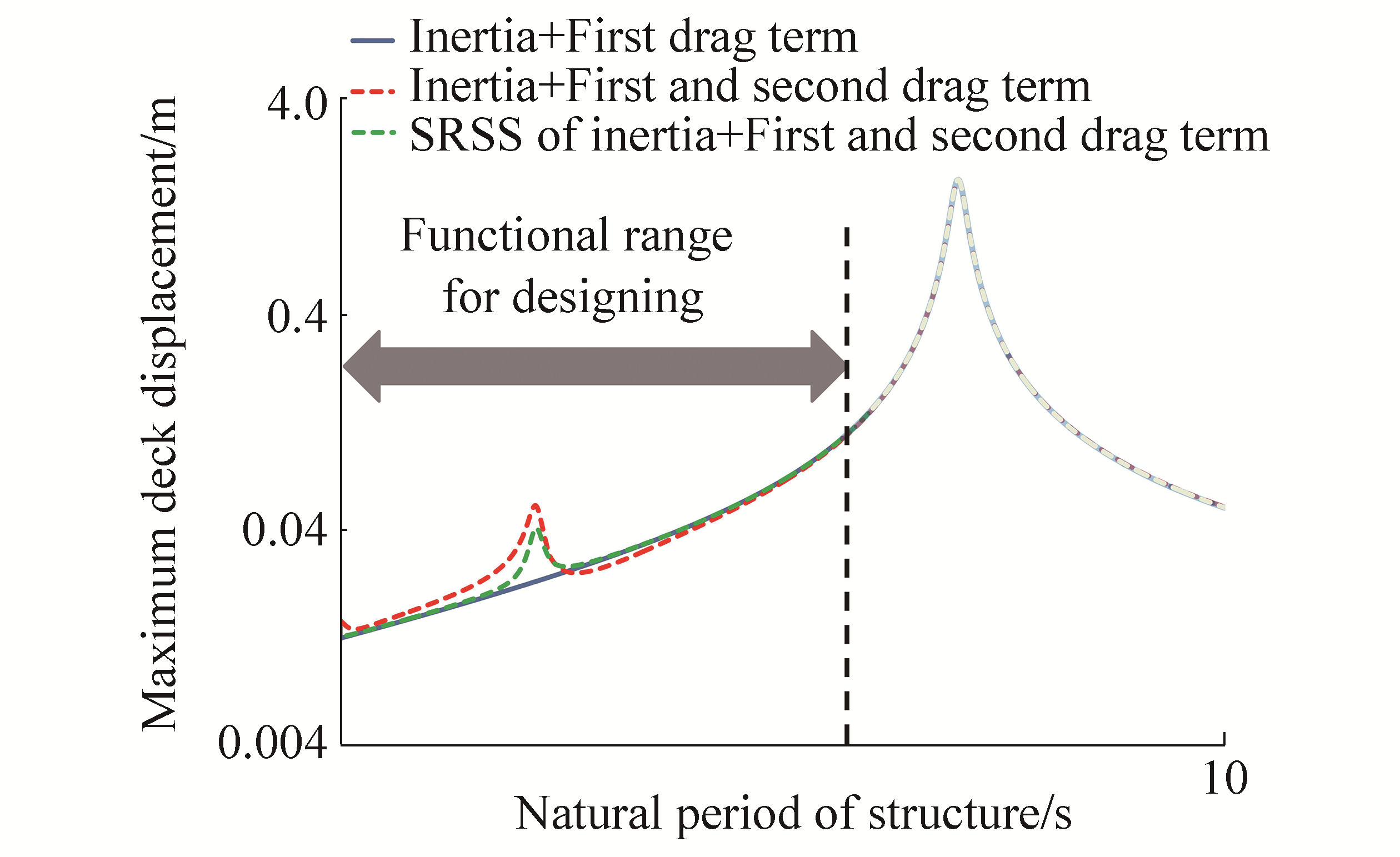
$ {\zeta _t} $ is the total damping of the structural system and is determined by the structural and hydrodynamic damping. For a better explanation, the response spectra of a structure in depth of 30 meters for a 100 year return period in Persian Gulf waves (${H_s} = 5.83\, {\rm{m}}, \, \, \, {T_p} = 7.1{\rm{s}}$) is depicted in Fig. 2. As seen in this figure, the response spectra are determined in three conditions:
1) Without consideration of the second order drag term
2) With consideration of the second order drag term and the numerical solution in time domain
3) With consideration of second order drag term and an approximate solution (SRSS)
The second order component of the drag term has a significant contribution on the natural vibration period of the fixed offshore structures. Also the SRSS method has acceptable results though it imposes a low cost of calculation.
With regard to presented entries, it can be concluded that response spectra of fixed offshore structures under ocean wave loading are impacted by numerous environmental and structural factors.
1. An ocean Wave loading condition (Wave period and Height) with regard to location of structure
2. Ratio of diameter to thickness of a circular member (for equal single degree of freedom structure)
3. Water depth
Accordingly, engineers can develop diagrams that indicate a fair preliminary estimate of the response of structures in different locations and under different environmental conditions. These diagrams are applicable in the initial stage of design. In this study, example diagrams corresponding to response spectra of fixed offshore structures in the Persian Gulf with different wave return periods are provided and shown in Fig. 3. As can be seen with increase wave intensity (increase of wave return period), the effect of the second order component of the drag force is increased. This behavior is due to an increase of the Keulegan Carpenter (KC) number that is an augmentation indicator of drag force in the Morrison equation based on Journee (2001). Also with an increase of water depth, the maximum response of the structure is increased due to structural geometry and the nature of ocean wave loading. As an example, the maximum deck displacement for a structure with a 2 second natural vibration period (D/t=100), excitation by waves with a 100 year return period, in water depth of 50 m, is estimated to equal about 0.05 meter.
4 Discussion and Conclusion
In this study a primary template for obtaining response spectrum of fixed offshore structures under wave loading was proposed. Also the effect of second order components of the drag force on the response spectra of a structure was assessed. The equation of motion for an equivalent single degree of freedom structure was obtained and response spectra of structure with and without consideration of the second order component of the drag force were compared. The results of this investigation showed the second order component of drag term had a decisive impact on the response spectra of the fixed offshore structure. Also, with regard to wave conditions of the Persian Gulf region, various water depths, and various diameter to thickness ratios of the equivalent structure, response spectra of structure diagrams were obtained. These diagrams could represent a fair preliminary estimate of the response of the structure in the initial design stage.


 , , , ,