


 ,
,
2. Collaborative Innovation Center for Advanced Ship and Deep-Sea Exploration, Shanghai 200240, China
1 Introduction
When a structure in contact with fluid vibrates, there is an interaction between the fluid and the structure. It is called fluid-structure interaction. Different methods should be applied to models with different levels of interaction. The structure in contact with low density fluid is a weak coupled problem, while the structure in contact with high density fluid, such as water, is a strong coupled problem. To solve the strong coupled system, a coupled method should be applied. The fluid-structure interaction level of a plate can be decided by the empirical formulation(Atalla and Bernhard, 1994).
When a structure in contact with fluid vibrates in low frequencies, the fluid is considered as irrotational ideal fluid under small linear load. If the fluid is compressible, then the governing equation of sound pressure or velocity potential is Helmholtz differential equation. In low frequency, the effect of fluid on structure is considered as an added mass effect(Wang et al., 2014). FEM/FEM and FEM/BEM are common methods for solving the vibration characteristics of fluid-structure systems.
Usually, when the structure is closed and the fluid domain is unbounded, FEM/Direct-BEM is an appropriate method(Everstine and Henderson, 1990; Everstine, 1991; Yao et al., 2004). It is easy to use the calculated added mass matrix by Direct-BEM to build system equation, but it can only solve closed structure and the interior or exterior problem needs to be solved separately. Another difficulty in Direct-BEM is the singular integral. When the structure is open and the fluid domain is unbounded, FEM/Indirect-BEM is a widely used method(Coyette and Fyfe, 1989; Jeans and Mathews, 1990; Vlahopoulos et al., 1999; Wei et al., 2011; Liu et al., 2014). There are two advantages to calculate the added mass matrix by Indirect-BEM. The first is that it can solve the interior and exterior problem simultaneously. The second is that the obtained matrix is symmetric so that the fluid equation and the structure equation can be coupled better. However, it costs more time to build the system matrix. And it is difficult to deal with the hypersingular integral in Indirect-BEM. FEM/FEM is usually applied to analyze the vibration characteristics of structure in bounded fluid(Gladwell, 1966; Petyt et al., 1976; Volcy et al., 1979; Lu and Clough, 1982; Wang et al., 1988; Everstine, 1997; Tong and Liu, 1997; Zheng et al., 1998; Ahlem, 2004; Thompson, 2005; Yao et al., 2006; Wu and Zhao, 2007; Zhao et al., 2007). The advantage of calculating the added mass matrix by FEM is that the obtained fluid mass and stiffness matrices are symmetric, sparse and real matrices. It is easier to compute the matrices using FEM than Direct-BEM or Indirect-BEM. For large scale exterior problems the FEM/FEM needs lower computational cost. FEM has no singular integral. And the obtained fluid mass and stiffness matrices are irrelevant to the vibrating frequency so that they need not to be computed repeatedly. BEM doesn’t have these advantages. Experiments are often used to verify the numerical results obtained by FEM/FEM or FEM/BEM(Volcy et al., 1979; Chen et al., 1999; Chen et al., 2003; Liu et al., 2014).
This paper presents a numerical method for calculating the added mass of structure that is in bounded fluid in low frequency. After adding the added mass matrix to the structure mass matrix, a fluid-structure interaction mass matrix is obtained. Combining the matrix with structure stiffness matrix, the generalized characteristic equation of the system is attained. The vibration characteristics of the system are calculated by solving the equation. In this paper, a FORTRAN code is programmed that computes the vibration characteristics of structure in the bounded fluid domain. The cantilever plate example demonstrates that fluid changes the structure’s dynamic characteristics. A verification experiment based on a loaded ship model is performed and the results show good correlation with the numerical solutions. The derivation of numerical method for the fluid-structure has a good reference value to the research of fluid-structure dynamics and acoustic radiation.
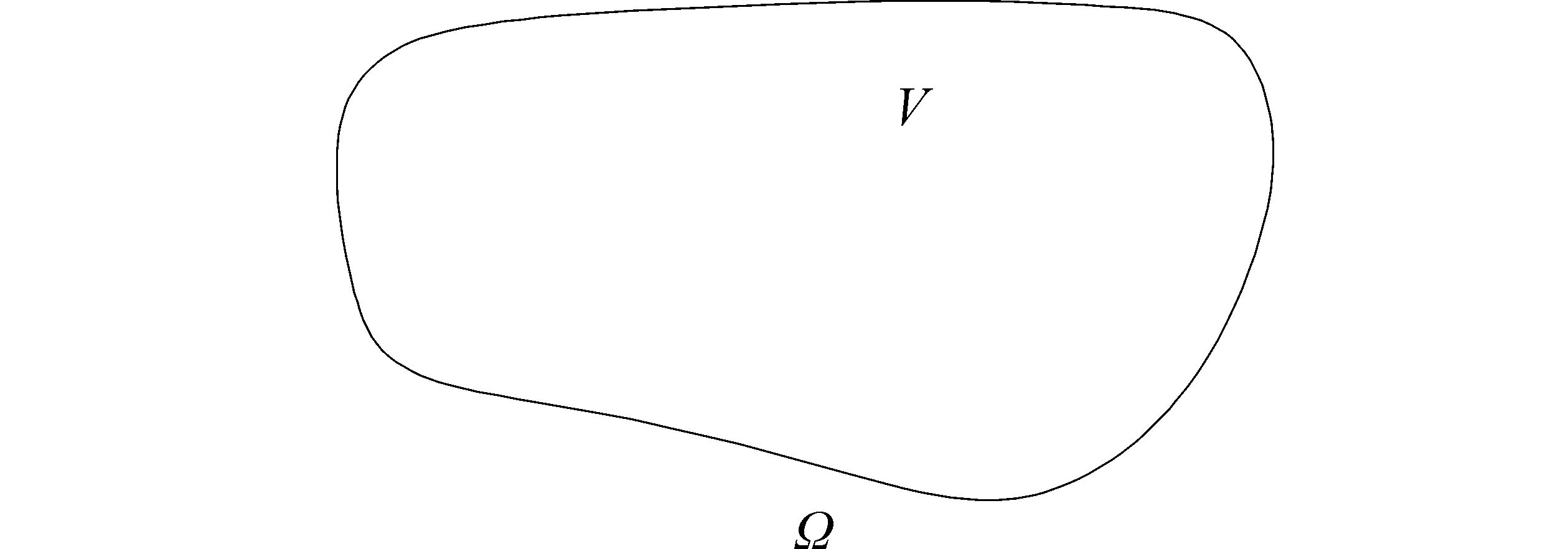
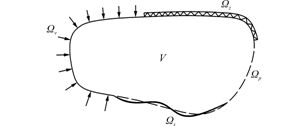
2 Basic theories 2.1 Derivation of Helmholtz integral equation in fluid domainAs shown in Fig. 1, V is the bounded fluid domain and $\Omega$ is its boundary. When the structure in contact with the fluid vibrates, the vibration has an effect on fluid, which produces a radiation sound pressure filed in the fluid domain. The sound pressure in the fluid domain also has an effect on the structure in return. For the irrotational, compressible fluid, under the small linear load, the pressure p in the fluid domain satisfies Helmholtz differential equation:

|
| Fig. 1 Representation of fluid domain and boundary |
For Eq.(1), the weighted integral form in the fluid domain is:

Using integration by parts, Eq.(2)becomes:
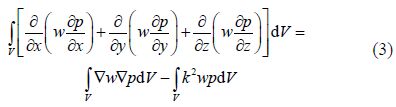
According to the Gaussian divergence theorem, the first term of Eq.(3)becomes:
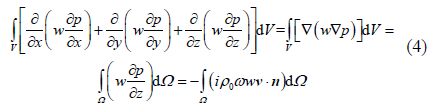
Substituting Eq.(4)into Eq.(3), Eq.(5)is obtained as follows:

Eq.(5)is the Helmholtz integral equation over the fluid domain and boundary. It’s the theoretical basis to solve Helmholtz differential equation.
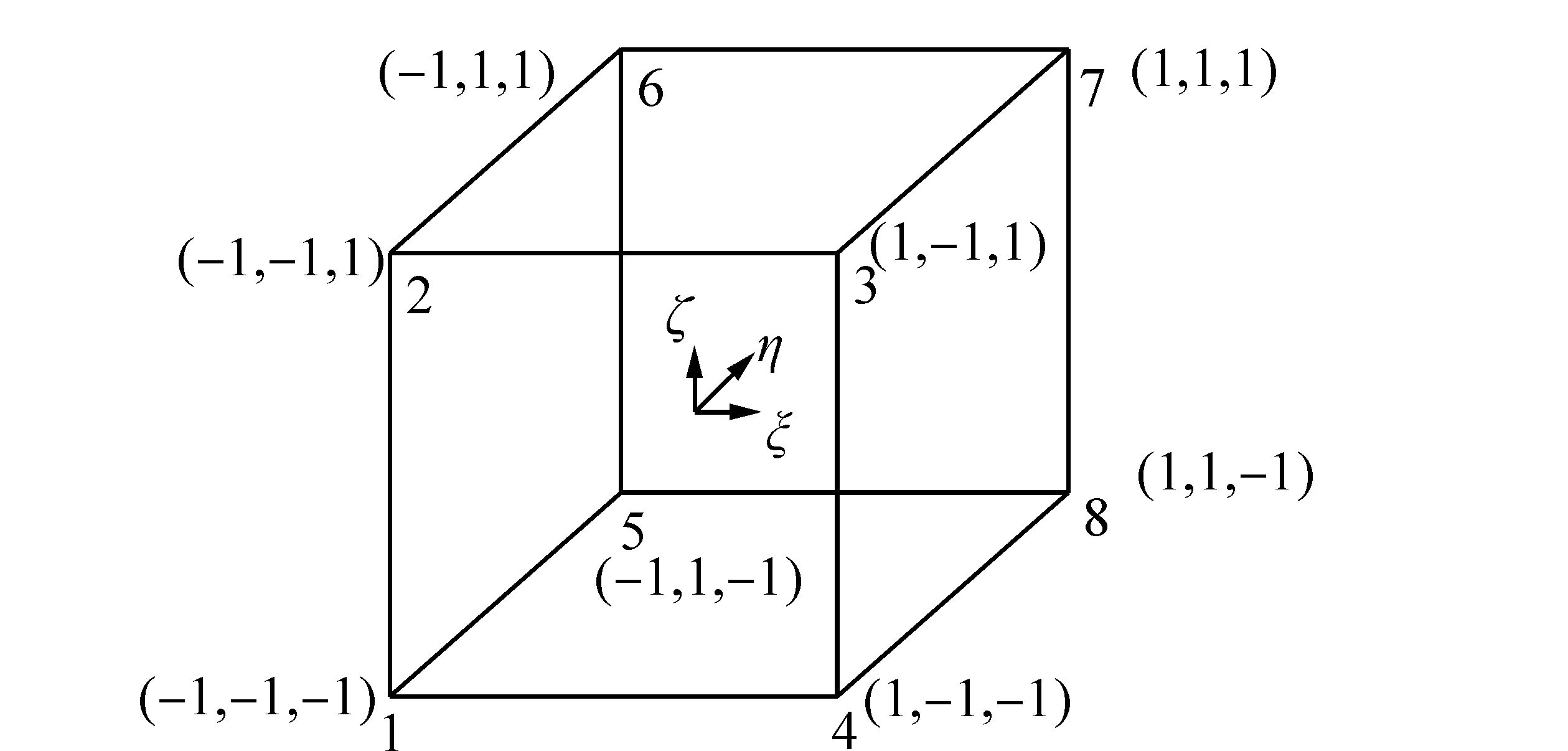
2.2 Solving Helmholtz integral equation of the fluid domain by FEMThis paper uses 8-nodes isoparametric hexahedral element to discretize the bounded fluid domain, as shown in Fig. 2. The shape function of 8-nodes isoparametric hexahedral element is:

|
| Fig. 2 8-node isoparametric element |
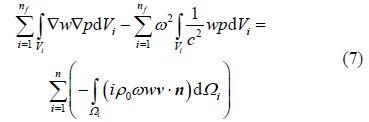
The discrete form of Eq.(5)is
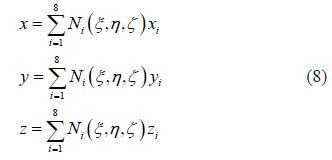
For 8-nodes isoparametric hexahedral element, coordinates transformation using the same shape function can satisfy the compatibility dem and :
The weighted function at any point in an element can be interpolated by the shape function:

The sound pressure at any point in an element can be interpolated by the shape function:

For Eq.(7), the first term on the left is $\sum\limits_{i=1}^{{{n}_{f}}}{\int\limits_{{{V}_{i}}}{\nabla w\nabla p\text{d}{{V}_{i}}}}$, according to Eq.(9) and Eq.(10):


${{B}^{e}}=\left[ \begin{matrix} \frac{\partial {{N}_{1}}}{\partial x} & \frac{\partial {{N}_{2}}}{\partial x} & \frac{\partial {{N}_{3}}}{\partial x} & \frac{\partial {{N}_{4}}}{\partial x} & \frac{\partial {{N}_{5}}}{\partial x} & \frac{\partial {{N}_{6}}}{\partial x} & \frac{\partial {{N}_{7}}}{\partial x} & \frac{\partial {{N}_{8}}}{\partial x} \\ \frac{\partial {{N}_{1}}}{\partial y} & \frac{\partial {{N}_{2}}}{\partial y} & \frac{\partial {{N}_{3}}}{\partial y} & \frac{\partial {{N}_{4}}}{\partial y} & \frac{\partial {{N}_{5}}}{\partial y} & \frac{\partial {{N}_{6}}}{\partial y} & \frac{\partial {{N}_{7}}}{\partial y} & \frac{\partial {{N}_{8}}}{\partial y} \\ \frac{\partial {{N}_{1}}}{\partial z} & \frac{\partial {{N}_{2}}}{\partial z} & \frac{\partial {{N}_{3}}}{\partial z} & \frac{\partial {{N}_{4}}}{\partial z} & \frac{\partial {{N}_{5}}}{\partial z} & \frac{\partial {{N}_{6}}}{\partial z} & \frac{\partial {{N}_{7}}}{\partial z} & \frac{\partial {{N}_{8}}}{\partial z} \\ \end{matrix} \right]$
Substituting Eq.(11) and Eq.(12)into $\sum\limits_{i=1}^{{{n}_{f}}}{\int\limits_{{{V}_{i}}}{\nabla w\nabla p\text{d}{{V}_{i}}}}$:
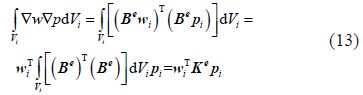

Transforming Eq.(14)to the integral form under the local coordinate system:

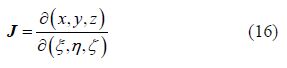
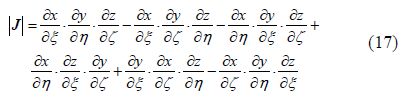
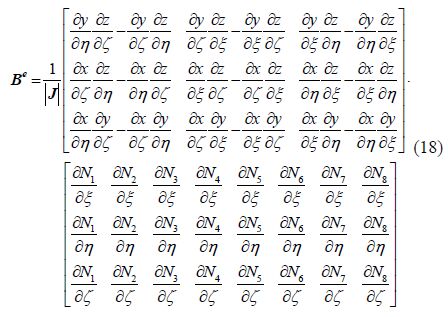
Considering the form of Be, it needs to be transformed from global coordinate system to local coordinate system before integration:
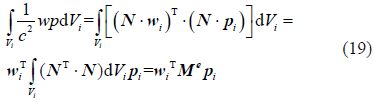
For Eq.(7), the second term on the left is $-\sum\limits_{i=1}^{{{n}_{f}}}{{{\omega }^{2}}\int\limits_{{{V}_{i}}}{\frac{1}{{{c}^{2}}}wp\text{d}{{V}_{i}}}}$, substituting Eq.(9) and Eq.(10)to Eq.(19):

The integral form of Eq.(20)in local coordinate system is:

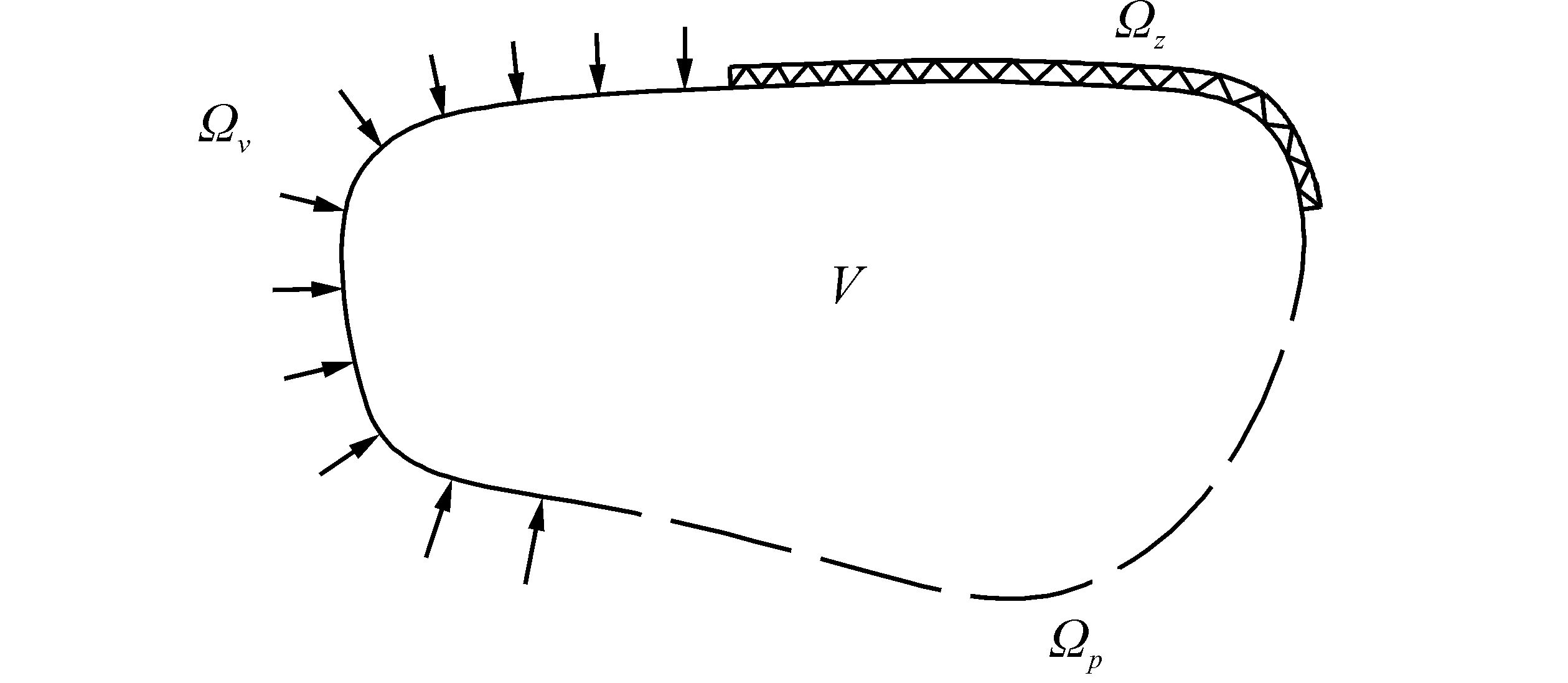
The right-h and side of Eq.(7)is $\sum\limits_{i=1}^{n}{\left(-\int\limits_{{{\Omega }_{i}}}{\left(i{{\rho }_{0}}\omega wv\cdot n \right)\text{d}{{\Omega }_{i}}} \right)}$. The integral boundary Ωcan be divided into velocity boundary Ωv, acoustic impedance boundary Ωz and pressure boundary Ωp, as shown in Fig. 3.
|
| Fig. 3 Boundary conditions of acoustic field |
Considering the derivation in Section 2.2, the governing equation of the acoustic field in FEM form is:

For the fluid-structure vibration characteristics problems, the normal velocity of structure is equal to fluid velocity in the coupled interface between fluid and structure. It is shown in Fig. 4.
|
| Fig. 4 Acoustic field boundary conditions of fluid-structure problems |
Without the damping effect, the structural motion equation in the FEM form is:

The sound pressure p, which is perpendicular to the fluid-structure interface, satisfies the following:

Considering the fluid-structure interaction, sound pressure acting on the structure can be seen as added normal loads. Combining Eq.(23) and Eq.(24), the structural motion equation considering fluid-structure interaction is:


On the fluid-structure interface, the velocity of structure can be seen as the boundary conditions of sound field. Using Eq.(22), the sound field equation considering fluid-structure interaction is


Combining Eq.(25) and Eq.(27), the fluid-structure interaction motion equations based on FEM theory is:

If fluid-structure interaction boundary is the only boundary(${{\mathbf{F}}_{a}}=0$), then p can be deleted in Eq.(29):

The corresponding equation of generalized eigenvalue problem is:

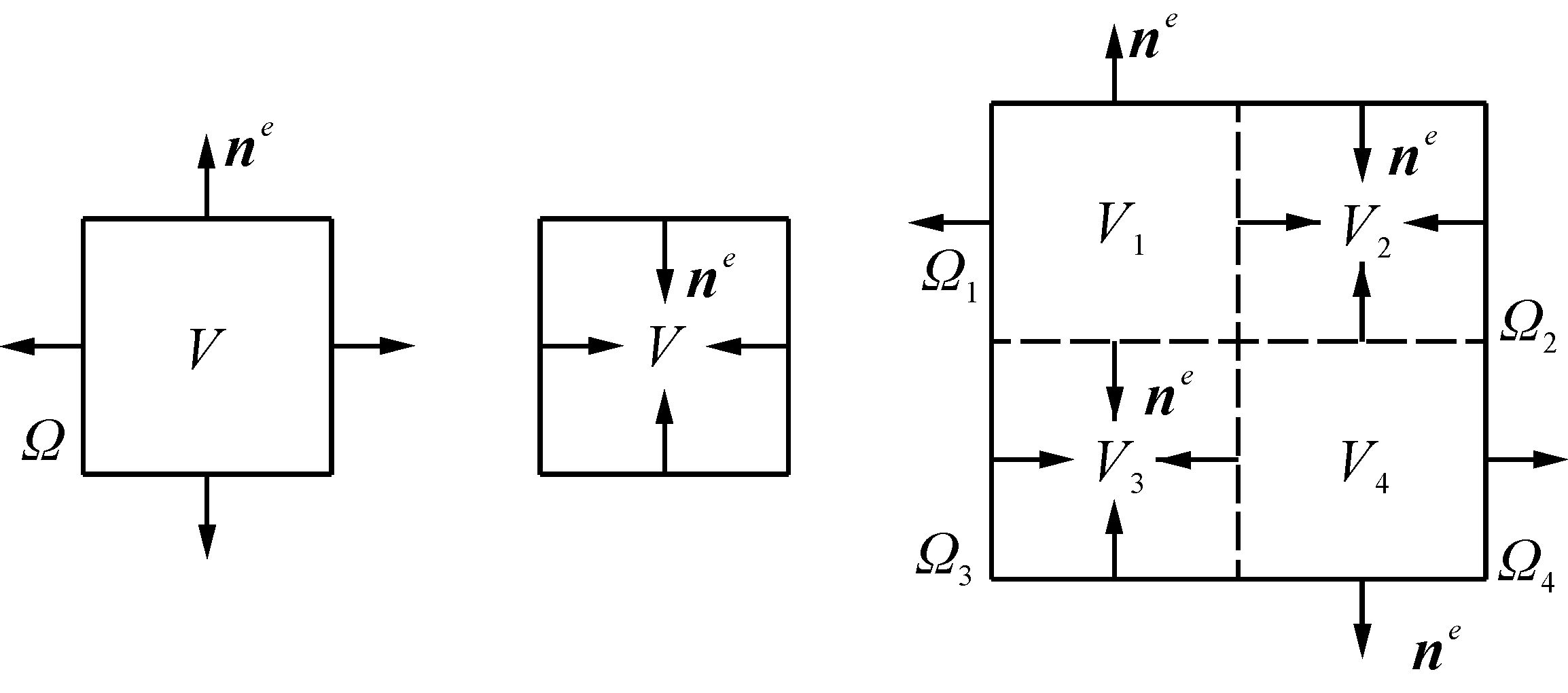
The fluid-structure coupling matrix Kc is related to the element normal vector ne. If there is only one fluid domain, as shown in Fig. 5(a), the normal vector ne of boundary element can either point into the fluid or point away from the fluid, and all the elements should be consistent. From the form of Madd, it can be found that it includes Kc and $K_{c}^{\text{T}}$. Therefore, for a multi-fluid domain problem, as shown in Fig. 5(b), the element normal vectors neof each fluid domain(V1, V2, V3 or V4)should be consistent.
|
| Fig. 5 The element normal direction of single and multi- fluid domain |
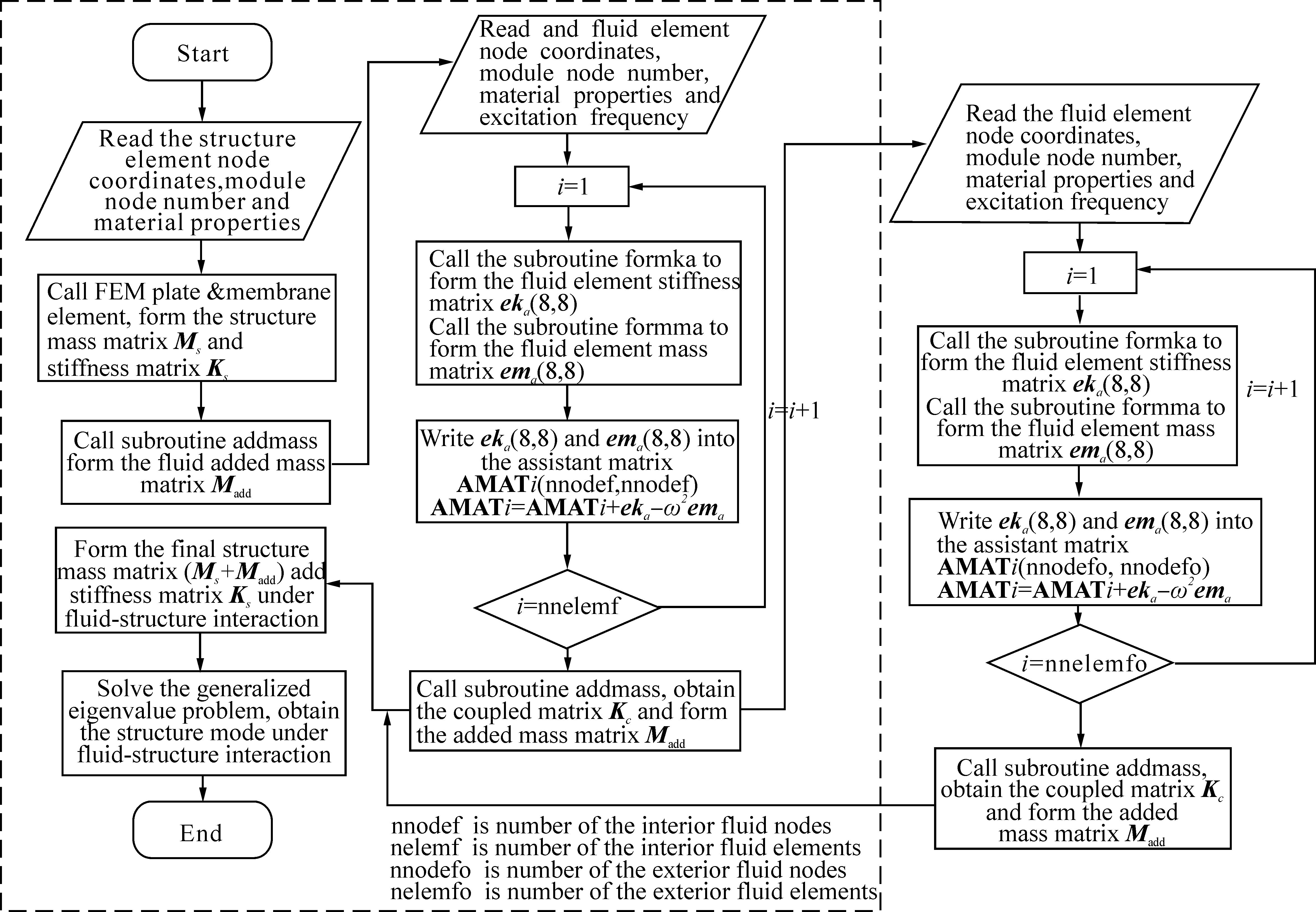
A FORTRAN program is developed to calculate the vibration characteristics of structure under fluid load and air load based on the fluid and structure finite element method theory. The program flow chart is shown in Fig. 6. Flow diagram in the dotted box is used for calculating air loaded ship model.
|
| Fig. 6 Flow charts of the coupled fluid-structure dynamic analysis program |
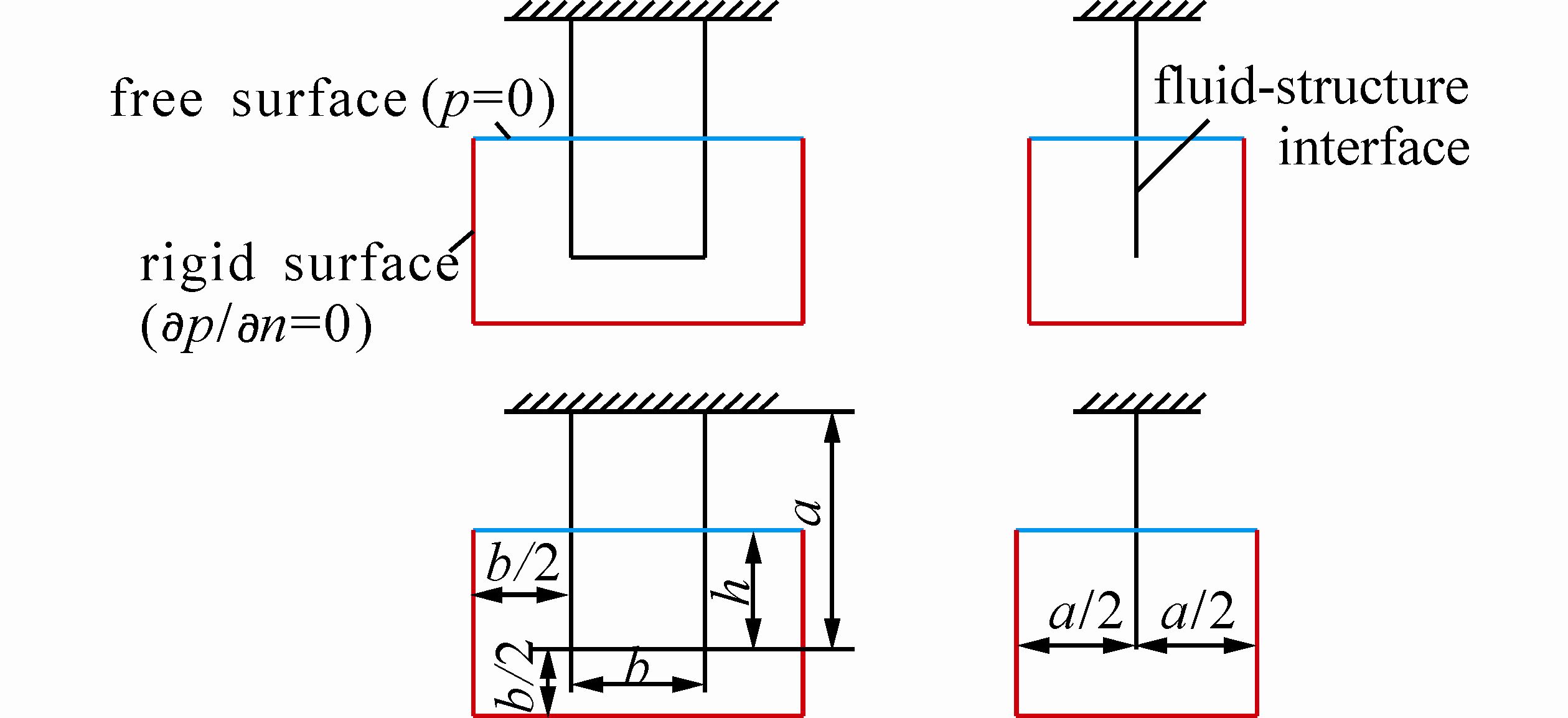
For elastic cantilever plate submerged in bounded fluid domain, boundaries of the fluid domain are shown in Fig. 7. The length of the plate a is 0.50 m, width b is 0.30 m and thickness t is 0.004 m. The Poisson ratio of the material is 0.3, the Young's modulus is N/m2 and the plate’s density is 7 800 kg/m3.
|
| Fig. 7 Boundaries of the fluid domain |
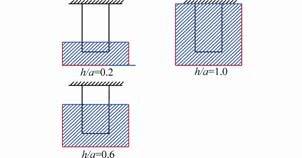
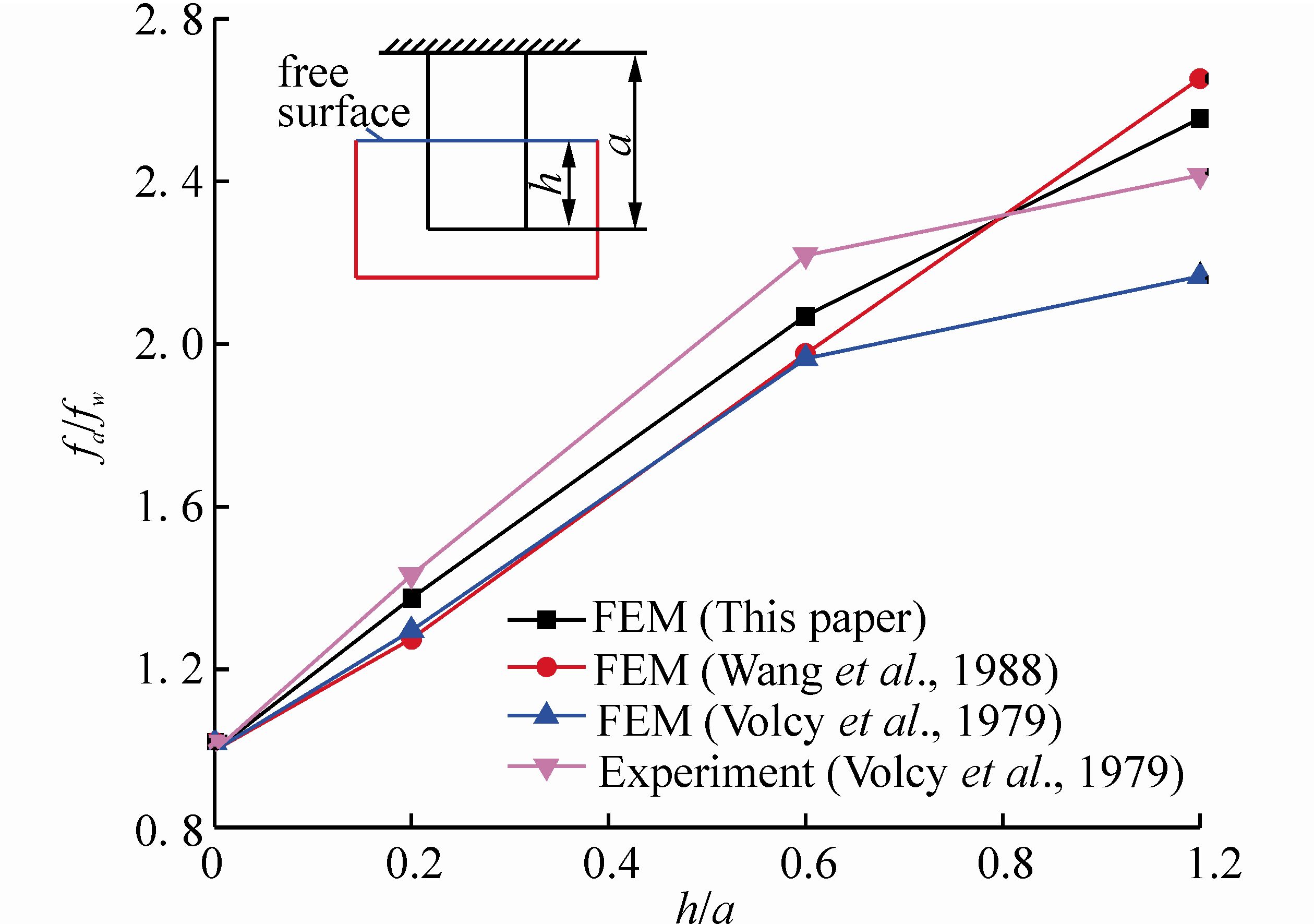
Assuming that the fluid is compressible, the fluid density is 1 000 kg/m3, and the sound velocity is 1 500 m/s. The upper surface of the fluid domain is free surface, so it has the boundary condition p=0. The other five surfaces of the fluid domain are rigid surfaces, so they have the boundary condition v=0. The vibration characteristics of cantilever plate submerged at three different depths shown in Fig. 8 are calculated. The calculated fundamental frequencies of the cantilever plates are shown in Table 1.
|
| Fig. 8 Three depths of the submerged cantilever plate |
| Method | In vacuum fa/Hz | In water fw/Hz | ||
| h/a=0.2 | h/a=0.6 | h/a=1.0 | ||
| FEM(This paper) | 13.67 | 9.96 | 6.66 | 5.45 |
| FEM(Wang et al., 1988) | 13.56 | 10.64 | 6.86 | 5.11 |
| FEM(Volcy et al., 1979) | 13.91 | 10.74 | 7.08 | 6.42 |
| Experiment(Volcy et al., 1979) | 12.80 | 8.94 | 5.77 | 5.30 |
It can be seen that the results shown in Table 1 and Fig. 9 are consistent with the results in Volcy et al.(1979) and Wang et al.(1988).
|
| Fig. 9 1st natural frequencies of the cantilever plate in air and in different submerged depths |
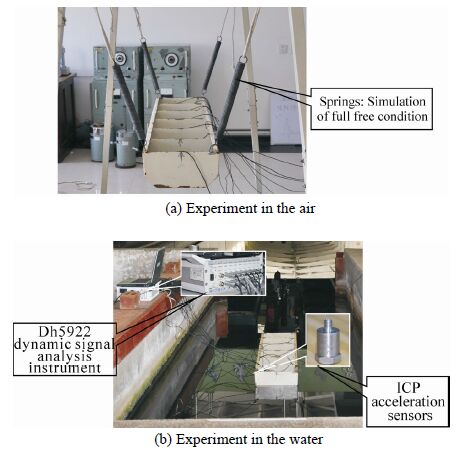
To verify the derived numerical method and the validity of the FORTRAN program in this paper, modal identification experiments were conducted for a full free ship model in the water and air under different loads.
4.1 Introduction to the experimental model and instrumentThe ship model’s length, width, moulded depth and steel plate thickness are 1.50, 0.30, 0.15 and 0.005 m. Fig. 10 shows the experiment that was done in the Ship Structure Vibration Laboratory and towing basin in Dalian University of Technology. The laboratory instruments included a DH5922 dynamic signal analysis instrument, ICP acceleration sensors, and so on.
|
| Fig. 10 Representation of identification experiment for the loaded ship model in the air and water |
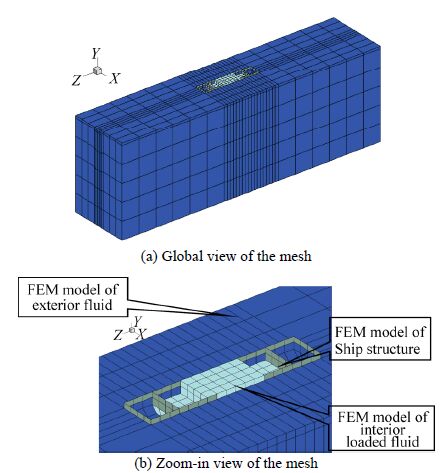
In this paper, using the dynamic analysis FORTRAN program for fluid-structure interaction problems, free modes of the loaded ship model are calculated. The Poisson ratio of the material is 0.3, the Young modulus 2.1x10¹¹ N/m2, and the density 7 800 kg/m3. The loaded water on the ship model is regarded as compressible fluid. Its density is 1 000 kg/m3 and the sound velocity is 1 500 m/s. The calculated frequency for the added mass matrix is 100 Hz. The meshes of the ship model and fluid are shown in Fig. 11. The boundary condition of the free surface of the fluid is set as p=0, and the boundary condition of rigid towing basin side walls and bottom is set as v=0.
|
| Fig. 11 Representation of mesh discretization for the ship model and the fluid |
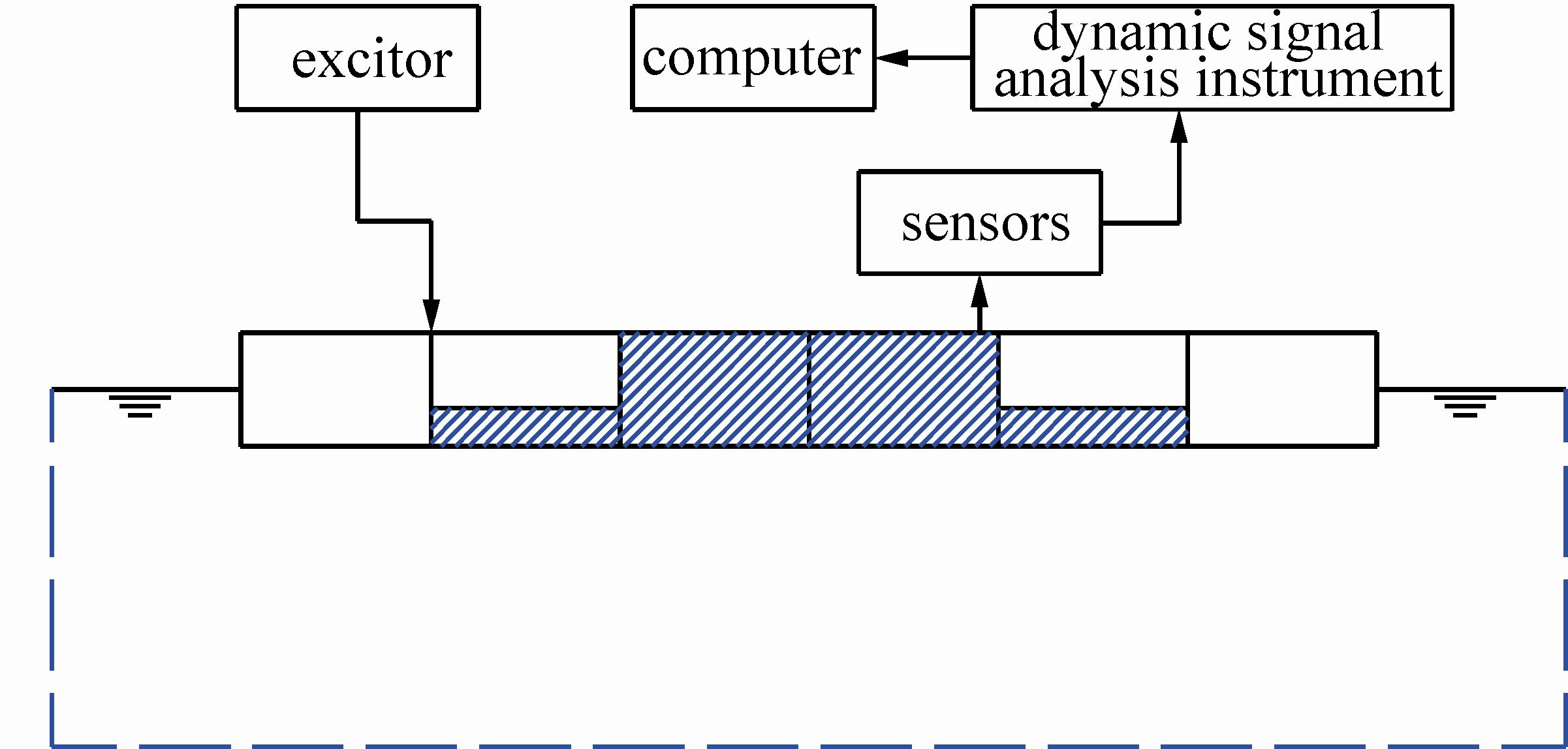
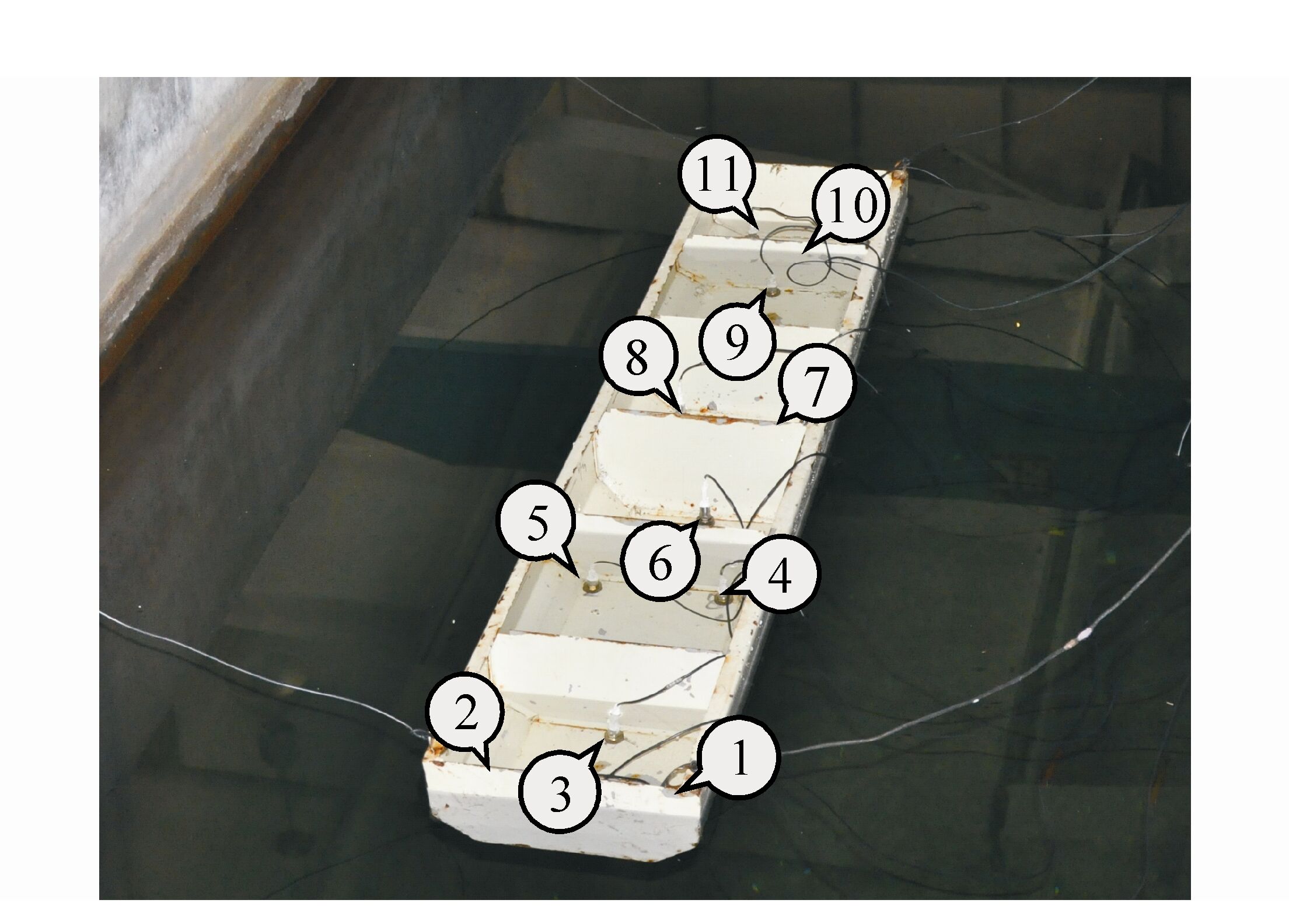
The schematic diagram of the modal identification experiment is shown in Fig. 12. The excitation on the ship model is a pulse type. The arrangement of the eleven acceleration sensors is shown in Fig. 13. Through the modal identification experiment, the ship model’s bending modes, including modal shapes and natural frequencies, can be measured.
|
| Fig. 12 Schematic diagram of the modal identification experiment |
|
| Fig. 13 Representation of sensors’ arrangement |
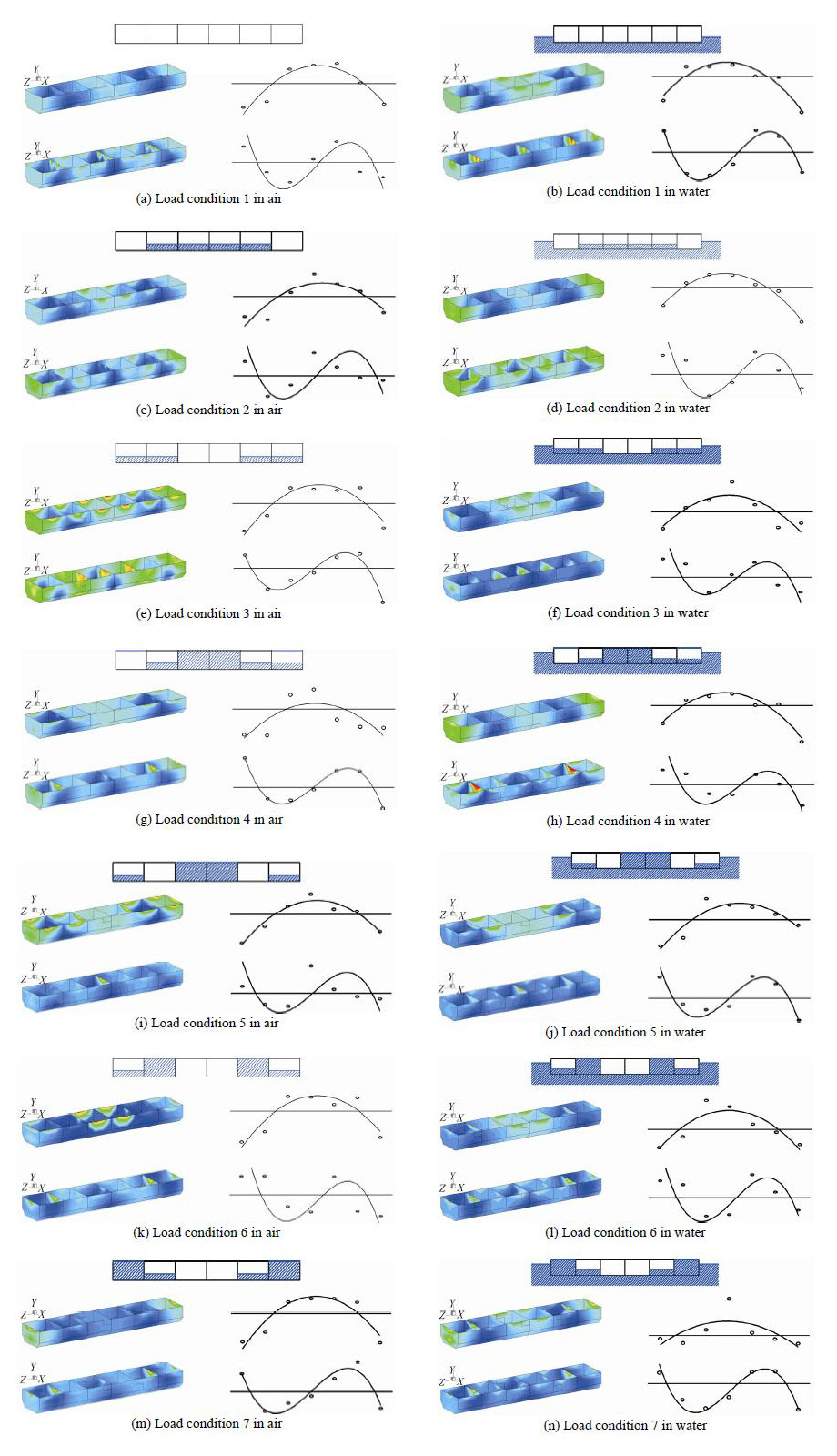
Numerical results of the ship model under seven load conditions are compared in the experiment. Fig. 14 compares the experimental and numerical modal shapes of the full free ship model. The first two order natural bending modal shapes under different loads in the air and in the fluid are presented, where the cloud maps on the left are the numerical modal shapes and the fitted curves on the right are the corresponding experimental modal shapes.
|
| Fig. 14 Seven load conditions and the corresponding ship model’s numerical & experimental modal shapes |
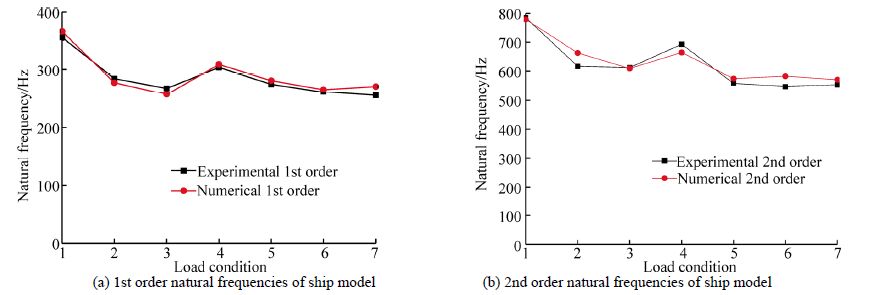
The first two order natural frequencies of loaded ship model’s bending modes in the air are shown in Table 2 and Fig. 15. The natural frequencies in water are shown in Table 3 and Fig. 16.
| Load conditions in air | Experimental 1st order | Numerical 1st order | Error of 1st order/% | Experimental 2nd order | Numerical 2nd order | Error of 2nd order/% |
| Case 1 | 354.76 | 364.82 | 2.84 | 784.41 | 779.06 | 0.68 |
| Case 2 | 284.71 | 277.57 | 2.51 | 617.06 | 663.43 | 7.51 |
| Case 3 | 267.93 | 256.98 | 4.09 | 612.40 | 609.31 | 0.50 |
| Case 4 | 303.56 | 308.65 | 1.68 | 693.33 | 664.76 | 4.12 |
| Case 5 | 275.09 | 281.28 | 2.25 | 557.59 | 574.20 | 2.98 |
| Case 6 | 261.06 | 265.48 | 1.69 | 546.37 | 583.32 | 6.76 |
| Case 7 | 255.13 | 270.88 | 6.17 | 553.11 | 570.29 | 3.11 |
|
| Fig. 15 Representation of testing and numerical natural values comparison in air |
| Load conditions in water | Experimental 1st order | Numerical 1st order | Error of 1st order/% | Experimental 2nd order | Numerical 2nd order | Error of 2nd order/% |
| Case 1 | 321.18 | 336.82 | 4.87 | 584.05 | 620.26 | 6.20 |
| Case 2 | 290.89 | 308.20 | 5.95 | 606.79 | 582.06 | 4.08 |
| Case 3 | 281.61 | 298.68 | 6.06 | 596.88 | 604.22 | 1.23 |
| Case 4 | 283.73 | 311.64 | 9.84 | 577.55 | 591.64 | 2.44 |
| Case 5 | 273.16 | 286.56 | 4.91 | 527.97 | 526.03 | 0.37 |
| Case 6 | 303.28 | 304.55 | 0.42 | 521.92 | 538.28 | 3.13 |
| Case 7 | 321.18 | 336.82 | 4.87 | 584.05 | 620.26 | 6.20 |
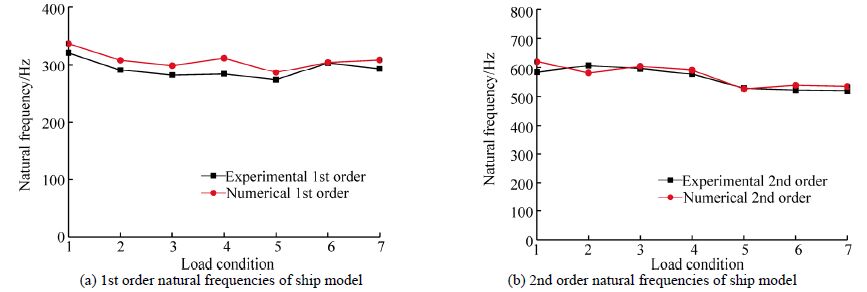
|
| Fig. 16 Representation of testing and numerical natural values comparison in water |
From Table 2, Table 3 and Fig. 14, it can be seen that the numerical results of the vibration modes of the ship model, are well consistent with the modal identification experiment results using the method derived in this paper. The results verify the method and the program. Comparing the load conditions 2 and 3 in the air and in the water, or comparing the load conditions 4, 5, 6 and 7, it can be determined that the locations of the loads have an effect on the structure vibration characteristics when the load quantity is constant. Comparing the load condition 2 and 4 or comparing the load condition 3 and 5 in the air and in the water, it can also be seen that the change of the load quantity has little effect on natural frequencies of the structure.
5 ConclusionsBased on the Helmholtz differential equation, the added mass matrix of the structure in bounded fluid domain is derived in low frequency. Considering the fluid compressibility, the vibration characteristics of the cantilever plate submerged at different depth are calculated. The different loaded ship models’ vibration characteristics in the air and in the fluid are also calculated. Finally, a modal identification experiment of a ship model is performed. Several conclusions are drawn below.
The method of deriving the structure adding mass matrix is simple and highly accurate. It has some benefits for calculating the fluid-structure interaction vibration characteristics and acoustic radiation characteristics.
Regarding the modal identification experiment of the structure in bounded fluid domain, the identified result can be influenced by a lot of factors, such as the position and the magnitude of the excitation, load condition and the outside interference signal.
From the modal identification experiment of the ship model under different load conditions, it can be seen that different locations of loads can influence the vibration characteristics of the structure in contact with fluid and the growth of load quantity probably has not a significant influence on the vibration characteristics of the structure.
| Ahlem A (2004). Simulation of vibro-acoustic problem using coupled FE/FE formulation and modal analysis. ASME/JSME 2004 Pressure Vessels and Piping Conference, San Diego, USA, 147-152. DOI: 10.1115/PVP2004-2865 | |
| Atalla N, Bernhard RJ (1994). Review of numerical solutions for low-frequency structural-acoustic problems. Applied Acoustic, 43(3), 271-294. DOI: 10.1016/0003-682X(94)90050-7 | |
| Chen Gang, Zhang Shengkun, Wen Changjian (1999). Experiment of fluid-structure interaction vibration of bottom panel of box-shaped ship model. Ship Engineering, (4), 13-14.(in Chinese) | |
| Chen Meixia, Luo Dongping, Cao Gang, Cai Minbo (2003). Analysis of vibration and sound radiation from ring-stiffened cylindrical shell. Journal of Huazhong University of Science and Technology (Nature Science Edition), 31(4), 102-104. (in Chinese) DOI: 10.13245/j.hust.2003.04.035 | |
| Coyette JP, Fyfe KR (1989). Solution of elasto-acoustic problems using a variational finite element boundary element technique. Proceedings of Winter Annual Meeting of the ASME, San Fransisco, USA, 15-25. | |
| Everstine GC (1991). Prediction of low-frequency vibrational frequencies of submerged structures. Journal of Vibration and Acoustics-Transactions of the ASME, 113(2), 187-191. DOI: 10.1115/1.2930168 | |
| Everstine GC (1997). Finite element formulations of structural acoustics problems. Computers & Structures, 65(3), 307-321. DOI: 10.1016/S0045-7949(96)00252-0 | |
| Everstine GC, Henderson FM (1990). Coupled finite-element boundary-element approach for fluid structure interaction. Journal of the Acoustical Society of America, 87(5), 1938-1947. DOI: 10.1121/1.399320 | |
| Gladwell GML (1966). A variational formulation of damped acousto-structural vibration problems. Journal of Sound and Vibration, 4(2), 172-186. DOI: 10.1016/0022-460X(66)90120-9 | |
| Jeans RA, Mathews IC (1990). Solution of fluid-structure interaction problems using a coupled finite-element and variational boundary element technique. Journal of the Acoustical Society of America, 88(5), 2459-2466. DOI: 10.1121/1.400086 | |
| Liu Cheng, Hong Ming, Liu Xiaobing (2014). The solution for vibration characteristics of submerged plates by applying FEM/ IBEM. Journal of Harbin Engineering University, 35(4), 395-400. (in Chinese) DOI: 10.3969/j.issn.1006-7043.201303052 | |
| Lu Xinsen, Clough RW (1982). A hybrid substructure approach for analysis of fluid-structure interaction in ship vibration. Journal of Vibration and Shock, 1, 17-27. (in Chinese) | |
| Petyt M, Lea J, Koopmann GH (1976). A finite-element method for determining acoustic modes of irregular shaped cavities. Journal of Sound and Vibration, 45(4), 495-502. DOI: 10.1016/0022-460X(76)90730-6 | |
| Thompson LL (2005). A review of finite-element methods for time-harmonic acoustics. Journal of the Acoustical Society of America, 119(3), 1315-1330. DOI: 10.1121/1.2164987 | |
| Tong Yujing, Liu Zhengxing (1997). The Additional water mass in solid-liquid coupling problem by FEM. Shanghai Journal of Mechanics, 18(4), 311-320 (in Chinese) | |
| Vlahopoulos N, Raveendra ST, Vallance C, Messer S (1999). Numerical implementation and applications of a coupling algorithm for structural-acoustic models with unequal discretization and partially interfacing surfaces. Finite Elements in Analysis and Design, 32(4), 257-277. DOI: 10.1016/S0168-874X(99)00008-6 | |
| Volcy GC, Morel P, Bureau M, Tanida K (1979). Some studies and researches related to the hydro-elasticity of steel work. Proceedings of the 122nd Euromech Colloquium on Numerical Analysis of the Dynamic of Ship Structures, Paris, France, 403-406. | |
| Wang Xiangbao, Han Jiwen, Lu Xinsen (1988). Fluid-structure coupled vibration of cantilever plates and continuous plates. Shipbuilding of China, 16, 53-63. (in Chinese) DOI: 10.13465 /j.cnki.jvs.1985.04.002 | |
| Wang Zheng, Hong Ming, Liu Cheng (2014). Domestic review of the submerged structure vibration and acoustic radiation characteristics based on FEM/BEM. Journal of Ship Mechanics, 18(11), 1397-1414. (in Chinese) | |
| Wei Jianhui, Chen Meixia, Mou Zhijie, Qiao Zhi (2011). Research on vibroacoustic characteristic of double cylinder shell underwater based on IBEM. Ship Science and Technology, 33(7), 9-13, 21. (in Chinese) DOI: 10. 3404/j.issn.1672-7649.2011.07.002 | |
| Wu Fang, Zhao Deyou (2007). Effect of water on the ship and ocean engineering structure. China Offshore Platform, 22(3), 22-26 (in Chinese) | |
| Yao Xiongliang, Qian Dejin, Zhang Yan (2006). Numerical analysis method for sound radiation of underwater structure in time domain. Chinese Journal of Ship Research, 11(5-6), 30-35. (in Chinese) | |
| Yao Xiongliang, Yang Nana, Tao Jingqiao (2004). Numerical research on vibration and sound radiation of underwater double cylindrical shell. Journal of Harbin Engineering University, 25(2), 136-140.(in Chinese) | |
| Zhao Guanjun, Liu Geng, Wu Liyan (2007). Simulation and experiment on coupled vibro-acoustic noise using modal superposition method. Mechanical Science and Technology for Aerospace Engineering, 26(12), 1633-1636. | |
| [25] | Zheng Zhiguo, Sun Dacheng, Liu Xianliang (1998). A Study on the fluid-structure interaction with wet model. Journal of North China Institute of Water Conservancy and Hydroelectric Power, 19(2), 22-25.(in Chinese) |