


 , , ,
, , ,
Reducing drag of marine vessels is a major goal of ship research. One promising technology involves utilization of air-ventilated cavities on the hull bottom to reduce the wetted surface area of a ship and its skin-friction resistance(up to 10%-30%). This leads to a reduction in required propulsive power, fuel consumption, and pollutant emissions. The extra power needed for air supply on well-designed air-cavity ships is usually about 1%-2% of the propulsive power. The main objective of this work is to develop a small-scale model of an air-cavity hull that can be easily modified and tested in an outdoor environment at relatively low cost. The secondary goal is to create a remotely controlled, self-propelled and instrumented boat platform that can be further developed into a high-performance unmanned boat.
The air-cavity approach for reducing ship drag has been studied and experimented with in the past, but with mixed success(Basin et al., 1969; Latorre, 1997; Matveev et al., 2006.) A possible arrangement(among others)of an air cavity system on a ship hull is illustrated in Fig. 1. The only serially produced marine vehicles with air cavities are planing and semi-planing l and ing craft and small fast ferries built in Russia in the last two decades(Matveev, 2005). There are several on-going developments of air-lubricated systems for ocean-going cargo vessels(Ceccio, 2010). One of the technical reasons for the slow implementation of this concept is the complex hydrodynamic phenomena in the presence of air cavities. This results in a difficulty maintaining large-area cavities at small air flow rates on realistic hull forms in a variety of operational conditions, such as motions in rough seas. Several research groups are actively working on various aspects of the air-cavity concept(Amromin et al. 2011; Matveev and Miller, 2011; Shiri et al. 2012; Elbing et al. 2013; Mäkiharju et al. 2013; Jang et al. 2014). The air-cavity approach for reducing ship drag has been studied and experimented with in the past, but with mixed success(Basin et al., 1969; Latorre, 1997; Matveev et al 2006.) A possible arrangement(among others)of an air cavity system on a ship hull is illustrated in Fig. 1. The only serially produced marine vehicles with air cavities are planing and semi-planing l and ing craft and small fast ferries built in Russia in the last two decades(Matveev, 2005). There are several on-going developments of air-lubricated systems for ocean-going cargo vessels(Ceccio, 2010). One of the technical reasons for the slow implementation of this concept is the complex hydrodynamic phenomena in the presence of air cavities. This results in a difficulty maintaining large-area cavities at small air flow rates on realistic hull forms in a variety of operational conditions, such as motions in rough seas. Several research groups are actively working on various aspects of the air-cavity concept(Amromin et al. 2011; Matveev and Miller, 2011; Shiri et al. 2012; Elbing et al. 2013; Mäkiharju et al. 2013; Jang et al. 2014).

|
| Fig. 1 Example of air cavity on ship hull bottom |
Unmanned boats have attracted significant attention in recent years as a promising means to execute missions that are dull, expensive or dangerous for manned operations(Manley, 2008; Yan et al. 2010). A number of prototypes have appeared, but for a broad application of robust unmanned boats further technological advancements are needed.
The project addressed in this paper is aimed at contributing to developments of both air-cavity systems and unmanned boats. Our main limitation is a relatively low initial budget, which motivates utilization of low-cost materials and equipment, outdoor tests(instead of expensive towing tank experiments), and involvement of undergraduate students. The next section describes a construction of the air-cavity boat platform and instrumentation. Results obtained in the initial tests are presented afterwards.
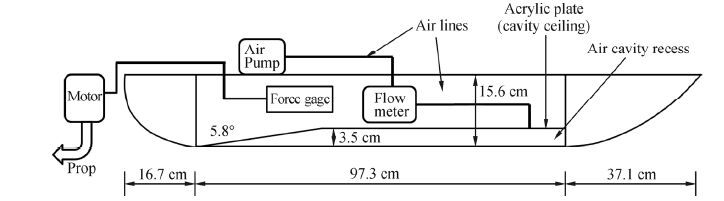
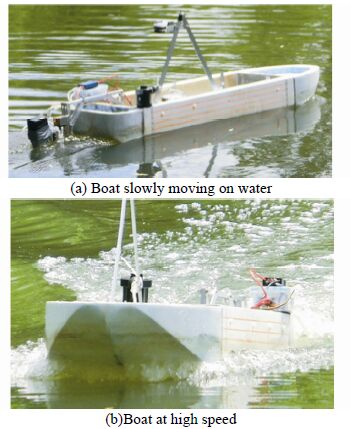
2 Construction and instrumentation 2.1 Hull constructionThis study is focused on the development of a testing platform with an air-ventilated hull. The overall system schematic and the boat on water are shown in Fig. 2 and Fig. 3, respectively.
|
| Fig. 2 Experimental system schematic |
|
| Fig. 3 Assembled air-cavity testing platform |
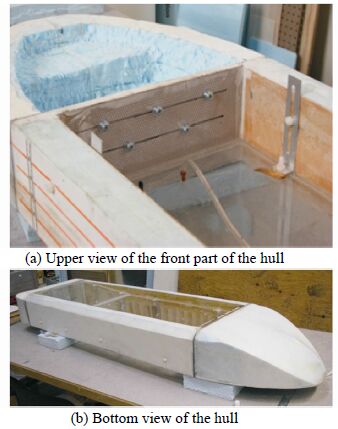
Due to the exploratory nature of this research-oriented project, a modular design was initially chosen to make it easy to adjust for different scenarios. This meant the hull construction involved building the bow stern and main hull sections separately. All three sections of the vessel were made of Styrofoam closed-cell foam. The foam blocks were roughly shaped using a hotwire device to cut through the foam and melt it at the same time. The hotwire was used because it could make clean edges and complex contours. These shapes were then s and ed smooth to achieve the final shape and size. A layup of fiberglass was wrapped around each foam section in order to create a hard, smooth shell to protect and strengthen the model. The fiberglass was then s and ed to remove wrinkles and to provide a smooth surface. The sections were then coated with fiberglass microballoons to fill in gaps and provided a s and able surface. Plywood plates were then attached to the inside of the main hull sections and joined with a carbon fiber and composite plate at each end to form a box with neither top nor bottom. The bow and stern sections where then bolted onto the main body with the composite plates becoming the connection surfaces between the two sections attached to each other with plastic nuts and bolts(Fig. 4).
|
| Fig. 4 Hull sections |
The ceiling of the cavity is a plate made of clear acrylic in order to be able to see through it into the cavity to monitor the water level in the cavity(Fig. 4). This plate was held in place using aluminum brackets which have been machined to be able to slide up and down when loosened to adjust the angle of the plate(Fig. 4). By drilling through the side walls of the main hull section and inserting aluminum tubes into the wall, the bolts could be tightened down without crushing the foam walls. To maintain a smooth surface on the bottom of the plate, nylon bolts were countersunk into the acrylic that stuck through to the brackets which are attached to the top surface of the acrylic. Silicon aquarium sealant was then used to seal gaps around the edges where the acrylic met the side walls and the plywood plates at the front and back of the main section, as well as where the brackets were attached(Fig. 4). Small openings were made in the front of the air cavity for air supply and optional pressure measurement in the air cavity. The final step in the basic construction of the hull was to carve out space in the bow and stern for ballast placement. The main longitudinal hull dimensions are indicated in Fig. 2; the beams of the boat and the cavity recess are 40.3 cm and 29.5 cm, respectively.
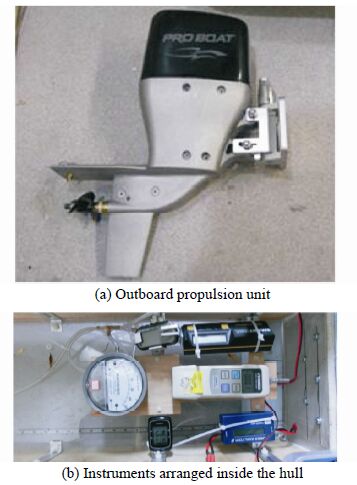
2.2 Equipment and instrumentsIn order to propel and control the boat, an electric propulsion system and radio-controlled equipment were installed on the boat. An outboard propulsion unit Pro Boat PRB4020 made by Horizon Hobby and commonly used for fast radio controlled(RC)boats(Fig. 5)was chosen in this project for ease of directly measuring the thrust force. This unit includes a brushless electric motor, which is controlled in the present setup with an 80-Amp electronic speed controller(ESC)Dynamite DYNM3820(also made by Horizon Hobby). The outboard motor frame was connected to the servo via a clevis and pushrod in order to produce change in the propulsion direction which acted as steering. In order for the motor and servo to be controlled from the shore, a Futaba receiver R617FS was installed that matched Futaba T7C transmitter used.
|
| Fig. 5 Propulsion and measuring equipment |
A Coghlan 12-V DC air pump was applied to provide air supply for the bottom cavity. It was connected to the same receiver and further to a second, generic ESC designed for st and ard brushed motors. LiPo batteries(2- and 3-cell)were used as an energy source for propulsive motor, air pump, ECS and the receiver. A Medusa power analyzer was utilized for checking current and power supplied to the motor in order to stay within the motor and ESC limits.
Thrust produced by the propulsion unit was measured by an Omega force gauge(DFG60-11)with a range of 10 kg and accuracy 10 g, which was mounted in line with the force applied. A special bracket was fashioned that attached the propulsion unit only to the force gage, which was rigidly fixed on the boat hull. A flow rate of air supplied into the cavity was quantified with help of a Dwyer Magnehelic differential pressure gage, which measured a pressure drop over an obstruction in the air line. The pressure differential was correlated against the flow rate in a separate calibration test with serially connected variable-area Dwyer flowmeters.
Two Garmin GPS modules were used to record the boat speed, and a digital level was applied for measuring trim. In low-speed controlled tests over ground, it was verified that the GPS units produced correct speed values. An arrangement of the measuring instruments on the boat hull is shown in Fig. 5. A GoPro video camera was mounted on the mast made of aluminum struts to capture readings of these devices.
Although the utilized sensors and data acquisition process allow us to capture essential steady-state data, the current system can definitely benefit from employing completely electronic sensors and data acquisition system, thus eliminating a need for video recording of display indicators. Instrumenting the boat with accelerometers will make it possible to carry out seakeeping studies of air-cavity hulls and provide valuable information about air-cavity dynamic behavior in unsteady conditions. With addition of automatic control elements, the system hydrodynamic performance can be further improved in unsteady conditions and autonomous operations can be made feasible.
3 Results of initial testsThe constructed air-cavity boat was tested outdoors in Hordemann Pond in Moscow, Idaho in summer 2014. Environmental conditions in most cases were calm; small waves and wind were determined to have insignificant effects. At least two experimental runs in opposite directions were made at each selected throttle setting in order to compensate for directional bias.
The main test series involved varying the throttle setting and measuring thrust, speed, trim, and air supply rate(in setups with air cavities). The boat was tested in high-speed displacement and semi-displacement modes(waterline length Froude numbers 0.2-0.6), having in a mind a possible application as a fast high-payload l and ing craft. Data recordings were made during straight runs of the boat in steady conditions over a distance of about 30 m. Several fixed throttle settings on the transmitter were used as a way to regulate thrust in an easily controllable manner, and it proved to be reliable.
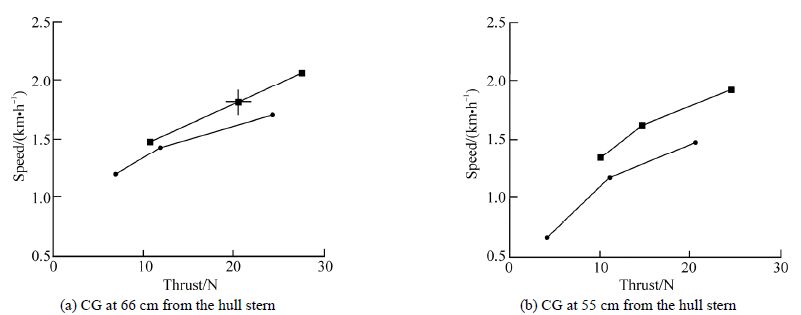
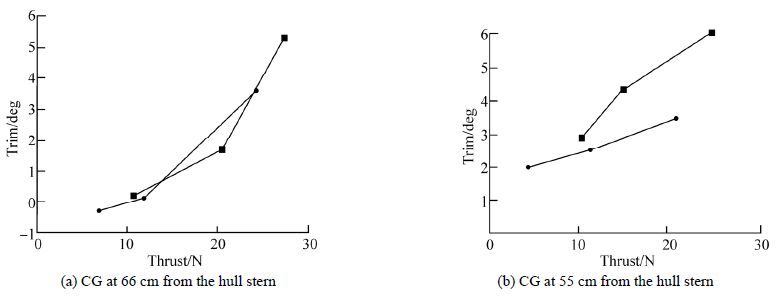
Representative results for the boat speed and trim as functions of the applied thrust are shown in Fig. 6 and 7. The boat mass in these tests was about 16.8 kg. Using movable ballast weights, two centers of gravity(CG)were implemented, 0.66 m and 0.55 m from the hull stern. The “solid” hull data correspond to the boat with an inset(plate)flush mounted into the bottom recess, so that the hull bottom is flat. The thrust values shown in Fig. 6 and Fig. 7 are not at the identical levels for the air-cavity and solid-hull configurations, since it was easier to keep the throttle positions at fixed values and measure the thrust forces. A specific system condition and a battery charge affect thrust generated at each throttle setting.
|
| Fig. 6 Measured speed and thrust for “solid” hull(circles) and air-cavity hulls(squares). Error bars in(a)indicates estimated experimental uncertainties |
|
| Fig. 7 Measured trim and thrust for “solid” hull(circles) and air-cavity hulls(squares) |
Results shown in Fig. 6 clearly indicate a speed increase with the thrust, as expected. It is also obvious that the air-cavity hull achieves substantially higher speeds at similar thrust values than the “solid” hull with a flat bottom(Fig. 6). A somewhat inferior performance of the hull with the back CG position(Fig. 6(b))is likely caused by more pronounced trim of this hull(Fig. 7). However, the air-cavity advantage is still present in this setup(Fig. 6(b)).
During the main test series with the air-cavity hulls(results of which are shown Fig. 6 and Fig. 7)the air flow rate supplied at a gage pressure 0.4 kPa was kept at a level 55±5 cm3/s. Additional tests with variable rates of air flow supply(±50% of the nominal level)did not show noticeable changes in the boat performance. The additional power for the air supply air in these tests is estimated to be about 10%-20% of the typical savings of propulsive power(or about 1%-2% of the total propulsive power). A test with the recessed hull but no air supply demonstrated a speed decrease of about 15% at similar thrust level.
Although scaling methods for water resistance of air cavity ship hulls are not yet well established, one simplified procedure(occasionally applied in practice)would include the following steps. The residual drag coefficient is determined for the model by subtracting frictional drag components for wetted hull sections. This residual drag coefficient is used for a large-scale hull at the same Froude number. Then, a frictional resistance is added using Reynolds number correlations for frictional drag coefficient and wetted areas on a large scale.
4 ConclusionsThe developed testing platform with an air-cavity hull can be used for optimizing air-cavity systems and obtaining experimental data needed for validation of numerical methods for hydrodynamics of ships with air-ventilated cavities. Initial test results clearly demonstrated a drag reduction advantage of a hull equipped with an air cavity. An upgrade of sensing and data acquisition equipment on this platform and conducting an extensive test series with a larger variety of loadings, hull/cavity geometries, and environmental conditions will allow better underst and ing of advantageous(as well as unfavorable)operational regimes of air-cavity ships, providing a database useful for design optimization in this class of marine vehicles. Since the present experimental setup is self-propelled and controlled remotely, another potential extension of the current work can be a development of an energy-efficient unmanned surface vehicle for a variety of civil and military missions.
| Amromin EL, Metcalf B, Karafiath G (2011). Synergy of resistance reduction effects for a ship with bottom air cavity. Journal of Fluids Engineering, 133(1), 021302.1-021302.7. DOI: 10.1115/1.4003422. |
| Basin A, Butuzov A, Ivanov A, Olenin Y, Petrov V, Potapov O, Ratner E, Starobinsky V, Eller A (1969). Operational tests of a cargo ship ‘XV VLKSM Congress’ with air injection under a bottom. River Transport, 52-53. (in Russian) |
| Ceccio SL (2010). Friction drag reduction of external flows with bubble and gas injection. Annual Review of Fluid Mechanics, 42, 183-203. DOI: 10.1146/annurev-fluid-121108-145504 |
| Elbing BR, Makiharju S, Wiggins A, Perlin M, Dowling DR, Ceccio SL (2013). On the scaling of air layer drag reduction. Journal of Fluid Mechanics, 717, 484-513. DOI: 10.1017/jfm.2013.387 |
| Jang J, Choi SH, Ahn S-M, Kim B, Seo JS (2014). Experimental investigation of frictional resistance reduction with air layer on the hull bottom of a ship. International Journal of Naval Architecture and Ocean Engineering, 6(1), 363-379. DOI: 10.2478/ijnaoe-2013-0185 |
| Latorre R (1997). Ship hull drag reduction using bottom air injection. Ocean Engineering, 24(1), 161-175. DOI: 10.1016/0029-8018(96)00005-4 |
| Mäkiharju SA, Elbing BR, Wiggins A, Schinasi S, Vanden-Broeck J-M, Dowling DR, Perlin M, Ceccio SL (2013). On the scaling of air entrainment from a ventilated partial cavity. Journal of Fluid Mechanics, 732, 47-76. DOI: 10.1017/jfm.2013.387 |
| Manley JE (2008). Unmanned surface vehicles, 15 years of development. OCEANS’08, Quebec City, Canada, 1-4. |
| Matveev KI (2005). Application of artificial cavitation for reducing ship drag. Oceanic Engineering International, 9(1), 35-41. |
| Matveev KI, Duncan R, Winkler J (2006). Acoustic, dynamic, and hydrodynamic aspects of air-lubricated hulls. Proceedings of the Undersea Defense Technology Conference, San Diego, USA, 1-8. |
| Matveev KI, Miller MJ (2011). Air cavity with variable length under model hull. Journal of Engineering for the Maritime Environment, 225(1), 161-169. DOI: 10.1177/1475090211398822 |
| Shiri A, Leer-Andersen M, Bensow RE, Norrby J (2012). Hydrodynamics of a displacement air cavity ship. 29th Symposium of Naval Hydrodynamics, Gothenburg, Sweden, 1-14. |
| Yan R, Pang S, Sun H, Pang Y (2010). Development and missions of unmanned surface vehicle. Journal of Marine Science and Application, 9(4), 451-457. DOI: 10.1007/s11804-010-1033-2 |