


2. 清华大学深圳研究生院国家环境保护环境微生物利用与安全控制重点实验室

 ,
,
随着社会经济的发展,水资源的短缺与污染问题日益突出,水质安全成为全社会关注的重要问题。水中的有毒有害化学污染物与病原微生物是公众关注的焦点。但是,水中微生物(包括非病原微生物)的有害组分,如内毒素与抗生素抗性基因,还未引起公众的广泛关注。内毒素的研究在医药卫生领域早已开展,但内毒素在水中的分布和去除特性研究相对较少。本文对内毒素及其在水中的浓度分布与处理去除效果进行了分析。
1 内毒素及其特性虽然内毒素(endotoxin)可作为结合在细胞上的细菌毒素的统称,但在细菌学上,内毒素指的是位于革兰氏阴性菌细胞壁的脂多糖(lipopolysaccharide,简称LPS)成分[1-5](也是本文内毒素的定义)。因此内毒素也存在于非病原性的革兰氏阴性菌中。平均每个大肠杆菌包含1.2×10⁶个脂多糖分子[1],约占细菌表面积的2/3、细胞干重的3.6%[6]。由于内毒素在细胞分裂或死亡过程中会从细胞释放到环境中[1-2, 7-8],内毒素在水中的存在形式可分为游离态与结合态(游离态是指释放到水体中的内毒素,结合态是指处于细胞壁的内毒素),两种形态的内毒素均具有生物活性[2, 9]。
内毒素是一种高分子量的复合物,分子结构复杂,由O—特异性多糖、核心寡聚糖与类脂A3部分组成。O—特异性多糖是内毒素分子中最易变异的结构,不同种属细菌的内毒素具有不同的多糖成分。类脂A是内毒素分子中最保守的结构,也是导致内毒素具有生物活性的主要结构[10-12]。内毒素单体的分子量约10~20 kDa,由于其属于两性(亲水性、疏水性)分子,在水中可聚集形成超过1 000 kDa的聚合体[13]。
内毒素是一种炎症因子与热原物质[9, 14]。可通过静脉注射、呼吸吸入与食用摄入等暴露途径引起人体多种病症,包括发热、过敏、腹泻、呕吐、呼吸困难、休克与血管内凝血,甚至死亡[2, 9]。值得注意的是内毒素还可强化其它有毒物质(如藻毒素)的毒害作用[15-16]。人体静脉注射1~10 ng/kg(体重)内毒素便会造成体温升高1.9℃,引起发烧[2]。当空气中的内毒素浓度达到100~200 ng/m3即可能影响肝功能[2]。由于内毒素的吸收同化机制尚未明确,关于摄入内毒素的剂量效应还未见报道[4]。鉴于内毒素对人体的危害,部分国家与地区已提出内毒素的控制标准,中国药典、英国药典与美国药典均要求注射用水的内毒素含量需小于0.25 EU/mL[17-19];国际职业卫生委员会提出为了避免呼吸道炎症,空气中内毒素浓度需低于10 ng/m3[2, 4];但目前内毒素尚未列入水环境标准中。
2 水中内毒素的浓度水平静脉注射与透析用水中的内毒素直接进入人体血液或体液,易造成发烧、内毒素血症等症状。而环境水体中的内毒素主要以气溶胶形式通过呼吸进入人体,造成发热、哮喘等病症。美国科罗拉多州一游泳馆工作人员的过敏性肺炎事件就由内毒素的吸入引起[20]。该馆的深水池配备水雾喷射、水幕墙等设施可造成水中内毒素的气溶胶化。当工作人员普遍出现咳嗽、胸闷等症状时,测得池水中内毒素浓度为95~120 ng/mL;当对池水进行臭氧处理后,其内毒素浓度下降至1 ng/mL,工作人员的症状便逐渐消失[20]。鉴于水资源的短缺,城市杂用、景观娱乐用水除使用饮用水、地表水外,也逐渐开始使用再生水(三级出水)、受纳污水(二级出水)的地表水。因此考察地表水、饮用水、城市污水厂二级处理出水与深度处理出水(三级出水)中的内毒素浓度,对于其安全使用具有重要意义。
本文通过文献调研,统计了地表水、饮用水、城市污水厂二级处理出水与深度处理出水(三级出水)中的内毒素浓度分布(图 1~4),数据来源于美国、加拿大、澳大利亚、芬兰、日本与中国学者于1976年至今公开发表的科技学术论文[3-5, 21-35]。早期内毒素浓度单位采用质量浓度ng/mL表示,但来源于不同菌种的内毒素具有不同的分子量,因此质量浓度不具有可比性。于是从80年代起,内毒素单位浓度Endotoxin Units (EU)/mL开始被广泛采用,即用内毒素的生物活性来表征浓度,一般1 ng/mL=4 ~17 EU/mL[4]。本文采用EU/mL为单位,对于未给出两种浓度换算关系的早期文献数据,统一取1 ng/mL=10 EU/mL[4]。
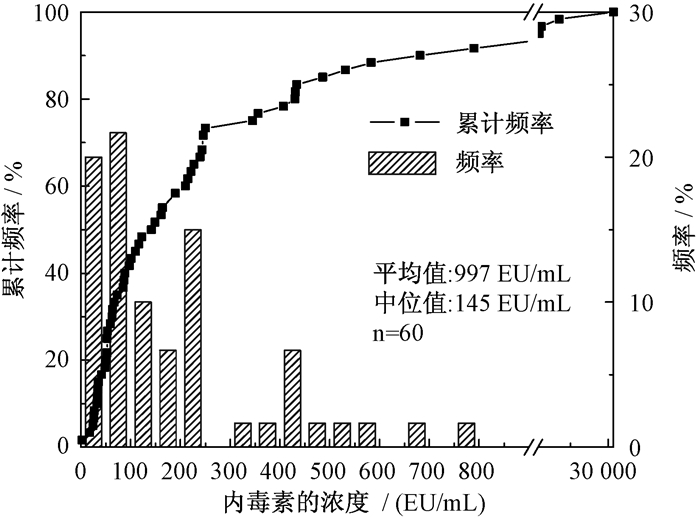
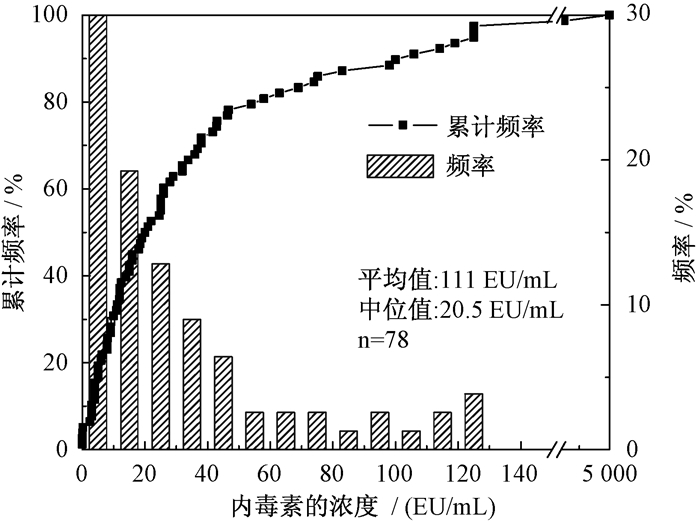
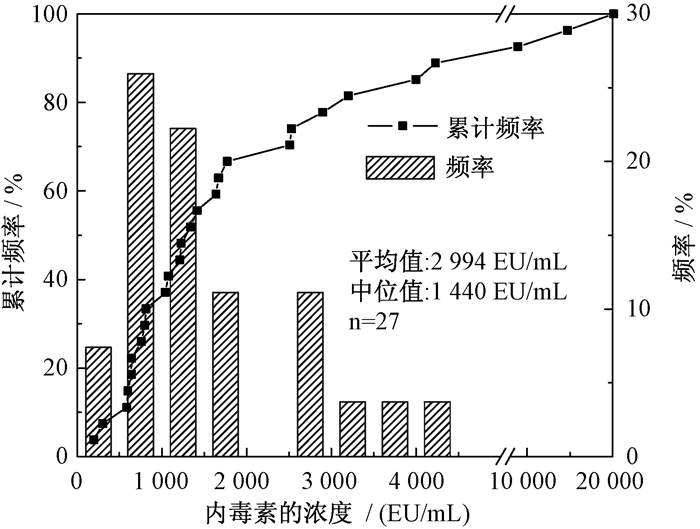
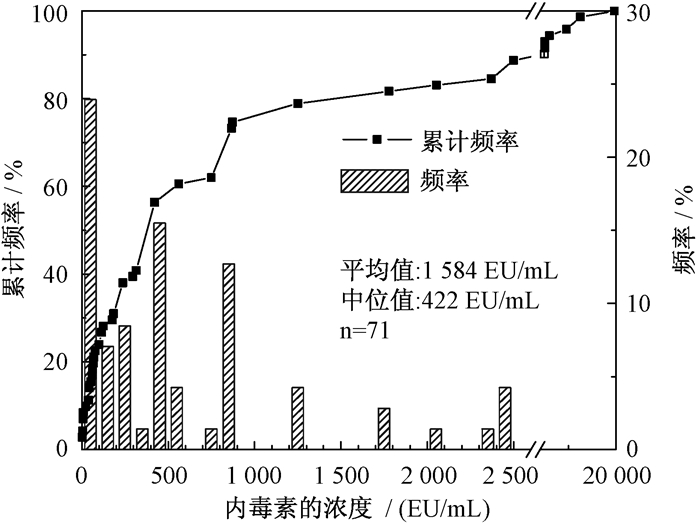
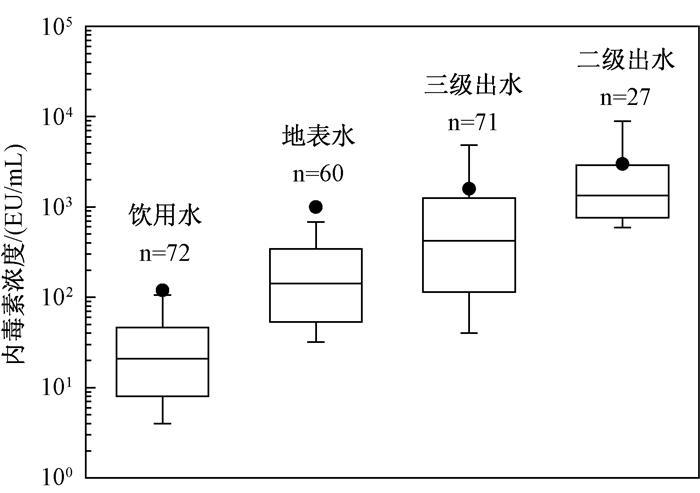
从图 1~4中可以看出,内毒素广泛存在于各种水体中。地表水中的内毒素浓度分布在3~32 000 EU/mL,其中90%的检出浓度水平在800 EU/mL以下,平均值为997 EU/mL,中位值为145 EU/mL。饮用水中同样存在内毒素,但浓度相对较低。除个别高达5 000 EU/mL外,饮用水中的内毒素浓度主要分布在0~125 EU/mL,平均值为120 EU/mL,中位值为23 EU/mL。污水处理厂二级出水中则存在高浓度的内毒素,检出浓度为201~20 100 EU/mL,其中90%的检出浓度水平在5 000 EU/mL以下,平均值为2 994 EU/mL,中位值为1 440 EU/mL。经过深度处理(包括混凝沉淀、砂滤、生物活性炭、膜过滤、消毒等工艺的组合)的出水中内毒素浓度分布在3~19 700 EU/mL,主要集中在1 000 EU/mL以下,平均值为1 584 EU/mL,中位值为422 EU/mL。
图 5比较了各水样中的内毒素浓度水平。内毒素浓度在饮用水、地表水、污水处理厂三级出水与二级出水中依次递增。由于革兰氏阴性菌广泛存在于环境中,且地表水越来越多地受到污水排放的污染,地表水中含有一定浓度的内毒素。虽然饮用水中内毒素浓度相对较低,但饮用水长期用于饮用、洗浴、空气加湿等用途,其中内毒素对人体健康存在潜在的风险。污水厂二级处理出水与深度处理出水中的内毒素浓度较高,内毒素可能在污水回用过程中,通过人体直接或间接接触引发人体的健康问题。因此需要对饮用水与污水中的内毒素进行控制与去除。
3 水处理过程对内毒素的去除效果
表 1总结了饮用水处理工艺与污水深度处理工艺对内毒素的去除效果,主要包括混凝沉淀过滤、生物活性炭与消毒工艺的作用。由此可知,混凝沉淀过滤对内毒素具有一定的去除效果,芬兰两个水厂中的混凝沉淀过滤工艺对内毒素的去除率可达80%以上[3, 26],但武汉两水厂中其去除率仅为11~49%[27],这可能是由于混凝沉淀过滤可去除微生物[39]从而去除结合态内毒素,但是不同水样中结合态与游离态内毒素所占比例不同[35],从而混凝沉淀过滤对内毒素的去除效果存在差异。生物活性炭不仅不能去除内毒素,反而会造成内毒素浓度升高50%,甚至升高近3倍,这可能由于活性炭柱中的革兰氏阴性菌释放内毒素[31]所致。
| 处理工艺 | 内毒素去除效果 | 水样类型 | 参考文献 |
| 混凝沉淀过滤 | |||
| 去除83~86% | 饮用水 | [3] | |
| 去除81~99% | 饮用水 | [26] | |
| 去除11~49% | 饮用水 | [27] | |
| 生物活性炭 | |||
| 增加2.6倍 | 饮用水 | [3] | |
| 增加50% | 污水 | [31] | |
| 消毒 | |||
| 氯消毒 | 去除速率1.3~1.4 EU/(mL·h) | 内毒素配水 | [33] |
| 增加0~4.6倍 | 饮用水 | [26] | |
| 部分去除11~25%,部分增加8% | 饮用水 | [4] | |
| 去除11~17% | 饮用水 | [27] | |
| 去除10~69% | 污水 | [31] | |
| 无去除,部分增加2倍 | 污水 | [34] | |
| 氯胺消毒 | 去除速率0.7~0.9 EU/(mL·h) | 内毒素配水 | [36] |
| 紫外消毒(中压灯) | 去除速率0.55 (EU/mL)/(mJ/cm2) | 内毒素配水 | [37] |
| 紫外消毒(低压灯) | 部分去除8~22%,部分增加 | 饮用水 | [4] |
| 无去除 | 污水 | [35] | |
| 臭氧消毒 | 去除速率0.7 EU/(mL·min) | 内毒素配水 | [38] |
| 去除57~74% | 饮用水 | [4] | |
| 去除8~35% | 饮用水 | [26] | |
| 去除30% | 污水 | [31] |
不同消毒工艺对内毒素的去除效果不同。氯、氯胺消毒与紫外消毒对内毒素的去除效果不稳定,去除率最高仅20%左右,并且可能造成内毒素浓度的增加。臭氧消毒对内毒素的去除率较高,最高可达74%,其去除速率也大于氯消毒与紫外消毒,说明臭氧的强氧化性利于去除内毒素。
4 结论炎症因子内毒素在各类水中普遍存在,尤其在城市污水厂二级处理出水与深度处理出水中的浓度超过1 000 EU/mL,且传统生物学指标无法反映内毒素污染状况及水平,因此需要重视对内毒素的检测。混凝沉淀过滤与消毒对内毒素有一定的去除作用,而生物活性炭反而增加内毒素的浓度,因此对于内毒素的控制与去除研究需要引起重视。
| [1] | Willams KL. Endotoxins:pyrogens, LAL testing and depyrogenation[M]. 3rd ed. New York:Informa Healthcare USA Inc, 2007, 27, 29, 67. |
| [2] | Anderson WB, Slawson RM, Mayfied CI. A review of drinking-water-associated endotoxin, including potential routes of human exposure[J]. Can J Microbiol, 2002, 48(7): 567–587. doi: 10.1139/w02-061 |
| [3] | Rapala J, Lahti K, Rasanen LA, et al. Endotoxins associated with cyanobacteria and their removal during drinking water treatment[J]. Water Res, 2002, 36(10): 2627–2635. doi: 10.1016/S0043-1354(01)00478-X |
| [4] | Gehr R, Yribe PU, Baptista IFDS, et al. Concentrations of endotoxins in waters around the island of montreal, and treatment options[J]. Water Qual Res J Can, 2008, 43(4): 291–303. |
| [5] | O'Toole J, Sinclair M, Jeavons T. Alternative water sources and endotoxin[J]. Water Sci Technol, 2008, 58(3): 603–607. doi: 10.2166/wst.2008.428 |
| [6] | Narita H, IsshikiI I, Funamizu N, et al. Organic matter released from activated sludge bacteria cells during their decay process[J]. Environ Technol, 2005, 26(4): 433–440. doi: 10.1080/09593332608618548 |
| [7] | Mattsby-Baltzer I, Lindgren K, Lindholm B, et al. Endotoxin shedding by enterobacteria:free and cell-bound endotoxin differ in Limulus activity[J]. Infect Immun, 1991, 59(2): 689–695. |
| [8] | Parikh SJ, Chorover J. Infrared spectroscopy studies of cation effects on lipopolysaccharides in aqueous solution[J]. Colloid Surface B, 2007, 55(2): 241–250. doi: 10.1016/j.colsurfb.2006.12.014 |
| [9] | Morrison DC, Danner RL, Dinarello CA, et al. Bacterial endotoxins and pathogenesis of gram-negative infections:current status and future direction[J]. J Endotoxin Res, 1994, 1(2): 71–83. doi: 10.1177/096805199400100201 |
| [10] | Liebers V, Raulf-Heimsoth M, Bruning T. Health effects due to endotoxin inhalation (review)[J]. Arch Toxicol, 2008, 82(4): 203–210. doi: 10.1007/s00204-008-0290-1 |
| [11] | Bramdembirg K, Wiese A. Endotoxins:relationships between structure, function, and activity[J]. Curr Top Med Chem, 2004, 4(11): 1127–1146. doi: 10.2174/1568026043388213 |
| [12] | Gorbet MB, Sefton MV. Endotoxin:the uninvited guest[J]. Biomaterials, 2005, 26(34): 6811–6817. doi: 10.1016/j.biomaterials.2005.04.063 |
| [13] | Petsh D, Anspach FB. Endotoxin removal from protein solutions[J]. J Biotech, 2000, 76(2-3): 97–119. doi: 10.1016/S0168-1656(99)00185-6 |
| [14] | Liao VHC, Chou WC, Chio CP, et al. A probabilistic approach to quantitatively assess the inhalation risk for airborne endotoxin in cotton textile workers[J]. J Hazard Mater, 2010, 177(1-3): 103–108. doi: 10.1016/j.jhazmat.2009.11.151 |
| [15] | Roth RA, Harkema JR, Pestka JP, et al. Is exposure to bacterial endotoxin a determinant of susceptibility to intoxication from xenobiotic agents?[J]. Toxicol Appl Pharm, 1997, 147(2): 300–311. doi: 10.1006/taap.1997.8301 |
| [16] | Best JH, Pflugmacher S, Wiegand C, et al. Effects of enteric bacterial and cyanobacterial lipopolysaccharides, and of microcystin-LR, on glutathione S-transferase activities in zebra fish (Danio rerio)[J]. Aquat Toxicol, 2002, 60(3-4): 223–231. doi: 10.1016/S0166-445X(02)00010-3 |
| [17] | 国家药典委员会. 中华人民共和国药典第二部[M]. 2005年版. 北京: 化学工业出版社, 2005: 76-82. |
| [18] | British pharmacopeia commission secretariat of the medicines and healthcare products regulatory agency. British Pharmacopeia, Vol[M]. 2012 Ed. London: Stationary Office, 2011: 3288. |
| [19] | United states pharmacopeial convention. United States Pharmacopeia, Vol[M]. Pharmacopeial Forum Ed. Rand McNally: U.S. Pharmacopeia Convention Inc, 2005: 803. |
| [20] | Anderson WB, Dixon DG, Mayfield CI. Estimation of endotoxin inhalation from shower and humidifier exposure reveals potential risk to human health[J]. J Water Health, 2007, 5(4): 553–572. doi: 10.2166/wh.2007.043 |
| [21] | Evans TM, Schillinger JE, Stuart DG. Rapid determination of bacteriological water quality by using Limulus Lysate[J]. Appl Environ Microbiol, 1978, 35(2): 376–382. |
| [22] | Haas CN, Neyer MA, Paller MS, et al. The utility of endotoxins as a surrogate indicator in potable water microbiology[J]. Water Res, 1983, 17(7): 803–807. doi: 10.1016/0043-1354(83)90075-1 |
| [23] | Jorgensen JH Lee JC, Alexander GA, et al. Comparison of limulus assay, standard plate count, and total coliform count for microbiological assessment of renovated wastewater[J]. Appl Environ Microbol, 1979, 37(5): 928–931. |
| [24] | Sykoraa JL, Keletia G, Rochea R, et al. Endotoxins, algae and limulus amoebocyte lysate test in drinking water[J]. Water Res, 1980, 14(7): 829–839. doi: 10.1016/0043-1354(80)90264-X |
| [25] | Wichmann G, Daegelmann C, Herbarth O, et al. Inflammatory activity in river-water samples[J]. Environ Toxicol, 2004, 19(6): 594–602. doi: 10.1002/tox.v19:6 |
| [26] | Rapala J, Niemela M, Berg KA, et al. Removal of cyanobacteria, cyanotoxins, heterotrophic bacteria and endotoxins at an operating surface water treatment plant[J]. Water Sci Technol, 2006, 54(3): 23–28. doi: 10.2166/wst.2006.443 |
| [27] | 段凌, 王欣, 张怡, 等. 武汉市自来水处理工艺过程中内毒素的含量[J]. 环境与健康杂志, 2008, 25(10): 856–858. doi: 10.3969/j.issn.1001-5914.2008.10.004 |
| [28] | Jorgensen JH, Lee JC, Pahren HR. Rapid detection of bacterial endotoxins in drinking water and renovated wastewater[J]. Appl Environ Microbol, 1976, 32(3): 347–351. |
| [29] | Mohamed ZA, Shehri AMA. Cyanobacteria and their toxins in treated-water storage reservoirs in Abha city, Saudi Arabia[J]. Toxicon, 2007, 50(1): 75–84. doi: 10.1016/j.toxicon.2007.02.021 |
| [30] | Abdulraheem A, Mustafa S, Al-Saffar N, et al. Detection of bacterial endotoxin in drinking tap and bottled water in Kuwait[J]. Environ Monit Assess, 2012, 184(12): 7323–7328. doi: 10.1007/s10661-011-2501-0 |
| [31] | Burger JS, Grabow WOK, Kfir R. Detection of endotoxin in reclaimed and conventionally treated drinking-water[J]. Water Res, 1989, 23(6): 733–738. doi: 10.1016/0043-1354(89)90207-8 |
| [32] | Kontana A, Papadimitriou CA, Samaras P, et al. Bioassays and biomarkers for ecotoxicological assessment of reclaimed municipal wastewater[J]. Water Sci Technol, 2008, 57(6): 947–953. doi: 10.2166/wst.2008.196 |
| [33] | Guizani M, Dhahbi M, Funamizu N. Assessment of endotoxin activity in wastewater treatment plants[J]. J Environ Monit, 2009, 11(7): 1421–1427. doi: 10.1039/b901879d |
| [34] | Huang H, Wu QY, Yang Y, et al. Effect of chlorination on endotoxin activities in secondary sewage effluent and typical Gram-negative bacteria[J]. Water Res, 2011, 45(16): 4751–4757. doi: 10.1016/j.watres.2011.06.013 |
| [35] | 黄璜, 胡洪营, 杨扬, 等. 二级出水内毒素活性及紫外线消毒对其的影响[J]. 中国给水排水, 2011, 27(7): 33–36. |
| [36] | Anderson WB, Mayfield CI, Dixon DG, et al. Endotoxin inactivation by selected drinking water treatment oxidants[J]. Water Res, 2003, 37(19): 4553–4560. doi: 10.1016/j.watres.2003.08.016 |
| [37] | Anderson WB, Huck PM, Dixon DG, et al. Endotoxin inactivation in water by using medium-pressure UV lamps[J]. Appl Environ Microbiol, 2003, 69(5): 3002–3004. doi: 10.1128/AEM.69.5.3002-3004.2003 |
| [38] | Rezaee A, Ghanizadeh G, Yazdanbakhsh AR, et al. Removal of endotoxin in water using ozonation process[J]. Aust. J. Basic Appl Sci, 2008, 2(3): 495–499. |
| [39] | 冯辉, 焦兆明. 静电除菌技术在污水再生处理中的应用[J]. 中国给水排水, 2008, 24(18): 87–88, 91. doi: 10.3321/j.issn:1000-4602.2008.18.025 |