 2016, Vol. 36

 [PDF全文]


2. 江苏省物质循环与污染控制重点实验室, 南京 210023;
3. 江苏省地理信息资源开发与利用协同创新中心, 南京 210023
2. Jiangsu Provincial Key Laboratory of Materials Cycling and Pollution Control, Nanjing 210023;
3. Jiangsu Center for Collaborative Innovation in Geographical Information Resource Development and Application, Nanjing 210023
多环芳烃(Polycyclic Aromatic Hydrocarbons, PAHs)是广泛分布于自然界的一类典型持久性有机污染物, 具有潜在的致癌和致畸变的能力, 在环境中的残留受到人们的广泛关注(郭建阳等, 2010;Ouvrard et al., 2013).由于PAHs溶解度低、疏水性强, 因而在水环境的水相中含量一般很低, 进入水体后易被颗粒物(如生物碎屑和胶体)吸附, 并随着重力沉降作用在沉积物中积累.因此, 沉积物是PAHs的主要环境归宿之一(Chiou et al., 1998; 宁怡等, 2012; Yang et al., 2008).沉积物中的PAHs通过解吸作用又会重新释放到环境中, 从而造成“二次污染”, 对生物和人体健康造成潜在的危害(谷超等, 2014; Schneider et al., 2007).近年来, 对表层沉积物及沉积柱中PAHs的含量、分布、来源、风险评价等方面已进行了广泛的研究(Acquaviita et al., 2014; Dong et al., 2014; Kanzari et al., 2014; Li et al., 2012).同时, 对水库沉积柱中PAHs也进行了一系列的研究(Fan et al., 2010; Ishitake et al., 2007), 分析PAHs的垂直分布与沉积记录, 进而重建当地PAHs的污染历史, 可为控制和减少PAHs提供理论依据.
目前, 我国对水库沉积物中的PAHs的分布特征和来源方面的研究已经取得一些成果.例如, 郭建阳等(2010)的研究结果显示, 水库沉积物中PAHs的含量从底层到表层基本上呈上升趋势, 主要来源于煤和木材的低温燃烧.赵健等(2009;2010)的研究表明, 水库剖面沉积物中PAHs总含量随着深度的增加而降低, 来源主要是化石燃料及生物质的燃烧;表层和剖面沉积物中PAHs总含量和有机碳含量有显著正相关关系.但关于宝象河水库PAHs的研究鲜有报道.宝象河水库位于云南省昆明市官渡区东部的大板桥镇, 于1958年8月建成.宝象河水库作为饮用水源, 建库初期除向水厂供水外, 还利用水面发展渔业;同时, 种植水土保持林(陈朝晖, 2009).此外, 滇池流域内仅次于盘龙江的第二大河流宝象河, 其水也源于宝象河水库.因此, 开展宝象河水库PAHs的污染调查具有重要意义.本研究采用GC-MS分析方法, 分析宝象河水库剖面沉积物中16种美国环境保护署(EPA)优控PAHs的含量与垂直分布, 并根据其组成特征和同分异构体的比值初步探讨水库中PAHs的主要来源.
2 采样与分析(Sample and analysis)样品采集时间为2013年8月, 采用自重式采样器于宝象河水库中(102°55′E, 25°1′N)(图 1)进行采集.共设置3个采样点, 沉积柱长均为50 cm, 现场进行切割, 然后装入密封袋保存.冷藏运回实验室, 于-20 ℃保存至分析.
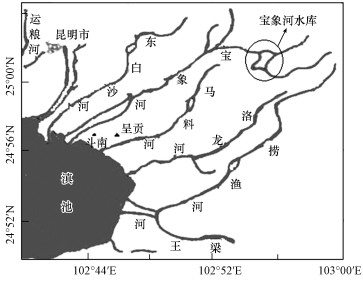 |
| 图 1 采样区域示意图 Fig. 1 Map of sampling site |
沉积物样品经冷冻干燥, 研磨, 过筛, 备用.准确称取5 g沉积物, 以正己烷/二氯甲烷(HPLC)(体积比为1:1)为提取液, 超声萃取1.5 h, 静置, 移取上层萃取清液, 旋转蒸发浓缩至2 mL.浓缩提取液通过无水硫酸钠/硅胶净化柱层析分离后用正己烷洗脱出PAHs.将溶液再度旋转蒸发, 浓缩至0.5 mL, 转移至进样瓶, 进行分析测定.
样品理化性质测定:总有机碳(Total Organic Carbon, TOC)采用有机碳分析仪(TOC-LCSH, 岛津公司, 日本)和固体进样器(SSM-5000A, 岛津公司, 日本)进行分析测定;总氮(Total Nitrogen, TN)含量测定采用过硫酸盐消化法;碳稳定同位素(δ13C)丰度采用质谱仪(Sercon 20-22, Sercon, UK)进行测定;粒度采用激光粒度仪(Mastersizer 2000, 英国)进行测定, 其粒度组成按以下粒径范围进行划分:黏粒( < 4 μm)、粉粒(4~64 μm)、砂粒(>64 μm).测定每个样品均设置3个重复, 最后取其平均值.
PAHs含量测定:采用日本岛津公司生产的气相色谱-质谱联用仪(GC-MS QP2010ultra)进行分析测定.分析条件为:Rtx®-5MS色谱柱, 规格为30 m×250 μm×0.25 μm;色谱分析条件:无分流自动进样1 μL, 进样口温度250 ℃, 载气为高纯氮气(99.999%);程序升温:90 ℃恒温1 min后, 以12 ℃·min-1升至180 ℃, 在180 ℃保持5 min, 再以5 ℃·min-1升至280 ℃, 恒温10 min.质谱条件:电子轰击(EI)离子源, 离子源温度200 ℃, 接口温度260 ℃, 数据采集采用SCAN模式扫描.以相对保留时间和特征碎片离子的峰强度比值对多环芳烃进行定性分析, 采用峰面积法、6点校正曲线定量(SIM模式).分析US EPA优控的16种PAHs, 所有化合物标准品购自德国Dr.Ehrenstorfer公司.
实验过程通过程序空白、加标空白及平行样品进行质量控制/质量保证, 以保证实验数据的精确性和准确性.PAHs回收率为80%~110%, 平均回收率为83%, 平行样测定相对误差均小于10%, 取平均值进行分析计算.
3 结果与讨论(Results and discussion) 3.1 水库沉积物的基本特征沉积物中TOC、δ13C与粒度的垂直分布如图 2所示.TOC含量范围为12.4~16.54 g·kg-1, 随深度的增加呈线性增加的趋势(r=-0.31, p < 0.05), 在20~50 cm深度范围内, 其增加趋势更为显著(r=-0.84, p < 0.01).C/N比值在2.5~5.7之间, 平均值为3.5.因此, 可以初步判断沉积物中有机质主要来源于藻类.δ13C值在-23.7‰~-22‰, 平均值为-22.9‰, 这表明有机质来源主要为C3植物或硅藻.沉积物中C/N比值与δ13C值的综合分析表明, 水库中有机质的来源为浮游植物藻类.沉积物粒度组成中以粉粒为主(43.8%~61.54%), 其次是黏粒(36.62%~54.55%), 砂粒含量最低( < 10%).
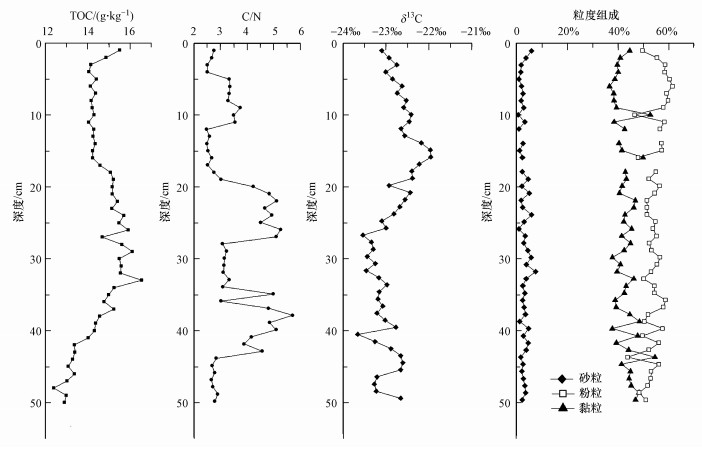 |
| 图 2 水库沉积物中TOC、δ13C与粒度的垂直分布 Fig. 2 Vertical distributions of TOC, δ13C and particle components in the sediment |
宝象河水库沉积物表层以下50 cm范围内, 16种US EPA优控的PAHs在样品中均有检出.相关性分析结果表明, 沉积物中2~3环PAHs(包括NAP、ACY、ACE、FLU、PHE、ANT)、4环PAHs(FLA、PYR、BaA、CHR)、5~6环PAHs(BbF、BkF、BaP、IcdP、DBA、BghiP)及PAHs总量均随深度的增加呈显著的降低趋势(p < 0.01).沉积物中PAHs总量介于162.26~762.24 ng·g-1之间, 平均值为423.30 ng·g-1.2~3环PAHs含量为128.34~518.81 ng·g-1, 平均值为279.88 ng·g-1, 占PAHs总量的42.2%~84.1%, 平均值为67.6%;4环PAHs含量为17.1~274.4 ng·g-1, 平均值为99.2 ng·g-1, 占PAHs总量的10.55%~36.1%, 平均值为21.6%.5~6环PAHs含量为11.4~143.7 ng·g-1, 平均值为44.2 ng·g-1, 占PAHs总量的3.8%~23.49%, 平均值为10.4%.在PAHs含量的垂直分布中(图 3), 自水库底层50 cm至距表层11 cm, PAHs总量呈上升趋势;在距表层11 cm处, PAHs含量达到最大值762.24 ng·g-1;11 cm到表层, PAHs含量呈降低趋势.2~3环PAHs的含量在距表层14 cm处最高, 底层50 cm至距表层14 cm其含量呈上升趋势, 14 cm至表层其含量呈降低趋势;4环PAHs含量的垂直变化与PAHs总量的变化趋势一致, 在距表层11 cm处达到最大值;5~6环PAHs含量从底层到表层呈缓慢上升趋势.从PAHs的总体趋势来看, 近年来水库沉积物中的PAHs污染有加重趋势, 值得关注.
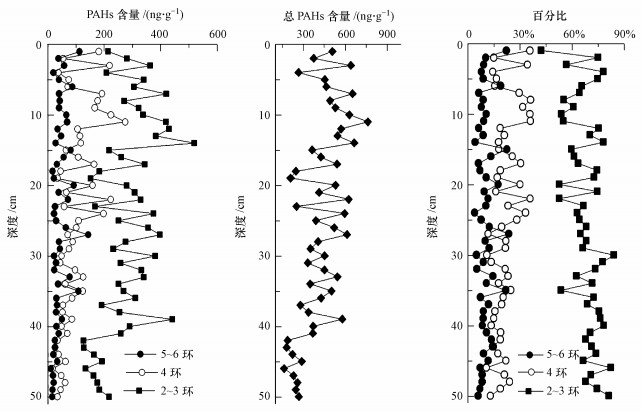 |
| 图 3 宝象河水库沉积物中PAHs的垂直分布 Fig. 3 Vertical distribution of PAHs in sediment core from Baoxianghe Reservoir |
从2~3环PAHs、4环PAHs及5~6环PAHs百分比的垂直分布趋势(图 3)可以看出, 虽然自距表层14 cm处开始2~3环PAHs含量呈降低趋势, 但沉积物中PAHs以2~3环PAHs为主要组分.在2~3环PAHs中, FLU和PHE主要来源于煤炭、生物质的不完全燃烧(Harrison et al., 1996; Wang et al., 2009; Zhang et al., 2013).4环PAHs中, FLA和PYR来源于煤炭与石油燃烧, BaA和CHR主要来源于石油及石油燃烧过程(Guo et al., 2006; Zhang et al., 2013).5~6环PAHs中, IcdP和BghiP主要来源于汽车尾气(Harrison et al., 1996; Mai et al., 2003; Wang et al., 2010).在宝象河水库沉积物中, FLU和PHE是2~3环PAHs的主要组分, 分别占12.2%~24.6%、58.7%~79%.FLU和PHE含量从水库底层至表层显著增加(图 4a), 表明不完全燃烧产生的PAHs呈增加趋势;FLA、PYR、BaA及CHR含量的显著增加(图 4b, 4c)表明来源于煤炭、石油燃烧的PAHs逐渐增加;IcdP和BghiP含量的显著增加(图 4d)表明汽车尾气产生的PAHs亦呈增加趋势.
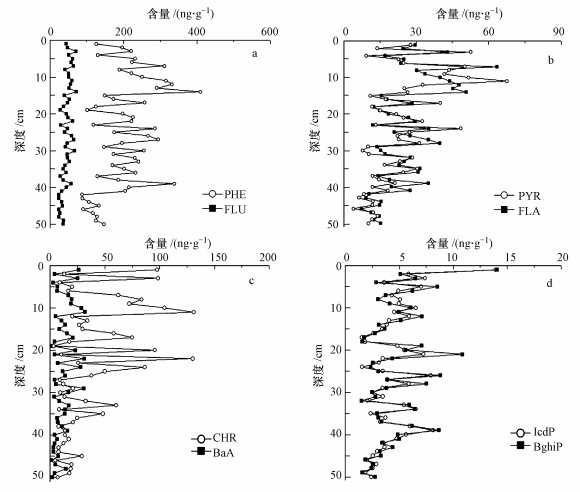 |
| 图 4 沉积物中PAHs各组分的垂直分布 Fig. 4 Vertical distribution of individual PAHs in the sediment core |
在我国大部分水域中, 河口、海湾、港口PAHs浓度较高, 污染较严重, 而内陆河流、湖泊PAHs浓度较低, 污染相对较轻(江敏等, 2014).我国主要水域沉积物中PAHs的含量范围为102~104 ng·g-1, 少数区域达到105 ng·g-1 (程家丽等, 2007).与国内相似水体沉积物相比, 宝象河水库沉积物中PAHs含量与已有研究的其他水库处于同一数量级, 显著高于贵州阿哈水库(107.6~142.1 ng·g-1) (谷超等, 2014), 低于密云水库(618.5~1087.9 ng·g-1)(郭建阳等, 2010)、河北王快水库(332.0~1039.8 ng·g-1) (赵健等, 2009)、程海(384.7~1127 ng·g-1)(Guo et al., 2010)及滇池(479.3~4560.8 ng·g-1)(Guo et al., 2013).
3.3 多环芳烃的来源分析自然界中PAHs的来源主要包括自然来源与人为活动.其中, 自然来源多为森林大火、火山喷发、生物合成等.人为的排放是PAHs的主要来源, 如矿物燃料(煤、石油、天然气等)的燃烧、纸张、木材及其他生物质的燃烧等(郭建阳等, 2010).目前, 常见的识别环境中PAHs来源的方法主要有分子比值法、化学质量平衡法、因子分析法、主成分分析法等.分子比值法是其中最常见的一种方法, 尤其在土壤和沉积物中常用来分析PAHs的来源(Chen et al., 2012; Sun et al., 2013; Zhang et al., 2015).常用的特征分子比值有ANT/(ANT+PHE)、FLA/(FLA+PYR)、BaA/(BaA+CHR)、IcdP/(IcdP+BghiP)等.
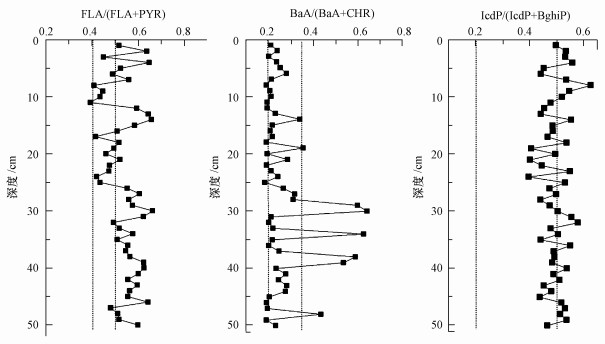
本文采用FLA/(FLA+PYR)、BaA/(BaA+CHR)和IcdP/(IcdP+BghiP)3组分子比值对宝象河水库沉积物中PAHs的来源进行分析研究.前人的研究结果(Ahrens et al., 2010; Jiang et al., 2009; Katsoyiannis et al., 2007; Yunker et al., 1999; Yunker et al., 2002)表明, 如果FLA/(FLA+PYR) < 0.4, BaA/(BaA+CHR) < 0.2, IcdP/(IcdP+BghiP) < 0.2, 说明PAHs主要是油成源;如果FLA/(FLA+PYR)>0.4, BaA/(BaA+CHR)>0.2, IcdP/(IcdP+BghiP)>0.2, 说明PAHs主要来源于燃烧过程;如果FLA/(FLA+PYR)比值在0.4~0.5之间, BaA/(BaA+CHR)比值在0.20~0.35之间, IcdP/(IcdP+BghiP)比值在0.2~0.5之间, 说明PAHs主要来源于液态化石燃料燃烧;如果FLA/(FLA+PYR)>0.5, BaA/(BaA+CHR)>0.35, IcdP/(IcdP+BghiP)>0.5, 则说明PAHs主要来源于煤炭、生物质的燃烧.宝象河水库沉积物中FLA/(FLA+PYR)、BaA/(BaA+CHR)和IcdP/(IcdP+BghiP)比值的垂直变化如图 5所示.从图中可以看出, FLA/(FLA+PYR)比值均大于0.4, BaA/(BaA+CHR)均大于0.2, IcdP/(IcdP+BghiP)均大于0.2, 这表明沉积物中PAHs主要来源于燃烧过程.其中, 底层至距表层26 cm处FLA/(FLA+PYR)比值大于0.5, 30~40 cm处有部分BaA/(BaA+CHR)比值大于0.35, 说明此阶段有煤炭、生物质燃烧产生PAHs.26 cm至表层FLA/(FLA+PYR)比值大于0.4, 表明此阶段既有液态化石燃料燃烧产生PAHs, 又有来源于煤炭、生物质燃烧产生的PAHs.30 cm至表层BaA/(BaA+CHR)比值介于0.20~0.35之间, 说明液态化石燃料燃烧是PAHs的主要来源.通过3组比值综合分析可以看出, 沉积物中PAHs主要来源由煤炭、生物质的燃烧过程转变为多种燃烧过程, 即液态化石燃料燃烧与煤炭、生物质燃烧.结合PAHs各组分的含量分析, PHE是主要成分, 其含量在87.2~410.1 ng·g-1之间, 占PAHs总量的58.7%~78.8%.综合分析表明, 沉积物中PAHs的主要来源是煤炭、生物质的燃烧, 这与Guo等(2013)对滇池沉积物中PAHs的研究结果一致, 与河北王快水库沉积物中PAHs来源(赵健等, 2009)相同, 不同于密云水库的煤、木材的低温燃烧(郭建阳等, 2010)及贵州阿哈水库的石油类污染来源(谷超等, 2014).
 |
| 图 5 宝象河水库沉积物中FLA/(FLA+PYR)、BaA/(BaA+CHR)和IcdP/(IcdP+BghiP)比值的垂直变化 Fig. 5 Vertical profile of FLA/(FLA+PYR), BaA/(BaA+CHR) and IcdP/(IcdP+BghiP) ratios in sediment core |
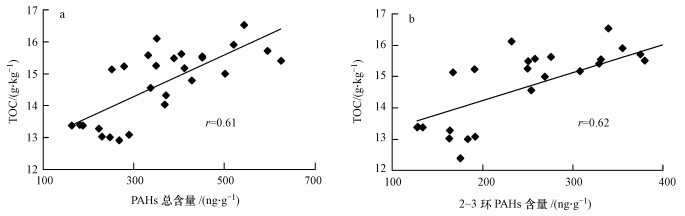
Guo等(2009)和Joness等(1989)研究发现, 沉积物中有机质含量与PAHs含量之间有显著相关性, 有机质是PAHs在沉积物中迁移的重要载体.赵健等(2009, 2011)的研究结果也表明, 水库沉积物含量与有机碳含量呈正相关关系.本研究将沉积物中PAHs含量与TOC含量性进行相关分析, 结果显示, 二者之间有显著的相关性, 而且沉积物底层50 cm至距表层20 cm处PAHs含量与TOC之间的相关性更为显著(r=0.61, p < 0.05)(图 6a).这表明TOC影响多环芳烃在沉积物中的分布, 影响多环芳烃的归宿.此外, PAHs各组分中, 2~3环PAHs的含量与TOC之间亦有显著相关性(r=0.62, p < 0.05)(图 6b).
 |
| 图 6 沉积物中PAHs与TOC的关系 Fig. 6 Relationships between PAHs concentration and TOC in sediment core |
Guo等(2007)研究表明, TOC与PAHs之间有显著正相关关系, TOC影响沉积物中PAHs的分布.Yang等(2011)对湖泊沉积物中的研究结果亦证明TOC与PAHs含量之间的相关性.Ghosh等(2000)研究表明, 沉积物中PAHs的空间分布与颗粒粒径大小有关, 细小的沉积物颗粒吸附有机污染物的浓度与颗粒中有机碳的含量具有一定相关性.因此, PAHs进入水体后易吸附在颗粒物上, 在水体中停留时间越长, 颗粒中有机质含量越高, 吸附的PAHs也会相应的增加.而宝象河水库沉积物中TOC含量与粒度组成的分析结果表明, 水库沉积物TOC含量较高, 且以粉粒、黏粒为主要粒度组成, 因此, 更易于吸附PAHs.
4 结论(Conclusions)1)宝象河水库沉积物中16种US EPA优控的PAHs均有检出, 其含量范围为162.26~762.24 ng·g-1.沉积物中PAHs以2~3环为主, 占PAHs总量的42.2%~84.1%.从PAHs的垂直分布看, 其含量基本上呈上升趋势, 且从底层到距表层11 cm处上升趋势较为明显.TOC与PAHs含量之间有显著正相关关系, TOC会影响宝象河水库沉积物中PAHs的分布.
2)宝象河水库中PAHs主要来源于燃烧过程, 即煤炭及生物质的燃烧.FLU、PHE、FLA、PYR、BaA、CHR、IcdP、BghiP含量的垂直变化趋势表明, 近年来燃烧过程产生的PAHs呈增加趋势, 应引起关注.
| [${referVo.labelOrder}] | Acquavita A, Falomo J, Predonzani S, et al. 2014. The PAH level, distribution and composition in surface sediments from a Mediterranean Lagoon: The Marano and Grado Lagoon (Northern Adriatic Sea, Italy)[J]. Marine Pollution Bulletin , 81 : 234–241. DOI:10.1016/j.marpolbul.2014.01.041 |
| [${referVo.labelOrder}] | Ahrens M J, Depree C V. 2010. A source mixing model to apportion PAHs from coal tar and asphalt binders in street pavements and urban aquatic sediment[J]. Chemosphere , 81 (11) : 1526–1535. DOI:10.1016/j.chemosphere.2010.08.030 |
| [${referVo.labelOrder}] | 陈朝晖.2009. 宝象河水库水质现状及保护对策[J]. 环境科学导刊 , 2009, 28 (1) : 48–49. |
| [${referVo.labelOrder}] | Chen H Y, Teng Y G, Wang J S. 2012. Source apportionment of polycyclic aromatic hydrocarbons (PAHs) in surface sediments of the Rizhao coastal area (China) using diagnostic ratios and factor analysis with nonnegative constraints[J]. Science of the Total Environment , 414 : 293–300. DOI:10.1016/j.scitotenv.2011.10.057 |
| [${referVo.labelOrder}] | 程家丽, 黄启飞, 魏世强.2007. 我国环境介质中多环芳烃的分布及其生态风险[J]. 环境工程学报 , 2007, 1 (4) : 138–144. |
| [${referVo.labelOrder}] | Chiou C T, Macgroddy S E, Kile D E. 1998. Partition characteristics of polycyclic aromatic hydrocarbons on soils and sediments[J]. Environmental Science and Technology , 32 : 264–269. DOI:10.1021/es970614c |
| [${referVo.labelOrder}] | Dong C D, Chen C F, Chen C W. 2014. Vertical profile, sources and equivalent toxicity of polycyclic aromatic hydrocarbons in sediment cores from the river mouths of Kaohsiung Harbor, Taiwan[J]. Marine Pollution Bulletin , 85 : 665–671. DOI:10.1016/j.marpolbul.2013.09.037 |
| [${referVo.labelOrder}] | Fan C W, Yang T N, Kao S J. 2010. Characteristics of sedimentary polycyclic aromatic hydrocarbons (PAHs) in the subtropical Feitsui Reservoir, Taiwan[J]. Journal of Hydrology , 391 : 217–222. DOI:10.1016/j.jhydrol.2010.07.020 |
| [${referVo.labelOrder}] | 谷超, 袁培耘, 梁隆超, 等.2014. 阿哈水库表层沉积物中多环芳烃的分布、来源及生态风险评价[J]. 河南农业科学 , 2014, 43 (10) : 58–61. |
| [${referVo.labelOrder}] | 郭建阳, 廖海清, 韩梅, 等.2010. 密云水库沉积物中多环芳烃的垂直分布、来源及生态风险评估[J]. 环境科学 , 2010, 31 (3) : 626–631. |
| [${referVo.labelOrder}] | Ghosh U, Gillette J S, Luthy R G, et al. 2000. Microscale location, characterization, and association of polycyclic aromatic hydrocarbons on Harbor sediment particles[J]. Environmental Science and Technology , 34 : 1729–1736. DOI:10.1021/es991032t |
| [${referVo.labelOrder}] | Guo J Y, Wu F C, Luo X, et al. 2010. Anthropogenic input of polycyclic aromatic hydrocarbons into five lakes in Western China[J]. Environmental Pollution , 158 : 2175–2180. DOI:10.1016/j.envpol.2010.02.018 |
| [${referVo.labelOrder}] | Guo J Y, Wu F C, Liao H Q, et al. 2013. Sedimentary record of polycyclic aromatic hydrocarbons and DDTs in Dianchi Lake, an urban lake in Southwest China[J]. Environmental Science and Pollution Research , 20 : 5471–5480. DOI:10.1007/s11356-013-1562-8 |
| [${referVo.labelOrder}] | Guo Z G, Lin T, Zhang G, et al. 2006. High-resolution depositional records of polycyclic aromatic hydrocarbons in the central continental shelf mud of the East China Sea[J]. Environmental Science and Technology , 40 : 5304–5311. DOI:10.1021/es060878b |
| [${referVo.labelOrder}] | Guo W, He M, Yang Z. 2009. Distribution, partitioning and sources of polycyclic aromatic hydrocarbons in Daliao River water system in dry season, China[J]. Journal of Hazardous Materials , 164 (2/3) : 1379–1385. |
| [${referVo.labelOrder}] | Guo W, He M C, Yang Z F, et al. 2007. Distribution of polycyclic aromatic hydrocarbons in water, suspended particulate matter and sediment from Daliao River watershed, China[J]. Chemosphere , 68 : 93–104. DOI:10.1016/j.chemosphere.2006.12.072 |
| [${referVo.labelOrder}] | Harrison R M, Smith D J, Luhana L. 1996. Source apportionment of atmosphereic polycyclic aromatic hydrocarbons collected from an urban location in Birmingham, UK[J]. Environmental Science and Technology , 30 : 825–832. DOI:10.1021/es950252d |
| [${referVo.labelOrder}] | Ishitake M, Moriwaki H, Katahira K, et al. 2007. Vertical profile of polycyclic aromatic hydrocarbons in a sediment core from a reservoir in Osaka City[J]. Environmental Geology , 52 : 123–129. DOI:10.1007/s00254-006-0465-0 |
| [${referVo.labelOrder}] | Jiang J J, Lee C L, Fang M D, et al. 2009. Polycyclic aromatic hydrocarbons in coastal sediments of southwest Taiwan: an appraisal of diagnostic ratios in hepatoma cell line PLHC-1[J]. Environmental Toxicology and Chemistry , 20 : 149–159. |
| [${referVo.labelOrder}] | 江敏, LeH T, 梅卫平, 等.2014. 舟山近海水体和沉积物中多环芳烃分布特征[J]. 环境科学 , 2014, 35 (7) : 2672–2679. |
| [${referVo.labelOrder}] | Joness K C, Stafford J A, Waterhouse K S. 1989. Organic contaminants in Welsh soil polycyclic aromatic hydrocarbons[J]. Environmental Science and Technology , 23 : 540–550. DOI:10.1021/es00063a005 |
| [${referVo.labelOrder}] | Kanzari F, Syakti A D, Asia L, et al. 2014. Distribution and sources of persistent organic pollutants (aliphatic hydrocarbons, PAHs, PCBs and pesticides) in surface sediments of an industrialized urban river (Huveaune), France[J]. Science of the Total Environment , 478 : 141–151. DOI:10.1016/j.scitotenv.2014.01.065 |
| [${referVo.labelOrder}] | Katsoyiannis A, Terzi E, Cai Q Y. 2007. On the use of PAH molecular diagnostic ratios in sewage sludge for the understanding of PAH sources[J]. Is this use appropriate?[J].Chemosphere , 69 (8) : 1337–1339. |
| [${referVo.labelOrder}] | Li B H, Feng C H, Li X, et al. 2012. Spatial distribution and source apportionment of PAHs in surficial sediments of the Yangtze Estuary, China[J]. Marine Pollution Bulletin , 64 : 636–643. DOI:10.1016/j.marpolbul.2011.12.005 |
| [${referVo.labelOrder}] | Mai B X, Qi S H, Zeng E Y, et al. 2003. Distribution of polycyclic aromatic hydrocarbons in the coastal region off Macao, China: assessment of input sources and transport pathways using compositional analysis[J]. Environmental Science and Technology , 37 : 4855–4863. DOI:10.1021/es034514k |
| [${referVo.labelOrder}] | 宁怡, 柯用春, 邓建才, 等.2012. 巢湖表层沉积物中多环芳烃分布特征及来源[J]. 湖泊科学 , 2012, 24 (6) : 891–898. |
| [${referVo.labelOrder}] | Ouvrard S, Chenot E D, Masfaraud J F. 2013. Long-term assessment of natural attenuation: Statistical approach on soil with aged PAH contamination[J]. Biodegradation , 24 (4) : 539–548. DOI:10.1007/s10532-013-9618-5 |
| [${referVo.labelOrder}] | Schneider A, Porte E, Barker A. 2007. Polychlorinated biphenyl release from resuspended Hudon River sediment[J]. Science and Technology , 41 : 1097–1103. DOI:10.1021/es0607584 |
| [${referVo.labelOrder}] | Sun L, Zang S Y. 2013. Relationship between polycyclic aromatic hydrocarbons (PAHs) and particle size in dated core sediments in Lake Lianhuan, Northeast China[J]. Science of the Total Environment , 461-462 : 180–187. DOI:10.1016/j.scitotenv.2013.04.102 |
| [${referVo.labelOrder}] | Wang L L, Yang Z F, Niu J F, et al. 2009. Characterization, ecological risk assessment and source diagnostics of polycyclic aromatic hydrocarbons in water column of the Yellow River Delta, one of the most plenty biodiversity zones in the world[J]. Journal of Hazardous Materials , 169 : 460–465. DOI:10.1016/j.jhazmat.2009.03.125 |
| [${referVo.labelOrder}] | Wang X, Yang H, Gong P, et al. 2010. One century sedimentary records of polycyclic aromatic hydrocarbons, mercury and trace elements in the Qinghai Lake, Tibetan Plateau[J]. Environmental Pollution , 158 : 3065–3070. DOI:10.1016/j.envpol.2010.06.034 |
| [${referVo.labelOrder}] | Yunker M B, Macdonald R W, Goyette D, et al. 1999. Natural and anthropogenic inputs of hydrocarbons to the Strait of Georgia[J]. Science of the Total Environment , 225 : 181–189. DOI:10.1016/S0048-9697(98)00362-3 |
| [${referVo.labelOrder}] | Yunker M B, Macdonald R W, Vingarzan R, et al. 2002. PAHs in the Fraser River basin: a critical appraisal of PAH ratios as indicators of PAH source and composition[J]. Organic Geochemistry , 33 : 489–515. DOI:10.1016/S0146-6380(02)00002-5 |
| [${referVo.labelOrder}] | Yang Z F, Tang Z W, Shen Z Y, et al. 2011. One-hundred-year sedimentary record of polycyclic aromatic hydrocarbons in urban lake sediments from Wuhan, Central China[J]. Water, Air and Soil Pollution , 217 : 577–587. DOI:10.1007/s11270-010-0611-x |
| [${referVo.labelOrder}] | Yang Z, Feng J, Niu J. 2008. Release of polycyclic aromatic hydrocarbon from Yangtze River sediment cores during periods of simulated resuspension[J]. Environmental Pollution , 155 : 366–374. DOI:10.1016/j.envpol.2007.11.007 |
| [${referVo.labelOrder}] | Zhang J, Wang J, Hua P, et al. 2015. The qualitative and quantitative source apportionments of polycyclic aromatic hydrocarbons in size dependent road deposited sediment[J]. Science of the Total Environment , 505 : 90–101. DOI:10.1016/j.scitotenv.2014.09.091 |
| [${referVo.labelOrder}] | 赵健, 周怀东, 陆瑾, 等.2009. 河北王快水库沉积物多环芳烃的分布、来源及生态风险评价[J]. 湖泊科学 , 2009, 21 (5) : 647–653. |
| [${referVo.labelOrder}] | 赵健, 周怀东, 富国, 等.2011. 河北西大洋水库沉积物中多环芳烃的分布、来源及生态风险评价[J]. 湖泊科学 , 2011, 23 (5) : 701–707. |
| [${referVo.labelOrder}] | Zhang R, Zhang F, Zhang T C. 2013. Sedimentary records of PAHs in a sediment core from tidal flat of Haizhou Bay, China[J]. Science of the Total Environment , 450-451 : 280–288. DOI:10.1016/j.scitotenv.2013.02.029 |