 2016, Vol. 36

 [PDF全文]


2. 中国科学院生态环境研究中心, 北京 100085
2. Research Center for Eco-Environmental Sciences, Chinese Academy of Sciences, Beijing 100085
多氯联苯(Polychlorinated Biphenyls,PCBs)被《关于持久性有机污染物的斯德哥尔摩公约》列为首批控制消除的12种污染物之一,PCBs的同类物多达209种,由于其在环境中具有难降解性、生物累积性、长距离传输和生物毒性等特点(Alcock et al., 1996),因而被认为是环境中普遍存在的持久性有机污染物(POPs).多氯联苯具有良好的化学惰性、抗热性、不可燃性、低蒸气压和高介电常数等优点,因此,在20世纪70年代前曾被大量生产并广泛应用于电力工业、塑料加工业、化工和印刷等领域.我国虽然在20世纪70年代禁止了PCBs的生产,但生产和使用PCBs产生的废物和污染场地中PCBs经二次挥发进入大气,成为环境中PCBs的重要来源之一.除此之外,多氯联苯作为副产物,可以在很多工业过程中产生和排放,而这些工业过程中含有PCBs的工业废弃物如废气、废液、废渣的排放(Guo et al., 2009;Nie et al., 2012a;2012b;Lv et al., 2011),成为近年来环境中PCBs的重要来源.PCBs在大气、水、土壤之间存在一个交换的平衡过程,大气环境中的PCBs随大气的干、湿沉降污染土壤和水体(孟庆昱等,2000;王莎莎等,2014).土壤既是PCBs的源,也是重要的汇,而且在人类食物链中是一个关键的环境介质,与人类的生活关系极为密切,因此,成为近年来的研究热点.有研究显示,意大利背景土壤中PCBs含量为0.26~2.0 ng · g-1(Domenico et al., 1993);土耳其烧结厂周边土壤中指示性PCBs含量约为7.1 ng · g-1(Odabasi et al., 2010);而在日本某钢铁厂周边土壤中PCBs-TEQ(Toxic Equivalent Quantity)即毒性当量值为0.15~4.2 pg · g-1(以TEQ 计,Yasuhiko et al., 1994).因此,关于土壤的PCBs的研究也越来越受到广泛关注.
近年来的研究表明,钢铁生产是多氯联苯特别是具有类二英多氯联苯(dioxin-PCBs)的排放源(Lee et al., 2001; Li et al., 2014).中国作为钢铁大国,据国家统计局统计数据显示,2011年全国粗钢产能高达8.2亿t,粗钢总产量6.83亿t.面对如此大规模的钢铁生产,研究钢铁厂对周边土壤PCBs污染水平的影响具有重要意义(Nie et al., 2011;Lv et al., 2011;Hu et al., 2013;Ba et al., 2009).而河北省是我国最大的钢铁生产省份,产能在2.4亿t左右,占全国总产量的29.3%;钢铁产量1.65亿t,占全国总产量的24%.迁安市位于河北省境内,矿石资源丰富,为钢铁厂提供了很好的环境依托,拥有多家大型钢铁生产企业,是开展PCBs环境水平研究的典型地区.因此,本研究通过在迁安市选择典型钢铁企业,对其周边土壤中的PCBs含量和分布特征开展研究,以期为评估钢铁企业排放的PCBs对周边环境的影响提供参考.
2 材料与方法(Materials and methods) 2.1 样品采集和分析研究选择的钢铁厂位于迁安市西北部,该地区属于华北地区,以黄壤为主,黄壤的物理性质表现为疏松、多孔隙,垂直节理发育,极易渗水,且有许多可溶性物质,易于PCBs等有毒物质的积累.该厂于2004年投产,年生产能力800万t,从投产至今已有10年之久.因为该厂同时具备炼钢、烧结、焦化等工业热工程车间,PCBs等有毒污染物在炼钢等工业热工程中可随烟道气和飞灰等途径进入到环境中并经过大气沉降进入土壤中,使得该市及钢铁厂周边环境土壤受到了PCBs等有毒污染物的影响.因此,该厂周边土壤中的PCBs等污染属于多方面复合污染.同时,该地区除了该钢铁厂炼钢、焦化、烧结等车间污染排放外,无其他污染源,因此,认为该钢铁厂为该地区污染源.于2014年夏季采集了所在区域周边的表层土壤,采样点位共有9处,具体点位如图 1所示(其中,Q1:39°58′36.50″N,118°33′4.50″E;Q2:39°58′29.50″N,118°34′32.10″E;Q3:39°57′36.60″N,118°32′51.90″E;Q4:39°57′31.80″N,118°33′34.20″E;Q5:39°59′9.50″N,118°32′32.50″E;Q6:39°59′17.20″N,118°33′7.80″E;Q7:39°59′23.60″N,118°34′56.80″E;Q8:39°57′0.80″N,118°34′37.00″E;Q9:39°58′26.80″N,118°29′37.60″E).
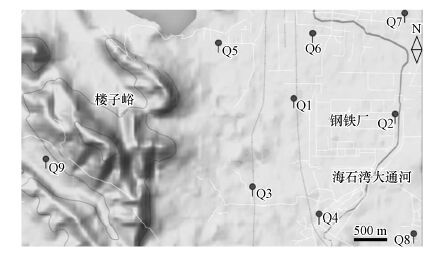 |
| 图 1 土壤样品分布示意图 Fig. 1 Distribution of soil sampling sites |
土壤样品采集参照我国标准方法《土壤和沉积物二英类的测定同位素稀释高分辨色谱-高分辨质谱法》(HJ 77.4—2008) 进行.使用金属铲具铲去表层杂草和石块,并在10 cm深度范围内采集土壤样品,而后将其放入聚乙烯密封袋中带回实验室并于-4 ℃下保存.采样点的具体位置由便携式GPS设备(Magellan GPS,San Dimas,CA,USA)记录.
PCBs的样品分析依据EPA-1668A方法,采用同位素稀释高分辨气相色谱-高分辨质谱(HRGC/HRMS)对样品进行分析.将土壤样品置于冷冻干燥机中冷冻干燥48 h左右,然后研磨过筛(60目).土壤样品中目标物的提取采用加速溶剂提取(ASE 350,DIONEX,USA)方法,称取10.0 g左右样品置于烧杯中,与1/3~1/4比例的硅藻土充分混合,加入1 ng13C12标记的PCBs净化内标(13C12-CB-1,3,4,15,19,37,54,81,77,104,114,105,126,155,167,156,157,169,188,189,202,205,206,208,209) .混合标准溶液平衡至少2 h之后,转入底部垫有滤膜的提取筒中.提取溶剂为正己烷/二氯甲烷(1 ∶ 1,体积比),温度为150 ℃,压力10.34×10⁶ Pa,静态提取时间15 min,循环提取2次.溶剂淋洗体积为70%萃取池体积,氮气吹扫时间为120 s.提取液经酸性硅胶柱、复合硅胶柱和碱性氧化铝柱净化.净化分离后得到的组分经旋转蒸发器浓缩至3~5 mL,然后氮吹浓缩至20 μL,并加入1 ng 13C12标记的进样内标(13C12-PCB-9,52,101,138,194) ,用于回收率的计算.
PCBs分析采用AutoSpecUltima型高分辨色质联用仪,气相色谱为Agilent 6890N,色谱柱为DB-5MS毛细管柱(60.0 m×0.25 mm×0.25μm).电离方式为电子轰击(EI),测定时采用选择离子方式(SIM).定量分析测定12种类二英PCB(PCB-77,81,105,114,118,123,126,156,157,167,169,189) 和7种指示性PCB(PCB-28,52,101,118,153,138,180) 含量(这7种PCBs在检测中具有代表性且有指示作用,全球检测体系污染物评估和规划中规定了PCB-28,52,101,118,153,138,180作为PCBs污染状况的指示性单体)(Björklund et al., 2002).空白样品中主要检出的多氯联苯的回收率为30%~150%,符合EPA-1668的要求.
3 结果与讨论(Results and discussion) 3.1 样品中dl-PCBs的含量土壤样品中各采样点dl-PCBs的含量如表 1所示.由表 1可以看出,土壤样品中dl-PCBs的总含量为4.77~462.04 pg · g-1,平均值为121.72 pg · g-1.土壤样品dl-PCBs的同类物分布特征比较相似,大部分样品中PCB-118为主要贡献者,PCB-118的含量范围为0.23~148.72 pg · g-1,贡献率为4.82%~51.78%,平均贡献率为25.98%;其次是PCB-105、PCB-77和PCB-156,PCB-105的含量为0.58~58 pg · g-1,贡献率为9.02%~18.54%,平均贡献率为14.65%.PCB-77含量为0.76~48.51 pg · g-1,贡献率为6.52%~38.85%,平均贡献率为18.15%.而PCB-156含量为0.33%~57.7%,贡献率为2.80%~12.49%,平均贡献率为7.22%.对于许多的热相关源、环境介质和生物样品,PCB-118都是dl-PCBs最主要的毒性同类物(Kim et al., 2004)
| 表 1 土壤样品中各采样点dl-PCBs含量 Table 1 Concentrations of dl-PCBs in the soil samples |
 |
该市及周边土壤中dl-PCBs-TEQ值分布特征如图 2.从图中可以清晰看出,土壤中dl-PCBs的TEQ值为0.03~1.34 pg · g-1(以TEQ计,下同),平均值为0.49 pg · g-1.围绕钢铁厂附近的土壤样品中dl-PCBs的TEQ相对较高,距离企业较远的Q9土壤样品中TEQ值为0.22 pg · g-1,钢铁厂周边土壤样品中TEQ值是对比土壤Q9中TEQ值的1~6倍;从图 2中可以看出,Q1、Q2、Q3、Q4四处采样点污染较为严重,且都是围绕着该市一家钢铁生产企业.由此可见,该钢铁企业生产所排放的PCBs等污染物对该市环境土壤污染较为严重,其中仍以Q2采样点居高,其TEQ值为1.34 pg · g-1,占总量的30%;而Q1采样点TEQ值为0.95 pg · g-1,占总量的21%;Q4处的TEQ值为0.9pg · g-1,只占总量的20%;Q3点的TEQ值为0.59 pg · g-1,占TEQ总量的13%.
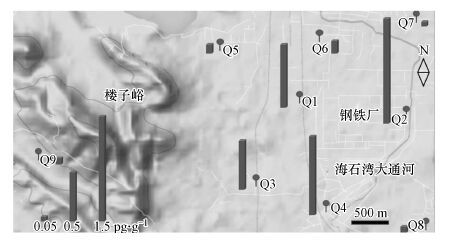 |
| 图 2 土壤样品中TEQ值分布 Fig. 2 TEQ of the soil samples |
土壤样品中指示性PCBs(PCB-180、PCB-153、 PCB-138、PCB-101、PCB-52、PCB-28) 的总含量为0.01~287.81 ng · g-1,平均值为89.95 ng · g-1.样品中指示性PCBs同类物含量分布特征如图 3所示.由图 3 可以看出,在所有土壤样品中,低氯代PCB-101都是指示性PCBs中最主要的贡献体.钢铁厂周边土壤样品中,PCB-101贡献率为11.0%~71.4%,平均贡献率为42.0%;其次是PCB-138、PCB-153和PCB-52,PCB-138的贡献率为9.4%~32.1%,平均贡献率为18.0%;PCB-153的贡献率为5.6%~24.5%,平均贡献率为13.0%;而PCB-52的贡献率为5.3%~24.4%,平均贡献率为12.0%.研究表明(Tian et al., 2012),铁矿石烧结过程中烟气样品PCB-138和PCB-153的总贡献率为6.55%,远低于本研究土壤样品的31.3%;而烟气样品中PCB-28的平均贡献率(80.4%)又远高于本研究土壤样品的6.0%.这可能是由于废气经过大气沉降进入土壤后,经过一系列的富集、挥发等作用,形成了指示性PCBs在烟气和土壤样品中不同的分布.
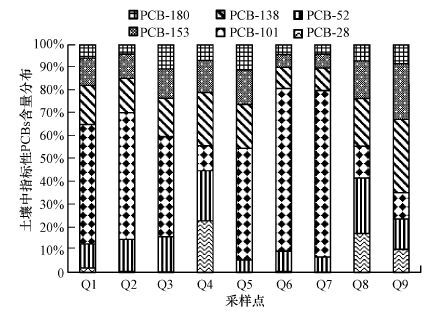 |
| 图 3 土壤样品中指示性PCBs含量分布 Fig. 3 Concentrations of indicator PCBs in the soil samples |
该市及钢铁厂周边土壤样品中dl-PCBs和指示性PCBs总含量为0.015~288.09 ng · g-1,平均值为90.07 ng · g-1.图 4对比了国内外土壤PCBs的研究结果(李英明等,2010;Pirard et al., 2005;Notarianni et al.,1998;Liu et al., 2013).从图 4中比较结果可得,意大利某工业区周边土壤中PCBs含量在0.11~98 ng · g-1之间,平均值为11.18 ng · g-1;法国某垃圾焚烧厂周边土壤PCBs含量在5.2~41.2 ng · g-1之间,平均值为14.43 ng · g-1;都明显低于本研究土壤中PCBs含量,而本研究中PCBs最高值为288.09 ng · g-1,分别是这两个地区最高值的3倍和7倍. 中国东北部地区某钢铁厂周边土壤PCBs含量在0.26~3.50 ng · g-1之间,平均值为0.95 ng · g-1; 中国华北地区某垃圾焚烧厂周边土壤中PCBs含量在0.02~0.26 ng · g-1之间,平均值为0.12 ng · g-1.通过对比可看出,本研究土壤中PCBs含量也明显高于相关研究.尽管如此,通过与《国家土壤质量标准》(GB 15618—2008) 对比发现,标准中列出的土壤中PCBs含量居民用地标准为0.5 mg · kg-1,商业用地标准为1.5 mg · kg-1,本研究结果与其相比仍远低于规定限值.
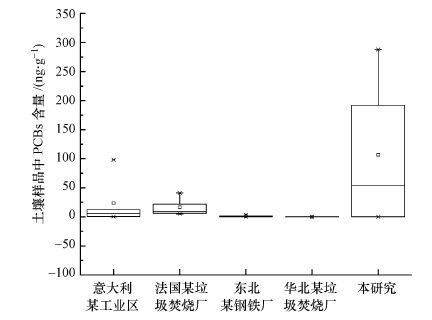 |
| 图 4 土壤样品中PCBs含量与国内外研究对比 Fig. 4 Comparison of PCBs in soil samples with studies worldwide |
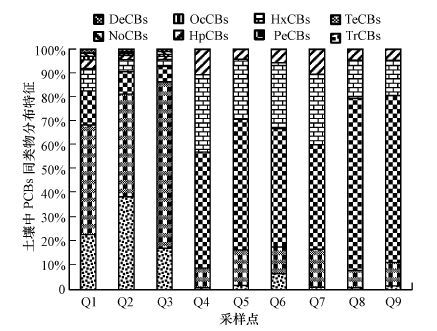
本研究土壤样品中PCBs同类物分布特征如图 5所示.由图 5可以看出,大部分样品的同系物分布特征相似,其中,低氯代同类物(TrCBs~HxCBs)的含量要远高于高氯代同类物(HpCBs~DeCBs),从TrCBs到HxCBs,4种同类物的平均贡献率为89.39%~95.79%,平均贡献率为93.67%.其中,贡献率最高的同类物是PeCBs,贡献率为6.5%~71.59%,平均值为40.67%.同时,PeCBs前后都呈现逐级下降的趋势.从图 5中还可以看出,Q1、Q2、Q3采样点的PCBs组成与其他样点存在很大差异,结合采样图可以看出,Q1、Q2、Q3是离钢铁厂最近的采样点位,更大程度上受到钢铁厂的影响,受到的污染更为直接且更为严重.
 |
| 图 5 土壤样品中PCBs同类物分布箱图 Fig. 5 Box plot of PCBs-TEQ in Beijing soils samples |
1) 迁安市土壤样品中,以围绕钢铁厂周边土壤污染较为严重,同时TEQ值也高于其他地区.由此可以看出,钢铁厂周边环境土壤很大程度上受到了PCBs等有毒污染物的影响.
2) 迁安市钢铁厂周边土壤污染要高于其他地区,造成这一现象的原因可能是该市为主要钢铁生产基地,其PCBs排放量超过其他地区.
3) 迁安市大部分样土壤品的同系物分布特征相似,其中,低氯代同类物的含量要远高于高氯代同类物,含量最高的同类物是PeCBs.说明低氯代同类物更易在土壤环境中富集,对于土壤介质的危害更严重.
| [1] | Alcock R E, Jones K C. 1996. Dioxins in the environment: a review of trend data[J]. Environmental Science & Technology , 30 (11) : 3133–3143. |
| [2] | Ba T, Zheng M, Zhang B, et al. 2009. Estimation and characterization of PCDD/Fs and dioxin-like PCBs from secondary copper and aluminum metallurgies in China[J]. Chemosphere , 75 (9) : 1173–1178. DOI:10.1016/j.chemosphere.2009.02.052 |
| [3] | Björklund E, Holst C V, Anklam E. 2002. Fast extraction,clean-up and detection methods for the rapid analysis and screening of seven indicator PCBs in food matrices[J]. Trac Trends in Analytical Chemistry , 21 (1) : 40–53. DOI:10.1016/S0165-9936(01)00120-0 |
| [4] | Di Domenico A, Ferri F, Fulgenzi A R, et al. 1993. Polychlorinated biphenyl,dibenzodioxin,and dibenzofuran occurrence in the general environment in Italy[J]. Chemosphere , 27 (1) : 83–90. |
| [5] | Guo L, Zhang B, Xiao K, et al. 2009. Levels and distributions of polychlorinated biphenyls in sewage sludge of urban wastewater treatment plants[J]. Journal of Environmental Sciences , 21 (4) : 468–473. DOI:10.1016/S1001-0742(08)62293-7 |
| [6] | Hu J, Zheng M, Nie Z, et al. 2013. Polychlorinated dibenzo-p-dioxin and dibenzofuran and polychlorinated biphenyl emissions from different smelting stages in secondary copper metallurgy[J]. Chemosphere , 90 (1) : 89–94. DOI:10.1016/j.chemosphere.2012.08.003 |
| [7] | Kim K S, Hirai Y, Kato M, et al. 2004. Detailed PCB congener patterns in incinerator flue gas and commercial PCB formulations (Kanechlor)[J]. Chemosphere , 55 (4) : 539–553. DOI:10.1016/j.chemosphere.2003.11.056 |
| [8] | Lee K T, Tanabe S, Koh C H. 2001. Contamination of polychlorinated biphenyls (PCBs) in sediments from Kyeonggi Bay and nearby areas,Korea[J]. Marine Pollution Bulletin , 42 (4) : 273–279. DOI:10.1016/S0025-326X(00)00124-7 |
| [9] | 李英明, 王璞, 丁磊, 等.2010. 钢铁厂及其周围土壤中二英和多氯联苯污染物的分布规律研究[J]. 中国环境监测 , 2010, 26 (2) : 1–5. |
| [10] | Li S, Zheng M, Liu W, et al. 2014. Estimation and characterization of unintentionally produced persistent organic pollutant emission from converter steelmaking processes[J]. Environmental Science and Pollution Research , 21 (12) : 7361–7368. DOI:10.1007/s11356-014-2652-y |
| [11] | Liu W, Li H, Tian Z, et al. 2013. Spatial distribution of polychlorinated biphenyls in soil around a municipal solid waste incinerator[J]. Journal of Environmental Sciences , 25 (8) : 1636–1642. DOI:10.1016/S1001-0742(12)60234-4 |
| [12] | Lv P, Zheng M H, Liu W B. 2011. Estimation of emissions of polychlorinated dibenzo-p-dioxins and dibenzofurans and dioxin-like polychlorinated biphenyls from Chinese hot dip galvanizing industries[J]. Environmental Engineering Science , 28 : 671–676. DOI:10.1089/ees.2010.0493 |
| [13] | Lv P, Zheng M, Liu G, et al. 2011. Estimation and characterization of PCDD/Fs and dioxin-like PCBs from Chinese iron foundries[J]. Chemosphere , 82 (5) : 759–763. DOI:10.1016/j.chemosphere.2010.10.077 |
| [14] | 孟庆昱, 储少岗.2000. 多氯联苯的环境吸附行为研究进展[J]. 科学通报 , 2000, 45 (15) : 1572–1583. |
| [15] | Nie Z, Liu G, Liu W, et al. 2012. Characterization and quantification of unintentional POP emissions from primary and secondary copper metallurgical processes in China[J]. Atmospheric Environment , 57 : 109–115. DOI:10.1016/j.atmosenv.2012.04.048 |
| [16] | Nie Z, Zheng M, Liu G, et al. 2012. A preliminary investigation of unintentional POP emissions from thermal wire reclamation at industrial scrap metal recycling parks in China[J]. Journal of hazardous materials , 215 : 259–265. |
| [17] | Nie Z, Zheng M, Liu W, et al. 2011. Estimation and characterization of PCDD/Fs,dl-PCBs,PCNs,HxCBz and PeCBz emissions from magnesium metallurgy facilities in China[J]. Chemosphere , 85 (11) : 1707–1712. DOI:10.1016/j.chemosphere.2011.09.016 |
| [18] | Notarianni V, Calliera M, Tremolada P, et al. 1998. PCB distribution in soil and vegetation from different areas in Northern Italy[J]. Chemosphere , 37 (14) : 2839–2845. |
| [19] | Odabasi M, Bayram A, Elbir T, et al. 2010. Investigation of soil concentrations of persistent organic pollutants,trace elements,and anions due to iron-steel plant emissions in an industrial region in Turkey[J]. Water,Air,& Soil Pollution , 213 (1/4) : 375–388. |
| [20] | Pirard C, Eppe G, Massart A C, et al. 2005. Environmental and human impact of an old-timer incinerator in terms of dioxin and PCB level: a case study[J]. Environmental science & technology , 39 (13) : 4721–4728. |
| [21] | Tian B, Huang J, Wang B, et al. 2012. Emission characterization of unintentionally produced persistent organic pollutants from iron ore sintering process in China[J]. Chemosphere , 89 (4) : 409–415. DOI:10.1016/j.chemosphere.2012.05.069 |
| [22] | Yasuhiko O, Takahiko M. 1994. Levels,features and a source of non-ortho polychlorinated biphenyl in soil[J]. Chemosphere , 28 (1) : 47–56. DOI:10.1016/0045-6535(94)90199-6 |
| [23] | 王莎莎, 高丽荣, 田益玲, 等.2014. 渤海湾海域 10 种鱼类中二噁英类及指示性多氯联苯的污染特征研究及风险评价[J]. 环境科学 , 2014, 35 (6) : 2281–2286. |