 2015, Vol. 35

 [PDF全文]


2. 中山大学化学与化学工程学院, 广州 510275;
3. 中山大学附属第三医院, 广州 510630
2. School of Chemistry and Chemical Engineering, Sun Yat-sen University, Guangzhou 510275;
3. The Third Affiliated Hospital of Sun Yat-sen University, Guangzhou 510630
多溴联苯醚(Polybrominated Diphenyl Ethers,简称PBDEs)是一类全球性有机污染物,作为阻燃剂被广泛用于不同种类的商业产品和聚合材料中,包括纺织品、家具、电器设备、电子零部件、玩具及建筑材料等(Mariani et al., 2008a; Vorkamp et al., 2011; Hites,2004; Cequier et al., 2013),其结构、性质与多氯联苯(PCBs)相似,有毒且具有持久性、高亲酯性、生物累积性(Wang et al., 2012; Rahman et al., 2001).
研究证明,空气(Cetin et al., 2011)、水(Wurl et al., 2006)、 土壤(Thorenz et al., 2010)、沉积物(Shen et al., 2006)、灰尘(Wilford et al., 2005)中都含有一定浓度的PBDEs,表明其已是环境中普遍存在的污染物.人类暴露于PBDEs的主要途径包括饮食、吸入灰尘及皮肤接触等(Pardo et al., 2014; Wang et al., 2013).人体血液(Sjodin et al., 1999)、精液(Akutsu et al., 2008)、尿液(Liu et al., 2012)、脂肪组织(Wang et al., 2012)、母乳(Eslami et al., 2006)中都含有PBDEs或其代谢产物,其对人类健康的影响已引起国内外研究者的广泛关注.然而,探讨PBDEs暴露对成年男性精液质量影响的研究十分有限.Liu等(2012)检测到中国台州人群精液样本中的PBDEs含量为53.2~121 pg · g-1.Abdelouahab等(2011)研究表明,BDE-47、BDE-100、∑BDE与精子活动性呈负相关,但与其它精液参数不相关.Toft等(2014)研究证明,BDE-47、BDE-153暴露与改变的精液参数不相关,表明男性生殖功能不受这些化合物暴露水平的影响.
综上所述,探讨PBDEs对男性精液质量影响的研究十分有限,且未得出一致的结论.因此,本研究通过测定珠江三角洲地区成年男性血液中PBDEs含量,分析PBDEs与男性精液质量之间的相关性;同时,探讨不同因素与血液中PBDEs含量之间的关系,以期为今后更进一步研究PBDEs暴露对男性生殖健康的影响提供依据.
2 材料与方法(Materials methods) 2.1 主要仪器与试剂实验所用仪器如表 1所示.
试剂:丙酮、二氯甲烷、正己烷、硅藻土、2.5 μg · mL-1多溴联苯醚标准液,其中,8种多溴联苯醚混标分别为BDE-28(2,4,4′-三溴联苯醚)、BDE-47(2,2,4,4-四溴联苯醚)、BDE-99(2,2′,4,4′,5-五溴联苯醚)、BDE-100(2,2′,4′,4,6-五溴联苯醚)、BDE-153(2,2′,4,4′,5,5′-六溴联苯醚)、BDE-154(2,2′,4,4′,5,6′-六溴联苯醚)、BDE-183((2,2′,3,4,4′,5′,6-七溴联苯醚)、BDE-209(十溴联苯醚).
| 表 1 仪器信息 Table 1 Instruments information |
 |
实验中所有玻璃容器都经过铬酸溶液浸泡24 h,自来水冲洗,然后超声清洗10 min,重复3次且前两次用自来水最后一次用超纯水,再在480 ℃下煅烧6 h,冷却后用双蒸水润洗3遍,最后用烘箱在70 ℃下烘干.
2.2 实验方法与步骤 2.2.1 样品的收集与储存2012年7月—2013年8月于广州某三甲医院辅助生殖科召集112名普通成年男性.征集条件:①无保护性行为超过12个月;②排除器质性损伤;③配偶生殖正常;④从事非传统高污染工业(如工矿、石油、火力发电)职业.112名中6人拒绝参与本项研究,3人患有无精子症.用静脉抽取和手淫的方式分别取得103名参与者的血液和精液样本,并根据最近3年的生活习惯填写临床资料调查表(如年龄、身高、体重、学历、生活习惯等).取4 mL血液加入肝胆素抗凝剂存放于真空玻璃管中;精液样本通过手淫方式收集并立即在医院实验室检测精液质量(精液浓度、a级精子数、b级精子数、c级精子数、d级精子数),剩余样本存放于集精杯送回实验室.全部收集样品最终存放于-80 ℃冰箱.
2.2.2 样品前处理冷冻干燥:血液样品在超低温冰箱(-80 ℃)中保存,取出后拿下盖子,用锡箔纸包好杯口,用针在锡箔纸上均匀扎孔;放入到完成预冷的冷冻干燥机内冷冻干燥24 h,完成干燥后取出样品,保存于超低温冰箱(-80 ℃).
快速溶剂萃取(ASE):冷冻所得粉末称重后加入已经装填好的ASE样品池中(装填办法:池子出口填滤纸,中部填入80%池子体积的硅藻土),ASE萃取程序为:100 ℃、1500 psi条件下用60 mL丙酮/二氯甲烷(1 ∶ 1)分3次萃取,每次进样前先用硅藻土进行一次空白萃取,作用是清洗ASE内部的管道,提取硅藻土的残余影响物及清洁溶剂收集瓶;合并3次萃取液,然后氮吹近干用500 μL正己烷定容至液相小瓶.
2.2.3 GC-MS优化条件优化PBDEs测定条件(Wang et al.,2012),具体如下所示.色谱条件:进样体积5 μL;进样口温度 280 ℃;辅助通道温度 280 ℃;载气(高纯N2)流速 1 mL · min-1;色谱柱为DB-5MS色谱柱(30 m×320 μm×0.25 μm);升温程序:100 ℃保持1 min,以20 ℃ · min-1升温至210 ℃,再以5 ℃ · min-1升温至260 ℃,保持2 min,最后以4 ℃ · min-1升温至300 ℃,保持5min.质谱条件:离子源为电子轰击源EI;电子倍增管的电压相对值1247,绝对值1388;扫描模式为SIM;溶剂延迟 5 min.具体扫描离子如表 2所示.
| 表 2 多溴联苯醚气质分析条件 Table 2 Polybrominated diphenyl ethers GC-MS analysis conditions |
|
在上述分析条件下,分别测定空白样品(正己烷)、标准样品、待测血液中各组分的保留时间和色谱峰面积.比对标准品,进行血液样品的定性分析;依据色谱峰面积,利用外标法获得的标准曲线计算出血液样品中多溴联苯醚的含量.
2.3 数据分析103名志愿者参与问卷调查,包括填写基本资料(年龄、体重和身高)、生活习惯(吸烟、饮酒)和其他相关信息(教育背景)等.血液中PBDEs含量和精液质量及不同因素之间的相互关系采用SPSS19.0软件进行分析,图像使用Origin8.5软件进行绘制.
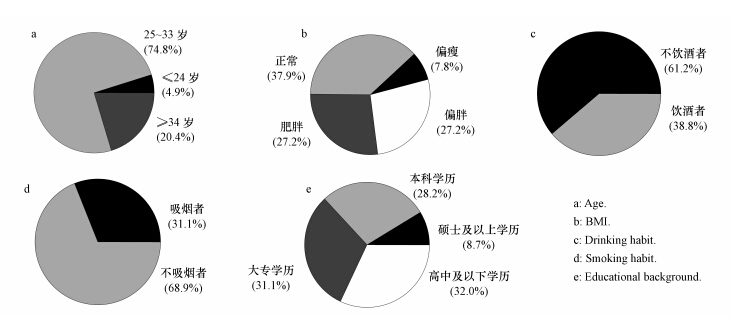
3 结果(Results) 3.1 问卷调查问卷调查统计结果如图 1所示.103名参与者中,年龄≤24岁的占4.9%,年龄为25~33岁的占74.8%,年龄≥34岁的占20.4%.亚洲成人体重指数(BMI)中,BMI<18.5为偏瘦,18.5≤BMI≤23为正常,23<BMI≤25为偏胖,BMI>25为肥胖(Anuurad et al.,2003).按此标准划分,则103名参与者中有7.8%存在偏瘦现象,正常体格的人数占37.9%,偏胖者占27.2%,肥胖者占27.2%.38.8%的参与者有饮酒习惯,31.1%的参与者有吸烟习惯.103名参与者中,高中及以下学历占32.0%,大专学历占31.1%,本科学历占28.2%,硕士及以上只有8.7%.
 |
| 图 1 问卷调查统计结果 Fig.1 Statistical results of questionnaire |
按照WHO的精子质量检测标准及仪器操作规范(Cooper et al., 2009),记录精子快速前向运动(a级)、慢速前向运动(b级)、非前向运动(c级)精子数量,分析统计结果见表 3.由表 3可知,精液浓度为(52.31×10⁷±39.56×10⁷)个 · mL-1,a、b、c、d、a+b级精子活力分别为12.99%±8.77%、21.69%±11.69%、24.79%±10.40%、41.83%±23.95%、34.94%±17.72%.
| 表 3 精液分析统计结果 Table 3 Statistical results for semen analysis |
|
由表 4可知,珠江三角洲地区人群血液中BDE-28、BDE-47、BDE-99、BDE-100、BDE-153、BDE-154、BDE-183均检出,其总含量达(66.70±5.59)ng · g-1.7种PBDEs中,BDE-47在血液中含量最高((25.39±2.15)ng · g-1),占总含量的38.07%,BDE-28次之((10.75±1.28)ng · g-1),BDE-183含量最小((4.47±0.71)ng · g-1),占总含量的6.70%.除BDE-47、BDE-28外,其余5种PBDEs含量水平相差不大.
| 表 4 血液中多溴联苯醚化合物的含量 Table 4 Concentration of PBDEs in blood samples |
|
血液中PBDEs含量之间存在一定的统计关系,具体如表 5所示.BDE-28、BDE-47、BDE-99、BDE-100、BDE-153、BDE-154、BDE-183两两之间在0.01水平上都显著正相关.
| 表 5 血液中PBDEs之间的相关性 Table 5 Connection of PBDEs in blood samples |
|
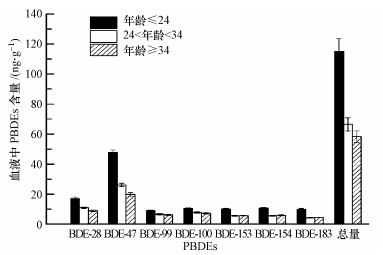
根据我国现阶段的生育年龄实际情况,将103名自愿者根据年龄分为3组.年龄24或24岁以下为第一组(n=5),24~34岁为第二组(n=77),年龄34或34岁之上为第三组人群(n=21).3个不同年龄分组中,血液中PBDEs含量对比结果见图 2.由图 2可知,无论是单一多溴联苯醚还是其总含量,24或24岁之下年龄组含量最高,其余两年龄组含量相差不大.就不同年龄组的单个多溴联苯醚而言,BDE-47含量最高.相对于BDE-28、BDE-47、∑7PBDEs而言,其含量从低年龄组向高年龄组递减,而BDE-99、BDE-100、BDE-153、BDE-154、BDE-183的含量变化趋势不明显.
 |
| 图 2 血液中PBDEs含量与不同年龄的关系 Fig.2 The relationship between PBDEs concentrations in blood and different ages |
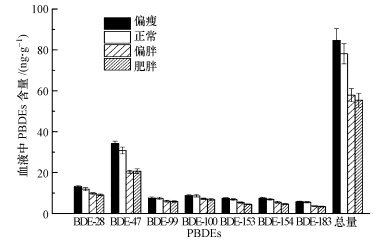
将103名志愿者分成偏瘦(BMI<18.5,n=8)、正常(18.5≤BMI≤23,n=39)、偏胖(23<BMI≤25,n=28)和肥胖(BMI>25,n=28)4类.不同BMI人群血液中PBDEs的含量对比结果见图 3,可知BDE-28、BDE-47、BDE-99、BDE-100、BDE-153、BDE-154、BDE-183、∑7PBDEs在偏瘦组人群血液中含量最高,正常组人群次之,偏胖组和肥胖组含量无显著差异.BDE-47和∑7PBDEs含量在不同BMI组人群血液中差异较显著,表明其含量受BMI的影响较明显.
 |
| 图 3 血液中PBDEs含量与不同BMI的关系 Fig.3 The The relationship between PBDEs concentrations in blood and different BMI |
由表 6可知,珠江三角洲地区32名吸烟者血液中的单一多溴联苯醚和其总含量都高于不吸烟者,证明吸烟可能会增加血液中PBDEs的积累.吸烟组人群与不吸烟组人群血液中的BDE-47(吸烟组:34.74 ng · g-1;不吸烟组:21.18 ng · g-1)和∑7PBDEs(吸烟组:86.80 ng · g-1;不吸烟组:57.64 ng · g-1)含量差异显著,表明其含量受吸烟影响的影响较明显.BDE-47在两组人群血液中含量均最高.
| 表 6 不同生活习惯的志愿者血液中PBDEs含量 Table 6 PBDEs concentrations in blood for volunteers with different living habits |
|
由表 6可知,珠江三角洲地区40名饮酒者血液中单一多溴联苯醚和其总含量都低于不饮酒者,该结果不同于吸烟者和不吸烟者,表明饮酒并未增加血液中PBDEs含量的积累.饮酒者和不饮酒者血液中BDE-47含量仍为最高.饮酒组与不饮酒组人群血液中BDE-47(饮酒组:22.44 ng · g-1;不饮酒组:30.05 ng · g-1)、BDE-154(饮酒组:2.96 ng · g-1;不饮酒组:6.37 ng · g-1)、BDE-183(饮酒组:1.13 ng · g-1;不饮酒组:4.99 ng · g-1)、∑7PBDEs(饮酒组:61.78 ng · g-1;不饮酒组:74.45 ng · g-1)含量差异显著.BDE-47在两组人群血液中含量仍为最高.
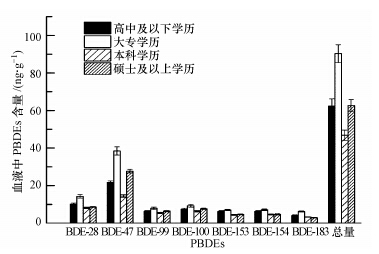
3.4.5 血液中PBDEs含量与学历的关系血液中PBDEs含量与学历的关系如图 4所示.分析发现,珠江三角洲地区有大专学历的人群血液中含有的单一PBDEs或其总含量都为最高,高中及以下学历的人群次之.本科学历的人群血液中BDE-28、BDE-153、BDE-154、BDE-183含量高于硕士及以上学历人群,而对于BDE-47、BDE-99、BDE-100、∑7PBDEs而言则相反.血液中BDE-28、BDE-47、∑7PBDEs含量受学历的影响较明显,整体未有含量随学历升高而递减或递增的趋势.
 |
| 图 4 血液中PBDEs含量与学历的关系 Fig.4 The relationship between PBDEs concentrations in blood and educational background |
由表 7可知,BDE-153、BDE-154和BDE-183与精液浓度在0.05水平上显著负相关(r=-0.22,p<0.05;r=-0.21,p<0.05;r=-0.20,p<0.05).BDE-99、BDE-100和BDE-183与c级精子显著正相关(r=0.20,p<0.05;r=-0.21,p<0.05;r=0.25,p<0.05).分析结果显示,部分单个PBDEs与精液浓度呈负相关,但血液中∑7PBDEs与精液含量及精子活动性无显著相关性.
| 表 7 血液中PBDEs含量与精液质量之间的相关性 Table 7 Correlations between PBDEs concentrations in blood and semen quality |
|
血液中PBDEs含量及其中含量最高的物质因研究人群、地区等不同而差异显著.Qu等(2007)研究显示,电子拆卸区工人血液中BDE-28、BDE-183、BDE-209最高含量分别可达148.3、60.2、3436 ng · g-1,其中,BDE-209为含量最高的物质.Jin等(2009)的研究结果表明,中国山东莱州湾南海岸地区156名居民血浆中BDE-28、BDE-47、BDE-99、BDE-100、BDE-153、BDE-154、BDE-183、BDE-209、∑8PBDEs算术平均含量分别达29.2、21.4、23.4、14.8、32.5、41.8、46.9、403 、613 ng · g-1,以BDE-209含量最高.珠江三角洲地区103名成年男性血液PBDEs含量要小于上述研究结果,但要比韩国21名母亲血液中∑7PBDEs含量高(Kim et al.,2012),且该研究中以BDE-47在血液中含量最高.
有研究显示,血液中PBDEs总含量与体重、身高、年龄的关系是微小的,特别是年龄与单一PBDEs及其总含量无显著相关性(Lee et al.,2007),BMI与BDE-153含量负相关且吸烟与PBDEs含量不相关(Jain,2013),其它可能影响血液中PBDEs含量的因素几乎没有研究专门探讨过,但有研究报道过饮酒与母乳中PBDEs总含量水平无显著相关性(Lind et al.,2003).本研究结果显示,不同年龄对18~42岁之间珠江三角洲地区男性血液中PBDEs含量的影响未呈现一致的趋势,除BDE-47外,不同BMI人群组单个PBDEs含量差异不显著,吸烟者血液中PBDEs含量高于不吸烟者,饮酒与不饮酒者则相反,随着学历升高PBDEs含量水平未有递减或递增的一致规律.因此,这些因素对血液中PBDEs含量的影响目前还没有定论,需要进一步的研究来论证.
探讨PBDEs暴露对成年男性精液质量影响的研究十分有限.本研究结果显示,部分单个PBDEs与精液浓度呈负相关,而PBDEs总含量与精子活动性无显著相关性.而Abdelouaha等(2011)研究表明,BDE-47、BDE-100、∑BDE与精子活动性呈负相关,但与其它精液参数无显著相关性;更有Toft等(2014)报道,BDE-47和BDE-153暴露与男性精液质量下降不相关.因此,血液中PBDEs暴露与男性精液质量的关系目前还未得出一致的结论.
5 结论(Conclusions)1)珠江三角洲地区103名成年男性血液中PBDEs含量水平位于相关研究报道的含量水平之间.
2)珠江三角洲地区18~42岁之间普通男性人群中,其血液中PBDEs含量未受到年龄、BMI和学历的显著影响;吸烟可能是血液中PBDEs积累的因素之一,而饮酒未使其含量增加.
3)BDE-153、BDE-154和BDE-183含量与精液浓度显著负相关,而PBDEs总含量与精子活动性无显著相关性,因此,血液中PBDEs含量与珠江三角洲地区男性精液质量无显著相关性.
| [1] | Abde louahab N,Ainmelk Y,Takser L.2011.Polybrominated diphenyl ethers and sperm quality[J].Reproductive Toxicology,31(4): 546-550 |
| [2] | Akutsu K, Takatori S, Nozawa S, et al. 2008. Polybrominated diphenyl ethers in human serum and sperm quality[J]. Bulletin of Environmental Contamination and Toxicology, 80(4): 345-350 |
| [3] | Cequier E, Marce R M, Becher G, et al. 2013. Determination of emerging halogenated flame retardants and polybrominated diphenyl ethers in serum by gas chromatography mass spectrometry[J]. Journal of Chromatography A, 1310: 126-132 |
| [4] | Cetin B, Odabasi M. 2011. Polybrominated diphenyl ethers (PBDEs) in indoor and outdoor window organic films in Izmir, Turkey[J]. Journal of Hazardous Materials, 185(2/3): 784-791 |
| [5] | Cooper T, Castilla J A. 2009. WHO laboratory manual for the examination and processing of human semen[J]. Journal of Andrology, 30: 9 |
| [6] | Eslami B, Koizumi A, Ohta S, et al. 2006. Large-scale evaluation of the current level of polybrominated diphenyl ethers (PBDEs) in breast milk from 13 regions of Japan[J]. Chemosphere, 63(4): 554-561 |
| [7] | Hites R A. 2004. Polybrominated diphenyl ethers in the environment and in people: A meta-analysis of concentrations[J]. Environmental Science & Technology, 38(4): 945-956 |
| [8] | Jain R B. 2013. Effect of smoking and caffeine consumption on polybrominated diphenyl ethers (PBDE) and polybrominated biphenyls (PBB)[J]. Journal of Toxicology and Environmental Health-Part A-Current Issues, 76(8): 515-532 |
| [9] | Jin J, Wang Y, Yang C Q, et al. 2009. Polybrominated diphenyl ethers in the serum and breast milk of the resident population from production area, China[J]. Environment International, 35(7): 1048-1052 |
| [10] | Liu H Q, Zhang M H, Wang X D, et al. 2012. Extraction and determination of polybrominated diphenyl ethers in water and urine samples using solidified floating organic drop microextraction along with high performance liquid chromato- graphy[J]. Microchimica Acta, 176(3/4): 303-309 |
| [11] | Kim T H, Bang D Y, Lim H J, et al. 2012. Comparisons of polybrominated diphenyl ethers levels in paired South Korean cord blood, maternal blood, and breast milk samples[J]. Chemosphere, 87(1): 97-104 |
| [12] | Lee S J, Ikonomou M G, Park H, et al. 2007. Polybrominated diphenyl ethers in blood from Korean incinerator workers and general population[J]. Chemosphere, 67(3): 489-497 |
| [13] | Lind Y, Darnerud P O, Atuma S, et al. 2003. Polybrominated diphenyl ethers in breast milk from Uppsala County, Sweden[J]. Environmental Research, 93(2): 186-194 |
| [14] | Liu P Y, Zhao Y X, Zhu Y Y, et al. 2012. Determination of polybrominated diphenyl ethers in human semen[J]. Environment International, 42: 132-137 |
| [15] | Mariani G, Canuti E, Castro-Jimenez J, et al. 2008. Atmospheric input of POPs into Lake Maggiore (Northern Italy): PBDE concentrations and profile in air, precipitation, settling material and sediments[J]. Chemosphere, 73(1): S114-S121 |
| [16] | Pardo O, Beser M I, Yusa V. 2014. Probabilistic risk assessment of the exposure to polybrominated diphenyl ethers via fish and seafood consumption in the region of Valencia (Spain)[J]. Chemosphere, 104: 7-14 |
| [17] | Qu W Y, Bi X H, Sheng G Y, et al. 2007. Exposure to polybrominated diphenyl ethers among workers at an electronic waste dismantling region in Guangdong, China[J]. Environment International, 33(8): 1029-1034 |
| [18] | Rahman F, Langford K H, Scrimshaw M D, et al. 2001. Polybrominated diphenyl ether (PBDE) flame retardants[J]. Science of the Total Environment, 275(1-3): 1-17 |
| [19] | Shen M, Yu Y J, Zheng G J, et al. 2006. Polychlorinated biphenyls and polybrominated diphenyl ethers in surface sediments from the Yangtze River Delta[J]. Marine Pollution Bulletin, 52(10): 1299-1304 |
| [20] | Sjodin A, Hagmar L, Klasson-Wehler E, et al. 1999. Flame retardant exposure: Polybrominated diphenyl ethers in blood from Swedish workers[J]. Environmental Health Perspectives, 107(8): 643-648 |
| [21] | Thorenz U R, Bandowe B, Sobocka J, et al. 2010. Method optimization to measure polybrominated diphenyl ether (PBDE) concentrations in soils of Bratislava, Slovakia[J]. Environmental Pollution, 158(6): 2208-2217 |
| [22] | Toft G, Lenters V, Vermeulen R, et al. 2014. Exposure to polybrominated diphenyl ethers and male reproductive function in Greenland, Poland and Ukraine[J]. Reproductive Toxicology, 43: 1-7 |
| [23] | Vorkamp K, Thomsen M, Frederiksen M, et al. 2011. Polybrominated diphenyl ethers (PBDEs) in the indoor environment and associations with prenatal exposure[J]. Environment International, 37(1): 1-10 |
| [24] | Wang C Y, Lin Z, Dong Q X, et al. 2012. Polybrominated diphenyl ethers (PBDEs) in human serum from Southeast China[J]. Ecotoxicology and Environmental Safety, 78: 206-211 |
| [25] | Wang H S, Jiang G M, Chen Z J, et al. 2013. Concentrations and congener profiles of polybrominated diphenyl ethers (PBDEs) in blood plasma from Hong Kong: Implications for sources and exposure route[J]. Journal of Hazardous Materials, 261: 253-259 |
| [26] | Wang N, Kong D Y, Shan Z J, et al. 2012. Simultaneous determination of pesticides, polycyclic aromatic hydrocarbons, polychlorinated biphenyls and phthalate esters in human adipose tissue by gas chromatography-tandem mass spectrometry[J]. Journal of Chromatography B-Analytical Technologies in the Biomedical And Life Sciences, 898: 38-52 |
| [27] | Wilford B H, Shoeib M, Harner T, et al. 2005. Polybrominated diphenyl ethers in indoor dust in Ottawa, Canada: Implications for sources and exposure[J]. Environmental Science & Technology, 39(18): 7027-7035 |
| [28] | Wurl O, Lam P, Obbard J P. 2006. Occurrence and distribution of polybrominated diphenyl ethers (PBDEs) in the dissolved and suspended phases of the sea-surface microlayer and seawater in Hong Kong, China[J]. Chemosphere, 65(9): 1660-1666 |