 2015, Vol. 35

 [PDF全文]


镉是一种机体的非必需微量元素,即使浓度很低也会对机体许多组织和器官产生毒性作用,因而引起了环境领域学者的普遍关注,并且由于镉常常来自于矿藏,其中也包括了锌矿,因此,镉、锌在自然界常常是共存的(Li et al., 2010; Guo et al., 2013).锌是一类机体的必需元素,但在高浓度时也可以对机体产生毒性作用.机体中镉、锌的吸收途径很可能是相同的,因为它们具有相似的电子构象及物化特性(Brzóska et al., 2001).研究发现,痕量金属可以通过不同的通道吸收,其中包括钙通道(Wang et al., 1999;高菁华等,2005).同时,已经有很多研究表明,镉通过钙通道转运,且有关镉、钙之间的相互作用也已经有大量报道(Hardy et al., 1985;Rainbow,1995;1997;Rainbow et al., 2005;Franklin et al., 2005;Li et al., 2008a).巯基官能团(SH—)与重金属具有高度亲和力,且是金属硫蛋白的重要官能团,在参与重金属解毒及氧化损伤防御中起到了重要作用,但目前关于金属的吸收机制和金属之间相互作用的报道较少.
近年来,亚细胞的金属解毒机制越来越受到关注(Wallace et al., 2003;Vijver et al., 2004;Li et al., 2008b; Goto et al., 2007;Wang et al., 2011),其中包括通过诱导金属硫蛋白(MT)产生的解毒机制.金属硫蛋白是一类金属螯合蛋白(Amiard et al., 2006;Mao et al., 2012),还有金属也可以储存在一定类型的结构中诸如金属富含颗粒(Klassen et al., 1998; Bonneris et al., 2005).研究发现,在镉暴露下水生有机体中金属硫蛋白的信号途径是非常敏感的(Wu and Chen, 2005;Ma et al., 2008).通过诱导MT的合成增加了机体螯合金属的能力,从而增强了对机体中镉毒性的防护作用.目前对于水生有机体中亚细胞组分的金属分布研究较少,课题组在前期实验中发现,锌会影响河南华溪蟹(Sinopotamon henanense)鳃中镉的亚细胞分布(柴茜,2014).为了更加深入地阐明华溪蟹鳃组织的镉、锌吸收机制及毒性效应,本实验在短期内采用钙离子通道抑制剂和巯基通道抑制剂两种抑制剂进行预处理,其中,巯基通道抑制剂会特异地与巯基集团结合,之后检测镉、锌在河南华溪蟹鳃组织及其亚细胞组分中的分布情况.
2 材料与方法(Materials and methods) 2.1 实验材料 2.1.1 实验动物河南华溪蟹(简称“溪蟹”),于2013年4月购自山西省太原市五龙口水产批发市场,置于水族缸(45 cm×35 cm×30 cm)中暂养2周以上备用.
2.1.2 主要试剂氯化镉(CdCl2)、硫酸锌(ZnSO4)试剂均为分析纯;硝酸、高氯酸均为优级纯;标准镉溶液100 mg · L-1,标准锌溶液100 mg · L-1(国家环境保护总局标准样品研究所);氯化镧、N-乙烷基顺丁烯二酰亚胺购自上海晶纯生化科技股份有限公司.
2.2 实验方法 2.2.1 实验设计实验采用体外暴露的方法,设置了3个CdCl2浓度组(50、100、500 μg · L-1,分别表示为Cd50、Cd100、Cd500)、2个ZnSO4浓度组(100、1000 μg · L-1,分别表示为Zn100、Zn1000)和1个对照组(曝气水);LaCl3为500 μmol · L-1,NEM为100 μmol · L-1.具体处理过程为:不同抑制剂分别预暴露4 h后对溪蟹进行重金属处理,处理时间为7 d.同时设置对照组,即没有抑制剂条件下重金属直接处理,其中,在Cd100和Zn100处理组中研究亚细胞水平中镉和锌的吸收.
随机选取平均体重为(21.22±1.52)g的(雌或雄)溪蟹,置于处理缸中,每缸10只,每个处理组设3个重复.实验用水为曝气48 h的自来水,水温(20±2)℃,pH=6.8,溶氧量6 mg · L-1以上.处理期间每隔2 d喂1次食物,不换水.
2.2.2 样品制备处理后从各组中取3只溪蟹,冲洗、解剖、取鳃,用滤纸将表面水分吸干净,称重,记录,冷冻至-80 ℃冰箱中以备使用.
2.2.3 鳃亚细胞组分的分离参照Wallace等(2003)和Kamunde等(2011)的方法,采用差速离心法分离不同组分:①以1 ∶ 3(g · mL-1)的比例在组织中加入PBS缓冲液(内含0.1 mmol · L-1 PMSF、1 mmol · L-1 DTT),用电动匀浆仪(FLUKO F6/10)冰浴匀浆,匀浆后将组织匀浆液于低温冷冻离心机(Eppendorf 5804R)离心10 min(800 g,4 ℃),分离出沉淀(P1)和上清液(S1);沉淀(P1)中加入500 μL双蒸水,吹打悬浮后在沸水中加热2 min,加入500 μL NaOH(1 mol · L-1)并充分混匀,在70 ℃水浴箱中加热60 min后10000 g离心30 min;沉淀部分(P2)为富含金属颗粒物质(Metal-rich Granules,MRG),上清部分(S2)为细胞碎片部分(Cellular Debris,CD).②上清液(S1)以3000 g离心15 min(4 ℃),分离出沉淀(P3)和上清液(S3);上清液(S3)于10000 g离心30 min(4 ℃),分离出沉淀(P4)和上清液(S4),其中,沉淀P3和P4为线粒体组分.③上清液(S4)用超高速冷冻离心机(日立CP 70MX)离心60 min(100000 g,4 ℃),沉淀部分(P5)为溶酶体组分,将上清部分(S5)在80 ℃水浴箱中加热10 min后,冰浴60 min,以50000 g离心10 min(4 ℃),沉淀部分(P6)为热变性蛋白组分(Heat-denaturable Proteins,HDP)(含酶),上清部分(S6)为热稳定蛋白组分(Heat-stable Proteins,HSP),其中,HSP和MRG组成生物解毒部分(Biologically Detoxified Metals,BDM),线粒体、溶酶体和HDP组成生物活性部分(Biologically Active Metals,BAM).具体实验操作步骤如图 1所示.
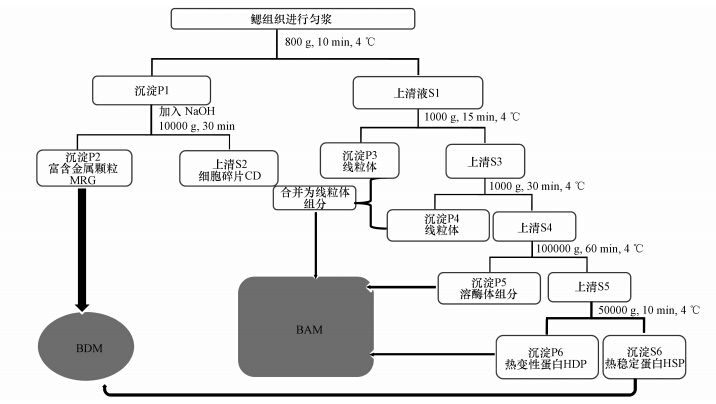 |
| 图 1 不同的离心速度分离出的不同亚细胞组分(P:沉淀;S:上清液;得到的亚细胞组分为:富含金属颗粒MRG、细胞碎片CD、线粒体、溶酶体、热变性蛋白HDP、热稳定蛋白HSP;其中,线粒体、溶酶体共同称为细胞器ORG,ORG和热变性蛋白HDP归类为生物活性部分BAM,而富含金属颗粒MRG和热稳定蛋白HSP归类为生物解毒部分BDM) Fig.1 Differential centrifugation method used to separate various subcellular fractions(P: pellet; S: supernatant; the subcellular fractions were obtained as follows: metal-rich granules(MRG),cellular debris & nuclei,organelles -ORG(mitochondria,microsome + lysosome),heat-denaturable proteins(HDP) and heat-stable proteins(HSP);ORG and HDP are grouped as biologically active metals(BAM), and HSP and MRG are grouped as biologically detoxified metal(BDM)) |
各组分经硝酸和高氯酸消化完全,定容后用火焰原子吸收分光光度计(VARIAN,AA240OFS)测定镉和锌的含量(μg · g-1,以湿重组织计).
2.2.5 统计分析数据用Excel和SPSS15.0软件分析处理,所得结果表示为平均值±标准差(mean ±SD),处理组与对照组的差异比较采用单因素方差分析(One-Way ANOVA),并应用Dunnett法将处理组与相应对照组进行比较, *p<0.05为有显著差异,**p<0.01为有极显著差异.
3 结果(Results) 3.1 通道抑制剂对镉、锌在鳃组织吸收的影响如图 2所示,在各浓度镉处理中,LaCl3能抑制镉的吸收(以湿重计,下同),并出现显著(p<0.05)和极显著(p<0.01)差异,NEM对50、100 μg · L-1镉浓度处理组无明显影响,而在500 μg · L-1镉浓度处理中,加入巯基抑制剂NEM则产生明显抑制作用(p<0.05).LaCl3同样抑制锌的吸收,但无显著性差异,NEM对各个处理浓度的锌均显著(p<0.05)和极显著(p<0.01)抑制.
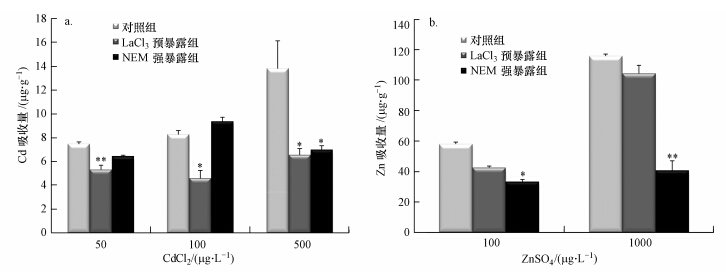 |
| 图 2 镉锌在河南华溪蟹鳃组织的吸收(与对照组相比,*p<0.05,**p<0.01) Fig.2 Cadmium or zinc absorption in the whole tissue of the gills in the freshwater crab Sinopotamon henanense |
如图 3所示,在亚细胞组分中,LaCl3极显著地减少了镉在细胞碎片(CD)中的分布(p<0.01),并显著降低镉在细胞器组分(ORG)中的分布(p<0.05,p<0.01).对于锌而言,加入LaCl3显著降低其在CD和HSP中的分布比例(p<0.05),但增加了其在MRG中的分布,并出现极显著性差异(p<0.01).
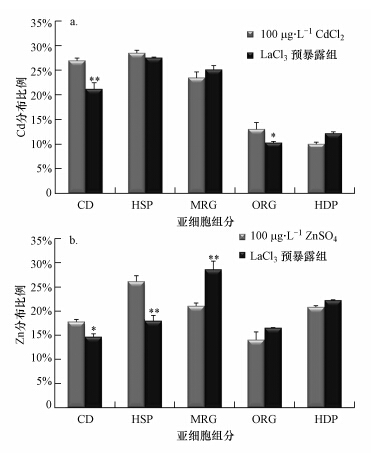 |
| 图 3 钙通道抑制剂对镉锌在河南华溪蟹鳃组织亚细胞组分中吸收的影响(与对照组相比,*p<0.05,**p<0.01) Fig.3 Effects of Ca-channel blocker(Lanthanum)on the cadmium or zinc absorption in the subcellular fractions of the gills in the freshwater crab Sinopotamon henanense |
如图 4所示,NEM极显著地降低了镉在HSP中的分布(p<0.01),而显著增强了其在 HDP中的分布(p<0.05).加入NEM后,锌在HSP和HDP中的分布下降,并分别呈现极显著(p<0.01)和显著(p<0.05)性差异,但在MRG组分中锌含量呈现极显著上升(p<0.01).
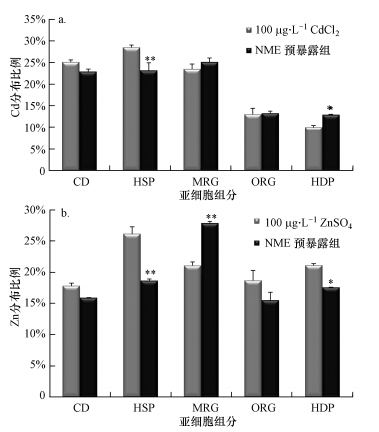 |
| 图 4 巯基抑制剂对镉锌在河南华溪蟹鳃组织亚细胞组分中吸收的影响(与对照组相比,*p<0.05,**p<0.01) Fig.4 Effects of N-ethylmaleimide on the cadmium or zinc absorption in the subcellular fractions of the gills in the freshwater crab Sinopotamon henanense |
为了阐明钙通道抑制剂和巯基抑制剂进入体内的机制,本实验提前将河南华溪蟹暴露到两种抑制剂中4 h,而后转移到金属暴露溶液中.钙通道抑制剂是一种抑制钙通道的阻抑剂,在许多种类的细胞中对于阻止镉的吸收有重要作用(Campbell et al., 2007).在目前的研究中,镉的吸收受到了显著抑制而锌的吸收在加入钙通道抑制剂后没有受到影响,说明钙通道与镉的吸收密切相关,但没有在锌的吸收中起到作用.镉的吸收受到抑制可能是由于Cd2+与Ca2+半径极其相近,Cd2+会与Ca2+竞争钙载体蛋白上的特异结合位点,并与之结合而进入细胞内.当钙通道抑制剂作用于生物机体时,能阻断细胞内储存的Ca2+释放出来,从而抑制镉进入细胞内.锌在水生动物体内主要通过肠道和鳃进行吸收和转运.有研究报道,锌在鱼类中也能通过钙离子通道吸收运输(Burry et al., 2003).钙离子通道中的配体门控钙通道受到配体与受体结合的影响.当受体和配体结合后,受体构型改变,钙通道开放(高菁华等,2005).这种受体包括亲离子受体,而Zn2+则通过与N-甲基-D-天冬氨酸(NMDA)受体结合进入细胞.研究发现,Zn2+进入细胞的速率也会受到Ca2+的影响.然而,钙离子通道与Zn2+的亲和力远大于Ca2+,一般来说,只有当体内Zn2+浓度很小时,Zn2+和Ca2+间存在竞争作用,钙通道抑制剂才会影响Zn2+的吸收(Glover et al., 2004).因此,Cd2+与Zn2+虽然都能通过钙离子通道进行吸收转运,但由于其分别与钙离子通道的亲和力差异较大,Cd2+与Zn2+在钙离子通道的吸收转运中无明显相互作用.这些都有助于我们更加深入地了解溪蟹鳃组织中的金属吸收机制.巯基抑制剂可以特异阻抑蛋白与包含巯基的复合物(如谷胱甘肽)的结合,在现有的研究中,溪蟹鳃组织中的镉、锌吸收受到巯基抑制剂的显著抑制,这说明它们的吸收是通过载体介导蛋白或是小分子的巯基复合物来完成的.因此,推测这两种金属是通过SH—介导转运过程来转运的.
4.2 钙通道抑制剂和巯基抑制剂对于机体中亚细胞金属分布的作用通过分析镉、锌两种金属在溪蟹鳃组织中的亚细胞分布,结果显示,LaCl3显著减少了镉在细胞器组分ORG和细胞碎片组分CD中的分布.ORG是生物机体的生物活性部分,一旦与镉结合,会造成有机体功能的损伤,可体现重金属的毒性作用.CD中含有细胞膜碎片,也是镉作用于机体的重要部位.本研究结果表明,LaCl3对镉的抑制作用主要发生在生物活性部位,可有效降低镉对生物体的毒性作用.同时,LaCl3虽然对锌的吸收没有显著作用,但亚细胞金属含量分析结果显示,LaCl3能促进Zn2+从热稳定蛋白HSP向金属富含颗粒MRG的转移,MRG是生物机体内金属排泄的重要渠道,证明此时锌在机体内的代谢作用增强.
巯基抑制剂NEM可显著抑制镉、锌在金属硫蛋白含量较多的HSP中的分布.热变性蛋白HDP和ORG同样属于生物体内的生物活性部分,主要包括酶类等.锌是多种酶(如抗氧化酶SOD)的金属辅基,且抗氧化酶CAT、抗氧化物质谷胱甘肽GSH中也含有巯基,这些抗氧化酶对生物体抵抗镉的氧化损伤有重要作用(Formigari et al., 2007).本实验结果显示,NEM处理后镉在HDP中的分布增加,但锌在HDP中的分布减少,表明在NEM作用下,锌对机体抵抗镉的毒性作用能力减弱,从而证明巯基蛋白及其复合物参与了镉、锌间的相互作用.
研究表明,LaCl3或NEM作用时,均能增加机体内锌在MRG中的分布,从而增强溪蟹机体中锌的代谢能力,说明当环境发生变化时,锌的代谢具有自我调节能力.
5 结论(Conclusions)在对溪蟹进行钙通道抑制剂和巯基抑制剂预处理后,研究了镉、锌两种金属在鳃组织及其亚细胞组分的分布情况,结果显示:Ca2+通道抑制剂LaCl3能显著抑制鳃组织中镉的吸收,但对锌吸收没有影响,而巯基抑制剂NEM对鳃组织镉、锌吸收均有明显的抑制作用.经LaCl3处理后镉在生物活性部分BAM中的分布显著下降,NEM则显著降低了镉在热稳定蛋白(HSP)中的蓄积;对于金属锌而言,NEM显著降低了锌在热变性蛋白(HDP)中的分布,且两种抑制剂处理后锌在MRG的分布均显著增加,表明鳃组织中锌的代谢具有自我调控能力.本研究有助于了解镉、锌在河南华溪蟹鳃组织中的吸收及相互作用的机制.
| [1] | Amia rd J C, Amiard-Triquet C, Barka S, et al. 2006. Metallothioneins in aquatic invertebrates: Their role in metal detoxification and their use as biomarkers [J]. Aquatic Toxicology, 76(2): 160-202 |
| [2] | Bonneris E, Giguère A, Perceval O, et al. 2005. Sub-cellular partitioning of metals (Cd, Cu, Zn) in the gills of a freshwater bivalve, Pyganodon grandis: role of calcium concretions in metal sequestration [J]. Aquatic Toxicology, 71(4): 319-334 |
| [3] | Brzóska M M, Moniuszko-Jakoniuk J. 2001. Interactions between cadmium and zinc in the organism [J]. Food and Chemical Toxicology, 39(10): 967-980 |
| [4] | Burry N R, Walker P A, Glover C N. 2003. Nutritive metal uptake in teleost fish [J]. Journal of Experimental Biology, 206: 11-23 |
| [5] | Campbell A K, Naseem R, Wann K, et al. 2007. Fermentation product butane 2, 3-diol induces Ca2+ transients in E. coli through activation of lanthanum-sensitive Ca2+ channels [J]. Cell Calcium, 41(2): 97-106 |
| [6] | 柴茜, 李颖君, 井维鑫, 等. 2014. 锌对镉在河南华溪蟹鳃组织亚细胞中富集的影响[J]. 环境科学学报, 34(6): 1628-1634 |
| [7] | Formigari A, Irato P, Santon A. 2007. Zinc, antioxidant systems and metallothionein in metal mediated-apoptosis: Biochemical and cytochemical aspects [J]. Comparative Biochemistry and Physiology Part C: Toxicology & Pharmacology, 146(4): 443-459 |
| [8] | Franklin N M, Glover C N, Nicol J A, et al. 2005. Calcium/cadmium interactions at uptake surfaces in rainbow trout: waterborne versus dietary routes of exposure [J]. Environmental Toxicology and Chemistry, 24(11): 2954-2964 |
| [9] | 高菁华, 汤浩. 2005. 钙通道的分类和几种主要钙通道的功能[J]. 日本医学介绍, 26(5): 232-235 |
| [10] | Glover C N, Bury N R, Hogstrand C. 2004. Intestinal zinc uptake in freshwater rainbow trout: evidence for apical pathways associated with potassium efflux and modified by calcium [J]. Biochimica et Biophysica Acta (BBA) - Biomembranes, 1663(1/2): 214- 221 |
| [11] | Goto D, Wallace W G. 2007. Interaction of Cd and Zn during uptake and loss in the polychaete Capitella capitata: Whole body and subcellular perspectives [J]. Journal of Experimental Marine Biology and Ecology, 352(1): 65-77 |
| [12] | Guo F, Tu R W, Wang W X. 2013. Different responses of abalone Haliotis discus hannai to waterborne and dietary-borne copper and zinc exposure [J]. Ecotoxicology and Environmental Safety, 91: 10-17 |
| [13] | Hardy R W, Shearer K D. 1985. Effect of dietary calcium phosphate and zinc supplementation on whole body zinc concentration of rainbow trout (Salmo gairdneri) [J]. Canadian Journal of Fisheries and Aquatic Sciences, 42(1): 181-184 |
| [14] | Kamunde C, MacPhail R. 2011. Subcellular interactions of dietary cadmium, copper and zinc in rainbow trout (Oncorhynchus mykiss) [J]. Aquatic Toxicology, 105(3/4): 518-527 |
| [15] | Klassen C D, Liu J. 1998. Induction of metallothionein as an adaptive mechanism affecting the magnitude and progression of toxicological injury [J]. Environmental Health Perspectives, 106(Suppl 1): 297-300 |
| [16] | Li L Z, Zhou D M, Luo X S, et al. 2008a. Effect of major cations and pH on the acute toxicity of cadmium to the earthworm Eisenia fetida: implications for the Biotic Ligand Model approach [J]. Archives of Environmental Contamination and Toxicology, 55(1): 70-77 |
| [17] | Li L Z, Zhou D M, Wang P, et al. 2008b. Subcellular distribution of Cd and Pb in earthworm Eisenia fetida as affected by Ca2+ ions and Cd-Pb interaction [J]. Ecotoxicology and Environmental Safety, 71(3): 632-637 |
| [18] | Li L Z, Zhou D M, Peijnenburg W J G M, et al. 2010. Uptake pathways and toxicity of Cd and Zn in the earthworm Eisenia fetida [J]. Soil Biology & Biochemistry, 42(7): 1045-1050 |
| [19] | Ma W L, Wang L, He Y J, et al. 2008. Tissue-specific cadmium and metallothionein levels in freshwater crab Sinopotamon henanense during acute exposure to waterborne cadmium [J]. Environmental Toxicology, 23(3): 393-400 |
| [20] | Mao H, Wang D H, Yang W X. 2012. The involvement of metallothionein in the development of aquatic invertebrate[J]. Aquatic Toxicology, 110-111: 208-213 |
| [21] | Rainbow P S. 1995. Physiology, physicochemistry and metal uptake-a crustacean perspective [J]. Marine Pollution Bulletin, 31(1/3): 55-59 |
| [22] | Rainbow P S. 1997. Ecophysiology of trace metal uptake in crustaceans [J]. Estuarine, Coastal and Shelf Science, 44(2): 169-175 |
| [23] | Rainbow P S, Black W H. 2005. Cadmium, zinc and the uptake of calcium by two crabs, Carcinus maenas and Eriocheir sinensis [J]. Aquatic Toxicology, 72(1/2): 45-65 |
| [24] | Vijver M G, van Gestel C A M, Lanno R P, et al. 2004. Internal metal sequestration and its ecotoxicological relevance: a review [J]. Environmental Science & Technology, 38(18): 4705-4712 |
| [25] | Wallace W G, Lee B G, Luoma S N. 2003. Subcellular compartmentalization of Cd and Zn in two bivalves. Ⅰ. Significance of metal-sensitive fractions (MSF) and biologically detoxified metal (BDM) [J]. Marine Ecology Progress Series, 249: 183-197 |
| [26] | Wang M J, Wang W X. 2011. Cadmium sensitivity, uptake, subcellular distribution and thiol induction in a marine diatom: Exposure to cadmium [J]. Aquatic Toxicology, 101(2): 377-386 |
| [27] | Wang W X, Fisher N S. 1999. Effects of calcium and metabolic inhibitors on trace element uptake in two marine bivalves [J]. Journal of Experimental Marine Biology and Ecology, 236(1): 149-164 |
| [28] | Wu J P, Chen H C. 2005. Metallothionein induction and heavy metal accumulation in white shrimp Litopenaeus vannamei exposed to cadmium and zinc [J]. Comparative Biochemistry and Physiology Part C: Toxicology & Pharmacology, 140(3/4): 383-394 |